
Luggage Market Size and Share
Market Overview
| Study Period | 2021 - 2031 |
|---|---|
| Market Size (2026) | USD 43.77 Billion |
| Market Size (2031) | USD 60.37 Billion |
| Growth Rate (2026 - 2031) | 6.64 % |
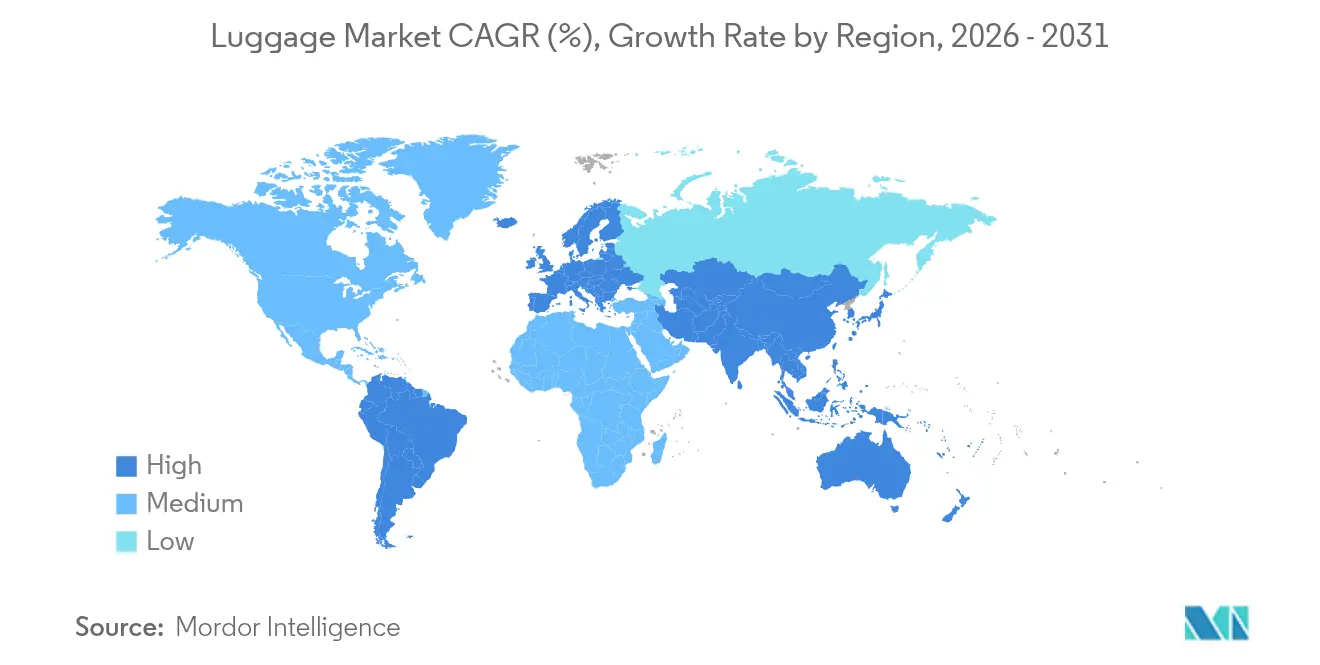
| Fastest Growing Market | South America |
| Largest Market | Asia Pacific |
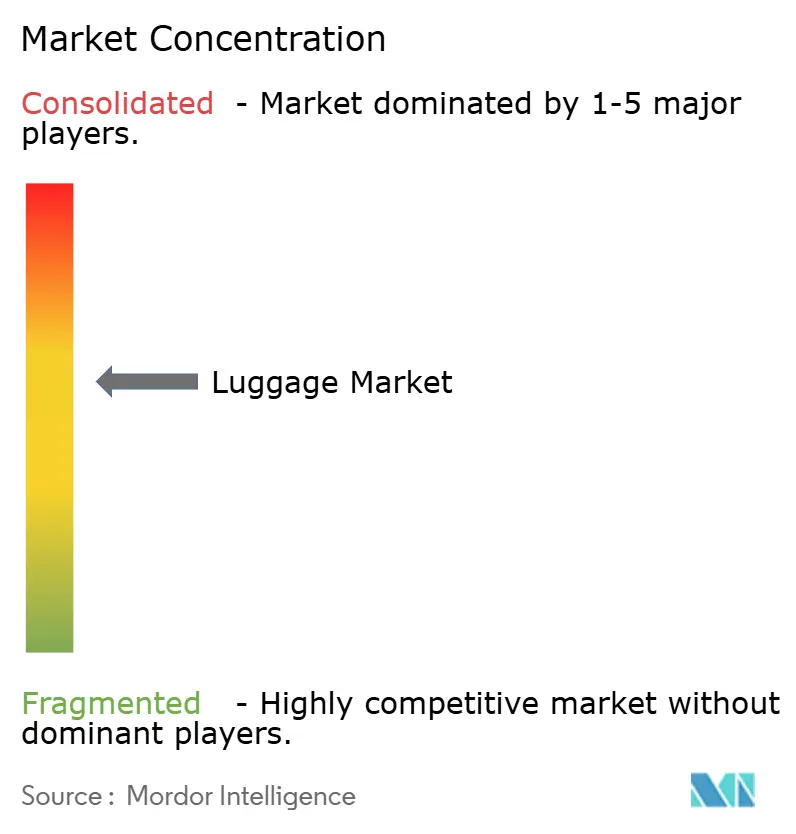
| Market Concentration | Medium |
Major Players
*Disclaimer: Major Players sorted in no particular order Image © Mordor Intelligence. Reuse requires attribution under CC BY 4.0. |
|
Luggage Market Analysis by Mordor Intelligence
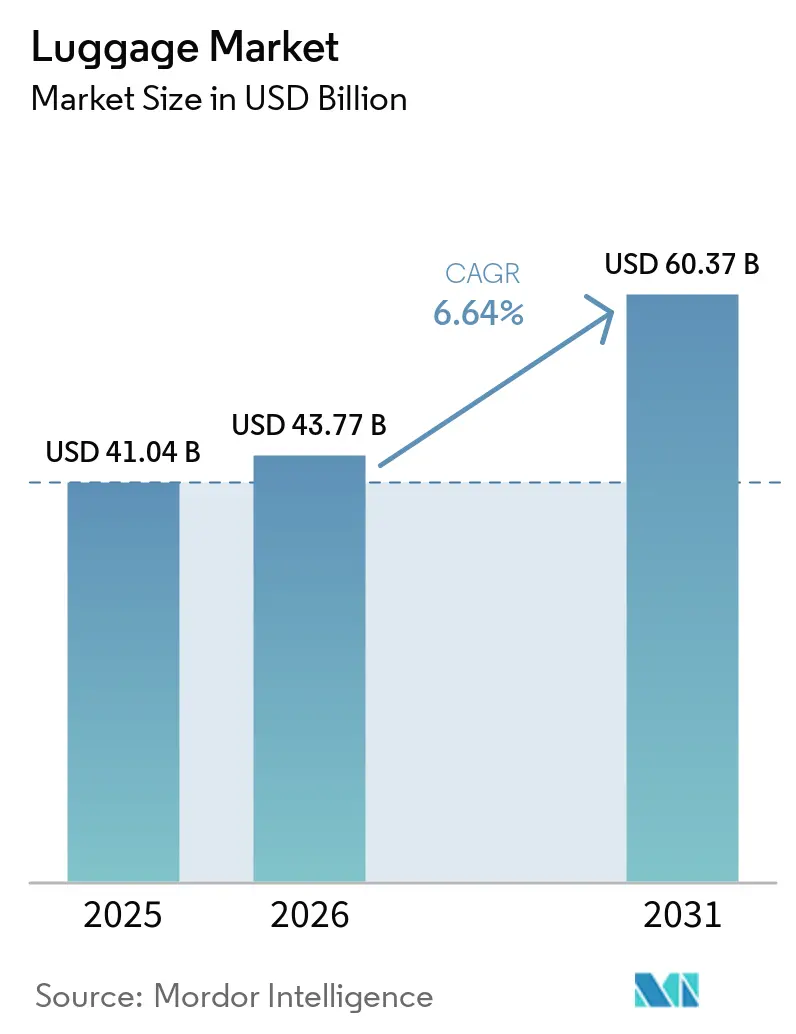
The Luggage Market size was valued at USD 41.04 billion in 2025 and estimated to grow from USD 43.77 billion in 2026 to reach USD 60.37 billion by 2031, at a CAGR of 6.64% during the forecast period (2026-2031). The market expansion is primarily attributed to the recovery of international and domestic travel across major tourism destinations and business centers. The World Tourism Organization (UN Tourism) reports that international tourist arrivals worldwide increased from 1.3 billion in 2023 to 1.4 billion in 2024, demonstrating a significant recovery in global travel [1]Source: UN Tourism, "International Tourist Arrivals," unwto.org. The market is experiencing increased demand for premium luggage products featuring technological advancements such as GPS tracking, USB charging, digital locks, and smart weight sensors. Millennial and Gen Z travelers' growing preference for leisure and business-leisure travel has increased the demand for versatile luggage options, including convertible backpacks, hybrid carry-ons, and modular systems. The Asia-Pacific region dominates market volume growth, driven by an expanding middle class and rising disposable incomes in China and India, while South America exhibits the highest growth rate due to enhanced travel infrastructure and increased tourism activities.
Key Report Takeaways
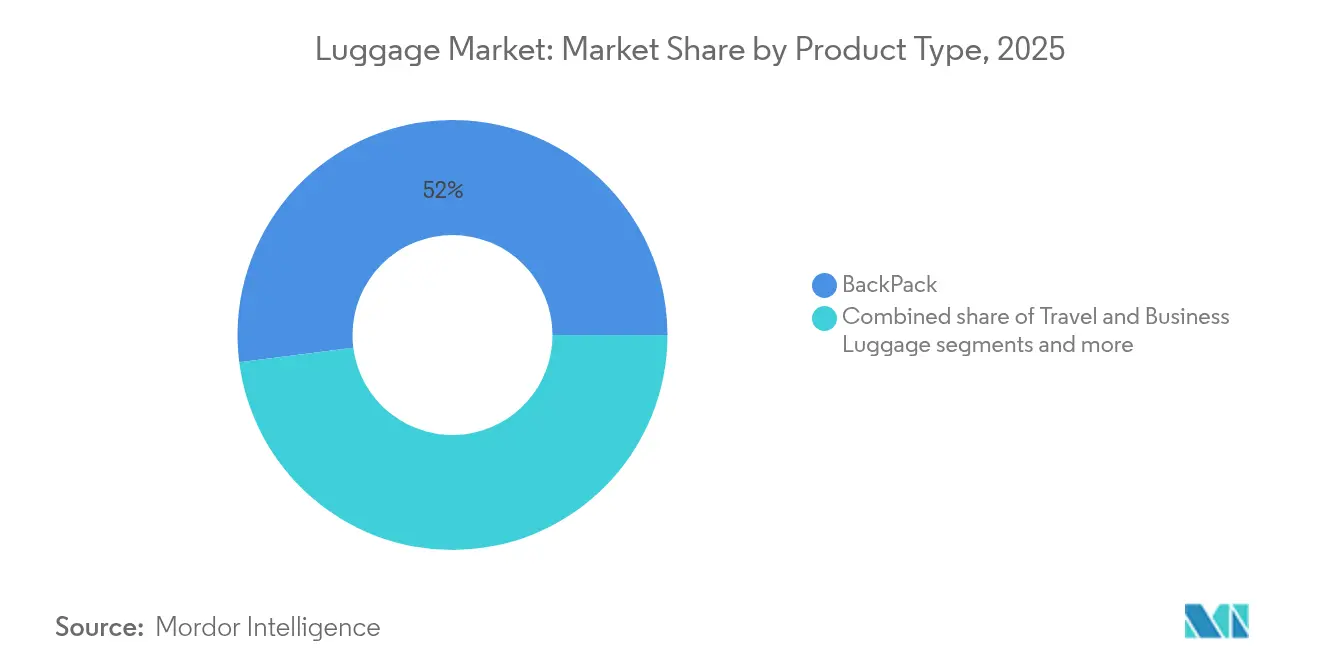
- By product type, backpacks led with a 52.02% revenue share of the global luggage market in 2025; travel luggage is projected to expand at a 6.85% CAGR through 2031.
- By material, soft cases commanded 78.96% of the global luggage market size in 2025, while hard cases are expected to advance at a 7.18% CAGR between 2026 and 2031.
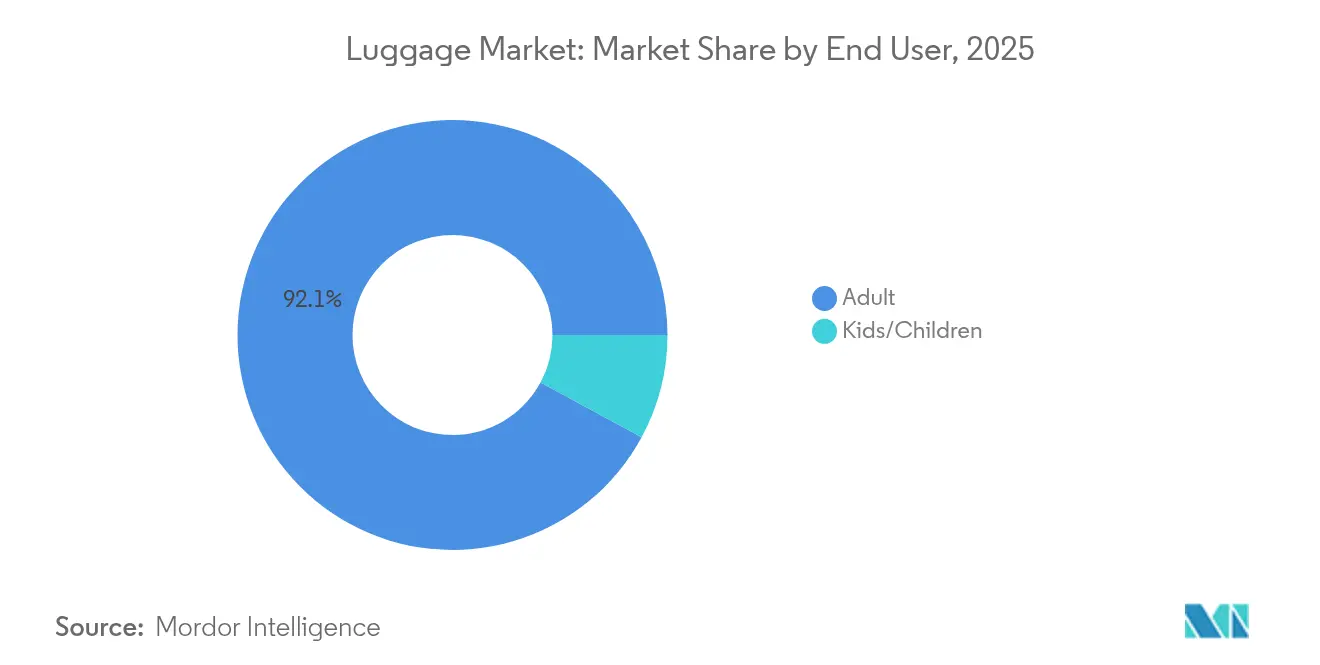
- By end user, the adult segment accounted for 92.11% of the global luggage market share in 2025, whereas kids/children luggage is set to grow at a 7.45% CAGR to 2031.
- By distribution channel, specialty stores held 44.12% revenue share in 2025, while online retail is predicted to post a 7.82% CAGR by 2031.
- By geography, Asia-Pacific captured 45.32% of the global luggage market in 2025; South America is forecast as the fastest-growing region at 8.14% CAGR.
Note: Market size and forecast figures in this report are generated using Mordor Intelligence’s proprietary estimation framework, updated with the latest available data and insights as of 2026.
Market Trends and Insights
Drivers Impact Analysis of Luggage Market*
| Driver | (~) % Impact on CAGR Forecast | Geographic Relevance | Impact Timeline |
|---|---|---|---|
| Increase in outstation and leisure travel | +0.8% | Global, with pronounced effect in Asia-Pacific and North America | Medium term (2-4 years) |
| Technological advancements in production | +0.7% | Global, with early adoption in North America and Europe | Long term (≥ 4 years) |
| Changing fashion trends and consumer preferences | +0.9% | Global, with stronger influence in urban centers | Short term (≤ 2 years) |
| Increasing corporate travel and business activities | +1.1% | Global, with concentration in major business hubs | Medium term (2-4 years) |
| Rise in sports and outdoor activities | +0.6% | North America, Europe, and emerging markets in Asia-Pacific | Medium term (2-4 years) |
| Influence of social media and celebrity endorsements | +0.5% | Global, with higher impact in regions with high social media penetration | Short term (≤ 2 years) |
| Source: Mordor Intelligence | |||


Increase in outstation and leisure travel
Leisure travel shows significant growth due to post-pandemic recovery and increased consumer spending on experiences over material goods. Millennials and Gen Z demonstrate higher travel spending from their disposable income, indicating evolving consumption patterns focused on memorable experiences. A European Travel Commission survey in March 2025 revealed that 66% of European respondents intended to travel within the region in the next six months, showing a strong recovery in travel intentions [2]Source: European Travel Commission, "Monitoring Sentiment for Intra-European Travel Spring/Summer 2025," etc-corporate.org. This behavioral shift has increased demand for luggage that balances functionality with aesthetics, benefiting premium and mid-range brands across market segments. The growth of business-leisure ("bleisure") travel necessitates versatile luggage suitable for both professional and leisure settings, driving innovations in multi-purpose design and storage solutions. Airlines' expanded revenue models, including strict baggage policies and size restrictions, have prompted travelers to invest in compliant and spacious luggage.
Technological advancements in production
The luggage industry has integrated advanced features into mainstream products, transforming traditional travel gear into smart accessories. GPS tracking enables real-time location monitoring through mobile applications, preventing loss and theft during transit. Weight sensors help travelers avoid excess baggage fees by providing accurate measurements before reaching the check-in counter. Detachable power banks offer convenient device charging during long journeys while complying with airline security regulations. Software developers collaborate extensively with manufacturers to ensure seamless Internet of Things (IoT) integration, enabling features like automated lock systems and proximity alerts. Blockchain technology creates unique digital signatures for each product, preventing counterfeit items from entering the supply chain and protecting brand value. Automated production processes, including precision robotic cutting and RFID tracking systems, minimize material waste and enhance end-to-end product traceability from the factory floor to retail shelves.
Changing fashion trends and consumer preferences
The luggage market has undergone a significant transformation as modern travelers increasingly view their travel bags and cases as essential style statements alongside their functional purpose. This shift is particularly evident in the premium segment, where sophisticated design elements, brand identity, and aesthetic appeal strongly influence purchasing decisions. Instagram and other social media platforms have substantially reinforced luggage's position as a fashion accessory, with travelers regularly documenting and sharing their travel gear through posts, stories, and travel content. Consumers actively seek distinctive designs, unique patterns, and innovative features to differentiate their luggage in airports, hotels, and other travel settings, prompting manufacturers to diversify and expand their product ranges across various price points and style categories. Luggage companies have established strategic partnerships with fashion designers and social media influencers to create exclusive limited-edition collections, expanding beyond traditional utility-focused offerings and creating new opportunities for product differentiation.
Increasing corporate travel and business activities
The recovery in business travel is driving significant growth in the luggage market, especially in premium and business segments. The market is experiencing increased demand as corporate travel budgets expand and international business activities resume globally. According to the Office for National Statistics (UK), international visits by inbound tourists in the United Kingdom increased from 5.1 million in 2022 to 6.5 million in 2023, indicating a strong return to business travel [3]Source: Office for National Statistics (UK), "Travel trends 2023," ons.gov.uk. In-person meetings remain crucial for business growth, with decision-makers viewing them as essential for maintaining and strengthening client relationships. This trend has substantially increased demand for professional, durable business luggage with advanced features. The rise in business travel has particularly benefited premium luggage manufacturers who offer high-quality materials and innovative designs. As corporate travel policies adapt to accommodate evolving employee preferences for comfort and convenience, manufacturers are developing innovative products that balance professional appearance with practical features, including dedicated laptop compartments, USB charging ports, and sophisticated organizational systems.
Restraints Impact Analysis of Luggage Market*
| Restraint | (~) % Impact on CAGR Forecast | Geographic Relevance | Impact Timeline |
|---|---|---|---|
| Availability of counterfeit products | -0.5% | Global, with higher prevalence in emerging markets | Long term (≥ 4 years) |
| Stringent security regulations at airports | -0.3% | Global, with stricter implementation in North America and Europe | Medium term (2-4 years) |
| Environmental concerns regarding materials | -0.2% | Global, with stronger regulatory pressure in Europe | Long term (≥ 4 years) |
| Fluctuating raw material prices | -0.2% | Global, with varying impact based on manufacturing locations | Short term (≤ 2 years) |
| Source: Mordor Intelligence | |||
Availability of counterfeit products
The luggage market faces significant disruption from counterfeit products that diminish brand value and consumer trust. These unauthorized replicas, featuring imitation logos of premium brands, typically use substandard materials and lack quality control, undermining legitimate manufacturers' market positioning and pricing strategies. The counterfeit trade flourishes particularly in developing markets with limited intellectual property enforcement, creating worldwide market distortions and reducing revenue for authentic manufacturers. According to Samsonite's regulatory documents, the company continuously battles counterfeit products, investing heavily in trademark protection and enforcement across regions. Their anti-counterfeiting strategy includes customs collaboration, enforcement agency partnerships, factory monitoring (especially in China, a major source of counterfeits), and surveillance of online marketplaces and websites. While companies implement protective measures such as blockchain verification, QR code tracking, and consumer education programs, these solutions increase operational costs, potentially limiting resources for product innovation and market growth.
Stringent Security Regulations at Airports
Airport security protocols significantly influence consumer preferences and design requirements in the luggage market. The adoption of advanced screening technologies, including X-ray machines, explosive detection systems, and biometric scanners, shapes product development. Current carry-on restrictions affect product specifications, particularly for smart luggage with electronic components such as GPS trackers, USB ports, and digital scales. Airports are upgrading their baggage management systems with automated sorting, RFID tracking, and artificial intelligence-powered solutions, requiring luggage manufacturers to adapt their products to comply with international security standards. While security regulations present design challenges, they also encourage innovation in materials like reinforced polycarbonates and configurations that improve security processing efficiency while maintaining product functionality. Manufacturers meeting regulatory requirements gain competitive advantages through security-compliant designs that improve the travel experience by reducing screening delays and ensuring hassle-free check-in processes.
*Our forecasts treat driver/restraint impacts as directional, not additive. The impact forecasts reflect baseline growth, mix effects, and variable interactions.
Luggage Market Segment Analysis
By Product Type:
Backpacks Lead While Travel Luggage AcceleratesBackpacks accounted for 52.02% of revenue in 2025, reflecting their dominance in daily commuting and short trips. The market growth for backpacks stems from increased casual office attire and remote work trends that require laptop-compatible designs. Features such as ergonomic straps, security compartments, and sustainable materials enhance their market position. Travel luggage is expected to exhibit the highest growth rate at 6.85% CAGR through 2031, driven by the recovery in leisure and business travel. The market accommodates convertible luggage designs that adapt from compact under-seat formats to expanded configurations for extended trips.
Business luggage demand increases with the rise in corporate travel expenditure. According to the Global Business Travel Association, China holds the position of the world's largest business travel market in 2024, with travel spending of USD 373 billion. Manufacturers focus on distinct features across categories to maintain competitive advantages. The integration of compression systems and noise-reducing wheels creates hybrid products that combine backpack and suitcase functionalities. The market experiences gradual growth in sports and adventure luggage, featuring reinforced external frames and hydration system compatibility for outdoor activities.


By Material:
Soft Case Dominance Amid Hard Case InnovationSoft cases maintained a 78.96% market share in 2025, driven by their flexibility, lighter weight, and cost-effectiveness. These cases provide adaptability for various travel scenarios, from business trips to leisure travel. The segment's growth continues through improvements in water-repellent coatings and antimicrobial linings that address hygiene requirements and enhance durability. Hard cases are projected to grow at a 7.18% CAGR, supported by developments in polycarbonate blends and recycled aluminum that improve durability while reducing weight. These materials offer enhanced protection for fragile items and electronics. The hard case segment benefits from airlines' expanded cabin size allowances, which encourage travelers to select protective shell designs for their security features.
Material innovations shape product development and market positioning in both segments. Samsonite's Roxkin panels use advanced polymer technology for increased strength. These innovations combine durability with environmental sustainability, appealing to environmentally conscious consumers who want long-lasting products with minimal ecological impact. While hard cases are expected to increase market share due to technological advancements and changing consumer preferences, soft cases will maintain their dominance in entry-level segments, particularly in developing markets.
By End User:
Adults Dominate While Children’s Segment GrowsAdults accounted for 92.11% of 2025 luggage sales, driven by frequent flyers, digital nomads, and business executives. Growing leisure travel budgets in Asia, particularly in China, India, and Southeast Asian countries, and consistent business travel in North America, maintain strong sales volume. The adult luggage market benefits from modular interior designs that accommodate both electronic devices and clothing, including specialized compartments for laptops, tablets, power banks, and organized storage for business attire. The kids/children luggage segment, while smaller, is projected to grow at 7.45% CAGR through 2031.
Parents increasingly favor ride-on and foldable designs for their convenience during airport transfers and family vacations. Features like bright colors, cartoon designs, and lightweight materials enable children to handle their luggage, fostering early brand loyalty and developing travel independence. Manufacturers are incorporating similar smart technology features in children's products, including Bluetooth tracking capabilities, GPS location services, and digital locks for family travel security. The kids' segment is driving the development of complementary product lines, such as coordinated parent-child luggage sets, themed travel accessories, and matching backpack collections.
By Distribution Channel:
Specialty Stores Lead as Online Retail SurgesSpecialty luggage stores accounted for 44.12% of sales in 2025, with customers valuing the ability to physically examine product features like wheels, zippers, and handles. These stores provide comprehensive expert guidance on airline regulations, weight restrictions, and efficient packing techniques, contributing to higher transaction values. Store associates offer personalized recommendations based on travel frequency, destination types, and specific customer requirements. The market projects online retail growth at 7.82% CAGR through 2031. Virtual tools, including augmented reality applications and detailed measurement guides, enable customers to assess luggage dimensions relative to airline compartments, helping overcome the limitations of online shopping.
The industry adopts integrated retail approaches, with physical stores serving as experience centers while direct-to-consumer websites collect customer data for targeted sales opportunities. These websites track browsing patterns, purchase history, and customer preferences to deliver personalized product recommendations. The global luggage market views different sales channels as complementary, implementing services like buy-online-pick-up-in-store, curbside returns, and cross-channel inventory visibility to enhance customer satisfaction and streamline the shopping experience.
Geography Analysis
APAC Luggage Market
Asia-Pacific accounts for 45.32% of the global luggage market in 2025. China's urban middle class and India's expanding domestic tourism drive substantial volume demand. The market shows clear price segmentation, with functional economy products performing well in tier-2 cities, while premium brands expand through airport travel-retail locations. Government investments in airport infrastructure and high-speed rail networks increase luggage usage opportunities. The region's growth stems from urbanization, higher disposable incomes, and increased travel activities. A robust e-commerce infrastructure supports market expansion, while Chinese consumers show evolving preferences toward premium products with innovative features.
South America Luggage Market
South America is expected to achieve an 8.14% CAGR from 2026 to 2031, the highest globally, driven by increasing international tourism. Brazil leads the market, while Argentina shows growth in online luggage sales, reflecting digital market development. Import tariffs and certification requirements create barriers for international brands. Local manufacturers focus on economy soft cases, creating opportunities in the premium and smart luggage segments.
EMEA and North America Luggage Market
Europe and North America maintain significant value shares due to high consumer purchasing power and demand for design-focused, sustainable products. German and French consumers show increasing interest in recycled materials, pushing manufacturers to provide detailed material composition. The United States drives North American demand through corporate travel and frequent domestic air travel. The Middle East and Africa demonstrate steady growth, supported by Gulf region investments in tourism and aviation infrastructure. Dubai International Airport's luxury retailers offer exclusive collections, attracting both regional and international travelers. This geographical diversification requires manufacturers to adapt their product ranges and marketing strategies to regional preferences.

Regulatory Landscape
Luggage brands and importers are operating under tighter consumer-product safety and market-surveillance frameworks, particularly in the EU and the United States. In the EU, the General Product Safety Regulation, Regulation (EU) 2023/988, has applied since December 13, 2024, raising requirements for placing only safe non-food consumer products on the market and strengthening obligations across the supply chain for economic operators selling luggage through both physical and online channels.
Cross-border compliance is also moving toward more formalized pre-entry documentation and aviation-linked constraints for smart luggage. In the United States, the Consumer Product Safety Commission (CPSC) eFiling requirement becomes mandatory on July 8, 2026, requiring electronic filing of product certificate data at entry via CBP ACE for a broad set of HTS codes that include luggage. For air travel, the 2025-2026 ICAO Technical Instructions (Doc 9284) continue to shape global dangerous-goods compliance for lithium batteries and power banks used in smart luggage, while EU aviation security measures were updated under Commission Implementing Regulation (EU) 2026/449, with specific provisions taking effect from October 1, 2026.
Competitive Landscape
The global luggage market shows moderate consolidation. Samsonite International S.A. holds multibrand coverage, combining American Tourister's mass appeal with Tumi's premium positioning. LVMH's ownership of RIMOWA enhances its luxury segment through aluminum aesthetics and minimalist design. Regional players like VIP Industries and Safari Industries maintain market share in India through established distribution networks. Away has proven the viability of direct-to-consumer models by integrating lifestyle marketing with customer-friendly return policies.
Sustainability and smart functionality have become key competitive factors. Samsonite International S.A.'s limited edition Proxis Circular, launched in 2025, incorporates at least 60% bio-circular and recycled materials. The product features Roxkin material in its outer shell, made from recycled cooking oil collected from restaurant kitchens. Victorinox's acquisition of a biometric-security startup indicates increasing focus on technology integration.
Industry consolidation is likely to increase as established companies seek design and digital capabilities, while startups target specific market segments like digital nomads and adventure trekkers. While price competition continues in entry-level segments, companies maintain profitability through premium offerings and repair services.
Luggage Industry Leaders
-
Samsonite International S.A.
-
LVMH Moet Hennessy Louis Vuitton SE
-
VIP Industries Ltd.
-
Safari Industries India Ltd.
-
It Luggage Limited
- *Disclaimer: Major Players sorted in no particular order
Luggage Market Companies Covered in this Report
- Samsonite International S.A.
- LVMH Moet Hennessy Louis Vuitton SE
- VIP Industries Ltd.
- Safari Industries India Ltd.
- It Luggage Limited
- Delsey Paris
- Victorinox AG
- Travelpro Products Inc.
- U.S. Luggage LLC
- Piquadro S.p.A.
- Valigeria Roncato S.p.A.
- JRSK, Inc. (Away)
- ATR Brands Limited (Antler Ltd.)
- Monos Travel Ltd.
- July and Co Pty Ltd
- Eagle Creek Holdings
- Chanel S.A.
- Hermes International S.A.
- Horizn Studios GmbH
- Bric's Milano S.p.A

Market Opportunities and Future Outlook
Sustainability-led product redesign and traceability are creating room for brands that can scale circular materials, transparency, and repair services. The EU policy direction around Digital Product Passports and restrictions on the destruction of unsold consumer goods, with milestones beginning July 2026 under the Ecodesign for Sustainable Products Regulation framework, is pushing demand for luggage architectures that support verified material sourcing, modular components, and after-sales repair. This is consistent with large-brand moves toward circular offerings, including Samsonite introducing circular economy suitcase concepts tied to Digital Product Passports, and with material suppliers promoting high recycled-content shells, such as NINETYGO and Covestro presenting a suitcase made with 90% post-consumer recycled polycarbonate at CHINAPLAS 2026.
Manufacturing localization and capacity clustering are also helping to improve availability, cost, and speed-to-market in high-growth travel corridors. India has become a major production base for global and regional brands, supported by expansions such as Samsonite scaling monthly output capacity at its Nashik facility to 700,000 units after phase two commissioning. On the innovation side, patented recyclable composite materials, including CLK Luggage receiving a national invention patent in October 2025 for a multi-dimensional polymer composite, point to differentiated hard-case performance while meeting circularity requirements, supporting premiumization and regulated-market access narratives in Europe and other sustainability-forward channels.
Recent Industry Developments in Luggage Market
- May 2026: VIP Industries Ltd. rolled out the Travel VIP campaign and introduced three luggage collections, VIP Classic, VIP Flex, and VIP Pod. The release expands its consumer-facing portfolio refresh across price points and supports re-engagement with demand through brand-led assortment segmentation.
- July 2025: VIP Industries Ltd. disclosed progress on its strategic reset following the 2025 change of control to Multiples Alternate Asset Management, including actions tied to leadership and operating model changes shared via exchange communication. The update signaled an accelerated restructuring cycle for a major Indian player, affecting competitive intensity in mass and mid-premium luggage.
- December 2024: Safari Industries commenced production at its new Jaipur manufacturing facility through its wholly owned subsidiary, expanding capacity to serve rising demand for luggage and travel accessories. The additional manufacturing footprint strengthens domestic supply capability and supports faster replenishment for branded retail and e-commerce channels.


Luggage Market Report Scope and Research Methodology
Market Definition and Coverage
The luggage market is defined as consumer bags and cases used to carry personal belongings during travel and commuting, sold through offline and online channels. It covers commonly purchased luggage items across major travel and non-travel use occasions.
Scope exclusions: We exclude travel accessories and small personal carry items that are not typically sold as luggage (such as wallets, toiletry kits, and simple pouches).
Segments Covered in This Report
-
By Product Type
- Travel Luggage
- Business Luggage
- Sports Luggage
- Backpack
-
By Material
- Hard Case
- Soft Case
-
By End User
- Adult
- Kids/Children
-
By Distribution Channel
- Supermarkets/Hypermarkets
- Specialty Stores
- Online Retail Stores
- Other Distribution Channels
-
By Geography
-
North America
- United States
- Canada
- Mexico
- Rest of North America
-
Europe
- Germany
- United Kingdom
- Italy
- France
- Spain
- Netherlands
- Poland
- Belgium
- Sweden
- Rest of Europe
-
Asia-Pacific
- China
- India
- Japan
- Australia
- Indonesia
- South Korea
- Thailand
- Singapore
- Rest of Asia-Pacific
-
South America
- Brazil
- Argentina
- Colombia
- Chile
- Peru
- Rest of South America
-
Middle East and Africa
- South Africa
- Saudi Arabia
- United Arab Emirates
- Nigeria
- Egypt
- Morocco
- Turkey
- Rest of Middle East and Africa
-
North America
Data Sources, Market Sizing, and Validation
Desk Research
Desk work starts by pulling stable reference points that explain luggage demand and supply patterns. We relied on public travel and mobility indicators, trade flows, and consumer price signals to ground the model, then built assumptions by region.
Sources used include publications such as UN World Tourism Organization travel statistics, World Bank macroeconomic indicators, UN Comtrade trade data for travel goods and bags, national customs and statistics portals for import-export and retail series, and patent databases to track innovation focus (for example, smart features and materials). We also reviewed company annual reports, investor presentations, and reputable business press to understand channel shifts and pricing direction. The desk sources listed are illustrative, since additional public references were also checked for collection, validation, and clarification.
Primary Interviews and Surveys
Primary discussions were completed with luggage manufacturers, brand distributors, travel retail participants, and large online and offline sellers, so key gaps from public data could be addressed. Because this is a global market, we also spoke with contacts across APAC, EMEA, and the Americas to pressure test price bands, channel mix, and the influence of travel recovery on near-term demand.
Distribution of primary research fieldwork respondents
| Company type | Respondent position | Region |
|---|---|---|
| Top tier: 29% | CXOs: 14% | APAC: 41% |
| Mid tier: 51% | Functional/Unit leaders: 37% | EMEA: 37% |
| Smaller Players: 20% | Managers: 49% | Americas: 22% |
Market-Sizing & Forecasting
Sizing begins with a top-down build where travel activity and consumer spend signals are translated into an addressable demand pool for luggage, then adjusted using trade intensity and channel structure by region. The totals are corroborated with selective bottom-up approximations, such as sampled price points by product group multiplied by estimated unit movement, followed by channel checks to correct obvious overcounts.
Key inputs that keep the model practical include international and domestic passenger traffic trends, tourism arrivals, household discretionary spending, average selling price movement between hard case and soft case items, online share shift versus offline retail, and import-export value trends for travel goods in large consuming countries. Where bottom-up inputs are thin for smaller countries, we use proxy ratios from similar markets and validate them through distributor and retailer feedback.
For forecasting, we use scenario analysis supported by short variable-based projections (travel demand, inflation and real income direction, and channel penetration), then apply a smoothing step so the curve reflects how luggage replacement cycles behave in real life.
Data Validation & Update Cycle
Outputs are cross-checked against independent signals, including trade value direction, travel activity recovery patterns, and price inflation lines, so the final totals do not rely on a single data series. Large variances are flagged, and we re-check drivers, units, and currency conversions before the numbers are signed off.
Each report goes through multiple internal reviews where assumptions are challenged and recalculated, and then a final pass is done close to publication to remove stale inputs. The study is refreshed annually, and interim updates are triggered when a material event changes travel volumes, supply availability, or pricing in a meaningful way.
Mordor Intelligence's Luggage Market Size Compared Against Other Published Estimates
Different publications often show different market sizes for luggage because product scope and counting logic are not consistent, even when the same country list is used. The biggest swings usually come from whether backpacks and casual bags are counted fully, how smart luggage is treated, and whether values reflect retail sales or a closer wholesale equivalent.
Another driver is the base year and refresh timing, because travel recovery and inflation move the market quickly, and small currency timing choices can create visible gaps. Some estimates also lean heavily on a single input such as retail value, without checking it against trade and travel signals, which can inflate totals in markets with high re-exports or mixed product baskets.
Benchmark comparison
| Source | Market Size | Gaps in Research Methodology |
|---|---|---|
| Mordor Intelligence | USD 43.77 B (2026) | |
| Global Consultancy A | USD 40.81 B (2024) | Uses an earlier base year and a shorter forward view, and the inclusion logic is less explicit around backpacks versus travel luggage, which can keep the number lower when travel demand rebounds. |
| Industry Publisher B | USD 38.82 B (2023) | Counts a broader set of traditional and smart luggage types but starts from an older base year and applies a long horizon CAGR, which can shift the current-year value downward versus a nearer-term demand-linked build. |
The spread in the table is mainly explained by base year selection and how closely the sizing is tied to travel activity and pricing, rather than only to category sales labels. By anchoring demand to travel indicators and then verifying it with trade and channel signals, the estimate stays aligned to what is actually purchased as luggage, a modeling choice applied by Mordor Intelligence.


Key Questions Answered in the Report
What is the current size of the global luggage market?
The market is valued at USD 43.77 billion in 2026.
How fast will the global luggage market grow by 2031?
It is projected to post a 6.64% CAGR and reach USD 60.37 billion.
Which product category leads the global luggage market?
Backpacks dominate with 52.02% revenue share as of 2025.
Which region is expanding the quickest?
South America is forecast to grow at an 8.14% CAGR from 2026 to 2031.
Page last updated on:


 Your data is secure and never sold or shared.


