
Low Fat Cheese Market Size and Share
Market Overview
| Study Period | 2021 - 2031 |
|---|---|
| Market Size (2026) | USD 22.62 Billion |
| Market Size (2031) | USD 27.91 Billion |
| Growth Rate (2026 - 2031) | 4.29 % |
| Fastest Growing Market | Asia-Pacific |
| Largest Market | North America |
| Market Concentration | Medium |
Major Players
*Disclaimer: Major Players sorted in no particular order Image © Mordor Intelligence. Reuse requires attribution under CC BY 4.0. |
|
Low Fat Cheese Market Analysis by Mordor Intelligence
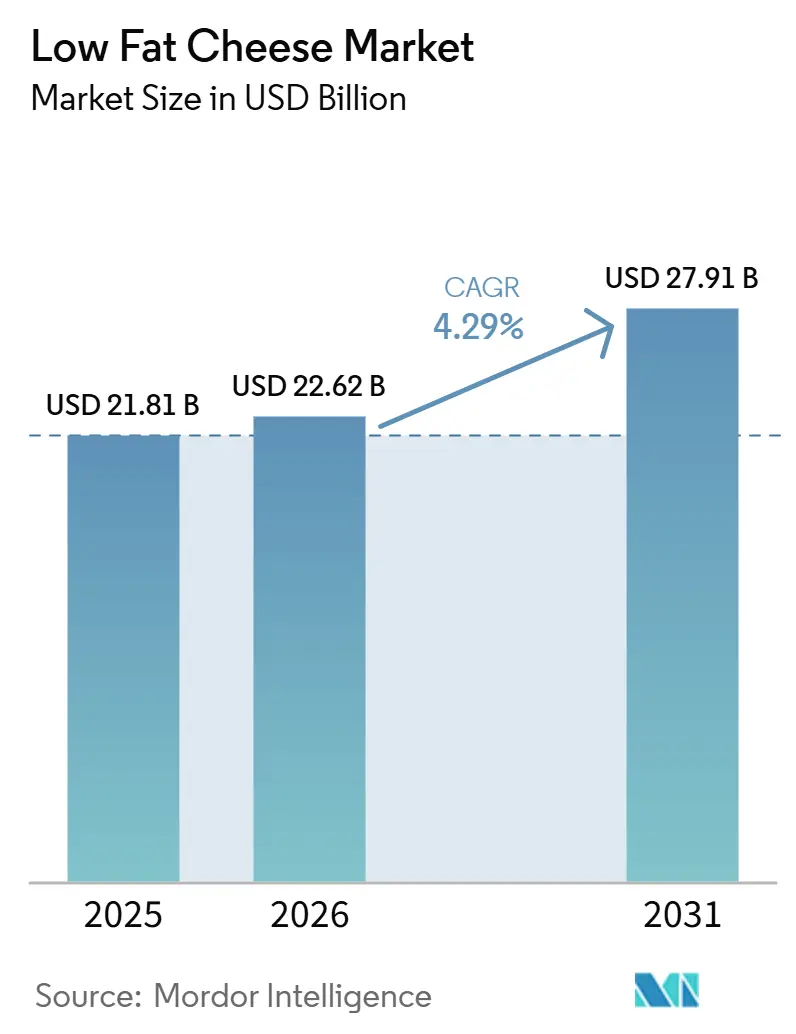
The low fat cheese market size is expected to grow from USD 21.81 billion in 2025 to USD 22.62 billion in 2026 and is forecast to reach USD 27.91 billion by 2031 at a 4.29% CAGR over 2026-2031. The low-fat cheese market is growing steadily, driven by increasing consumer preference for healthier dairy products, rising demand for protein-rich foods, and product innovation that has improved the taste and texture of reduced-fat cheese. Growing awareness of balanced nutrition, along with wider availability of low-fat cheese across supermarkets, specialty stores, and online retail channels, continues to support market expansion. Manufacturers are broadening their product portfolios with new formats and formulations to meet evolving consumer preferences while strengthening their presence across all the distribution channels.
Key Report Takeaways
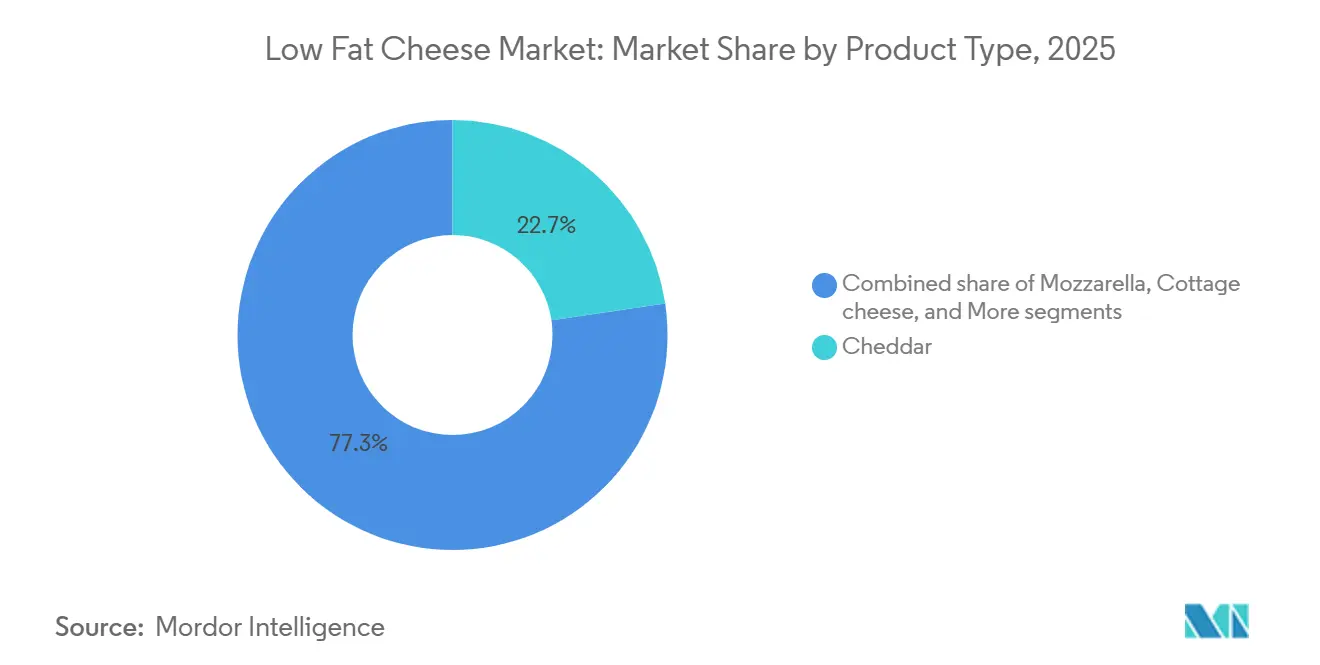
- By product type, cheddar held 22.66% of the 2025 low fat cheese market share, while cottage cheese is forecast to record the highest CAGR of 5.65% during 2026-2031.
- By fat content, the low-fat tier accounted for 58.24% of the low fat cheese market share in 2025, while fat-free cheese is projected to grow at a 5.72% CAGR during 2026-2031.
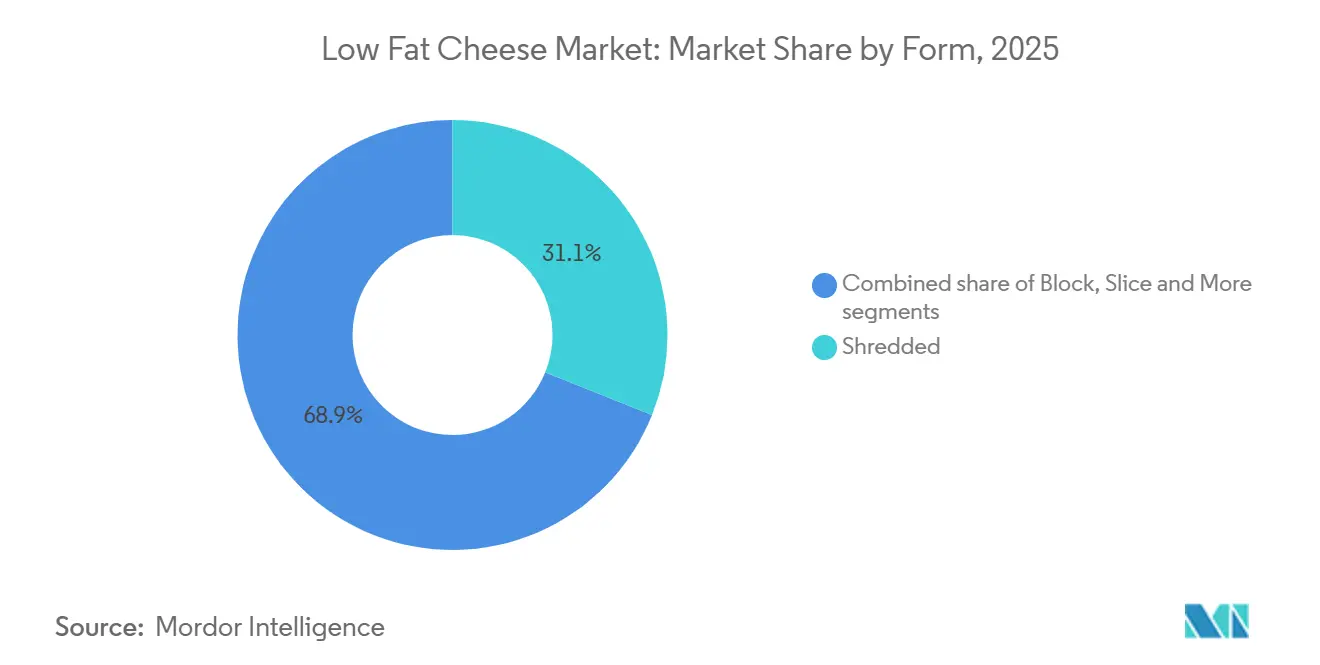
- By form, shredded cheese represented 31.06% of the 2025 low fat cheese market share, while other is expected to to grow at a 5.34% CAGR during 2026-2031.
- By distribution channel, supermarkets and hypermarkets held 52.35% of the 2025 low fat cheese market share, while online retail stores are projected to grow at a 6.01% CAGR during 2026-2031.
- By geography, North America captured 37.46% of the global low fat cheese market share in 2025, while Asia-Pacific is forecast to expand at a 5.85% CAGR during 2026-2031.
Note: Market size and forecast figures in this report are generated using Mordor Intelligence’s proprietary estimation framework, updated with the latest available data and insights as of January 2026.
Global Low Fat Cheese Market Trends and Insights
Drivers Impact Analysis*
| Driver | (~) % Impact on CAGR Forecast | Geographic Relevance | Impact Timeline |
|---|---|---|---|
| Growing consumer focus on weight management and calorie reduction | +1.1% | Global, strongest momentum in North America and Western Europe | Short term (≤ 2 years) |
| Expansion of high-protein and functional food | +0.9% | North America, Europe, Asia-Pacific urban centers | Medium term (2–4 years) |
| Product innovation in low-fat cheese | +0.8% | Global | Medium term (2–4 years) |
| Expansion of premium and specialty low-fat cheese varieties | +0.5% | North America, Europe, Australia | Long term (≥ 4 years) |
| Increasing prevalence of lifestyle-related health conditions | +0.6% | Asia-Pacific, Middle East and Africa, South America | Medium term (2–4 years) |
| Rising demand for healthier ready-to-eat and convenience foods | +0.5% | North America, Asia-Pacific | Short term (≤ 2 years) |
| Source: Mordor Intelligence | |||
Growing consumer focus on weight management and calorie reduction
Growing consumer focus on weight management and calorie reduction is driving demand for low-fat cheese, as consumers seek dairy products that provide protein and calcium with lower fat and calorie content. Increasing awareness of health risks associated with overweight and obesity has encouraged consumers to incorporate reduced-fat dairy products into their daily diets without compromising nutritional value. In response, manufacturers are expanding their portfolios with low-fat cheese variants that offer improved taste, texture, and convenience. According to the World Health Organization (WHO), approximately 35 million children under the age of five were overweight in 2024, while the organization continues to recognize obesity as one of the world's fastest-growing public health challenges[1]Source: World Health Organization, "Obesity and overweight", who.int. This reinforces consumer interest in healthier food choices and supports demand for low-fat dairy products, including low-fat cheese.
Expansion of high-protein and functional food
The growing demand for high-protein and functional foods is driving interest in low-fat cheese, as consumers seek nutrient-dense products that support muscle health, satiety, and overall wellness while limiting fat intake. As a protein-rich dairy product with reduced fat content, low-fat cheese is gaining traction in snacks, breakfast items, ready-to-eat meals, and other health-focused food applications. According to the 2025 International Food Information Council (IFIC) Food & Health Survey, "good source of protein" was the top attribute consumers used to define a healthy food, selected by 38% of respondents, ahead of attributes such as freshness and low sugar[2]Source: International Food Information Council, "2025 IFIC Food & Health Survey", ific.org. Additionally, the 2025 IFIC Spotlight Survey: Americans' Perceptions of Protein reported that 35% of Americans increased their protein intake over the past year, while 56% prioritize protein at dinner, 44% at breakfast, and 42% at lunch[3]Source: International Food Information Council, "Americans’ Perceptions of Protein", ific.org. These findings highlight the growing emphasis on protein-rich foods and support demand for products such as low-fat cheese.
Product innovation in low-fat cheese
Product innovation in low-fat cheese is driving market growth as manufacturers invest in advanced processing techniques and ingredient formulations to improve the taste, texture, meltability, and overall sensory appeal of reduced-fat cheese products. Companies are expanding their portfolios with new flavors, formats, and functional variants to meet evolving consumer preferences while maintaining nutritional benefits such as lower fat content and high protein levels. Innovations in packaging, portion-controlled formats, and clean-label formulations are further enhancing product convenience and consumer appeal. Ongoing research and development aimed at narrowing the sensory gap between low-fat and conventional cheese is improving consumer acceptance and encouraging repeat purchases, supporting the long-term growth of the low-fat cheese market.
Expansion of premium and specialty low-fat cheese varieties
The expansion of premium and specialty low-fat cheese varieties is supporting market growth by offering consumers a wider selection of healthier cheese products without compromising on quality, flavor, or versatility. Manufacturers are introducing reduced-fat versions of specialty cheeses such as feta, parmesan, cream cheese, and mozzarella, while incorporating attributes such as lactose-free, organic, clean-label, and high-protein formulations to address evolving consumer preferences. Premium packaging, artisanal production methods, and value-added product positioning are further enhancing product appeal and supporting premiumization within the category. The growing availability of differentiated specialty products is enabling manufacturers to reach a broader consumer base, strengthen brand competitiveness, and encourage higher adoption of low-fat cheese in everyday consumption.
Restraints Impact Analysis*
| Restraint | (~) % Impact on CAGR Forecast | Geographic Relevance | Impact Timeline |
|---|---|---|---|
| Taste and texture challenges | -0.8% | Global; most acute in premium and aged-cheese segments | Short to medium term (≤ 4 years) |
| Higher manufacturing and ingredient costs | -0.7% | Global; highest cost exposure in North America and Europe | Short term (≤ 2 years) |
| Fluctuating dairy raw material prices | -0.6% | Europe, North America | Short term (≤ 2 years) |
| Growing popularity of plant-based cheese alternatives | -0.7% | Europe, North America, urban Asia-Pacific | Long term (≥ 4 years) |
| Source: Mordor Intelligence | |||
Taste and texture challenges
Taste and texture challenges remain a significant restraint in the low-fat cheese market, as reducing fat content alters a product's creaminess, mouthfeel, meltability, and overall flavor profile. Consumers often associate full-fat cheese with superior taste and texture, making it difficult for low-fat alternatives to achieve comparable sensory acceptance. Maintaining the desired sensory characteristics while reducing fat content remains a complex formulation challenge for manufacturers, particularly across different cheese varieties. These limitations can reduce repeat purchases and slow consumer adoption, especially in applications where flavor and melting performance are critical, such as pizzas, sandwiches, and cooked dishes.
Higher manufacturing and ingredient costs
Higher manufacturing and ingredient costs are a significant restraint on the low-fat cheese market. Producing reduced-fat cheese often requires specialized processing techniques and functional ingredients to maintain acceptable taste, texture, and meltability. Manufacturers invest in advanced formulations, protein modifications, stabilizers, and process optimization to compensate for the reduced fat content, which increases overall production expenses. These additional costs can result in higher retail prices compared to conventional cheese, potentially limiting consumer adoption in price-sensitive markets. Cost pressures also challenge manufacturers' ability to balance product quality, affordability, and profitability, particularly during periods of rising production expenses.
*Our forecasts treat driver/restraint impacts as directional, not additive. The impact forecasts reflect baseline growth, mix effects, and variable interactions.
Segment Analysis
By Product Type: Cheddar Anchors Value as Cottage Cheese Rewrites the Growth Narrative
Cheddar accounted for the largest share of the low-fat cheese market at 22.66% in 2025. Its position is driven by widespread consumer acceptance, versatile applications, and strong demand across a variety of consumption occasions. Low-fat cheddar is commonly available in block, sliced, and shredded formats, making it suitable for sandwiches, burgers, salads, snacks, and home cooking. Continued product innovation has helped improve its taste and texture, further strengthening consumer preference and sustaining its market leadership.
Cottage cheese is projected to register the fastest CAGR of 5.65% during 2026–2031. Growth is driven by rising consumer preference for high-protein, lower-fat dairy products and increasing incorporation of cottage cheese into health-focused diets, snacks, and meals. Manufacturers are expanding their product portfolios with flavored, lactose-free, and protein-enhanced variants to appeal to a broader consumer base. Growing consumer awareness of functional nutrition and the nutritional benefits of cottage cheese is expected to support the segment's growth over the forecast period.



By Fat Content: Low-Fat Tier Dominates While Fat-Free Claims the Acceleration Premium
Low-fat cheese accounted for the largest share of the low-fat cheese market at 58.24% in 2025. This segment's dominance is driven by strong consumer preference for products that balance reduced fat content with acceptable taste, texture, and functionality. Low-fat cheese is available across a wide range of cheese varieties, making it the preferred choice for health-conscious consumers seeking healthier dairy options without significantly compromising their eating experience.
The fat-free segment is projected to register the fastest CAGR of 5.72% during 2026–2031. Rising demand for lower-calorie dairy products, increasing health awareness, and growing consumer focus on weight management are driving the adoption of fat-free cheese. Manufacturers are expanding their product portfolios with new fat-free cheese varieties and formulations to meet evolving consumer preferences for healthier dairy products. These factors are expected to support the segment's growth over the forecast period.
By Form: Shredded Format Leads While Other Forms Grow
Shredded cheese accounted for the largest share of the low-fat cheese market at 31.06% in 2025. The segment's dominance is attributed to its convenience, ease of use, and strong consumer preference for ready-to-use cheese formats. Shredded low-fat cheese is available across multiple cheese varieties and is offered in resealable packaging that enhances convenience and freshness. Ongoing product innovation and broad consumer acceptance continue to support the segment's leading market position.
The other forms segment is projected to register the fastest CAGR of 5.34% during 2026–2031. Growth is driven by increasing consumer demand for convenient, portion-controlled, and on-the-go dairy products that align with healthy snacking trends. Manufacturers are expanding their portfolios with formats such as string cheese and cheese crumbles to cater to evolving consumer preferences. The growing popularity of protein-rich snacks and continued product diversification are expected to support the segment's growth over the forecast period.
By Distribution Channel: Supermarkets Hold the Value While Online Retail Stores Shift the Growth Frontier
Supermarkets and hypermarkets accounted for the largest share of the low-fat cheese market at 52.35% in 2025. This segment's dominance is driven by extensive product availability, well-established cold-chain infrastructure, and a wide variety of low-fat cheese products from multiple brands. Consumers prefer these retail formats for one-stop shopping convenience, frequent promotional activities, and access to both mainstream and premium product offerings. Broad geographic presence and strong distribution networks further support the segment's position.
Online retail stores are projected to register the fastest CAGR of 6.01% during 2026–2031. Growth is driven by increasing consumer preference for convenient shopping, expanding e-commerce penetration, and a wider assortment of low-fat cheese products available through digital platforms. Online channels allow consumers to compare products, access specialty and premium offerings, and benefit from home delivery and subscription-based purchasing options. Continued investments in cold-chain logistics and digital retail infrastructure are expected to support the growth of this distribution channel over the forecast period.
Geography Analysis
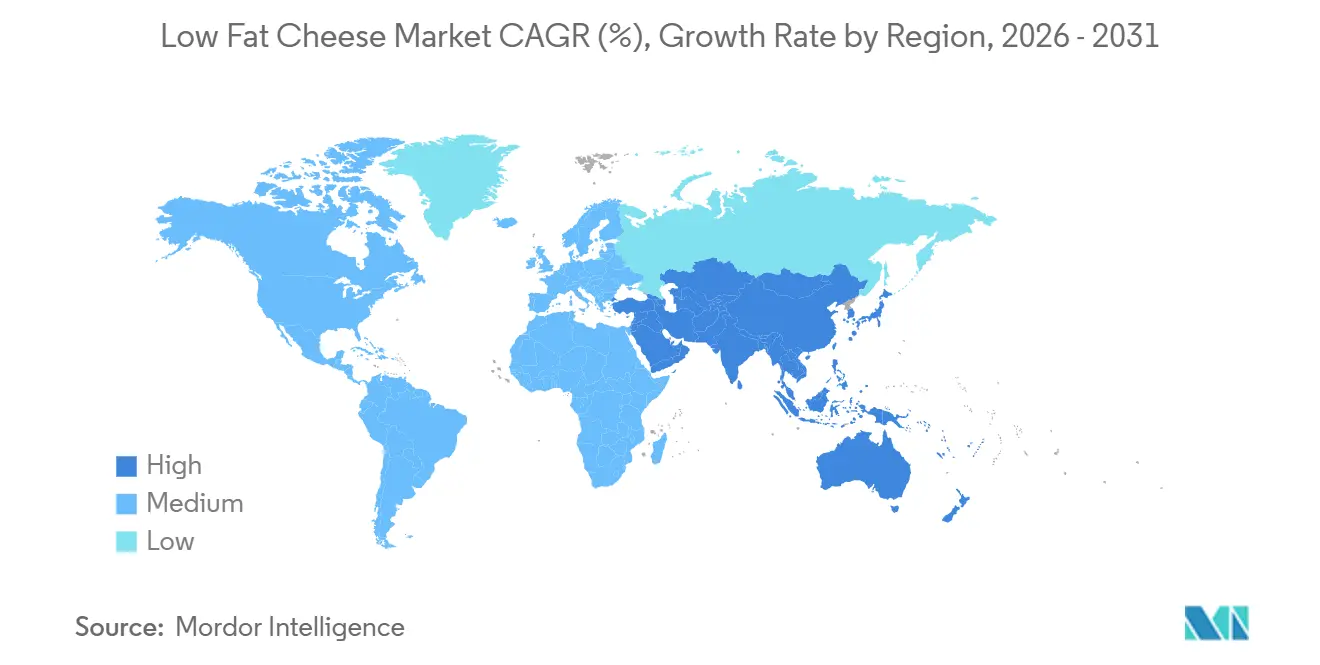
North America accounted for the largest share of the low-fat cheese market at 37.46% in 2025. The region's position is supported by a well-established dairy industry, high consumer awareness of healthier food choices, and strong demand for reduced-fat dairy products. A broad presence of low-fat cheese products across supermarkets/hypermarkets, convenience stores, specialty stores, and online retail platforms, together with continuous product innovation and the presence of leading cheese manufacturers, has further strengthened market growth. Growing consumer preference for high-protein and lower-fat dairy products continues to reinforce North America's leading position in the global market.
Asia-Pacific is projected to register the fastest CAGR of 5.85% during 2026–2031. Growth is driven by increasing urbanization, rising disposable incomes, growing consumer adoption of Western dietary habits, and increasing demand for healthier dairy products. Expanding availability through supermarkets/hypermarkets, online retail platforms, and specialty stores is improving consumer access to low-fat cheese, while rising health awareness and demand for nutritious, protein-rich foods are expected to support market growth throughout the forecast period.
South America is emerging as a promising market for low-fat cheese. Rising health consciousness, improving household incomes, and increasing demand for healthier dairy products are contributing to market growth across the region. Manufacturers are expanding their product portfolios and strengthening their presence across key distribution channels to meet evolving consumer preferences. Growing consumption of packaged and value-added dairy products is expected to create new growth opportunities for the low-fat cheese market in the coming years.

Competitive Landscape
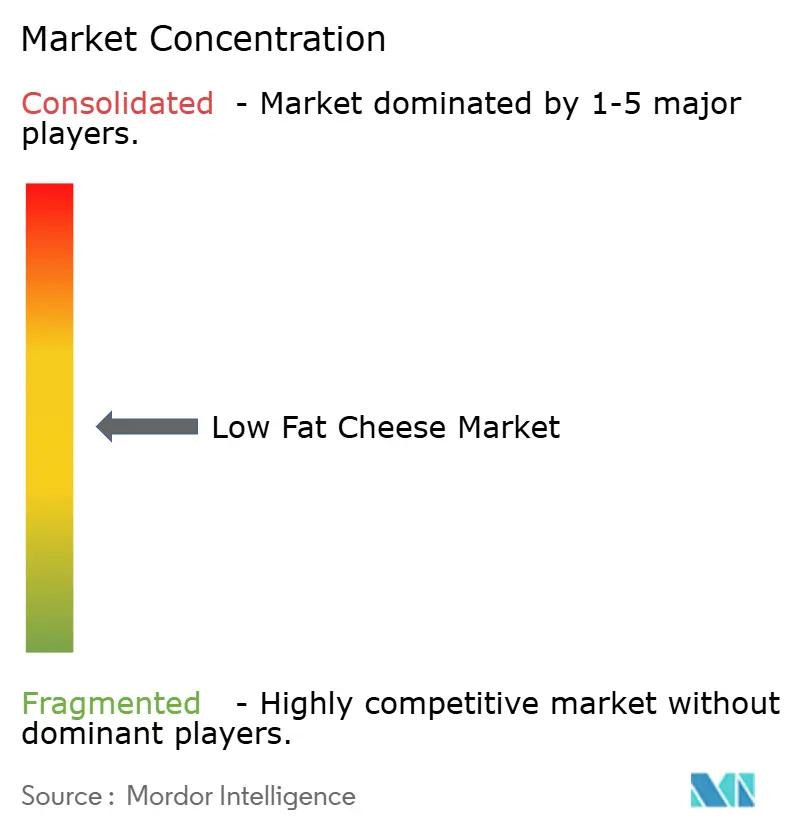
The low-fat cheese market is moderately consolidated, with a few multinational dairy companies competing alongside regional cheese manufacturers and private-label producers. Large companies benefit from extensive manufacturing capabilities, established distribution networks, and strong brand recognition, while regional players compete by offering locally produced, specialty, and value-oriented products. Product quality, pricing, innovation, and retail presence are the primary competitive factors across the market.
Major players, including Lactalis Group, Kraft Heinz, Inc., Arla Foods, Saputo Inc., and Bel Group, are strengthening their market positions through product innovation, portfolio expansion, and investment in healthier dairy offerings. Companies are introducing new low-fat cheese varieties with improved taste, texture, and nutritional profiles while expanding into high-protein, lactose-free, and specialty cheese segments to address evolving consumer preferences. Strategic partnerships, production capacity expansions, and broader retail distribution continue to support their competitive positioning across global markets.
The market is also seeing increasing participation from regional dairy companies and private-label brands expanding their low-fat cheese portfolios to capture growing consumer demand for healthier dairy products. Manufacturers are focusing on premium formulations, clean-label ingredients, convenient packaging formats, and specialty cheese varieties to differentiate their offerings. Product innovation centered on nutritional value, flavor diversification, and premium positioning is expected to intensify competition and encourage broader product differentiation across the low-fat cheese market.
Low Fat Cheese Industry Leaders
-
Lactalis Group
-
Kraft Heinz, Inc.
-
Arla Foods
-
Saputo Inc.
-
Bel Group
- *Disclaimer: Major Players sorted in no particular order

Recent Industry Developments
- February 2026: Kraft Natural Cheese launched Protein Sticks in Mild Cheddar and Pepper Jack varieties, expanding its reduced-fat cheese offerings with a convenient, high-protein snack format. The products provide 17 grams of protein per serving and contain 50% less fat than Kraft’s traditional cheese varieties, targeting consumers seeking healthier, portable cheese options.
- March 2025: Lactalis UK & Ireland expanded its Lindahls portfolio with the launch of its first protein cheese range, including low-fat Cottage Cheese, Gouda Slices, Greek Cheese, and Quark. The retail range was developed to meet growing consumer demand for high-protein, lower-fat dairy products, strengthening the company's presence in the functional cheese segment.
- September 2024: Cathedral City launched a high-protein, half-fat cheddar range across block, sliced, grated, and mini formats, expanding its reduced-fat cheese portfolio. The products contain 50% less fat than standard cheddar while providing 30g of protein per 100g, targeting health-conscious consumers seeking improved nutrition without compromising on taste.


Global Low Fat Cheese Market Report Scope
The low fat cheese market comprises cheese products with reduced fat content that serve as a healthier alternative to conventional cheese while maintaining nutritional value and functionality. Market growth is driven by increasing consumer preference for healthier dairy products, rising demand for high-protein foods, and continuous product innovation. The market is segmented by product type into cheddar, mozzarella, cottage cheese, cream cheese, parmesan, and others; by fat content into fat-free, reduced-fat, and low-fat; by form into block, sliced, shredded, and others; by distribution channel into supermarkets and hypermarkets, convenience stores, and others; and by geography into North America, Europe, Asia-Pacific, South America, and the Middle East and Africa.
| Cheddar |
| Mozzarella |
| Cottage Cheese |
| Cream Cheese |
| Parmesan |
| Feta |
| Ricotta |
| Other Low-Fat Cheeses |
| Fat-Free |
| Reduced-Fat |
| Low-Fat |
| Block |
| Sliced |
| Shredded |
| Others |
| Supermarkets/Hypermarkets |
| Convenience Stores |
| Specialty Stores |
| Online Retail Stores |
| Other Distribution Channels |
| North America | United States |
| Canada | |
| Mexico | |
| Rest of North America | |
| Europe | Germany |
| United Kingdom | |
| Italy | |
| France | |
| Spain | |
| Netherlands | |
| Poland | |
| Belgium | |
| Sweden | |
| Rest of Europe | |
| Asia-Pacific | China |
| India | |
| Japan | |
| Australia | |
| Indonesia | |
| South Korea | |
| Thailand | |
| Singapore | |
| Rest of Asia-Pacific | |
| South America | Brazil |
| Argentina | |
| Colombia | |
| Chile | |
| Peru | |
| Rest of South America | |
| Middle East and Africa | South Africa |
| Saudi Arabia | |
| United Arab Emirates | |
| Nigeria | |
| Egypt | |
| Morocco | |
| Turkey | |
| Rest of Middle East and Africa |
| By Product Type | Cheddar | |
| Mozzarella | ||
| Cottage Cheese | ||
| Cream Cheese | ||
| Parmesan | ||
| Feta | ||
| Ricotta | ||
| Other Low-Fat Cheeses | ||
| By Fat Content | Fat-Free | |
| Reduced-Fat | ||
| Low-Fat | ||
| By Form | Block | |
| Sliced | ||
| Shredded | ||
| Others | ||
| By Distribution Channel | Supermarkets/Hypermarkets | |
| Convenience Stores | ||
| Specialty Stores | ||
| Online Retail Stores | ||
| Other Distribution Channels | ||
| By Geography | North America | United States |
| Canada | ||
| Mexico | ||
| Rest of North America | ||
| Europe | Germany | |
| United Kingdom | ||
| Italy | ||
| France | ||
| Spain | ||
| Netherlands | ||
| Poland | ||
| Belgium | ||
| Sweden | ||
| Rest of Europe | ||
| Asia-Pacific | China | |
| India | ||
| Japan | ||
| Australia | ||
| Indonesia | ||
| South Korea | ||
| Thailand | ||
| Singapore | ||
| Rest of Asia-Pacific | ||
| South America | Brazil | |
| Argentina | ||
| Colombia | ||
| Chile | ||
| Peru | ||
| Rest of South America | ||
| Middle East and Africa | South Africa | |
| Saudi Arabia | ||
| United Arab Emirates | ||
| Nigeria | ||
| Egypt | ||
| Morocco | ||
| Turkey | ||
| Rest of Middle East and Africa | ||


Key Questions Answered in the Report
What is the forecast for the low fat cheese market through 2031?
The category is projected to rise from USD 22.62 billion in 2026 to USD 27.91 billion by 2031, at a 4.29% CAGR. Growth is supported by protein-focused, reduced-fat, lactose-free, and convenient dairy formats.
Which low fat cheese product type is growing the fastest?
Cottage cheese is forecast to grow at a 5.65% CAGR from 2026 to 2031, supported by protein-focused demand and broader consumer use.
Which fat-content category has the largest position?
Low-fat cheese held 58.24% of category value in 2025, while fat-free cheese is forecast to grow faster at a 5.72% CAGR.
Which region offers the strongest growth outlook?
Asia-Pacific is forecast to expand at a 5.85% CAGR from 2026 to 2031 as cold-chain capacity and online retail develop. North America remained the largest region, with 37.46% share in 2025.
Page last updated on:





