
Loop-mediated Isothermal Amplification Market Size and Share
Market Overview
| Study Period | 2020 - 2031 |
|---|---|
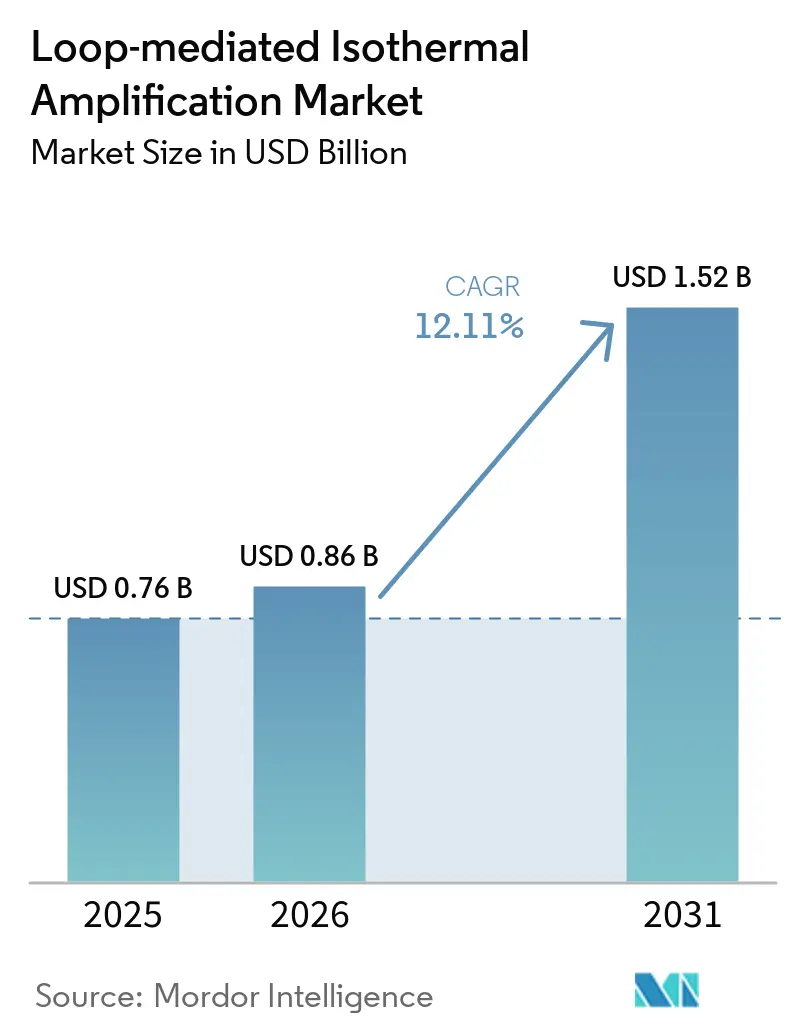
| Market Size (2026) | USD 0.86 Billion |
| Market Size (2031) | USD 1.52 Billion |
| Growth Rate (2026 - 2031) | 12.11 % |
| Fastest Growing Market | Asia-Pacific |
| Largest Market | North America |
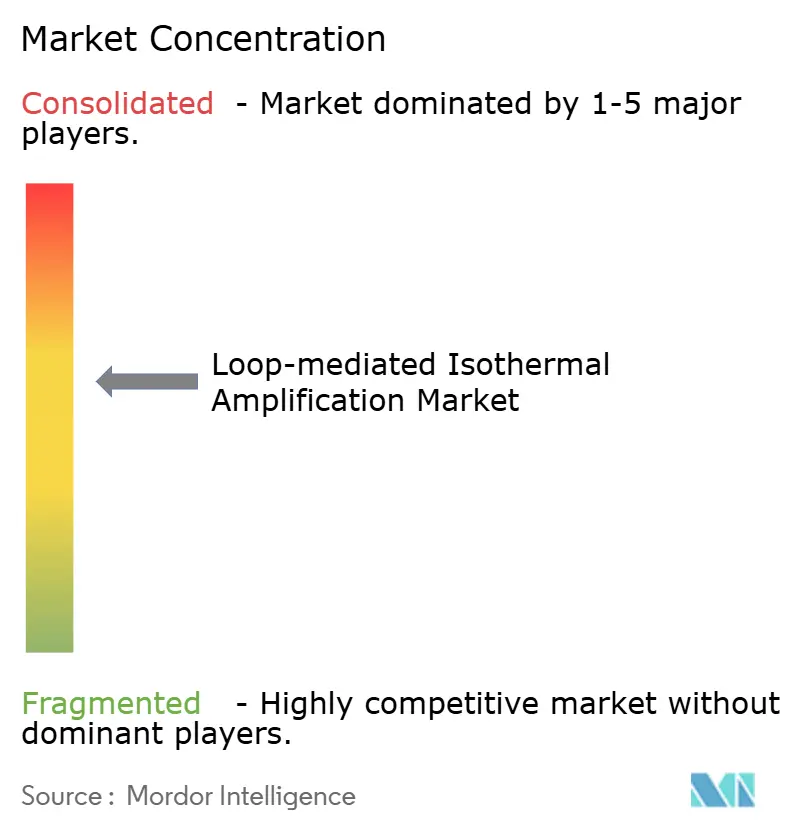
| Market Concentration | Medium |
Major Players *Disclaimer: Major Players sorted in no particular order Image © Mordor Intelligence. Reuse requires attribution under CC BY 4.0. | |
Loop-mediated Isothermal Amplification Market Analysis by Mordor Intelligence
The Loop-mediated Isothermal Amplification Market size is expected to increase from USD 0.76 billion in 2025 to USD 0.86 billion in 2026 and reach USD 1.52 billion by 2031, growing at a CAGR of 12.11% over 2026-2031.
Loop-mediated isothermal amplification amplifies nucleic acids at a constant temperature, which removes the need for thermal cycling equipment. The method can produce results within 15 to 60 minutes, and supports use outside centralized laboratories. FDA-authorized LAMP-based microbial tests showed that the method had moved beyond early research use in clinical diagnostics by 2025. Healthcare providers are seeking molecular tests that support timely treatment decisions and decentralized service delivery. These conditions support opportunities for established diagnostics suppliers and specialist platform developers in the loop-mediated isothermal amplification market.
Key Report Takeaways
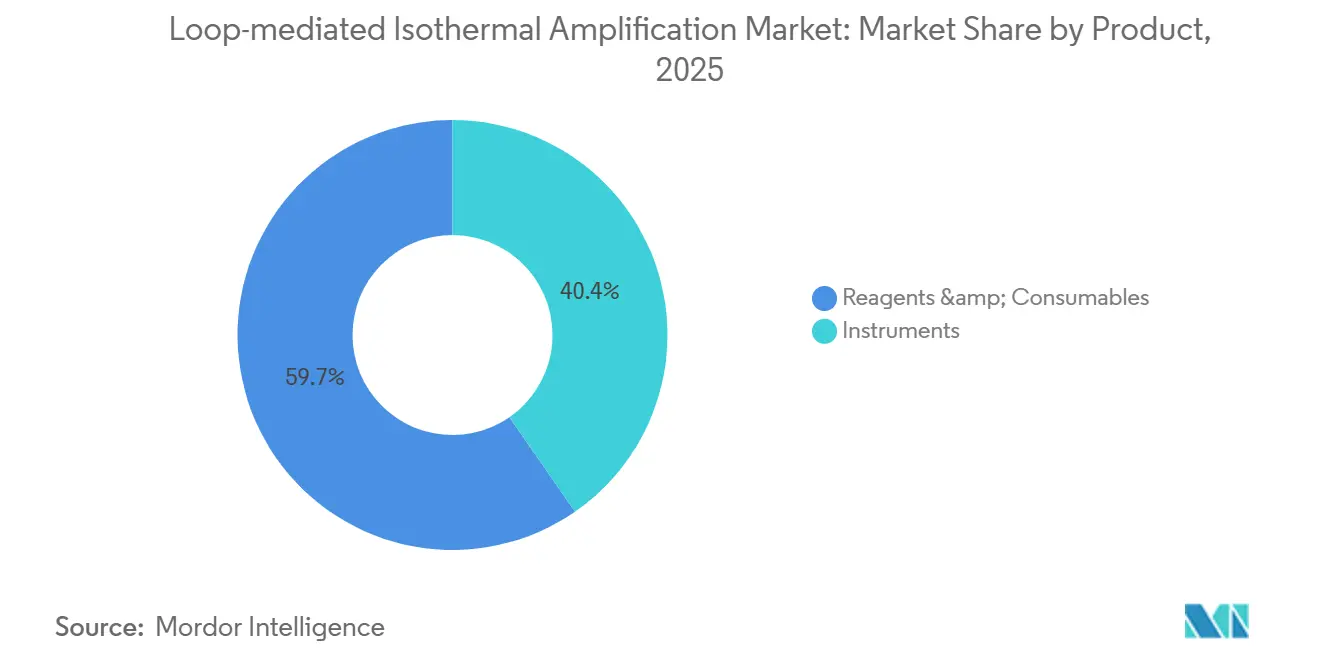
- By product, reagents and consumables held 59.65% of the loop-mediated isothermal amplification market share in 2025, while the instruments segment is projected to grow at a CAGR of 14.65% through 2031.
- By technology, microfluidic technology held 63.65% of the loop-mediated isothermal amplification market share in 2025, while the advanced infrared optical technology segment is projected to grow at a CAGR of 14.76% through 2031.
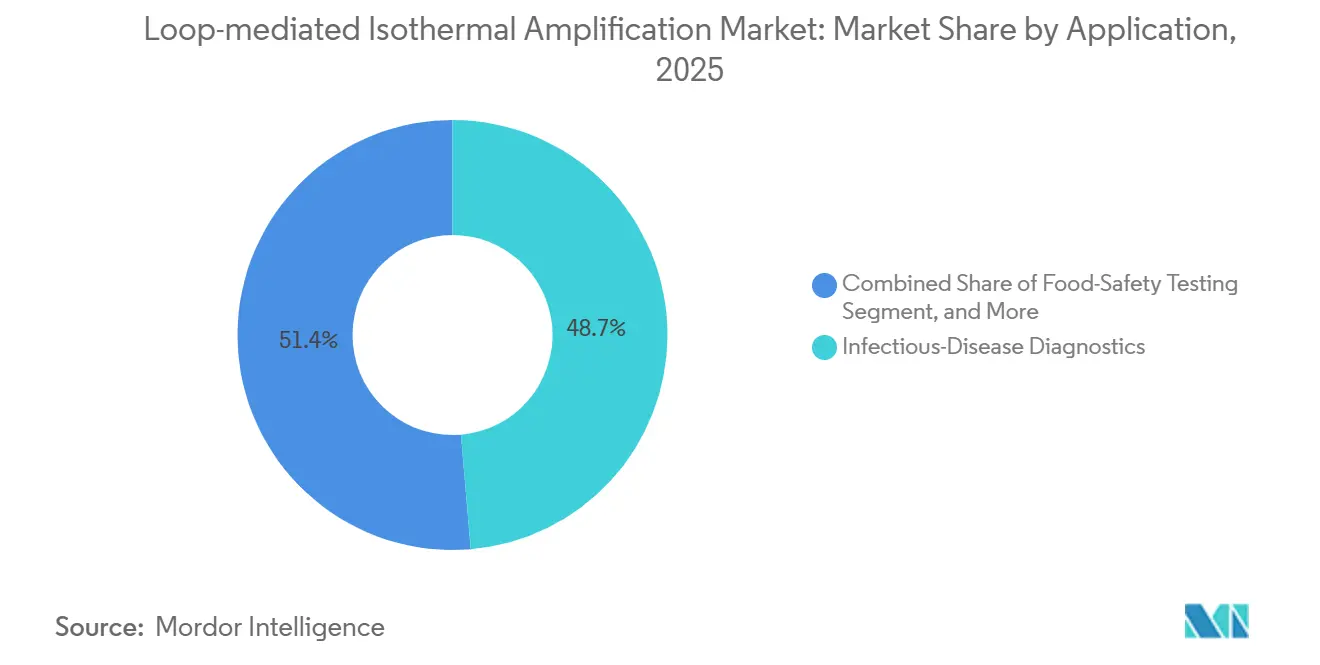
- By application, infectious-disease diagnostics held 48.65% of the loop-mediated isothermal amplification market size in 2025 and is projected to grow at the highest CAGR of 15.98% through 2031.
- By end user, hospitals and clinics held 55.57% of revenue in 2025, while the diagnostic laboratories segment is projected to grow at a CAGR of 15.32% through 2031.
- By geography, North America held 44.28% of revenue in 2025, while Asia-Pacific is projected to grow at a CAGR of 13.54% through 2031.
Note: Market size and forecast figures in this report are generated using Mordor Intelligence’s proprietary estimation framework, updated with the latest available data and insights as of January 2026.
Market Trends and Insights
Drivers Impact Analysis of Loop-mediated Isothermal Amplification Market*
| Driver | (~) % Impact on CAGR Forecast | Geographic Relevance | Impact Timeline |
|---|---|---|---|
| Faster Results Than Conventional PCR | +2.50% | Global | Short term (≤ 2 years) |
| Decentralized Infectious-Disease Testing | +3.00% | APAC core, spill-over to MEA and South America | Medium term (2-4 years) |
| Simplified Workflow and Low Infrastructure Requirements | +1.80% | APAC, MEA and South America | Long term (≥ 4 years) |
| Expansion of Food-Safety and Environmental Testing | +1.50% | Global, concentrated in EU, US and China | Medium term (2-4 years) |
| Ambient-Stable Reagent and Cartridge Innovation | +1.20% | Global | Short term (≤ 2 years) |
| CRISPR, Microfluidic, and Smartphone-Enabled Assay Integration | +0.02 | North America and EU, with spill-over to APAC | Long term (≥ 4 years) |
| Source: Mordor Intelligence | |||
Faster Results Than Conventional PCR
LAMP can return positive results within 15 to 30 minutes at a fixed 60 to 65°C. Conventional qPCR can require 60 to 90 minutes because it uses repeated thermal cycling steps. Thermo Fisher described a lyo-ready Bst polymerase that supported detection in under 10 minutes under its stated conditions[1]. Faster pathogen identification can shorten the period of empirical antibiotic prescribing in hospitals. This makes the loop-mediated isothermal amplification market relevant to antimicrobial stewardship programs and physician office testing. The 30 FDA-authorized microbial LAMP tests cataloged in 2025 also provide a regulatory precedent for later assays.
Decentralized Infectious-Disease Testing
Many health facilities lack the infrastructure needed to operate conventional PCR systems. LAMP platforms can be used where laboratory space, trained operators, or stable grid power are limited. Eiken Chemical presented a solar-powered, battery-operated Malaria-LAMP instrument that produces results in 1.5 hours without grid electricity. This configuration supports use at community health posts in high-burden infectious disease settings. Distributed testing infrastructure can also support preparedness programs that need testing closer to affected populations. These operating conditions broaden the addressable settings for the loop-mediated isothermal amplification market.
Simplified Workflow and Low Infrastructure Requirements
LAMP uses a constant-temperature reaction rather than a thermocycling process. This can reduce equipment requirements at locations that cannot support a conventional molecular laboratory. Sealed workflows can limit handling steps and reduce the need for specialized operators. The resulting format is suited to clinics, agricultural testing stations, and field surveillance programs. Eiken Chemical’s LAMP product portfolio includes applications intended for infectious-disease testing in these settings. Lower infrastructure requirements can support wider adoption of the loop-mediated isothermal amplification market in resource-limited regions.
Expansion of Food-Safety and Environmental Testing
Colorimetric LAMP readouts can be used without fluorescence readers or specialized laboratory staff. This enables pathogen testing at food facilities, ports of entry, farms, and inspection sites. A 2025 study detected 4 major foodborne pathogens in meat samples and reported detection limits as low as 18 CFU/mL. The study also reported 100% accuracy across 52 meat and meat product samples. Separate 2025 research described a field-deployable LAMP workflow for detecting Yersinia in water matrices. These applications extend the loop-mediated isothermal amplification market beyond human clinical testing.
Restraints Impact Analysis of Loop-mediated Isothermal Amplification Market*
| Restraint | (~) % Impact on CAGR Forecast | Geographic Relevance | Impact Timeline |
|---|---|---|---|
| PCR Switching Costs and Established Laboratory Workflows | -1.50% | North America and Europe | Medium term (2-4 years) |
| Reimbursement and Evidence Gaps for Decentralized Testing | -1.20% | Global, excluding US where CPT 87426 applies | Medium term (2-4 years) |
| Primer-Design Complexity and False-Positive Control | -0.80% | Global | Short term (≤ 2 years) |
| Bst Polymerase Supply and Licensing Exposure | -0.60% | Global, with LMIC markets most exposed | Medium term (2-4 years) |
| Source: Mordor Intelligence | |||
PCR Switching Costs and Established Laboratory Workflows
High-volume clinical laboratories have established PCR workflows, validation procedures, and operator training. Moving to LAMP can require new primer libraries and revised quality documentation. Laboratories may also need to validate results against their existing PCR reference methods. Large qPCR platforms often carry multiyear service agreements that discourage mid-cycle replacement. The barrier is strongest in centralized laboratories, where LAMP has a smaller operational advantage. This can slow uptake in the loop-mediated isothermal amplification market across North America and Europe.
Reimbursement and Evidence Gaps for Decentralized Testing
Reimbursement for decentralized LAMP testing remains uneven outside the United States. The draft cited Medicare payment under CPT code 87426 at USD 50 to USD 100 per test. Public procurement in low- and middle-income countries often emphasizes unit cost over workflow value. This can limit adoption of premium platforms despite demonstrated clinical utility. Manufacturers may then have fewer post-market data sets to support broader payer and regulatory acceptance. The coverage gap remains a constraint on the loop-mediated isothermal amplification market.
*Our forecasts treat driver/restraint impacts as directional, not additive. The impact forecasts reflect baseline growth, mix effects, and variable interactions.
Loop-mediated Isothermal Amplification Market Segment Analysis
By Product:
Consumables Sustain Revenue While Instruments Signal Platform MaturityReagents and consumables held 59.65% of product revenue in 2025. This share reflects the recurring purchase pattern that follows instrument placement. Each installed instrument can generate repeat demand for enzymes, master mixes, cartridges, and other assay materials. This makes reagent supply relationships important for suppliers serving hospitals and diagnostic laboratories. Meridian Bioscience offered lyo-ready and air-dryable LAMP master mixes that combine polymerase, buffer, dNTPs, and compatible excipients. Such materials can support ambient-stable workflows and reduce cold-chain requirements. Thermo Fisher’s glycerol-free lyo-ready Bst polymerase was positioned for microfluidic-compatible assays. These features support continued reagent demand within the loop-mediated isothermal amplification market. The product mix gives established reagent suppliers a durable position after instrument sales are completed.
Instruments are projected to grow at a CAGR of 14.65% from 2026 to 2031. The loop-mediated isothermal amplification market size for instruments is supported by compact fluorescence optics, infrared heating, and connected readouts. Manufacturers are integrating Bluetooth and Wi-Fi functions into smaller devices for point-of-care use. Compact systems can reduce physical space requirements while preserving analytical capability. ISO 13485 and the EU In Vitro Diagnostic Regulation create meaningful entry requirements for device suppliers. These requirements favor companies that can support validation, documentation, and quality systems. Laboratories also seek to expand molecular menus without the higher initial commitment associated with qPCR platforms. Growth in instruments therefore complements rather than displaces recurring consumables demand. The two product categories create separate routes to value in the loop-mediated isothermal amplification market.
By Technology:
Microfluidics Dominates While Infrared Optics Opens the Next Growth FrontierMicrofluidic technology held 63.65% of technology revenue in 2025. Its share reflects the ability to combine sample loading, amplification, and signal detection in a sealed cartridge. A closed cartridge can reduce contamination risk and lower the amount of operator handling. These benefits are important for clinical laboratories assessing decentralized testing methods. A 2025 portable device combined RT-qPCR and RT-LAMP with passive flow control in a compact format. The reported workflow reduced total assay time to 42 minutes and maintained equivalent quantitative accuracy. Microfluidics also supports a smaller instrument footprint than conventional qPCR systems. This technology base supports the largest portion of the loop-mediated isothermal amplification market. It remains important for sample-to-answer workflows that must be simple and contained.
Advanced infrared optical technology is projected to grow at a CAGR of 14.76% from 2026 to 2031. Noncontact infrared heating can avoid precision-machined heating blocks and reduce power use. It can also control temperature in sealed reaction chambers without physical contact. This design can reduce aerosol contamination risk in decentralized settings. A 2026 chip combined aerosol sampling with LAMP-CRISPR infrared detection for airborne virus surveillance in 85 minutes. The example linked infrared-enabled testing with biosecurity and environmental monitoring. Smartphone-readable fluorescence channels may widen access where conventional fluorescence readers are unavailable. These attributes support future technology choices in the loop-mediated isothermal amplification market. Modern microsystem technology also remains relevant for paper-based and printed circuit board formats that seek lower fabrication costs.
By Application:
Infectious-Disease Diagnostics Leads on Both Volume and VelocityInfectious-disease diagnostics held 48.65% of application revenue in 2025. The segment is also projected to grow at a CAGR of 15.98% through 2031. Respiratory viruses, sexually transmitted infections, tuberculosis, malaria, and neglected tropical diseases all support the breadth of current LAMP development. A 2026 LAMP-lateral-flow dipstick study reported SARS-CoV-2 detection across N and ORF1ab genes within 30 minutes[2]. It reported a limit of detection of 18.92 copies per µL without fluorescence instrumentation. These formats can support use in decentralized clinical settings that need simple result interpretation. The application’s breadth supports the largest share of the loop-mediated isothermal amplification market. The dual position in volume and growth reflects the immediate need for accessible molecular infectious-disease testing.
Food-safety testing and veterinary diagnostics provide adjacent uses for LAMP technology. Salmonella serotyping workflows can support testing closer to poultry production and agricultural sites. A 2024 study described detection and serotyping for relevant Salmonella strains in environmental poultry flock samples. These applications can reduce dependence on centralized sequencing for some initial testing needs. Oncology and genetic testing remained the smallest application area in the supplied draft. Genomtec’s OncoSNAAT work indicated interest in isothermal detection of single-nucleotide variants. Its government-supported work also covered AI-assisted development of diagnostic platforms. Turnaround time and workflow simplicity are particularly relevant in these potential applications. The loop-mediated isothermal amplification market can therefore extend into settings that value rapid molecular results.

By End User:
Hospitals Drive Volume While Diagnostic Laboratories Absorb New Product LaunchesHospitals and clinics held 55.87% of end-user revenue in 2025. Their position reflects broad infectious-disease testing needs across inpatient wards and emergency departments. Institutional purchasing agreements can also support larger instrument procurement volumes. Hospitals need testing systems that can respond to respiratory, bloodstream, and other urgent pathogen questions. Point-of-care clinics and research institutes also contribute to the demand for accessible LAMP chemistry. The supplied draft noted reported reaction costs of USD 0.21 for home-brewed Bst large-fragment polymerase. That finding indicated how low-cost chemistry could support academic and lower-income settings[3]. Agricultural stations and veterinary reference laboratories add further demand as assay menus expand. These end users support the established volume base of the loop-mediated isothermal amplification market.
Diagnostic laboratories are projected to grow at a CAGR of 15.32% from 2026 to 2031. Independent networks can use LAMP platforms to expand molecular menus without thermal cycler capital costs. This allows laboratories to consider assays for urogenital, respiratory, wound, and antimicrobial-resistance testing. The draft reported that Pro-Lab Diagnostics USA launched its Pro-AMP platform in July 2026 for qualified physician offices and high-complexity laboratory settings. The platform was configured as an isothermal nucleic acid amplification system. Reimbursement visibility remains important when operators decide whether to add new test menus. U.S. coverage developments may improve the commercial case for qualifying devices. Faster laboratory adoption would increase demand for connected instruments and recurring assay materials. This supports the fastest end-user growth outlook within the loop-mediated isothermal amplification market.
Geography Analysis
North America and Europe Loop-mediated Isothermal Amplification Market
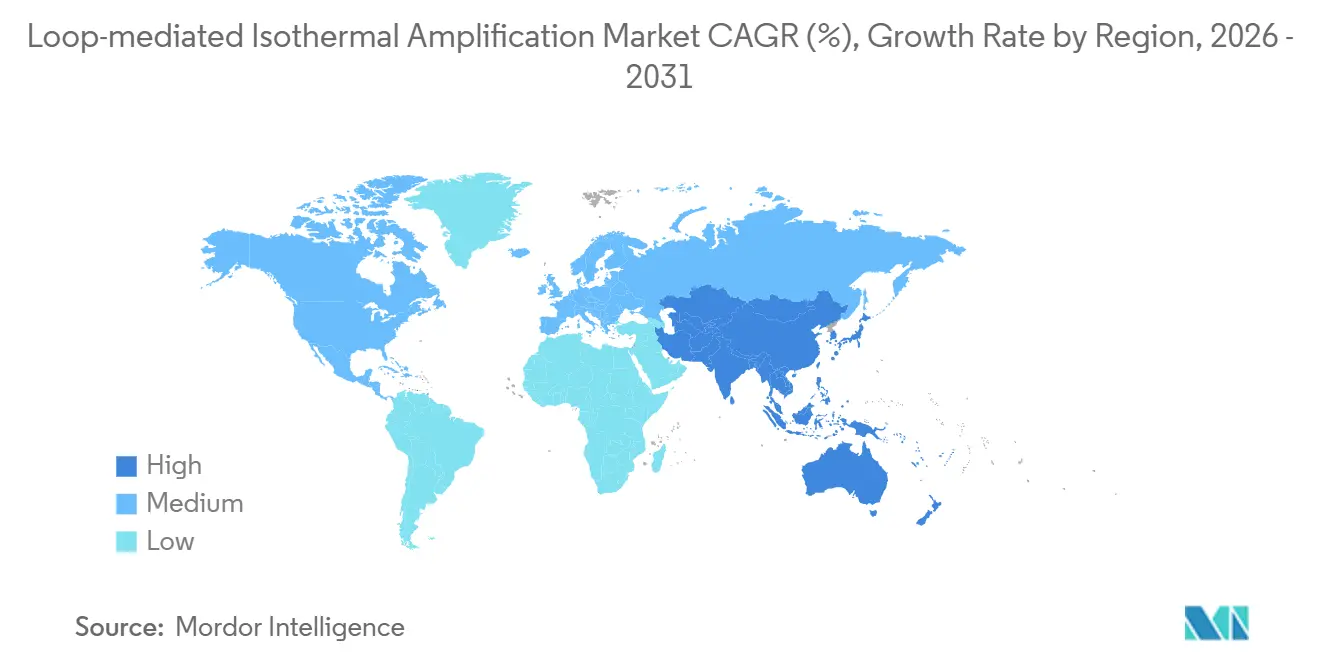
North America held 44.28% of global revenue in 2025, the largest regional share. The region has a dense network of CLIA-certified laboratories and an established molecular diagnostics infrastructure. The supplied draft identified CPT code 87426 as a clear public-payer signal for qualifying infectious-agent testing. The United States anchors regional demand, while Canada and Mexico are integrating point-of-care testing for tuberculosis and respiratory surveillance. The July 2026 Pro-AMP launch described in the supplied draft indicated continued interest in physician office laboratory settings. Europe remained the second-largest region, led by Germany, the United Kingdom, and France. The EU IVDR cycle has encouraged portfolio updates and compliance-led market access. bioMérieux received IVDR CE marking for BIOFIRE SPOTFIRE respiratory panels in March 2026. These dynamics sustain established demand in the loop-mediated isothermal amplification market.
APAC Loop-mediated Isothermal Amplification Market
Asia-Pacific is projected to grow at a CAGR of 13.54% from 2026 to 2031. China’s IVD manufacturing capacity, India's decentralized testing programs, and Japan’s approval processes shape regional demand. Eiken Chemical is the original LAMP patent holder and demonstrated Malaria-LAMP implementation in the region during June 2026. The platform’s solar-powered design supports locations without reliable grid electricity. The supplied draft also described Molbio Diagnostics’ plans to expand its disease panel across infectious and veterinary applications. India’s CDSCO rules and China’s Class III IVD pathway influence product entry and validation requirements. These regulatory conditions can support wider use of compliant devices and assays. Asia-Pacific, therefore, provides the strongest regional growth outlook for the loop-mediated isothermal amplification market.
MEA and South America Loop-mediated Isothermal Amplification Market
The Middle East, Africa, and South America are smaller regional markets with distinct operational needs. Cold-chain-free reagents and solar-compatible instruments can be suitable for African testing settings with infrastructure constraints. Eiken Chemical’s TB-LAMP received WHO support in the supplied draft, providing a relevant validation pathway for high-burden infectious disease testing. GCC countries are investing in domestic diagnostics capacity, creating opportunities for suppliers with localization capabilities. Brazil, Argentina, and Mexico provide key South American demand centers as district-level laboratory capacity expands. Regional surveillance programs can increase demand for molecular testing closer to communities. These factors create longer-term openings for the loop-mediated isothermal amplification market.
Competitive Landscape
The loop-mediated isothermal amplification market has moderate concentration. bioMérieux, Thermo Fisher Scientific, Becton Dickinson, and Abbott Laboratories have established reagent supply chains and commercial channels. Their integrated instrument and reagent approaches can support customer retention. Eiken Chemical’s foundational patents create an additional source of intellectual-property leverage. Commercial LAMP use requires an appropriate license, while some enzyme purchases carry limited research-use rights. This structure makes reagent access and licensing important to platform developers. The supplied draft identified specialist companies including Genomtec, OptiGene, HiberGene, Atila BioSystems, and Molbio Diagnostics. These companies focus on platforms tailored to decentralized and resource-limited testing needs.
Established companies are using portfolio and compliance strategies to maintain access to regulated markets. bioMérieux obtained IVDR CE marking for its BIOFIRE SPOTFIRE R/STplus Panel and R/STplus Panel Mini in March 2026. Thermo Fisher supplies lyo-ready enzyme components that support OEM assay development. OptiGene launched Novus in April 2026 for on-site DNA and RNA detection across agriculture, animal health, food security, and biosecurity. These moves show that suppliers are pursuing both clinical and nonclinical workflows. Competitive pressure is strongest in respiratory diagnostics and food-safety pathogen testing. Overlapping primer sets and regulatory submissions can limit pricing power in these applications.
Genomtec received funding for AI-assisted primer design and broader platform commercialization in June 2026. It also received its 21st worldwide patent decision in July 2026 for a bacterial STI detection assay. These actions focus on assay development tools and intellectual property. CRISPR-coupled LAMP remains an important technical direction for multiplexed detection. The first cleared platforms with reliable multiplex performance could change the competition with qPCR in hospital testing. The available evidence supports moderate concentration, with established suppliers holding important channel, reagent, and intellectual-property positions.
Loop-mediated Isothermal Amplification Industry Leaders
-
Eiken Chemical Co., Ltd.
-
Meridian Bioscience, Inc.
-
New England Biolabs, Inc.
-
OptiGene Limited
-
Molbio Diagnostics Pvt. Ltd.
- *Disclaimer: Major Players sorted in no particular order
Loop-mediated Isothermal Amplification Market Companies Covered in this Report
- Abbott Laboratories
- Atila BioSystems, Inc.
- Beckton Dickinson
- Canon
- DiaSorin
- Fujirebio Holdings, Inc.
- Genomtec S.A.
- HiberGene Diagnostics Limited
- IQGEN N.V.
- Lucigen
- Mast Group Ltd.
- Meridian Bioscience, Inc.
- NIPPON GENE CO., LTD.
- New England Biolabs
- OptiGene
- QuidelOrtho
- Sysmex
- Thermo Fisher Scientific
- Ustar Biotechnologies (Hangzhou) Ltd.
Recent Industry Developments in Loop-mediated Isothermal Amplification Market
- July 2026: Genomtec (Poland) received a USPTO decision granting its 21st worldwide patent, covering an LAMP-based assay for bacterial STI detection; the company simultaneously holds over 30 patent proceedings across key international markets, including European patents for proprietary primer-design methods and non-contact heating technology.
- June 2026: Genomtec secured EUR 9 million-plus in total available funding, comprising EUR 2.6 million in new equity financing and a EUR 1.65 million AI-focused project grant from the Lower Silesian Intermediate Body, to advance commercialization of its diagnostics platforms and automate LAMP-based primer design through artificial intelligence, significantly compressing assay development timelines.
- March 2026: bioMérieux received IVDR CE-marking for its BIOFIRE SPOTFIRE R/STplus Panel and the new R/STplus Panel Mini, enabling near-patient multiplex respiratory diagnostics for influenza, RSV, SARS-CoV-2, and human rhinovirus/enterovirus across Europe; commercial availability confirmed for Q2 2026 in CE-recognizing countries.
- April 2026: OptiGene (UK) launched Novus, a next-generation molecular diagnostics platform for rapid, one-step, on-site DNA and RNA detection, targeting agriculture, animal health, food security, food authenticity, and biosecurity end users; the platform reduces liquid-handling complexity relative to laboratory-based molecular methods.
Global Loop-mediated Isothermal Amplification Market Report Scope
According to the report’s scope, loop-mediated isothermal amplification (LAMP) is a rapid, highly specific nucleic acid amplification technique that amplifies DNA at a constant temperature. It is widely used for molecular diagnostics due to its simplicity and quick results.
The loop-mediated isothermal amplification market is segmented into product, technology, application, end user, and geography. By product, the market is segmented into instruments and reagents & consumables. By technology, the market is segmented into microfluidic technology, advanced infrared optical technology, modern microsystem technology, and other technologies. By application, the market is segmented into infectious-disease diagnostics, food-safety testing, veterinary diagnostics, and oncology and genetic testing. By end user, the market is segmented into hospitals and clinics, diagnostic laboratories, point-of-care and decentralized clinics, research and academic institutes, and other end users. By geography, the market is segmented into North America, Europe, Asia-Pacific, the Middle East and Africa, and South America. The report also covers the estimated market sizes and trends for 17 countries across major regions globally. The report offers values (USD) for all the above segments.
Segmentation Overview
| Instruments |
| Reagents & Consumables |
| Microfluidic Technology |
| Advanced Infrared Optical Technology |
| Modern Microsystem Technology |
| Other Technologies |
| Infectious-Disease Diagnostics |
| Food-Safety Testing |
| Veterinary Diagnostics |
| Oncology and Genetic Testing |
| Hospitals and Clinics |
| Diagnostic Laboratories |
| Point-of-Care and Decentralized Clinics |
| Research and Academic Institutes |
| Other End Users |
| North America | United States |
| Canada | |
| Mexico | |
| Europe | Germany |
| United Kingdom | |
| France | |
| Italy | |
| Spain | |
| Rest of Europe | |
| Asia-Pacific | China |
| Japan | |
| India | |
| Australia | |
| South Korea | |
| Rest of Asia-Pacific | |
| Middle East and Africa | GCC |
| South Africa | |
| Rest of Middle East and Africa | |
| South America | Brazil |
| Argentina | |
| Rest of South America |
| By Product | Instruments | |
| Reagents & Consumables | ||
| By Technology | Microfluidic Technology | |
| Advanced Infrared Optical Technology | ||
| Modern Microsystem Technology | ||
| Other Technologies | ||
| By Application | Infectious-Disease Diagnostics | |
| Food-Safety Testing | ||
| Veterinary Diagnostics | ||
| Oncology and Genetic Testing | ||
| By End User | Hospitals and Clinics | |
| Diagnostic Laboratories | ||
| Point-of-Care and Decentralized Clinics | ||
| Research and Academic Institutes | ||
| Other End Users | ||
| Geography | North America | United States |
| Canada | ||
| Mexico | ||
| Europe | Germany | |
| United Kingdom | ||
| France | ||
| Italy | ||
| Spain | ||
| Rest of Europe | ||
| Asia-Pacific | China | |
| Japan | ||
| India | ||
| Australia | ||
| South Korea | ||
| Rest of Asia-Pacific | ||
| Middle East and Africa | GCC | |
| South Africa | ||
| Rest of Middle East and Africa | ||
| South America | Brazil | |
| Argentina | ||
| Rest of South America | ||
Key Questions Answered in the Report
What will be the forecast value for loop-mediated isothermal amplification market by 2031?
The loop-mediated isothermal amplification market size is expected to increase from USD 0.76 billion in 2025 to USD 0.86 billion in 2026 and reach USD 1.52 billion by 2031, growing at a CAGR of 12.11% over 2026-2031.
Which product category generated the most revenue in 2025?
Reagents and consumables led product revenue with a 59.7% share in 2025.
Which technology is growing fastest?
Advanced infrared optical technology is projected to grow at a 14.8% CAGR through 2031.
Why is infectious-disease testing important for LAMP adoption?
Infectious-disease diagnostics held 48.7% of application revenue in 2025 and recorded a projected 15.0% CAGR through 2031.
Which region is expected to grow fastest through 2031?
Asia-Pacific is projected to grow at a 13.5% CAGR from 2026 to 2031.
What limits broader use of LAMP platforms?
PCR switching costs, uneven reimbursement, primer-design challenges, and polymerase licensing can slow adoption.