
Lithium Iron Phosphate (LFP) Powder Market Size and Share
Market Overview
| Study Period | 2021 - 2031 |
|---|---|
| Market Size (2026) | USD 23.43 Billion |
| Market Size (2031) | USD 46.68 Billion |
| Growth Rate (2026 - 2031) | 14.78 % |
| Fastest Growing Market | Asia-Pacific |
| Largest Market | Asia-Pacific |
| Market Concentration | Medium |
Major Players *Disclaimer: Major Players sorted in no particular order Image © Mordor Intelligence. Reuse requires attribution under CC BY 4.0. | |
Lithium Iron Phosphate (LFP) Powder Market Analysis by Mordor Intelligence
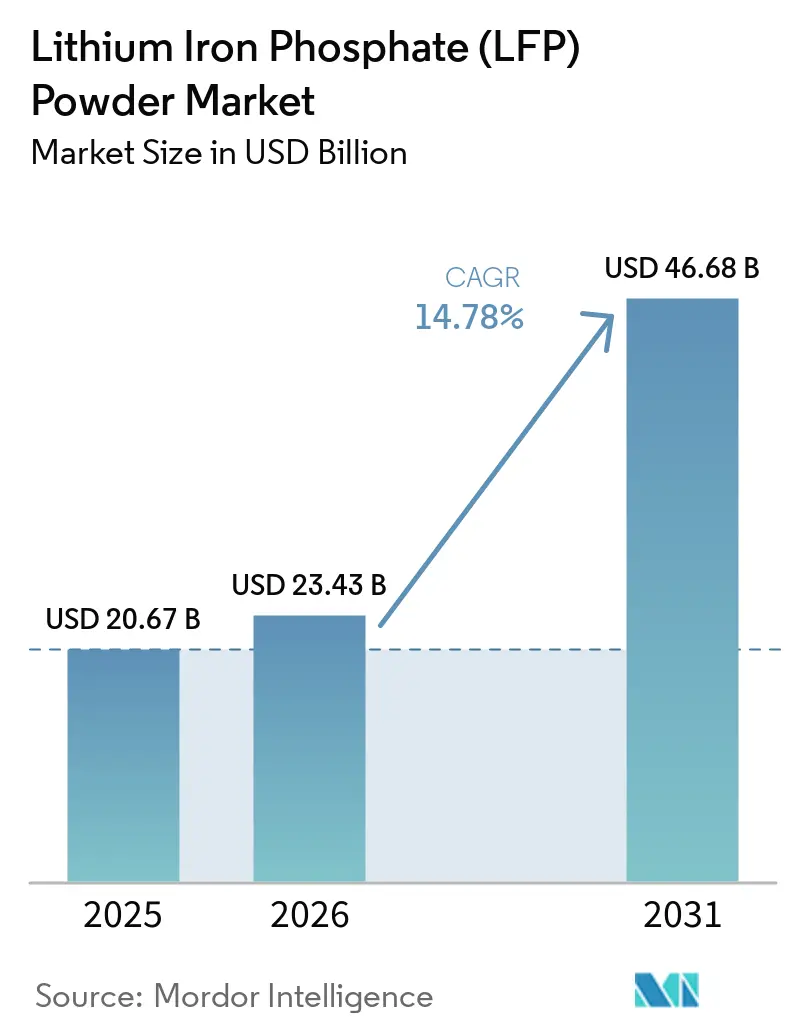
The lithium iron phosphate (LFP) powder market size was estimated at USD 20.67 billion in 2025 and is estimated to grow from USD 23.43 billion in 2026 to USD 46.68 billion by 2031, at a CAGR of 14.78% during the forecast period (2026-2031). The lithium iron phosphate (LFP) powder market is expanding as electric vehicle manufacturers and stationary storage developers draw on the same cathode material supply base, although the product grades they require, purchasing cycles, and delivery schedules can differ substantially. This shared supply base can create allocation pressure when both demand pools increase orders simultaneously, particularly for battery-grade and high-compaction-density products that have already completed cell-maker qualification. Cost remains central because LFP chemistry supports standard-range vehicle programs and large battery energy storage projects without cobalt or nickel, helping buyers manage both purchase cost and supply chain complexity. Procurement practices are also changing as buyers evaluate origin, certification, and process control alongside price, making technical acceptability insufficient without a dependable qualification record and clear supporting documentation. This creates different conditions for Chinese suppliers and for producers seeking to build a qualified supply base outside China, particularly where local policy requirements and customer preferences favor an alternative origin. The LFP powder market therefore depends on the balance between rapidly growing demand, excess standard-grade capacity, the availability of technically consistent premium material, and the pace at which new facilities can complete customer qualification.
Key Report Takeaways
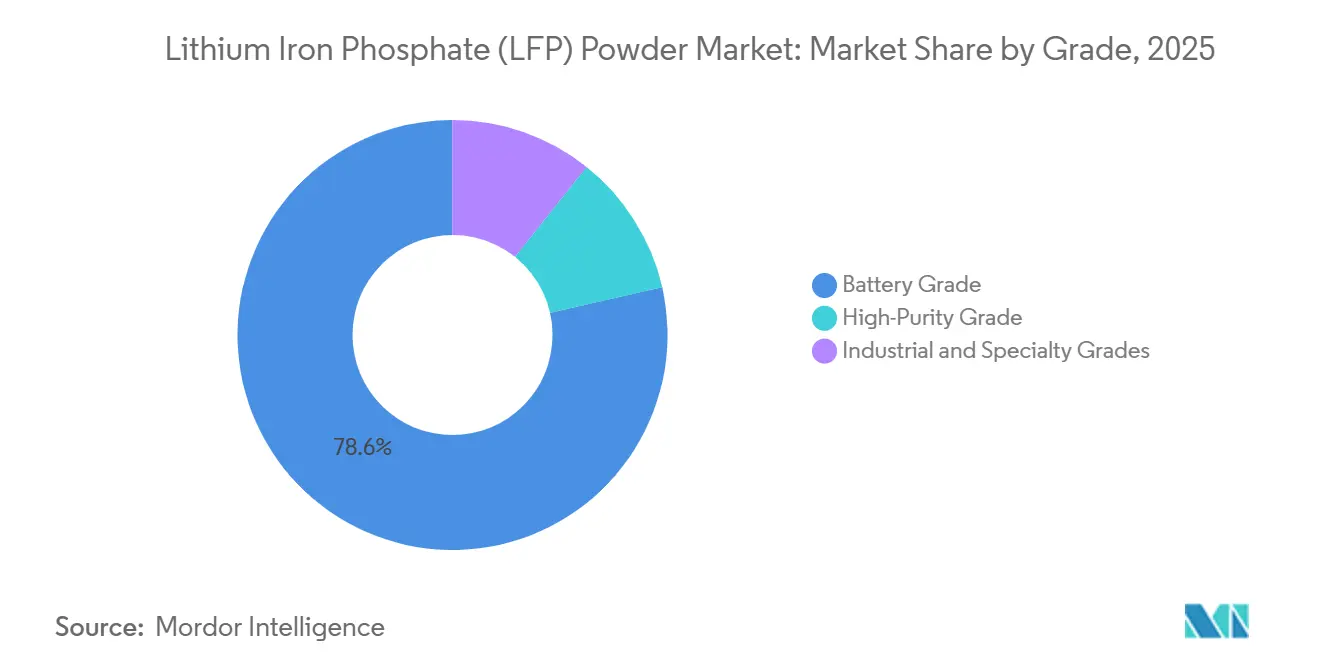
- By grade, battery-grade powder held 78.56% of the lithium iron phosphate (LFP) powder market share in 2025, while industrial and specialty grades are forecast to grow at a 15.34% CAGR through 2031.
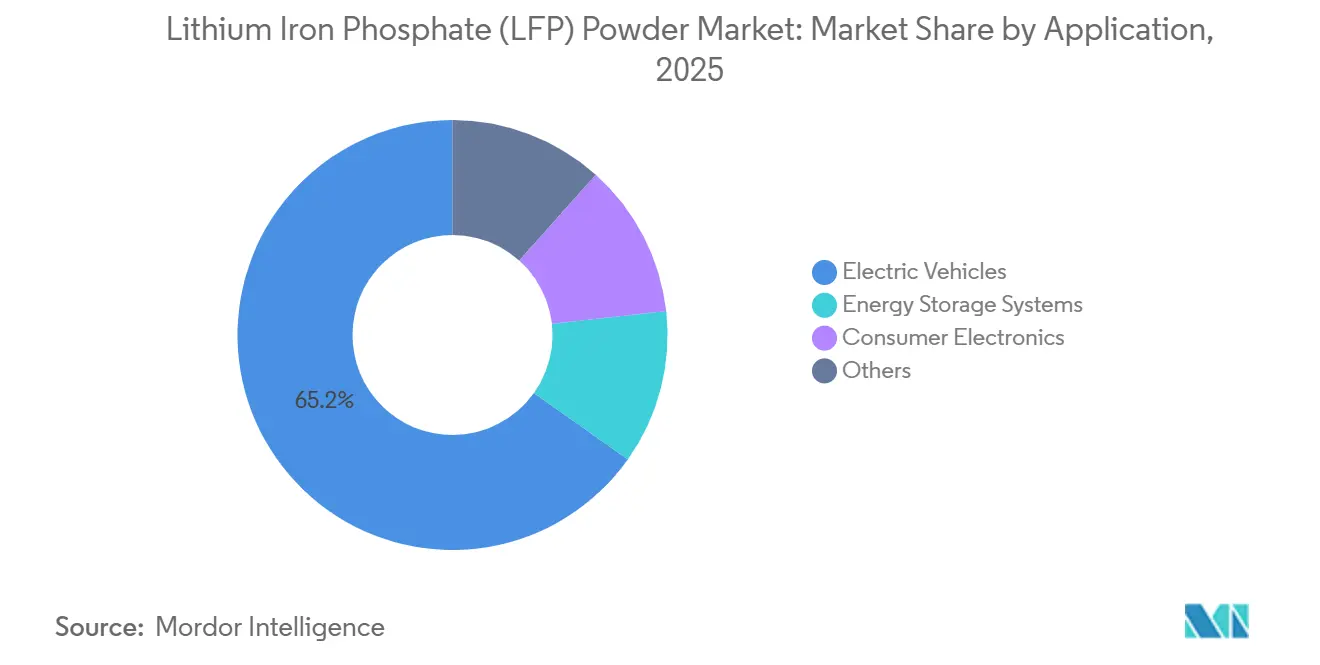
- By application, electric vehicles accounted for 65.17% of the lithium iron phosphate (LFP) powder market share in 2025, while energy storage systems are projected to grow at a 16.62% CAGR through 2031.
- By geography, Asia-Pacific accounted for 66.21% of global revenue in 2025 and is projected to expand at a 15.89% CAGR through 2031.
Note: Market size and forecast figures in this report are generated using Mordor Intelligence’s proprietary estimation framework, updated with the latest available data and insights as of January 2026.
Market Trends and Insights
Drivers Impact Analysis of Lithium Iron Phosphate (LFP) Powder Market*
| Drivers | (~) % Impact on CAGR Forecast | Geographic Relevance | Impact Timeline |
|---|---|---|---|
| Cost-Competitive LFP Adoption in Standard-Range Electric Vehicles | +4.5% | Global, concentrated in China, Europe, and North America | Short term (≤ 2 years) |
| Utility-Scale Storage Deployment for Renewable Integration | +3.0% | Global, with peak intensity in China, the United States, and the Gulf Cooperation Council (GCC) | Short term (≤ 2 years) |
| Cobalt- and Nickel-Reduced Supply-Chain Exposure | +2.0% | Global, with early gains in North America and the European Union | Medium term (2-4 years) |
| China-Origin LFP Qualification as a Benchmark for Globalized Cell Design | +0.8% | Asia-Pacific core, with spillover to North America and Europe | Medium term (2-4 years) |
| Carbon-Coating and Particle-Engineering Improvements | +1.2% | Global, led by Chinese and Korean research centers | Long term (≥ 4 years) |
| Regionalization of Cathode-Material Capacity Outside China | +1.5% | North America, Europe, and South Korea | Long term (≥ 4 years) |
| Source: Mordor Intelligence | |||
Cost-Competitive LFP Adoption in Standard-Range Electric Vehicles
The lithium iron phosphate (LFP) powder market benefits from the lower material cost of LFP chemistry in standard-range electric vehicles, where buyers generally prioritize an accessible vehicle price over the longest available driving range. Automakers use LFP-based variants to support lower-priced vehicle programs and maintain a clear separation from high-range premium models, rather than applying a single battery design across all vehicle classes. This approach is important because high-output vehicle programs require a stable cathode formulation across long production runs, multiple production locations, and varying customer order patterns. Battery-grade powder suppliers must therefore maintain consistent particle morphology, carbon content, sintering performance, moisture control, and impurity levels from batch to batch. Changes to these attributes can require lengthy customer requalification, additional cell testing, and adjustments to manufacturing settings, which can disrupt a buyer's schedule. As more manufacturers standardize LFP use in core vehicle lines, purchasing decisions become more dependent on a supplier's proven process record than on a one-time price offer. The LFP powder market favors suppliers with validated process recipes, reliable output, and established customer relationships.
Utility-Scale Storage Deployment for Renewable Integration
Utility-scale storage is a major demand driver for the LFP powder market because renewable electricity is not always generated when the grid requires it. Solar and wind projects increasingly require storage to provide dispatchable electricity, stabilize supply, and meet grid operating requirements. Storage developers select LFP because its chemistry supports frequent cycling and has an established safety profile for stationary applications operating over extended periods. These projects place particular emphasis on powder tap density, carbon-coating uniformity, particle distribution, and long cycle life, as each property affects the final cell and system design. Producers are adjusting product specifications to meet the requirements of high-compaction-density grades that can support large battery energy storage systems through repeated charge and discharge cycles. Procurement teams are also paying closer attention to whether a supplier can reproduce these characteristics at scale across multi-year delivery programs. Published work on carbon coating and surface modification demonstrates why process control remains important for LFP cathode performance.
Cobalt- and Nickel-Reduced Supply-Chain Exposure
The LFP powder market benefits from a chemistry that does not use cobalt or nickel, two materials that can create additional sourcing and reporting demands in battery supply chains. This reduces exposure to raw-material sourcing concerns relevant to battery procurement, particularly for manufacturers selling into markets with formal supplier due diligence requirements. The OECD due diligence framework has made responsible mineral sourcing a formal procurement consideration for manufacturers and buyers[1]. Iron and phosphate do not eliminate the need for supplier oversight, but they simplify the material composition compared with nickel-rich cathodes and can make disclosure requirements more straightforward. This can make LFP more practical for buyers who need clear supply chain documentation, consistent records, and lower exposure to constrained material flows. Integrated producers can reinforce this advantage by controlling precursor supply, monitoring feedstock quality, and documenting the origin of materials for international customers. These conditions make material traceability part of the product offering rather than a separate administrative exercise.
Regionalization of Cathode-Material Capacity Outside China
The LFP powder market is developing new production capacity outside China as buyers seek more diverse cathode supply and greater confidence in material origin. ICL Group and Shenzhen Dynanonic announced a strategic agreement in January 2025 to establish LFP cathode production for the European battery market. EnergyX and Wildcat Discovery Technologies announced a joint venture for a 15,000-ton commercial LFP cathode manufacturing facility in Texas, scheduled to begin operations in June 2026. The facility commenced operations as planned. These announcements addressed the need for a supply that meets local procurement, certification, and customer qualification requirements. New plants must still undergo extensive qualification before they can supply major cell makers at scale, even after construction and equipment installation are complete. The qualification period preserves the importance of established producers even as new capacity is announced, and allows buyers to assess process consistency over time. It also gives compliant material a clearer commercial role, in which origin and certification requirements directly affect procurement decisions.
Restraints Impact Analysis of Lithium Iron Phosphate (LFP) Powder Market*
| Restraints | (~) % Impact on CAGR Forecast | Geographic Relevance | Impact Timeline |
|---|---|---|---|
| Lower Gravimetric and Volumetric Energy Density Versus Nickel-Rich Cathodes | -2.0% | Global, most acute in the North American and European premium electric vehicle segments | Long term (≥ 4 years) |
| Lithium-Carbonate Price and Mine-Supply Volatility | -1.5% | Global, with China as the price discovery center | Short term (≤ 2 years) |
| Concentration of LFP Processing and Qualification in China | -1.0% | North America and Europe for procurement risk, China for geopolitical risk | Medium term (2-4 years) |
| Particle-Size, Purity, and Carbon-Coating Process-Control Burden | -0.7% | Global, most acute for producers outside China | Long term (≥ 4 years) |
| Source: Mordor Intelligence | |||
Lower Gravimetric and Volumetric Energy Density Versus Nickel-Rich Cathodes
The lithium iron phosphate (LFP) powder market faces limitations in vehicle applications where high energy density is the primary requirement and product design prioritizes maximum range. Long-range passenger vehicles and premium performance models require more range from a limited battery mass and size, which preserves the role of nickel-rich cathodes in those designs. Pack engineering can increase usable space through prismatic and blade-cell formats, improved cell arrangement, and more efficient thermal design. However, it cannot fully overcome the underlying gravimetric limitations of LFP chemistry without altering the basic chemistry that gives LFP its cost and safety advantages. This keeps nickel-rich cathodes relevant in applications where buyers place the highest value on range, acceleration, and compact battery packs. It also means LFP powder suppliers must focus on segments where cost, safety, cycle life, and stable daily operation carry more weight than maximum energy density. This distinction is important because it prevents the LFP powder market from serving every electric vehicle application in the same way.
Lithium-Carbonate Price and Mine-Supply Volatility
Lithium carbonate remains a significant input cost for LFP powder producers, and price movements can alter the economics of cathode processing even when demand remains firm. Price fluctuations can affect processing margins, customer contract discussions, and the timing of inventory purchases. This risk is particularly relevant for suppliers with limited access to secured lithium supply or those that must purchase material during periods of sharp price movement. Long-term offtake arrangements, disciplined inventory planning, and integrated upstream operations can reduce direct exposure to spot-market volatility. Volatile lithium prices can also affect the economics of battery storage projects and vehicle programs, as cell costs remain a significant share of total project or vehicle costs. The lithium iron phosphate (LFP) powder market, therefore, favors producers that can offer technically qualified material, dependable delivery, and predictable input-cost management. This advantage accrues to suppliers with stronger financial capacity and closer coordination between raw material purchasing and cathode sales.
*Our forecasts treat driver/restraint impacts as directional, not additive. The impact forecasts reflect baseline growth, mix effects, and variable interactions.
Lithium Iron Phosphate (LFP) Powder Market Segment Analysis
By Grade:
Battery-Grade Powder Drives Demand, While Specialty Formulations Expand Use CasesBattery-grade material held 78.56% of the lithium iron phosphate (LFP) powder market share in 2025, as electric vehicle and grid-storage cell manufacturers required consistent cathode inputs for large-scale production. This grade supports applications that process large numbers of cells through repeatable manufacturing workflows, where minor variations in material behavior can affect cell yield, cycle life, and production efficiency. Customers evaluate electrochemical uniformity, cycle-life consistency, impurity levels, particle characteristics, and coating quality before approving a supplier. When a powder producer changes a recipe, carbon source, particle profile, or sintering condition, requalification can take months, as the customer must confirm that the revised material performs as expected in its cell design. These requirements strengthen customer retention for suppliers that have demonstrated stable output at scale and can deliver consistent specifications across changing order cycles.
High-purity LFP serves a smaller set of consumer electronics and specialty applications, where end users require a closer match between powder characteristics and equipment performance. These applications include power tools, defense electronics, portable industrial equipment, and other products that require strict contamination control and reliable discharge behavior. Industrial and specialty grades are projected to expand at a 15.34% CAGR from 2026 to 2031, making them the fastest-growing grade category and a viable route for suppliers seeking demand outside large vehicle and storage programs. Marine propulsion, low-speed electric vehicles, telecom backup systems, and data center uninterruptible power supply systems contribute to this demand, as each use case values durability and controlled performance. Research on lithium niobate coatings shows how surface treatments can reduce charge-transfer resistance in LFP cathode materials. These requirements give qualified specialty powder suppliers scope to compete on performance, reliability, and certification rather than scale alone.

By Application:
Electric Vehicles Lead Revenue, While Energy Storage Changes Material RequirementsElectric vehicles accounted for 65.17% of the lithium iron phosphate (LFP) powder market in 2025. Their position reflects sustained demand for standard-range models, the established scale of LFP-based cell production, and the need for manufacturers to offer lower-cost vehicle options. Automakers use this chemistry where cost, safety, durability, and a reliable supply base are more important than maximum driving range. Large vehicle programs also require cathode suppliers to meet strict production consistency, quality assurance, and delivery schedules across multiple batches. This demand structure keeps battery-grade material central to the LFP powder market and makes supplier qualification a significant commercial barrier.
Energy storage systems are projected to grow at a 16.62% CAGR from 2026 to 2031. This application requires materials that can support daily cycling, extended operating periods, and consistent performance in utility-scale systems expected to operate for many years. Contractors evaluate powder tap density, particle quality, and carbon-coating consistency, as these properties influence cathode compaction, cell behavior, and the economics of storage-system design. The emphasis on multi-year system life raises the commercial value of materials that retain capacity through repeated cycles and remain stable under regular operating conditions. Academic research has identified carbon coatings and surface modifications as important approaches to improving LFP cathode behavior. Consumer electronics and other applications, including electric marine equipment, industrial machinery, and 2- and 3-wheelers, provide a smaller but stable demand that can broaden the customer base for different powder grades.
Geography Analysis
APAC Lithium Iron Phosphate (LFP) Powder Market
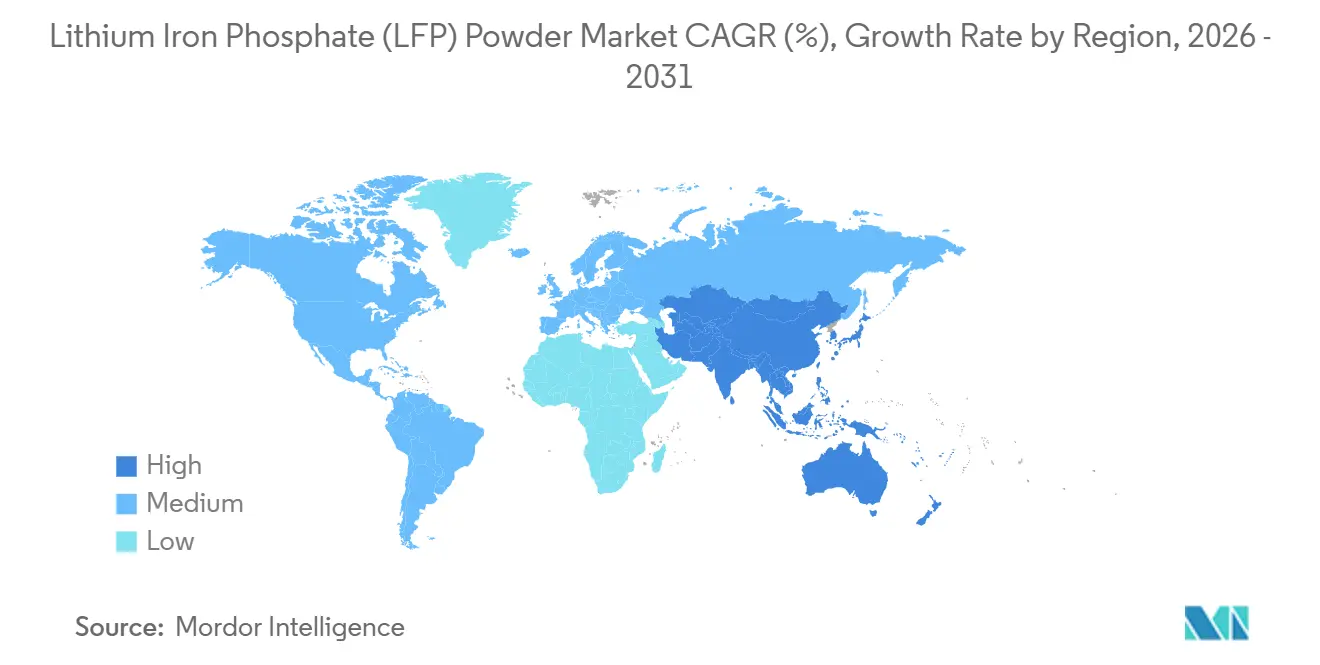
Asia-Pacific held 66.21% of the lithium iron phosphate (LFP) powder market share in 2025 and is forecast to grow at a 15.89% CAGR through 2031. China remains the regional production center due to its integrated supply chain, which spans iron phosphate precursor production, cathode synthesis, and cell assembly, supported by a large LFP battery customer base. This structure enables high output levels, close coordination between cathode producers and cell manufacturers, and faster commercialization of new products. However, it also creates a challenging environment for smaller standard-grade suppliers, as excess capacity can put pressure on margins and limit price competitiveness. Higher-compaction-density LFP materials remain more differentiated, as cell producers require stricter process performance and tighter product specifications. India, Japan, South Korea, and ASEAN countries contribute to regional demand through electric vehicle programs and the deployment of renewable energy storage, though China remains the central manufacturing base.
North America and Europe Lithium Iron Phosphate (LFP) Powder Market
North America is developing a domestic cathode supply base as storage deployment grows and local supply chain requirements increase. The region continues to rely on imported material while planned domestic capacity progresses through construction, process development, and customer qualification. The EnergyX and Wildcat Discovery Technologies joint venture in Texas illustrates efforts to establish commercial LFP cathode production domestically[2]. Europe is similarly pursuing regional supply to support battery manufacturing, reduce procurement risk, and provide cell makers with more sourcing options. The ICL and Dynanonic agreement in Spain reflects an effort to supply European battery customers with locally produced LFP material. Both regions face a gap between announced capacity and the proven process maturity required for sustained cell-customer shipments, making qualification schedules important to their near-term supply outlook.
MEA and South America Lithium Iron Phosphate (LFP) Powder Market
South America holds lithium brine resources in Argentina and Chile, while Brazil has significant phosphate deposits that could support a future regional raw material base. These resources could enable future LFP processing; however, downstream cathode manufacturing remains limited, and the gap between mining or chemical production and qualified powder manufacture is still wide. The Middle-East and Africa are currently smaller demand regions, but renewable energy diversification, off-grid electrification, and the need for reliable backup power are driving interest in stationary storage. Utility-scale projects in the Gulf can generate demand for grid-grade powder even where cathode manufacturing is absent, as projects can procure cells and materials through international supply chains. High-temperature operating conditions also make thermal stability relevant in distributed and community storage settings, where system developers require robust battery performance. South Africa's manganese and iron resources may support upstream material supply, while broader regional electrification can create demand for lower-cost storage technologies. The LFP powder market can therefore find demand beyond its current manufacturing centers where developers prioritize safe, durable storage and local project pipelines reach sufficient scale.
Competitive Landscape
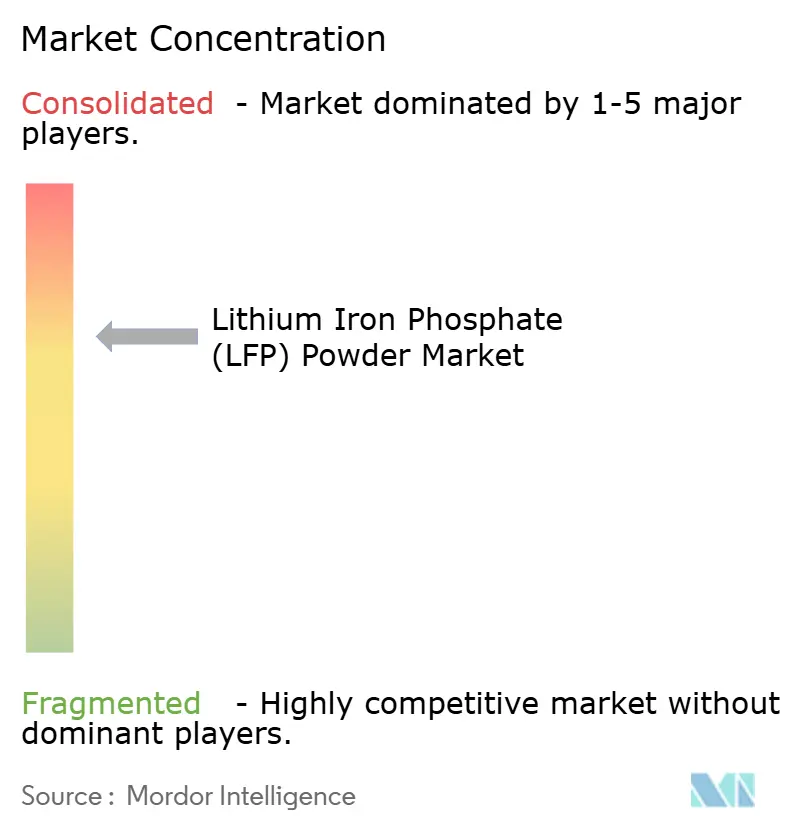
The lithium iron phosphate (LFP) powder market is moderately consolidated among large Chinese cathode suppliers, while standard-grade capacity remains highly competitive with severe margin pressure. Leading suppliers benefit from established customer qualifications, large-scale processing, access to precursor materials, and the ability to support customers through long-term supply arrangements. Their positions are reinforced when cathode production is combined with iron phosphate and lithium-related operations, providing closer control over material inputs. This integration can reduce input-cost exposure, improve supply visibility for cell customers, and help producers respond more quickly to changes in demand. The competitive environment remains difficult for smaller producers that lack both scale and differentiated product specifications, particularly when customers can source comparable standard-grade material elsewhere.
In July 2026, Hunan Yuneng announced an integrated production complex that includes LFP cathode capacity, iron phosphate production, phosphate mining, and lithium carbonate processing. This plan illustrates how major producers are seeking greater control over the material chain rather than relying entirely on external feedstock suppliers. Dynanonic has pursued international expansion through its European agreement with ICL, while EnergyX and Wildcat are pursuing a US manufacturing route through their proposed Texas facility. These moves indicate that location, upstream access, qualification capability, and the ability to meet regional procurement requirements are becoming as important as nominal cathode capacity.
Premium competition centers on certified non-Chinese supply and higher-performance powder formulations, rather than on standard-grade capacity alone. Suppliers outside China need to establish process reliability while managing input costs that may be higher than those of integrated Chinese peers, and must do so before major customers will place repeat orders. This requires attention to precursor quality, plant operating discipline, coating control, testing records, logistics, and the ability to maintain consistent specifications as commercial output increases. Chinese producers must also continue improving carbon-coating control, particle engineering, and compaction density to avoid competing solely on quantity when surplus standard material is available. These technical improvements are important because customers use cathode materials in carefully defined cell recipes, and a powder that performs well in a laboratory must demonstrate the same behavior across production batches. Patent portfolios and established manufacturing know-how can provide protection in technically demanding customer programs, where material consistency after full cell-level testing is essential. They also help suppliers justify material selection when buyers are assessing cycle life, processing stability, and the practical requirements of a specific battery design. The LFP powder market is therefore shaped by a divide between broad standard-grade capacity and more demanding qualified material, with different margins and customer requirements for each group. Producers that can combine validated technical performance with a secure regional supply position are better placed to serve buyers whose decisions are increasingly influenced by origin and certification.
Lithium Iron Phosphate (LFP) Powder Industry Leaders
-
Hunan Yuneng New Energy Battery Material Co., Ltd.
-
Hubei Wanrun New Energy Technology Co., Ltd.
-
Shenzhen Dynanonic Co., Ltd.
-
Lopal Tech. Group Co., Ltd.
-
Gotion
- *Disclaimer: Major Players sorted in no particular order
Lithium Iron Phosphate (LFP) Powder Market Companies Covered in this Report
- Chongqing Terui Battery Materials Co., Ltd.
- Contemporary Amperex Technology Co., Limited.
- Gotion
- Guizhou Anda Energy Technology Co., Ltd.
- Hubei Wanrun New Energy Technology Co., Ltd.
- Hunan Reshine New Material Co., Ltd.
- Hunan Yuneng New Energy Battery Material Co., Ltd.
- Lopal Tech. Group Co., Ltd.
- Ningbo Ronbay New Energy Technology Co., Ltd.
- Pulead Technology Industry Co., Ltd.
- Rongtong Hi-Tech
- RT-Hitech Co., Ltd.
- Shandong Fengyuan Lithium Energy Technology Co., Ltd.
- Shenzhen Dynanonic Co., Ltd.
- Xiamen Tungsten New Energy Materials Co., Ltd.
Recent Industry Developments in Lithium Iron Phosphate (LFP) Powder Market
- August 2026: China commissioned a 1 GW/4 GWh LFP grid-forming battery energy storage system (BESS) in Inner Mongolia, representing an investment of CNY 3 billion (USD 445 million). Recognized as the world's single-site grid-forming LFP BESS, the project sets new duty-cycle performance specifications for grid-grade powder and aligns with China's 2026-2030 renewable energy plan, which mandates grid-forming technology at scale.
- July 2026: Hunan Yuneng announced a CNY 24 billion (USD 3.5 billion) integrated production complex in southwestern China, adding 800,000 metric tons per year of LFP cathode capacity alongside 1 million metric tons per year of iron phosphate, upstream phosphate mining, and lithium carbonate processing. The five-year, multiphase project marks a move toward full vertical integration by the LFP cathode producer.
Global Lithium Iron Phosphate (LFP) Powder Market Report Scope
Lithium Iron Phosphate (LFP) powder is a grey, green, or black crystalline solid used as the primary cathode material in LFP rechargeable batteries. It features an olivine crystal structure and is typically carbon-coated to improve electrical conductivity, making it suitable for electric vehicles and energy storage applications.
The lithium iron phosphate (LFP) powder market is segmented by grade, application, and geography. By grade, the market is segmented into battery grade, high-purity grade, and industrial and specialty grades. By application, the market is segmented into electric vehicles, energy storage systems, consumer electronics, and others. The report also covers market size and forecasts for lithium iron phosphate (LFP) powder across 15 countries in major regions. The market sizes and forecasts are provided in terms of value (USD).
Segmentation Overview
| Battery Grade |
| High-Purity Grade |
| Industrial and Specialty Grades |
| Electric Vehicles |
| Energy Storage Systems |
| Consumer Electronics |
| Others |
| Asia-Pacific | China |
| India | |
| Japan | |
| South Korea | |
| ASEAN Countries | |
| Rest of Asia-Pacific | |
| North America | United States |
| Canada | |
| Mexico | |
| Europe | Germany |
| United Kingdom | |
| France | |
| Italy | |
| NORDIC Countries | |
| Rest of Europe | |
| South America | Brazil |
| Argentina | |
| Rest of South America | |
| Middle-East and Africa | Saudi Arabia |
| South Africa | |
| Rest of Middle-East and Africa |
| By Grade | Battery Grade | |
| High-Purity Grade | ||
| Industrial and Specialty Grades | ||
| By Application | Electric Vehicles | |
| Energy Storage Systems | ||
| Consumer Electronics | ||
| Others | ||
| By Geography | Asia-Pacific | China |
| India | ||
| Japan | ||
| South Korea | ||
| ASEAN Countries | ||
| Rest of Asia-Pacific | ||
| North America | United States | |
| Canada | ||
| Mexico | ||
| Europe | Germany | |
| United Kingdom | ||
| France | ||
| Italy | ||
| NORDIC Countries | ||
| Rest of Europe | ||
| South America | Brazil | |
| Argentina | ||
| Rest of South America | ||
| Middle-East and Africa | Saudi Arabia | |
| South Africa | ||
| Rest of Middle-East and Africa | ||
Key Questions Answered in the Report
What is current market size of Lithium Iron Phosphate (LFP) Powder Market?
The lithium iron phosphate (LFP) powder market size was estimated at USD 20.67 billion in 2025 and is estimated to grow from USD 23.43 billion in 2026 to USD 46.68 billion by 2031, at a CAGR of 14.78% during the forecast period (2026-2031).
Which grade has the largest revenue share?
Battery-grade powder led with a 78.56% revenue share in 2025 because it serves high-volume electric vehicle and storage-cell production.
Which application is growing fastest?
Which application is growing fastest? Energy storage systems are forecast to grow at a 16.62% CAGR through 2031 as renewable projects require more storage capacity.
Which region leads LFP powder demand?
Asia-Pacific accounted for 66.21% of global revenue in 2025 and is forecast to expand at a 15.89% CAGR through 2031.