
Lithium Cobalt Oxide (LCO) Market Size and Share
Market Overview
| Study Period | 2021 - 2031 |
|---|---|
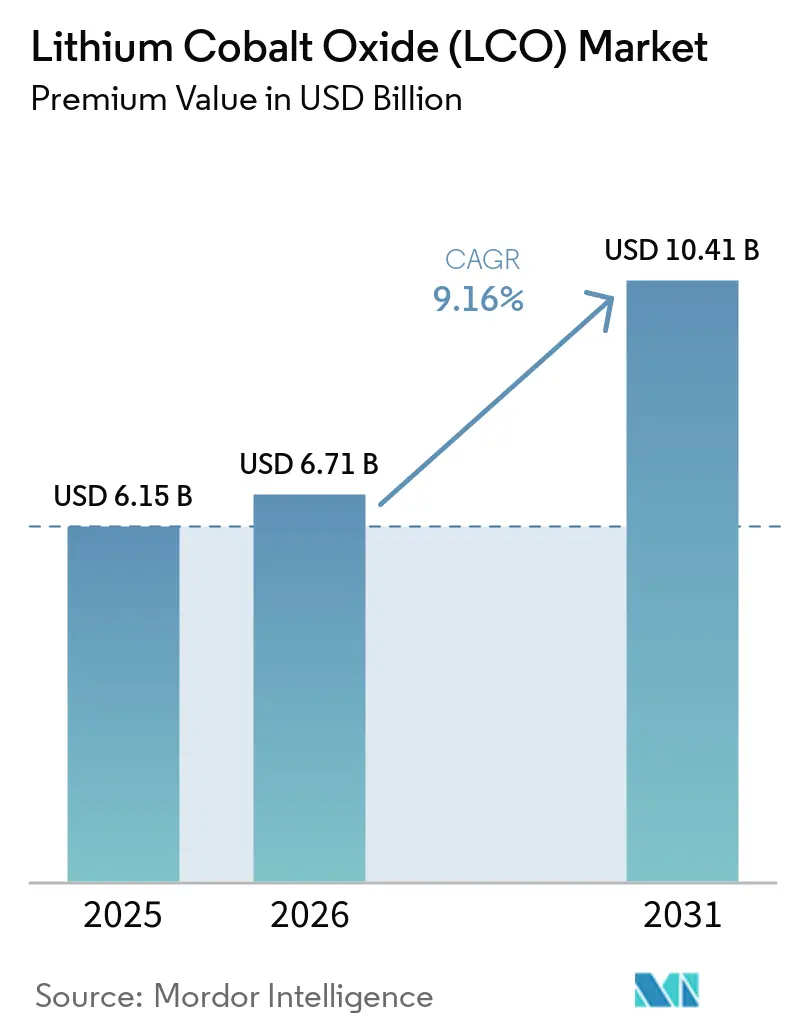
| Market Size (2026) | USD 6.71 Billion |
| Market Size (2031) | USD 10.41 Billion |
| Growth Rate (2026 - 2031) | 9.16 % |
| Fastest Growing Market | Asia-Pacific |
| Largest Market | Asia-Pacific |
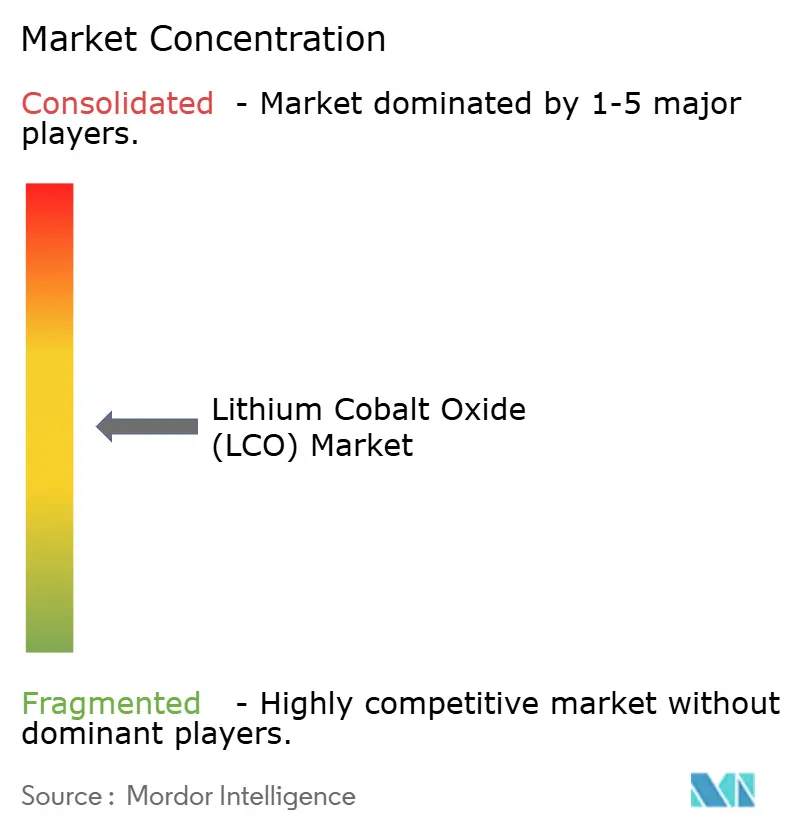
| Market Concentration | Medium |
Major Players *Disclaimer: Major Players sorted in no particular order Image © Mordor Intelligence. Reuse requires attribution under CC BY 4.0. | |
Lithium Cobalt Oxide (LCO) Market Analysis by Mordor Intelligence
The Lithium Cobalt Oxide (LCO) market size was valued at USD 6.15 billion in 2025 and is estimated to grow from USD 6.71 billion in 2026 to reach USD 10.41 billion by 2031, at a CAGR of 9.16% during the forecast period (2026-2031). The lithium cobalt oxide market remains centered on compact devices where energy density and limited internal space matter more than material cost. Premium smartphones, foldable devices, and newer wearable products support demand because they need more battery capacity within smaller designs and cannot readily use bulkier cell formats. The lithium cobalt oxide market also benefits when device makers pair silicon-carbon anodes with high-voltage cathodes, which supports thinner products, longer runtimes, and product differentiation at the premium end. This positioning narrows the lithium cobalt oxide market’s exposure to broad electric vehicle battery demand, where lithium iron phosphate and nickel manganese cobalt chemistries are more common and often more cost-competitive. Cobalt supply restrictions and higher input prices remain important because they can raise battery costs, limit procurement flexibility, and make alternative chemistries more attractive.
Key Report Takeaways
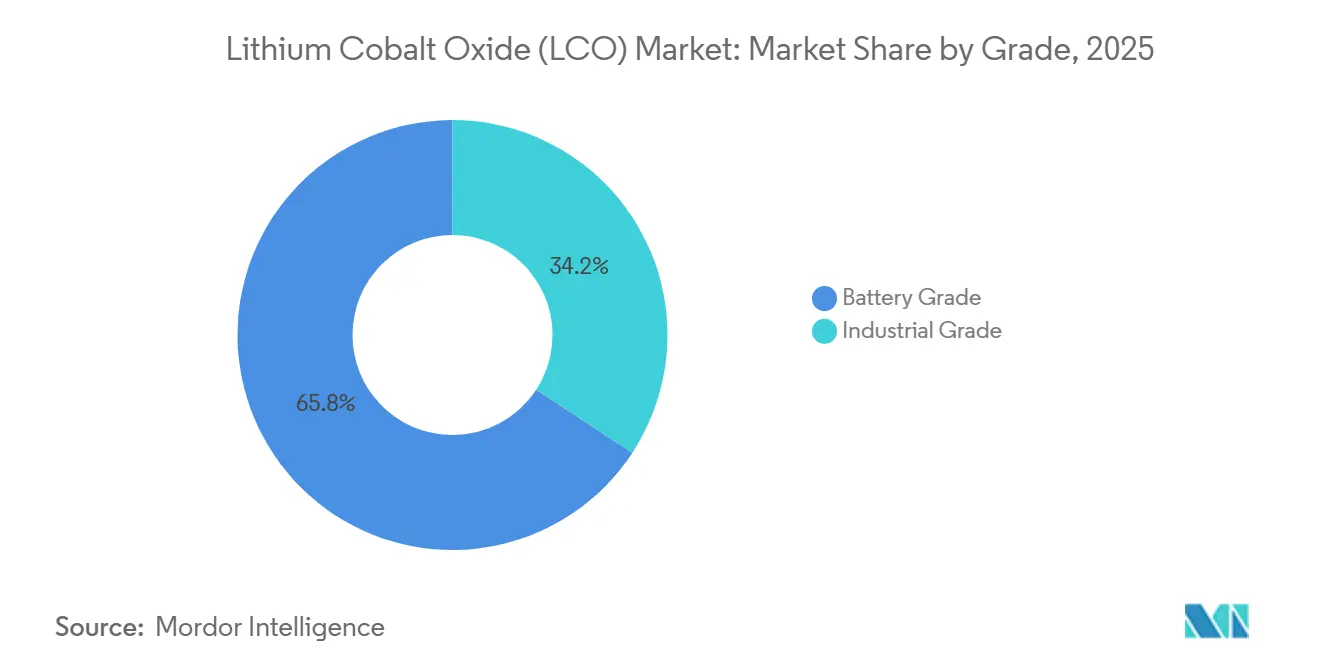
- By grade, battery grade held 65.78% of the lithium cobalt oxide market share in 2025 and is projected to advance at a 9.74% CAGR through 2031.
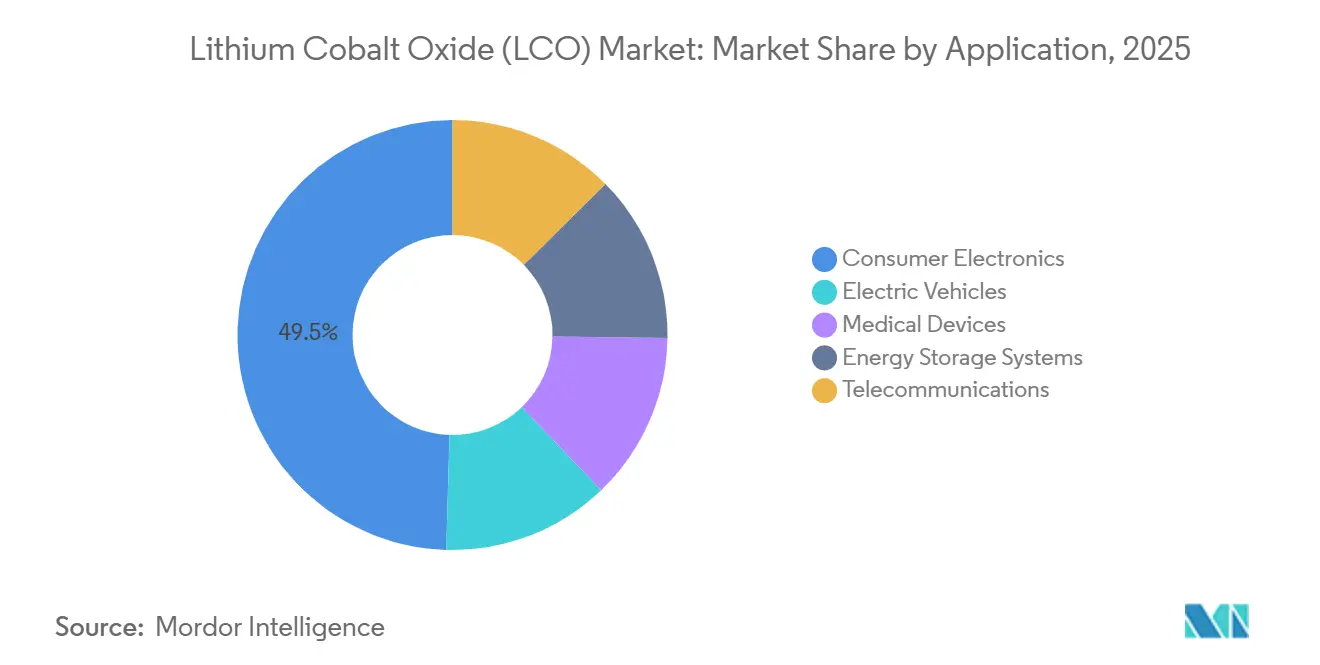
- By application, consumer electronics held 49.53% of the lithium cobalt oxide market share in 2025, while electric vehicles are projected to advance at a 10.37% CAGR through 2031.
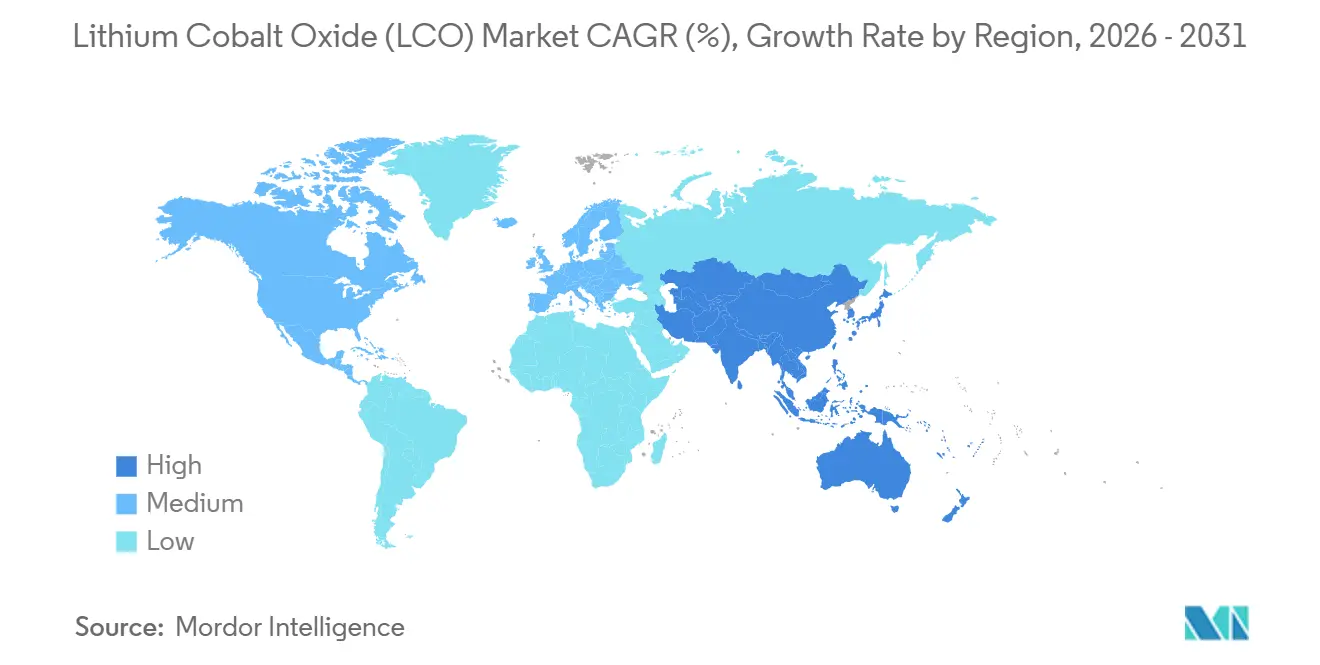
- By geography, Asia-Pacific held 52.86% of the lithium cobalt oxide market share in 2025 and is projected to advance at a 9.89% CAGR through 2031.
Note: Market size and forecast figures in this report are generated using Mordor Intelligence’s proprietary estimation framework, updated with the latest available data and insights as of January 2026.
Market Trends and Insights
Drivers Impact Analysis of Lithium Cobalt Oxide (LCO) Market*
| Driver | (~) % Impact on CAGR Forecast | Geographic Relevance | Impact Timeline |
|---|---|---|---|
| High-Density Demand in Premium Portable Electronics | +3.5% | Global, concentrated in APAC (China, South Korea, Japan) and North America | Medium term (2-4 years) |
| Growth in Wearables, Foldables, Drones and Medical Implants | +2.1% | Global, with highest adoption velocity in China, EU, and United States | Medium term (2-4 years) |
| Battery Grade Purity and Coating Innovation | +1.4% | APAC core, spillover to North America and EU | Long term (≥ 4 years) |
| Expansion of Portable and Distributed Energy Storage | +1.0% | Global, with early gains in Southeast Asia and South Asia | Long term (≥ 4 years) |
| Cobalt Recovery Economics and Circular Feedstock Availability | +0.8% | Global, concentrated in China and EU | Medium term (2-4 years) |
| Source: Mordor Intelligence | |||
High-Density Demand in Premium Portable Electronics
Premium smartphones remain a major outlet for the lithium cobalt oxide market because their battery specifications favor high volumetric energy density within tightly controlled device dimensions. Device makers increasingly use silicon-carbon anodes with high-voltage lithium cobalt oxide cathodes to increase cell-level energy density without increasing battery size. Syensqo stated in 2025 that its Energain SA076 electrolyte additive had entered commercial use in lithium cobalt oxide battery systems operating above 4.53 V. The company expected broader deployment on 4.55 V flagship platforms during 2026, reflecting continued work to raise operating voltage while managing electrolyte stability. Artificial intelligence-enabled processing, high-refresh-rate displays, and newer modem loads increase battery capacity needs in flagship handsets and make energy efficiency more important to device design. These requirements can raise cathode loading per device even when handset unit sales do not increase at the same pace.
Growth in Wearables, Foldables, Drones and Medical Implants
The lithium cobalt oxide market gains from devices that require compact battery cells without compromising operating time. Foldable phones and augmented reality or virtual reality devices need thin battery designs that can accommodate their more complex structures. Wearable medical devices also support demand because battery chemistry changes can require renewed device qualification. The Food and Drug Administration’s Quality System Regulation applies to medical-device manufacturing, creating formal controls around approved product designs. Unmanned Aerial Vehicles (UAVs) use energy-dense cells to extend flight times while staying within payload limits. These use cases are smaller than mass consumer electronics, but they add demand across inspection, agricultural, health care, and defense applications.
Battery Grade Purity and Coating Innovation
Battery grade purity and coating innovation support the lithium cobalt oxide market by enabling cells to operate at higher voltages. Commercial lithium cobalt oxide voltage limits have moved beyond earlier 4.35 V formulations toward 4.45 V to 4.55 V products. Higher-purity material, controlled particle morphology, and consistent tap density are important when cathodes operate under these conditions. Research published in August 2026 reported stable lithium cobalt oxide cycling to 4.65 V through zirconium bulk pillaring and lattice-matching surface engineering. Beijing Easpring Material Technology Co., Ltd. identified lithium cobalt oxide as a core product line alongside solid-state battery cathode materials in its 2025 annual reporting. The company also reported batch supply of all-solid-state lithium cobalt oxide formulations to customers in China and Japan.
Expansion of Portable and Distributed Energy Storage
Portable power stations, power banks, and compact backup units create focused opportunities for the lithium cobalt oxide market. These applications favor compact energy storage when physical footprint is more important than long cycle life or the lowest installed cost. High-density cells can fit space-constrained backup installations where bulkier battery designs are less suitable and where equipment placement is restricted. Small-cell network expansion can add to this demand because dense urban networks require more distributed equipment locations with limited available space. The lithium cobalt oxide market may also benefit from portable backup demand in Southeast Asia and South Asia, where compact systems can address local reliability needs. These applications remain specialized, but they broaden the customer base beyond smartphones, tablets, and laptops and reduce reliance on any single portable-device category.
Restraints Impact Analysis of Lithium Cobalt Oxide (LCO) Market*
| Restraint | (~) % Impact on CAGR Forecast | Geographic Relevance | Impact Timeline |
|---|---|---|---|
| Cobalt Price Volatility and Supply Concentration | -2.0% | Global; most acute in China (largest LCO producer and consumer) | Short term (≤ 2 years) |
| Substitution by LFP, NMC, NCA and Cobalt-Free Chemistries | -1.8% | Global; most intense in Europe and North America | Long term (≥ 4 years) |
| Thermal Runaway Risk at High Charge Rates | -1.2% | Global; compliance factors most stringent in EU and North America | Medium term (2-4 years) |
| Source: Mordor Intelligence | |||
Cobalt Price Volatility and Supply Concentration
Cobalt price volatility and supply concentration constrain the lithium cobalt oxide market because cobalt is a key cost component in lithium cobalt oxide cathode materials. The Democratic Republic of the Congo limited cobalt hydroxide exports to 87,000 metric tons in 2026 under its quota system. The Cobalt Institute reported a global mined cobalt supply of 270 kilotons in 2025, with the Democratic Republic of the Congo contributing 73% of the supply. The institute also reported a 96-kiloton ex-Democratic Republic of the Congo supply deficit during 2025. Cobalt hydroxide prices increased during 2025, raising input costs for cathode and battery producers. Higher raw-material costs can pressure margins in consumer devices, where manufacturers are sensitive to final product pricing.
Substitution by LFP, NMC, NCA and Cobalt-Free Chemistries
Lithium iron phosphate (LFP), nickel manganese cobalt (NMC), and nickel cobalt aluminum (NCA) are established cathode chemistries, and LFP accounted for more than 55% of global electric vehicle battery deployment in 2025. The International Energy Agency also reported that LFP exceeded 90% penetration in stationary energy storage during 2025[1]. LFP offers lower cost and has improved in energy density, which increases substitution pressure in mid-range devices and transport applications. POSCO FUTURE M stated that it completed pilot development of lithium manganese-rich cathode materials during 2025 and targeted mass-production qualification in 2026. The lithium cobalt oxide market faces its greatest substitution risk in cost-sensitive applications, where energy-density advantages do not justify the material premium, while cobalt-free alternatives are more likely to affect the 2028-2031 period as technical and manufacturing limitations are addressed.
*Our forecasts treat driver/restraint impacts as directional, not additive. The impact forecasts reflect baseline growth, mix effects, and variable interactions.
Lithium Cobalt Oxide (LCO) Market Segment Analysis
By Grade:
Battery Grade Consolidates on Purity and Voltage PremiumsBattery grade held 65.78% of the lithium cobalt oxide market share in 2025 and is projected to advance at a 9.74% CAGR through 2031. The segment benefits from stricter purity standards across premium smartphone and portable-device supply chains, where minor material variation can affect cell performance. Battery grade material generally requires high cobalt purity, controlled particle morphology, and consistent tap density to support reliable manufacturing. These characteristics help cells maintain performance as operating voltage moves beyond 4.45 V and as device makers seek greater capacity from a fixed battery volume. Premium device makers use battery grade cathodes because lower grade feedstocks can experience faster capacity loss at high voltage. Industrial grade lithium cobalt oxide serves ceramic colorants, magnetic materials, and catalyst applications, providing a more stable but slower-moving demand base.
Battery grade demand is also supported by efforts to increase secondary cobalt use in cathode production. China removed its restriction on black-mass imports in August 2025, allowing overseas secondary battery material to enter domestic refining capacity and expanding potential feedstock sources. This change can improve the availability of recycled cobalt feedstock for the lithium cobalt oxide industry, particularly for producers with refining and material-processing capabilities. DOWA ECO-SYSTEM established an integrated process for recovering nickel and cobalt sulfates from used lithium-ion batteries in June 2026. The recovered materials were supplied to cathode material producers as samples for performance verification before wider commercial adoption. Integrated recovery systems can reduce reliance on virgin feedstock, diversify procurement options, and improve supply resilience for battery grade manufacturers.
By Application:
Consumer Electronics Anchors Revenue, Electric Vehicles Lead GrowthConsumer electronics held 49.53% of the market share in 2025, supported by premium smartphones, tablets, and laptops. The application retains demand because volumetric energy density remains essential in thin, lightweight devices. High-voltage cathodes paired with silicon-carbon anodes allow manufacturers to increase battery capacity without enlarging device dimensions. Electric vehicles are projected to advance at a 10.37% CAGR through 2031. Ultra-light performance vehicles and compact urban mobility platforms can use lithium cobalt oxide, where energy density has a clear performance value. The lithium cobalt oxide market size for consumer electronics, therefore, continues to provide a broad revenue base, while smaller applications add faster growth.
Solid-state battery development is another application pathway for lithium cobalt oxide. Beijing Easpring Material Technology Co., Ltd. disclosed in September 2025 that it had supplied solid-state battery cathode materials to customers, including BYD, FAW, and CASIC. Medical devices provide another stable outlet because approved designs face high costs and time requirements when changing battery chemistry. The Food and Drug Administration’s device quality requirements reinforce the need for controlled design and manufacturing changes. Energy storage systems and telecommunications use lithium cobalt oxide in compact backup products and space-limited installations. Telecommunications demand is linked to the growth of denser small-cell networks, especially in the Asia-Pacific region.

Geography Analysis
APAC Lithium Cobalt Oxide (LCO) Market
Asia-Pacific held 52.86% of the market share in 2025 and is projected to advance at a 9.89% CAGR through 2031. China has a central role in cobalt refining, cathode production, battery-cell manufacturing, and device assembly. This integrated supply chain supports the region’s leadership in the lithium cobalt oxide market. Japan retains a specialized role in high-precision consumer electronics and high-purity cathode materials. South Korea supplies global original equipment manufacturer, or OEM, customers through established cathode-material capabilities. The region also has strong links between component suppliers, cell manufacturers, and device assemblers.
North America and Europe Lithium Cobalt Oxide (LCO) Market
North America and Europe represent a regional demand base focused on supply-chain controls and differentiated technologies. In North America, advanced-manufacturing incentives support local battery-material investment, although battery grade lithium cobalt oxide capacity remains limited outside Asia. Europe’s Battery Regulation requires more detailed supply-chain information for battery materials, including cobalt traceability. These requirements can favor suppliers with documented sourcing and auditable production processes. Beijing Easpring Material Technology Co., Ltd. is developing a cathode active material plant in Kotka, Finland, that is expected to begin commercial production in 2027.
South America and MEA Lithium Cobalt Oxide (LCO) Market
South America, and Middle-East and Africa are developing demand regions, where consumption is tied mainly to consumer electronics adoption. Brazil and Argentina support regional uptake through growing smartphone use and domestic electronics assembly. In the Middle-East, advanced manufacturing plans may create longer-term interest in battery materials. The Democratic Republic of the Congo remains more important as a cobalt supplier than as a lithium cobalt oxide consumer. Its export quota decisions affect raw material availability and cost for lithium cobalt oxide producers worldwide. For the lithium cobalt oxide market, this regional exposure is primarily a supply-side consideration rather than a local consumption driver. South Africa could develop a supporting role in cobalt processing, although commercial readiness remains uncertain.
Competitive Landscape
The lithium cobalt oxide market is moderately concentrated. Xiamen Tungsten Co., Ltd. and Tianjin B&M Science and Technology Co., Ltd. are established producers in global lithium cobalt oxide cathode manufacturing. Beijing Easpring Material Technology Co., Ltd. maintains lithium cobalt oxide as a core product line while expanding its solid-state battery-material portfolio. Its strategy reflects the need for lithium cobalt oxide producers to maintain a presence in established products while preparing for new cell architectures. Japanese suppliers retain differentiated positions where stringent purity and high-voltage performance are required. Competitive strength depends on product consistency, supply reliability, technical support, and customer qualification.
High-voltage coating capability and recycled-feedstock integration are important areas of competition in the lithium cobalt oxide market. The August 2026 study on zirconium pillaring and surface engineering showed a route toward stable cycling at 4.65 V. Producers that can translate such approaches into commercial materials may improve capacity and performance for premium devices. DOWA ECO-SYSTEM’s June 2026 recovery process provides an example of supply-chain integration around recycled nickel and cobalt sulfates. These strategies can reduce feedstock exposure while supporting battery grade material requirements. International Electrotechnical Commission (IEC) 62619 adds safety requirements for industrial secondary lithium cells and batteries, creating compliance considerations for larger stationary applications[2].
Partnerships and regional production projects are shaping the competitive direction of the lithium cobalt oxide market. AMG Lithium GmbH and Beijing Easpring Material Technology Co., Ltd. signed a memorandum of understanding in October 2025 for battery grade lithium hydroxide monohydrate supply. The arrangement connects AMG’s Bitterfeld-Wolfen refinery in Germany with Easpring’s planned Finnish cathode-material facility. Umicore stated in March 2026 that its Battery Cathode Materials business targeted adjusted earnings before interest, taxes, depreciation, and amortization (EBITDA) positivity in 2026 through cost discipline and take-or-pay commitments. The company also stated that it was exploring partnership options across its cathode-material manufacturing footprint. These moves show that competition increasingly includes supply security, recycling access, and regional customer support.
Lithium Cobalt Oxide (LCO) Industry Leaders
-
Nippon Chemical Industrial CO., LTD.
-
NICHIA CORPORATION
-
Xiamen Tungsten Co., Ltd.
-
Huayou Cobalt Co., Ltd.
-
Umicore
- *Disclaimer: Major Players sorted in no particular order
Lithium Cobalt Oxide (LCO) Market Companies Covered in this Report
- BASF
- Beijing Easpring Material Technology Co., Ltd.
- Cosmo Advanced Materials & Technology Co., Ltd.
- GEM Co., Ltd.
- Huayou Cobalt Co., Ltd.
- Hunan Changyuan Lico Co., Ltd.
- Hunan Shanshan Energy Technology Co., Ltd.
- NICHIA CORPORATION
- Nippon Chemical Industrial CO., LTD.
- POSCO FUTURE M
- Reshine New Material Co., Ltd.
- Tianjin B&M Science and Technology Co., Ltd.
- Umicore
- Xiamen Tungsten Co., Ltd.
Recent Industry Developments in Lithium Cobalt Oxide (LCO) Market
- March 2026: Ateios Systems and Kodak announced the expansion of the Ateios RaiCore battery electrode platform to three widely used cathode chemistries: Lithium Cobalt Oxide (LCO), Lithium Iron Phosphate (LFP), and Nickel Manganese Cobalt (NMC). The platform also earned third-party verification for the elimination of perfluoroalkyl alkane (PFA) forever chemicals.
- March 2025: Beijing Easpring Material Technology Co., Ltd. began construction of its cathode active material plant in Kotka, Finland, which is expected to be completed by 2027. The new facility is anticipated to expand the production capacity of cathode active materials, supporting the growing demand for Lithium Cobalt Oxide (LCO) in the region.
Global Lithium Cobalt Oxide (LCO) Market Report Scope
Lithium Cobalt Oxide (LCO) is a chemical compound used as the positive electrode (cathode) material in rechargeable lithium-ion batteries. It features a layered crystal structure that allows lithium ions to move easily between layers. It is commonly used in portable electronics such as smartphones, laptops, and cameras due to its high energy density.
The Lithium Cobalt Oxide Market is segmented by grade, application, and geography. By grade, the market is segmented into battery grade and industrial grade. By application, the market is segmented into consumer electronics, electric vehicles, medical devices, energy storage systems, and telecommunications. The report also covers the market size and forecasts for lithium cobalt oxide in 15 countries across major regions. For each segment, the market sizing and forecasts have been done on the basis of value (USD).
Segmentation Overview
| Battery Grade |
| Industrial Grade |
| Consumer Electronics |
| Electric Vehicles |
| Medical Devices |
| Energy Storage Systems |
| Telecommunications |
| Asia-Pacific | China |
| India | |
| Japan | |
| South Korea | |
| ASEAN Countries | |
| Rest of Asia-Pacific | |
| North America | United States |
| Canada | |
| Mexico | |
| Europe | Germany |
| United Kingdom | |
| France | |
| Italy | |
| NORDIC Countries | |
| Rest of Europe | |
| South America | Brazil |
| Argentina | |
| Rest of South America | |
| Middle-East and Africa | Saudi Arabia |
| South Africa | |
| Rest of Middle-East and Africa |
| By Grade | Battery Grade | |
| Industrial Grade | ||
| By Application | Consumer Electronics | |
| Electric Vehicles | ||
| Medical Devices | ||
| Energy Storage Systems | ||
| Telecommunications | ||
| By Geography | Asia-Pacific | China |
| India | ||
| Japan | ||
| South Korea | ||
| ASEAN Countries | ||
| Rest of Asia-Pacific | ||
| North America | United States | |
| Canada | ||
| Mexico | ||
| Europe | Germany | |
| United Kingdom | ||
| France | ||
| Italy | ||
| NORDIC Countries | ||
| Rest of Europe | ||
| South America | Brazil | |
| Argentina | ||
| Rest of South America | ||
| Middle-East and Africa | Saudi Arabia | |
| South Africa | ||
| Rest of Middle-East and Africa | ||
Key Questions Answered in the Report
What is the size of the lithium cobalt oxide market?
The lithium cobalt oxide market stands at USD 6.71 billion in 2026 and is projected to reach USD 10.41 billion by 2031.
What is driving demand for lithium cobalt oxide?
Premium portable electronics remain important because high-voltage lithium cobalt oxide supports compact cells with high energy density. Silicon-carbon anodes also support battery-capacity gains in thin device designs, including premium smartphones, foldables, tablets, and newer wearable products.
Which grade held the largest share in 2025?
Battery grade held 65.78% of the market share in 2025.
Which application is projected to grow fastest through 2031?
Electric vehicles are projected to advance at a 10.37% CAGR through 2031, supported by specialized lightweight mobility and solid-state battery uses.