
Liquid Lens For Machine Vision Market Size and Share
Market Overview
| Study Period | 2020 - 2031 |
|---|---|
| Market Size (2026) | USD 72.94 Million |
| Market Size (2031) | USD 120.34 Million |
| Growth Rate (2026 - 2031) | 10.53 % |
| Fastest Growing Market | Asia-Pacific |
| Largest Market | Asia-Pacific |
| Market Concentration | Medium |
Major Players *Disclaimer: Major Players sorted in no particular order Image © Mordor Intelligence. Reuse requires attribution under CC BY 4.0. | |
Liquid Lens For Machine Vision Market Analysis by Mordor Intelligence
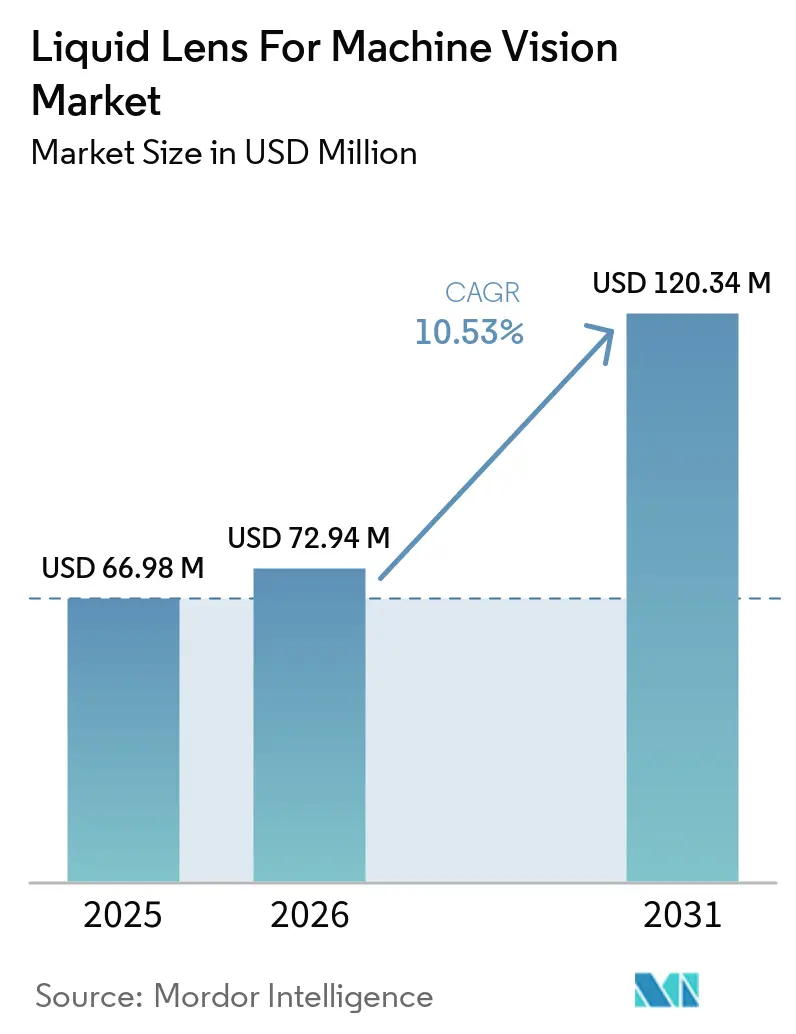
The liquid lens for machine vision market size stood at USD 66.98 million in 2025 and is forecast to reach USD 120.34 million by 2031, expanding at a CAGR of 10.53% during 2026-2031. The liquid lens for machine vision market is driven by demand for faster inspection across electronics, logistics, pharmaceutical production, and automated manufacturing lines. Electronically tunable optics can replace motor-driven focusing systems where repeated focal changes would otherwise slow the inspection cycle. This approach also removes moving mechanical parts that can create maintenance concerns on systems with demanding uptime requirements. Suppliers are therefore focused on optical performance, driver integration, application design support, and compatibility with machine vision software.
Key Report Takeaways
- By component, Standalone Liquid Lens Elements held 52.37% of the liquid lens for machine vision market share in machine vision in 2025, while Integrated Camera Module Assemblies are projected to expand at a 11.13% CAGR through 2031.
- By technology, Current-Driven Polymer-Membrane Liquid Lenses held 58.46% of the liquid lens for machine vision market share in the machine vision market in 2025, while Electrowetting-Based Liquid Lenses are projected to expand at a 11.09% CAGR through 2031.
- By end-user industry, Semiconductor and Electronics held 29.18% in 2025, while Logistics and Warehousing is projected to expand at a 11.92% CAGR through 2031.
- By spectral band, the Visible Spectrum held 71.34% in 2025, while the Short-Wave Infrared is projected to expand at a 11.48% CAGR through 2031.
- By geography, Asia-Pacific held 40.27% in 2025 and is projected to expand at a 11.52% CAGR through 2031.
Note: Market size and forecast figures in this report are generated using Mordor Intelligence’s proprietary estimation framework, updated with the latest available data and insights as of January 2026.
Market Trends and Insights
Drivers Impact Analysis of Liquid Lens For Machine Vision Market*
| Driver | (~) % Impact on CAGR Forecast | Geographic Relevance | Impact Timeline |
|---|---|---|---|
| High-Speed Automated Inspection Demand | +2.8% | Global, largest gains in Asia-Pacific and North America | Medium term (2-4 years) |
| Compact Autofocus System Adoption | +1.9% | Global, high density in Asia-Pacific and Europe | Short term (≤ 2 years) |
| Semiconductor and Electronics Inspection Growth | +1.6% | Asia-Pacific core, with spillover to North America | Long term (≥ 4 years) |
| Barcode Reading and Logistics Automation Expansion | +1.4% | Global, led by North America, Asia-Pacific, and Western Europe | Short term (≤ 2 years) |
| Dynamic Refocusing for Variable Working Distances | +1.1% | Global, with high relevance in automotive and food inspection | Medium term (2-4 years) |
| Integration With AI-Enabled Vision Systems | +1.0% | Global, with fastest uptake in Asia-Pacific and North America | Long term (≥ 4 years) |
| Source: Mordor Intelligence | |||
Rising Demand for High-Speed Automated Inspection
Quality requirements on high-volume production lines are increasing the need for adaptive focusing in the liquid lens for the machine vision market. Fixed-focus lenses can become limiting when targets vary in height within the same field of view. This is common in printed circuit board solder-joint inspection, semiconductor packaging, and automotive powertrain component inspection. Liquid lenses can refocus in 2-25 milliseconds without mechanical movement, allowing a single camera to inspect height-varying surfaces while maintaining line throughput.[1] The same system can capture multiple focal planes during a single inspection cycle and produce extended-depth-of-field images without stopping the conveyor. This capability can reduce the need for multi-camera arrays in die-attach and flip-chip inspection.
Increasing Adoption of Compact Autofocus Systems
Lens-level autofocus is changing how vision equipment makers configure camera platforms in the liquid lens for the machine vision market. The controller can be integrated into the lens body and connected to the camera via a single cable. poLight reported 42 commercial TLens design wins at the end of 2025, compared with 28 in 2024, and 21 products remained in shipment. Its MLens off-the-shelf M12 focusing lens portfolio launched in January 2026 for industrial machine vision original equipment manufacturers that want lower nonrecurring engineering requirements. Corning introduced the V-PE-80R0 variable-focus and astigmatism lens in 2025 with an 8-electrode electrowetting design. The design allows adjustment of sphere, cylinder, and axis without moving parts, extending the use of compact autofocus assemblies.
Growth of Semiconductor and Electronics Inspection
More complex semiconductor packaging is raising optical inspection requirements across the liquid lens market for machine vision. Chiplet stacking, fan-out wafer, September 2025, reflecting preparation for increased demand for semiconductor equipment, fer-level packaging, and heterogeneous integration, increases the sensitivity of inspection processes to focal variation. Wafer bow can cause focal drift at sub-150 nm defect-sensitivity requirements. Onto Innovation introduced the Dragonfly G5 in March 2026, with 150 nm defect sensitivity and more than a 3x improvement in throughput through multi-mode illumination and AI-powered classification. This performance level raises expectations for optical components supplied to semiconductor inspection platforms. Jenoptik announced a low-double-digit-million-EUR investment in expanded optics manufacturing in Jena during September 2025, reflecting preparation for increased semiconductor equipment demand.
Expansion of Barcode Reading and Logistics Automation
Automated barcode reading and parcel inspection are expanding the addressable applications for the liquid lens for machine vision market. Autonomous mobile robots and fast conveyor systems need reliable imaging across different object heights and orientations. Liquid lens autofocus supports barcode capture at conveyor speeds up to 3.2 meters per second without mechanical settling time. That capability supports systems that must identify codes as parcels move through receiving, sorting, and fulfillment operations. Optical requirements increase further when a single camera is expected to read codes, extract text, and identify damage in a single pass. Cognex positions its SLX-290 platform for classification and identification in logistics environments, reflecting this broader inspection requirement.
Restraints Impact Analysis of Liquid Lens For Machine Vision Market*
| Restraint | (~) % Impact on CAGR Forecast | Geographic Relevance | Impact Timeline |
|---|---|---|---|
| High Integration and Qualification Costs | -1.8% | Global, most acute in North America and Europe | Medium term (2-4 years) |
| Limited High-Aperture and High-Resolution Options | -1.2% | Global, with high relevance in Asia-Pacific semiconductor fabs | Long term (≥ 4 years) |
| Long-Term Sealing, Fluid Stability, and Thermal Drift Risks | -0.8% | Global, acute in high-temperature processing environments | Long term (≥ 4 years) |
| Dependence on Mechanical and Fixed-Focus Optics | -0.7% | Global, particularly persistent in South America and Africa | Short term (≤ 2 years) |
| Source: Mordor Intelligence | |||
High Integration and Qualification Costs
The adoption cost for the liquid lens for the machine vision market extends beyond the lens component. It can include driver electronics, firmware development, trigger synchronization, thermal calibration, and validation testing. Regulatory-grade systems can require 12-24 months for integration and qualification. The lens driver must be coordinated with the camera exposure trigger at millisecond precision to prevent image capture during fluid-interface oscillation.[2] Adaptive-optics systems in the USD 400,000-USD 850,000 total-system range can require an 18-24-month payback case. Standardized products from poLight and Corning can reduce nonrecurring engineering requirements, but the broader qualification burden remains a barrier.
Limited Availability of High-Aperture and High-Resolution Configurations
The liquid lens market for machine vision remains constrained when applications require clear apertures larger than 16 mm. Maintaining wavefront quality becomes more difficult at these larger formats than in standard 8-10 mm configurations. This limits its use in long-working-distance semiconductor inspection, large-sensor cameras, and high-magnification telecentric systems requiring apertures larger than 25 mm. A study in Optics Letters reported an electrowetting lens with ionic liquids that achieved more than 92% transmittance across a broad spectrum, but the demonstrated aperture was 10 mm. A July 2026 study of a membrane-free electrowetting design combined continuous focusing and electromagnetic zoom, achieving a 100 ms response time, but it remained at the research stage, with a 1x-1.5x zoom range and a sub-16 mm aperture. These limits leave a technical gap for large-format semiconductor inspection systems.
*Our forecasts treat driver/restraint impacts as directional, not additive. The impact forecasts reflect baseline growth, mix effects, and variable interactions.
Liquid Lens For Machine Vision Market Segment Analysis
By Component:
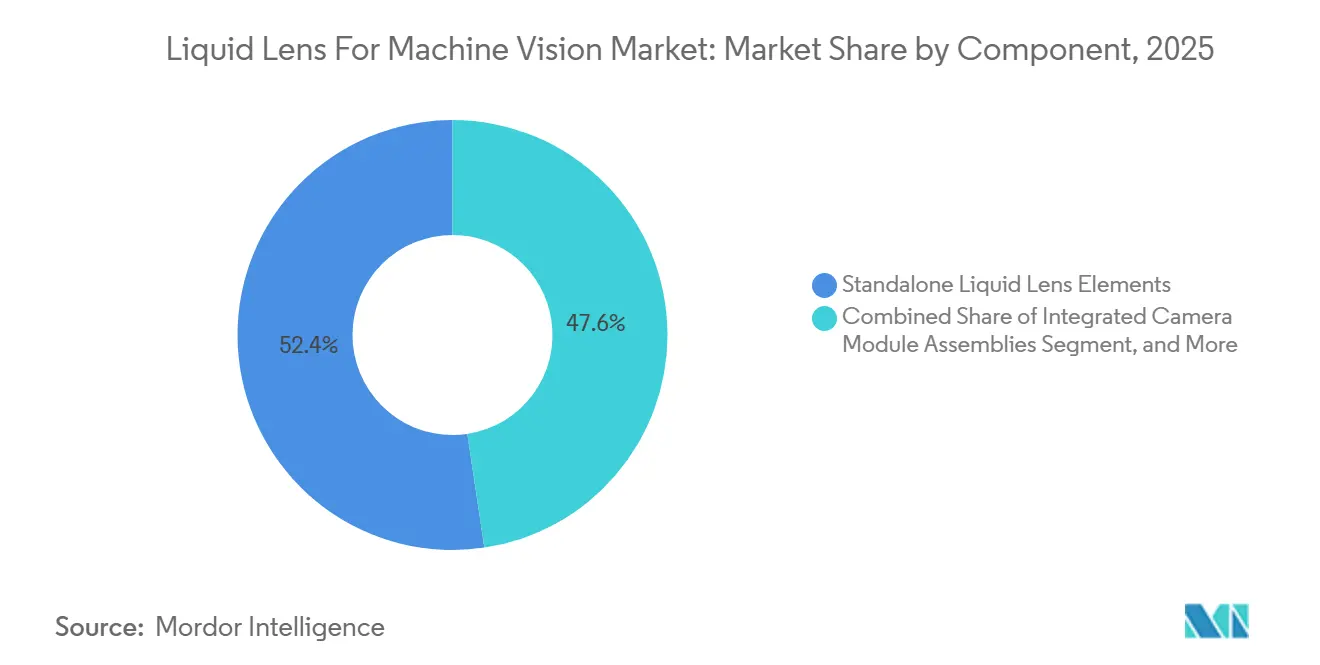
Standalone Elements Support Flexible System Design, While Modules Lead Future ExpansionStandalone Liquid Lens Elements accounted for 52.37% of the liquid lens market size for machine vision in 2025. System integrators favor modular optical designs because individual components can be qualified independently. These designs also allow field replacement when a system needs service. Many early systems combined separate elements, driver boards, and custom integration logic. Those prior qualification investments can make established installations less likely to switch quickly to integrated alternatives.
Integrated Camera Module Assemblies are projected to expand at a 11.13% CAGR from 2026 to 2031. Factory-calibrated modules reduce integration work through a plug-and-play format. Optotune launched the ELM-F C-mount module series in February 2026, combining a liquid lens, fixed focal-length optics, and a temperature-compensated controller for 1.1-inch sensors. Lens drivers and controllers remain essential to the component architecture. On-lens controller intelligence can reduce bill-of-materials complexity and simplify software integration for original equipment manufacturers.

By Technology:
Polymer-Membrane Platforms Lead, While Electrowetting Gains Precision ApplicationsCurrent-Driven Polymer-Membrane Liquid Lenses accounted for 58.46% of the liquid lens market size in the machine vision market in 2025. Their position reflects compatibility with standard industrial power supplies and an established record of reliability. These lenses are also supported by a favorable cost structure at moderate clear apertures. Optotune's EL series represents a widely deployed commercial polymer-membrane format. The technology can provide 2-25 ms response times with limited electromagnetic interference in sensor-dense inspection environments.
Electrowetting-Based Liquid Lenses are projected to expand at a 11.09% CAGR from 2026 to 2031. Voltage control fits naturally with digital systems and can allow independent adjustment of several optical parameters. A 2026 study presented a double-liquid aspherical electrowetting lens with a seven-ring electrode design. The study reported an imaging resolution of 80.635 line pairs per millimeter at 240 V. Piezoelectric polymer-based and liquid-crystal approaches retain specialized roles in research instrumentation, while broader machine-vision use awaits further improvements in response time and working-aperture range.
By End-User Industry:
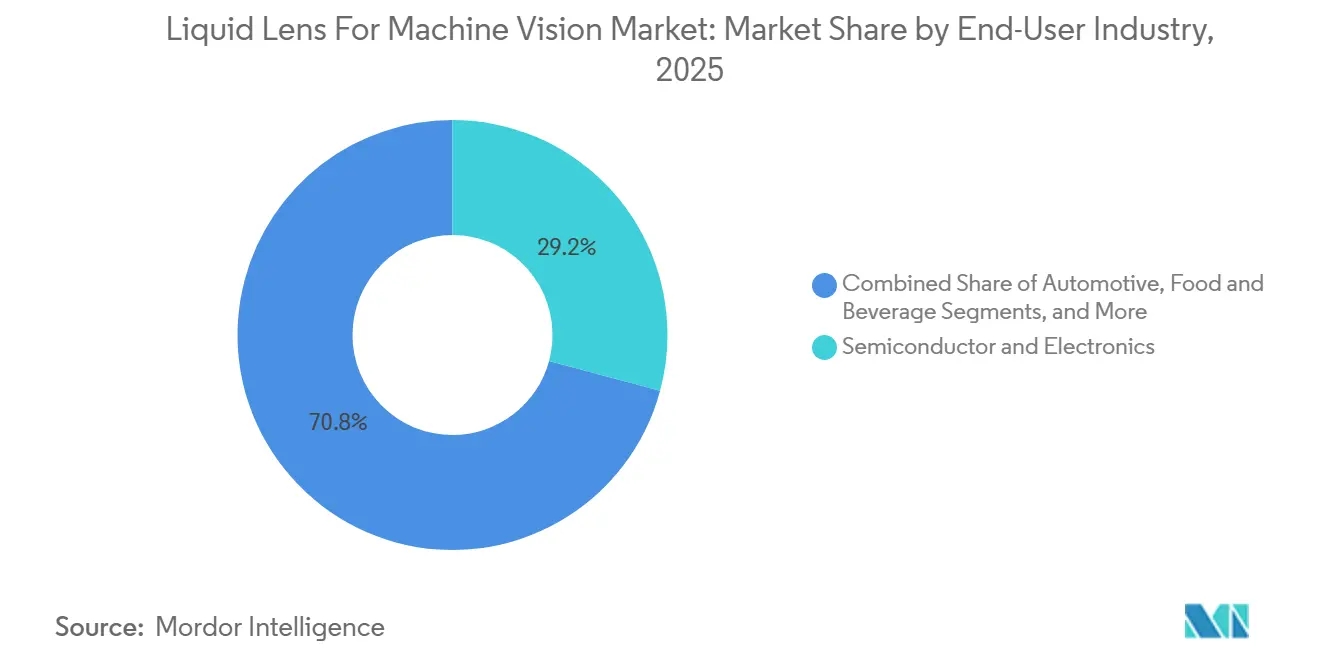
Semiconductor Inspection Sets Requirements, While Logistics Increases Deployment VolumesSemiconductor and Electronics accounted for 29.18% of the end-user segment in 2025. This segment sets demanding optical requirements because inspection tasks have narrow tolerances. Semiconductor equipment suppliers need components that support high resolution, fast focus adjustment, and repeatable performance. The Dragonfly G5 introduced by Onto Innovation in March 2026 has 150 nm defect sensitivity and a reported 3x-5x throughput improvement. These specifications shape the qualification expectations faced by component suppliers.
Logistics and warehousing are projected to expand at a 11.92% CAGR from 2026 to 2031. E-commerce fulfillment operations need adaptive barcode reading across variable parcel sizes and heights. A July 2026 Arducam case study described liquid-lens parameter optimization for smart-forklift barcode scanning at a 1-meter working distance. Pharmaceutical and medical applications also require calibrated visual inspection systems because documentation and traceability needs are rising. Automotive, food and beverage, energy and power, and other end-user industries use adaptive focus for body-panel inspection, agricultural sorting, and photovoltaic monitoring.
By Spectral Band:
Visible Spectrum Leads Current Demand, While SWIR Broadens Specialized UseVisible Spectrum accounted for 71.34% of the spectral-band segment in 2025. Its lead reflects the installed base of RGB camera systems across established inspection uses. Standardized illumination hardware and mature integration processes also support this position. Visible imaging remains central to common inspection tasks that do not require material-level spectral discrimination. This installed base supports continuing demand for compatible tunable optics.
Short-Wave Infrared is projected to expand at a 11.48% CAGR from 2026 to 2031. Lower sensor costs and improved material discrimination are broadening the use of SWIR systems. Sony's SenSWIR technology supports imaging from 400 nm to 1,700 nm through bonded compound InGaAs photodiodes and silicon readout circuits. Teledyne DALSA introduced the Kaleido SWIR hyperspectral camera in May 2026 for industrial sorting in recycling, food safety, and pharmaceutical applications. Near-infrared, ultraviolet, and multispectral systems remain specialized for wafer inspection, coating verification, and agricultural sorting.
Geography Analysis
APAC Liquid Lens for Machine Vision Market
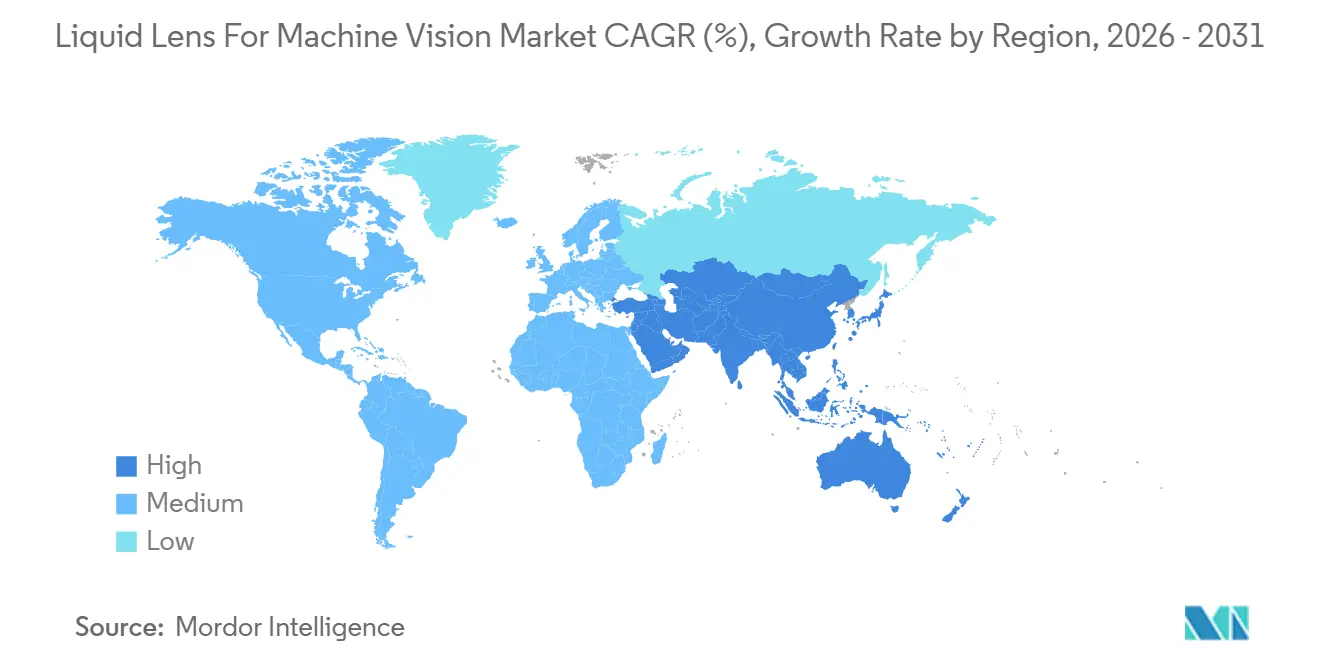
Asia-Pacific accounted for 40.27% of the regional total in 2025 and is projected to grow at a 11.52% CAGR through 2031. The region combines strong installed demand with new manufacturing capacity. China supports both supply-side and demand-side activity in adaptive optics. Q Technology established a dedicated TLens assembly and test line in China after its 2025 strategic investment agreement with poLight. The agreement generated NOK 171.5 million in net proceeds (USD 16.0 million) as stated in the source. South Korea and Japan are high-precision demand centers in the liquid lens market for machine vision. Wintest exhibited its RYUGU liquid lens at the Image Sensing Exhibition 2026 in Yokohama. The company also received purchase orders from the NanoTerasu synchrotron facility for its technology. These activities show use in scientific precision instrumentation alongside industrial machine vision.
North America and Europe Liquid Lens for Machine Vision Market
North America and Europe remain important revenue pools for precision-grade deployments. Semiconductor, pharmaceutical, and industrial automation facilities in these regions apply demanding qualification requirements. Jenoptik reported revenue of EUR 1,046 million (USD 1.21 billion) in fiscal 2025 and identified semiconductor equipment as a core growth area. The company began work on expanded Jena production capacity in the summer of 2026, with production planned for the second half of 2027.
MEA and South America Liquid Lens for Machine Vision Market
South America, the Middle East, and Africa remain earlier-stage regions for the liquid lens for machine vision market. Higher integration costs and a limited base of application engineers constrain near-term adoption. Brazil and Argentina have early activity in agricultural sorting. Food processing and logistics projects in the UAE and Saudi Arabia also create demand for autofocus barcode reading. Off-the-shelf M12 modules can reduce the engineering barrier in regions with less internal optics expertise.
Competitive Landscape
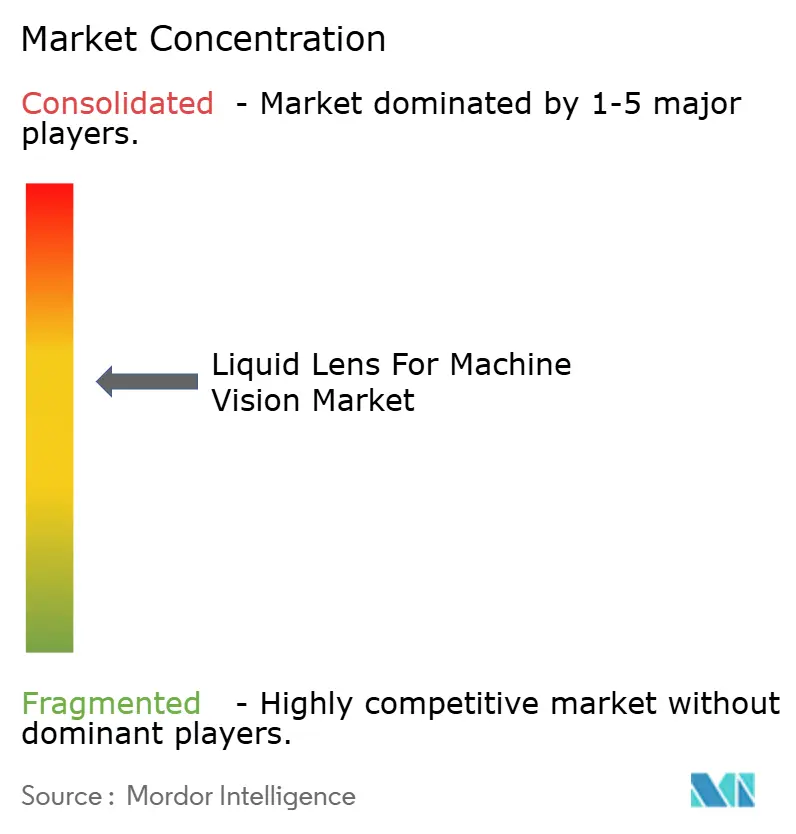
The liquid lens for machine vision market has a moderate level of concentration among specialist optical components. Optotune Switzerland AG, Corning Incorporated's Varioptic business, and poLight ASA hold important intellectual property in polymer-membrane and electrowetting actuation. Opto Engineering S.p.A. and Sill Optics GmbH and Co. KG operate in the integrated-optics tier. No single supplier was identified as holding a majority share. Competition, therefore, depends on optical performance, product availability, application support, and integration depth.
Suppliers are standardizing formats to reduce customer nonrecurring engineering requirements. They are also extending spectral compatibility to address SWIR inspection applications. poLight aligned with STMicroelectronics in 2025 for MEMS actuator manufacturing and entered a Q Technology partnership for Asia-Pacific assembly capacity. Optotune launched ELM-F C-mount modules in February 2026 with embedded temperature-compensated controllers. Corning expanded compact optical correction options through its V-PE-80R0 electrowetting lens.
A gap remains for SWIR-compatible liquid lens modules with apertures above 20 mm. Larger InGaAs sensor formats may require image circles larger than 25 mm, but volume production has not yet closed this optical gap. A US patent describes a hybrid zoom assembly that combines solid lenses, a membrane-based liquid lens, and a motor system for extended working-distance use.[3] These architectures could combine fast focal adjustment with a broader mechanical range. The competitive balance reflects specialized intellectual property, differentiated integration capabilities, and continued demand for application-specific optical designs.
Liquid Lens For Machine Vision Industry Leaders
-
Optotune Switzerland AG
-
Corning Incorporated
-
Edmund Optics, Inc.
-
Opto Engineering S.p.A.
-
Sill Optics GmbH and Co. KG
- *Disclaimer: Major Players sorted in no particular order
Liquid Lens For Machine Vision Market Companies Covered in this Report
- Optotune Switzerland AG
- Corning Incorporated, Varioptic Business
- Edmund Optics, Inc.
- Opto Engineering S.p.A.
- Sill Optics GmbH and Co. KG
- poLight ASA
- LensVector Inc.
- Basler AG
- Elcyo Co., Ltd.
- Wintest Corporation
- SUSS MicroOptics SA
- Physik Instrumente (PI) GmbH and Co. KG
- Hamamatsu Photonics K.K.
- Schneider-Kreuznach GmbH and Co. KG
- Jenoptik AG
- Kowa Company, Ltd.
- Navitar, Inc.
- VS Technology Corporation
- Myutron Inc.
- Theia Technologies, Inc.
- Goyo Optical Inc.
Recent Industry Developments in Liquid Lens For Machine Vision Market
- July 2026: Arducam published a technical case study of its custom liquid-lens barcode scanning solution for smart forklifts, optimizing motor parameters for reliable focus at 1-meter working distances during forklift motion.
- June 2026: Wintest Corporation exhibited the RYUGU liquid lens at the Image Sensing Exhibition 2026 in Yokohama, demonstrating voltage-controlled focal length and magnification adjustment with a 15 ms response time for factory inspection cameras.
- February 2026: Optotune Switzerland AG launched the ELM-F series Fixed Focal Length C-Mount Liquid Lens Modules, enabling millisecond refocusing from 200 mm to infinity across focal lengths of 12 to 50 mm, with embedded temperature-compensated controllers and 1.1-inch sensor support for industrial inspection, robotics, and automation.
- January 2026: poLight ASA launched the MLens off-the-shelf M12 focusing camera lens portfolio for industrial machine vision OEMs, leveraging TLens technology with 1 ms focus speed and 1 mW power consumption, positioning poLight higher in the value chain by selling complete lens products rather than optical elements.
Global Liquid Lens For Machine Vision Market Report Scope
The Liquid Lens for Machine Vision Market refers to the market for liquid lens components and technologies used in machine vision systems to provide electronically tunable focusing and optical adjustment without conventional mechanical lens movement. Liquid lenses can enable rapid focusing, depth-of-field adjustment, and working-distance accommodation, making them suitable for automated inspection and imaging applications.
The Liquid Lens for Machine Vision Market Report is Segmented by Component (Standalone Liquid Lens Elements, Integrated Camera Module Assemblies, and Lens Drivers and Controllers), Technology (Electrowetting-Based Liquid Lenses, Current-Driven Polymer-Membrane Liquid Lenses, and Other Tunable Liquid Lens Technologies), End-User Industry (Semiconductor and Electronics, Automotive, Food and Beverage, Pharmaceutical and Medical, Logistics and Warehousing, Energy and Power, and Other End-User Industries), Spectral Band (Visible Spectrum, Near-Infrared, Short-Wave Infrared, Ultraviolet, and Multispectral), and Geography (North America, South America, Europe, Asia-Pacific, Middle East, and Africa). The Market Forecasts are Provided in Terms of Value (USD).
Segmentation Overview
| Standalone Liquid Lens Elements |
| Integrated Camera Module Assemblies |
| Lens Drivers and Controllers |
| Electrowetting-Based Liquid Lenses |
| Current-Driven Polymer-Membrane Liquid Lenses |
| Other Tunable Liquid Lens Technologies |
| Semiconductor and Electronics |
| Automotive |
| Food and Beverage |
| Pharmaceutical and Medical |
| Logistics and Warehousing |
| Energy and Power |
| Other End-User Industries |
| Visible Spectrum |
| Near-Infrared |
| Short-Wave Infrared |
| Ultraviolet |
| Multispectral |
| North America | United States |
| Canada | |
| Mexico | |
| South America | Brazil |
| Argentina | |
| Rest of South America | |
| Europe | Germany |
| United Kingdom | |
| France | |
| Italy | |
| Spain | |
| Rest of Europe | |
| Asia-Pacific | China |
| Japan | |
| India | |
| South Korea | |
| Rest of Asia-Pacific | |
| Middle East | United Arab Emirates |
| Saudi Arabia | |
| Rest of Middle East | |
| Africa | South Africa |
| Egypt | |
| Nigeria | |
| Rest of Africa |
| By Component | Standalone Liquid Lens Elements | |
| Integrated Camera Module Assemblies | ||
| Lens Drivers and Controllers | ||
| By Technology | Electrowetting-Based Liquid Lenses | |
| Current-Driven Polymer-Membrane Liquid Lenses | ||
| Other Tunable Liquid Lens Technologies | ||
| By End-User Industry | Semiconductor and Electronics | |
| Automotive | ||
| Food and Beverage | ||
| Pharmaceutical and Medical | ||
| Logistics and Warehousing | ||
| Energy and Power | ||
| Other End-User Industries | ||
| By Spectral Band | Visible Spectrum | |
| Near-Infrared | ||
| Short-Wave Infrared | ||
| Ultraviolet | ||
| Multispectral | ||
| By Geography | North America | United States |
| Canada | ||
| Mexico | ||
| South America | Brazil | |
| Argentina | ||
| Rest of South America | ||
| Europe | Germany | |
| United Kingdom | ||
| France | ||
| Italy | ||
| Spain | ||
| Rest of Europe | ||
| Asia-Pacific | China | |
| Japan | ||
| India | ||
| South Korea | ||
| Rest of Asia-Pacific | ||
| Middle East | United Arab Emirates | |
| Saudi Arabia | ||
| Rest of Middle East | ||
| Africa | South Africa | |
| Egypt | ||
| Nigeria | ||
| Rest of Africa | ||
Key Questions Answered in the Report
What is the liquid lens for machine vision market size?
The liquid lens for machine vision market stood at USD 66.98 million in 2025 and is forecast to reach USD 120.34 million by 2031, at a 10.53% CAGR during 2026-2031.
What is driving adoption of liquid lenses in machine vision systems?
High-speed inspection, compact autofocus needs, semiconductor inspection, and logistics automation are central demand drivers.
Which component category leads demand for liquid lenses?
Standalone Liquid Lens Elements held 52.37% in 2025, while Integrated Camera Module Assemblies have the highest projected component CAGR of 11.13%.
Which end-user application is expected to expand fastest?
Logistics and Warehousing is projected to expand at a 11.92% CAGR through 2031 as fulfillment centers use adaptive imaging for barcode reading.
Which optical technology has the largest installed position?
Current-Driven Polymer-Membrane Liquid Lenses held 58.46% in 2025 because of power-supply compatibility, reliability, and cost at moderate apertures.
Which region is expected to lead demand through 2031?
Asia-Pacific held 40.27% in 2025 and is projected to expand at a 11.52% CAGR through 2031.