
Lime Oil Market Size and Share
Market Overview
| Study Period | 2022 - 2032 |
|---|---|
| Market Size (2027) | USD 562.67 Million |
| Market Size (2032) | USD 741.93 Million |
| Growth Rate (2027 - 2032) | 5.69 % |
| Fastest Growing Market | Asia-Pacific |
| Largest Market | North America |
| Market Concentration | Medium |
Major Players *Disclaimer: Major Players sorted in no particular order Image © Mordor Intelligence. Reuse requires attribution under CC BY 4.0. | |
Lime Oil Market Analysis by Mordor Intelligence
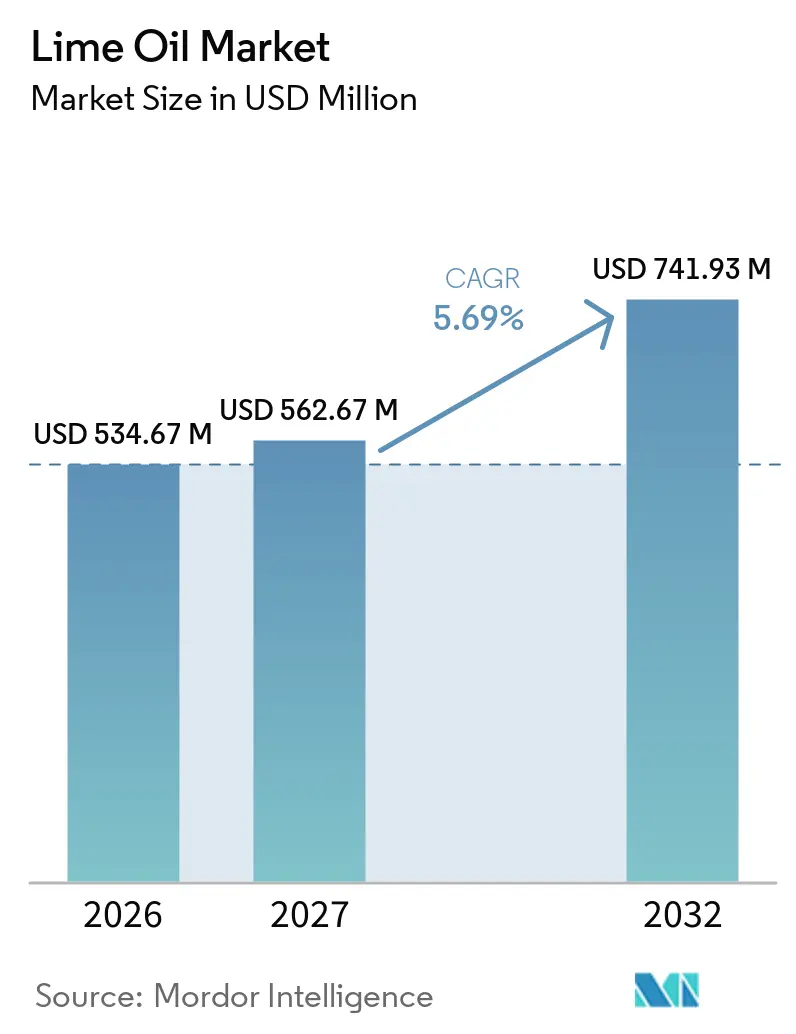
The lime oil market size grew from USD 534.67 million in 2026 to USD 562.67 million in 2027, and is forecast to reach USD 741.93 million by 2032 at a 5.69% CAGR over 2027-2032. The lime oil market benefits from growing demand for recognizable botanical flavors in beverages and stricter documentation requirements for natural flavor claims. Demand also increases for product grades that preserve a fresh character under demanding processing conditions. Regulatory and formulation requirements are shifting purchasing decisions toward traceable supplies and grades with reliable performance. Stabilization, encapsulation, and deterpenation technologies are expanding the use of lime oil in processed beverages and leave-on cosmetics. However, supply remains vulnerable because Mexico plays a central role in both lime cultivation and industrial extraction. Consequently, buyers are diversifying procurement across Peru, Sri Lanka, and Southeast Asia.
Key Report Takeaways
- By product type, cold-pressed lime oil led the lime oil market with a share of 61.78% in 2026, while distilled lime oil is anticipated to register the fastest CAGR of 6.53% during 2027-2032.
- By nature, conventional lime oil dominated the market with a share of 67.63% in 2026, while organic lime oil is anticipated to register the fastest CAGR of 7.01% during 2027-2032.
- By end-use industry, food and beverages led the market with a share of 34.63% in 2026, while cosmetics and personal care is anticipated to register the fastest CAGR of 6.61% during 2027-2032.
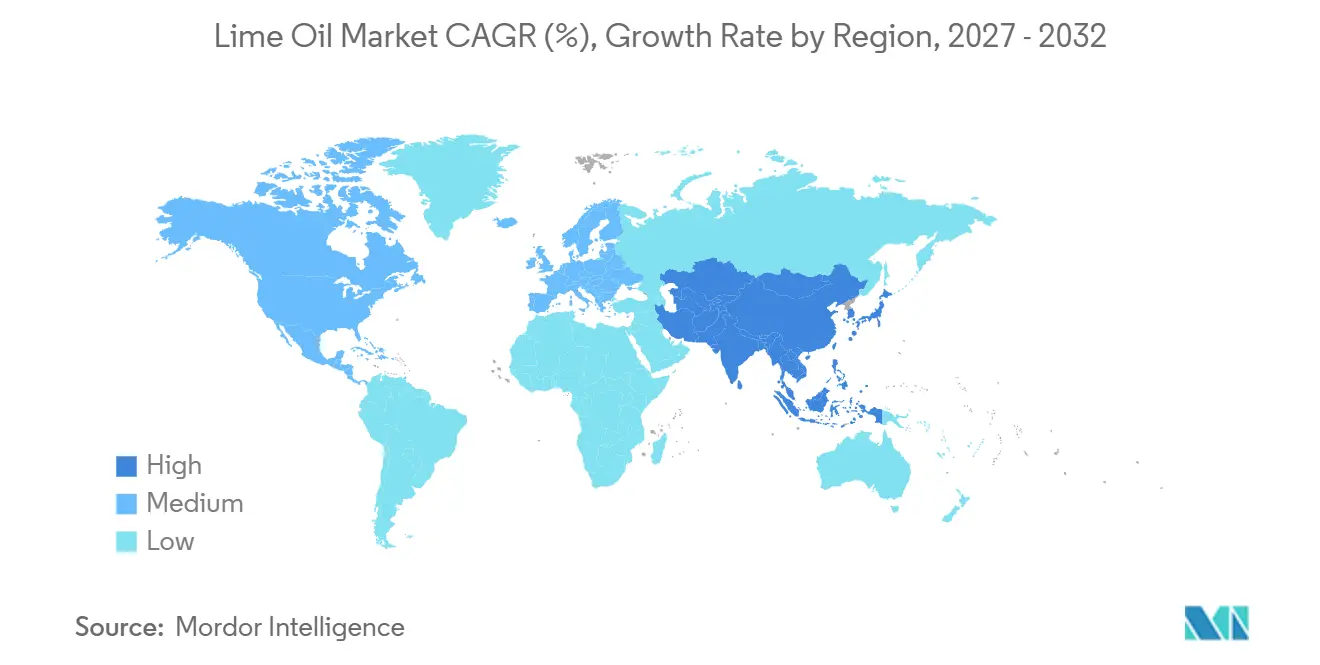
- By geography, North America led lime oil market with a share of 39.12% in 2026, while Asia-Pacific is projected to register the fastest CAGR of 6.87% during 2027-2032.
Note: Market numbers in this report are based on Mordor Intelligence's proprietary estimation framework, which combines nine months of actuals with Q4 projections for base year 2026.
Global Lime Oil Market Trends and Insights
Drivers Impact Analysis*
| Driver | (~) % Impact on CAGR Forecast | Geographic Relevance | Impact Timeline |
|---|---|---|---|
| Rising demand for citrus-flavored beverages | +1.3% | Global, strongest in North America and Asia-Pacific | Medium term (2-4 years) |
| Preference for recognizable plant-derived flavor ingredients | +1.0% | North America and Europe, with spillover to Asia-Pacific | Medium term (2-4 years) |
| Product innovation in energy drinks and functional beverages | +0.8% | North America primarily, with emerging activity in Asia-Pacific | Short term (≤ 2 years) |
| Demand for fresh citrus fragrances in household and cleaning products | +0.7% | Global, concentrated in Europe and North America | Long term (≥ 4 years) |
| Incorporation of citrus oils in cosmetics and personal care | +1.1% | Global, with fastest traction in Asia-Pacific and Europe | Medium term (2-4 years) |
| Advances in flavor ingredient technology and formulation compatibility | +0.5% | Global, led by North American and European research centers | Long term (≥ 4 years) |
| Source: Mordor Intelligence | |||
Rising Demand for Citrus-Flavored Beverages
Citrus remained the leading flavor family in beverage product development. Lime’s sharper acidity is well suited to low- and zero-sugar beverages, as it can mask off-notes from high-intensity sweeteners. This trend provides the Lime Oil Market with exposure to functional beverages, electrolyte waters, and zero-sugar carbonated mixers. Natural flavor authentication requirements in Europe also support demand, independent of shifts in consumer beverage consumption. Spray-dried citrus powders and related encapsulation systems enable gradual flavor release and enhance product performance in sports nutrition and functional beverages. Fresh citrus fragrances also support applications in household and cleaning products, where lime-derived materials can deliver both fragrance and grease-dissolving properties.
Preference for Recognizable, Plant-Derived Flavor Ingredients
Consumer interest in ingredients derived from recognizable botanical sources creates opportunities for lime oil in food and beverage formulations. Lime oil delivers a concentrated citrus flavor suitable for beverages, confectionery, sauces, and other processed foods. In June 2024, the United States Food and Drug Administration (FDA) reiterated that, under its food-labeling regulations, natural flavorings may include essential oils, extracts, and other flavoring constituents derived from fruits, herbs, and similar plant materials[1]. This regulatory recognition supports food manufacturers’ use of plant-derived flavor ingredients and creates potential opportunities for lime oil suppliers. However, the FDA information defines natural flavorings for regulatory purposes and does not directly measure consumer preferences for lime oil.
Product Innovation in Energy Drinks and Functional Beverages
Functional beverages are expanding the use of lime oil into higher-growth, ingredient-intensive categories than traditional carbonated soft drinks. The April 2026 launch of GHOST Energy x 7UP Lemon Lime demonstrated that lime-citrus profiles achieve broad distribution through co-branded energy drinks. Kerry’s NextGens Citrus technology removes unstable components from natural citrus materials while retaining a fresh character for up to 12 months in beverage applications. This technology directly addresses stability constraints that previously limited lime oil use in hot-fill and aseptic formats. Suppliers offering treated, stability-enhanced lime oil grades are better positioned to serve brands seeking shelf lives of 12 to 18 months. This capability is important in the Lime Oil Market, as flavor performance must remain consistent throughout distribution and storage. Commodity cold-pressed lime oil remains relevant for applications where fresh aroma is more important than extended stability.
Incorporation of Citrus Oils in Cosmetics and Personal Care
Scientific research is shifting lime oil from a fragrance-only ingredient toward a functionally supported cosmetic input. A June 2025 study published by the National Library of Medicine found that fresh key lime essential oil inhibited collagenase and elastase, with IC50 values of 63.97 μg/mL and 145.02 μg/mL, respectively[2]. These findings support its use in dermatologically positioned formulations beyond fragrance applications. European cosmetic requirements related to photosensitivity encourage the use of distilled grades in leave-on products, as distillation reduces furocoumarin content. Consequently, the Lime Oil Market benefits from demand for sunscreen, day cream, and related personal care products that require safer citrus profiles.
Restraints Impact Analysis*
| Restraint | (~) % Impact on CAGR Forecast | Geographic Relevance | Impact Timeline |
|---|---|---|---|
| Vulnerability of lime production to climatic and crop variability | -1.2% | Global, centered on Mexico, Peru, and Southeast Asia | Short term (≤ 2 years) |
| High raw-material requirements and extraction costs | -0.8% | Global supply chain, acute in North America and Europe | Medium term (2-4 years) |
| Oxidation and shelf-life limitations | -0.5% | Global, most limiting for cold-pressed grade adoption | Long term (≥ 4 years) |
| Regulatory compliance and application-specific restrictions | -0.4% | Europe and North America, with spillover to the Middle East and Africa | Medium term (2-4 years) |
| Source: Mordor Intelligence | |||
Vulnerability of Lime Production to Climatic and Crop Variability
The lime oil market relies on tropical and subtropical supply regions, particularly Mexico, Peru, and Southeast Asia. Weather events in these regions can reduce extraction volumes, as the supply chain has limited buffer capacity. Buyers increasingly monitor crop conditions and alternative origins, as supply uncertainty has become a recurring procurement challenge. Unfavourable weather can also affect fruit quality and oil content, reducing extraction yields and making it difficult for processors to meet consistent quality specifications. Peru and Asian suppliers provide additional sourcing options; however, their imports can also affect industrial lime pricing in Mexico. Production disruptions and price fluctuations may reduce growers’ willingness to allocate fruit to processing, even during seasons with adequate crop availability.
High Raw-Material Requirements and Extraction Costs
The global lime oil market faces cost pressures because production depends on the availability and pricing of fresh lime fruit. In September 2025, the United States Department of Agriculture (USDA) reported weather-related supply disruptions in Brazil’s Tahiti lime industry during the 2024/25 season, affected fruit availability[3]. These fluctuations can increase raw material procurement costs for processors using lime fruit to produce essential oil, potentially compressing manufacturers’ profit margins when they cannot pass higher input costs on to customers. Additionally, competition for available fruit between fresh-market sales and industrial processing can further complicate raw-material sourcing during periods of limited supply. Consequently, supply uncertainties make it difficult for lime oil manufacturers to maintain consistent production costs and pricing.
*Our forecasts treat driver/restraint impacts as directional, not additive. The impact forecasts reflect baseline growth, mix effects, and variable interactions.
Segment Analysis
By Product Type: Cold-Pressed Grade Retains Its Premium Position While Distilled Grades Gain Wider Use
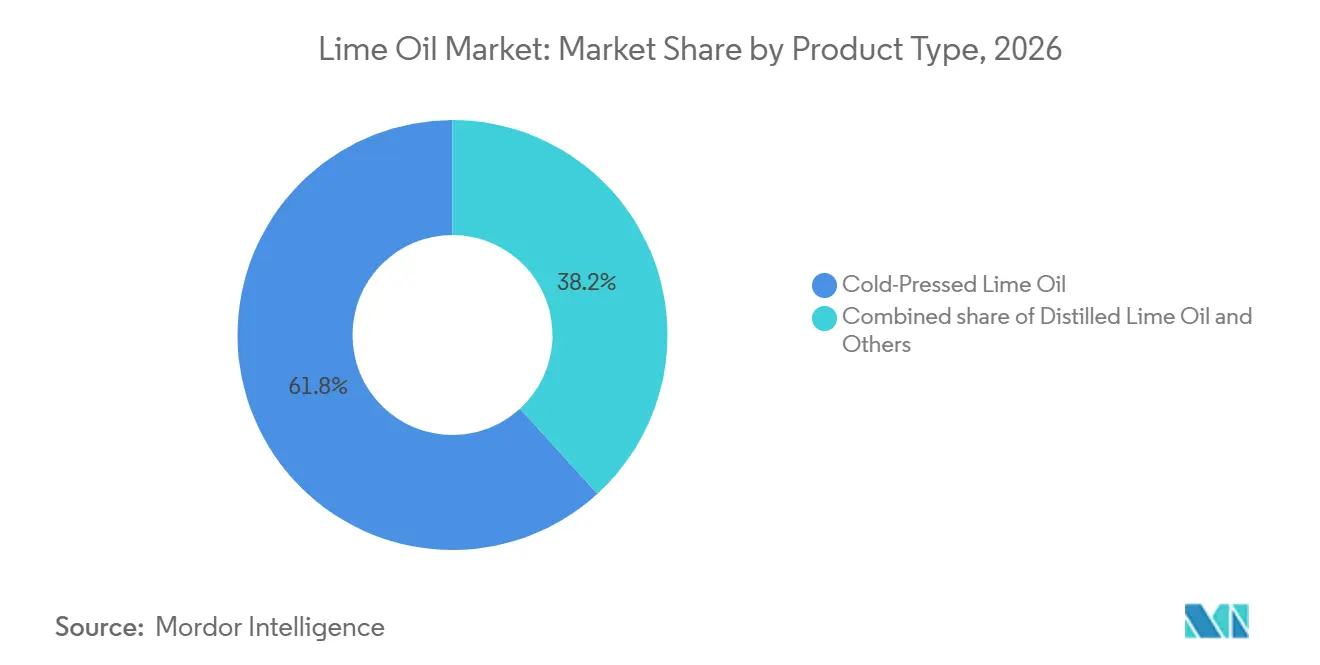
Cold-pressed lime oil accounted for 61.78% of product-type demand in 2026. This position reflects its use in beverages, fine fragrances, and premium personal care products, where formulators value its full terpene profile and fresh top note. Cold pressing retains volatile constituents more effectively than heat-based processes, supporting its sensory advantages. The process also enables co-production with lime juice, allowing manufacturers to recover oil from existing processing streams.
However, cold-pressed grades are susceptible to oxidation, particularly in applications requiring a longer shelf life. The Lime Oil Market for distilled grades is projected to grow at a CAGR of 6.53% through 2032. Distillation removes much of the furocoumarin content associated with phototoxic reactions, making distilled lime oil more suitable for sunscreens, day creams, and colognes. Treatt exhibited TREATTZEST™ Lime Expressed and TREATTZEST™ Lime Distilled at SIMPPAR Paris in June 2025 for fragrance and personal care applications.

By Nature: Conventional Supply Leads Volume While Organic Grades Expand Faster
Conventional lime oil accounted for 67.63% of the nature segment in 2026. Large-scale processing systems in Mexico, Peru, and Southeast Asia support its volume advantage by converting perishable agricultural inputs into a consistent industrial ingredient. The Lime Oil Market relies on these systems to maintain a reliable supply. Conventional supply can also absorb raw material price fluctuations more effectively than certified organic supply. High-throughput beverage and household cleaning applications typically require the volumes that conventional producers can deliver. These contracts provide processors with clearer demand signals ahead of each crop cycle, benefiting the Lime Oil Market.
Organic lime oil is projected to grow at a CAGR of 7.01% through 2032, the fastest rate among nature categories. Retailer ingredient policies and clean beauty programs are driving demand for certified plant-derived oils in new skincare formulations. United States National Organic Program requirements and European certification frameworks establish the compliance foundation for these products. However, certification transition requirements in Mexico can constrain the pace of supply expansion while sustaining price premiums. The Lime Oil Market leverages these channels to address direct-to-consumer wellness demand and professional formulation requirements.
By End Use Industry: Food and Beverages Provides Scale While Cosmetics and Personal Care Grows Faster
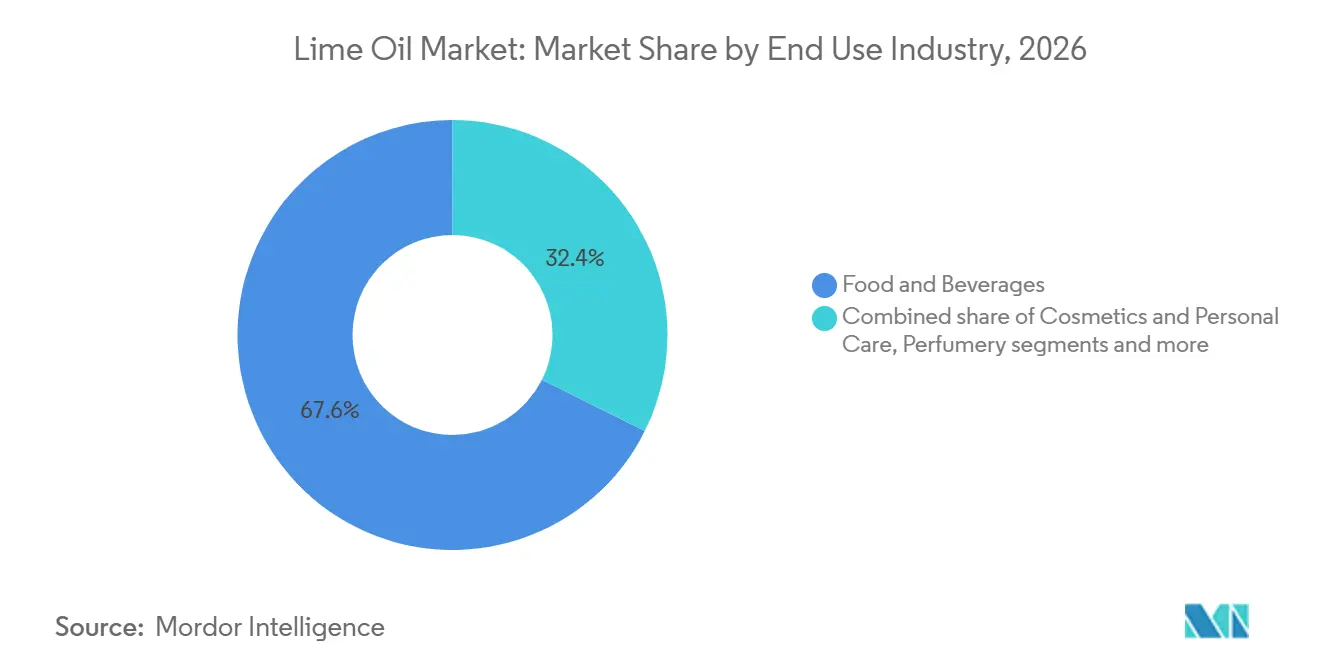
Food and beverages accounted for 34.63% of end-use demand in 2026. Lime oil is used in carbonated beverages, ready-to-drink cocktails, flavored water, and confectionery. Its acidity profile also supports formulations designed to reduce sugar content. Limited orange supply can encourage the use of lime-forward blends when other citrus inputs become more expensive. Food and beverages, therefore, represent the volume base for the Lime Oil Market, supported by frequent reformulation activity across beverage categories.
Pharmaceuticals and dietary supplements represent relevant adjacent applications, as research has identified antimicrobial activity of Citrus aurantifolia peel oil against oral pathogens. Perfumery and household cleaning products generate stable demand, as d-limonene provides fragrance and cleaning benefits. Cosmetics and personal care are forecast to grow at a CAGR of 6.61% through 2032, representing the fastest growth rate among end-use segments. Clinical research, nanoemulsion delivery formats, and consumer preference for botanical fragrances support this expansion. Other uses, including food preservation, agricultural biopesticides, and bio-based solvents, remain smaller but offer longer-term applications for d-limonene.
Geography Analysis
North America holds a 39.12% share of the Lime Oil Market in 2026. The region benefits from supply chains linking Mexican growing areas with United States flavor houses and cold-pressing facilities. The Lime Oil Market depends on these connections, as close coordination among fruit handling, extraction, and flavor development helps minimize losses from perishable raw materials. High raw material costs have led some beverage manufacturers to explore citrus extender technologies. International Flavors & Fragrances established a Citrus Innovation Center in Lakeland, Florida, in collaboration with Florida Polytechnic University, to expand its application development capabilities. Canada contributes demand for premium natural personal care products, while Mexican processors serve domestic requirements and export markets.
Europe operates under stringent quality, traceability, and safety requirements for lime oil imports. Consequently, traceability is a commercial requirement in the Lime Oil Market rather than a post-procurement documentation exercise. Natural flavor authentication regulations and cosmetics requirements favor suppliers with verified sourcing practices and comprehensive product documentation. Germany, the United Kingdom, and France represent key demand centers, supported by their established flavor and fragrance industries.
Asia-Pacific is expected to register a CAGR of 6.87% through 2032, the fastest growth rate among regions in the Lime Oil Market. Rising middle-class consumption, local formulation activities, and investments by multinational flavor and fragrance companies support this outlook. India is a major producer, Sri Lanka supplies certified organic distilled grades, and Indonesia and Thailand are emerging as processing and consumption centers. Peru is also expanding its role as an exporter, while Brazil provides an additional regional sourcing alternative. The Middle East and Africa remain smaller markets; however, premium fragrance and personal care demand is increasing in the United Arab Emirates and Saudi Arabia, while South Africa serves as a regional distribution hub.
Competitive Landscape
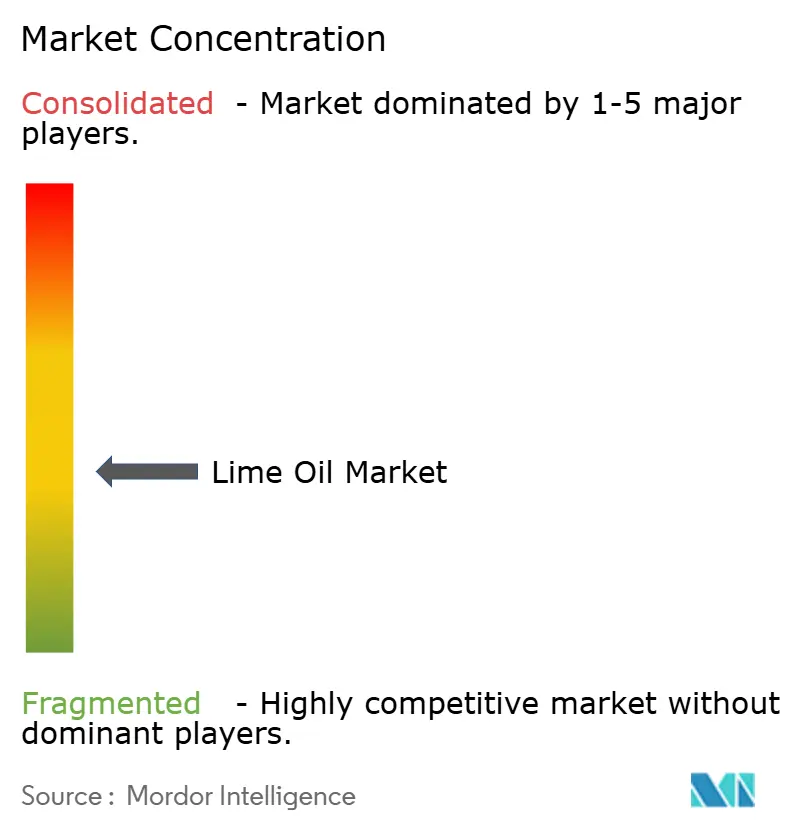
The lime oil market is moderately fragmented, with Givaudan, DSM-Firmenich, International Flavors & Fragrances, and Symrise operating alongside specialist citrus extractors and regional essential oil producers. Large companies compete through application development, global sourcing, and formulation-stability technologies. DSM-Firmenich and Givaudan are expanding capacity in Asia-Pacific, where both consumption and local production are growing. International Flavors & Fragrances Citrus Innovation Center in Florida enhances its customer-facing development capabilities in North America.
Döhler Group acquired a 28% interest in Treatt after Natara Global's proposed acquisition lapses in November 2025. Under a formal relationship agreement, Treatt appointed Helga Moelschl as a non-independent non-executive director in February 2026. Such local commercial presence helps lime oil suppliers adapt their offerings to regional beverage, fragrance, and personal care requirements. These actions demonstrate how mid-sized specialists use commercial partnerships and regional infrastructure to manage pricing pressure.
Phototoxin-free and stability-optimized lime oil grades offer significant opportunities in leave-on cosmetics and sun care applications. Smaller suppliers, including Berjé, Ultra International, Aromaaz International, Lionel Hitchen, Citrus and Allied Essences, Ungerer, CIFAL HERBAL, The Lebermuth Co., Natures Natural India, and Young Living, use direct sourcing across Peru, Sri Lanka, and Southeast Asia to improve availability during Mexican supply disruptions. Mexican extractors and processors, including Citrolim, Citrojugo, Citricos de Apatzingan, Citricos Vega Hermanos, and Grupo Tecnaal, remain important because they connect growing areas with oil recovery and export activities. Consequently, the lime oil market places greater emphasis on documented handling practices and application testing as products progress from raw oil to finished formulations. The industry therefore rewards technical reliability and sourcing flexibility, in addition to raw material access.
Lime Oil Industry Leaders
-
Citrolim
-
Citrojugo
-
Givaudan SA
-
DSM-firmenich AG
-
Symrise AG
- *Disclaimer: Major Players sorted in no particular order
Recent Industry Developments
- December 2025: Symrise completed the acquisition of Floral Concept, strengthening its Premium Naturals position within the Grasse fragrance cluster. The acquisition also expanded the company’s natural ingredient sourcing and transformation capabilities for premium citrus and fragrance ingredients.
- June 2024: IFF introduced Lime Oil CP Persian Mexico FCR LMR, a cold-pressed Persian lime oil derived from fruit peels, as part of its Pure Premium Citrus range. The launch expanded the company’s portfolio of natural fragrance ingredients for home care, fabric care, and air care applications.
- April 2024: Berjé acquired Global Citrus International and Acelim del Peru, companies engaged in the cultivation and processing of lime-based products, including lime essential oils, lime juice, and lime peel. This acquisition expanded Berjé’s direct access to lime production and processing operations in Peru, strengthening its sourcing and supply capabilities.
Global Lime Oil Market Report Scope
Lime oil is an essential oil extracted from lime fruit peel, valued for its fresh citrus aroma and flavouring properties.
The global lime oil market is segmented by product type, nature, end-use industry, and geography. By product type, the market is segmented into cold-pressed lime oil, distilled lime oil, and others. By nature, the market is segmented into organic and conventional. By end-use industry, the market is segmented into food and beverages, cosmetics and personal care, pharmaceuticals and dietary supplements, perfumery, household and cleaning products, aromatherapy, and others. Based on geography, the market is classified into North America, Europe, South America, Asia-Pacific, and the Middle East and Africa. The market forecasts are provided in terms of value (USD).
| Cold-Pressed Lime Oil |
| Distilled Lime Oil |
| Others |
| Organic |
| Conventional |
| Food and Beverages |
| Cosmetics and Personal Care |
| Pharmaceuticals and Dietary Supplements |
| Perfumery |
| Household and Cleaning Products |
| Aroma Theraphy |
| Others |
| North America | United States |
| Canada | |
| Mexico | |
| Rest of North America | |
| Europe | Germany |
| United Kingdom | |
| Italy | |
| France | |
| Spain | |
| Netherlands | |
| Rest of Europe | |
| Asia-Pacific | China |
| India | |
| Japan | |
| Australia | |
| Indonesia | |
| Thailand | |
| Rest of Asia-Pacific | |
| South America | Brazil |
| Argentina | |
| Rest of South America | |
| Middle East and Africa | South Africa |
| Saudi Arabia | |
| United Arab Emirates | |
| Turkey | |
| Rest of Middle East and Africa |
| By Product Type | Cold-Pressed Lime Oil | |
| Distilled Lime Oil | ||
| Others | ||
| By Nature | Organic | |
| Conventional | ||
| By End Use Industry | Food and Beverages | |
| Cosmetics and Personal Care | ||
| Pharmaceuticals and Dietary Supplements | ||
| Perfumery | ||
| Household and Cleaning Products | ||
| Aroma Theraphy | ||
| Others | ||
| By Geography | North America | United States |
| Canada | ||
| Mexico | ||
| Rest of North America | ||
| Europe | Germany | |
| United Kingdom | ||
| Italy | ||
| France | ||
| Spain | ||
| Netherlands | ||
| Rest of Europe | ||
| Asia-Pacific | China | |
| India | ||
| Japan | ||
| Australia | ||
| Indonesia | ||
| Thailand | ||
| Rest of Asia-Pacific | ||
| South America | Brazil | |
| Argentina | ||
| Rest of South America | ||
| Middle East and Africa | South Africa | |
| Saudi Arabia | ||
| United Arab Emirates | ||
| Turkey | ||
| Rest of Middle East and Africa | ||
Key Questions Answered in the Report
What is the current and projected size of the lime oil market, and what is its expected growth rate?
The lime oil market was valued at USD 534.67 million in 2026 and is estimated to reach USD 562.67 million in 2027. The market is forecast to grow to USD 741.93 million by 2032, registering a CAGR of 5.69% during 2027-2032.
Which product type held the largest share of the lime oil market in 2026?
Cold-pressed lime oil was the leading product type, accounting for 61.78% of the market in 2026.
Which nature segment dominated the lime oil market in 2026?
The conventional segment dominated the market with a 67.63% share in 2026.
Which end-use industry accounted for the largest share of the lime oil market in 2026?
The food and beverages industry held the largest market share, accounting for 34.63% of total revenue in 2026.
Which region held the largest share of the lime oil market in 2026?
North America led the market, capturing 39.12% of the total market share in 2026.