
Leonardite Market Size and Share
Market Overview
| Study Period | 2021 - 2031 |
|---|---|
| Market Size (2026) | USD 0.85 Billion |
| Market Size (2031) | USD 1.15 Billion |
| Growth Rate (2026 - 2031) | 6.23 % |
| Fastest Growing Market | North America |
| Largest Market | Asia-Pacific |
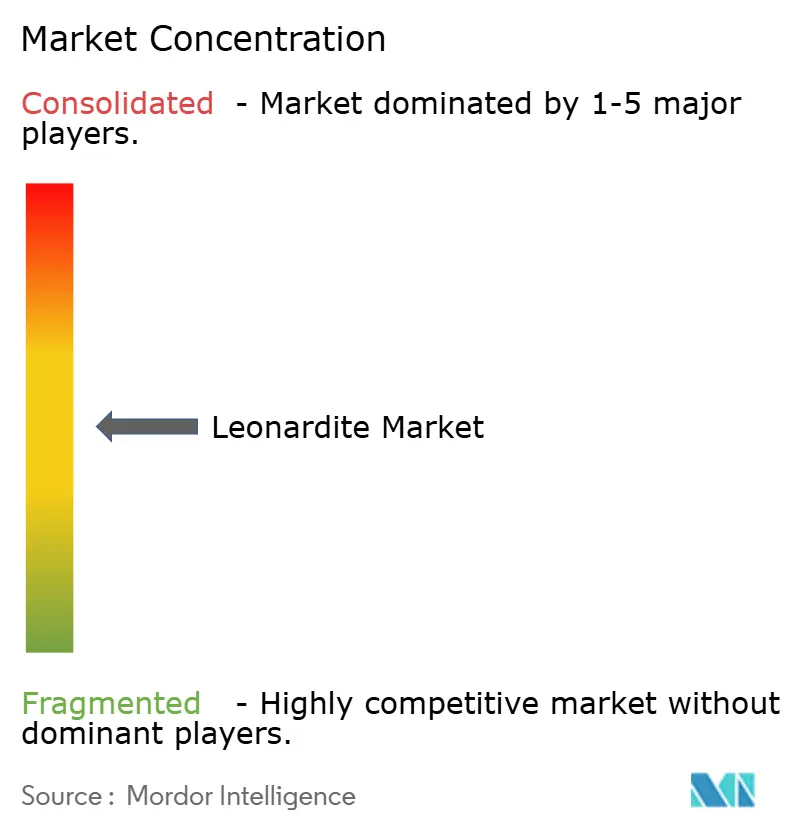
| Market Concentration | Medium |
Major Players *Disclaimer: Major Players sorted in no particular order Image © Mordor Intelligence. Reuse requires attribution under CC BY 4.0. | |
Leonardite Market Analysis by Mordor Intelligence
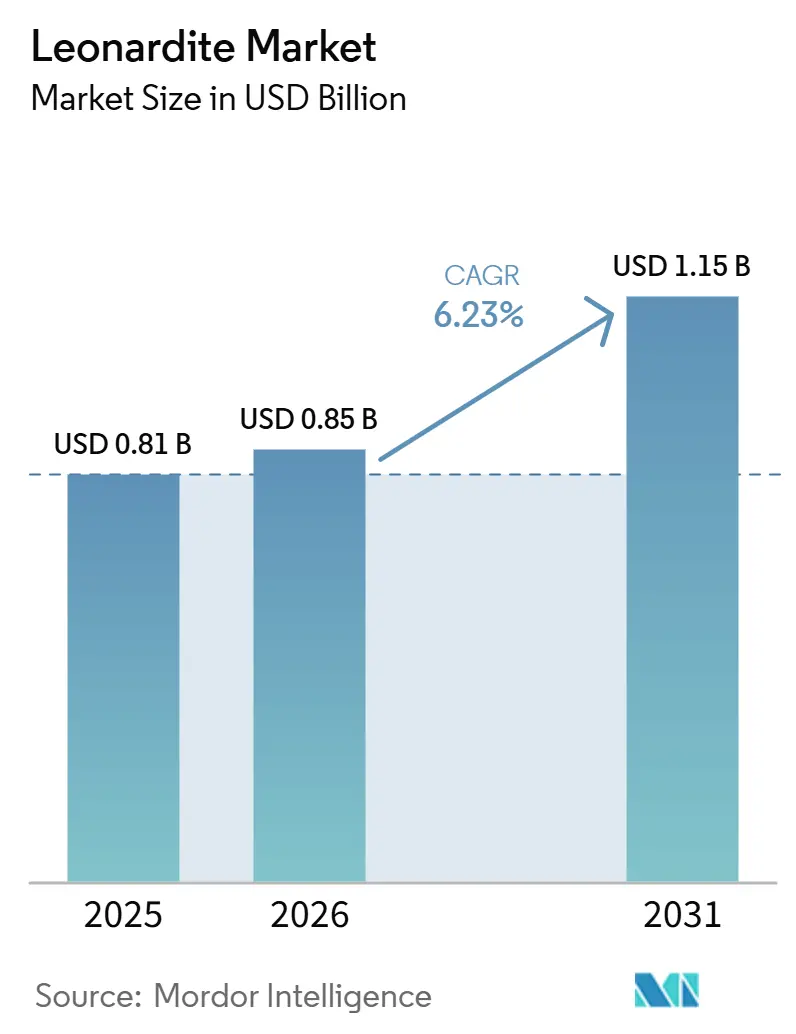
The leonardite market size is anticipated to increase from USD 0.81 billion in 2025 and USD 0.85 billion in 2026, to reach USD 1.15 billion by 2031, growing at a CAGR of 6.23% over 2026-2031. The market is gaining support from a wider shift toward soil health management, as growers now treat soil structure, nutrient retention, and root-zone performance as core yield inputs rather than secondary practices. Certified organic acreage, residue-sensitive crop systems, and regenerative farming programs are also strengthening demand, as leonardite aligns with procurement rules that restrict many conventional soil inputs. A second layer of growth is coming from precision fertigation, where liquid humate formulations are better aligned with drip irrigation, greenhouse production, and specialty crop systems that need consistent application through irrigation hardware. Competitive positioning in the market depends less on scale alone and more on deposit quality, formulation consistency, agronomic validation, and route-to-market depth, which keeps room open for regional suppliers as well as vertically integrated producers. The outlook remains favorable because soil restoration funding, nutrient efficiency needs, and digital input purchasing are moving on separate tracks and still point in the same direction for repeat agricultural use.
Key Report Takeaways
- By product form, solid leonardite led with 58.2% of the leonardite market size in 2025, while liquid leonardite is anticipated to expand at an 8.1% CAGR during 2026-2031.
- By application, soil conditioner accounted for 42.2% of the leonardite market share in 2025, while fertigation is estimated to advance at an 8.5% CAGR during 2026-2031.
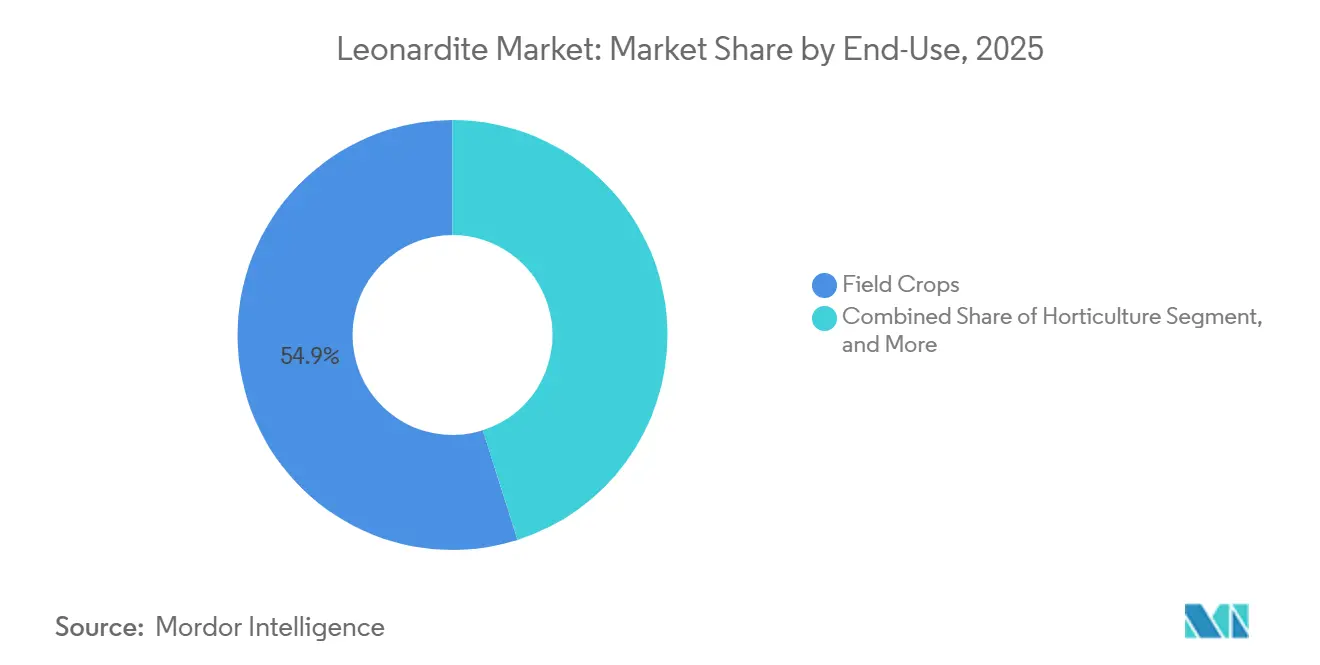
- By end-use, field crops accounted for 54.9% of the leonardite market share in 2025, while horticulture recorded the fastest projected CAGR of 7.0% during 2026-2031.
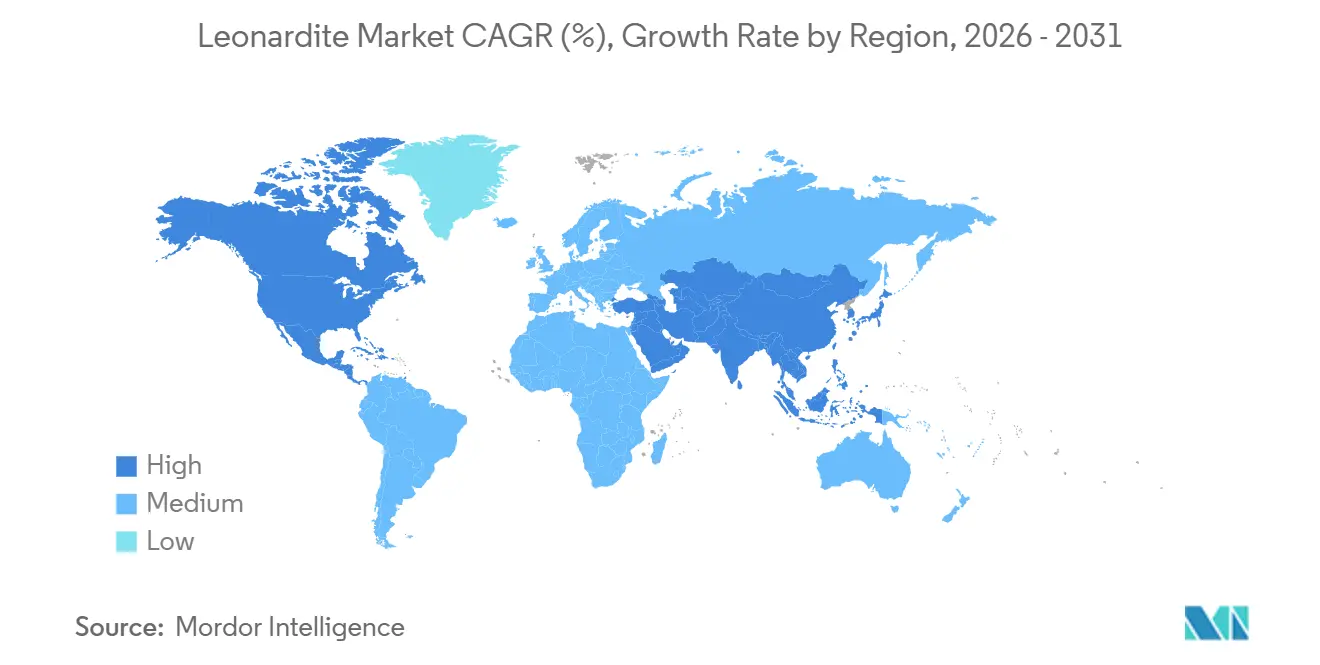
- By geography, North America held 52.5% of the leonardite market share in 2025, while Asia-Pacific posted the highest projected CAGR at 7.8% during 2026-2031.
Note: Market size and forecast figures in this report are generated using Mordor Intelligence’s proprietary estimation framework, updated with the latest available data and insights as of January 2026.
Market Trends and Insights
Drivers Impact Analysis of Leonardite Market*
| Driver | (~) % Impact on CAGR Forecast | Geographic Relevance | Impact Timeline |
|---|---|---|---|
| Rising adoption of leonardite-based soil conditioners in sustainable agriculture | +1.40% | Global | Short term (≤ 2 years) |
| Expansion of organic and regenerative farming programs | +1.20% | Global, with North America and Europe leading and spillover to South America and Africa | Medium term (2-4 years) |
| Precision fertigation and liquid humate compatibility gains | +1.00% | North America and Europe, with growing relevance in Asia-Pacific core markets | Medium term (2-4 years) |
| Demand for higher nutrient use efficiency under input cost pressure | +0.90% | Global | Short term (≤ 2 years) |
| Soil carbon restoration and resilience farming adoption | +0.70% | North America and Europe, with spillover to Asia-Pacific and South America | Long term (≥ 4 years) |
| Certification-driven demand from organic and residue-constrained crop systems | +0.60% | Global, with North America and Europe leading | Long term (≥ 4 years) |
| Source: Mordor Intelligence | |||
Rising Adoption of Leonardite-Based Soil Conditioners in Sustainable Agriculture
The leonardite market is benefiting from a wider move toward soil conditioners that improve the physical and biological condition of farmland, not only short-term nutrient supply. Growers are paying closer attention to root development, water retention, and soil aggregation because those factors shape yield stability across repeated crop cycles. Leonardite fits this requirement well because its humic content supports cation exchange and helps retain nutrients in the root zone for longer use. This makes the product easier to justify in field crop systems where purchase decisions are often tied to repeat performance rather than one-season response. The same pattern supports stronger demand in horticulture and greenhouse production, where soil quality issues show up quickly in crop performance. The market also gains from the fact that soil health products can stay relevant even when fertilizer plans change, since they support the soil system itself. This gives leonardite a role that is adjacent to standard fertilizer programs rather than fully dependent on them. As a result, the leonardite market is seeing repeat demand from growers who now measure soil structure and nutrient retention as direct operating priorities.
Expansion of Organic and Regenerative Farming Programs
The leonardite market is also supported by the steady expansion of organic and regenerative farming programs across major producing regions. According to the Research Institute of Organic Agriculture (FiBL), global organic farmland reached 98.9 million hectares in 2024, while certified organic producers totaled 4.8 million across nearly 190 countries, which shows that approved soil inputs now serve a much larger user base than before[1]Source: FiBL and IFOAM – Organics International, “The World of Organic Agriculture: Statistics and Emerging Trends 2026,” Biofach, fibl.org. This matters because many certified systems narrow the range of acceptable soil amendments, which strengthens the position of leonardite products that meet organic or low-residue procurement rules. Africa’s significant increase in certified organic farmland also points to the emergence of new demand in regions where soil restoration and input efficiency are both important. The United States Department of Agriculture Natural Resources Conservation Service launched the Regenerative Pilot Program in December 2025, allocating USD 700 million for fiscal year 2026 to bring soil-supportive practices into funded farm programs. The market benefits from this shift because funded conservation adoption usually creates more stable buying behavior than purely discretionary purchases. It also broadens the addressable base to small and mid-sized growers who previously had less reason to commit to repeated soil amendment use. Over time, this makes the market less dependent on niche organic channels and more connected to mainstream conservation spending.
Precision Fertigation and Liquid Humate Compatibility Gains
Precision fertigation is becoming a strong growth path for the leonardite market because it changes how soil-support products are delivered at the farm level. Drip systems, variable-rate irrigation controls, and sensor-led nutrient management all favor inputs that dissolve cleanly and remain stable during repeated application events. Liquid leonardite fits this use pattern because it can be applied directly into the root zone, which is valuable in orchards, protected vegetables, and greenhouse systems. A 2026 review in Applied Water Science described how precision fertigation is improving crop and soil management through more targeted water and nutrient delivery, which supports the commercial case for consistent liquid humate formulations[2]Source: Muhammad et al., “Enhancing Crop Productivity and Soil Health Through Precision Fertigation, Advancements, Challenges and Future Prospects,” Applied Water Science, link.springer.com. The market gains additional momentum because this delivery method typically delivers a higher realized value per hectare than standard broadcast. This kind of crop-level evidence makes adoption easier in professional farming systems that want application precision and measurable nutrient response. The result is a leonardite market that increasingly captures value from application quality as much as from raw product volume.
Demand for Higher Nutrient Use Efficiency Under Input Cost Pressure
The leonardite market is advancing because growers are under pressure to use fertilizer more efficiently instead of simply applying more. The International Fertilizer Association reported that global nitrogen, phosphorus, and potassium consumption reached 205 million nutrient metric tons in 2025[3]Source: International Fertilizer Association, “Public Summary Medium-Term Fertilizer Outlook 2025-2029,” International Fertilizer Association, fertilizer.org, yet affordability remained under strain, which pushes farms to focus on input return per unit applied. A 2025 Nature Communications study also showed that nutrient use efficiency stayed below 50% for rice and maize across much of the world, with major nitrogen and phosphorus surpluses in large farming economies. Leonardite supports this need because humic substances improve nutrient retention and help keep applied inputs available in the soil-root system. That means the product is not positioned as a replacement for fertilizer, but as a support input that helps improve the performance of existing fertilizer plans. This distinction matters because it keeps the market relevant in conventional farming systems that are not shifting to certified organic production. It also supports repeat use in crops where yield response alone may not justify major changes in nutrient strategy, but better use efficiency still has clear value. For the leonardite market, input cost pressure is therefore acting as a practical adoption driver rather than a short-term price story.
Restraints Impact Analysis of Leonardite Market*
| Restraint | (~) % Impact on CAGR Forecast | Geographic Relevance | Impact Timeline |
|---|---|---|---|
| Feedstock variability across leonardite deposits | -0.70% | Global, with Asia-Pacific and South America more exposed to inconsistent import quality | Short term (≤ 2 years) |
| Product efficacy depends on soil type, pH, and application practice | -0.50% | Global | Medium term (2-4 years) |
| Farmer awareness of humic acid performance remains limited | -0.40% | Asia-Pacific core markets, with spillover to Africa and South America | Long term (≥ 4 years) |
| Alternative humates, biostimulants, and compost inputs create substitution pressure | -0.50% | Global | Medium term (2-4 years) |
| Source: Mordor Intelligence | |||
Feedstock Variability Across Leonardite Deposits
A major restraint for the leonardite market is the wide variation in raw material quality across deposits and mining regions. Buyers do not purchase leonardite only by origin, they also judge it by humic content, oxidation level, consistency, and downstream formulation performance. When producers switch sources or blend material from different mines, finished product performance can become less predictable from batch to batch. That creates difficulty for distributors and growers who expect repeatable field response, especially in liquid formulations and premium agricultural programs. Omnia Group’s positioning around high-oxidation Australian feedstock shows that the deposit profile can be a commercial differentiator rather than a background detail. China’s GB/T 34765-2024 standard, implemented in 2025, also underscores the need for clearer measurement of fulvic acid in fertilizers and soil conditioners, reflecting how quality dispersion affects the wider humic products space. The market is more exposed, with uneven import oversight and buyers lacking independent testing support. In those settings, quality uncertainty can delay procurement decisions, weaken product claims, and reduce trust in suppliers that cannot prove stable source quality.
Product Efficacy Sensitivity to Soil Type, pH, and Application Practice
The leonardite market also faces a practical restraint: product performance varies with soil type, pH, and application method. Leonardite does not produce the same outcome in every field, even when the product itself is consistent. Response can vary with salinity, alkalinity, soil texture, crop choice, irrigation method, and whether the grower applies the material as part of a supporting nutrient program. This creates a sales challenge because many farmers still judge value by visible seasonal yield effects rather than by longer-term soil improvement. Research and technical guidance on precision fertigation show that the delivery method matters greatly, meaning that poor application fit can reduce the value growers see from humic products. The same issue occurs in field conditions, where leonardite is used without soil analysis or crop-specific dosage guidance. In those cases, underperformance is often linked to agronomic mismatch rather than product failure, but the commercial outcome can still be lower repeat purchasing. For the leonardite market, this restraint favors suppliers that pair products with technical advice and makes entry harder for low-support competitors.
*Our forecasts treat driver/restraint impacts as directional, not additive. The impact forecasts reflect baseline growth, mix effects, and variable interactions.
Leonardite Market Segment Analysis
By Product Form:
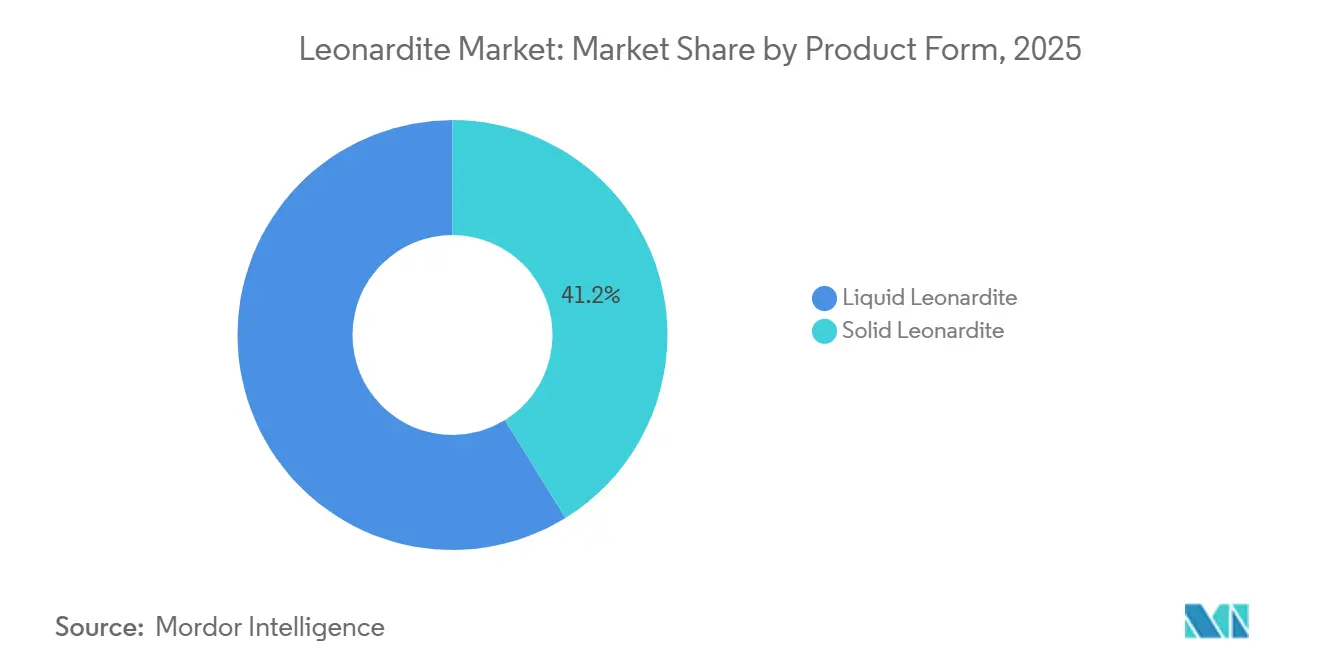
Liquid Leonardite Captures the Precision Agriculture PremiumSolid leonardite held 58.2% of the leonardite market size in 2025, supported by its long-standing use in broadcast and in-furrow programs across field crops. Granules and powders remain the volume base because they store well, move efficiently in bulk, and fit established dealer channels. This gives the leonardite market a dependable foundation in large-acre cereal and oilseed systems. Liquid material remained smaller, but it gained favor where cleaner delivery and faster field integration mattered most. The segment mix still reflects a balance between logistics efficiency, formulation fit, and farm application practice.
Liquid leonardite is estimated to grow at an 8.1% CAGR through 2031, making it the fastest-moving product form in the market. Growth is strongest in orchards, protected vegetables, greenhouse systems, and controlled environment agriculture, where growers can quickly measure responses and justify premium formulations. Humintech GmbH has aligned with this shift through fertigation-ready lines such as Liqhumus Liquid 18, which are designed for irrigation-based delivery rather than bulk soil spreading. Omnia Group also uses deposit quality and formulation consistency to compete in the export-oriented liquid humate market. Across the leonardite industry, this pattern shows a gradual move from simple bulk supply toward higher-value application-specific formulations.



By Application:
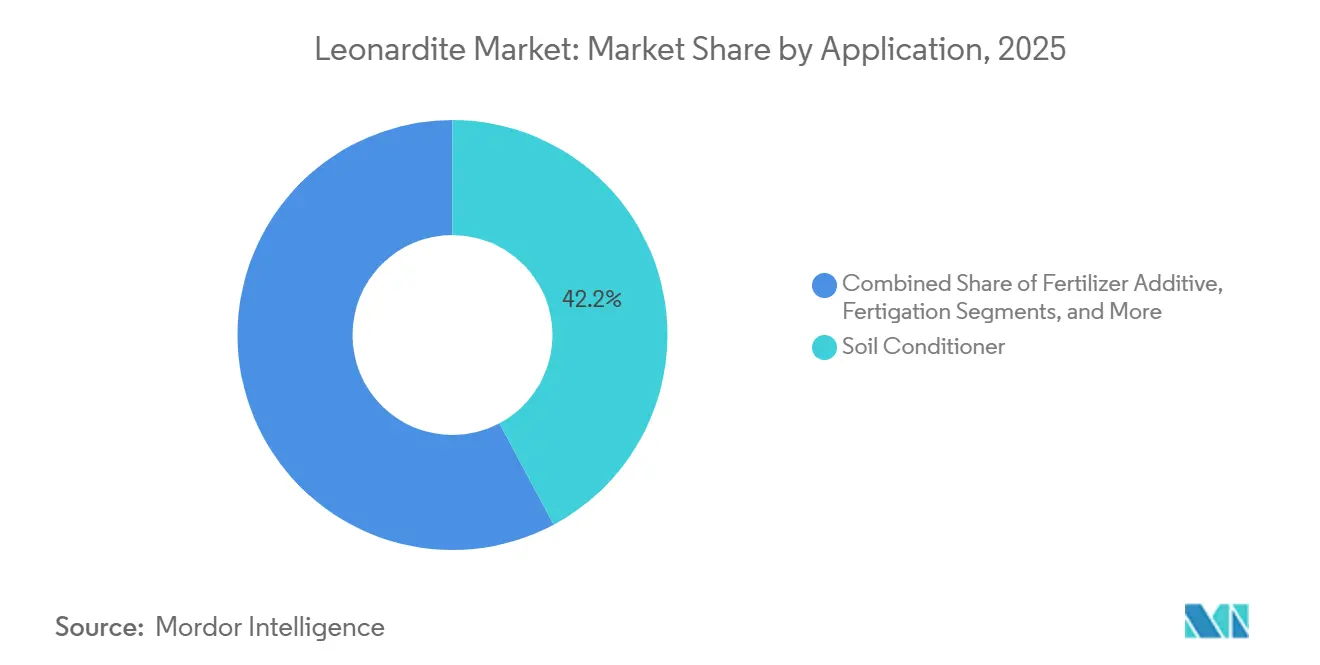
Soil Conditioning Underpins Volume, Fertigation Drives Premium GrowthSoil conditioner accounted for 42.2% of the leonardite market in 2025, reflecting its deep use in cereal and oilseed rotations, where organic matter depletion remains a long-term concern. Fertilizer additives were identified as an important use because humic substances help improve nutrient availability within existing fertility programs. Seed treatment and other agricultural uses remained smaller, but they served specialized crop needs and soil-repair programs. This structure keeps the market anchored in broad-acre agronomy rather than a narrow specialty niche. It also shows that the category still derives most of its volume from routine soil management rather than one-off interventions.
Fertigation is anticipated to grow at an 8.5% CAGR through 2031, making it the fastest-growing application in the leonardite market. The strongest pull is coming from vegetables, fruit crops, orchards, and protected cultivation, where drip infrastructure supports direct root-zone delivery. Daymsa's (Samca Group) Naturvital Plus registration in September 2025 illustrates how liquid leonardite-derived products are being positioned within more formal plant biostimulant and irrigation-led programs. Chinese field research also showed that applying fulvic acid with phosphorus improved corn yield and phosphorus use efficiency, further strengthening the case for precise crop nutrition integration. Within the leonardite industry, fertigation is therefore becoming a higher-value use case rather than simply another delivery option.
By End-Use:
Field Crops Anchor Revenue, Horticulture Sets the Growth PaceField crops accounted for 54.9% of revenue in 2025 and represented the broadest demand base in the leonardite market. Wheat, rice, maize, soybean, and cotton systems support this lead because they cover large acreage and already use repeat soil-support practices in many regions. Turf and ornamentals, along with greenhouse production, remained smaller but commercially distinct because they buy on performance and specification rather than volume alone. This mix provides the leonardite market with both scale and diversification among agricultural users. It also reduces dependence on any single crop cycle or on a single regional farming model.
Horticulture is estimated to expand at a 7.0% CAGR through 2031, making it the fastest-growing end-use segment in the leonardite market. Higher per-hectare crop value in vegetables, fruit, and ornamentals supports premium spending on inputs that improve root activity, nutrient retention, and irrigation performance. Greenhouse and controlled environment agriculture are also important because growers can observe responses more clearly and adjust programs faster than in open-field farming. Research published in the National Library of Medicine showed that humalite improved soil nitrogen availability and plant uptake across multiple growing seasons, supporting the value case for premium use settings in 2025[4]Source: PMC / National Library of Medicine, “The Effect of Humalite on Improving Soil Nitrogen Availability and Plant Uptake,” National Library of Medicine, pmc.ncbi.nlm.nih.gov. In the leonardite market, this keeps specialty crop demand on a stronger growth path than the already mature field crop base.
Geography Analysis
The Americas Leonardite Market
North America accounted for 52.5% of the leonardite market in 2025 and remained the largest regional contributor. The region combines high-quality deposits in New Mexico, Wyoming, and Alberta with mature agricultural distribution and technical usage patterns. The United States Department of Agriculture Natural Resources Conservation Service Regenerative Pilot Program, launched in December 2025 with USD 700 million for fiscal year 2026, adds a funded demand signal for soil-focused agricultural practices. Canada supports regional supply through Alberta humalite production, which serves both domestic agriculture and export markets. South America is becoming more relevant, especially in Brazil and Argentina, where large row-crop systems and degraded soils provide a practical case for repeated soil-restoration inputs.
EMEA Leonardite Market
Europe remained one of the more structured regions in the leonardite market, thanks to regulatory and sustainability policies that support orderly product access. Regulation (European Union) 2019/1009 provides producers with a common framework for soil improvers and non-microbial plant biostimulants, helping approved products move across member states more efficiently. The Middle East remains an active agricultural use market for humic soil stabilization, while Africa still starts from a smaller base but gains long-term support from expanding certified organic area.
APAC Leonardite Market
Asia-Pacific is anticipated to record the fastest regional CAGR at 7.8% through 2031 in the leonardite market. China is a central driver because fertilizer reduction programs and domestic humic product supply have made the shift toward efficiency-oriented inputs more operational than symbolic. Regional growth also reflects strong agronomic need in intensive farming systems where soil condition and fertilizer efficiency remain persistent concerns. Japan, South Korea, and Australia add a more mature layer to regional demand, with stronger emphasis on precision-formulated inputs for protected horticulture and specialty crops.

Competitive Landscape
The leonardite market is moderately fragmented, with players such as HGS BioScience, Leonardite Products LLC, Humintech GmbH, Black Earth Humic (WestMET), and Omnia Specialties Australia Pty Ltd (Omnia Group) accounting for a significant share of revenue in 2025. HGS BioScience led the market, followed by Leonardite Products LLC and Humintech GmbH, which shows that leadership exists but does not close the field to smaller competitors. This structure keeps the leonardite market open to regional suppliers, deposit-specific specialists, and application-focused brands. HGS BioScience has strengthened its position through vertical integration and portfolio expansion, including its April 2025 acquisitions of Menefee Mining Corporation and Earthgreen Products, Inc. Those moves demonstrate a clear strategy to build a broader biological inputs platform around leonardite access and formulation capabilities.
Leonardite Products LLC remains competitive through distribution depth and product alignment with certified organic procurement, which matters in both dealer-led and online channels. Humintech GmbH has focused on international market development, with 2025 activity in Morocco and Ukraine showing an emphasis on technical channel building rather than only share defense in Europe. Omnia Group continues to differentiate through control of feedstock quality and finished liquid formulations, which supports export-oriented positioning in premium agricultural use cases.
The leonardite market still leaves meaningful white space in Southeast Asia and sub-Saharan Africa, where commercial agriculture is expanding faster than technical input support systems. In those regions, suppliers that combine product access with soil-specific application guidance may gain faster traction than those selling on price alone. Biorex LLC shows how smaller operators can still build credibility through regulatory approvals, including certification from the Italian Ministry of Agriculture for leonardite and potassium humate products. Across the market, transparent product specification, proven field performance, and dependable source quality remain stronger competitive tools than simple production scale.
Leonardite Industry Leaders
HGS BioScience
Leonardite Products LLC
Humintech GmbH
Omnia Specialities Australia Pty Ltd (Omnia Group)
Black Earth Humic (WestMET)
- *Disclaimer: Major Players sorted in no particular order
Leonardite Market Companies Covered in this Report
- HGS BioScience
- Leonardite Products LLC
- Leonardita del Ebro
- Black Earth Humic (WestMET)
- Humintech GmbH
- Huma, Inc.
- Biorex LLC
- Shandong Chuangxin Humic Acid Technology Co., Ltd
- Omnia Specialities Australia Pty Ltd (Omnia Group)
- Canadian Humalite International Inc.
- Humate International
- Daymsa (Samca Group)

Recent Industry Developments in Leonardite Market
- October 2025: HGS BioScience acquired NutriAg Ltd., a Toronto-based developer of bionutritional technologies. The transaction expanded HGS BioScience's North American footprint and integrated NutriAg's proprietary PolyAldoCarbosate platform with the company's HumiK ONE and GrowPlex product lines, broadening its portfolio across humic and fulvic acids, and microbial technologies.
- September 2025: Daymsa (Samca Group) obtained European Union registration for Naturvital Plus as a non-microbial plant biostimulant (Category PFC 6(B)) under Regulation (European Union) 2019/1009. The registration, one of the first achieved for a liquid activated leonardite product within the European Union biostimulant framework.
- April 2025: HGS BioScience acquired Menefee Mining Corporation and Earthgreen Products, Inc., securing access to the world-renowned Menefee Formation leonardite reserves in New Mexico. The acquisition completed the company's vertical integration from mine to finished formulation and expanded its portfolio of patented granule, powder, and liquid extracted humate products


Global Leonardite Market Report Scope
Leonardite is a naturally oxidized form of lignite (brown coal) characterized by a high concentration of humic substances, including humic acid and fulvic acid. The Leonardite Market Report is Segmented by Product Form (Solid Leonardite and Liquid Leonardite), by Application (Soil Conditioner, Fertilizer Additive, Seed Treatment, Fertigation, and Other Agricultural Applications), by End-Use(Field Crops, Horticulture, Turf and Ornamentals, and Greenhouse and Controlled Environment Agriculture), and Geography (North America, South America, Europe, Asia-Pacific, the Middle East, and Africa). Market forecasts are provided in terms of value (USD).
| Solid Leonardite |
| Liquid Leonardite |
| Soil Conditioner |
| Fertilizer Additive |
| Seed Treatment |
| Fertigation |
| Other Agricultural Applications |
| Field Crops |
| Horticulture |
| Turf and Ornamentals |
| Greenhouse and Controlled Environment Agriculture |
| North America | United States |
| Canada | |
| Mexico | |
| Rest of North America | |
| South America | Brazil |
| Argentina | |
| Rest of South America | |
| Europe | Germany |
| France | |
| United Kingdom | |
| Spain | |
| Italy | |
| Russia | |
| Rest of Europe | |
| Asia-Pacific | China |
| India | |
| Japan | |
| South Korea | |
| Australia | |
| Rest of Asia-Pacific | |
| Middle East | Saudi Arabia |
| United Arab Emirates | |
| Rest of Middle East | |
| Africa | South Africa |
| Egypt | |
| Rest of Africa |
| By Product Form | Solid Leonardite | |
| Liquid Leonardite | ||
| By Application | Soil Conditioner | |
| Fertilizer Additive | ||
| Seed Treatment | ||
| Fertigation | ||
| Other Agricultural Applications | ||
| By End-Use | Field Crops | |
| Horticulture | ||
| Turf and Ornamentals | ||
| Greenhouse and Controlled Environment Agriculture | ||
| By Geography | North America | United States |
| Canada | ||
| Mexico | ||
| Rest of North America | ||
| South America | Brazil | |
| Argentina | ||
| Rest of South America | ||
| Europe | Germany | |
| France | ||
| United Kingdom | ||
| Spain | ||
| Italy | ||
| Russia | ||
| Rest of Europe | ||
| Asia-Pacific | China | |
| India | ||
| Japan | ||
| South Korea | ||
| Australia | ||
| Rest of Asia-Pacific | ||
| Middle East | Saudi Arabia | |
| United Arab Emirates | ||
| Rest of Middle East | ||
| Africa | South Africa | |
| Egypt | ||
| Rest of Africa | ||


Key Questions Answered in the Report
What is the projected value of the Leonardite market by 2031?
The leonardite market is projected to reach USD 1.15 billion by 2031, rising from USD 0.85 billion in 2026 at a 6.23% CAGR.
Which application area currently leads agricultural demand for leonardite?
Soil conditioner led demand with a 58.2% revenue share in 2025, reflecting widespread use in cereal and oilseed soil management programs.
Which application is growing fastest through 2031?
Fertigation is the fastest-growing application, with an anticipated 8.5% CAGR through 2031 as liquid formulations gain traction in drip and protected agriculture.
Which region leads revenue and which region grows fastest?
North America held 52.5% of 2025 revenue, while Asia-Pacific is projected to post the fastest CAGR at 7.8% through 2031.
Page last updated on:





