
Legal Practice Management Software Market Size and Share
Market Overview
| Study Period | 2020 - 2031 |
|---|---|
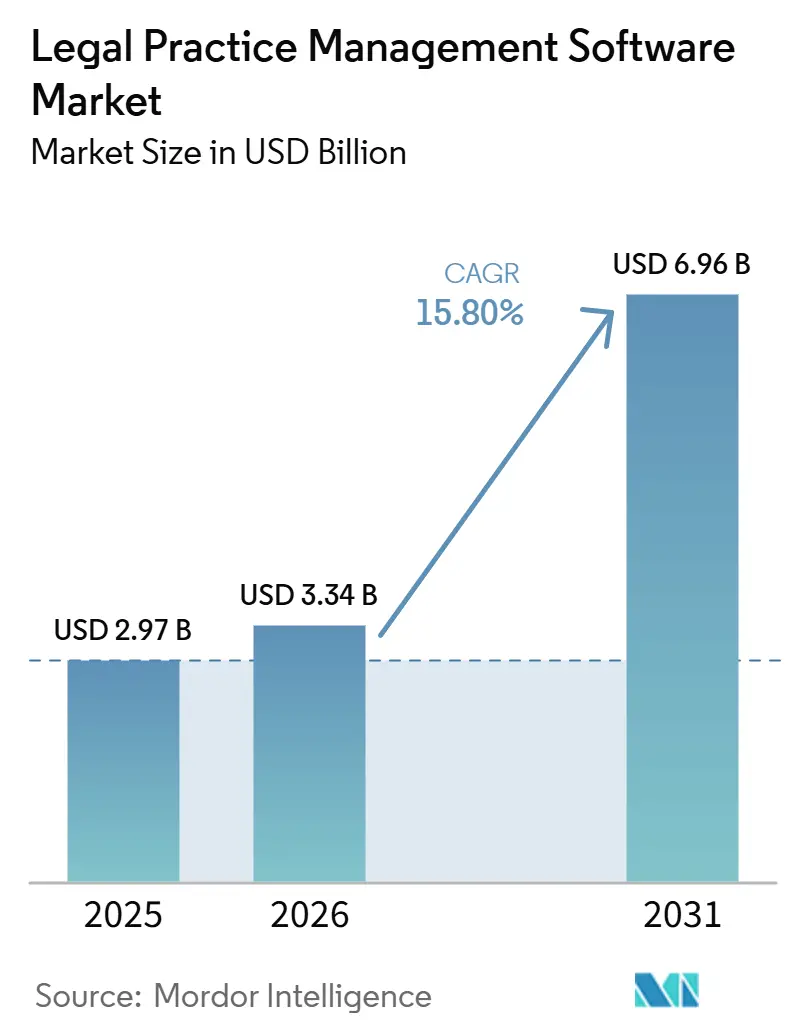
| Market Size (2026) | USD 3.34 Billion |
| Market Size (2031) | USD 6.96 Billion |
| Growth Rate (2026 - 2031) | 15.80 % |
| Fastest Growing Market | Asia-Pacific |
| Largest Market | North America |
| Market Concentration | Low |
Major Players *Disclaimer: Major Players sorted in no particular order Image © Mordor Intelligence. Reuse requires attribution under CC BY 4.0. | |
Legal Practice Management Software Market Analysis by Mordor Intelligence
The legal practice management software market size is expected to increase from USD 2.97 billion in 2025 to USD 3.34 billion in 2026 and reach USD 6.96 billion by 2031, growing at a CAGR of 15.80% over 2026-2031. The legal practice management software market is expanding because law firms and corporate legal teams are replacing disconnected on-premises tools with cloud platforms that bring case work, billing, documents, and client communication into one operating layer. Capital deployment in 2025 and 2026 showed that vendors and large legal organizations now treat these platforms as core infrastructure, which has accelerated product rollouts, acquisition activity, and AI-led platform investment across the sector. Demand is also moving beyond basic record keeping because clients expect faster matter updates, clearer billing visibility, and more transparent collaboration, which is pushing vendors to deepen workflow tools and portal features. Competitive positioning is increasingly shaped by the ability to combine governance controls, legal domain data, and AI automation in a way that large firms can adopt without weakening confidentiality standards. Growth opportunities remain strongest where subscription pricing lowers adoption barriers, hybrid deployment helps firms manage data residency and privilege concerns, and implementation services support more complex AI-enabled rollouts.
Key Report Takeaways
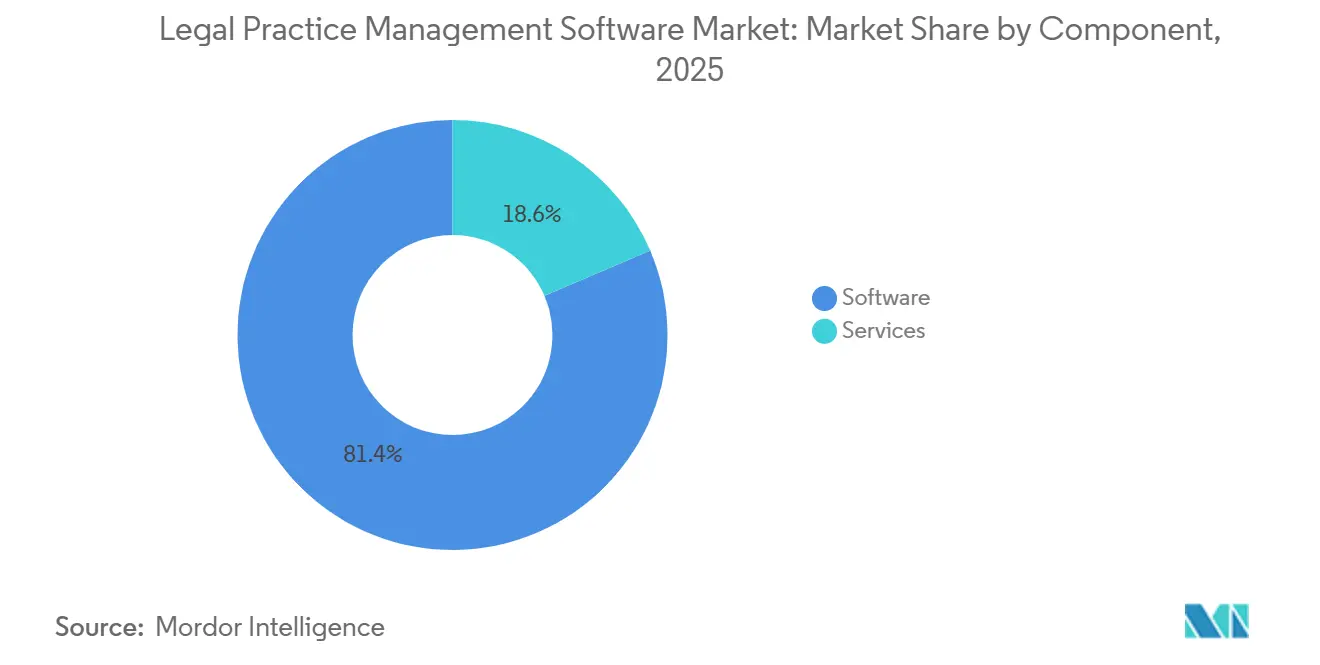
- By component, software held 81.43% of the legal practice management software market in 2025, while services are projected to expand at 17.92% through 2031.
- By deployment mode, cloud-based deployment accounted for 71.28% of the market in 2025, while hybrid deployment is projected to grow at 18.54% through 2031.
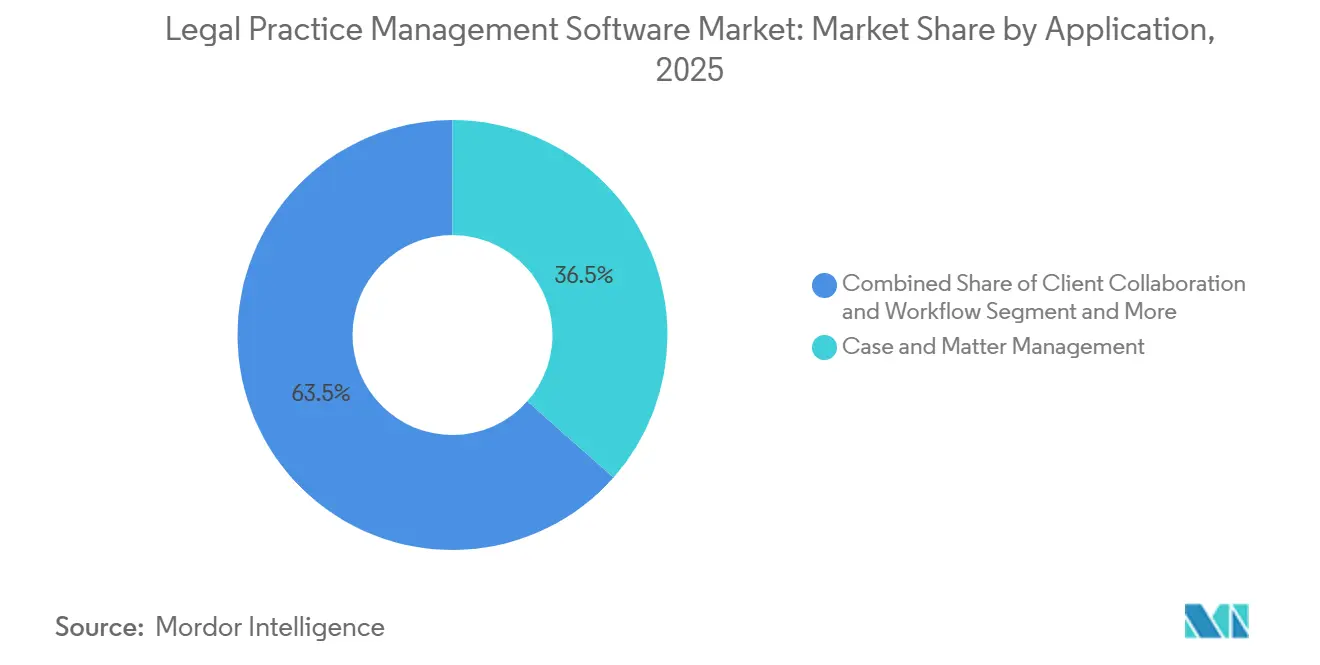
- By application, case and matter management represented 36.54% of the market in 2025, while client collaboration and workflow is projected to expand at 18.86% through 2031.
- By organization size, large enterprises held 65.81% of the market in 2025, while SMEs are projected to grow at 17.68% through 2031.
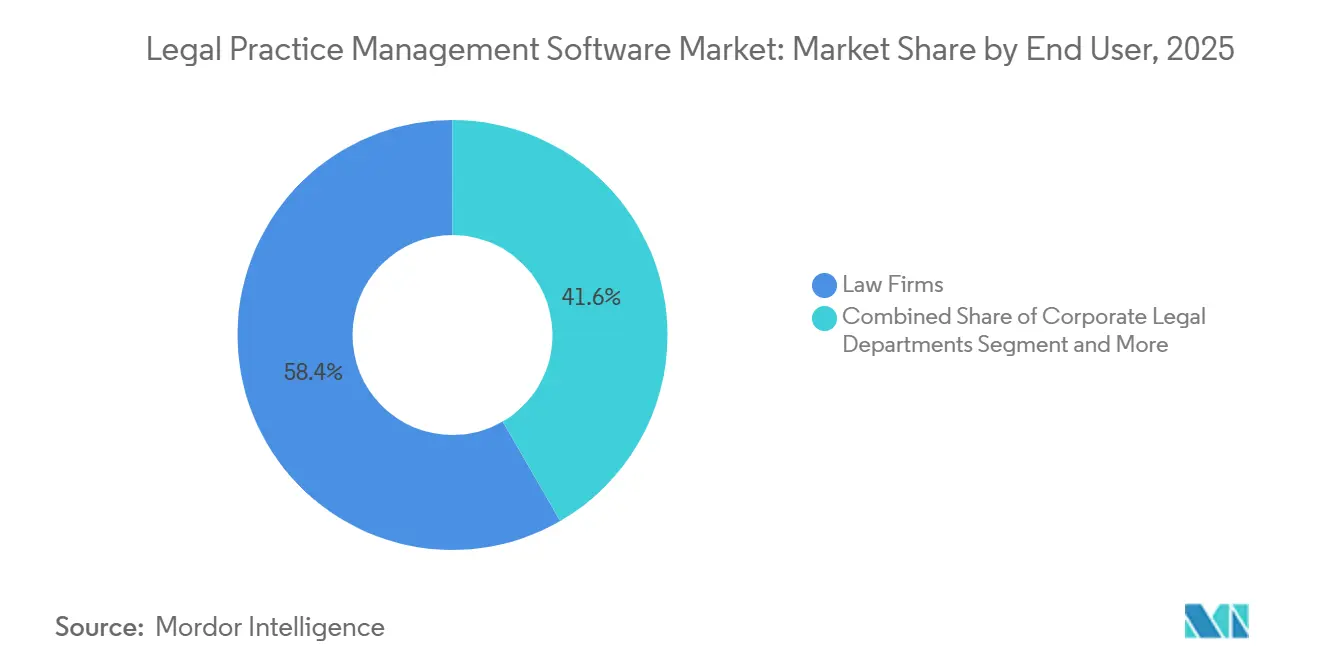
- By end user, law firms accounted for 58.36% of the market in 2025, while corporate legal departments are projected to advance at 18.21% through 2031.
- By geography, North America held 40.87% of the market in 2025, while Asia-Pacific is projected to expand at 20.36% through 2031.
Note: Market size and forecast figures in this report are generated using Mordor Intelligence’s proprietary estimation framework, updated with the latest available data and insights as of January 2026.
Market Trends and Insights
Drivers Impact Analysis of Legal Practice Management Software Market*
| Driver | (~) % Impact on CAGR Forecast | Geographic Relevance | Impact Timeline |
|---|---|---|---|
| Rising Cloud-First Modernization In Law Firms | +3.2% | Global, concentrated in North America and Europe | Short term (≤ 2 years) |
| AI-Assisted Matter And Workflow Automation | +2.8% | Global, with early gains in North America and Asia-Pacific | Short term (≤ 2 years) |
| Remote And Hybrid Legal Work Operating Models | +1.5% | North America and Europe | Medium term (2-4 years) |
| Client Demand For Faster Status Visibility And Self-Service Portals | +1.2% | North America, Asia-Pacific core, spill-over to Middle East and Africa | Medium term (2-4 years) |
| Compliance-Driven Auditability And Retention Controls | +0.9% | Global, with early gains in EU, United States, and Australia | Long term (≥ 4 years) |
| Consumption-Based Pricing Pressure On Legacy Per-Attorney Licenses | +0.6% | North America and Europe | Medium term (2-4 years) |
| Source: Mordor Intelligence | |||
Rising Cloud-First Modernization In Law Firms
Cloud migration has become a competitive requirement in the legal practice management software market because firms now need continuous product updates that on-premises systems cannot deliver at the same speed or with the same consistency. The Wolters Kluwer Benchmark Report 2026 found that 90.5% of German law firms planned to increase legal tech spending over the next 3 years, and law firm management software, AI applications, and cybersecurity stood among the leading priorities in that spending cycle.[1] This spending pattern matters because cloud delivery is closely tied to ongoing AI feature deployment, security updates, and product configuration changes that firms increasingly expect as part of standard service. It also matters because flexible, usage-based pricing is easier to support in cloud environments, helping vendors address firms that want lower upfront commitments and more predictable operating costs. In Japan, GVA TECH and Yoshizumi Information launched Benpal for Google Workspace in July 2026, with law-firm-specific security settings and AI workflow templates, demonstrating how vendors are packaging cloud adoption around local workflow and compliance needs. The legal practice management software market is therefore benefiting from a modernization cycle where infrastructure choice, delivery model, and pricing structure are becoming closely linked rather than separate buying decisions.
AI-Assisted Matter And Workflow Automation
AI has moved from a supporting feature into a central operating layer in the legal practice management software market, and investment patterns in 2026 showed that buyers increasingly view this shift as durable. Harvey announced a USD 200 million funding round in March 2026 at an USD 11 billion valuation, and the company said more than 100,000 lawyers across 1,300+ organizations used the platform, with 25,000+ custom agents deployed across Mergers and Acquisitions, due diligence, contract drafting, and document review workflows. Intapp launched Celeste in February 2026 as a purpose-built agentic AI platform for professional services firms, with governance tools such as ethical walls, conflict screening, and auditability built into deployment architecture. This pattern is important because large firms are not only testing AI for isolated tasks, they are embedding it into the workflows that connect research, drafting, collaboration, and matter oversight. As those workflows become more automated, firms can handle more matters that previously carried weak staffing economics, which increases demand for platforms that can coordinate higher activity volumes across the full matter lifecycle. The legal practice management software market is therefore expanding with AI because lower unit effort is increasing the amount of work that organized software systems must manage, not reducing the need for those systems.
Remote And Hybrid Legal Work Operating Models
Distributed legal work has widened the functional scope that the legal practice management software market must serve, because remote access alone is no longer enough for firms and legal departments working across locations and time zones. Hybrid teams now need real-time co-editing, centralized audit trails, secure client communication, and matter coordination that remains visible across attorneys, legal operations teams, and external counsel. The Association of Corporate Counsel stated in its 2025 State of the Corporate Law Department Report that technology investment remained the main path for legal departments to manage growing workloads without matching headcount increases.[2] That shift has raised the value of shared workspaces and structured collaboration modules within practice management platforms, especially when outside counsel and corporate clients need to work from a single controlled environment. Platforms that keep communication, task progress, and document exchange within a single matter record are gaining favor because they reduce reliance on separate messaging, project management, and file-sharing tools. The legal practice management software market is also seeing stronger demand from firms that need cross-jurisdictional coordination features, as dispersed legal teams create greater process risk when work remains spread across disconnected systems.
Client Demand For Faster Status Visibility And Self-Service Portals
Client expectations are changing the legal practice management software market because outside counsel are increasingly measured against the transparency standards that business buyers already receive from other enterprise software categories. Law firms that lack client portals, automated billing notices, or in-app communication tools for matters are facing rising pressure to modernize how they share updates, documents, and workflow milestones. The ACC and Everlaw survey of 657 in-house legal professionals across 30 countries found that 61% planned to push for changes in how legal services are delivered and priced, and 49% expected client demand to drive changes in billing models.[3] This demand is giving vendors an advantage by enabling them to build intake, relationship tracking, status visibility, and client collaboration directly into the matter workflow, rather than relying on separate products. The pattern is especially important in mid-market firms where dedicated business development or legal operations teams are limited, because one system must support both legal work and client-facing process management. The legal practice management software market is therefore moving toward platforms that embed service visibility into daily matter execution rather than adding it as an extra reporting layer after the work is done.
Restraints Impact Analysis of Legal Practice Management Software Market*
| Restraint | (~) % Impact on CAGR Forecast | Geographic Relevance | Impact Timeline |
|---|---|---|---|
| Data Confidentiality And Privilege Risk Concerns | -2.4% | Global, acute in EU, Asia-Pacific, and jurisdictions with strict data localization | Short term (≤ 2 years) |
| Complex Integration With Disparate Legal And Accounting Stacks | -1.8% | Global, concentrated in North America and Europe | Medium term (2-4 years) |
| Extended Change Management In Partner-Led Firms | -0.9% | North America and Europe | Long term (≥ 4 years) |
| Jurisdiction-Specific Compliance And Data Residency Friction | -0.7% | EU, Asia-Pacific, Middle East and Africa | Long term (≥ 4 years) |
| Source: Mordor Intelligence | |||
Data Confidentiality And Privilege Risk Concerns
Confidentiality remains one of the strongest barriers in the legal practice management software market because legal users must manage not only breach exposure, but also the risk that privilege protections could be weakened through poor data handling. Firms are concerned about multi-tenant cloud environments, third-party access requests, and weak segregation controls because the legal consequences of privilege failure can be more serious than ordinary data security incidents. The Wolters Kluwer Benchmark Report 2026 found that 38.9% of German law firms identified GDPR compliance and sensitive information security as primary barriers to AI and legal tech adoption. Vendors serving this market must also account for overlapping compliance requirements that vary across Europe, North America, and Asia-Pacific, which slows standardized rollout and increases product design complexity. The issue is especially important for larger firms handling conflict-sensitive work, because the governance architecture must support ethical screens, restricted access to sensitive matters, and defensible audit trails across many users. The legal practice management software market, therefore, faces slower adoption where buyers believe functionality is advancing faster than confidentiality controls, even when workflow benefits are clear.
Complex Integration With Disparate Legal And Accounting Stacks
Integration is a persistent restraint in the legal practice management software market because many firms still run deeply customized combinations of billing systems, document repositories, accounting tools, court filing portals, and e-discovery software. Replacing or connecting these systems requires long implementation cycles, complex data migration, and process redesign that can strain budgets and internal staffing capacity. Wolters Kluwer reported in its Legisway Benchmark 2025 that 34% of legal departments still had no dedicated digital transformation budget, which limits the ability to fund broader integration programs even when strategic intent is present.[4] These conditions favor incumbent vendors because long deployment horizons make switching more difficult once a firm has invested time in a given operating environment. They also create caution among mid-size buyers who want modernization but cannot absorb the cost and disruption that come with multi-system integration. The legal practice management software market, therefore, grows fastest where vendors can shorten deployment, simplify migration, and reduce the operational burden of connecting legacy tools to newer workflow layers.
*Our forecasts treat driver/restraint impacts as directional, not additive. The impact forecasts reflect baseline growth, mix effects, and variable interactions.
Legal Practice Management Software Market Segment Analysis
By Component:
Software Scale Supports Broader Services DemandSoftware held 81.43% of the market in 2025, which made it the core revenue base for the legal practice management software market and the main platform through which firms adopted billing, matter, document, and collaboration functions. Services are projected to grow at 17.92% through 2031, indicating that implementation, customization, training, and managed support are becoming increasingly important as buyers expand platform scope and AI usage. This relationship is structural because every added workflow, automation rule, or data migration requirement creates more work after the initial software sale. The legal practice management software market is therefore seeing stronger service pull from complex deployments where firms need help translating legacy processes into standardized digital workflows. That trend is particularly visible in large firms and corporate legal teams that want to connect matter data, reporting, and governance controls across broader user groups.
Clio completed its USD 1 billion acquisition of vLex in November 2025 and paired that move with a USD 500 million Series G funding round, signaling that major vendors were building larger platform ecosystems capable of capturing value well beyond license fees. The same move also showed that software breadth now influences services demand, because richer product stacks require onboarding support, workflow configuration, and training across larger legal teams. At the other end of the customer base, vendors serving smaller firms are still competing through fast deployment and lighter service requirements, which helps reduce friction in a price-sensitive part of the legal practice management software market. Those two patterns can coexist because enterprise buyers often need tailored post-sale support, while small firms place more value on quick time to use and simpler self-service setup. The result is a component mix where software remains dominant in revenue share, but services continue to gain strategic weight as platforms become more complex and more embedded in legal operating routines.
By Deployment Mode:
Cloud Leadership Coexists With Fast Hybrid GrowthCloud-based deployment accounted for 71.28% of the market in 2025, which gave it the largest position in the legal practice management software market and reflected the pull of remote access, continuous updates, and easier subscription delivery. Hybrid deployment is projected to grow at 18.54% through 2031, which shows that many larger buyers still want to split workloads between cloud and firm-controlled environments. This pattern is less about resistance to cloud and more about selective control, especially where firms need to separate highly sensitive matter data from less sensitive collaboration or analytics layers. The legal practice management software market is therefore evolving toward mixed architectures rather than a simple one-direction move away from all non-cloud environments. Buyers are increasingly selecting deployment structures based on matter sensitivity, privilege needs, and jurisdictional data handling obligations rather than on one broad technology preference.
Hybrid growth is also tied to the pace of AI adoption because firms often want the productivity gains of cloud-based tools while keeping certain workflows under tighter internal control. On-premises deployment still matters for courts, public bodies, and organizations operating under stricter localization or security mandates, although its long-term role is narrower than that of cloud or hybrid models. The legal practice management software market is rewarding vendors that can offer layered deployment choices without forcing clients into one fixed infrastructure path. That flexibility becomes more important in large-firm environments where conflict review, ethical screening, and privilege-sensitive records may need different handling rules than client communication or research tasks. The deployment landscape is therefore becoming more nuanced, with cloud retaining leadership because of scale and speed, while hybrid gains faster growth because it better matches the operational risk profile of complex legal work.
By Application:
Matter Management Leads While Collaboration Expands FastestCase and matter management accounted for 36.54% of the market in 2025, making it the largest application base in the legal practice management software market and confirming its role as the record system around which adjacent functions are organized. Client collaboration and workflow are projected to grow at 18.86% through 2031, reflecting stronger client demands for transparency, portal access, and live workflow visibility. In practice, this means the center of value is widening from internal file control toward software that also supports how firms communicate progress and coordinate tasks with clients. The legal practice management software market, therefore, is not shifting away from matter systems; it is expanding outward from them into more connected workflow layers. That progression is helping vendors that can combine status tracking, communication, and process controls within a single matter environment, rather than relying on disconnected tools.
Document and knowledge management is also changing because AI-assisted drafting and research functions are being inserted directly into day-to-day matter workflows. Filevine launched LOIS Legal Research in June 2026 and positioned it around passage-level citation validation within the matter interface, demonstrating how legal research tools are moving closer to execution workflows rather than remaining in separate systems. Financial and practice management is also gaining relevance because firms want profitability, utilization, and realization data that directly connect to matter activity rather than sitting in standalone billing environments. The legal practice management software market is thus seeing tighter integration across the matter, research, billing, and collaboration layers as firms seek a single workflow spine across legal operations. Applications that help firms reduce re-entry, improve visibility, and make client-facing work easier are likely to gain a greater share because they address both internal efficiency and external service expectations simultaneously.

By Organization Size:
Large Enterprises Lead While SMEs Gain Faster MomentumLarge enterprises held 65.81% of the market in 2025, giving them the largest share of the legal practice management software market and reflecting their larger budgets, higher workflow complexity, and earlier investment in legal technology. SMEs are projected to grow at 17.68% through 2031, showing that smaller firms are becoming more active buyers as pricing models and delivery methods become easier to absorb. This shift is tied to SaaS subscriptions and per-matter pricing, which reduce upfront commitment and lower the internal IT burden that once limited adoption among smaller practices. The legal practice management software market is therefore widening beyond its traditional enterprise base without losing large-firm leadership. Client expectations are also driving this shift, as smaller firms are being asked to provide the same billing clarity and matter visibility that clients already expect from larger counsel relationships.
Clio expanded Clio Work in 2026 to all solo, small, and mid-sized law firms, reflecting a deliberate product positioning around broader access, simpler onboarding, and more scalable use for firms that may not have dedicated technology teams.[5] This matters because SME adoption often depends on speed, simplicity, and immediate workflow value rather than on deep customization at the time of purchase. The legal practice management software market is giving vendors an advantage by enabling them to package sophisticated capabilities into lighter deployment models for smaller buyers while still leaving room for future expansion. At the same time, enterprise vendors continue to benefit from the larger service and configuration needs of complex organizations, which keeps revenue concentration tilted toward larger clients even as SME growth accelerates. The result is a two-speed customer structure in which large enterprises still anchor current revenue, while smaller firms are contributing more meaningfully to future expansion.
By End User:
Law Firms Remain The Core Base While Corporate Legal Teams AccelerateLaw firms accounted for 58.36% of the legal practice management software market share in 2025, making them the leading end-user group and reflecting long-standing use across billing, docketing, matter tracking, and document control. Corporate legal departments are projected to grow at 18.21% through 2031, indicating that they are becoming a more important growth engine inside the legal practice management software market as internal legal operations become more software-driven. That rise is tied to stronger pressure from general counsels to manage spend, improve process visibility, and move away from general-purpose tools. The legal practice management software market is therefore broadening from a law-firm-centered base toward a more balanced structure where in-house teams increasingly shape product direction. Courts remain relevant in selected deployment categories, but they do not keep pace with the demand seen in law firms and corporate legal departments.
Wolters Kluwer reported in its Legisway Benchmark 2025 that contract lifecycle management adoption among legal departments rose from 33% in 2024 to 42% in 2025, while the use of general-purpose contract tools fell from 46% to 33%, suggesting a deliberate move toward purpose-built software. These findings show that end-user growth is being shaped by legal operations maturity as much as by traditional law firm demand. The legal practice management software market is consequently seeing greater buying influence from corporate teams that expect workflow governance, contract tools, analytics, and coordination with outside counsel in a single, connected environment. As those expectations deepen, vendors with strong enterprise integration and transparency features are likely to gain more traction across the in-house segment.
Geography Analysis
The Americas Legal Practice Management Software Market
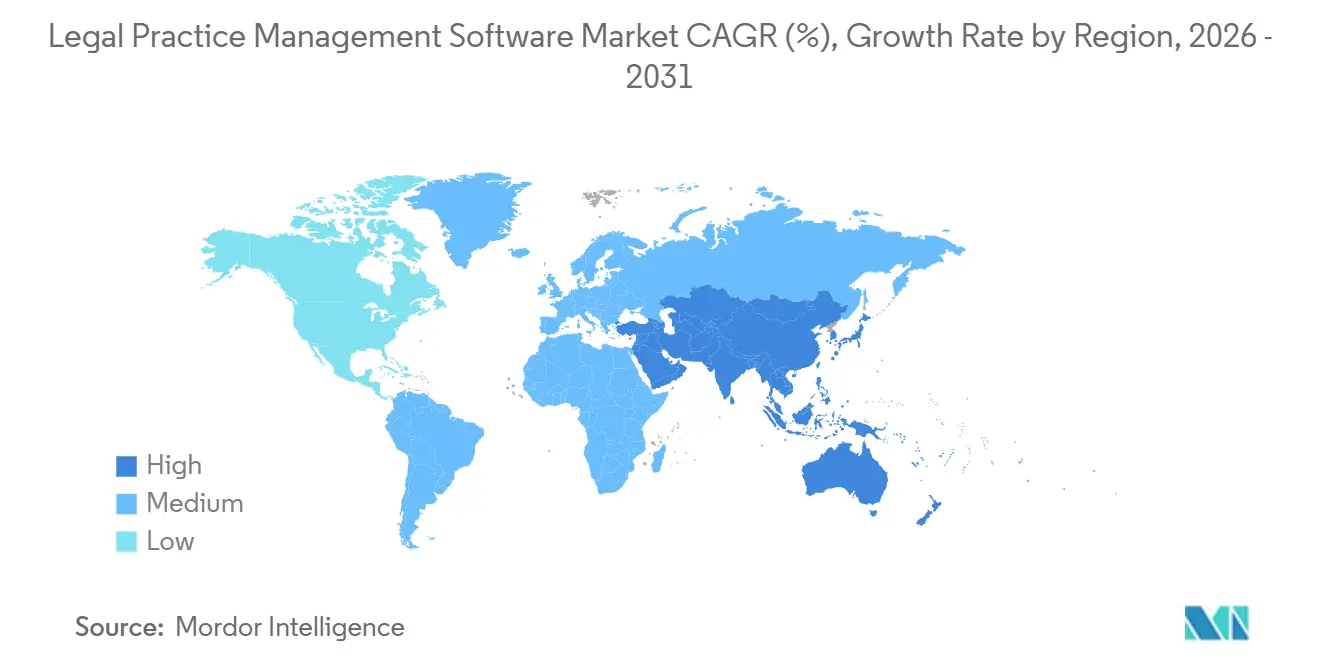
North America held 40.87% of the legal practice management software market size in 2025, which made it the largest regional contributor and reflected the strength of its legal technology ecosystem, large law firm base, and well-developed in-house legal buyer community. The United States remained the anchor market because it combines enterprise law firms, active vendor competition, and early adoption of AI-led legal workflows across both private practice and corporate legal departments. Canada also strengthened its role in 2026 when Clio acquired Jurisage, a legal data startup with more than 470,000 cases from 43 courts, supporting the launch of Clio Work in Canada and reinforcing the importance of localized legal data assets. Thomson Reuters also expanded its workflow position in the region through a May 2026 partnership expansion with Anthropic that connected Claude to CoCounsel Legal, which underscored the speed of product development around agentic workflows. South America remained earlier in adoption, but Brazil continued to stand out because growing legal sector formalization and compliance-driven corporate legal investment are creating a clearer base for structured software demand.
APAC Legal Practice Management Software Market
Asia-Pacific is projected to grow at 20.36% through 2031, which makes it the fastest-growing regional segment in the legal practice management software market and reflects a mix of court digitization, legal services expansion, and faster enterprise software rollout. Japan, India, and Australia are important because digital court systems and related reform programs are pushing firms toward platforms that can work with newer judicial and administrative processes. In Japan, Legalscape reported in June 2026 that 1 in 3 attorneys across the 3 Tokyo bar associations used its platform, which showed that adoption had already spread across large, mid-sized, and solo practices. Thomson Reuters also launched Westlaw Advantage Australia in March 2026 as its first fiduciary-grade agentic AI research capability in that market, signaling that Asia-Pacific was moving higher in enterprise product rollout priorities. The legal practice management software market is gaining speed in the region because regulatory modernization and private sector legal digitization are moving together rather than separately.
EMEA Legal Practice Management Software Market
Europe remained a well-established region in the legal practice management software market, with Germany, the United Kingdom, and France serving as major demand centers because they combine mature legal services sectors with stronger compliance expectations. Wolters Kluwer found in 2026 that more than 90% of German law firms expected legal tech spending to increase over the next 3 years, which highlighted the region's appetite for law firm software, AI tools, and cybersecurity investment. The same report showed that 38.9% of German law firms viewed GDPR and sensitive information security as major barriers to AI adoption, which means compliance creates both friction and a differentiation path for vendors with stronger data controls.[6] In the Middle East and Africa, the UAE and Saudi Arabia led growth activity through legal services modernization and court digitization agendas, while Nigeria and South Africa remained earlier-stage opportunities tied to gradual practice formalization.
Competitive Landscape
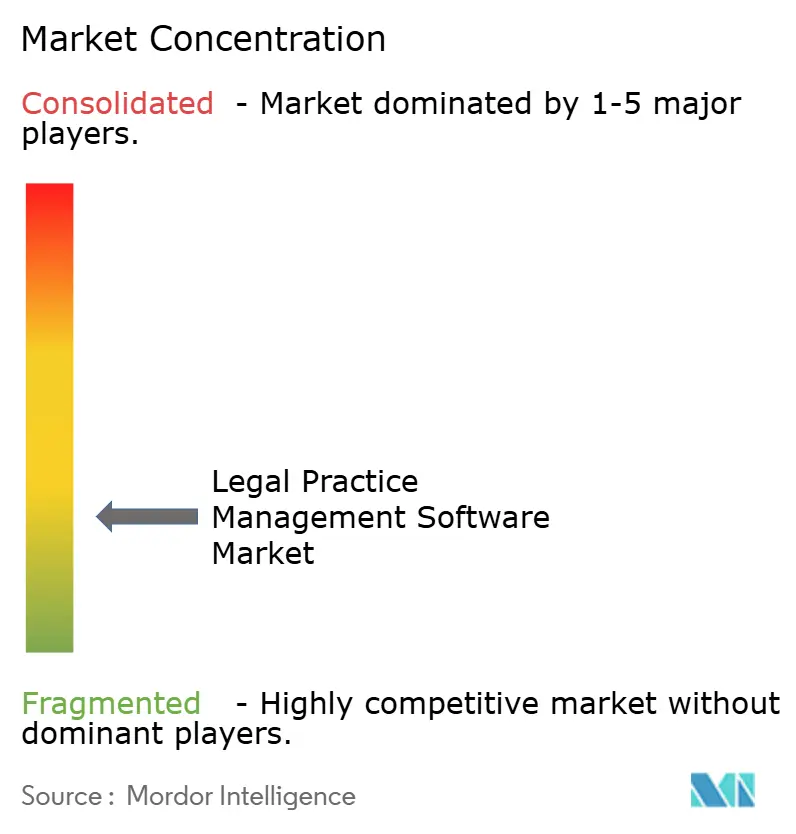
The legal practice management software market remained moderately fragmented in 2026, with competition increasingly split between broad platform consolidators and specialized vendors focused on discrete tasks such as billing, litigation workflow, client intake, or time capture. This structure matters because buyers are choosing not only between brands, but also between different product philosophies, with some preferring one integrated operating layer and others favoring specialist depth in selected workflows. Clio strengthened its platform consolidation by completing its USD 1 billion vLex acquisition in November 2025 and pairing it with a USD 500 million Series G funding round at a USD 5 billion valuation. That move built on its March 2025 acquisition of ShareDo, later launched as Clio Operate in North America in March 2026, which extended its reach from smaller firms toward larger multi-jurisdiction practices CLIO.COM. The legal practice management software market is therefore seeing consolidation not only for scale, but also for product range, data depth, and customer coverage across firm sizes.
Thomson Reuters pursued a parallel strategy by expanding CoCounsel Legal and deepening its relationship with Anthropic, signaling that large incumbents were moving quickly to combine trusted legal content with more active AI workflow execution. The company announced in May 2026 that Claude would connect directly with CoCounsel Legal via a Model Context Protocol integration, enabling users to move between general-purpose AI interaction and citation-grounded legal workflows within a single environment. It also opened early access in June 2026 to the next generation of CoCounsel Legal for all U.S. customers, with workspaces, a Brief Builder AI agent, and expanded deep research across Westlaw and Practical Law. These actions show that the legal practice management software market is competing on integrated workflow depth, not only on standalone AI capability or document storage features. Buyers at the upper end of the market are also paying closer attention to how well vendors can govern, ensure research quality, and maintain operational consistency across a single platform.
Intapp took a more governance-led approach in February 2026, launching Celeste as an agentic AI platform for professional services firms, with ethical walls, conflict screening, and audit trails built into its design. That product direction showed that competitive advantage in the legal practice management software market is moving toward governed AI infrastructure, especially among enterprise buyers that cannot separate automation gains from compliance obligations. Smaller vendors such as Smokeball, PracticePanther, and CosmoLex still defend space by focusing on tight workflow fit, simple deployment, and jurisdiction-specific libraries for smaller firms, which keeps the field from concentrating too quickly. White space remains strongest in hybrid deployment for mid-market firms, in AI governance for conflict-sensitive matters, in non-English legal research integration across Asia-Pacific, and in self-service onboarding for very small practices.
Legal Practice Management Software Industry Leaders
-
Clio Inc.
-
Thomson Reuters Corporation
-
The Access Group
-
Aderant, LLC
-
LEAP Legal Software Pty Ltd
- *Disclaimer: Major Players sorted in no particular order
Legal Practice Management Software Market Companies Covered in this Report
- Clio Inc.
- Thomson Reuters Corporation
- The Access Group
- Aderant, LLC
- LEAP Legal Software Pty Ltd
- Themis Solutions Inc.
- PracticePanther LLC
- MyCase, Inc.
- Rocket Matter, LLC
- CosmoLex Cloud LLC
- Actionstep Group Limited
- Smokeball, Inc.
- Filevine, Inc.
- Intapp, Inc.
- Litify, Inc.
- RELX PLC
- Abacus Data Systems, Inc.
- Lexicon Services, Inc.
- CARET Legal
- Tabs3 Software, LLC
- SurePoint Technologies, Inc.
- Bill4Time, LLC
- TimeSolv Corporation
- Legal Files Software, Inc.
- App4Legal LLC
Recent Industry Developments in Legal Practice Management Software Market
- July 2026: Filevine opened a new engineering hub in Prague, accelerating international development capacity for its LOIS (Legal Operating Intelligence System) agentic AI platform. The expansion reflects the company's strategy to build AI capabilities across European legal markets alongside its existing North American presence.
- June 2026: Clio acquired Jurisage, a Canadian legal data startup with over 470,000 cases from 43 courts, enabling the Canadian launch of Clio Work and building on its June 2025 vLex acquisition for global legal research coverage.
- June 2026: Thomson Reuters opened early access to the next generation of CoCounsel Legal for all US customers, rebuilt on Anthropic's Claude Agent SDK with new workspaces, a Brief Builder AI agent, and extended deep research across Westlaw and Practical Law. General availability in the United States is targeted for August 2026, with Canada, the UK, and Australia to follow.
- May 2026: Intapp announced that Ropes and Gray selected Intapp DealCloud and Celeste for firm-wide deployment, integrating relationship intelligence and agentic AI across growth, compliance, and profitability workflows.
Global Legal Practice Management Software Market Report Scope
The Legal Practice Management Software Market Report is Segmented by Component (Software and Services), by Deployment Mode (Cloud-Based, On-Premises, and Hybrid), by Application (Case Management, Document Management, and more), by Organization Size (Large Enterprises, and SMEs), by End User (Law Firms, Legal Departments, and Courts), and Geography. The Market Forecasts are Provided in Terms of Value (USD).
Segmentation Overview
| Software |
| Services |
| Cloud-Based |
| On-Premises |
| Hybrid |
| Case and Matter Management |
| Document and Knowledge Management |
| Financial and Practice Management |
| Client Collaboration and Workflow |
| Large Enterprises |
| Small And Medium Enterprises |
| Law Firms |
| Legal Departments |
| Courts |
| North America | United States | |
| Canada | ||
| Mexico | ||
| South America | Brazil | |
| Rest Of South America | ||
| Europe | Germany | |
| United Kingdom | ||
| France | ||
| Italy | ||
| Spain | ||
| Russia | ||
| Rest Of Europe | ||
| Asia-Pacific | China | |
| India | ||
| Japan | ||
| South Korea | ||
| Australia | ||
| Rest Of Asia-Pacific | ||
| Middle East And Africa | Middle East | Turkey |
| Saudi Arabia | ||
| United Arab Emirates | ||
| Rest Of Middle East | ||
| Africa | South Africa | |
| Nigeria | ||
| Rest Of Africa | ||
| By Component | Software | ||
| Services | |||
| By Deployment Mode | Cloud-Based | ||
| On-Premises | |||
| Hybrid | |||
| By Application | Case and Matter Management | ||
| Document and Knowledge Management | |||
| Financial and Practice Management | |||
| Client Collaboration and Workflow | |||
| By Organization Size | Large Enterprises | ||
| Small And Medium Enterprises | |||
| By End User | Law Firms | ||
| Legal Departments | |||
| Courts | |||
| By Geography | North America | United States | |
| Canada | |||
| Mexico | |||
| South America | Brazil | ||
| Rest Of South America | |||
| Europe | Germany | ||
| United Kingdom | |||
| France | |||
| Italy | |||
| Spain | |||
| Russia | |||
| Rest Of Europe | |||
| Asia-Pacific | China | ||
| India | |||
| Japan | |||
| South Korea | |||
| Australia | |||
| Rest Of Asia-Pacific | |||
| Middle East And Africa | Middle East | Turkey | |
| Saudi Arabia | |||
| United Arab Emirates | |||
| Rest Of Middle East | |||
| Africa | South Africa | ||
| Nigeria | |||
| Rest Of Africa | |||
Key Questions Answered in the Report
What is the 2026 value of the legal practice management software market?
The legal practice management software market was valued at USD 3.34 billion in 2026 and is projected to reach USD 6.96 billion by 2031 at a CAGR of 15.80%.
What is driving demand for legal practice management software in law firms?
Demand is rising because firms are moving from fragmented tools to cloud platforms that combine matter management, billing, documents, workflow, and client collaboration in one system.
Which application area leads legal practice management software adoption?
Case and matter management led with 36.54% of the market in 2025, while client collaboration and workflow is projected to grow the fastest at 18.86% through 2031.
Which end users are expanding fastest in legal practice management software?
Law firms remained the largest end user with 58.36% share in 2025, but corporate legal departments are projected to grow faster at 18.21% through 2031.
Which region offers the strongest growth outlook for legal practice management software?
Asia-Pacific has the strongest growth outlook with a projected 20.36% CAGR through 2031, supported by court digitization and expanding corporate legal services demand.
Why are hybrid deployment models gaining traction in legal practice management software?
Hybrid deployment is growing because firms want cloud-based collaboration and AI capabilities while keeping privilege-sensitive records and compliance-heavy workflows under tighter internal control.