
Legal Knowledge Management Software Market Size and Share
Market Overview
| Study Period | 2020 - 2031 |
|---|---|
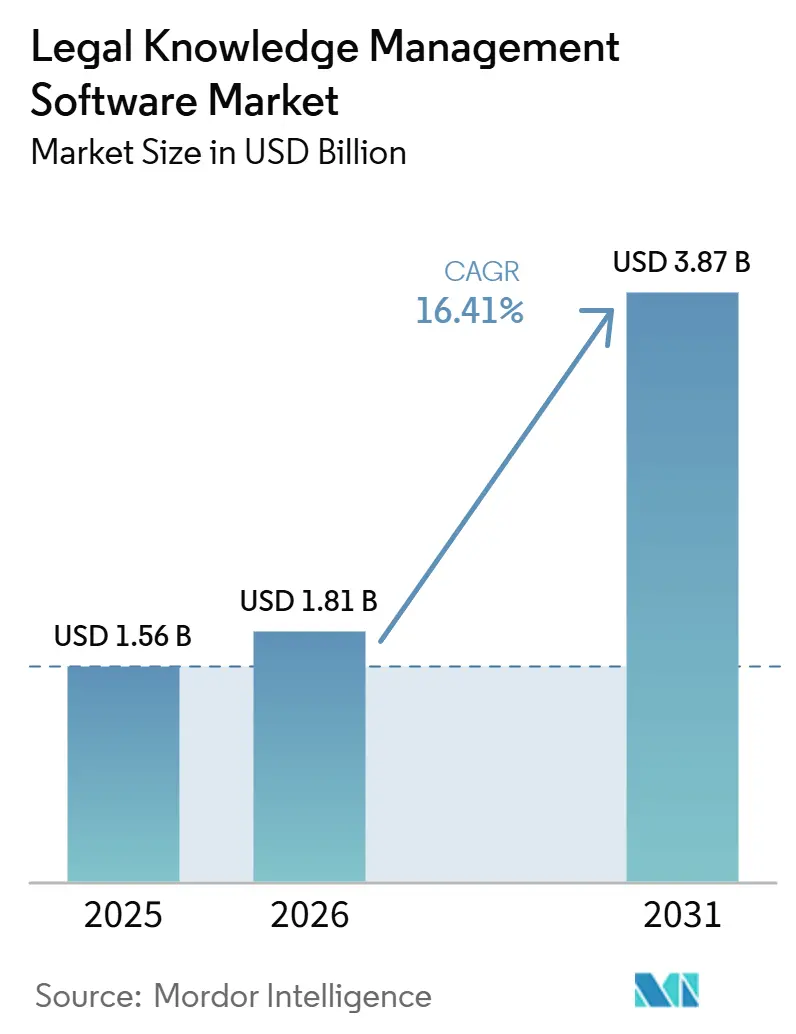
| Market Size (2026) | USD 1.81 Billion |
| Market Size (2031) | USD 3.87 Billion |
| Growth Rate (2026 - 2031) | 16.41% CAGR |
| Fastest Growing Market | Asia-Pacific |
| Largest Market | North America |
| Market Concentration | Medium |
Major Players *Disclaimer: Major Players sorted in no particular order Image © Mordor Intelligence. Reuse requires attribution under CC BY 4.0. | |
Legal Knowledge Management Software Market Analysis by Mordor Intelligence
The legal knowledge management software market size stood at USD 1.56 billion in 2025 and USD 1.81 billion in 2026 and is forecast to reach USD 3.87 billion by 2031 at a CAGR of 16.41%. The market is expanding because legal teams now treat internal knowledge as a working asset that supports search, drafting, reuse, and review in live matters, rather than storing it as a static archive. Daily AI usage across legal work has moved knowledge access closer to core operations, making governed repositories, search controls, and audit trails more important in software buying decisions. The legal knowledge management software market is also benefiting from cloud adoption, hybrid work models, and a wider push to reduce repeated research across teams and offices. Competition is shifting toward platforms that combine retrieval, governance, and workflow integration into a single stack, raising switching costs for established customers while creating room for vendors that solve cross-repository access and compliance needs effectively. The main opportunity now sits in platforms that can connect matter history, document systems, and attorney know-how without weakening privilege controls, while the main risk remains uneven data readiness across firms and legal departments.
Key Report Takeaways
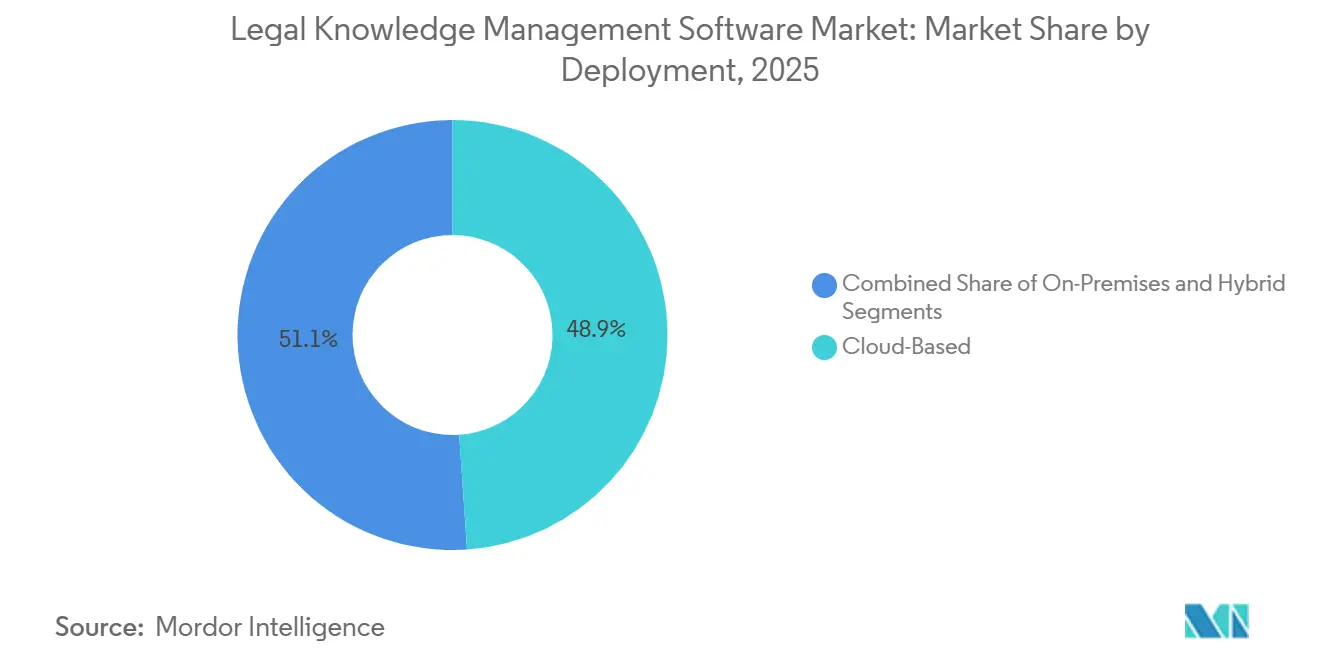
- By deployment, cloud-based solutions held 48.93% of the legal knowledge management software market share in 2025, while hybrid deployment is projected to expand at 18.13% through 2031.
- By application, document and knowledge repository management accounted for 39.71% of the legal knowledge management software market size in 2025, while matter and case knowledge management is projected to grow at 19.28% through 2031.
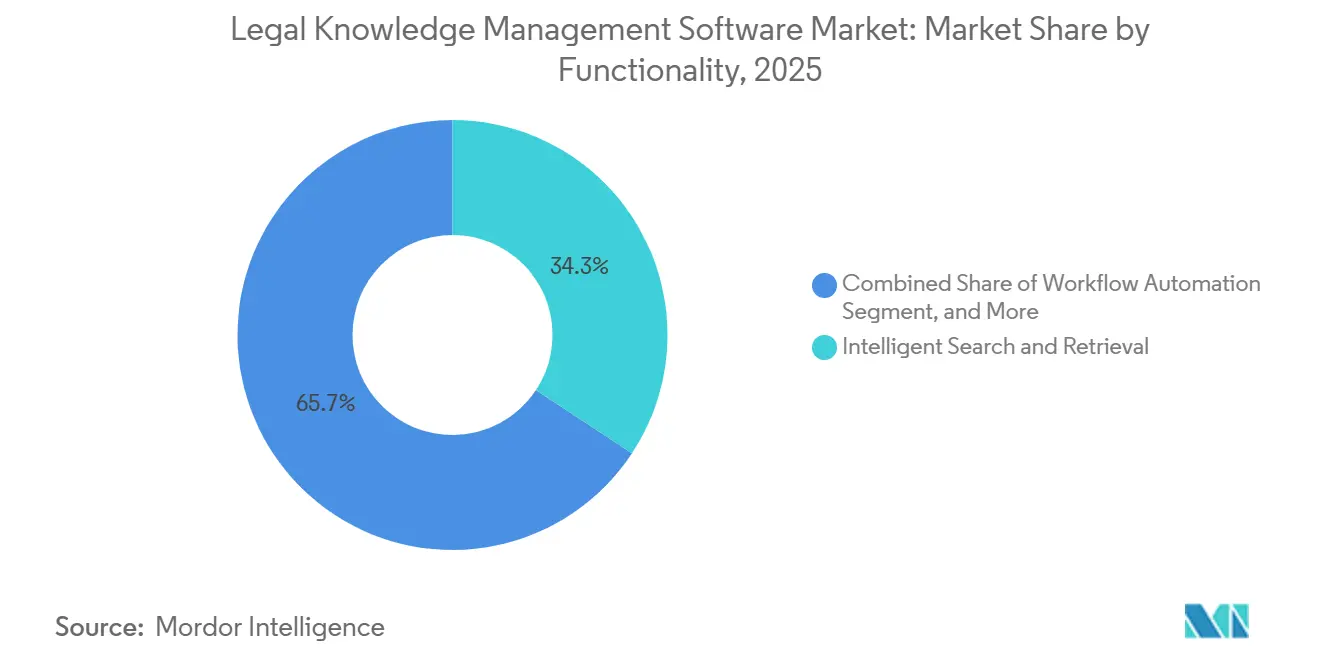
- By functionality, intelligent search and retrieval held 34.27% share in 2025, while analytics and reporting are projected to expand at 20.91% through 2031.
- By end user, law firms accounted for 54.63% share in 2025, while corporate legal departments are projected to advance at 22.73% through 2031.
- By geography, North America held 39.57% share in 2025, while Asia-Pacific is projected to grow at an 18.43% CAGR through 2031.
Note: Market size and forecast figures in this report are generated using Mordor Intelligence’s proprietary estimation framework, updated with the latest available data and insights as of January 2026.
Global Legal Knowledge Management Software Market Trends and Insights
Drivers Impact Analysis*
| DRIVER | (~) % IMPACT ON CAGR FORECAST | GEOGRAPHIC RELEVANCE | IMPACT TIMELINE |
|---|---|---|---|
| Growing Demand for AI-Assisted Legal Search and Retrieval | +5.2% | Global, strongest in North America and Asia-Pacific | Short term (≤ 2 years) |
| Rising Need for Knowledge Reuse Across Matters and Teams | +3.8% | Global, particularly North America and Europe | Medium term (2-4 years) |
| Expansion of Cloud-First Legal Workflows | +3.1% | Global, rapid uptake in Asia-Pacific and South America | Short term (≤ 2 years) |
| Increasing Compliance and Auditability Requirements | +2.4% | North America and Europe, spill-over to Asia-Pacific | Medium term (2-4 years) |
| Growth in Remote and Hybrid Legal Service Delivery | +1.9% | Global, strongest in North America and Europe | Short term (≤ 2 years) |
| Rising Integration With Document Management and Practice Platforms | +1.3% | North America, Europe, and Australia | Long term (≥ 4 years) |
| Source: Mordor Intelligence | |||
Growing Demand for AI-Assisted Legal Search and Retrieval
The legal knowledge management software market is being reshaped by the move from keyword search toward retrieval that can recognize matter context, attorney experience, and related work product. Legal teams are already working in that direction because 92% of legal professionals reported daily use of at least 1 AI tool in 2026, and 52% said AI-assisted work directly lifted revenue by 6%-20%.[1]Wolters Kluwer, “Legal AI Adoption, Time Savings, Revenue Growth,” Wolters Kluwer, WOLTERSKLUWER.COM. That pattern is changing software demand because buyers now expect knowledge systems to return usable answers from internal records instead of only locating folders and files. The gain is not coming from AI alone, because iManage reported that organizations with stronger knowledge foundations were nearly twice as likely to report year-over-year revenue growth. The legal knowledge management software market, therefore, sits closer to core AI infrastructure than to a supporting back-office tool. Vendors that improve retrieval precision across repositories are likely to capture more budget because better recall and ranking affect billable efficiency, response speed, and reuse of prior legal work.
Rising Need for Knowledge Reuse Across Matters and Teams
The legal knowledge management software market is also advancing because firms and in-house teams are under pressure to reuse prior work instead of paying for the same analysis many times. Legal matters often share clauses, issues, negotiation history, and internal guidance, but that material is usually spread across document systems, emails, and local storage with weak metadata discipline. iManage found that 72% of organizations planned to invest in a new document or knowledge management platform within the next 2 years, which shows how broad the replacement cycle has become. The value of reuse is especially clear where legal departments want faster answers on recurring supplier, contract, and regulatory questions. That is why the legal knowledge management software market is moving beyond simple storage toward systems that connect precedent, matter history, and know-how in a searchable structure. Procurement standards are also becoming stricter, which means buyers increasingly want governance and auditability built into the knowledge layer rather than added later through separate tools.
Expansion of Cloud-First Legal Workflows
The legal knowledge management software market is benefiting from a work model in which legal teams expect secure access across offices, client sites, and remote settings. Cloud-based deployment already led with a 48.93% share in 2025, indicating that demand has shifted toward easier updates, faster rollouts, and less infrastructure management. The strongest growth is now in hybrid models, as many buyers want cloud-scale while keeping sensitive datasets in controlled environments across jurisdictions. Security still shapes the pace of that transition, because iManage reported that nearly 30% of organizations delayed AI adoption due to security concerns. In Europe, the CCBE guidelines on cloud computing for lawyers have provided firms with a practical reference point for vendor reviews, especially regarding confidentiality, responsibility, and data location.[2]Council of Bars and Law Societies of Europe, “CCBE Guidelines on the Use of Cloud Computing by Bars and Lawyers,” CCBE, DIGITAL.SAV-FSA.CH. As a result, the legal knowledge management software market is rewarding vendors that can demonstrate both cloud performance and strong control frameworks.
Increasing Compliance and Auditability Requirements
The legal knowledge management software market is seeing stronger demand from buyers who want clearer control over how AI touches client content and matter records. iManage reported that nearly 1-third of organizations had already faced a policy-impacting incident from unregulated AI tools, which is pushing governance from a legal concern into a procurement requirement. That pressure is stronger in regulated legal environments where client confidentiality, ethical walls, and matter-level permissions cannot be treated as optional features. The CCBE cloud guidance has reinforced this direction by emphasizing professional responsibility and safeguards for lawyers using third-party digital infrastructure. The practical result is that audit logs, access tracing, and controlled AI interactions are now central selling points rather than technical details. Vendors that can demonstrate precise governance at the client and matter level are likely to win more enterprise reviews in the legal knowledge management software market, especially where firms operate across multiple jurisdictions.
Restraints Impact Analysis*
| RESTRAINT | (~) % IMPACT ON CAGR FORECAST | GEOGRAPHIC RELEVANCE | IMPACT TIMELINE |
|---|---|---|---|
| Data Security and Client Confidentiality Concerns | -2.8% | Global, most acute in North America and Europe | Short term (≤ 2 years) |
| Integration Friction With Legacy Legal Systems | -1.6% | North America and Europe, especially large law firms | Medium term (2-4 years) |
| High Switching Costs for Large Law Firms and Enterprises | -1.1% | North America, Europe, and Australia | Long term (≥ 4 years) |
| User Resistance to Workflow Change and Knowledge Capture Discipline | -0.7% | Global | Medium term (2-4 years) |
| Source: Mordor Intelligence | |||
Data Security and Client Confidentiality Concerns
The legal knowledge management software market still faces its strongest barrier in the handling of privileged and confidential client information. Legal buyers evaluate these systems more strictly than many other enterprise applications because a control failure can create ethical, contractual, and regulatory exposure at the same time. Wolters Kluwer found that ethical concerns and data privacy were the top challenges for 39% of legal AI implementers in 2026. That concern slows deployment when firms need to ingest large volumes of matter history, since they must first decide what content can be queried, who can access it, and how AI outputs should be supervised. Certification and proof of controls have therefore moved closer to the center of enterprise buying processes, especially for vendors trying to sell into large firms and regulated corporate environments. The legal knowledge management software market will keep seeing uneven adoption where buyers remain unconvinced that search convenience can coexist with strict confidentiality and privilege protection.
Integration Friction With Legacy Legal Systems
The legal knowledge management software market also faces slower adoption, where buyers have layered legal technology estates built over many years. Large firms and corporate legal departments often run document systems, billing tools, practice platforms, research products, CRM tools, and HR systems that were not designed to work together. A knowledge platform becomes less useful when critical repositories remain outside the searchable graph, because AI-assisted retrieval then returns only part of the institutional record. Vendors are responding with open connectors, broader integration libraries, and governed access models that reduce custom development needs. Thomson Reuters has already moved in this direction by integrating CoCounsel Legal with DeepJudge so subscribers can surface firm knowledge inside research, drafting, and analysis workflows without leaving the platform. Even so, the legal knowledge management software market will continue to face longer sales and implementation cycles where buyers lack internal IT capacity or need phased migration from older legal systems.
*Our forecasts treat driver/restraint impacts as directional, not additive. The impact forecasts reflect baseline growth, mix effects, and variable interactions.
Segment Analysis
By Deployment: Cloud Leads While Hybrid Gains Strategic Weight
Cloud-based solutions held 48.93% of the legal knowledge management software market in 2025, which made this the leading deployment model across the category. That position reflected the lower infrastructure burden, easier updates, and wider support for distributed legal work. The legal knowledge management software market has reached a point where cloud is no longer treated as an experimental delivery model for most buyers. It is now the default path for many new deployments, while on-premises setups are increasingly reserved for highly regulated use cases. Buyers also favor cloud deployments because they help vendors roll out AI features, security patches, and interface changes faster across large customer bases.
Hybrid deployment is projected to grow at 18.13% through 2031, and that pace shows that many firms want more than a simple cloud migration story. Hybrid architecture works well where part of the knowledge base must stay in a jurisdictionally controlled environment, while other workflows benefit from shared search and collaboration. This balance is especially important for firms serving cross-border clients with varied residency and confidentiality expectations. The legal knowledge management software market is, therefore, rewarding vendors that can combine common search experiences with strong location-based controls. On-premises deployments are still relevant for government agencies and conservative enterprise buyers that want full infrastructure control, but their role is shifting from mainstream choice to specialized option.



By Application: Repository Depth Supports Faster Matter Intelligence
Document and knowledge repository management accounted for 39.71% of the legal knowledge management software market size in 2025, which kept it at the center of spending across applications. This segment remains the foundation because firms have years of work product, templates, playbooks, and client records that need structure before they can deliver value in daily legal work. Much of the category still depends on the quality of tagging, indexing, and permissioning within these repositories. Without that base, AI tools may produce shallow results or miss relevant material that already exists inside the firm. The legal knowledge management software market continues to benefit from investments that make stored content easier to search, classify, and reuse at scale.
Matter and case knowledge management is forecast to grow at 19.28% through 2031, which makes it the fastest-moving application area in the market. Buyers are placing more value on deal history, case strategy, negotiation patterns, and internal decisions because that knowledge is often more commercially useful than generic document access alone. The legal knowledge management software industry is moving toward systems that can connect repository content with the facts and workflow of a live matter. That shift also raises retention value for vendors, because matter-linked intelligence can become deeply embedded in how firms work and learn over time. Legal research and precedent management, along with enterprise legal collaboration, still play important supporting roles because they help connect internal knowledge with external authority and shared team execution.
By Functionality: Retrieval Remains the Core, Analytics Gains Influence
Intelligent search and retrieval held 34.27% share in 2025, which made it the leading functionality within the legal knowledge management software market. This leadership is logical because the basic promise of the category is fast access to the right internal legal content. Buyers judge these platforms by how accurately they surface clauses, templates, memos, and prior matter records in a way that reflects the context of the present issue. Strong retrieval can also reduce repeated research and help firms use senior attorney know-how more widely across teams. That makes search quality a direct driver of user adoption, perceived value, and platform stickiness.
Analytics and reporting are projected to grow at 20.91% through 2031, and that rise shows a broader change in how buyers measure return on knowledge investments. Managing partners, legal operations leaders, and general counsel increasingly want visibility into reuse rates, duplicate effort, and the performance of AI-assisted work. iManage expanded Insight+ in March 2026 with enterprise-scale metadata indexing and multi-region deployment support, which shows how vendors are connecting knowledge graphs with reporting needs in more complex customer environments.[3]iManage, “iManage Insight+ Addresses AI Governance Gap With Enhanced Contextual Intelligence,” iManage, IMANAGE.COM. Workflow automation and content governance are also becoming more valuable because they reduce manual upkeep and help ensure that users and AI systems access current, approved content. The legal knowledge management software market is therefore widening from a retrieval problem into a measurement and control problem as well.
By End User: Law Firms Hold the Base While Corporate Teams Expand Faster
Law firms accounted for 54.63% share in 2025, which gave them the largest end-user position in the legal knowledge management software market. Their lead reflects decades of investment in precedent libraries, work-product banks, and matter archives that support repeatable legal practice. Many leading vendors built their products around law firm workflows first, which helped sustain revenue concentration in this segment. Large firms also tend to have bigger requirements for permissions, ethical walls, search precision, and multi-office knowledge sharing. That installed base continues to support recurring demand for upgrades, AI layers, and more advanced governance features.
Corporate legal departments are projected to grow at 22.73% through 2031, and that pace shows how quickly in-house teams are changing their operating model. These teams are under pressure to answer recurring questions internally, control outside counsel spending, and preserve internal legal reasoning for future use. The legal knowledge management software industry is benefiting from that shift because in-house buyers increasingly want tools that help them search prior advice, contract positions, and compliance responses in one place. Government agencies and academic and research institutions remain smaller in revenue terms, but they add meaningful opportunity where legal content volumes are high and traceability matters. Everlaw added momentum to that part of the market when it introduced Everlaw Prime for government agencies in 2026, combining public records intake and eDiscovery workflows in one platform.
Geography Analysis
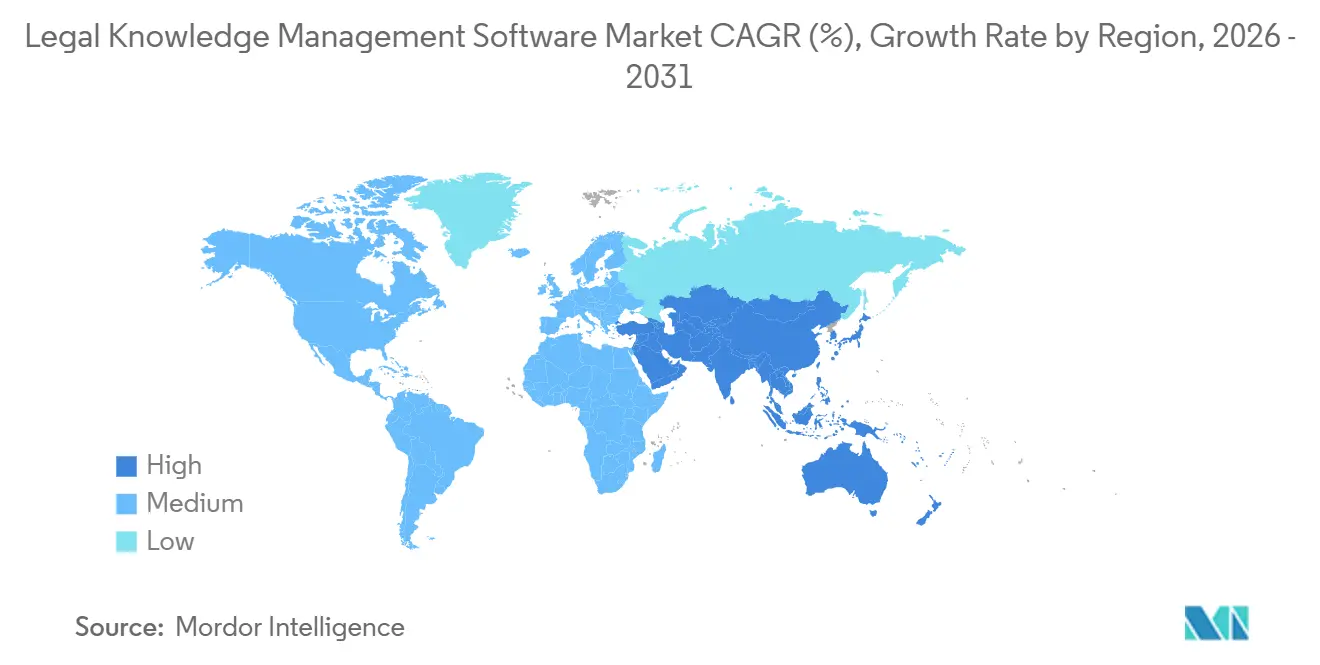
North America held 39.57% of the legal knowledge management software market share in 2025, which kept it as the largest regional contributor. The region benefits from a high concentration of large law firms, larger legal technology budgets, and a mature buying culture for workflow and knowledge tools. The United States remains the center of demand because many of the biggest law firms and enterprise legal departments are based there. Canada is gaining importance as vendors shape AI capabilities around local precedent and trusted domestic datasets. Clio strengthened that regional position in June 2026 when it acquired Jurisage to support AI-powered legal work in Canada with a Canadian legal data foundation.[4]Clio, “Clio Acquires Jurisage to Accelerate the Future of Legal AI in Canada,” Newswire, NEWSWIRE.CA.
Europe remains a strong region in the legal knowledge management software market because compliance expectations are shaping product design more directly than in many other regions. Buyers across the region place a heavier weight on jurisdiction-specific hosting, auditability, and controlled AI access. That creates a favorable environment for vendors that can prove governance maturity rather than only feature breadth. Wolters Kluwer expanded Libra across Eastern Europe in March 2026, which showed how regional scale and compliance-focused rollout can become a competitive advantage in European legal technology. The United Kingdom, Germany, and France remain especially important because their legal services ecosystems are large and their regulatory expectations make software selection more rigorous.
Asia-Pacific is projected to grow at an 18.43% CAGR through 2031, which makes it the fastest-growing regional block in the legal knowledge management software market. Growth in the region is supported by expanding cloud adoption, more active legal operations functions, and a rising interest in AI-supported legal workflows. India is benefiting from easier access to SaaS tools for smaller and mid-sized firms, while China is developing domestic legal technology suited to local procedural and language needs. Australia, Japan, and South Korea represent more mature demand pockets where buyers are extending existing legal technology stacks with stronger retrieval and governance features. South America remains earlier in adoption, with momentum concentrated in large corporate legal departments and leading domestic law firms. The Middle East and Africa is still nascent, but directionally it supports future demand for localized legal knowledge infrastructure as digital legal work expands.

Competitive Landscape
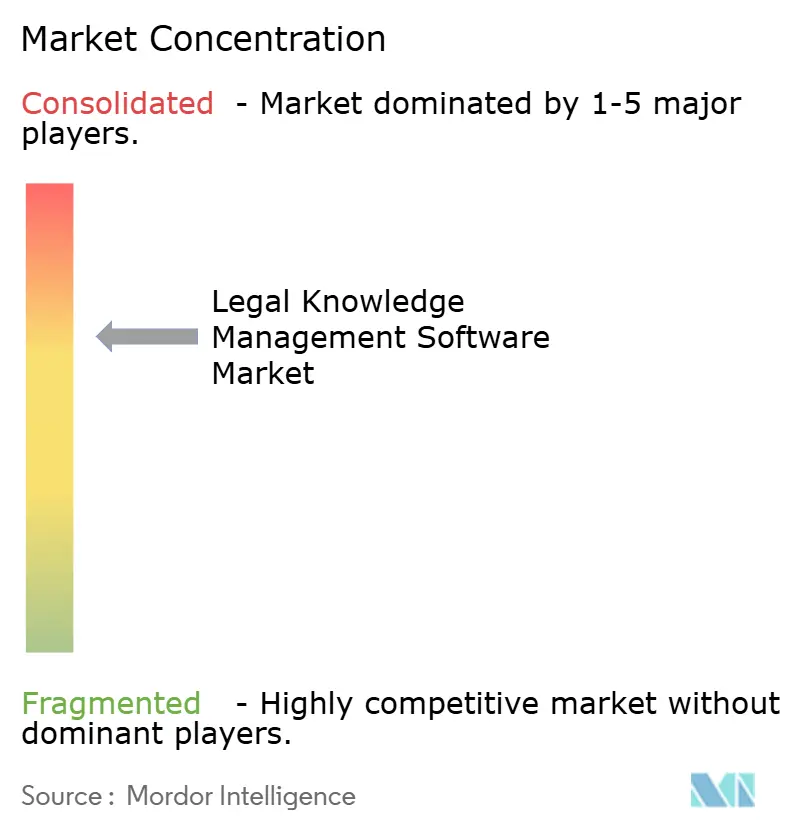
The legal knowledge management software market is moderately consolidated at the platform layer, with a group of established vendors holding strong positions among large law firms and enterprise legal departments. iManage, Thomson Reuters, RELX through LexisNexis, and Wolters Kluwer remain the most visible incumbents in that top tier. At the same time, the market still has a long tail of more than 20 vendors competing across mid-market, specialist, and workflow-specific use cases. That mix gives the category both scale advantages at the top and meaningful room for challengers below it. The legal knowledge management software market is therefore competitive not only on product depth, but also on how well each vendor fits different customer sizes, deployment preferences, and governance expectations.
A major competitive pattern now centers on AI-enabled retrieval, governed access, and tighter workflow integration. LexisNexis moved aggressively in May 2026 when it launched Lexis+ with Protégé into general availability, combining agentic legal workflows with a 200 billion document knowledge graph and more than 4 million new documents added daily.[5]LexisNexis, “LexisNexis Launches Next Evolution of Lexis+ With Protégé,” LexisNexis Pressroom, LEXISNEXIS.COM. That move raised pressure on specialized vendors because it linked authoritative content, AI assistance, and workflow execution in 1 product environment. iManage responded to the same market shift by expanding AI governance and contextual intelligence within its platform roadmap in 2026. The legal knowledge management software market is now rewarding vendors that can anchor AI access inside governed content estates instead of treating AI as a separate add-on.
Mergers, acquisitions, and ecosystem partnerships are also reshaping competition in the legal knowledge management software market. Clio continued its upmarket push in June 2026 by acquiring Jurisage, which strengthened its AI and data capabilities in Canada and supported a broader move into knowledge-intensive legal workflows. NetDocuments also widened its ecosystem position in late 2025 when Vincent by Clio joined the ndConnect interoperability program, allowing joint users to access AI-powered international legal research inside document workflows. Mitratech expanded its governed AI footprint in July 2026 by extending the ARIES AI ecosystem into HR compliance intelligence, which showed how adjacent compliance use cases can support broader account expansion. Competitive advantage is therefore moving toward vendors that can combine strong legal content control, easier integration, and a broader workflow role across legal and compliance work.
Legal Knowledge Management Software Industry Leaders
Thomson Reuters Corporation
iManage LLC
NetDocuments Software Inc.
Clio Manage
Wolters Kluwer N.V.
- *Disclaimer: Major Players sorted in no particular order

Recent Industry Developments
- June 2026: Clio acquired Jurisage, a Canadian legal AI and data company holding one of the country's most comprehensive AI-ready legal datasets, to accelerate the launch of Clio Work in Canada. The acquisition gives Clio a trust-anchored Canadian knowledge layer to ground AI-powered matter intelligence in Canadian legal precedent.
- May 2026: LexisNexis launched Lexis+ with Protégé into general availability, delivering agentic legal workflows grounded in a 200 billion document knowledge graph with more than 4 million new documents added daily. The platform entered deployment across AmLaw 100 firms at launch, with international rollout planned throughout 2026.
- March 2026: Wolters Kluwer completed its Eastern European expansion of the Libra legal AI workspace with a four-country rollout across Czech Republic, Slovakia, Hungary, and Romania, completing the vendor's broader European platform rollout initiated with the acquisition of Libra Technology in November 2025.
- March 2026: iManage released significant advances to Insight+, including enterprise-scale metadata indexing and data warehouse integration, enabling firms to connect Insight+ to their centralized data sources without requiring individual system integrations. Multi-region deployment support was also added to address data sovereignty requirements.


Global Legal Knowledge Management Software Market Report Scope
The Legal Knowledge Management Software Market refers to solutions that enable law firms, corporate legal departments, and regulatory bodies to capture, organize, and manage legal knowledge assets, such as case law, statutes, precedents, contracts, and internal expertise. These solutions enhance knowledge sharing, improve workflow efficiency, support compliance tracking, and enable informed decision-making while promoting collaboration and reducing duplication of effort in legal operations.
The Legal Knowledge Management Software Market Report is Segmented by Deployment (Cloud-Based, On-Premises, and Hybrid), Application (Legal Research and Precedent Management, Document and Knowledge Repository Management, Matter and Case Knowledge Management, and Enterprise Legal Collaboration), Functionality (Intelligent Search and Retrieval, Workflow Automation, Analytics and Reporting, and Content Governance and Version Control), End User Industry (Law Firms, Corporate Legal Departments, Government Agencies, and Academic and Research Institutions, and Other End User Industries), and Geography (North America, South America, Europe, Asia-Pacific, and Middle East and Africa). The Market Forecasts are Provided in Terms of Value (USD).
| Cloud-Based |
| On-Premises |
| Hybrid |
| Legal Research and Precedent Management |
| Document and Knowledge Repository Management |
| Matter and Case Knowledge Management |
| Enterprise Legal Collaboration |
| Intelligent Search and Retrieval |
| Workflow Automation |
| Analytics and Reporting |
| Content Governance and Version Control |
| Law Firms |
| Corporate Legal Departments |
| Government Agencies |
| Academic and Research Institutions |
| Other End User Industries |
| North America | United States | |
| Canada | ||
| Mexico | ||
| South America | Brazil | |
| Argentina | ||
| Rest of South America | ||
| Europe | United Kingdom | |
| Germany | ||
| France | ||
| Rest of Europe | ||
| Asia-Pacific | China | |
| Japan | ||
| India | ||
| South Korea | ||
| Australia | ||
| Rest of Asia-Pacific | ||
| Middle East and Africa | Middle East | United Arab Emirates |
| Saudi Arabia | ||
| Rest of Middle East | ||
| Africa | South Africa | |
| Kenya | ||
| Rest of Africa | ||
| By Deployment | Cloud-Based | ||
| On-Premises | |||
| Hybrid | |||
| By Application | Legal Research and Precedent Management | ||
| Document and Knowledge Repository Management | |||
| Matter and Case Knowledge Management | |||
| Enterprise Legal Collaboration | |||
| By Functionality | Intelligent Search and Retrieval | ||
| Workflow Automation | |||
| Analytics and Reporting | |||
| Content Governance and Version Control | |||
| By End User Industry | Law Firms | ||
| Corporate Legal Departments | |||
| Government Agencies | |||
| Academic and Research Institutions | |||
| Other End User Industries | |||
| By Geography | North America | United States | |
| Canada | |||
| Mexico | |||
| South America | Brazil | ||
| Argentina | |||
| Rest of South America | |||
| Europe | United Kingdom | ||
| Germany | |||
| France | |||
| Rest of Europe | |||
| Asia-Pacific | China | ||
| Japan | |||
| India | |||
| South Korea | |||
| Australia | |||
| Rest of Asia-Pacific | |||
| Middle East and Africa | Middle East | United Arab Emirates | |
| Saudi Arabia | |||
| Rest of Middle East | |||
| Africa | South Africa | ||
| Kenya | |||
| Rest of Africa | |||


Key Questions Answered in the Report
What is the current size of the legal knowledge management software market?
The legal knowledge management software market stood at USD 1.56 billion in 2025, and USD 1.81 billion in 2026 and is forecast to reach USD 3.87 billion by 2031 at a 16.41% CAGR.
Which deployment model leads legal knowledge management software spending?
Cloud-based solutions led with 48.93% share in 2025, while hybrid deployment is projected to grow faster through 2031 at 18.13%.
Which application area is expanding the fastest in legal knowledge platforms?
Matter and case knowledge management is projected to grow at 19.28% through 2031, ahead of other application areas in this category.
Why are legal teams investing more in knowledge management tools now?
Buyers are trying to improve AI-assisted search, reuse prior work across matters, reduce repeated research, and strengthen governance over confidential content.
Which end users create the largest revenue base for this category?
Law firms held the largest share at 54.63% in 2025, but corporate legal departments are projected to grow faster at 22.73% through 2031.
Which region offers the strongest near-term growth potential?
Asia-Pacific is projected to grow at 18.43% through 2031, while North America remained the largest regional market with 39.57% share in 2025.
Page last updated on:






