
Legal AI Verification Software Market Size and Share
Market Overview
| Study Period | 2020 - 2031 |
|---|---|
| Market Size (2026) | USD 0.41 Billion |
| Market Size (2031) | USD 1.72 Billion |
| Growth Rate (2026 - 2031) | 33.21 % |
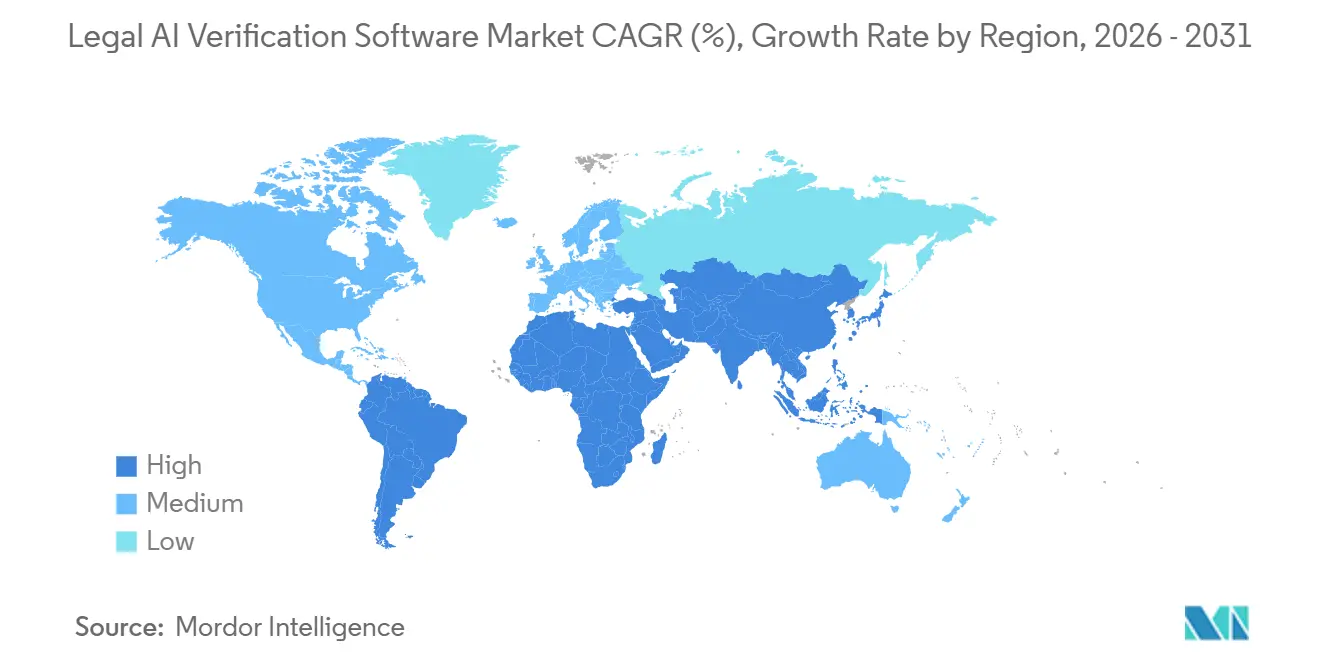
| Fastest Growing Market | Asia-Pacific |
| Largest Market | North America |
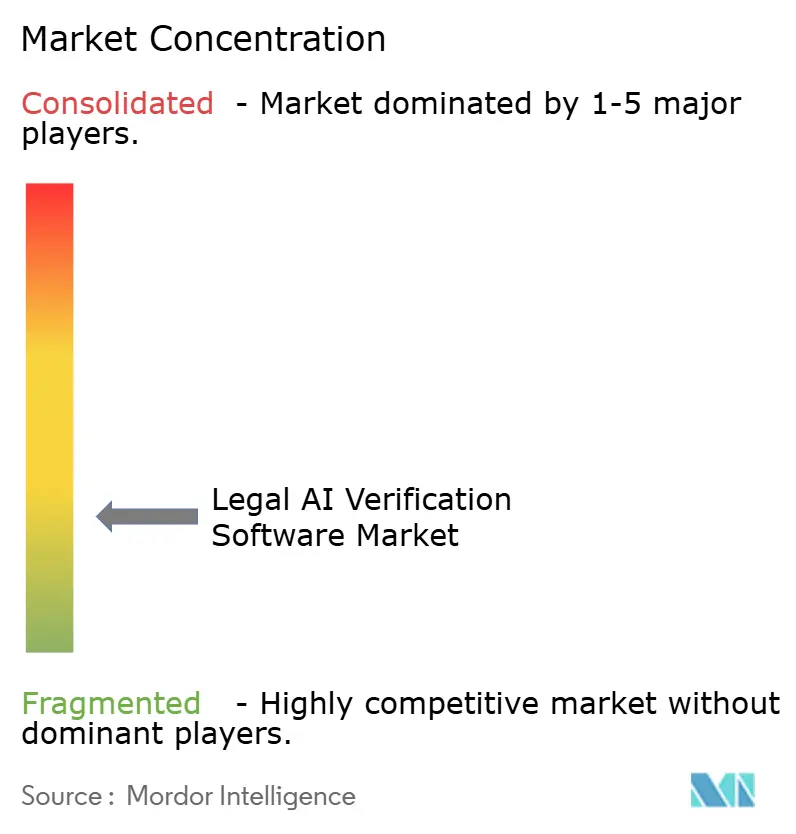
| Market Concentration | Low |
Major Players *Disclaimer: Major Players sorted in no particular order Image © Mordor Intelligence. Reuse requires attribution under CC BY 4.0. | |
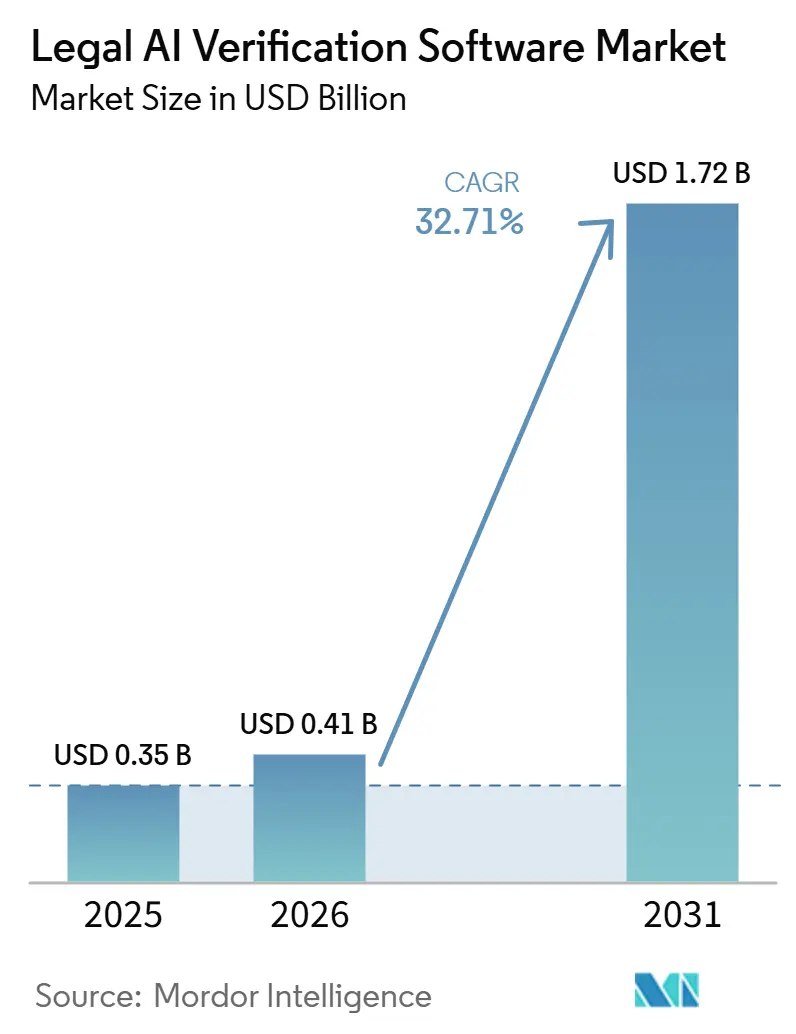
Legal AI Verification Software Market Analysis by Mordor Intelligence
The Legal AI Verification Software Market size was valued at USD 0.35 billion in 2025 and estimated to grow from USD 0.41 billion in 2026 to reach USD 1.72 billion by 2031, at a CAGR of 33.21% during the forecast period 2026-2031. Growth follows the wider use of generative AI for research, drafting, contract review, and discovery work. These uses create more legal content that requires checking before it is shared with clients or filed in court. Verification tools are becoming part of risk controls because legal teams need to confirm sources, facts, and reasoning. Large platforms are embedding these checks into familiar legal applications, which reduces the burden of adoption for lawyers. This shift creates opportunities for providers that can combine authoritative legal content, clear audit records, and secure deployment options.
Key Report Takeaways
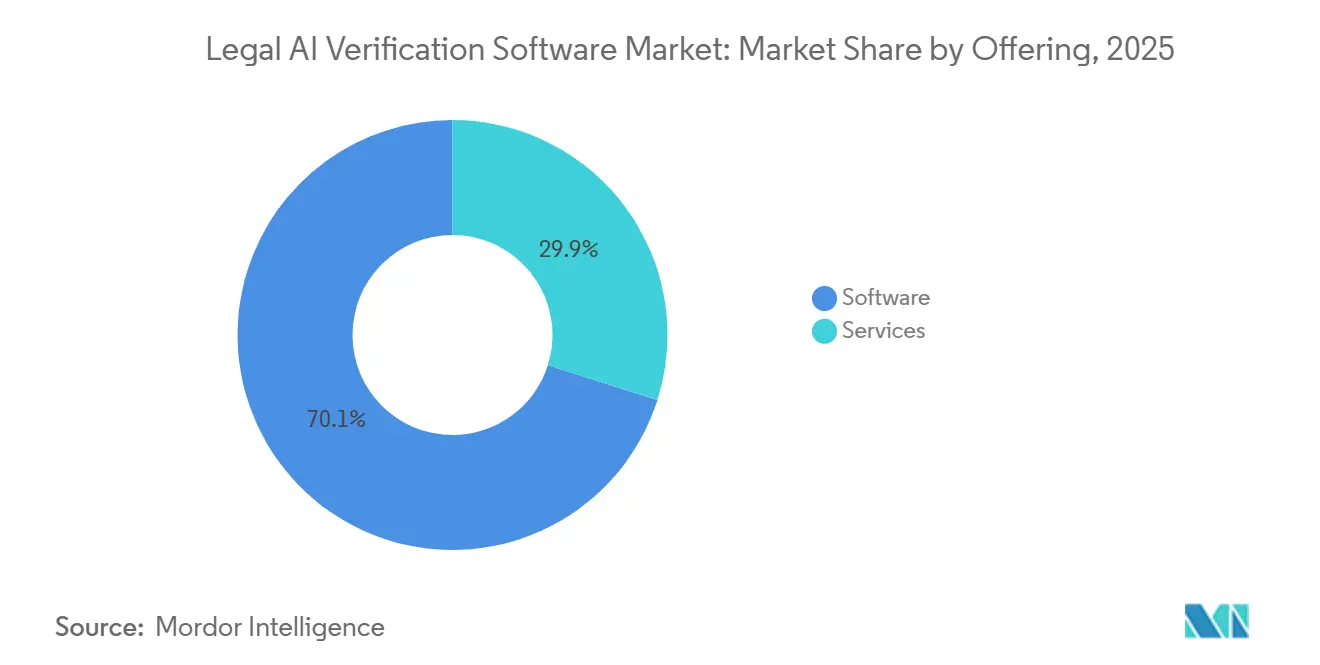
- By offering, software held 70.12% of the Legal AI Verification Software Market share in 2025, while services are projected to expand at a 35.04% CAGR through 2031.
- By verification capability, citation and authority verification held 44.21% of the Legal AI Verification Software Market share in 2025, while legal fact and evidence verification is projected to expand at a 34.38% CAGR through 2031.
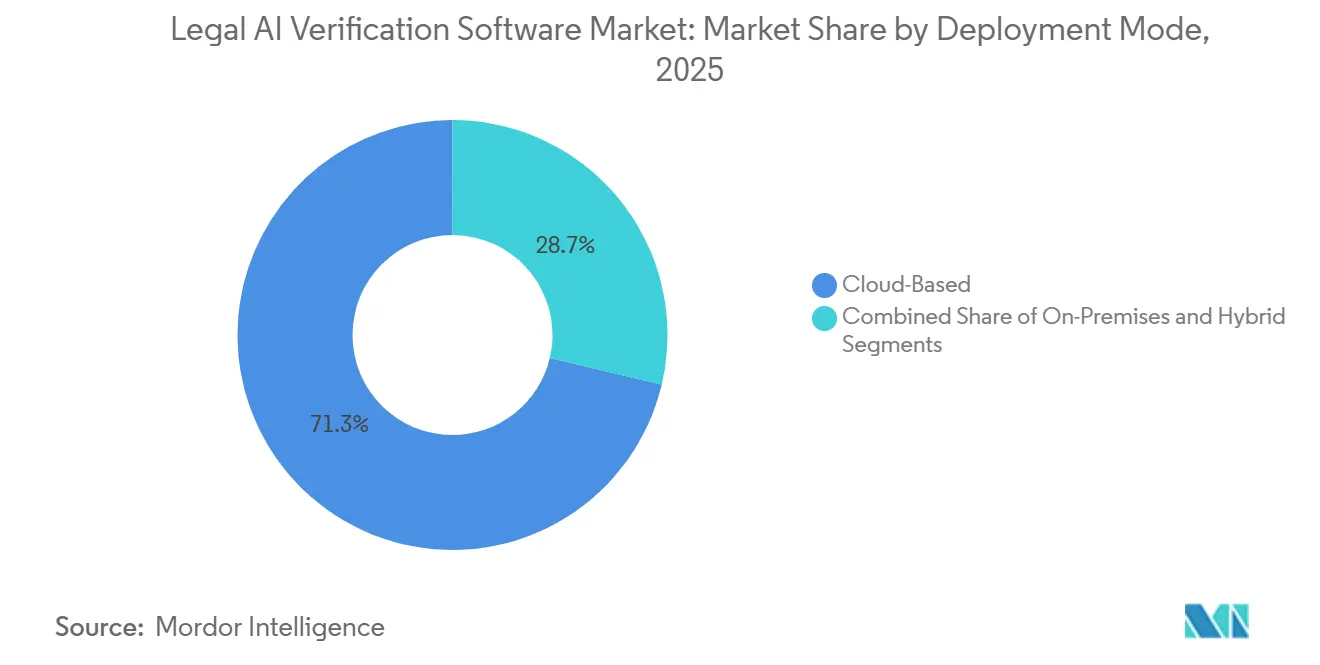
- By deployment mode, cloud-based deployment held 71.29% of the Legal AI Verification Software Market share in 2025, while hybrid deployment is projected to expand at a 35.40% CAGR through 2031.
- By end user, law firms held 55.19% of the Legal AI Verification Software Market share in 2025, while corporate legal departments are projected to expand at a 34.68% CAGR through 2031.
- By geography, North America held 35.16% of the Legal AI Verification Software Market share in 2025, while Asia-Pacific is projected to expand at a 34.02% CAGR through 2031.
Note: Market size and forecast figures in this report are generated using Mordor Intelligence’s proprietary estimation framework, updated with the latest available data and insights as of January 2026.
Market Trends and Insights
Drivers Impact Analysis of Legal AI Verification Software Market*
| Driver | (~) % Impact on CAGR Forecast | Geographic Relevance | Impact Timeline |
|---|---|---|---|
| Expansion of AI-Generated Legal Work | +7.8% | Global, with early intensity in North America and Western Europe | Short term (≤ 2 years) |
| Rising Cost of Citation and Authority Errors | +6.4% | North America, with secondary relevance in Europe | Short term (≤ 2 years) |
| Demand for Defensible Audit Trails | +5.3% | Global, strongest in North America and Europe | Medium term (2-4 years) |
| Integration Into Word and Legal Platforms | +4.2% | Global, with early adoption in North America and Europe | Short term (≤ 2 years) |
| Growing Multijurisdictional Complexity | +3.1% | Global, with early intensity in North America, Europe, and Asia-Pacific | Medium term (2-4 years) |
| Court and Client Pressure for Verified Outputs | +2.4% | Primarily North America and Europe | Short term (≤ 2 years) |
| Source: Mordor Intelligence | |||
Expansion of AI-Generated Legal Work Product
Legal work is moving beyond limited trials of generative AI. Harvey reported that more than 100,000 legal professionals across over 1,300 organizations used its platform for critical work in March 2026. The ACC and Everlaw report described active generative AI use among in-house counsel rising from 23% to 52% in 1 year. Each research, drafting, contract review, or discovery tool can introduce different errors that need independent checking before work is released. Agentic systems add to this need when they perform multiple legal tasks with limited human review and pass outputs from step to step. The Legal AI Verification Software Market therefore benefits as verification becomes a normal control within legal workflows rather than an optional final check.
Rising Cost of Citation and Authority Errors
Fabricated citations and unsupported quotations can create financial and professional consequences for attorneys. A 2025 review from Sterne Kessler documented sanctions and proposed court responses to AI hallucinations in filings. Courts have made clear that lawyers remain responsible for the work submitted in their names, even if a tool prepared part of the material. The resulting risk extends beyond a single document, as an error can prompt a stronger review of later submissions from the same firm. Legal teams can use verification records to show that they reviewed citations and supporting authority before filing. This makes organization-wide verification more compelling than relying on individual lawyers' discretion in the Legal AI Verification Software Market.
Demand for Defensible Audit Trails in Legal Workflows
Clients and regulators increasingly expect legal teams to document how they use and review AI-supported work. ABA Formal Opinion 512 placed the use of generative AI within lawyers' existing supervisory duties. A clear record can show which sources were checked, what was changed, and who completed the review. This record supports professional responsibility procedures, internal quality management, and client reporting. It also matters to legal process outsourcing providers when clients include verification expectations in service agreements. The Legal AI Verification Software Market is supported by products that make this documentation easier to produce and retain.
Integration Into Microsoft Word and Legal Platforms
Verification works best when lawyers can use it within the applications they use to write and review documents. Microsoft introduced Legal Agent in Word through its Frontier program in April 2026.[1] The feature analyzes agreements, applies tracked changes, and links suggestions to the source language inside the document environment. Embedded tools reduce the need to move text into a separate application for checking and preserve the review context. They also make verification available to lawyers who may not choose a stand-alone product. The Legal AI Verification Software Market must therefore address both direct buyers and larger software platforms that bundle validation features into existing legal workflows.
Restraints Impact Analysis of Legal AI Verification Software Market*
| Restraint | (~) % Impact on CAGR Forecast | Geographic Relevance | Impact Timeline |
|---|---|---|---|
| Incomplete and Uneven Primary Law Coverage | -4.8% | Asia-Pacific, Middle East and Africa, and South America | Long term (≥ 4 years) |
| Privilege, Confidentiality, and Data Sovereignty Concerns | -3.9% | Europe, Asia-Pacific, especially China, and government-focused jurisdictions | Medium term (2-4 years) |
| Ambiguous Accountability for AI-Assisted Errors | -3.1% | Global | Medium term (2-4 years) |
| Limited High-Quality Evaluation Benchmarks | -2.2% | Global | Long term (≥ 4 years) |
| Source: Mordor Intelligence | |||
Incomplete and Uneven Primary-Law Coverage
A verification result is limited by the legal sources the platform indexes. Stanford researchers found that leading legal research tools produced hallucinations on 17% to 33% of tested queries. The issue is more difficult for non-English materials, subnational administrative rules, and emerging-market regulations. Building a reliable legal corpus requires licensed content, editorial work, and continual updates. Smaller suppliers cannot solve broad coverage gaps through model tuning alone. This limits the Legal AI Verification Software Market, where cross-border legal work requires dependable access to local primary law.
Privilege, Confidentiality, and Data Sovereignty Concerns
Client confidentiality can limit the use of cloud-based verification services for sensitive matters. ABA Formal Opinion 512 requires lawyers to make reasonable efforts to prevent unauthorized disclosure when using generative AI. Government legal offices and defense-related teams may also be unable to send matter-specific material to external cloud services. The EU AI Act becomes broadly applicable on August 2, 2026, imposing compliance requirements on European legal teams that use high-risk AI systems. These conditions increase demand for hybrid and on-premises options, but they can lengthen procurement and implementation in the Legal AI Verification Software Market. Providers with strong security controls and clear data handling practices have an advantage in these settings.
*Our forecasts treat driver/restraint impacts as directional, not additive. The impact forecasts reflect baseline growth, mix effects, and variable interactions.
Legal AI Verification Software Market Segment Analysis
By Offering:
Services Support More Complex DeploymentsSoftware held 70.12% of 2025 revenue in the Legal AI Verification Software Market. Subscription platforms provide citation checking, contract clause validation, and review of AI-generated outputs for lawyers and firms. Their share reflects early adoption through software-as-a-service products that are easy to deploy across teams. Services are projected to grow at a 35.04% CAGR through 2031.
Advisory, implementation, and managed verification work become more important when clients connect multiple capabilities into a single legal workflow. Large firms increasingly combine software licenses with managed verification support. This approach can reduce pure software margins but also create a more durable relationship between a vendor and its client. Enterprise deployments now cover discovery, contract review, compliance, and legal research rather than a single citation-checking task. These deployments require customization, data preparation, continuing calibration, and human review for sensitive matters or unusual jurisdictions.
By Verification Capability:
Citation Checks Lead While Fact Review Gains GroundCitation and authority verification accounted for 44.21% of 2025 revenue. The segment is closely tied to the risk of fabricated citations in court submissions. It provides an immediate way for legal teams to compare generated citations with authoritative sources. Legal fact and evidence verification is projected to grow at a 34.38% CAGR through 2031.
This reflects broader use of generative AI for factual narratives and evidence summaries, not only legal research. Contract and clause verification supports attestable contract review in M&A due diligence and supplier risk work. Regulatory and compliance verification becomes more relevant as legal teams manage rules across states and countries. A 2026 study in Scientific Reports found that AI-driven contract risk automation can reduce regulatory exposure in complex commercial settings. Legal reasoning and output verification remain less developed, but their potential grows when AI systems carry out multi-step tasks that need review of both recommendations and cited material in the Legal AI Verification Software Market.
By Deployment Mode:
Cloud Leads and Hybrid Adoption AcceleratesCloud-based deployment accounted for 71.29% of 2025 revenue. It offers lower initial costs and supports fast rollout across distributed legal teams. Cloud tools also connect readily with software-as-a-service platforms used for practice management and document review. Hybrid deployment is projected to grow at a 35.40% CAGR through 2031.
The Legal AI Verification Software Market benefits from hybrid systems that offer cloud performance while retaining greater control over sensitive documents. A hybrid model can pair a cloud interface with an on-premises legal database for jurisdictions or document classes not available in a cloud index. This structure can address both coverage and confidentiality requirements simultaneously. On-premises deployment remains relevant for government legal agencies and defense-related users subject to strict data residency rules. Microsoft stated that Legal Agent in Word is cloud-hosted while working within the Microsoft 365 environment used by enterprise clients.

By End User:
Law Firms Remain the Largest BuyersLaw firms represented 55.19% of 2025 revenue in the Legal AI Verification Software Market. Their early adoption reflects direct responsibility for filings and the need to check work before it reaches a court or client. Many firms are moving from individual use to written policies that require citation checks for selected documents. Corporate legal departments are projected to grow at a 34.68% CAGR through 2031 as in-house teams extend generative AI across contracting, compliance, and legal operations.
The ACC and Everlaw report projected active generative AI use among in-house counsel to reach 70% by the end of 2027. Courts and government legal agencies offer opportunities focused on compliance, though their procurement processes can be lengthy. Legal process outsourcing firms use verification capabilities to meet client requirements outlined in service-level agreements. Other organizations include legal aid groups, compliance consultancies, and bar-admitted nonprofits. Usage-based pricing can make the tools more accessible to these smaller users as platform costs decline.
Geography Analysis
North America Legal AI Verification Software Market
North America held 35.16% of 2025 revenue in the Legal AI Verification Software Market. The region has a high concentration of generative AI adoption in legal work and active professional guidance on responsible use. The United States remains the main revenue source because court rules and state directives create urgent compliance needs. Canada follows a similar path at a lower level of activity, while Mexico is at an earlier stage but gains exposure through cross-border matters handled by U.S.-based firms.
APAC Legal AI Verification Software Market
Asia-Pacific is projected to grow at a 34.02% CAGR through 2031. Commercial contract volumes, digitalization programs, and enterprise legal technology investment support the Legal AI Verification Software Market in the region. Adoption in the region is more focused on contracts and compliance than on litigation citation checks. Japan's gradual legal market liberalization, South Korea's enterprise technology investment, and Australia's AI governance approach add to regional demand. Local coverage remains a constraint because many legal databases do not yet index all relevant domestic sources.
EMEA and South America Legal AI Verification Software Market
Europe, South America, the Middle East, and Africa are adopting verification tools at different rates. The EU AI Act is encouraging European legal teams to assess certified platforms and related conformity requirements.[2] Brazil and Argentina are early South American markets, supported by multinational legal departments using contract verification. The UAE and Saudi Arabia benefit from national digitalization programs, while South Africa and Nigeria are the more commercially advanced African markets. These regions can leverage global platforms in the Legal AI Verification Software Market, while local legal corpus coverage continues to expand.
Competitive Landscape
The Legal AI Verification Software Market is fragmented across stand-alone citation tools, enterprise legal AI platforms, and contract lifecycle management providers. No company leads every verification capability. Competition depends on the quality of the legal corpus, workflow integration, security controls, and the ability to serve different jurisdictions. Harvey raised USD 200 million at a USD 11 billion valuation in March 2026 to expand AI agents for law firms and enterprises. This funding shows that well-capitalized platforms are treating verification as a central product capability.
Luminance launched its Luna Crescent model in June 2026, using training on more than 220 million verified legal contracts.[3] It later combined its contract intelligence workflow with LexisNexis citation grounding and Shepard's citations through a strategic alliance announced in April 2026. Microsoft also introduced Legal Agent in Word in April 2026, bringing source-linked review into a widely used document environment. These moves show that reliable legal content and embedded workflows are increasingly intertwined in the Legal AI Verification Software Market.
Clio completed its acquisition of vLex for USD 1 billion in November 2025 and said the combined platform was supported by more than 1 billion editorially enriched legal documents across 110 jurisdictions. Harvey also acquired Lume in March 2026 and Benchmark in July 2026, extending its work into data integration, M&A workflows, and investment intelligence. Providers still have opportunities among mid-sized law firms, government agencies, and legal process outsourcing firms. These buyers often need lower prices, stronger data controls, and wider jurisdictional coverage. The Legal AI Verification Software Market remains diverse because no top player's combined share was provided, and competition spans several platform types.
Legal AI Verification Software Industry Leaders
-
Clearbrief, Inc.
-
Everlaw, Inc.
-
Luminance Technologies Ltd
-
Descrybe, Inc.
-
Relativity ODA LLC
- *Disclaimer: Major Players sorted in no particular order
Legal AI Verification Software Market Companies Covered in this Report
- Clearbrief, Inc.
- LawCatch, Inc. dba BriefCatch
- Ark Legal AI, Inc.
- LitigatorsAi, Inc.
- Everlaw, Inc.
- Relativity ODA LLC
- Reveal Data Corporation
- Luminance Technologies Ltd
- LegalSifter, Inc.
- Ironclad, Inc.
- Harvey AI Corp.
- Icertis, Inc.
- SirionLabs, Inc.
- ContractPod Technologies, Inc.
- Litera Corp.
- vLex Group Limited
- Fastcase, Inc.
- Descrybe, Inc.
- Evatt AI Private Limited
- Manupatra Information Solutions Private Limited
Recent Industry Developments in Legal AI Verification Software Market
- July 2026: Harvey AI Corp. announced strategic investments from Goldman Sachs Alternatives Growth Equity and J.P. Morgan Growth Equity Partners. The participation of 2 global financial institutions underscored Harvey's positioning as legal AI infrastructure beyond law firms, with the company already deployed across 50 asset management firms, including KKR, Blue Owl Capital, and Bridgewater Associates.
- July 2026: Harvey AI Corp. acquired Benchmark, a New York-based AI-powered investment intelligence platform, for undisclosed terms. The deal, Harvey's third acquisition of 2026, extended verification and intelligence capabilities into asset management deal workflows, following the March 2026 acquisition of data integration platform Lume and the January 2026 acquisition of Hexus.
- June 2026: Luminance Technologies Ltd. launched Luna Crescent, its first proprietary vertical large language model, built exclusively for contract work and trained on over 220 million verified legal documents. Luna Crescent outperformed general-purpose alternatives by 5% on Luminance's proprietary ContractIQ Bench evaluation, targeting precision limitations in contract clause verification and institutional memory retention across enterprise contract portfolios.
- June 2026: LitigatorsAi, Inc. launched its Court Safe Citation Validation platform, providing automated multi-agent citation validation for brief filings. The tool targeted paralegals and litigation support teams, delivered a documented review record for each submission, and addressed Rule 11 compliance requirements. Plans started at USD 79, with a 45-day full-access trial offered to early adopters through July 2026.
Global Legal AI Verification Software Market Report Scope
The Legal AI Verification Software Market comprises software platforms that enable legal professionals and organizations to validate, verify, audit, and monitor the accuracy, reliability, compliance, and traceability of AI-generated legal outputs. These solutions offer capabilities such as citation and authority verification, legal document validation, contract verification, evidence authentication, regulatory compliance checks, litigation filing verification, and hallucination detection. Law firms, corporate legal departments, courts, government agencies, and legal service providers use these platforms to improve legal accuracy, reduce risk, enhance compliance, and ensure trust in AI-assisted legal workflows.
The Legal AI Verification Software Market Report is Segmented by Offering (Software, and Services), Verification Capability (Citation and Authority Verification, Legal Fact and Evidence Verification, Contract and Clause Verification, Regulatory and Compliance Verification, and Legal Reasoning and Output Verification), Deployment Mode (Cloud-Based, On-Premises, and Hybrid), End User (Law Firms, Corporate Legal Departments, Courts and Government Legal Agencies, Legal Process Outsourcing Firms, and Other End Users), and Geography (North America, South America, Europe, Asia-Pacific, Middle East, and Africa). The Market Forecasts are Provided in Terms of Value (USD).
Segmentation Overview
| Software |
| Services |
| Citation and Authority Verification |
| Legal Fact and Evidence Verification |
| Contract and Clause Verification |
| Regulatory and Compliance Verification |
| Legal Reasoning and Output Verification |
| Cloud-Based |
| On-Premises |
| Hybrid |
| Law Firms |
| Corporate Legal Departments |
| Courts and Government Legal Agencies |
| Legal Process Outsourcing Firms |
| Other End Users |
| North America | United States |
| Canada | |
| Mexico | |
| South America | Brazil |
| Argentina | |
| Rest of South America | |
| Europe | Germany |
| United Kingdom | |
| France | |
| Italy | |
| Spain | |
| Russia | |
| Rest of Europe | |
| Asia-Pacific | China |
| Japan | |
| India | |
| South Korea | |
| Australia and New Zealand | |
| Rest of Asia-Pacific | |
| Middle East | Saudi Arabia |
| United Arab Emirates | |
| Turkey | |
| Rest of Middle East | |
| Africa | South Africa |
| Nigeria | |
| Rest of Africa |
| By Offering | Software | |
| Services | ||
| By Verification Capability | Citation and Authority Verification | |
| Legal Fact and Evidence Verification | ||
| Contract and Clause Verification | ||
| Regulatory and Compliance Verification | ||
| Legal Reasoning and Output Verification | ||
| By Deployment Mode | Cloud-Based | |
| On-Premises | ||
| Hybrid | ||
| By End User | Law Firms | |
| Corporate Legal Departments | ||
| Courts and Government Legal Agencies | ||
| Legal Process Outsourcing Firms | ||
| Other End Users | ||
| By Geography | North America | United States |
| Canada | ||
| Mexico | ||
| South America | Brazil | |
| Argentina | ||
| Rest of South America | ||
| Europe | Germany | |
| United Kingdom | ||
| France | ||
| Italy | ||
| Spain | ||
| Russia | ||
| Rest of Europe | ||
| Asia-Pacific | China | |
| Japan | ||
| India | ||
| South Korea | ||
| Australia and New Zealand | ||
| Rest of Asia-Pacific | ||
| Middle East | Saudi Arabia | |
| United Arab Emirates | ||
| Turkey | ||
| Rest of Middle East | ||
| Africa | South Africa | |
| Nigeria | ||
| Rest of Africa | ||
Key Questions Answered in the Report
What is the Legal AI Verification Software Market size?
Its value is estimated at USD 0.41 billion in 2026 and is forecast to reach USD 1.72 billion by 2031 at a 33.21% CAGR. The forecast is tied to the growing use of verifiable AI-supported legal work.
What is driving adoption of legal AI verification software?
Generative AI use in research, drafting, contract review, and discovery is increasing the need to check sources, facts, and AI-generated outputs before work reaches clients or courts. Clear validation records also support professional responsibility procedures.
Which verification capability has the largest revenue share?
Citation and authority verification led with 44.21% of 2025 revenue. Legal teams use these tools to reduce the risk of fabricated citations and unsupported authority in filings and research work.
Which deployment model is growing fastest?
Hybrid deployment is projected to expand at a 35.40% CAGR through 2031. It can provide cloud functionality while allowing firms to retain more control over sensitive documents and legal data.
Who are the leading users of these tools?
Law firms held 55.19% of 2025 revenue, while corporate legal departments are projected to grow fastest at a 34.68% CAGR through 2031. In-house teams are extending AI use across contracting, compliance, and legal operations.
Which region is expanding fastest?
Asia-Pacific is projected to grow at a 34.02% CAGR through 2031. Growth is supported by contract, compliance, legal digitalization, and enterprise legal technology needs across the region.