
Legal AI Hallucination Detection Software Market Size and Share
Market Overview
| Study Period | 2020 - 2031 |
|---|---|
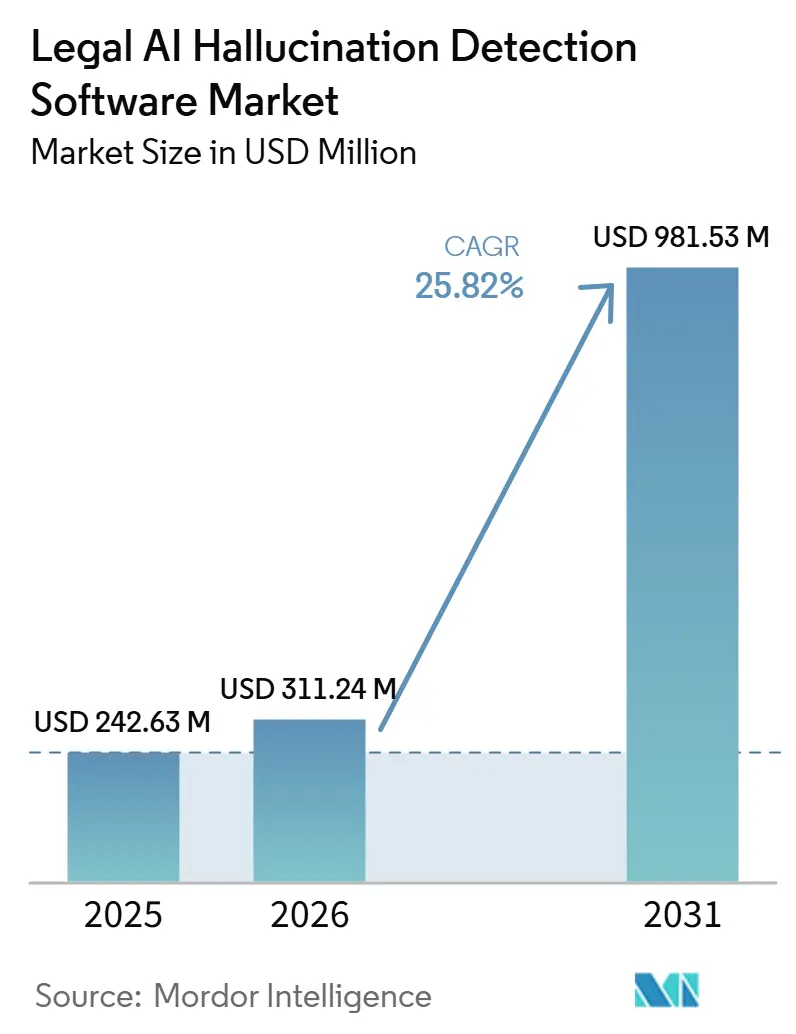
| Market Size (2026) | USD 311.24 Million |
| Market Size (2031) | USD 981.53 Million |
| Growth Rate (2026 - 2031) | 25.82 % |
| Fastest Growing Market | Asia-Pacific |
| Largest Market | North America |
| Market Concentration | Medium |
Major Players *Disclaimer: Major Players sorted in no particular order Image © Mordor Intelligence. Reuse requires attribution under CC BY 4.0. | |
Legal AI Hallucination Detection Software Market Analysis by Mordor Intelligence
The legal AI hallucination detection software market size was projected to expand from USD 242.63 million in 2025 and USD 311.24 million in 2026 to USD 981.53 million by 2031, registering a CAGR of 25.82% between 2026 to 2031. The need to verify AI-generated legal work is becoming more urgent as legal teams use these tools for research, drafting, and document review. Courts and professional bodies have made clear that lawyers remain responsible for the accuracy of AI output. This shifts verification software from a productivity feature toward a control for professional and business risk. Established legal content platforms are building verification into their broader AI products, while specialist suppliers focus on testing accuracy and creating review records. The legal AI hallucination detection software market, therefore, offers opportunities for products that can confirm both the existence of an authority and whether it supports the legal point being made in the user’s actual jurisdiction and current legal context.
Key Report Takeaways
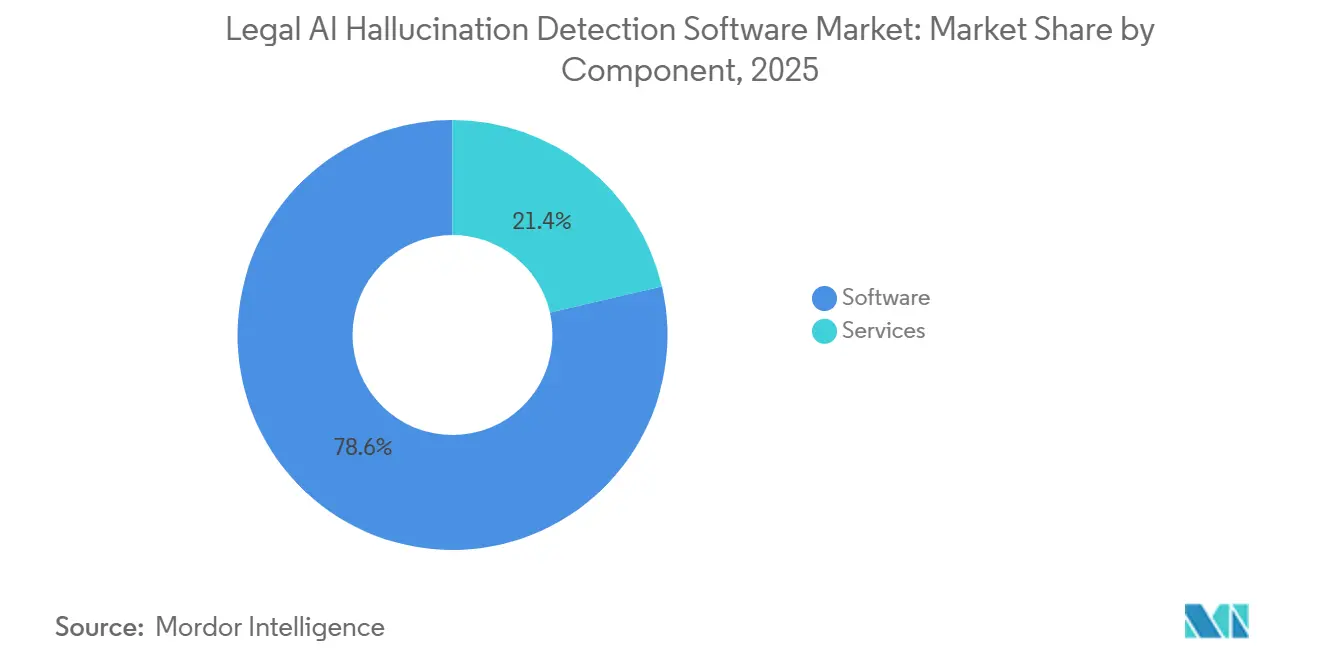
- By component, software held 78.63% of revenue in the legal AI hallucination detection software market in 2025, while services are projected to expand at a 27.11% CAGR through 2031.
- By deployment, cloud accounted for 67.81% of revenue in 2025 and is projected to expand at a 28.76% CAGR through 2031.
- By verification capability, citation and case law verification accounted for 31.43% of revenue in 2025 in the legal AI hallucination detection software market, while contract and clause validation is projected to expand at a 29.35% CAGR through 2031.
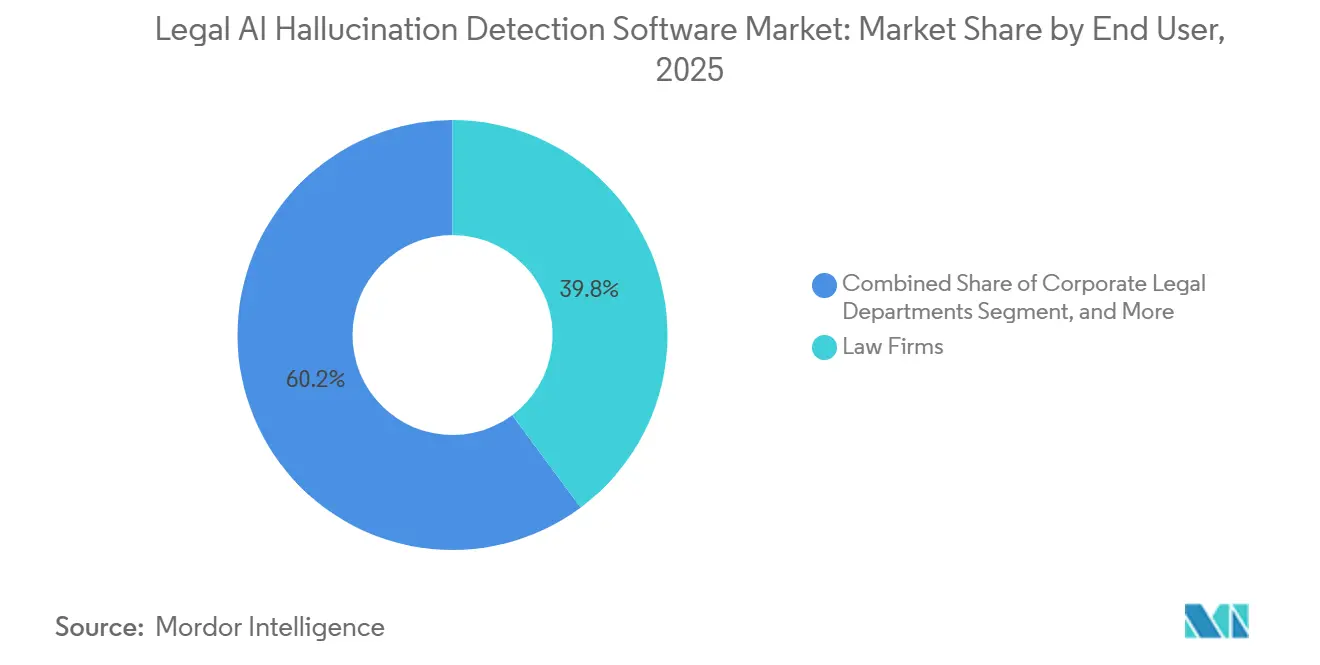
- By end user, law firms held 39.83% of revenue in 2025, while corporate legal departments are projected to expand at a 31.86% CAGR through 2031.
- By organization size, large enterprises held 62.76% of revenue in the legal AI hallucination detection software market in 2025, while mid-sized enterprises are projected to expand at a 33.62% CAGR through 2031.
- By geography, North America held 41.76% of revenue in 2025, while Asia-Pacific is projected to expand at a 34.58% CAGR through 2031.
Note: Market size and forecast figures in this report are generated using Mordor Intelligence’s proprietary estimation framework, updated with the latest available data and insights as of January 2026.
Market Trends and Insights
Drivers Impact Analysis of Legal AI Hallucination Detection Software Market*
| DRIVER | (~) % IMPACT ON CAGR FORECAST | GEOGRAPHIC RELEVANCE | IMPACT TIMELINE |
|---|---|---|---|
| Rising Legal AI Adoption in High-Stakes Workflows | +7.2% | Global | Short term (≤ 2 years) |
| Mandatory Verification of AI-Generated Legal Citations | +5.8% | North America and EU | Short term (≤ 2 years) |
| Expansion of Retrieval-Augmented Generation and Grounded Generation | +4.3% | Global | Medium term (2-4 years) |
| Regulatory and Professional-Duty Pressure for Traceable AI Outputs | +3.6% | North America, EU, APAC | Medium term (2-4 years) |
| Demand for Audit Trails, Explainability, and Defensible Human Oversight | +2.4% | North America and EU | Medium term (2-4 years) |
| Embedded Verification in Document and Legal-Research Workflows | +1.9% | Global | Long term (≥ 4 years) |
| Source: Mordor Intelligence | |||
Rising Legal AI Adoption Restructures Verification From Optional to Obligatory
Corporate legal departments reported 87% AI adoption in 2026, compared with 44% in 2025, according to the General Counsel Report cited in the source material. As AI moves into research, drafting, and review work, each output can contain several statements and citations that need checking. The resulting review requirement can grow faster than the number of AI tools deployed. Legal and governance teams represented 19.5% of enterprise AI use in 2026, based on Harmonic Security analysis reported by Law.com. This was the highest share among business functions and reflects the importance of legal workflows in enterprise AI use, especially where work must be reviewed before it is filed, sent, or relied on internally. The legal AI hallucination detection software market benefits because each new legal AI workflow creates another need to validate its output.
Court Sanctions Harden Citation Verification as a Compliance Baseline
US courts have increasingly treated fabricated legal citations as conduct warranting sanctions. The 5th US Circuit Court of Appeals sanctioned an attorney USD 2,500 in February 2026 for fictitious citations in a brief and noted that the issue showed no sign of abating. The 9th Circuit imposed the same sanction in June 2026 after a filing included non-existent cases and fabricated quotations from real decisions. Existing rules on competence and candor apply to AI-generated work, according to American Bar Association Formal Opinion 512.[1]American Bar Association, “Formal Opinion 512: Generative Artificial Intelligence Tools,” American Bar Association, acc.com This makes citation verification a recurring compliance requirement rather than an occasional quality review for the legal AI hallucination detection software market and its customers. Suppliers can position their products as controls that reduce professional liability exposure and support more defensible review processes.
Retrieval-Augmented Generation and Grounded Generation Sustain Verification Needs
Retrieval-augmented generation is widely used to ground legal AI responses in source material, but it does not remove error risk. A 2025 study of leading legal research tools found hallucination rates of 17% to 33% for purpose-built retrieval-augmented generation systems. The study documented both fabricated citations and incorrect descriptions of actual holdings, which have different consequences in legal work. The same research stream found that retrieval, human-feedback training, and guardrails can sharply reduce errors, although this approach requires several layers of controls. LegalGraphRAG research presented in 2026 also examined whether retrieved facts satisfy legal conditions rather than relying only on semantic similarity.[2]Association for Computational Linguistics, “LegalGraphRAG: Multi-Agent Graph Retrieval-Augmented Generation for Reliable Legal Reasoning,” Proceedings of the 64th Annual Meeting of the Association for Computational Linguistics, aclanthology.org The legal AI hallucination detection software market has room for tools that assess the accuracy of a legal proposition as well as the source behind it, including the link between the source, stated rule, and conclusion.
Professional-Duty Rules and Court Directives Institutionalize Traceable AI Output Requirements
Professional guidance is defining more specific expectations for human review of AI-generated legal work. The State Bar of California issued 2026 guidance that addressed agentic AI and stated that delegation to an autonomous system does not reduce an attorney’s duty to verify outputs. In France, the Conseil National des Barreaux adopted an AI deontology guide in March 2026 that warned of disciplinary proceedings when AI content is used without appropriate verification. Firms can therefore treat documented verification as part of their professional-risk controls. Products that retain an audit trail can help users show how a citation, clause, or statement was reviewed. This supports demand for legal AI hallucination detection software market offerings that fit established governance and documentation practices across firms, corporate departments, and public institutions.
Restraints Impact Analysis of Legal AI Hallucination Detection Software Market*
| RESTRAINT | (~) % IMPACT ON CAGR FORECAST | GEOGRAPHIC RELEVANCE | IMPACT TIMELINE |
|---|---|---|---|
| Lack of Standardized Hallucination Severity Metrics | -2.3% | Global | Long term (≥ 4 years) |
| Jurisdictional and Temporal Complexity of Legal Authority | -2.0% | Global | Long term (≥ 4 years) |
| False Positives and Review Burden in Verification Workflows | -1.6% | North America and EU | Medium term (2-4 years) |
| Confidentiality, Data Residency, and Privilege Constraints | -1.3% | EU, APAC | Long term (≥ 4 years) |
| Source: Mordor Intelligence | |||
Absence of Standardized Severity Benchmarks Creates Procurement Friction
The legal AI hallucination detection software market has no universal method for classifying the seriousness of an AI error. Current research distinguishes invented sources from inaccurate descriptions of real sources. However, supplier metrics do not always separate these error types, making direct product comparisons difficult. The 2025 Stanford study showed that retrieval-based tools may reduce fabrication more effectively than mischaracterization. Buyers may find it hard to connect a reported accuracy rate to the liability risk in a particular legal workflow. The absence of legal-specific standards from bodies such as ISO and IEEE can extend evaluation periods and favor suppliers with stronger sales narratives rather than clearer technical evidence in the legal AI hallucination detection software market.
Multi-Jurisdictional Authority Complexity Limits Verification Coverage and Accuracy
Legal authority varies by jurisdiction and changes over time, which makes broad verification coverage difficult. A decision may remain valid in one US federal circuit while being overruled or limited in another. Civil-law jurisdictions also place a different weight on statutes and court decisions than common-law jurisdictions. German legal guidance in 2025 required attorneys to scrutinize each AI-generated citation, including scholarly references that can be fabricated. Maintaining current statutory and case-law collections requires regular updates and adds costs for smaller suppliers. International firms can remain exposed when a product has limited foreign-law coverage, even where it performs well on US sources, which limits the consistency of legal AI hallucination detection software market deployments.
*Our forecasts treat driver/restraint impacts as directional, not additive. The impact forecasts reflect baseline growth, mix effects, and variable interactions.
Legal AI Hallucination Detection Software Market Segment Analysis
By Component:
Software Platforms Lead Revenue While Services Support ImplementationSoftware held 78.63% of the legal AI hallucination detection software market revenue in 2025. Buyers favor platforms that can process large volumes of AI-generated legal documents and work within drafting and filing processes. This preference reflects pressure to avoid a separate human review step that can remove the efficiency benefits of AI. Verification is increasingly expected inside the system that generates the legal output. Thomson Reuters rebuilt CoCounsel Legal around a citation ledger that creates evidence trails, which can be checked within a session.[3]Thomson Reuters, “One Million Professionals Turn to CoCounsel as Thomson Reuters Scales AI for Regulated Industries,” Thomson Reuters Investor Relations, ir.thomsonreuters.com The approach moves the offering beyond a simple citation-checking add-on.
Services are projected to expand at a 27.11% CAGR through 2031. This includes professional services, managed verification, training, and implementation support. Many law firms do not yet have internal AI governance teams that can configure and maintain these systems without help. Managed services can combine deployment fees with feedback from real verification work. That feedback can improve the supplier’s product over time and make it harder for rivals to match the offering. Small firms and regional practices are more likely to use managed services rather than purchase a full software deployment.


By Deployment:
Cloud Leads Adoption While On-Premises Serves Restricted WorkflowsCloud accounted for 67.81% of the legal AI hallucination detection software market revenue in 2025 and is projected to expand at a 28.76% CAGR through 2031. Cloud delivery supports frequent updates to case law, statutes, and court decisions. It also allows suppliers to update verification models without requiring customers to manage local infrastructure. LexisNexis expanded Lexis+ with Protégé internationally in May 2026, using its cloud platform to provide access to legal content and Shepard’s Citations validation.[4]LexisNexis, “LexisNexis Launches Next Evolution of Lexis+ with Protégé,” LexisNexis Pressroom, lexisnexis.com This model can help vendors introduce citation validation across markets more quickly. The segment leads both revenue and growth because updated legal content is central to verification quality.
On-premises delivery remains relevant for government bodies, financial services, legal teams, and firms managing classified or sensitive matters. For these users, data residency and privilege limits can make external processing unacceptable. Hybrid systems are being developed for organizations that need retrieval-based verification while retaining documents in a controlled environment. Such deployments generally involve longer procurement cycles than cloud subscriptions. They can also carry higher contract values because they require a more specialized setup and governance. The difference means cloud leadership by revenue does not fully describe the value associated with hybrid and on-premises contracts.
By Verification Capability:
Citation Checking Leads While Contract Validation Grows FastestCitation and case law verification accounted for 31.43% of the legal AI hallucination-detection software market share in 2025. The segment is tied directly to court filings, where a fabricated citation can result in sanctions and reputational harm. ClearBrief introduced the Cite Check Report in December 2025 to provide a single audit trail for reviewing factual and legal-authority citations. The product underscores a broader need to verify factual assertions and legal citations. Statutory and regulatory validation, fact and authority checking, and legal-document risk scoring support different stages of legal work. Together, these functions extend verification from pre-filing checks into drafting, compliance, and risk assessment.
Contract and clause validation is projected to expand at a 29.35% CAGR through 2031. Legal teams are using AI-supported agreement management tools to speed document review and workflow completion. That activity creates more AI-generated contract language that needs clause-level confirmation. Audit and explainability are still the smallest capability areas, but demand can increase as governance programs require traceable and human-reviewable outputs. The LegalGraphRAG research points to clause-level validation methods that could support this direction.
By End User:
Law Firms Hold Revenue Leadership While Corporate Departments Grow FasterLaw firms accounted for 39.83% of the legal AI hallucination detection software market revenue in 2025. Their exposure is immediate because court filings are made under an attorney’s name and can lead to sanctions if they contain fabricated authority. Law firms also face reputational costs when inaccurate AI content reaches clients or courts. They need verification that fits research, drafting, filing, and review workflows. The segment’s leading position is likely to narrow as corporate legal teams expand their AI deployment. Larger firms can also use verification records to improve supervision across dispersed practices and matters.
Corporate legal departments are projected to expand at a 31.86% CAGR through 2031. Their demand follows wider use of AI for contract review, regulatory analysis, and internal legal research. An inaccurate AI-generated explanation of a contractual obligation can expose a business to liability before a dispute reaches court. Government agencies and courts form another growing user group as they apply AI to research and administrative work. India’s Supreme Court published draft regulations for AI use in courts in 2026, following a case involving hallucinated authority. Alternative legal service providers, legal technology suppliers, and academic institutions remain smaller user groups, but they can support verification infrastructure, APIs, and benchmark data.

By Organization Size:
Large Enterprises Lead While Mid-Sized Users Broaden AccessLarge enterprises held 62.76% of the legal AI hallucination detection software market revenue in 2025. They adopted AI earlier and have larger volumes of legal output that can justify dedicated verification contracts. Many also have formal legal operations and AI governance teams that can manage enterprise-wide software deployment. Their agreements often include usage-based verification tiers, which can reduce per-document cost at high volumes. This structure supports substantial spending even when the number of individual users is limited, reinforcing the early revenue concentration of the legal AI hallucination detection software market. Cloud subscriptions can gradually reduce the cost threshold that has favored large organizations.
Mid-sized enterprises are projected to expand at a 33.62% CAGR through 2031. Subscription pricing makes verification tools more accessible to regional and boutique firms that could not previously support enterprise deployments. LegalOn Technologies raised USD 50 million in July 2025 and announced a collaboration with OpenAI for legal-domain and contract workflows. This activity reflects interest in serving the broader corporate legal customer base. Small firms face the same risk of AI errors but often lack sufficient workflow volume for dedicated software. They are more likely to use bundled verification features within legal research subscriptions, which limits their revenue contribution per user.
Geography Analysis
North America Legal AI Hallucination Detection Software Market
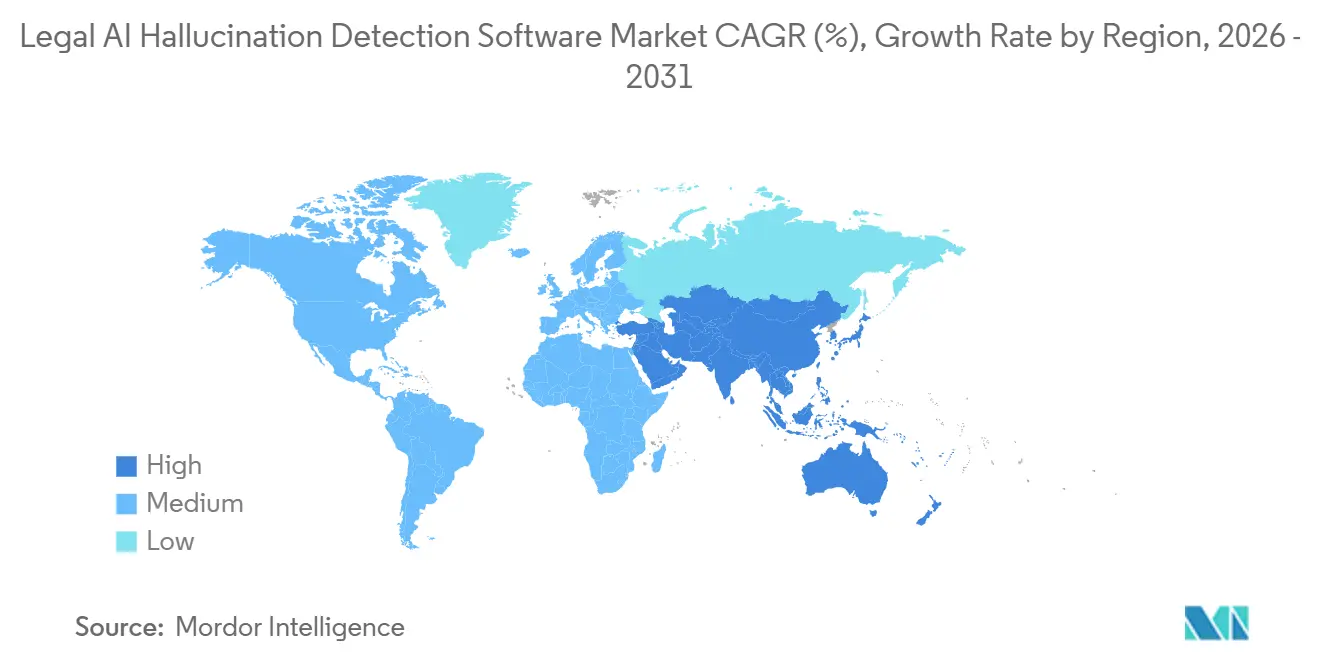
North America held 41.76% of the legal AI hallucination detection software market share in 2025. The region benefits from the United States’ litigation environment and a growing number of court responses to inaccurate AI filings. The 5th Circuit sanctioned an attorney USD 2,500 in February 2026, and the 9th Circuit issued the same sanction in June 2026. American Bar Association guidance has also clarified that established professional responsibilities apply to AI-generated work. Canada and Mexico add demand through cross-border matters that require careful authority checks.
Europe Legal AI Hallucination Detection Software Market
Europe represented a meaningful share in 2025, led by the United Kingdom, Germany, France, and the Netherlands. German courts documented cases involving fabricated citations in 2025, including rulings from the Amtsgericht Köln and Landgericht Frankfurt. French professional guidance in 2026 increased the disciplinary risk associated with unverified AI use. Data sovereignty is particularly important for European buyers. GDPR requirements and EU AI Act transparency obligations can support demand for hybrid and on-premises deployment. Russia, the Netherlands, and other European countries contribute smaller, but growing volumes as legal AI adoption extends beyond early users.
APAC, South America and MEA Legal AI Hallucination Detection Software Market
Asia-Pacific is projected to expand at 34.58% CAGR through 2031. India’s Supreme Court set aside an order on July 2, 2026, after it relied on AI-generated hallucinated case law. The Court also published draft 2026 regulations for AI use in courts and directed the Bar Council of India to establish a verification-norms committee.[5]Supreme Court of India, “Hallucinations and How to Address Them in Light of Regulations for Use of Artificial Intelligence in Courts, 2026,” SCC Online, scconline.com A 2025 regional study found that 67% of legal professionals viewed hallucination accuracy as their leading AI adoption concern. China needs products aligned to local legal citation formats and civil-law authority structures. South Korea, Japan, and Australia are also adding demand as professional guidance develops. South America remains an early-stage market, with Brazil as the main regional demand center. The Middle East and Africa are emerging through court modernization and digital governance programs in the UAE and Saudi Arabia, while South Africa, Egypt, and Nigeria provide smaller but growing volumes for the legal AI hallucination-detection software market.

Competitive Landscape
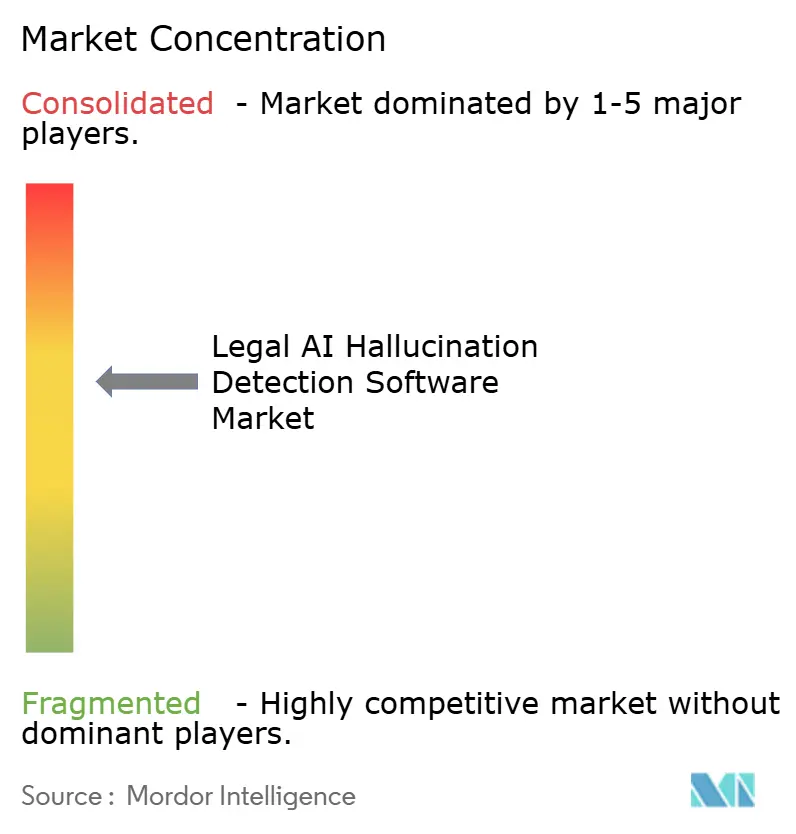
The legal AI hallucination detection software market has a moderate concentration profile. LexisNexis and Thomson Reuters have substantial installed bases, supported by long-standing ownership of legal content. The specialist layer is more fragmented, with providers offering citation review, model evaluation, and observability tools for the legal AI hallucination detection software market. Thomson Reuters rebuilt CoCounsel Legal in 2026 around a citation ledger that creates a session-verifiable evidence trail. This design is intended to prevent the system from citing material it did not retrieve from an authoritative source. The move raises expectations for verification built into legal AI platforms rather than offered only as a separate feature.
LexisNexis formed an alliance with Harvey in June 2025 to combine its retrieval infrastructure, Shepard’s Citations verification, and primary law content with Harvey’s platform. In May 2026, LexisNexis expanded Lexis+ with Protégé for international rollout and integrated real-time citation validation. Harvey’s acquisitions of Hexus and Benchmark during 2026 point to a strategy of extending into document analytics and financial-services use cases. Norm AI’s July 2026 funding round was directed toward supervisory agents for regulated enterprise AI deployments. LegalOn combined its 2025 funding with an OpenAI collaboration for contract verification workflows. These moves show that broad platform capability is becoming a central competitive requirement in the legal AI hallucination detection software market.
ClearBrief focuses on non-generative AI for citation checking, which avoids the risk that the verification layer itself produces a new hallucination. Patronus AI and Arize AI operate in the evaluation and observability layer and can serve as infrastructure suppliers to legal technology providers. The main gap in the legal AI hallucination detection software market remains multilingual, jurisdiction-agnostic verification that performs well across civil-law and common-law sources. This gap is important because many leading platforms remain strongest on US federal and state content. Buyers are likely to place more value on proposition-level verification that tests whether a case supports the statement made. Existence-level verification only confirms that a cited source can be found. The legal AI hallucination detection software industry may therefore reward suppliers that demonstrate clear coverage and accuracy across the legal proposition, source, jurisdiction, and time period, while the legal AI hallucination detection software market remains open to specialized suppliers.
Legal AI Hallucination Detection Software Industry Leaders
LexisNexis (RELX Inc.)
Thomson Reuters Corporation
Clearbrief, Inc.
Microsoft Corporation
Harvey AI, Inc.
- *Disclaimer: Major Players sorted in no particular order
Legal AI Hallucination Detection Software Market Companies Covered in this Report
- LexisNexis (RELX Inc.)
- Thomson Reuters Corporation
- Clearbrief, Inc.
- Microsoft Corporation
- Harvey AI, Inc.
- GroundTruth, Manoff Technologies, Inc.
- Thirty Seven Inc.
- Ark Legal AI, Inc.
- Casetext, Inc.
- vLex, Inc.
- Clio Technologies, Inc.
- Litera Corp.
- Relativity ODA LLC
- Everlaw, Inc.
- DISCO Technology, Inc.
- Luminance Technologies Ltd.
- Robin AI Ltd.
- Spellbook Technologies Inc.
- Patronus AI, Inc.
- Arize AI, Inc.
- Google LLC
- Amazon Web Services, Inc.
- NVIDIA Corporation

Recent Industry Developments in Legal AI Hallucination Detection Software Market
- July 2026: Norm AI raised USD 120 million in a Series C at a USD 1.2 billion valuation, led by Khosla Ventures, with participation from Blackstone, Bain Capital Ventures, Fenwick LLP, Coatue, Vanguard, New York Life, TIAA, and former Kirkland and Ellis chairman Jeff Hammes. The round is earmarked for supervisory agent development for regulated enterprise AI deployments, expanding Norm AI’s practice area coverage and hiring senior attorneys to ensure legally defensible AI outputs.
- July 2026: Harvey AI acquired Benchmark, an asset management intelligence platform, marking its third acquisition since January 2026. The deal expands Harvey’s addressable market beyond law firms into financial services, where investment memo and deal document verification represents a high-value adjacent use case.
- June 2026: Thomson Reuters opened early access to its completely rebuilt CoCounsel Legal, featuring a patent-pending citation ledger architecture and fiduciary-grade AI positioning, with general availability planned for August 2026 in the United States followed by rollouts in Canada, the United Kingdom, and Australia.
- May 2026: LexisNexis launched the expanded Lexis+ with Protégé platform on May 7, 2026, combining authoritative legal content, real-time Shepard’s Citations validation, and agentic AI workflows for global rollout throughout 2026, following US general availability announced in early 2026.


Global Legal AI Hallucination Detection Software Market Report Scope
The Legal AI Hallucination Detection Software Market is defined as the market for specialized solutions that detect, flag, and reduce inaccuracies or “hallucinations” produced by AI systems in legal applications. These inaccuracies may include misinterpreted statutes, fabricated case references, and incorrect billing data. These platforms use multi-agent validation, retrieval-augmented generation (RAG), anomaly detection, and explainability frameworks to improve reliability and support compliance in AI-assisted legal workflows. By reducing error rates and liability risks, legal AI hallucination detection software helps corporate legal departments, law firms, and regulatory bodies adopt generative AI with greater confidence and use it as enterprise-grade support for legal operations.
The Legal AI Hallucination Detection Software Market Report is Segmented by Component (Software, and Services [Professional Services, Managed Verification Services, and Training and Implementation Services]), Deployment (Cloud, On-Premises, and Hybrid), Verification Capability (Citation and Case Law Verification, Statutory and Regulatory Validation, AI Fact and Authority Verification, Contract and Clause Validation, Legal Document Risk Scoring, and AI Output Audit and Explainability), End User (Law Firms, Corporate Legal Departments, Government Agencies and Courts, Alternative Legal Service Providers, Legal Technology Vendors, Academic Institutions, and Other End Users), Organization Size (Large Enterprises, Mid-sized Enterprises, and Small Firms), and Geography (North America, South America, Europe, Asia-Pacific, and Middle East and Africa). The Market Forecasts are Provided in Terms of Value (USD).
| Software | |
| Services | Professional Services |
| Managed Verification Services | |
| Training and Implementation Services |
| Cloud |
| On-Premises |
| Hybrid |
| Citation and Case Law Verification |
| Statutory and Regulatory Validation |
| AI Fact and Authority Verification |
| Contract and Clause Validation |
| Legal Document Risk Scoring |
| AI Output Audit and Explainability |
| Law Firms |
| Corporate Legal Departments |
| Government Agencies and Courts |
| Alternative Legal Service Providers |
| Legal Technology Vendors |
| Academic Institutions |
| Other End Users |
| Large Enterprises |
| Mid-sized Enterprises |
| Small Firms |
| North America | United States | |
| Canada | ||
| Mexico | ||
| South America | Brazil | |
| Argentina | ||
| Chile | ||
| Rest of South America | ||
| Europe | United Kingdom | |
| Germany | ||
| France | ||
| Netherlands | ||
| Russia | ||
| Rest of Europe | ||
| Asia-Pacific | China | |
| India | ||
| Japan | ||
| South Korea | ||
| Australia | ||
| Rest of Asia-Pacific | ||
| Middle East and Africa | Middle East | United Arab Emirates |
| Saudi Arabia | ||
| Israel | ||
| Turkey | ||
| Rest of Middle East | ||
| Africa | South Africa | |
| Egypt | ||
| Nigeria | ||
| Rest of Africa | ||
| By Component | Software | ||
| Services | Professional Services | ||
| Managed Verification Services | |||
| Training and Implementation Services | |||
| By Deployment | Cloud | ||
| On-Premises | |||
| Hybrid | |||
| By Verification Capability | Citation and Case Law Verification | ||
| Statutory and Regulatory Validation | |||
| AI Fact and Authority Verification | |||
| Contract and Clause Validation | |||
| Legal Document Risk Scoring | |||
| AI Output Audit and Explainability | |||
| By End User | Law Firms | ||
| Corporate Legal Departments | |||
| Government Agencies and Courts | |||
| Alternative Legal Service Providers | |||
| Legal Technology Vendors | |||
| Academic Institutions | |||
| Other End Users | |||
| By Organization Size | Large Enterprises | ||
| Mid-sized Enterprises | |||
| Small Firms | |||
| By Geography | North America | United States | |
| Canada | |||
| Mexico | |||
| South America | Brazil | ||
| Argentina | |||
| Chile | |||
| Rest of South America | |||
| Europe | United Kingdom | ||
| Germany | |||
| France | |||
| Netherlands | |||
| Russia | |||
| Rest of Europe | |||
| Asia-Pacific | China | ||
| India | |||
| Japan | |||
| South Korea | |||
| Australia | |||
| Rest of Asia-Pacific | |||
| Middle East and Africa | Middle East | United Arab Emirates | |
| Saudi Arabia | |||
| Israel | |||
| Turkey | |||
| Rest of Middle East | |||
| Africa | South Africa | ||
| Egypt | |||
| Nigeria | |||
| Rest of Africa | |||


Key Questions Answered in the Report
What is the size of the legal AI hallucination detection software sector?
The legal AI hallucination detection software market size was projected to expand from USD 242.63 million in 2025 and USD 311.24 million in 2026 to USD 981.53 million by 2031, registering a CAGR of 25.82% between 2026 to 2031.
What is driving demand for legal AI verification tools?
Increased legal AI use, court sanctions for fabricated citations, and professional duties to verify AI outputs are supporting demand.
Which deployment model leads adoption for legal AI verification?
Cloud led with 67.81% of revenue in 2025 and is projected to expand at a 28.76% CAGR through 2031.
Which verification capability is growing fastest?
Contract and clause validation is projected to expand at a 29.35% CAGR through 2031 as AI-generated contract language becomes more common.
Which end users are expanding fastest?
Corporate legal departments are projected to expand at a 31.86% CAGR through 2031, driven by AI use in contract, research, and compliance work.
Which region is growing fastest for these tools?
Asia-Pacific is projected to expand at a 34.58% CAGR through 2031, supported by legal AI adoption and judicial attention to hallucinated case law.
Page last updated on:





