
Market Overview
| Study Period | 2021 - 2031 |
|---|---|
| Forecast Data Period | 2026 - 2031 |
| Base Year Market Size (2025) | USD 96.40 Million |
| Market Size (2026) | USD 103.30 Million |
| Market Size (2031) | USD 154.5 Million |
| Growth Rate (2026 - 2031) | 8.38 % |
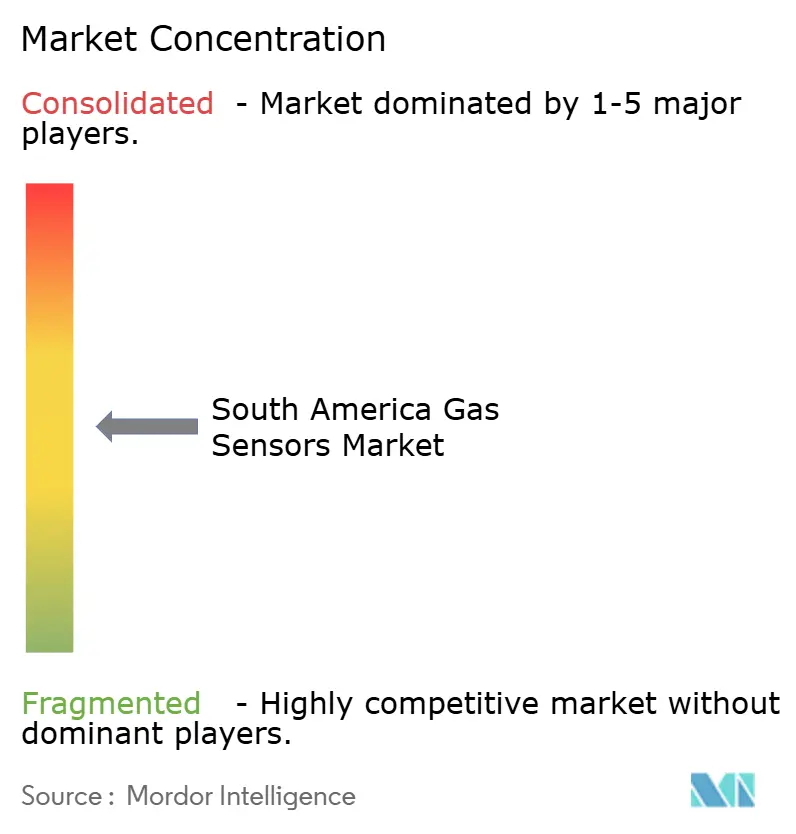
| Market Concentration | Medium |
Major Players *Disclaimer: Major Players sorted in no particular order Image © Mordor Intelligence. Reuse requires attribution under CC BY 4.0. | |
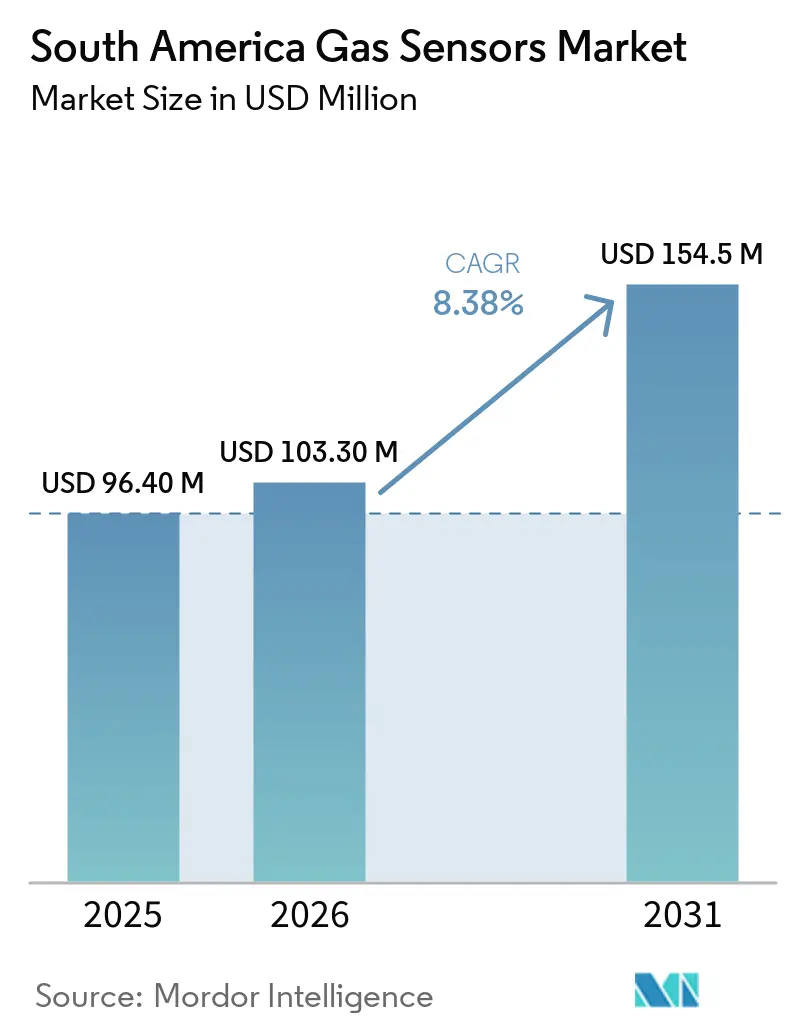
South America Gas Sensors Market Analysis by Mordor Intelligence
The South America Gas Sensors Market size is projected to expand from USD 96.40 million in 2025 and USD 103.30 million in 2026 to USD 154.5 million by 2031, registering a CAGR of 8.38% between 2026 to 2031.
Demand is shifting from periodic manual checks toward continuous gas detection across industrial sites and public settings, because operating teams need more regular visibility over personnel exposure, process conditions, and environmental releases. Safety rules and emissions reporting are widening demand beyond refineries into mining, smart buildings, food cold-chain logistics, and automotive HVAC systems, which broadens the customer base beyond traditional process industries. Brazil remains the main regional demand center, while Argentina and Colombia offer recurring demand through upstream development and methane monitoring requirements, and Chile and Peru add mining-led needs across the wider regional landscape. Suppliers are adapting their portfolios for fixed industrial systems and low-power connected nodes, which require different sales channels and maintenance models, from engineering-led plant projects to distributed public monitoring programs with frequent device deployment and calibration needs. Service coverage and component import costs remain important limits, especially at remote sites where calibration access is limited and travel, logistics, and maintenance resources add to operating costs.
Key Report Takeaways
- By gas type, hydrocarbons (VOC/CH₄) held 26.10% of the South America gas sensors market share in 2025, while carbon dioxide (CO₂) is projected to be the fastest-expanding gas type through 2031.
- By technology, MEMS semiconductor optical sensors are projected to expand at a CAGR of 10.15% through 2031, the highest rate within the technology category.
- By form factor, fixed/in-situ modules held 54.77% of the market share in 2025, while wearable badges/patches are projected to expand at a CAGR of 12.09% through 2031.
- By connectivity, wired protocols led the installed base in 2025, while wireless connectivity is projected to expand at a CAGR of 11.31% through 2031.
- By end-use industry, industrial safety and process applications held 43.36% of the South America gas sensors market size in 2025, while environmental monitoring and smart city nodes are projected to expand at a CAGR of 10.83% through 2031.
- By geography, Brazil held 48.55% of the South America gas sensors market share in 2025, while the Rest of South America is projected to expand at a CAGR of 9.22% through 2031.
Note: Market size and forecast figures in this report are generated using Mordor Intelligence’s proprietary estimation framework, updated with the latest available data and insights as of January 2026.
Market Trends and Insights
Drivers Impact Analysis of South America Gas Sensors Market*
| Driver | (~) % Impact on CAGR Forecast | Geographic Relevance | Impact Timeline |
|---|---|---|---|
| Stricter Industrial Safety and Emissions Regulations | +2.8% | National, Brazil, Argentina, Colombia, and Peru | Short term (≤ 2 years) |
| Expansion of Oil and Gas, Mining, and Chemical Operations | +2.3% | Brazil, Argentina, Vaca Muerta, and Colombia | Medium term (2-4 years) |
| Methane-Leak Detection for Remote Production Assets | +1.8% | Argentina, Neuquén and Chubut, and Brazil offshore pre-salt | Long term (≥ 4 years) |
| Growth in Smart-City and Indoor-Air-Quality Monitoring | +1.4% | Brazil, Colombia, and Paraguay | Medium term (2-4 years) |
| Connected-Worker and Wireless Sensor Deployments | +1.0% | Brazil and Chile copper and lithium mining | Short term (≤ 2 years) |
| Lithium and Copper Project Monitoring Requirements | +0.8% | Chile, Argentina, and Peru | Long term (≥ 4 years) |
| Source: Mordor Intelligence | |||
Stricter Industrial Safety and Emissions Regulations
Brazil maintains a structured occupational safety framework through NR-15, NR-20, NR-33, and NR-35. These rules cover unhealthy activities, flammables, confined spaces, work at height, gas detector calibration, and protection in explosive atmospheres. ABNT revised ABNT NBR IEC 60079-29-2 in December 2024, strengthening requirements for selecting, installing, using, and maintaining flammable-gas and oxygen detectors. The revision increases documentation and calibration record requirements, which can bring replacement demand for legacy equipment that lacks the required records or cannot demonstrate continued performance against the updated requirements. Peru published its 2026 mining safety and health regulation in March 2026, extending formal gas-monitoring obligations to more mid-tier mining operations that had previously been less consistently covered by formal compliance requirements[1]. A potential revision to Brazil's NR-15 could increase the use of continuous monitoring in sectors that still rely on periodic sampling.
Expansion of Oil and Gas, Mining, and Chemical Operations
BP announced a major oil and gas discovery at the Bumerangue block in Brazil's Santos Basin in August 2025. Future deepwater development would require fixed gas sensors for process safety, emergency shutdown systems, and operational integrity requirements. In Argentina, Vaca Muerta production plans by Vista Energy and YPF support demand for hydrocarbon and CO₂ monitoring under provincial emissions reporting requirements. New petrochemical infrastructure near Añelo and Neuquén City also requires VOC and toxic-gas monitoring in confined spaces and loading areas. Electrochemical multi-gas instruments remain the normal specification for those applications, where workers may face a mix of hydrocarbon, carbon dioxide, and toxic-gas exposures during routine operations. Recovered industrial CO₂ used in food-grade supply chains creates another use for purity sensors that is linked to petrochemical output rather than oil price movements.
Methane-Leak Detection for Remote Production Assets
Colombia has explicit oil and gas methane requirements that include biannual leak detection and repair activity and technology standards. This framework supports scheduled demand for equipment that can identify and document emissions at production assets, rather than relying only on operator-led inspections that occur without a regular compliance schedule. Brazil's ANP was developing methane rules expected to take effect by 2026, while Chubut prohibits methane venting and Neuquén has monitoring, measurement, reporting, and verification requirements for hydrocarbon operators. Petrobras deployed wireless acoustic transmitters at 114 pressure safety valve monitoring points at the RPBC refinery in São Paulo, identifying leaks that would have released 20,000 metric tons of CO₂ equivalent over 6 months. The project saved USD 220,000 and was completed 80% faster than a comparable wired project. Brazil's Empresa de Pesquisa Energética reported that structured leak detection and repair campaigns using optical gas imaging can reduce fugitive methane emissions in oil production and can shift sensor spending from a compliance cost toward an operational investment.
Growth in Smart-City and Indoor-Air-Quality Monitoring
Paraguay modernized its air quality network in Asunción in April 2026 with solar-powered stations measuring CO, NO₂, O₃, PM2.5, and PM10 in real time. The deployment shows that environmental monitoring is becoming more formal in South American economies that were previously smaller sources of sensor demand. Brazil's AirView+ program introduced continuous ambient networks across Recife, Salvador, Rio de Janeiro, Belo Horizonte, and Curitiba through 2025 agreements involving municipal governments and the Google-Aurassure platform. A 2026 study recorded pollution patterns across 6 South American cities using in-situ networks, including locations in São Paulo and Montevideo. Civic projects require continuous calibration and lower-cost devices at scale. Industrial systems, by contrast, carry higher certification requirements and higher system values, so suppliers need different product lines and service arrangements for each buyer group, including local technical support and calibration capabilities that public projects may not require to the same degree.
Restraints Impact Analysis of South America Gas Sensors Market*
| Restraint | (~) % Impact on CAGR Forecast | Geographic Relevance | Impact Timeline |
|---|---|---|---|
| High Installation and Lifecycle Costs | -1.5% | National, with greatest burden at remote upstream and mining locations | Short term (≤ 2 years) |
| Sensor Interference, Drift, and Calibration Burden | -0.9% | National, with greatest impact in the Amazon basin and Andean sites | Medium term (2-4 years) |
| Limited Local Service and Calibration Infrastructure | -0.7% | Brazil outside the São Paulo-Rio axis, Argentina, Peru, and Bolivia | Long term (≥ 4 years) |
| Fragmented Procurement Across Small Industrial Operators | -0.4% | Colombia's SME sector, Peru highland mining, and Bolivia | Medium term (2-4 years) |
| Source: Mordor Intelligence | |||
High Installation and Lifecycle Costs
Fixed multi-point gas detection networks require certified wiring, commissioning, annual calibration, and sensor element replacement. In South American industrial facilities, those lifecycle requirements can cost 2 to 4 times the listed hardware price. Brazil's import duties on sensor components add 10-20% to landed costs compared with global benchmarks. This cost structure can delay refresh cycles and helps explain the continued use of older wired systems, even where newer architectures could reduce the amount of cable, scaffolding, and site work required. A Brazilian systematic review found that low-cost air-quality sensor nodes in South America ranged from USD 71 to USD 1,573 before calibration services[2]. Remote operators are giving more attention to NDIR and MEMS designs with service intervals of 3 years or more, rather than electrochemical cells that may require replacement after 12-24 months.
Sensor Interference, Drift, and Calibration Burden
High humidity in the Amazon basin can shorten electrochemical cell life, while H₂S in pre-salt crude streams can affect VOC readings. Temperature changes at Andean mining sites can also push solid-state MOS devices beyond their stated operating range. A field evaluation in Colombia's Aburrá Valley found that PM2.5 and O₃ devices needed correction models to achieve correlation coefficients above 0.8 against certified analyzers. The result highlights the calibration work required in complex terrain and variable microclimates. Published calibration intervals of 6-12 months can be insufficient in several regional operating environments, increasing consumables use and raising the risk that safety programs rely on readings that need additional correction. Inmetro accreditation and ISO/IEC 17025-conformant calibration are important under Brazil's framework, but accredited providers are scarce outside the São Paulo-Rio de Janeiro corridor.
*Our forecasts treat driver/restraint impacts as directional, not additive. The impact forecasts reflect baseline growth, mix effects, and variable interactions.
South America Gas Sensors Market Segment Analysis
By Gas Type:
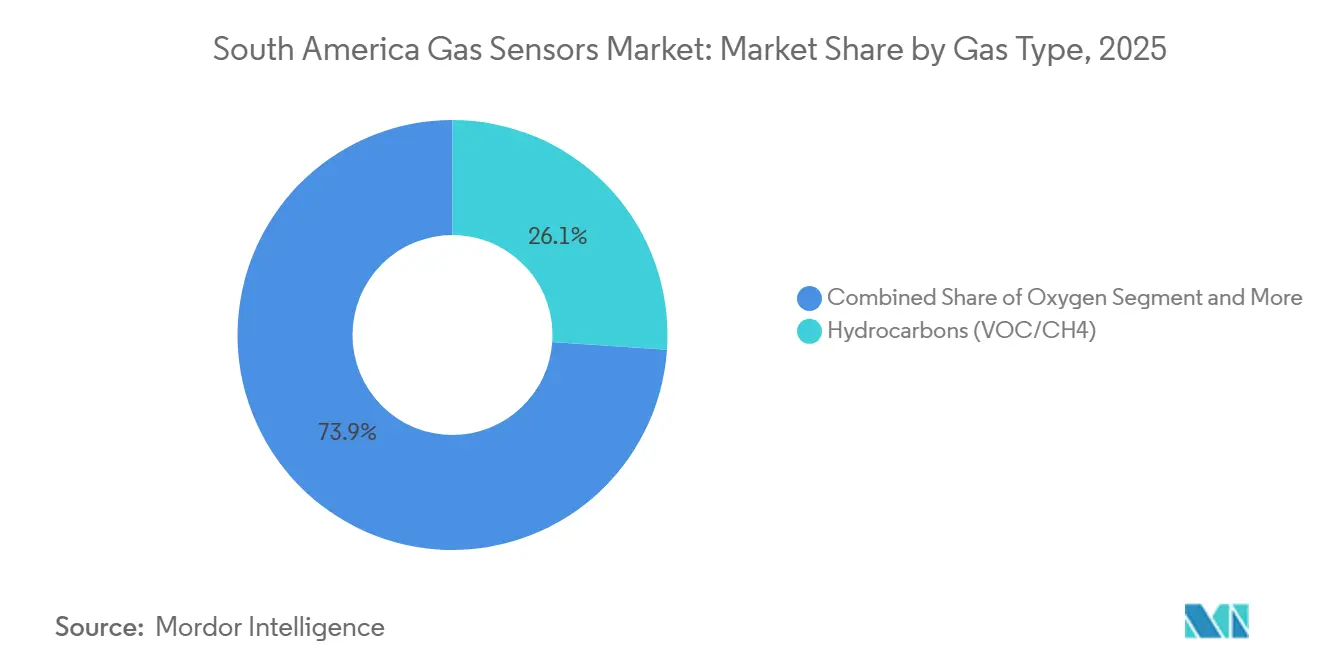
Hydrocarbons Lead, While CO₂ Opens New Application ChannelsGas type selection remains closely tied to the source of exposure and the monitoring purpose at each facility, including worker protection, leak identification, process control, air-quality oversight, and food storage integrity. This keeps multi-gas configurations important, where flammable, toxic, and oxygen-deficient conditions can occur together.
Hydrocarbons (VOC/CH₄) held 26.10% of the South America gas sensors market share in 2025. The segment reflects flammable-gas exposure in upstream oil and gas, steel, and chemical operations across Brazil, Argentina, and Colombia. Catalytic bead instruments and multi-gas electrochemical devices configured for lower-explosive-limit monitoring remain standard equipment in refineries and industrial plants. Their broad installed base supports replacement demand where operators must maintain coverage in hazardous locations, particularly where refineries, production facilities, and chemical plants cannot safely operate without continuous monitoring.
CO₂ is the fastest-expanding gas type through 2031. Building automation, HVAC optimization, food and beverage cold chains, and offshore monitoring needs at high-CO₂ pre-salt reservoirs support this demand. BP's Bumerangue discovery contains elevated CO₂ in associated gas, creating a further need for CO₂ sensing if the block moves into development. O₂ sensors retain a stable role in confined-space verification, while H₂S and SO₂ devices support sour-gas processing and sulfuric acid operations in Chilean and Peruvian mining. NOₓ monitoring is also extending through urban programs in São Paulo, Bogotá, and Santiago as ambient air standards tighten.
The category therefore serves both heavy industrial safety needs and a wider set of commercial and civic applications, allowing suppliers to address exposure risks in production environments as well as ventilation, storage, and ambient monitoring needs. That range reduces reliance on any single industrial purchasing cycle.

By Technology:
Electrochemical Devices Retain Scale, While MEMS Gains GroundMEMS semiconductor optical devices are forecast to expand at a CAGR of 10.15% through 2031, the highest rate across technology types. Their smaller size and lower power use suit battery-powered equipment, IoT wearables, and LoRaWAN nodes. A 2026 study described an integrated NDIR CO₂ sensor built on a single silicon substrate with improved optical coupling and rapid gas exchange[3]. These technical characteristics are relevant to industrial and civic deployments that operate in humid or thermally variable conditions, where sensor footprint, power draw, and the ability to exchange gas rapidly affect installation choices.
Electrochemical technology retains the deepest installed base in the South America gas sensors industry. It remains widely specified for CO, H₂S, and O₂ monitoring where parts-per-million sensitivity and established calibration procedures are important. PID sensors support VOC monitoring for petrochemical hygiene and industrial exposure assessments. NDIR devices are expanding from process safety into building systems as CO₂ requirements become more common in offices, schools, and hospitals. Catalytic bead products remain a cost-effective option for fixed combustible-gas monitoring when NDIR's higher unit cost is not justified, especially at sites that already have mature hard-wired detection systems and established maintenance practices.
Technology choice also depends on service intervals, available power, operating conditions, and the type of gas that requires detection. These considerations preserve demand for several established sensing methods.
By Form Factor:
Fixed Modules Hold the Base, While Wearables Lead ExpansionArea monitors can supplement personal devices when a task creates changing exposure conditions across a work zone. This combination lets managers review worker safety and local atmospheric conditions through the same connected program.
Fixed/in-situ modules held 54.77% of the South America gas sensors market size in 2025. Refineries, offshore facilities, and chemical plants use hard-wired continuous monitoring because their safety systems are designed around permanent area coverage. These installations have long service lives and are costly to remove or replace. As a result, fixed systems are likely to remain important even as connected alternatives gain use, because replacement requires careful changes to certified equipment that is integral to an operating plant's safety design.
Wearable badges and patches are forecast to expand at a CAGR of 12.09% through 2031, the highest rate among form factors. Connected-worker programs in Brazil's steel sector, Chile's copper mines, and Argentina's upstream sites support this shift. Industrial Scientific deployed Ventis Pro5 personal monitors and Radius BZ1 area monitors at Gerdau steel plants in Brazil, reducing detector maintenance time from 45 days to 24 working hours. Portable handheld devices remain necessary for confined-space entry, emergency response, and field inspections. The move toward wearable systems will take time because fixed certified systems are already embedded in operating plants, yet personal and area devices can add coverage where mobile workers enter spaces beyond a fixed detector's range.
The practical choice between fixed, portable, and wearable equipment depends on how workers move through a facility and where exposure may occur, as well as whether the safety task involves permanent coverage, planned entry, or a temporary work area. Operators often use more than 1 form factor within a single safety program.
By Connectivity:
Wireless Changes the Cost of Remote CoverageRemote asset coverage is important in upstream fields, mines, and facilities with dispersed safety equipment, where crews may be separated from centralized control rooms and dependable monitoring can require devices positioned across a wide operating area. It also allows monitoring points to be added without redesigning the permanent electrical infrastructure.
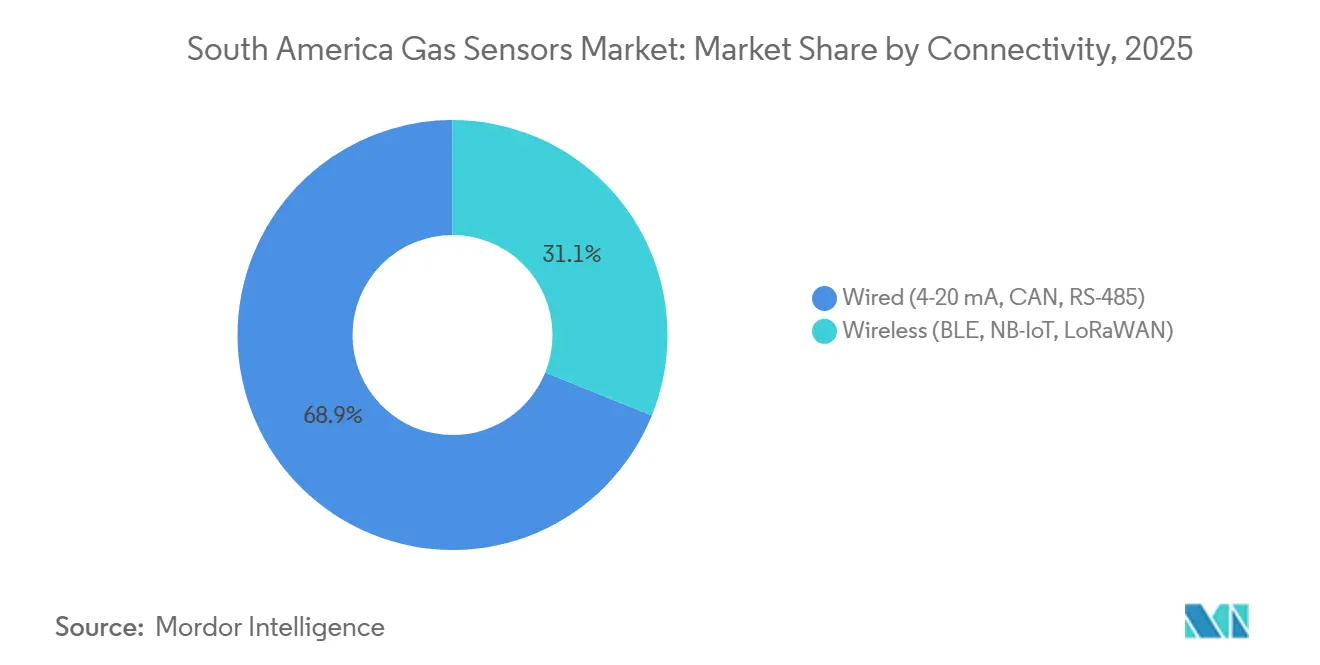
Wireless connectivity is projected to expand at a CAGR of 11.31% through 2031. BLE, NB-IoT, and LoRaWAN support low-power deployment at remote facilities where wiring costs are high. The South America gas sensors market size for wireless solutions is supported by improvements in sensor energy efficiency and wider low-power network coverage. Wireless platforms are particularly relevant where scaffolding, local power, and plant shutdowns make hard-wired projects costly, such as remote upstream assets and large industrial sites with extensive hazardous-area infrastructure.
Wired 4-20 mA, CAN, and RS-485 systems led the 2025 installed base in refineries and chemical plants. Petrobras used WirelessHART transmitters at 114 pressure safety valve monitoring points at the RPBC refinery and reported USD 3 million in installation savings compared with a wired project. The system avoided scaffolding, process shutdowns, and local power requirements. MSA's ALTAIR io 4 combines wearable monitoring with CAT-M LTE connectivity and is available in regional channels including Brazil and Chile. LoRaWAN also supports municipal air-quality networks where cellular service is unavailable or too costly, allowing cities to place distributed monitoring points in schools, transit corridors, and other public locations.
Connectivity decisions also reflect existing control systems, network access, and the disruption that would result from changing certified equipment. Wireless and wired systems can therefore operate alongside each other at the same site, allowing operators to retain permanent protection while adding flexible monitoring points where process conditions or worker locations change.
By End-Use Industry:
Industrial Safety Leads, While Environmental Monitoring Advances FastestThe end-use mix, therefore, combines mature compliance spending with newer public and commercial monitoring applications. Suppliers need to match sensor range, certification, connectivity, and service support to the needs of each setting.
Industrial safety and process applications held 43.36% of the South America gas sensors market share in 2025. Oil and gas extraction, refining, and petrochemical activity create the region's largest base of demand for gas detection equipment. Procurement is linked to plant construction cycles and regulatory recertification, which provides recurring business for suppliers with established service and distribution networks. This segment remains central to the commercial position of full-system vendors, since buyers value equipment certification, installed-base support, technical advice, and dependable calibration services alongside the detector itself.
Environmental monitoring and smart city nodes are forecast to expand at a CAGR of 10.83% through 2031. Governments in Brazil, Colombia, Paraguay, and Chile are investing in continuous air networks to support ambient standards and reporting commitments. Automotive powertrain and HVAC demand is tied to Brazil's vehicle assembly sector, where OEMs specify NOₓ and O₂ sensors. Building automation is emerging in commercial properties in São Paulo, Buenos Aires, and Bogotá through CO₂-based ventilation controls. Food, beverage, and cold-chain logistics use CO₂ and O₂ devices for modified-atmosphere packaging and cold-storage monitoring, connecting demand to food-processing activity as well as safety requirements.
These varied use cases give suppliers opportunities across safety, process control, mobility, building operations, and food logistics. They also require sales and service capabilities that can support several customer groups, because a refinery buyer, municipal agency, building operator, and food logistics provider each evaluate equipment against different operating priorities.
Geography Analysis
Brazil Gas Sensors Market
Brazil held 48.55% of the South America gas sensors market share in 2025. Its position reflects industrial density, active regulatory enforcement, and the scale of domestic oil procurement. Petrobras's refinery network and pre-salt program, with further potential from BP's Bumerangue discovery, support long-term process safety spending. The December 2024 ABNT update creates compliance-related replacement demand for detectors used in explosive atmospheres. AirView+ deployments across 5 Brazilian cities opened a separate public-sector channel for CO₂, VOC, and particulate monitoring in schools and transit settings. Inmetro certification lead times can slow the introduction of globally available connected-worker products in classified locations, leaving suppliers with local approvals and service arrangements better positioned to serve time-sensitive industrial procurement programs.
Argentina and Colombia Gas Sensors Market
Argentina is a major growth area outside Brazil, supported by Vaca Muerta development and provincial methane monitoring obligations. YPF has measured methane emissions and venting at Vaca Muerta blocks since 2020 through satellite imagery, aerial imaging, and portable detection cameras. Vista Energy used infrared optical cameras and real-time analytics at 7 wellpads, showing a more advanced approach to flare monitoring. Colombia has a different demand pattern because its biannual leak detection and repair requirement supports scheduled purchases of portable and fixed electrochemical devices. Medellín's air authority is moving toward IoT-connected low-cost sensors to widen coverage in the Aburrá Valley. This public demand complements the country's industrial oil and gas base, providing a second procurement channel that is tied to air-quality coverage rather than directly to upstream production activity.
Broader South America Gas Sensors Market
The Rest of South America is forecast to expand at a CAGR of 9.22% through 2031. Chile, Peru, Ecuador, and other markets are supported by mining safety formalization and expanding environmental monitoring requirements. Lomas Bayas became the first mining company in Chile to deploy Hexagon's Smart Center platform in May 2025, while Codelco signed a memorandum with Hexagon in December 2025 on safety and environmental monitoring tools. Peru's 2026 mining safety regulation widens gas-monitoring requirements for mid-size and artisanal operators[4]. Paraguay's solar-powered stations in Asunción signal stronger air-quality spending in smaller economies. These needs extend opportunities beyond the region's established oil and gas centers, as mining formalization and city monitoring programs create new requirements in countries with lower historic equipment penetration.
Competitive Landscape
The South America gas sensors market is moderately fragmented. Honeywell International, MSA Safety, and Drägerwerk hold significant positions through broad product portfolios, regional distributors, and Inmetro-certified hazardous-area offerings. In Brazil, certification and technical service coverage act as meaningful barriers for suppliers entering large industrial accounts, because buyers must be confident that equipment and follow-up support meet hazardous-area operating requirements. ABB and Siemens compete through wider automation and building management portfolios, where gas sensing forms part of a larger safety or energy-efficiency system. This positions full-system suppliers differently from companies that offer sensor elements or modules alone, since end users generally require installed equipment, certification support, monitoring software, service access, and maintenance continuity.
Competition is moving beyond the device itself toward software, fleet management, and monitoring services. Industrial Scientific's iNet platform, MSA's Grid cloud software, and Blackline Live support subscription-based connected safety programs. Industrial Scientific and Gerdau agreed to a 6-year connected safety program across 4 Brazilian plants, combining personal and area monitors with maintenance and live monitoring services. MSA's connected wearable offering reflects the same shift from stand-alone equipment purchases to managed safety operations, where fleet data and ongoing support become part of the customer relationship. Siemens became a partner in a March 2026 program for smart CO₂ sensing, digital-twin, and ventilation optimization solutions for commercial and healthcare buildings.
Service gaps create room for suppliers that can support remote mining and upstream installations, particularly where operators struggle to arrange certified calibration, replace sensor elements, or obtain timely maintenance support outside major urban centers. Calibration as a service, wireless networks designed for leak detection and repair, and lower-cost LoRaWAN nodes for mid-sized cities are the main areas of demand not fully served by current regional infrastructure. Blackline updated Inmetro certification for connected safety wearables in July 2026, while Crowcon opened pre-orders for its modular IQ connected portable detector range in September 2025. Shape Digital, Shell Brasil, MODEC Brasil, and Unicamp began a 36-month R&D partnership in August 2025 for AI-based gas-leak detection and safety-barrier monitoring at offshore units. These developments show that technical service, data capability, and local certification are increasingly important alongside hardware, particularly when customers seek connected monitoring across distributed workers, remote assets, and complex industrial sites.
South America Gas Sensors Industry Leaders
-
ABB Ltd.
-
Honeywell International Inc.
-
MSA Safety Incorporated
-
Siemens AG
-
Robert Bosch GmbH
- *Disclaimer: Major Players sorted in no particular order
South America Gas Sensors Market Companies Covered in this Report
- ABB Ltd.
- Honeywell International Inc.
- MSA Safety Incorporated
- Drägerwerk AG & Co. KGaA
- Siemens AG
- Robert Bosch GmbH
- Amphenol Corporation
- Industrial Scientific Corporation
- Blackline Safety Corporation
- Crowcon Detection Instruments Limited
- RIKEN KEIKI CO., LTD.
- Figaro Engineering Inc.
- Nemoto & Co., Ltd.
- Dynament Ltd.
- MEMBRAPOR AG
- Trolex Ltd.
- Sensirion AG
- Process Sensing Technologies
- GfG Gesellschaft für Gerätebau mbH
- SENKO CO., LTD.
Recent Industry Developments in South America Gas Sensors Market
- July 2026: Blackline Safety updated its INMETRO certification (Certificate BRA 22.GE0002X, Ex ia IIC T3 Ga) for connected safety wearables, enabling deployment in Brazil's classified explosive-atmosphere locations and expanding the company's addressable footprint in the region's largest gas sensor economy.
- September 2025: MSA Safety launched its HVAC-R solutions portfolio, including the Bacharach Parasense Refrigerant Tracking and Compliance software and FieldServer gateways, for Brazil and South America at Febrava 2025
- July 2025: Industrial Scientific and Gerdau, the largest multinational steel producer in Brazil, signed a safety-focused partnership deploying the iNet® connected safety platform, Ventis® Pro5 personal gas monitors, and Radius® BZ1 area monitors across Gerdau's Brazilian steel plants in Ouro Branco, Divinópolis, Sete Lagoas, and Barão de Cocais. Detector maintenance time fell from 45 days to 24 working hours, with the 6-year commitment also encompassing iNet Exchange maintenance services and iNet Now Live Monitoring software.
South America Gas Sensors Market Report Scope
Gas sensors are electronic devices engineered to detect, monitor, and measure the concentration of specific gases within a given environment. They convert chemical gas data into readable electrical signals to ensure safety, control emissions, and optimize industrial processes.
The South America Gas Sensors Market Report is Segmented by Gas Type (Oxygen, Carbon Monoxide (CO), Carbon Dioxide (CO₂), Nitrogen Oxides (NOx), Hydrocarbons (VOC/CH4), and Other Gases (SO₂, H2S)), Technology (Electrochemical, Photo-Ionization (PID), Solid-State / MOS, Catalytic Bead, Non-Dispersive Infrared (NDIR), and MEMS-Semiconductor Optical), Form Factor (Fixed / In-Situ Modules, Portable / Hand-Held Devices, and Wearable Badges / Patches), Connectivity (Wired (4-20 mA, CAN, RS-485) and Wireless (BLE, NB-IoT, LoRaWAN)), End-Use Industry (Industrial Safety and Process (Oil and Gas, Chemicals), Automotive Powertrain and HVAC, Building Automation / Smart Homes, Medical and Life-Science Equipment, Food, Beverage, and Cold-Chain Logistics, Environmental Monitoring and Smart City Nodes, and Other End-Use Industries), and Country (Brazil, Argentina, Colombia, and Rest of South America). The Market Forecasts are Provided in Terms of Value (USD).
Segmentation Overview
By Gas Type
| Oxygen |
| Carbon Monoxide (CO) |
| Carbon Dioxide ( CO₂) |
| Nitrogen Oxides (NOx) |
| Hydrocarbons (VOC/CH4) |
| Other Gases ( SO₂, H2S) |
By Technology
| Electrochemical |
| Photo-Ionization (PID) |
| Solid-State / MOS |
| Catalytic Bead |
| Non-Dispersive Infrared (NDIR) |
| MEMS-Semiconductor Optical |
By Form Factor
| Fixed / In-Situ Modules |
| Portable / Hand-Held Devices |
| Wearable Badges / Patches |
By Connectivity
| Wired (4-20 mA, CAN, RS-485) |
| Wireless (BLE, NB-IoT, LoRaWAN) |
By End-Use Industry
| Industrial Safety and Process (Oil and Gas, Chemicals) |
| Automotive Powertrain and HVAC |
| Building Automation / Smart Homes |
| Medical and Life-Science Equipment |
| Food, Beverage, and Cold-Chain Logistics |
| Environmental Monitoring and Smart City Nodes |
| Other End-Use Industries |
By Country
| Brazil |
| Argentina |
| Colombia |
| Rest of South America |
| By Gas Type | Oxygen |
| Carbon Monoxide (CO) | |
| Carbon Dioxide ( CO₂) | |
| Nitrogen Oxides (NOx) | |
| Hydrocarbons (VOC/CH4) | |
| Other Gases ( SO₂, H2S) | |
| By Technology | Electrochemical |
| Photo-Ionization (PID) | |
| Solid-State / MOS | |
| Catalytic Bead | |
| Non-Dispersive Infrared (NDIR) | |
| MEMS-Semiconductor Optical | |
| By Form Factor | Fixed / In-Situ Modules |
| Portable / Hand-Held Devices | |
| Wearable Badges / Patches | |
| By Connectivity | Wired (4-20 mA, CAN, RS-485) |
| Wireless (BLE, NB-IoT, LoRaWAN) | |
| By End-Use Industry | Industrial Safety and Process (Oil and Gas, Chemicals) |
| Automotive Powertrain and HVAC | |
| Building Automation / Smart Homes | |
| Medical and Life-Science Equipment | |
| Food, Beverage, and Cold-Chain Logistics | |
| Environmental Monitoring and Smart City Nodes | |
| Other End-Use Industries | |
| By Country | Brazil |
| Argentina | |
| Colombia | |
| Rest of South America |
Key Questions Answered in the Report
What is the South America gas sensors market size?
The South America gas sensors market size is estimated at USD 103.3 million in 2026 and is forecast to reach USD 154.5 million by 2031, at a CAGR of 8.38%.
What is driving demand for gas sensors in South America?
Industrial safety rules, methane leak detection, oil and gas development, mining activity, and city air-quality monitoring are key sources of demand.
Which gas type held the largest share in South America?
Hydrocarbons, including VOC and CH₄, held 26.10% of regional demand in 2025 because of exposure risks in upstream, refinery, steel, and chemical operations.
Which form factor is expanding most quickly?
Wearable badges and patches are forecast to expand at a CAGR of 12.09% through 2031, supported by connected-worker safety programs.
Why are wireless gas detection systems gaining use?
Wireless devices reduce the need for cabling, scaffolding, local power, and shutdowns at remote or hazardous sites. The wireless category is forecast to expand at a CAGR of 11.31% through 2031.
Which country is the largest regional demand center?
Brazil held 48.55% of demand in 2025, supported by its industrial base, refinery activity, pre-salt operations, and gas detection regulations.