
Laboratory Ovens Market Size and Share
Market Overview
| Study Period | 2020 - 2031 |
|---|---|
| Market Size (2026) | USD 1.74 Billion |
| Market Size (2031) | USD 2.27 Billion |
| Growth Rate (2026 - 2031) | 5.48 % |
| Fastest Growing Market | Asia-Pacific |
| Largest Market | North America |
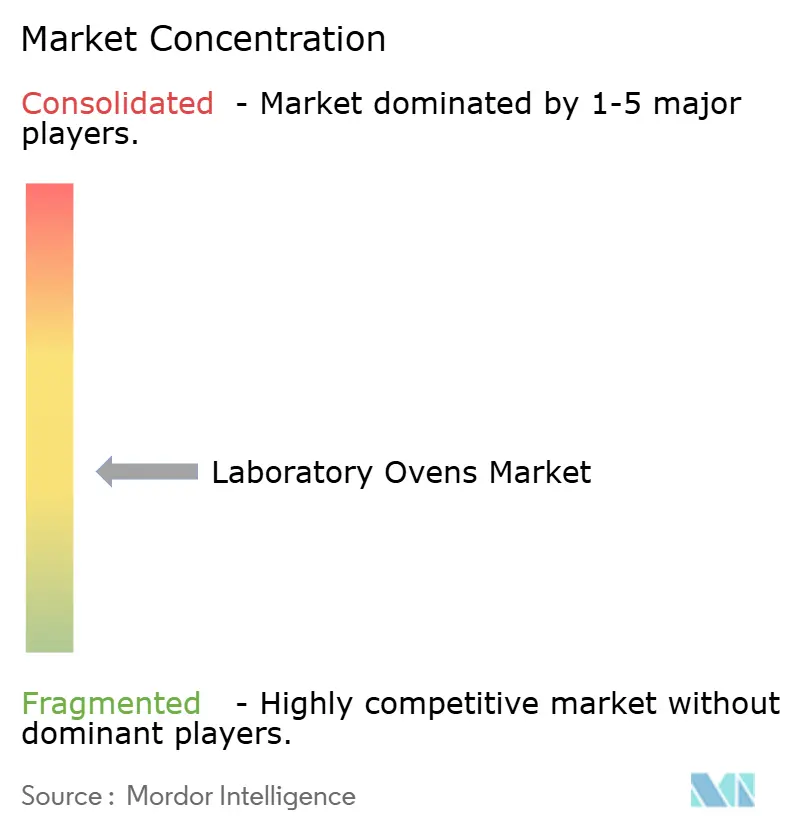
| Market Concentration | Medium |
Major Players *Disclaimer: Major Players sorted in no particular order Image © Mordor Intelligence. Reuse requires attribution under CC BY 4.0. | |
Laboratory Ovens Market Analysis by Mordor Intelligence
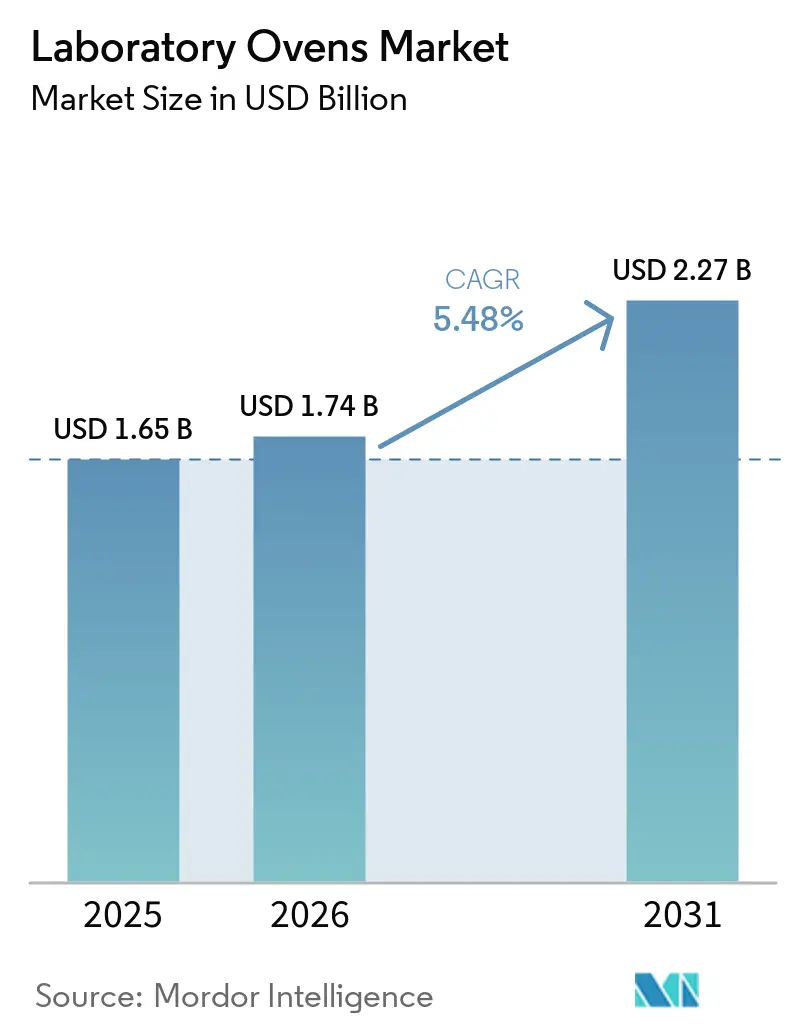
The Laboratory Ovens Market size is expected to increase from USD 1.65 billion in 2025 to USD 1.74 billion in 2026 and reach USD 2.27 billion by 2031, growing at a CAGR of 5.48% over 2026-2031.
Demand is moving toward equipment that supports controlled thermal work, documented performance, and dependable temperature conditions in regulated laboratories. Pharmaceutical manufacturing, semiconductor fabrication, battery-material processing, and contract laboratory expansion support this demand base. Procurement decisions increasingly consider recordkeeping, validation documents, service support, and system connectivity alongside hardware performance. This favors suppliers that can combine precise equipment with documentation that fits established laboratory procedures. Buyers also consider whether a supplier can support installation, performance review, staff training, and service throughout the equipment life cycle. Equipment that fits existing laboratory systems can reduce the time required to establish a new process. Suppliers with established technical support can respond more effectively when a regulated laboratory needs evidence of performance. Lower-priced suppliers retain opportunities in standard convection equipment, particularly where the work does not require extensive documentation. Their position is weaker where formal validation, audit-ready records, and defined service coverage are part of the purchase requirement.
Key Report Takeaways
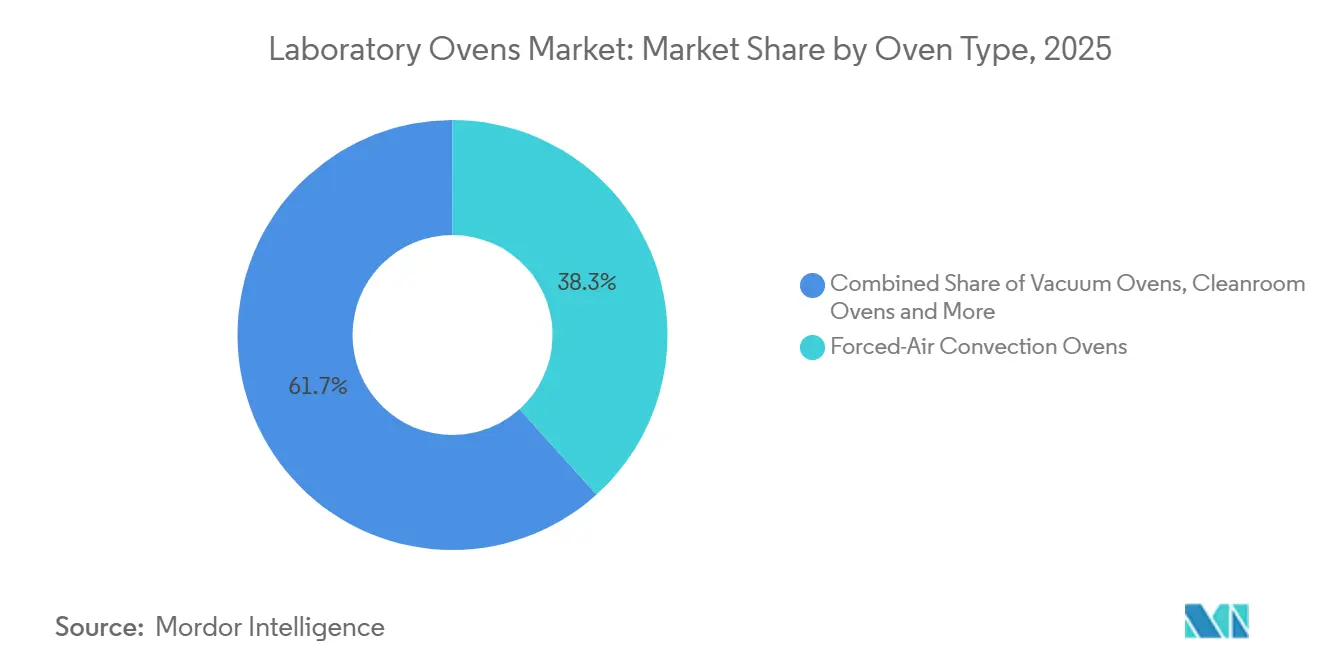
- By oven type, forced-air convection ovens led with 38.31% revenue share in 2025, while vacuum ovens are forecast to expand at a 6.65% CAGR through 2031.
- By capacity, small-capacity units held 42.24% revenue share in 2025, while large-capacity units are projected to record a 6.42% CAGR through 2031.
- By configuration, floor-standing units accounted for 67.14% revenue share in 2025, while pass-through ovens are expected to advance at a 7.42% CAGR through 2031.
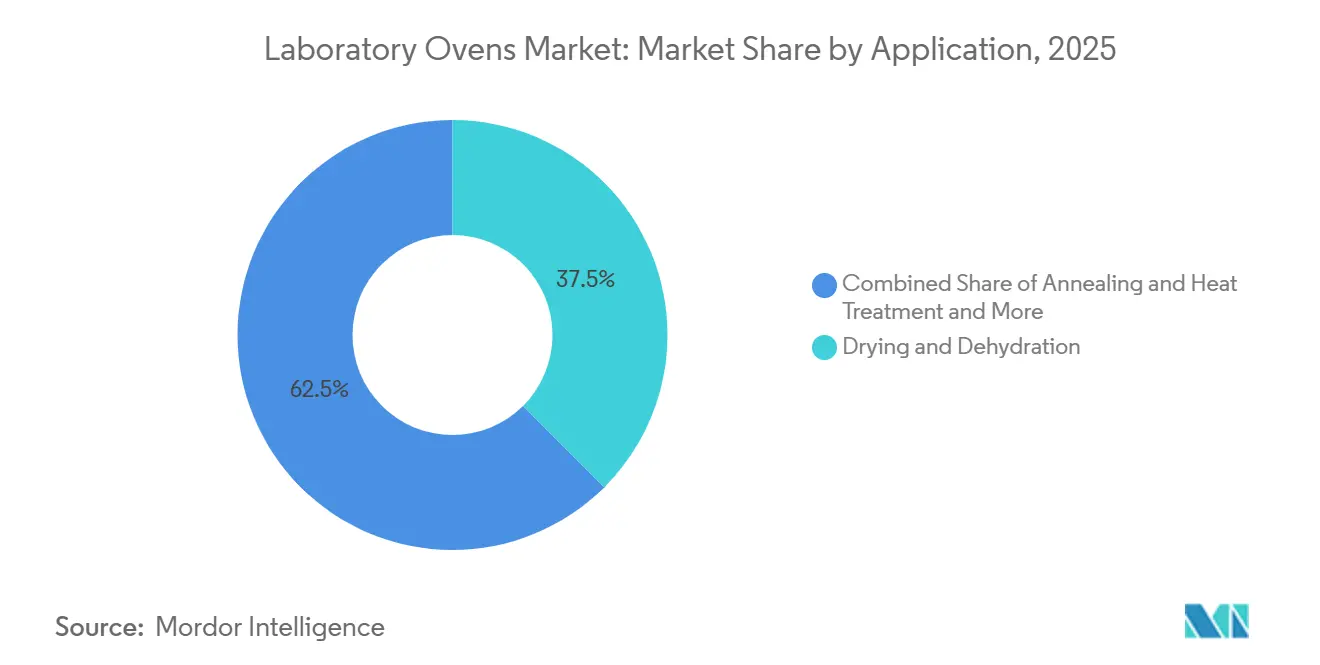
- By application, drying and dehydration represented 37.54% revenue share in 2025, while annealing and heat treatment are projected to grow at a 6.32% CAGR through 2031.
- By end user, pharmaceutical and biotechnology companies held 43.61% revenue share in 2025, while clinical and diagnostic laboratories are forecast to grow at a 6.65% CAGR through 2031.
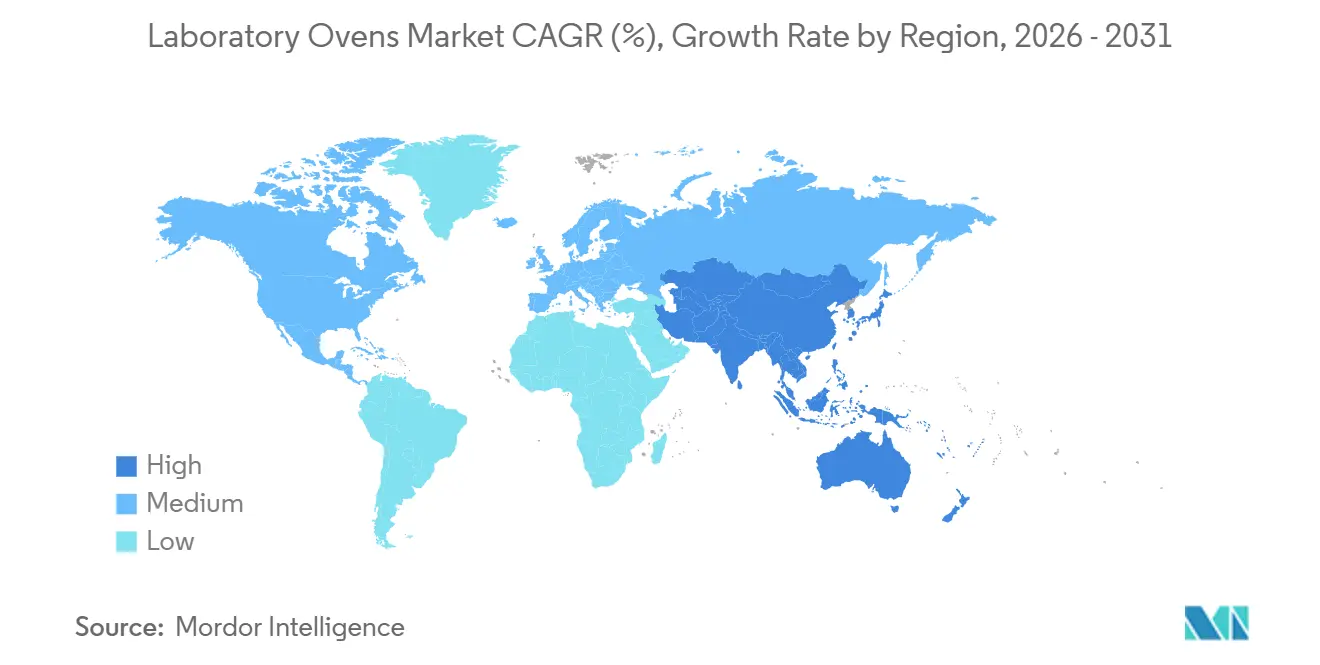
- By geography, North America held 36.61% revenue share in 2025, while Asia-Pacific is expected to record the highest CAGR at 7.25% through 2031.
Note: Market size and forecast figures in this report are generated using Mordor Intelligence’s proprietary estimation framework, updated with the latest available data and insights as of January 2026.
Global Laboratory Ovens Market Trends and Insights
Drivers Impact Analysis*
| Driver | (~) % Impact on CAGR Forecast | Geographic Relevance | Impact Timeline |
|---|---|---|---|
| Pharmaceutical And Biotechnology R&D Expansion | +1.5% | North America, Europe, APAC | Short term (≤ 2 years) |
| Validated, Data-Integrity-Ready Thermal Processing | +1.0% | North America, EU GMP and GLP environments | Short term (≤ 2 years) |
| Laboratory Modernization And Automation | +0.8% | Global | Medium term (2-4 years) |
| Semiconductor, Electronics, And Battery-Material Processing | +0.7% | APAC core, spillover to North America and EU | Medium term (2-4 years) |
| Growth Of Contract Research And Testing Laboratories | +0.6% | Global, concentrated in North America and APAC | Medium term (2-4 years) |
| Low-Oxygen Processing For Heat-Sensitive And Oxidation-Prone Materials | +0.4% | Global | Long term (≥ 4 years) |
| Source: Mordor Intelligence | |||
Pharmaceutical And Biotechnology R&D Expansion Sustains Instrument Investment
Declared R&D spending by 46 major pharmaceutical companies reached USD 201.30 billion in 2025, compared with USD 195.50 billion in 2024. That spending supports laboratory work at multiple points in drug development, including stability studies, API drying, formulation work, and qualification activity. European pharmaceutical manufacturers invested EUR 60.00 billion (USD 64.90 billion) in R&D during 2025, which indicates a substantial regional base for laboratory equipment demand[1]European Federation of Pharmaceutical Industries and Associations, “The Pharmaceutical Industry in Figures 2026,” European Federation of Pharmaceutical Industries and Associations, efpia.eu.. The laboratory ovens market benefits when development work requires repeatable drying conditions and records that can be reviewed during quality procedures. Biologic drug programs can require nitrogen-purged or vacuum drying conditions to limit oxidation, which supports demand for higher-specification equipment. This need keeps the laboratory ovens market linked to the mix of research programs, not only to the total level of R&D spending.
Research teams need equipment that can repeat a defined thermal process across multiple samples and development stages. A stability protocol may require the same conditions to be maintained over a set testing period. API and formulation work can require separate operating conditions for different materials. This creates demand for equipment ranges that cover both routine drying and more specialized vacuum or inert-atmosphere work. It also means that purchasing decisions often reflect the needs of a program portfolio rather than a single laboratory task, because research organizations must consider how different teams will use a piece of equipment over time, how readily it can support new protocols, and whether its documentation can be carried across activities that have separate quality requirements.
Validated, Data-Integrity-Ready Thermal Processing Redefines Equipment Specifications
Requirements for traceable thermal processing are changing the specifications used to buy laboratory ovens. Facilities subject to GMP procedures need equipment records that can support batch documentation and calibration practices. The FDA describes the scope and application of Part 11 requirements for electronic records and electronic signatures. Laboratories increasingly expect documented IQ and OQ procedures and controls that support electronic record management. This requirement favors suppliers that provide validation documentation and usable software as part of the equipment package. It also increases replacement demand where older equipment cannot connect to laboratory information management systems or create machine-readable audit trails. The change is relevant because documented processes need information that can be reviewed without manual reconstruction. A supplier that provides operating records and qualification documents can reduce the administrative work required after installation.
Laboratories may prefer equipment with controls that are familiar to quality and information technology teams. This makes documentation a practical part of equipment selection rather than an additional service considered after a purchase, because laboratories need to understand how a unit will be introduced into their procedures, how staff will use and review its controls, and whether the supplier can provide the records and technical support needed to make the equipment useful within a regulated workflow from the point of installation onward. It also makes standardization across several instruments more valuable for laboratories that manage large volumes of controlled work, since consistent controls, records, and operating practices can make it easier for personnel to move between equipment, follow established procedures, and maintain a clear history for work that quality teams must review.
Semiconductor, Electronics, And Battery-Material Processing Opens Industrial-Scale Demand
The laboratory ovens market gains demand from semiconductor and battery processes that require controlled heating, drying, and low-oxygen conditions. SEMI projected worldwide 300mm fab equipment spending to rise 18% to USD 133 billion in 2026 and to reach USD 151 billion in 2027. Wafer fabrication can require photoresist baking, HMDS pretreatment, and moisture removal. Battery electrode drying, electrolyte preparation, and vacuum sealing also depend on controlled thermal processing. These applications place greater weight on temperature stability and controlled atmospheres than routine laboratory drying. The resulting demand supports vacuum ovens and cleanroom-ready equipment, rather than standard equipment alone.
Semiconductor and battery users often need process conditions that are stable across repeated production or development cycles. They may also need equipment that fits a clean operating environment and supports documented settings. These needs increase the relevance of chamber design, monitoring controls, and service access. They also make application knowledge important when suppliers specify a system for a customer. Demand is therefore linked to the quality requirements of the process, not simply to the number of facilities being built, because new capacity can use different types of thermal equipment depending on the material, temperature range, atmosphere, cleanliness controls, and documentation requirements associated with the process performed at that location.
Growth Of Contract Research And Testing Laboratories Expands The Addressable Customer Base
Contract research and testing laboratories need broad instrument coverage because they work across multiple client protocols. A new facility or capacity expansion can therefore create an equipment purchase event rather than a simple replacement purchase. WuXi Biologics supported 1,064 integrated client projects as of June 30, 2026, which shows the scale of client activity handled by large outsourced development and manufacturing providers. The laboratory ovens market is supported when these providers expand laboratory capacity across development, testing, and manufacturing work. Growth beyond established research centers can also create demand for mid-range equipment and local service capability. This customer base values flexible equipment because separate client programs often require distinct temperature conditions and documentation. Contract laboratories must often manage work with different sample types, schedules, and reporting needs in the same facility.
Equipment that can support several validated procedures can make capacity planning easier. A documented operating history can also help staff organize work across client assignments. These conditions make reliable controls and service support relevant to everyday laboratory operations, because staff need equipment that can be scheduled across client work, operated according to defined procedures, and supported when a changing project mix creates new demands for capacity, temperature settings, or documented process control. They also create a reason to select equipment that can be adapted as the laboratory adds new client programs.
Restraints Impact Analysis*
| Restraint | (~) % Impact on CAGR Forecast | Geographic Relevance | Impact Timeline |
|---|---|---|---|
| High Total Cost Of Ownership For Validated And Specialized Ovens | -0.7% | Global | Short term (≤ 2 years) |
| Calibration, Validation, And Skilled-Service Constraints | -0.5% | North America, Europe | Medium term (2-4 years) |
| Energy Consumption And Sustainability Compliance | -0.4% | EU, North America | Long term (≥ 4 years) |
| Component And Nitrogen-Supply Dependency | -0.3% | APAC core, spillover to EU | Medium term (2-4 years) |
| Source: Mordor Intelligence | |||
High Ownership Costs Constrain Uptake Among Smaller And Emerging-Market Laboratories
The total cost of a validated laboratory oven includes more than the initial equipment purchase. Qualification documents, service agreements, periodic performance checks, and certified consumables can add 40.00% to 60.00% to capital cost over a 5-year ownership period. These costs can make specialized equipment harder to obtain for smaller contract laboratories and academic institutions. Larger pharmaceutical and industrial buyers can absorb the cost when compliance is required for their operating procedures. Smaller buyers may select lower-cost equipment that lacks the same validation support.
The laboratory ovens market, therefore, has a clear difference between premium validated products and standard products exposed to stronger price competition. The premium segment is supported by customers who must demonstrate compliance and cannot readily reduce documentation requirements. The standard segment serves customers whose processes are less dependent on formal qualification packages. Suppliers need to match their product design and service model to these different buyer needs. A product with more documentation can offer practical value to a regulated laboratory, but it may be difficult to justify for a small research setting. This difference affects the range of equipment that customers can consider when they plan a purchase, because the choice between a standard unit and a validated system can shape not only the initial price but also the availability of records, service, operating support, and the ability to use the equipment within a defined quality process.
Calibration And Validation Talent Shortages Lengthen Deployment Timelines
Laboratory oven commissioning depends on access to qualified calibration and validation personnel. The Metrology Institute reported that 60.00% of advanced manufacturers faced difficulty filling qualified calibration roles[2]Metrology Institute, “Advancing America’s Metrology Workforce,” Metrology Institute, metrologyinstitute.org.. Delays in the availability of qualified personnel can postpone IQ and OQ activity by weeks or months. This matters most where accredited calibration providers are limited or facilities operate outside major pharmaceutical and industrial centers. Equipment may be installed before it can enter routine regulated use. The restraint increases the value of suppliers that provide strong field-service coverage and clear validation packages.
Customers need access to technicians who can support calibration work and explain the required procedures. Service availability can influence the timing of a purchase as well as the choice of supplier. Laboratories in smaller cities may face a longer wait when specialist support is concentrated in major hubs. Clear documentation can help users prepare for commissioning, although it does not remove the need for qualified service personnel. The issue remains important because equipment is most valuable only after it can be placed into routine operation, and delays can affect laboratory schedules when a newly installed unit cannot support planned work until its calibration and validation activities have been completed by personnel with the required qualifications and procedural knowledge.
*Our forecasts treat driver/restraint impacts as directional, not additive. The impact forecasts reflect baseline growth, mix effects, and variable interactions.
Segment Analysis
By Oven Type: Vacuum Ovens Gain Ground Across Semiconductor And Battery Applications
Forced-air convection ovens accounted for 38.31% of the laboratory ovens market share by oven type in 2025. Their established use in pharmaceutical drying, sterilization, food science, and materials quality control supports that position, because many laboratories need dependable equipment for recurring work rather than a highly specialized thermal process, and because these applications can be handled with operating conditions that are familiar to staff and fit routine laboratory procedures. Active air circulation and moderate temperature operation fit a wide range of standard workflows. Gravity convection ovens remain relevant where airflow disturbance can affect temperature-sensitive or particulate-sensitive work. Vacuum ovens are the fastest-growing type, with the laboratory ovens market size for vacuum ovens projected to rise at a 6.65% CAGR from 2026 to 2031. Their growth is tied to semiconductor bake-out and lithium-ion battery electrode drying, where low-oxygen conditions help limit material degradation, and where customers may need to demonstrate that thermal conditions were managed consistently across batches, samples, or production-related development work that cannot be handled effectively with conventional air-based heating alone.
Cleanroom ovens serve controlled-environment manufacturing lines, while high-temperature ovens and furnaces support specialized materials work. These categories have a smaller role than convection equipment but often carry higher unit prices because their specifications are more demanding, because users can require construction materials, operating ranges, controls, and documentation that match a narrowly defined process, and because the equipment may need to work reliably within a controlled environment that has little tolerance for variation. High-temperature vacuum equipment can reach 1,000°C for advanced ceramics and aerospace materials research. Data logging and documented temperature control are important in these applications because process conditions must be repeatable. Connectivity is also changing product design across oven types. BINDER stated that its FED Avantgarde. Line products offer up to 30.00% lower energy consumption than conventional units, Ethernet connectivity, and programmable ramp-soak controls. Memmert introduced its NextGen platform and myChamber ecosystem in March 2026, adding connectivity and security functions across its heating and drying oven range.



By Capacity: Small Units Dominate, but Large-Scale Processing Is the Growth Engine
Small-capacity ovens under 50 liters held 42.24% of the laboratory ovens market share within the capacity segment in 2025. Benchtop research, early-stage pharmaceutical R&D, and quality-control sampling support demand for these units. Their compact form fits laboratories where space is limited, and sample batches are small. Medium-capacity equipment from 50 liters to 200 liters serves routine laboratory and industrial testing requirements. Large-capacity units from 201 liters to 500 liters are projected to grow at a 6.42% CAGR through 2031, as users need to process larger batches without moving samples across several small units, and as laboratories add capacity for stability studies, clinical processing, and industrial quality work that requires consistent conditions across a larger chamber. Larger batches, expanded stability programs, and industrial quality-control activity support this demand.
Extra-large equipment above 500 liters serves specialized needs such as aerospace component conditioning and large pharmaceutical stability work. These installations generally involve higher equipment prices and greater service requirements. Some laboratories are using modular or stackable small-capacity units instead of a single large unit. This approach allows incremental capacity additions, separate temperature zones, and less exposure to a single equipment failure, while allowing a laboratory to continue using other units if one chamber is unavailable and to assign equipment to separate protocols without forcing all samples through a single shared thermal process. Thermo Fisher Scientific introduced the Heratherm Environmental Chamber series in August 2025 for stability, photostability, and incubation work. A common product platform can reduce the administrative burden of managing several separate equipment families and their related qualification documents.
By Configuration: Floor-Standing Units Lead, Pass-Through Ovens Signal Cleanroom Integration
Floor-standing units held 67.14% of the laboratory ovens market share by configuration in 2025. Their capacity and operating stability make them suitable for production-scale pharmaceutical and industrial applications, where operators need space for larger loads and where equipment is commonly selected for regular use in established quality processes rather than for occasional small-sample research tasks. In these settings, throughput usually matters more than a compact footprint. Benchtop ovens continue to support discovery research and quality-control sampling in smaller workspaces. Pass-through ovens are projected to grow at a 7.42% CAGR through 2031. Their use is increasing in cleanrooms where material flow and cross-contamination control are key operating requirements.
Cleanroom-compatible pass-through ovens can use stainless-steel chambers, silicone-free interiors, and filtered air supplies to protect sensitive devices or wafers. These features make the equipment more complex than standard floor-standing units, as the design must address how materials move between spaces, how clean conditions are maintained, and how the oven supports the specific operating procedures of a manufacturing line where sensitive components can be affected by particles or unsuitable process conditions. The laboratory ovens industry benefits as semiconductor cleanroom construction requires more controlled thermal processing. Pass-through equipment must also support demanding temperature performance and remote monitoring in some facilities.
By Application: Drying Leads, Heat Treatment Emerges as the Disruptive Growth Vector
Drying and dehydration accounted for 37.54% of the laboratory ovens market share by application in 2025. The application is used across pharmaceutical work, food science, materials testing, and electronics drying, which gives drying equipment a broad customer base and makes it a familiar part of laboratory practice where samples must be prepared, conditioned, or tested under managed temperature settings. Sterilization and depyrogenation require validated temperature uniformity and controlled air movement in pharmaceutical fill-finish and device manufacturing. Baking and curing support polymer composites, printed circuit board assembly, and adhesive-bonding operations. Pharmaceutical and biotechnology processing includes API drying, lyophilization support, and sterility testing. Material testing and quality control also create demand across automotive, aerospace, and electronics activities, where laboratories may condition components, assess how materials respond to heat, or prepare samples for further testing, creating a steady need for equipment that can provide repeatable conditions within defined operating parameters.
Annealing and heat treatment is the fastest-growing application, with the laboratory ovens market size for this application advancing at a 6.32% CAGR through 2031. Battery electrode coils need staged drying that can combine atmospheric heating with vacuum-cycle drying. This work can require temperatures of 80°C to 150°C and moisture control that protects electrochemical performance. Semiconductor annealing helps relieve stress in thin films and activate implanted dopants. Temperature uniformity across a wafer surface can affect device yield. The laboratory ovens market is therefore gaining demand for purpose-built configurations that address battery and semiconductor processes. General-purpose equipment may not meet the same requirements for controlled atmosphere, uniformity, or process documentation, which is why users working with sensitive battery materials or semiconductor components can place more weight on the design of the chamber, the repeatability of controls, and the availability of records that describe how the thermal process was completed.
By End User: Pharma/Biotech Anchor Demand, Diagnostics Laboratories Accelerate
Pharmaceutical and biotechnology companies held 43.61% of the laboratory ovens market share by end user in 2025. Their demand spans API synthesis, formulation development, stability testing, and manufacturing quality control, so a single organization can require several equipment formats for research laboratories, development teams, manufacturing support functions, and quality-control areas that operate under distinct procedures. The range of activities supports the use of both benchtop and production-scale equipment, because early development functions can need compact units for small samples. In contrast, manufacturing-support and quality functions can need larger equipment that accommodates routine batches and fits documented procedures used across a larger operational setting. Industrial quality-control laboratories are an important secondary user group for rubber testing, coatings curing, and component conditioning. Academic and research institutes provide a consistent base of demand for benchtop and mid-range equipment. Their purchasing activity can be shaped by public funding and grant cycles.
Clinical and diagnostic laboratories are the fastest-growing end-user group at a 6.65% CAGR through 2031. This reflects laboratory infrastructure spending that is becoming equipment demand across diagnostic workflows. Asia-Pacific is an important source of expansion, with private diagnostic networks and hospital laboratory upgrades in China and India. Hitachi High-Tech stated that its LABOSPECT TS Total Laboratory Automation system began operating at Seegene Medical Foundation in Seoul in October 2025. Automation can increase the volume and consistency of laboratory workflows. It can also increase the need for thermal processing equipment that is reliable, standardized, and compatible with connected operating environments, because diagnostic laboratories may seek to reduce variation between workflows and need instruments that can fit established procedures as laboratory capacity and automation systems are expanded.
Geography Analysis
North America held 36.61% of the laboratory ovens market share in 2025. The region has a large base of FDA-regulated pharmaceutical manufacturing, contract research activity, and academic research facilities. The United States accounted for the largest part of regional demand. At the same time, Canada added demand from university research and pharmaceutical manufacturing, and Mexico provided a further source of activity as new pharmaceutical and electronics manufacturing capacity increased the need for laboratory infrastructure and related thermal processing equipment. Mexico provides an emerging source of demand as pharmaceutical and electronics manufacturing capacity grows. FDA requirements for electronic records influence procurement by increasing the need for documented and traceable equipment in regulated settings.
Europe was the second-largest regional market, led by Germany, the United Kingdom, France, Italy, and Spain. Germany’s chemical and pharmaceutical sector generated EUR 230 billion (USD 249.00 billion) in revenue in 2025 and employed 545,000 people[3]Verband der Chemischen Industrie, “Quartalsbericht 2/2026 zur Lage der chemisch-pharmazeutischen Industrie,” Presseportal, presseportal.de.. This industrial base supports laboratory equipment use in research, production, and quality functions. Semiconductor projects in Germany are also adding demand for cleanroom thermal processing equipment, because controlled manufacturing environments require equipment that can support material handling, temperature consistency, and contamination-control procedures for sensitive components and process steps. Energy management requirements encourage buyers to consider more efficient equipment designs, particularly when laboratory and industrial sites review how equipment use fits internal energy practices, replacement plans, and operating costs, and when a newer model can offer controls or construction that supports a more managed approach to routine thermal work. The laboratory ovens market size in Europe is therefore supported by replacement activity as well as by new laboratory and cleanroom installations.
Asia-Pacific is the fastest-growing regional area, with the laboratory ovens market size projected to grow at a 7.25% CAGR through 2031. China, Japan, India, South Korea, and Australia combine pharmaceutical manufacturing expansion, semiconductor capacity building, and laboratory service growth. China’s policy support for pharmaceutical self-reliance is directing investment toward hospitals, university research centers, and contract manufacturing organizations. Japan is a significant semiconductor equipment center, and the Japan Semiconductor Equipment Association projected Japanese-made semiconductor and FPD manufacturing equipment sales to increase 24.00% in fiscal year 2026. India is expanding pharmaceutical exports and contract research capacity into Tier 2 and Tier 3 cities, which broadens the locations where laboratories may need equipment, local service, and practical operating formats that fit the needs of growing research and testing operations. Middle East and Africa and South America remain smaller regional markets, with healthcare infrastructure investment and pharmaceutical and diagnostic activity providing demand support, as organizations add laboratory capabilities that need basic and specialized thermal processing equipment to support research, testing, quality work, and the operation of expanding health-related facilities.

Competitive Landscape
The laboratory ovens market is moderately fragmented, and no single manufacturer holds a commanding global share. Memmert, BINDER, Carbolite Gero, and Nabertherm compete through precision equipment, validated documentation, and specialized applications. Thermo Fisher Scientific has a broad North American and global distribution through its Heratherm heating and drying portfolio. Jeio Tech and Yamato Scientific have strong positions in their home regions and participate in the global mid-tier segment. Product performance remains important, but connectivity, validation support, and service quality are becoming more significant purchase factors. This leaves suppliers with complete equipment and software packages in a stronger position when customers have regulated workflow requirements, because buyers can consider temperature control, records, qualification documents, connectivity, and support as connected parts of the same operating need instead of as separate purchases.
Memmert launched its NextGen platform in March 2026 with the myChamber ecosystem, enhanced connectivity, and integrated security functions. The release shows how suppliers are connecting heating and drying equipment to data-management environments. Thermo Fisher Scientific introduced its Heratherm Environmental Chamber series in August 2025, covering stability, photostability, and incubation configurations. These moves address customer interest in broader, validated product platforms, where a product family can support several laboratory uses and where common controls, documentation, and service arrangements can make equipment selection and subsequent management simpler for an organization with multiple work areas. Suppliers that only offer standard hardware face pressure from lower-cost Asian competitors. They also face pressure from suppliers that can provide documentation, integration support, and service through one procurement relationship, since customers can place value on a supplier that understands the equipment, the records needed for its use, and the practical support required when a laboratory installs, validates, maintains, or expands its thermal processing capability.
Bruker made a minority equity investment in Atinary Technologies in August 2026 to advance self-driving laboratory capabilities through Chemspeed automation hardware and SciY software. The move illustrates how laboratory equipment providers are adding software and automation capability. The National Science Foundation awarded USD 19.50 million to Scripps Research, UCLA, and Sunthetics to establish an autonomous chemistry laboratory node. As laboratory workflows become more automated, ovens may need to operate as programmable parts of connected processes, with controls and information that can be used alongside other instruments, rather than as isolated equipment that depends only on direct manual operation and separate recordkeeping. This raises the importance of compatible controls and data interfaces, because equipment needs to share usable information with the wider laboratory environment and allow operators to include thermal processing in structured workflows, while still meeting the practical requirements of temperature control, service access, and documented operation that apply to laboratory ovens. Smaller specialists without proprietary software or established validation support may face greater margin pressure at both the premium and standard ends of the laboratory ovens market.
Laboratory Ovens Industry Leaders
Thermo Fisher Scientific Inc.
Memmert GmbH + Co. KG
Binder GmbH
Yamato Scientific Co., Ltd.
Carbolite Gero Ltd. (Verder Group)
- *Disclaimer: Major Players sorted in no particular order

Recent Industry Developments
- May 2026: ASML increased its 2026 global cleanroom infrastructure capital expenditure budget from USD 3.5 billion to USD 4.2 billion. The company prioritized investments in ISO Class 1–3 temperature-control modules, fan filter units, and AMC filtration systems. This investment cycle generated structured downstream demand for cleanroom-grade pass-through and vacuum ovens across fab projects in Europe and Asia.
- January 2026: Hitachi High-Tech's Total Laboratory Automation system, LABOSPECT TS, began operating at Seegene Medical Foundation in Seoul after a multi-year consulting and design engagement (Hitachi High-Tech, January 2026). The installation reflected the increasing conversion of diagnostic laboratory investments in Asia into the procurement of high-throughput, automation-integrated instruments.


Global Laboratory Ovens Market Report Scope
As per the scope of the report, a laboratory oven is a device used in laboratories for high-precision heating, drying, sterilizing, or curing of samples and materials. It provides controlled temperature environments to ensure consistent and accurate results during scientific experiments and industrial processes.
The laboratory ovens market is segmented by oven type into gravity convection ovens, forced-air convection ovens, vacuum ovens, cleanroom ovens, high-temperature laboratory ovens and furnaces, and other oven types. By capacity, the market is segmented into small capacity (under 50 liters), medium capacity (50 to 200 liters), large capacity (201 to 500 liters), and extra-large capacity (above 500 liters). By configuration, the market is segmented into benchtop ovens, floor-standing ovens, pass-through ovens, and other configurations. By application, the market is segmented into drying and dehydration, sterilization and depyrogenation, baking and curing, annealing and heat treatment, material testing and quality control, pharmaceutical and biotechnology processing, and other applications. By end user, the market is segmented into pharmaceutical and biotechnology companies, clinical and diagnostic laboratories, academic and research institutes, industrial quality control laboratories, and other end users. By geography, the market is segmented into North America, Europe, Asia-Pacific, the Middle East and Africa, and South America. The market report also covers the estimated market sizes and trends for 17 countries across major regions globally. For each segment, the market size and forecast are provided in terms of value (USD).
| Gravity Convection Ovens |
| Forced-Air Convection Ovens |
| Vacuum Ovens |
| Cleanroom Ovens |
| High-Temperature Laboratory Ovens and Furnaces |
| Other Oven Types |
| Small Capacity, Under 50 Liters |
| Medium Capacity, 50 to 200 Liters |
| Large Capacity, 201 to 500 Liters |
| Extra-Large Capacity, Above 500 Liters |
| Benchtop Ovens |
| Floor-Standing Ovens |
| Pass-Through Ovens |
| Other Configurations |
| Drying and Dehydration |
| Sterilization and Depyrogenation |
| Baking and Curing |
| Annealing and Heat Treatment |
| Material Testing and Quality Control |
| Pharmaceutical and Biotechnology Processing |
| Other Applications |
| Pharmaceutical and Biotechnology Companies |
| Clinical and Diagnostic Laboratories |
| Academic and Research Institutes |
| Industrial Quality-Control Laboratories |
| Other End Users |
| North America | United States |
| Canada | |
| Mexico | |
| Europe | Germany |
| United Kingdom | |
| France | |
| Italy | |
| Spain | |
| Rest of Europe | |
| Asia-Pacific | China |
| Japan | |
| India | |
| Australia | |
| South Korea | |
| Rest of Asia-Pacific | |
| Middle East and Africa | GCC |
| South Africa | |
| Rest of Middle East and Africa | |
| South America | Brazil |
| Argentina | |
| Rest of South America |
| By Oven Type | Gravity Convection Ovens | |
| Forced-Air Convection Ovens | ||
| Vacuum Ovens | ||
| Cleanroom Ovens | ||
| High-Temperature Laboratory Ovens and Furnaces | ||
| Other Oven Types | ||
| By Capacity | Small Capacity, Under 50 Liters | |
| Medium Capacity, 50 to 200 Liters | ||
| Large Capacity, 201 to 500 Liters | ||
| Extra-Large Capacity, Above 500 Liters | ||
| By Configuration | Benchtop Ovens | |
| Floor-Standing Ovens | ||
| Pass-Through Ovens | ||
| Other Configurations | ||
| By Application | Drying and Dehydration | |
| Sterilization and Depyrogenation | ||
| Baking and Curing | ||
| Annealing and Heat Treatment | ||
| Material Testing and Quality Control | ||
| Pharmaceutical and Biotechnology Processing | ||
| Other Applications | ||
| By End User | Pharmaceutical and Biotechnology Companies | |
| Clinical and Diagnostic Laboratories | ||
| Academic and Research Institutes | ||
| Industrial Quality-Control Laboratories | ||
| Other End Users | ||
| By Geography | North America | United States |
| Canada | ||
| Mexico | ||
| Europe | Germany | |
| United Kingdom | ||
| France | ||
| Italy | ||
| Spain | ||
| Rest of Europe | ||
| Asia-Pacific | China | |
| Japan | ||
| India | ||
| Australia | ||
| South Korea | ||
| Rest of Asia-Pacific | ||
| Middle East and Africa | GCC | |
| South Africa | ||
| Rest of Middle East and Africa | ||
| South America | Brazil | |
| Argentina | ||
| Rest of South America | ||


Key Questions Answered in the Report
How large is the laboratory ovens market?
The laboratory ovens market is estimated at USD 1.74 billion in 2026 and is forecast to reach USD 2.27 billion by 2031 at a 5.48% CAGR.
Which laboratory oven type is growing fastest?
Vacuum ovens are forecast to grow at a 6.65% CAGR through 2031 because semiconductor and battery processes often require low-oxygen thermal conditions.
Why are validated laboratory ovens important?
Regulated laboratories need documented performance, traceable records, and validation support that align with their quality procedures.
Which configuration is expanding most quickly?
Pass-through ovens are projected to grow at a 7.42% CAGR through 2031 as cleanroom workflows require controlled material movement and contamination control.
Which end users account for the largest demand?
Pharmaceutical and biotechnology companies held 43.61% of 2025 end-user revenue because thermal processing is used throughout drug development and quality control.
Which region is growing fastest for laboratory ovens?
Asia-Pacific is forecast to grow at a 7.25% CAGR through 2031, supported by pharmaceutical manufacturing, semiconductor capacity, and laboratory services growth.
Page last updated on:





