
Konjac Flour Market Size and Share
Market Overview
| Study Period | 2027 - 2032 |
|---|---|
| Market Size (2027) | USD 1.42 Billion |
| Market Size (2032) | USD 1.61 Billion |
| Growth Rate (2027 - 2032) | 2.55 % |
| Fastest Growing Market | North America |
| Largest Market | Asia-Pacific |
| Market Concentration | Medium |
Major Players *Disclaimer: Major Players sorted in no particular order Image © Mordor Intelligence. Reuse requires attribution under CC BY 4.0. | |
Konjac Flour Market Analysis by Mordor Intelligence
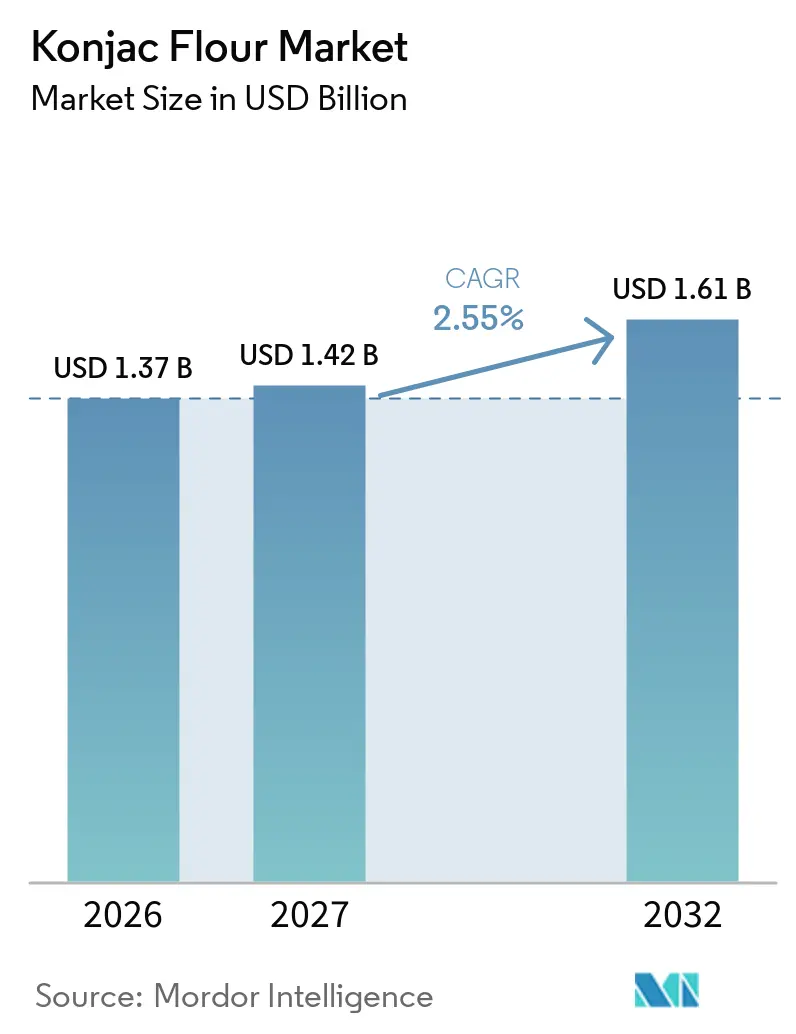
The Konjac Flour Market is estimated to reach USD 1.37 billion in 2026, increase to USD 1.42 billion in 2027, and reach USD 1.61 billion by 2032, registering a CAGR of 2.55% during 2027–2032. Demand is supported by the growing use of konjac flour as a low-calorie, high-fiber ingredient and its increasing adoption in gluten-free and low-carbohydrate food formulations. Its glucomannan content provides thickening, gelling, stabilizing, and water-binding properties, supporting its use across noodles and pasta, meat and seafood alternatives, bakery products, dairy alternatives, sauces, and other processed foods. Conventional konjac flour represents the largest product type, accounting for 43.81% of the market in 2026, while blended konjac flour is projected to record the fastest growth at a CAGR of 5.83% through 2032. By grade, food-grade konjac flour dominates with a 71.31% share, supported by its established use in food processing, while pharmaceutical-grade products are projected to grow at a CAGR of 6.08%. Food and beverages remain the largest application, accounting for 68.23% of the market, whereas dietary supplements are expected to record faster growth at 5.95%. Asia-Pacific leads the regional market with a 45.68% share in 2026, supported by established konjac cultivation, processing capabilities, and consumption, particularly in China and Japan. North America is projected to be the fastest-growing region, registering a CAGR of 6.56% during 2027–2032.
Key Report Takeaways
- The konjac flour market is estimated at USD 1.37 billion in 2026 and is projected to reach USD 1.61 billion by 2032, registering a CAGR of 2.55% during 2027–2032.
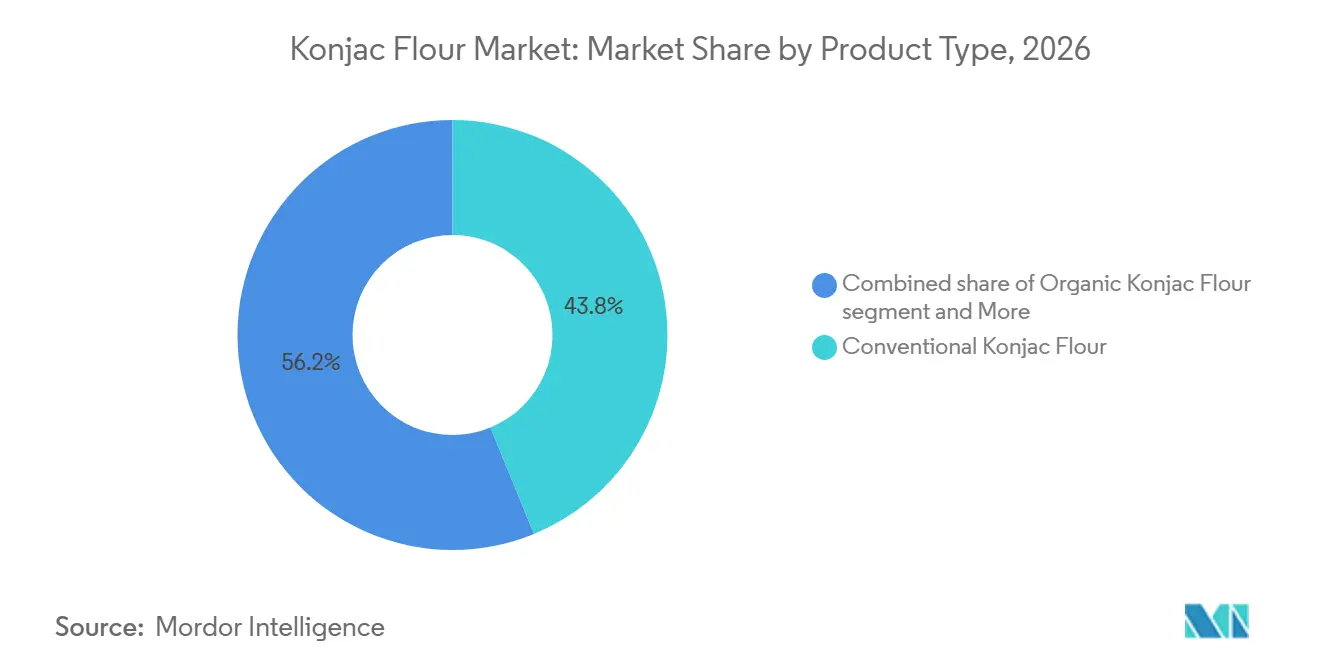
- By product type, conventional konjac flour holds the largest market share at 43.81% in 2026, while blended konjac flour is projected to record the fastest CAGR of 5.83% through 2032.
- By grade, food grade accounts for the largest share at 71.31% in 2026, while pharmaceutical grade is expected to grow at the fastest CAGR of 6.08%.
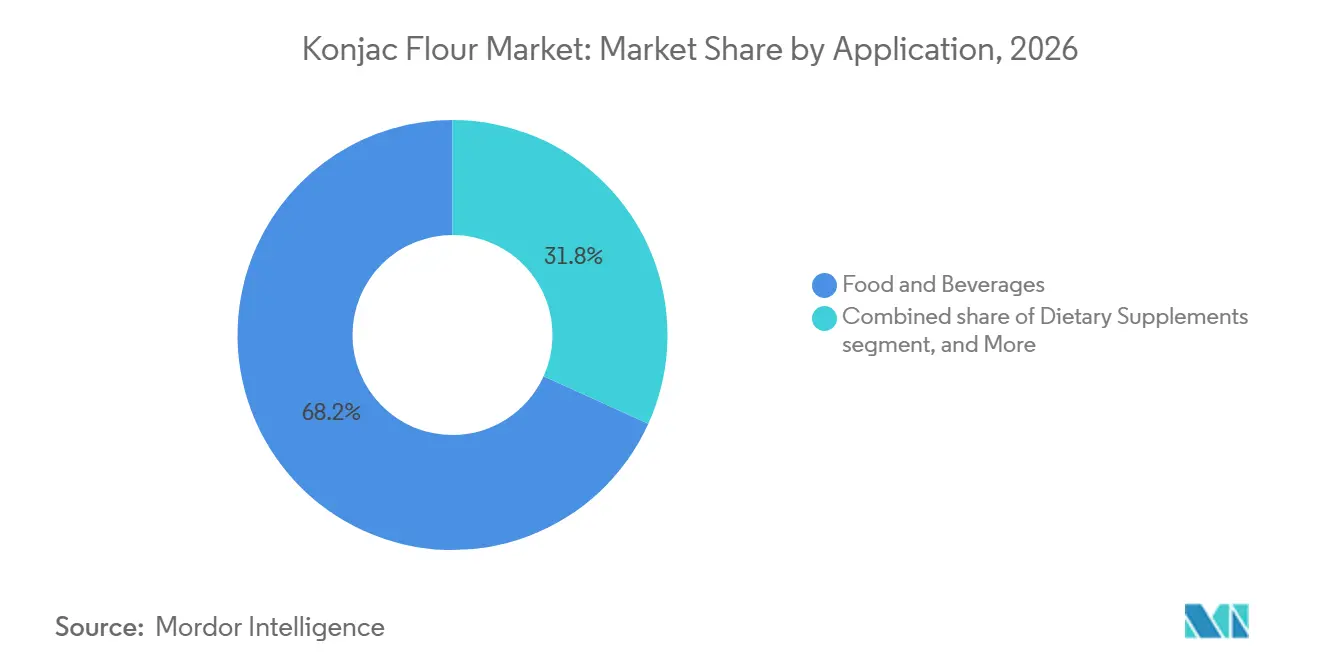
- By application, food and beverages represent the largest segment, accounting for 68.23% in 2026, while dietary supplements are projected to expand at a CAGR of 5.95%.
- By geography, Asia-Pacific leads with 45.68% of the market in 2026, while North America is projected to record the fastest regional CAGR of 6.56% through 2032.
Note: Market numbers in this report are based on Mordor Intelligence's proprietary estimation framework, which combines nine months of actuals with Q4 projections for base year 2026.
Market Trends and Insights
Drivers Impact Analysis of Konjac Flour Market*
| DRIVER | (+) % IMPACT ON CAGR FORECAST | GEOGRAPHIC RELEVANCE | IMPACT TIMELINE |
|---|---|---|---|
| Rising demand for konjac flour as a low-calorie and high-fiber food ingredient | +1.0% | Global, particularly North America, Europe and Asia-Pacific, where demand for low-calorie and fiber-rich food products is increasing | Medium term (2–4 years) |
| Growing adoption of gluten-free and low-carbohydrate food products | +0.8% | Global, particularly North America and Europe, with growing adoption in urban markets across Asia-Pacific | Medium term (2–4 years) |
| Increasing use of konjac glucomannan as a thickening, gelling and stabilizing agent | +0.7% | Global, particularly Asia-Pacific and Europe, where food manufacturers use hydrocolloids in processed food formulations | Short term (Less than 2 years) |
| Growing use of konjac flour in plant-based meat alternatives and functional food formulations | +0.6% | Global, particularly North America and Europe, with expanding product development in Asia-Pacific | Long term (More than 4 years) |
| Growing demand for soluble dietary fiber and digestive health ingredients | +0.6% | Global, particularly North America, Europe and Japan, where functional food and dietary supplement markets are established | Medium term (2–4 years) |
| Expansion of konjac-based noodles, rice and other convenience food products | +0.5% | Primarily Asia-Pacific, with growing demand in North America and Europe | Short term (Less than 2 years) |
| Source: Mordor Intelligence | |||
Rising demand for konjac flour as a low-calorie and high-fiber food ingredient
Growing consumer interest in calorie control and dietary fiber is supporting demand for konjac flour, as its primary component, konjac glucomannan, is a soluble dietary fiber with high water-binding capacity. When incorporated into food formulations, it can increase bulk and modify texture while helping manufacturers develop low-calorie products. This supports its use in konjac noodles, rice alternatives, and other reduced-calorie food products. As demand for fiber-enriched and calorie-conscious foods expands, konjac flour offers manufacturers a functional ingredient for reformulating conventional products and developing foods positioned around dietary fiber intake and weight management.[1]
Growing adoption of gluten-free and low-carbohydrate food products
The growing development of gluten-free and low-carbohydrate food products is creating opportunities for konjac flour, particularly as manufacturers seek functional ingredients that can improve the texture and structure of products formulated without conventional wheat-based ingredients. Konjac glucomannan can be incorporated into rice flour and other starch-based formulations to modify viscosity, water absorption, cooking characteristics, and texture. A 2025 study published in Food Chemistry: X demonstrated that konjac glucomannan, when combined with curdlan, could improve the quality of gluten-free rice pasta while reducing its starch digestibility [2]. Such formulation applications support the use of konjac flour in gluten-free noodles, pasta, and other specialty food products, broadening its potential adoption among manufacturers targeting consumers with specific dietary preferences.
Increasing use of konjac glucomannan as a thickening, gelling and stabilizing agent
The functional properties of konjac glucomannan are supporting its use as a hydrocolloid in food processing, particularly in applications requiring viscosity control, gel formation, water retention, and texture improvement. Its ability to interact with other polysaccharides and starches allows food manufacturers to modify the consistency and structural properties of different formulations. A 2024 review published in Food Science identifies konjac glucomannan among the polysaccharide-based food colloids used for functions such as thickening, gelling, water retention, and stabilization [3]. These properties support its incorporation into sauces, dressings, soups, noodles, dairy alternatives, and processed food products, encouraging demand from manufacturers seeking multifunctional ingredients for formulation and processing applications.
Growing use of konjac flour in plant-based meat alternatives and functional food formulations
The development of plant-based meat alternatives is creating additional formulation opportunities for konjac flour, as food manufacturers require ingredients that can improve the texture, binding, and structural properties of meat substitutes. Konjac glucomannan can contribute to gel formation and influence the hardness, microstructure, and texture of plant-based meat analogues. A 2024 study published in the International Journal of Biological Macromolecules examined the effects of konjac glucomannan with different deacetylation levels on plant-based meat analogues and found that its functional performance varied with the degree of modification [4]. This highlights its potential as a formulation ingredient in plant-based foods, while continued product development in functional and alternative-protein categories may create further opportunities for konjac flour suppliers.
Growing demand for soluble dietary fiber and digestive health ingredients
Increasing interest in soluble dietary fiber and ingredients associated with digestive health is supporting the use of konjac flour in functional foods and dietary supplements. Konjac glucomannan is a water-soluble dietary fiber that exhibits hydration, adsorption, and rheological properties, influencing its behavior during digestion and its application in nutrition-oriented formulations. A 2024 review published in Carbohydrate Polymers examined the relationship between the colloidal properties of konjac glucomannan and glucose and lipid metabolism, highlighting its potential nutritional applications [5]. These characteristics support its use in fiber-enriched foods, glucomannan supplements, and other products targeting digestive wellness and dietary fiber intake, creating opportunities beyond conventional food processing.
Restraints Impact Analysis of Konjac Flour Market*
| RESTRAINT | (−) % IMPACT ON CAGR FORECAST | GEOGRAPHIC RELEVANCE | IMPACT TIMELINE |
|---|---|---|---|
| Dependence on seasonal konjac corm production and agricultural supply | −0.8% | Global, particularly regions dependent on concentrated konjac cultivation and agricultural supply from Asia-Pacific | Long term (More than 4 years) |
| Fluctuations in raw material prices and processing costs | −0.7% | Global, particularly konjac flour processors exposed to changes in corm prices, energy costs, drying and milling expenses | Medium term (2–4 years) |
| Variability in raw-material quality and processing standards | −0.5% | Global, particularly food and pharmaceutical ingredient markets requiring consistent glucomannan content, purity, viscosity and functional performance | Medium term (2–4 years) |
| Regulatory and labeling requirements for konjac-based food ingredients | −0.4% | Global, particularly North America and Europe, where food safety, ingredient approval and labeling requirements influence market entry and compliance costs | Short term (Less than 2 years) |
| Source: Mordor Intelligence | |||
Dependence on seasonal konjac corm production and agricultural supply
Konjac flour production depends on the availability and quality of konjac corms, making raw material supply sensitive to agricultural conditions and cultivation cycles. Variations in weather, rainfall, temperature, and crop yields can affect corm availability and create fluctuations in the quantity of raw materials supplied to processors. Since konjac cultivation is concentrated in specific production regions, disruptions in major growing areas can also affect procurement and processing schedules. These supply uncertainties may limit manufacturers' ability to maintain consistent production volumes, fulfil large-volume orders, and ensure stable product availability across export markets.
Fluctuations in raw material prices and processing costs
Variations in konjac corm prices, agricultural input costs, energy expenses, and processing requirements can increase the cost of konjac flour production. The conversion of konjac corms into flour involves cleaning, drying, milling, and, depending on the required grade, additional purification and refinement processes. These operations require processing infrastructure, quality-control systems, and consistent energy inputs, adding to manufacturers' operating expenses. Fluctuating input and processing costs can create pricing uncertainty for producers and affect their ability to maintain competitive prices, particularly when supplying cost-sensitive food manufacturers and international buyers.
*Our forecasts treat driver/restraint impacts as directional, not additive. The impact forecasts reflect baseline growth, mix effects, and variable interactions.
Konjac Flour Market Segment Analysis
By Product Type:
Conventional Konjac Flour Leads While Blended Konjac Flour Expands FastestConventional konjac flour accounted for 43.81% of the market value in 2026, making it the largest product type. Its established use as a source of konjac glucomannan supports demand across food processing applications, including noodles, pasta, sauces, and other processed food products. Its thickening, gelling, stabilizing, and water-binding properties make it a functional ingredient for manufacturers seeking to modify texture and consistency in food formulations. Conventional flour therefore benefits from its broad applicability and established use among food ingredient processors.
Blended konjac flour is projected to record the fastest growth among product types, registering a CAGR of 5.83% during 2027–2032. Its growth potential is supported by the use of konjac flour in combination with other functional ingredients to achieve specific formulation characteristics, including improved viscosity, texture, gel strength, and processing performance. Such blends can help manufacturers adapt konjac-based ingredients to different food applications and product requirements. Increasing formulation requirements across convenience foods, gluten-free products, and plant-based alternatives may create further opportunities for blended konjac flour.

By Grade:
Food Grade Dominates While Pharmaceutical Grade Records the Fastest GrowthFood-grade konjac flour accounted for 71.31% of the market value in 2026, making it the largest grade segment. Its dominance is supported by the established use of konjac glucomannan as a functional ingredient in food and beverage processing. Food-grade products are used in applications such as noodles, pasta, sauces, bakery products, and meat alternatives, where thickening, gelling, and water-retention properties are important for product formulation. The broad range of food applications and established demand from food manufacturers support the segment's leading position.
Pharmaceutical-grade konjac flour is projected to grow at the fastest CAGR of 6.08% during 2027–2032. Growth is supported by the functional properties of konjac glucomannan and its potential use in specialized pharmaceutical formulations and delivery systems. Its ability to absorb water, form viscous solutions, and modify formulation characteristics makes it relevant for research and development involving excipients and other pharmaceutical applications. Increasing interest in plant-derived functional ingredients may create additional opportunities for pharmaceutical-grade konjac flour, although product purity, specification consistency, and regulatory compliance remain important requirements.
By Application:
Food and Beverages Lead While Dietary Supplements Expand FastestFood and beverages accounted for 68.23% of the konjac flour market value in 2026, making it the largest application segment. Konjac flour is used in food formulations for its thickening, gelling, stabilizing, and water-binding properties. Its applications include noodles and pasta, meat and seafood alternatives, bakery and confectionery, dairy and dairy alternatives, and sauces, dressings, and soups. The expansion of low-calorie, gluten-free, and low-carbohydrate food products further supports its relevance as a functional ingredient. Its established use in konjac-based noodles and rice alternatives also contributes to demand from food manufacturers.
Dietary supplements are projected to register the fastest growth, with a CAGR of 5.95% during 2027–2032. This growth is supported by the use of konjac glucomannan as a soluble dietary fiber in supplement formulations targeting fiber intake, digestive health, and weight management. Its water-absorbing properties and ability to form viscous solutions make it suitable for capsules, powders, and other supplement formats. Growing interest in fiber-based nutritional products and functional ingredients may support further adoption of konjac flour and glucomannan-derived ingredients in the nutraceutical category.
Geography Analysis
Asia-Pacific Konjac Flour Market
Asia-Pacific accounted for 45.68% of the konjac flour market share in 2026, making it the largest regional market and an important center for konjac cultivation, processing, and consumption. China plays a significant role in regional supply, supported by established konjac cultivation and flour-processing activities. Japan also contributes to regional demand through its established use of konjac in traditional food products, including konnyaku and shirataki noodles. The region's familiarity with konjac-based foods, availability of raw materials, and presence of ingredient manufacturers support demand across food processing and other applications. Food-grade konjac flour remains particularly relevant for noodles, rice alternatives, and processed food formulations.
North America and Europe Konjac Flour Market
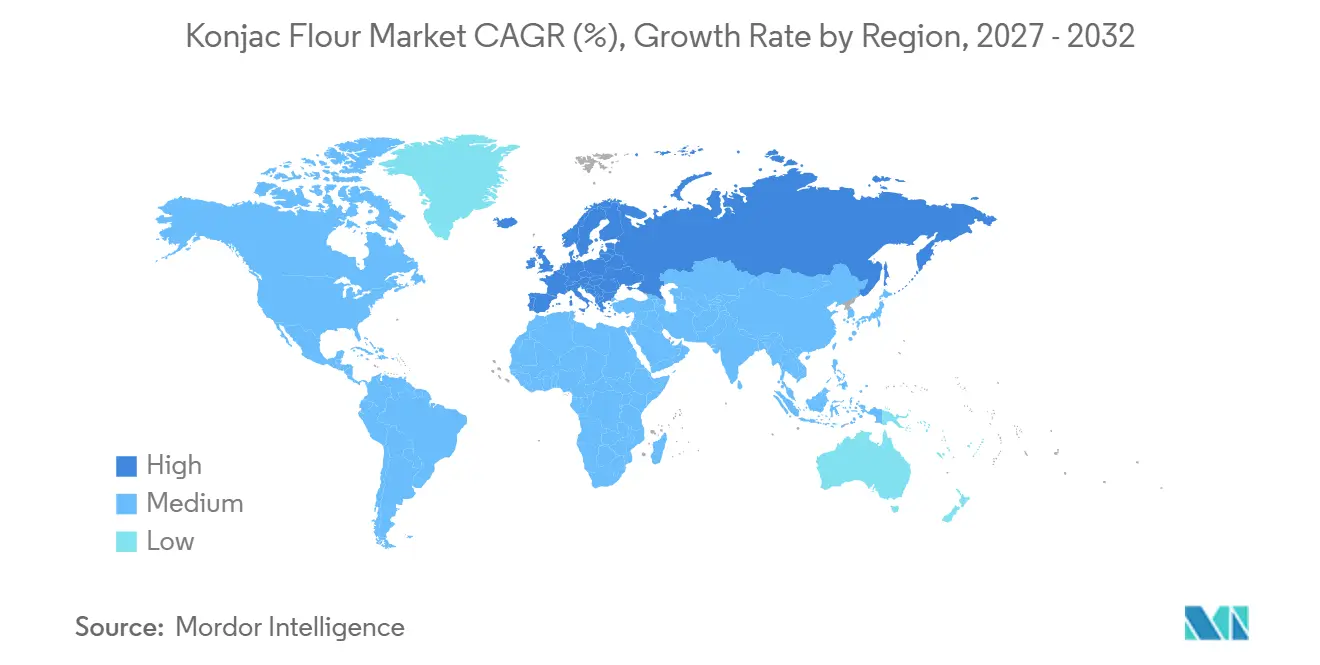
North America is projected to be the fastest-growing regional market, registering a CAGR of 6.56% during 2027–2032. Demand potential is supported by interest in low-calorie, gluten-free, low-carbohydrate, and fiber-rich food products. Konjac flour offers opportunities in noodles, pasta alternatives, plant-based meat formulations, and dietary supplements because of its glucomannan content and functional properties. Growing product development in functional foods and specialty dietary products may further support adoption among food manufacturers and supplement companies. Europe represents another important market, supported by demand for functional ingredients, plant-based food formulations, and soluble dietary fiber. The use of konjac glucomannan in food and supplement applications provides opportunities for suppliers, subject to applicable ingredient approval, labeling, and product requirements.
Middle East and Africa and South America Konjac Flour Market
South America represents an emerging opportunity for konjac flour, particularly in Brazil and Argentina, as manufacturers explore functional ingredients for low-calorie foods, fiber-enriched products, and dietary supplements. However, market development may depend on consumer awareness, product availability, and the ability of suppliers to establish distribution channels for konjac-based ingredients. The Middle East and Africa also offer potential opportunities through the food processing and dietary supplement industries, although awareness and familiarity with konjac-based products may remain relatively limited in several markets. Imported ingredient availability, regulatory requirements, and distribution infrastructure are important considerations for market expansion. Across both regions, food-grade applications and supplement formulations could provide entry points for suppliers seeking to expand beyond established konjac-consuming markets.
Competitive Landscape
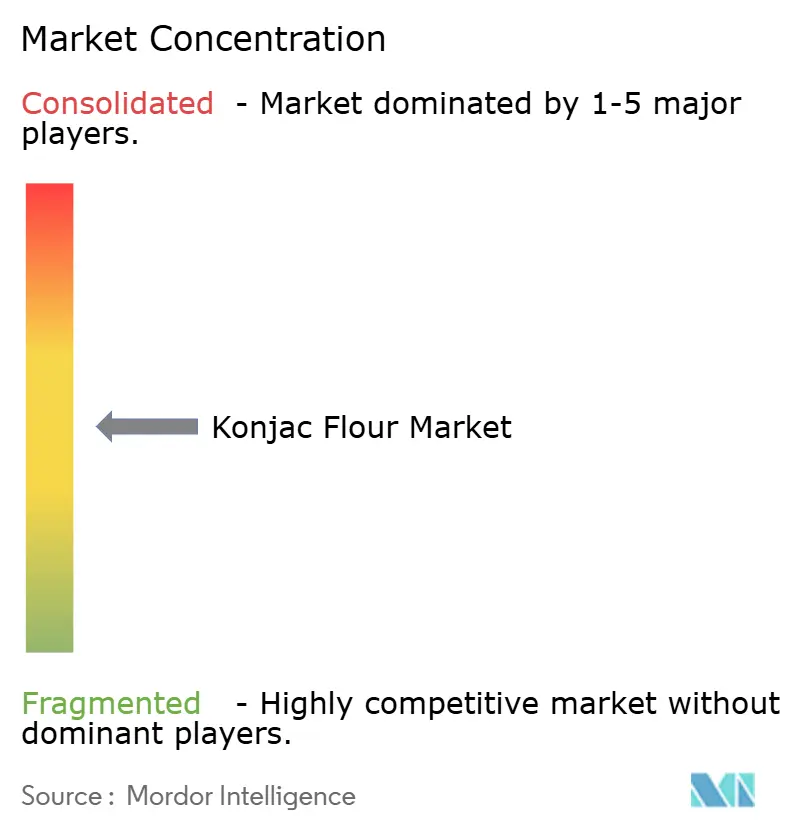
The Konjac Flour Market has a moderately fragmented structure, with competition distributed across konjac processors, hydrocolloid manufacturers, and suppliers of specialty food ingredients. Companies such as Hubei Yizhi Konjac Biotechnology, Baoji Konjac Chemical, Green Fresh Group, Shanghai Brilliant Gum, and Hubei Konson Konjac Gum participate in the ingredient supply side of the market. These companies compete through product quality, glucomannan content, processing capabilities, supply consistency, and the ability to meet different customer specifications. Their relevance is particularly strong in food-grade konjac flour and glucomannan-based ingredients used in noodles, processed foods, and other food formulations.
The competitive landscape also includes companies such as Shimizu Chemical Corporation, Sichuan Sentaiyuan Biotechnology, Zhejiang E.C.L. Konjac, Shaanxi Jintai Biological Engineering, and Chengdu Root Industry. Their inclusion reflects the presence of specialized suppliers and processors in the konjac ingredient value chain. Other companies in the competitive set, including Nexira, Bioriginal Food & Science, and NOW Health Group, provide exposure to broader functional ingredient, nutritional ingredient, and supplement markets. These companies should be assessed according to their actual konjac product portfolios and commercial activities rather than treated uniformly as direct konjac flour manufacturers.
Competition is influenced by the different requirements of the market's product types and grades. Conventional konjac flour benefits from established food-processing applications, while blended konjac flour offers opportunities for suppliers developing application-specific formulations. Food-grade products serve the largest application base, whereas pharmaceutical-grade products require greater attention to purity, consistency, and technical specifications. Manufacturers that can provide reliable glucomannan content, consistent viscosity, quality documentation, and dependable supply may be better positioned to serve food processors and specialized ingredient buyers.
Konjac Flour Industry Leaders
-
Baoji Konjac Chemical Co., Ltd.
-
Greenfresh (Group) Co., Ltd.
-
Hubei Konson Konjac Gum Co., Ltd.
-
Hubei Yizhi Konjac Biotechnology Co., Ltd.
-
BLG
- *Disclaimer: Major Players sorted in no particular order
Konjac Flour Market Companies Covered in this Report
- Hubei Yizhi Konjac Biotechnology Co., Ltd.
- Baoji Konjac Chemical Co., Ltd.
- Green Fresh (Group) Co., Ltd.
- Shanghai Brilliant Gum Co., Ltd.
- Hubei Konson Konjac Gum Co., Ltd.
- Shimizu Chemical Corporation
- Sichuan Sentaiyuan Biotechnology Co., Ltd.
- Henan Xin Industry Co., Ltd.
- Zhejiang E.C.L. Konjac Co., Ltd.
- Shaanxi Jintai Biological Engineering Co., Ltd.
- Chengdu Root Industry Co., Ltd.
- Shanghai Tianjiu Biotechnology Co., Ltd.
- Henan Liankong Biotechnology Co., Ltd.
- Zhejiang Shangfang Biotechnology Co., Ltd.
- Fujian Shengong Food Co., Ltd.
- Hubei Jianshi Konjac Industry Development Co., Ltd.
- Hubei Yikangyuan Konjac Biotechnology Co., Ltd.
- Nexira
- Bioriginal Food & Science Corp.
- NOW Health Group, Inc.
Recent Industry Developments in Konjac Flour Market
- September 2026: Hubei Yizhi Konjac Biotechnology announced its participation in Fi Asia Indonesia 2026, held in Jakarta from September 16–18. The company presented konjac powder and carrageenan hydrocolloid solutions for applications including noodles, jelly products, and meat formulations, highlighting its focus on food ingredient development and international customer engagement.
- July 2026: Shaanxi Jiwei Food expanded its presence in Thailand through collaboration with two Thai companies to develop spicy chicken and mala konjac noodle products. The products entered 7-Eleven supermarkets in Thailand, with the company reporting average weekly shipments of three 40-foot high-cube containers.
- June 2026: Shaanxi Jiwei Food showcased its konjac product portfolio at the 2026 SIAL Shanghai International Food and Beverage Exhibition. The company reported receiving recognition from domestic and overseas buyers and securing multiple cooperation intentions, supporting its efforts to expand commercial relationships in international markets.
- April 2026: Shaanxi Jiwei Food partnered with Pepsi China Co., Ltd. to export konjac snacks, primarily to Thailand, Singapore, Hong Kong, and Vietnam. The company reported average daily shipments of two 40-foot high-cube containers, indicating expanding cross-border distribution for its konjac-based convenience food products.
Global Konjac Flour Market Report Scope
For this study, the Konjac Flour Market is defined as the sales value of commercially produced konjac flour derived from konjac corms and processed, packaged, distributed, and sold for food, pharmaceutical, cosmetic, and other industrial applications. The market covers conventional konjac flour, organic konjac flour, purified konjac flour, and blended konjac flour, segmented by grade, including food grade, pharmaceutical grade, and industrial grade. Applications covered include food and beverages, comprising noodles and pasta, meat and seafood alternatives, bakery and confectionery, dairy and dairy alternatives, sauces, dressings and soups, and other food applications; dietary supplements and nutraceuticals; pharmaceuticals; cosmetics and personal care; animal feed; and other industrial applications. The market is analyzed across North America, Europe, Asia-Pacific, South America, and the Middle East and Africa, with country-level coverage as specified in the report. Market sizing and forecasts are presented in value terms across the defined product types, grades, applications, and geographies.
Segmentation Overview
| Conventional Konjac Flour |
| Organic Konjac Flour |
| Purified Konjac Flour |
| Blended Konjac Flour |
| Food Grade |
| Pharmaceutical Grade |
| Industrial Grade |
| Food and Beverages | Noodles and Pasta |
| Meat and Seafood Alternatives | |
| Bakery and Confectionery | |
| Dairy and Dairy Alternatives | |
| Sauces, Dressings and Soups | |
| Other Food Applications | |
| Dietary Supplements and Nutraceuticals | |
| Pharmaceuticals | |
| Cosmetics and Personal Care | |
| Animal Feed | |
| Other Industrial Applications |
| North America | United States |
| Canada | |
| Mexico | |
| Rest of North America | |
| Europe | United Kingdom |
| Germany | |
| France | |
| Italy | |
| Spain | |
| Poland | |
| Netherlands | |
| Rest of Europe | |
| Asia-Pacific | China |
| Japan | |
| India | |
| South Korea | |
| Australia | |
| Rest of Asia-Pacific | |
| South America | Brazil |
| Argentina | |
| Colombia | |
| Rest of South America | |
| Middle East and Africa | South Africa |
| Saudi Arabia | |
| United Arab Emirates | |
| Turkey | |
| Rest of Middle East and Africa |
| By Product Type | Conventional Konjac Flour | |
| Organic Konjac Flour | ||
| Purified Konjac Flour | ||
| Blended Konjac Flour | ||
| By Grade | Food Grade | |
| Pharmaceutical Grade | ||
| Industrial Grade | ||
| By Application | Food and Beverages | Noodles and Pasta |
| Meat and Seafood Alternatives | ||
| Bakery and Confectionery | ||
| Dairy and Dairy Alternatives | ||
| Sauces, Dressings and Soups | ||
| Other Food Applications | ||
| Dietary Supplements and Nutraceuticals | ||
| Pharmaceuticals | ||
| Cosmetics and Personal Care | ||
| Animal Feed | ||
| Other Industrial Applications | ||
| By Geography | North America | United States |
| Canada | ||
| Mexico | ||
| Rest of North America | ||
| Europe | United Kingdom | |
| Germany | ||
| France | ||
| Italy | ||
| Spain | ||
| Poland | ||
| Netherlands | ||
| Rest of Europe | ||
| Asia-Pacific | China | |
| Japan | ||
| India | ||
| South Korea | ||
| Australia | ||
| Rest of Asia-Pacific | ||
| South America | Brazil | |
| Argentina | ||
| Colombia | ||
| Rest of South America | ||
| Middle East and Africa | South Africa | |
| Saudi Arabia | ||
| United Arab Emirates | ||
| Turkey | ||
| Rest of Middle East and Africa | ||
Key Questions Answered in the Report
What is the Konjac Flour Market size in 2026?
The Konjac Flour Market size is estimated at USD 1.37 billion in 2026.
What is the projected size of the Konjac Flour Market by 2032?
The Konjac Flour Market is projected to reach USD 1.61 billion by 2032.
What is the expected growth rate of the Konjac Flour Market?
The market is expected to register a CAGR of 2.55% during 2027–2032.
Which region holds the largest share of the Konjac Flour Market?
Asia-Pacific holds the largest regional share, accounting for 45.68% of the market in 2026.