
Japan Microgreens Market Size and Share
Market Overview
| Study Period | 2021 - 2031 |
|---|---|
| Forecast Data Period | 2026 - 2031 |
| Base Year Market Size (2025) | USD 113 Million |
| Market Size (2026) | USD 121.20 Million |
| Market Size (2031) | USD 171.70 Million |
| Growth Rate (2026 - 2031) | 7.21 % |
| Market Concentration | Medium |
Major Players *Disclaimer: Major Players sorted in no particular order Image © Mordor Intelligence. Reuse requires attribution under CC BY 4.0. | |
Japan Microgreens Market Analysis by Mordor Intelligence
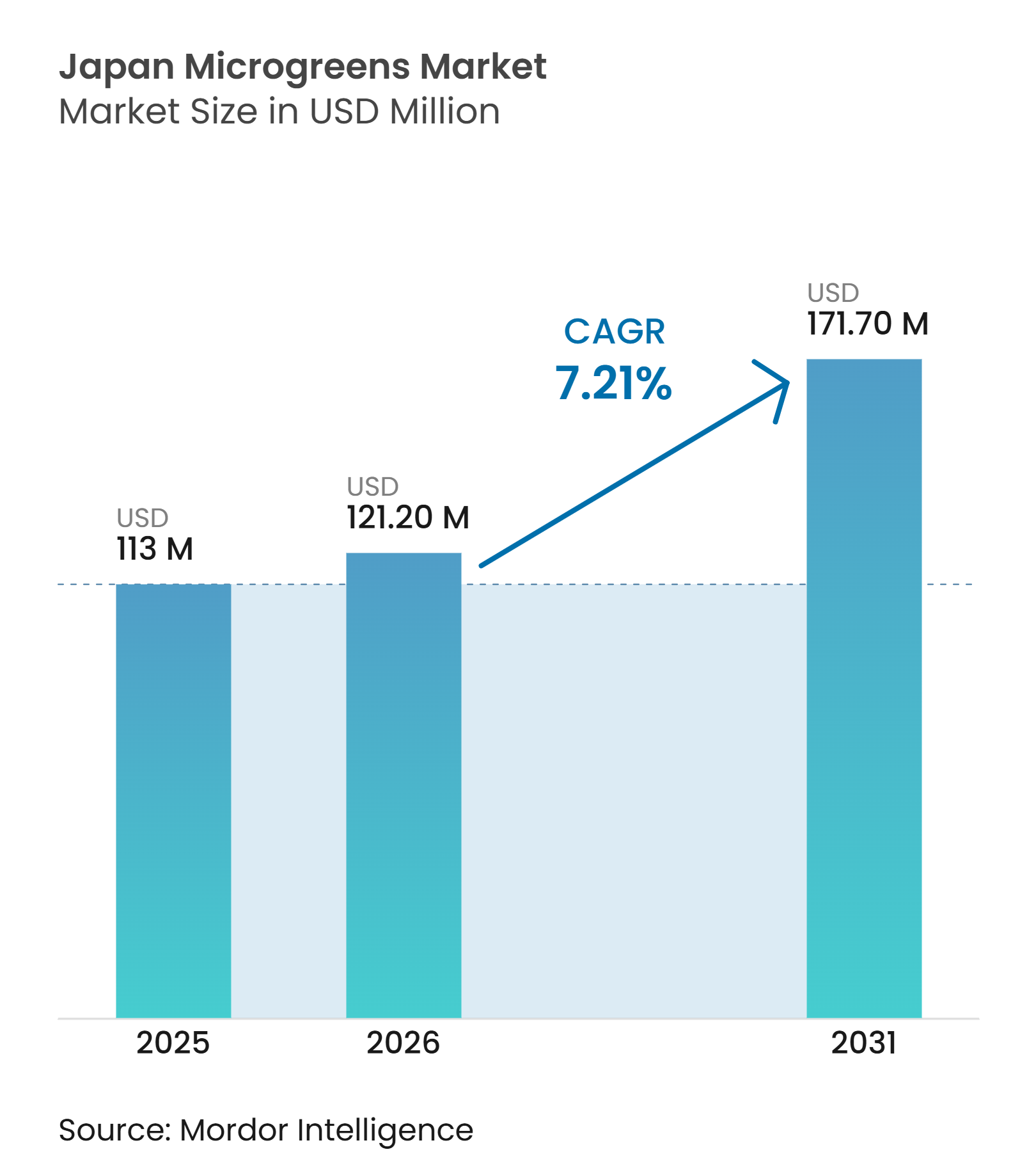
The Japan microgreens market was valued at USD 113.0 million in 2025 and is projected to grow from USD 121.20 million in 2026 to USD 171.70 million by 2031, at a CAGR of 7.21% during the forecast period from 2026 to 2031. This growth is supported by demand for fresh, locally sourced specialty produce in major cities, where buyers seek reliable harvest timing and direct connections to local growers. Indoor cultivation helps producers maintain supply across seasons, reduces exposure to weather-related disruptions, and provides customers with a more dependable option when conventional vegetable supply is interrupted. Restaurants, hotels, and specialty retailers remain important buyers due to their requirements for consistent quality, flavor, traceability, and frequent small-volume deliveries suited to specialized menus. Automation, light-emitting diode (LED) lighting, and environmental controls can expand access to urban production sites, although electricity, labor, equipment, and property costs remain significant constraints. Regional grower programs and direct digital sales can extend the Japan microgreens market beyond the established metropolitan customer base, provided growers can maintain quality and manage delivery times.
Key Report Takeaways
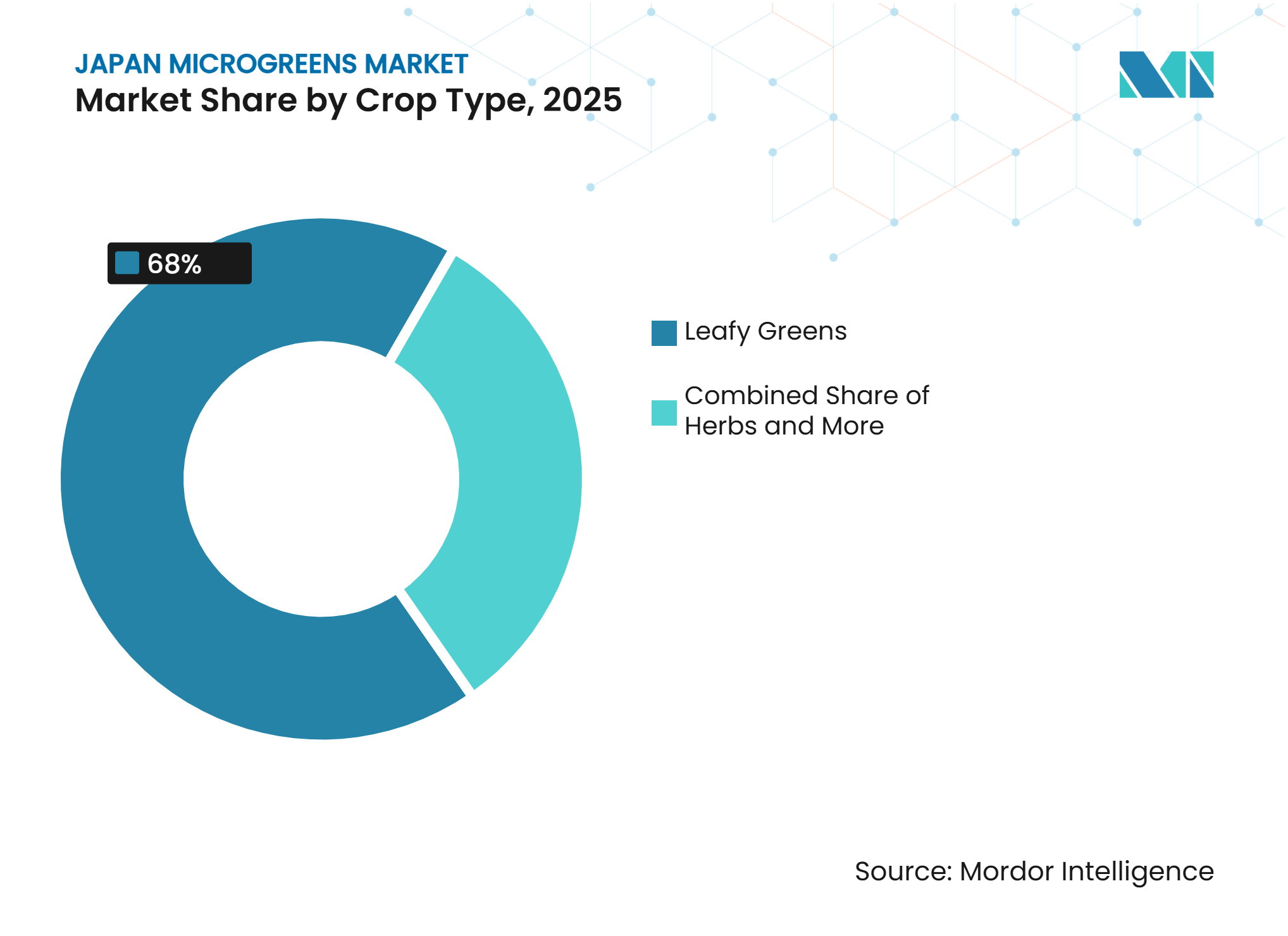
- By crop type, leafy greens accounted for the largest 68.0% of the Japan microgreens market share in 2025, while herbs recorded the highest projected CAGR of 9.6% from 2026 to 2031.
- By farming method, indoor farming accounted for the largest share at 47.0% in 2025, while the Japan microgreens market size for vertical farming is projected to grow at the highest CAGR of 9.4% from 2026 to 2031.
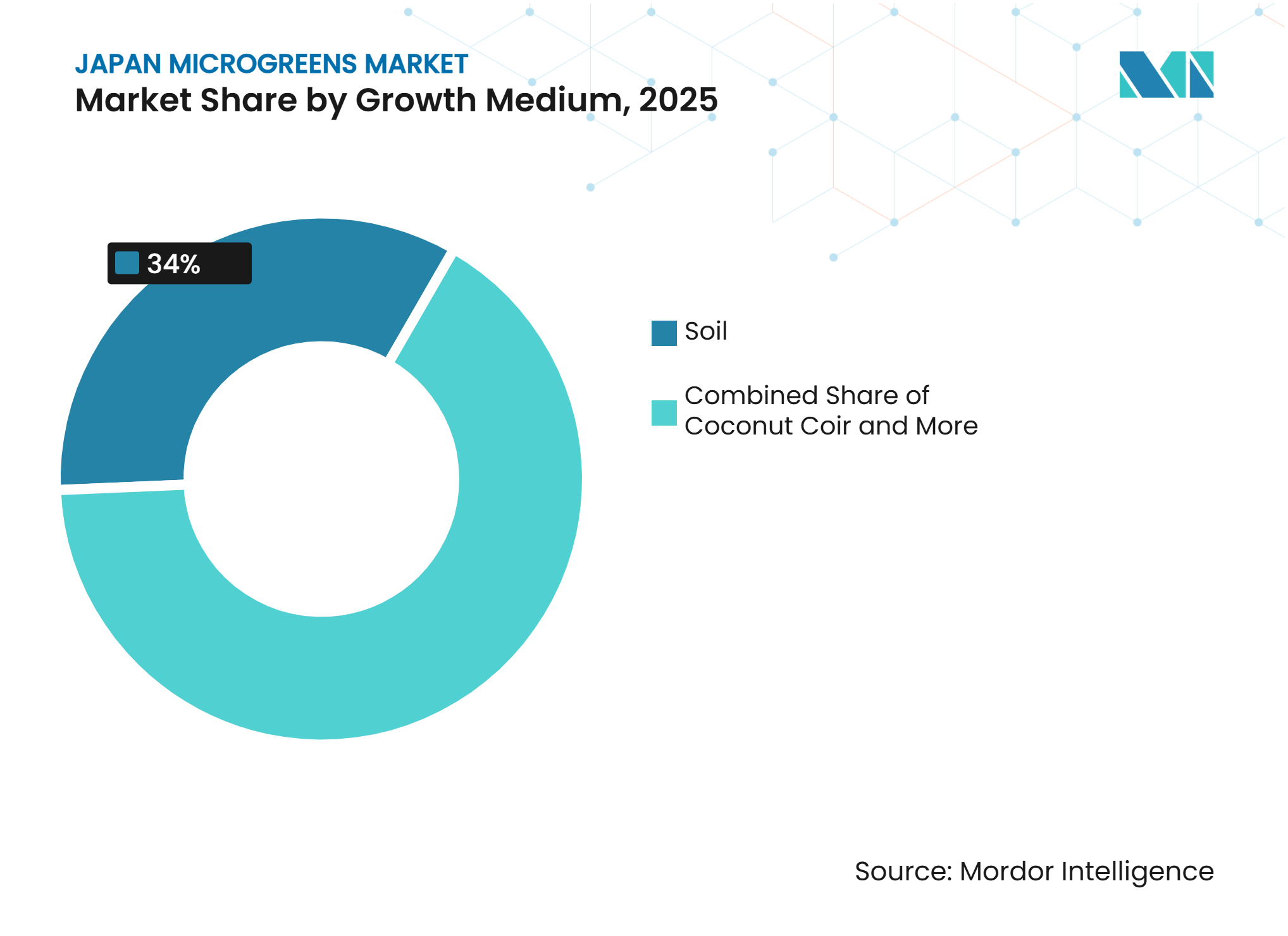
- By growth medium, soil accounted for the largest share at 34.0% in 2025, while coconut coir is projected to grow at the fastest CAGR of 9.0% from 2026 to 2031.
- By distribution channel, restaurants and foodservice distributors accounted for the largest share at 46.0% in 2025, while online retail and direct-to-consumer are projected to grow at the fastest CAGR of 10.3% from 2026 to 2031.
Note: Market size and forecast figures in this report are generated using Mordor Intelligence’s proprietary estimation framework, updated with the latest available data and insights as of January 2026.
Market Trends and Insights
Drivers Impact Analysis of Japan Microgreens Market*
| Driver | (~) % Impact on CAGR Forecast | Geographic Relevance | Impact Timeline |
|---|---|---|---|
| Rising Demand for Nutrient-Dense and Functional Foods | 2.10% | National, with concentration in Kanto and Kansai urban centers | Medium term (2-4 years) |
| Expansion of Premium Foodservice and Chef-Led Applications | 1.60% | Tokyo, Osaka, and Kyoto foodservice hubs | Medium term (2-4 years) |
| Growth of Controlled-Environment Agriculture in Urban Areas | 1.20% | National, with early gains in Tokyo, Osaka, and Fukuoka | Long term (≥ 4 years) |
| Demand for Year-Round Local Produce Amid Weather Volatility | 0.90% | National, with high relevance in Hokkaido and Kyushu | Short term (≤ 2 years) |
| Short Crop Cycles and Low Water Requirements | 0.70% | National | Short term (≤ 2 years) |
| Increasing Adoption of Farm-to-Table and Clean-Label Produce | 0.60% | Urban and peri-urban areas, including tourism corridors in Kyoto and Hakone | Medium term (2-4 years) |
| Source: Mordor Intelligence | |||
Rising Demand for Nutrient-Dense and Functional Foods
Japan's vegetable consumption remains below recommended levels, increasing demand for nutrient-rich food options. The Ministry of Agriculture, Forestry and Fisheries reported that average vegetable intake in Japan was 256.0 grams per person per day, below the 350-gram daily target under Health Japan 21[1]. This gap highlights the relevance of compact, nutrient-dense vegetables that can be incorporated into salads, prepared meals, and other dishes. Microgreens address this need by providing concentrated nutritional value in small portions, supporting their positioning as functional, health-oriented fresh produce.
Expansion of Premium Foodservice and Chef-Led Applications
The expansion of Japan's foodservice sector is creating more opportunities for specialty ingredients used in chef-led dishes. The Japan Foodservice Association (JFSA) reported that dinner restaurant sales reached 106.6% of the previous year's levels in 2025, indicating continued growth in this foodservice category. This expansion increases the number of dining occasions where chefs can incorporate microgreens to add visual appeal, texture, and distinctive flavors to prepared dishes. As restaurant activity grows, specialty produce suppliers can access more recurring business-to-business demand, supporting wider adoption of microgreens across premium dining and chef-led applications.
Growth of Controlled-Environment Agriculture in Urban Areas
Japan's expansion of controlled-environment agriculture is strengthening the production infrastructure for crops that require consistent growing conditions. The Ministry of Agriculture, Forestry, and Fisheries (MAFF) reported 37,000 hectares of greenhouse facilities in 2024, providing a substantial base for controlled horticultural production[2]. This infrastructure supports greater use of environmental controls that can stabilize crop quality and production schedules regardless of outdoor conditions. For microgreens, these capabilities are particularly relevant, as short production cycles and freshness requirements favor predictable cultivation and rapid supply. Expanding controlled production infrastructure can therefore support the Japan microgreens market by enabling more reliable year-round local production.
Short Crop Cycles and Low Water Requirements
Short crop cycles give microgreens producers greater flexibility to schedule successive harvests and respond to frequent fresh-produce orders. Biomimesis Co., Ltd. states that microgreens reach harvest size approximately 2 to 6 days after germination, followed by 4 to 10 days of growth, enabling production from germination to harvest within a short period. This rapid turnover allows growers to plan successive batches, adjust varieties based on buyer requirements, and replenish fresh products more frequently. This production flexibility is particularly relevant for urban foodservice supply, where freshness and responsive ordering can strengthen the commercial use of microgreens and support market growth.
Restraints Impact Analysis of Japan Microgreens Market*
| Restraint | (~) % Impact on CAGR Forecast | Geographic Relevance | Impact Timeline |
|---|---|---|---|
| High Electricity and Labor Costs in Controlled Environments | -1.70% | National, with high exposure in Tokyo and Osaka | Short term (≤ 2 years) |
| Short Shelf Life and Limited Long-Distance Distribution | -0.90% | Non-metropolitan areas and rural regions with limited cold-chain coverage | Medium term (2-4 years) |
| Limited Consumer Familiarity Beyond Premium Foodservice | -0.50% | National, especially smaller cities and rural prefectures | Medium term (2-4 years) |
| Crop Contamination and Production-Consistency Risks | -0.40% | National | Short term (≤ 2 years) |
| Source: Mordor Intelligence | |||
High Electricity and Labor Costs in Controlled Environments
The short shelf life of microgreens limits the geographic reach of Japan's suppliers, as products require rapid delivery and proper storage to maintain freshness. The Agriculture and Livestock Industries Corporation (ALIC) notes that a Japanese microgreens producer achieves 7 days of refrigerated freshness through proprietary technology[3]. This limited freshness window requires growers to coordinate closely with buyers across harvesting, cooling, packaging, and transportation. Longer distribution routes increase handling and temperature-control requirements, raising logistics complexity and the risk of quality deterioration. As a result, limited postharvest durability can restrict long-distance distribution and constrain the expansion of Japan's microgreens market.
Short Shelf Life and Limited Long-Distance Distribution
The short shelf life of microgreens limits the geographic reach of Japan's suppliers, as products require rapid delivery and proper storage to maintain freshness. The Agriculture and Livestock Industries Corporation (ALIC) notes that a Japanese microgreens producer achieves 7 days of refrigerated freshness through proprietary technology. This limited freshness window requires growers to coordinate closely with buyers on harvesting, cooling, packaging, and transportation. Longer distribution routes increase handling and temperature-control requirements, raising logistics complexity and the risk of quality deterioration. As a result, limited postharvest durability restricts long-distance distribution and constrains the expansion of Japan's microgreens market.
*Our forecasts treat driver/restraint impacts as directional, not additive. The impact forecasts reflect baseline growth, mix effects, and variable interactions.
Japan Microgreens Market Segment Analysis
By Crop Type:
Leafy Greens Anchor Revenue and Herbs AccelerateLeafy greens accounted for the largest 68.0% of the Japan microgreens market share in 2025, driven by their established culinary use across restaurants, hotels, and specialty grocery channels. Broccoli, radish, pea, sunflower, arugula, lettuce, and chicory varieties offer options for different flavors, textures, and presentation requirements. Fennel, carrot, and basil serve specialized culinary applications, allowing growers to diversify offerings for chef-led menus and premium retail. This range of applications supports recurring demand across foodservice and specialty produce channels, reinforcing leafy greens as the leading crop category in the market.
Herbs are projected to record the highest CAGR of 9.6% from 2026 to 2031, supported by their role as concentrated finishing ingredients in Japanese, French, and fusion cuisine. Micro-herbs provide aromatic flavor and visual differentiation while requiring small quantities per serving. Their use across composed dishes allows chefs to introduce specialty varieties without substantially altering core menu structures. Other crops, including sunflower shoots and specialty seeds, complement herb offerings in plant-based and functional food applications. Wider crop diversification can help growers respond to changing culinary preferences and strengthen the market's range of specialty products.



By Farming Method:
Indoor Farming Infrastructure Commands While Vertical Farming Grows FastIndoor farming accounted for the largest share at 47.0% in 2025, as controlled production supports consistent growing conditions and year-round scheduling. Indoor facilities can be located closer to urban customers, helping growers coordinate frequent deliveries of perishable microgreens to restaurants, retailers, and foodservice distributors. Managed temperature, humidity, lighting, and sanitation support standardized production across successive cycles. Commercial greenhouse and soil-based approaches remain relevant where buyers prioritize specific cultivation characteristics or supply requirements. This range of production methods allows growers to align cultivation systems with customer needs, supporting continued market development.
The Japan microgreens market for vertical farming is projected to grow at the highest CAGR of 9.4% from 2026 to 2031, supported by the ability to stack production vertically within constrained urban footprints. Tiered systems can increase production capacity relative to floor space when lighting, irrigation, and environmental controls are properly integrated. Sensor-based monitoring can help operators maintain crop conditions and coordinate production schedules, while automation can reduce the need for repetitive handling. Hydroponic and soil-based systems remain relevant alternatives for growers with different product specifications. This technological diversity supports the adoption of efficient cultivation formats.
By Growth Medium:
Soil Retains Scale and Coconut Coir Gains Premium InterestSoil accounted for the largest share of 34.0% in 2025. Soil-based cultivation supports growers seeking specific flavor, texture, and cultivation characteristics for culinary applications. This medium also offers a familiar production approach for smaller farms that serve nearby restaurants and specialty retailers. Peat moss, hydroponic nutrient solutions, tissue paper, and other media offer alternatives suited to different requirements, including moisture management, handling, and production consistency. These options allow producers to select growing media based on crop characteristics and customer expectations, supporting the continued use of multiple growing media within Japan's microgreens market.
Coconut coir is projected to grow at the fastest CAGR of 9.0% from 2026 to 2031, supported by its moisture-retention properties and suitability for controlled cultivation. When growers manage irrigation and substrate quality effectively, coir can provide a consistent rooting environment across production cycles. Its use can complement production systems seeking alternative growing media for microgreens and specialty crops. Other substrates, including biodegradable mats and bio-based materials, serve growers with different handling and sustainability requirements. The availability of multiple media options enables producers to adapt cultivation practices to crop, facility, and customer specifications.

By Distribution Channel:
Restaurants and Foodservice Distributors Dominates and Online Retail and Direct-to-Consumer ExpandRestaurants and foodservice distributors accounted for the largest share at 46.0% in 2025, driven by direct procurement relationships and frequent replenishment requirements for fresh microgreens. Restaurants use specialty varieties for plating, flavor, and texture, while distributors connect growers with multiple foodservice accounts. Hypermarkets, supermarkets, specialty grocery stores, and farmers' markets serve as additional channels for reaching consumers with varying purchasing preferences. Channel diversity allows growers to balance recurring foodservice orders with retail and direct sales. This structure supports market development while enabling suppliers to tailor packaging, delivery frequency, and product selection to each channel.
Online retail and direct-to-consumer channels are projected to grow at the fastest CAGR of 10.3% from 2026 to 2031, supported by digital ordering, subscription models, and convenient delivery. Online channels provide consumers with information on crop varieties, origin, harvest timing, and cultivation practices that are often less visible in physical stores. Direct ordering helps growers coordinate production with confirmed demand and reduce excess inventory. Home-growing kits complement fresh microgreen sales by extending consumer engagement with cultivation. These capabilities allow digital channels to expand market access while complementing established foodservice and retail relationships.
Geography Analysis
Kanto is a major commercial hub for demand for premium fresh produce, as Tokyo and the surrounding prefectures combine dense urban populations with extensive restaurant, hotel, and specialty retail activity. This environment supports frequent purchases of perishable ingredients and creates opportunities for growers to locate production near customers. Tokyo, Kanagawa, Saitama, and Chiba also offer interconnected logistics routes that enable shorter delivery schedules. Indoor farms can use commercial, industrial, or repurposed spaces within these markets, while nearby suburban areas provide additional production and distribution options. These conditions support localized supply and product differentiation.
Kansai represents another important demand center, with Osaka, Kyoto, and Kobe combining restaurant, hotel, tourism, and specialty food activities. Kyoto's culinary reputation and Osaka's broad dining base create opportunities for microgreens used in presentation, flavor, and menu differentiation. Regional growers can serve these buyers through shorter distribution routes than suppliers shipping from distant production areas. Chubu, including Nagoya and surrounding prefectures, provides additional demand from restaurants, hotels, institutional foodservice, and specialty retailers. Together, these markets create varied customer requirements for crop selection, packaging, delivery frequency, and cultivation practices, supporting geographic diversification.
The Kanto region has a particularly large addressable urban customer base. The Statistics Bureau of Japan reported that the Tokyo metropolitan area, comprising Tokyo-to, Kanagawa-ken, Saitama-ken, and Chiba-ken, had a population of 36.986 million on October 1, 2025, representing 30.1% of Japan's population. This concentration supports a broad network of restaurants, retailers, and foodservice buyers that can be served through localized production and frequent deliveries. Other regions, including Kansai, Chubu, Tohoku, Shikoku, Hokkaido, and Kyushu, provide additional opportunities as local growers and distributors develop customer relationships and reliable supply arrangements.
Competitive Landscape
Market Concentration
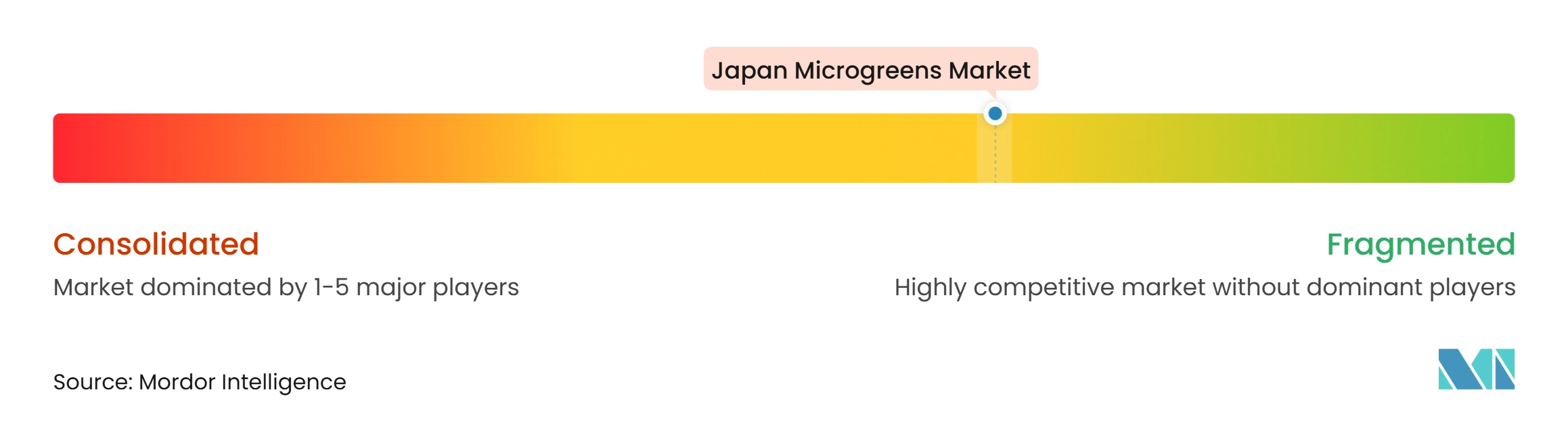
The Japan microgreens market is moderately fragmented in 2025, with Murakami Farm Co., Ltd., Microgreen Co., Ltd., Edomae Herb, Biomimesis Co., Ltd., and THE SIMPLE, Inc. (Micro Farm) among the major players. These companies and other regional growers use different cultivation and distribution models to serve restaurants, hotels, retailers, and direct customers. Competition is shaped by crop selection, cultivation practices, freshness, consistency, and customer service. Smaller growers can emphasize relationships with chefs and customized products, while established operators can develop broader production capabilities. This structure supports multiple competitive positioning strategies across Japan.
Murakami Farm Co., Ltd. focuses on micro-herbs and sprout products supported by controlled production and quality management, while Microgreen Co., Ltd. and THE SIMPLE, Inc. (Micro Farm) operate more specialized microgreen-focused models. Edomae Herb differentiates through soil-based indoor cultivation, while Biomimesis Co., Ltd. combines microgreen production technology with cultivation support. These approaches create distinct competitive positions based on cultivation method, crop characteristics, production consistency, and customer requirements. Regional growers can also compete through shorter delivery routes and direct chef relationships, allowing them to tailor products and services to local foodservice demand.
Product differentiation is an important competitive factor in Japan's microgreens market, as professional buyers seek distinctive flavors, colors, shapes, and aromas for culinary applications. Murakami Farm Co., Ltd. addresses these requirements through its dedicated micro-herb series, which offers multiple varieties for restaurant use. The company distributes these products through produce markets, mass retailers, and its business-use online store, providing access across different purchasing channels. This combination of specialized product characteristics and broad channel coverage illustrates how suppliers can strengthen their competitive positioning through crop differentiation and market accessibility to meet the varied requirements of professional microgreens buyers.
Japan Microgreens Industry Leaders
-
Murakami Farm Co., Ltd.
-
Microgreen Co., Ltd.
-
Edomae Herb
-
Biomimesis Co., Ltd.
-
THE SIMPLE, Inc. (Micro Farm)
- *Disclaimer: Major Players sorted in no particular order
Japan Microgreens Market Companies Covered in this Report
- Murakami Farm Co., Ltd.
- Biomimesis Co., Ltd.
- Microgreen Co., Ltd.
- Edomae Herb
- OTM activation Co., Ltd.
- Blue Leaf Microgreens
- THE SIMPLE, Inc. (Micro Farm)
- Terada Farm Co., Ltd.
- Ferme du Soleil Inc.
- Farm Sam
Recent Industry Developments in Japan Microgreens Market
- June 2026: Microgreen Co., Ltd. opened the TORIDORI Shibuya store in Tokyo, expanding its physical presence for Japanese cultural experience workshops aimed primarily at international visitors. The new location broadened the company's customer-facing operations beyond its existing microgreens production and sales activities.
- November 2025: Blue Leaf Microgreens collaborated with YAMAJI DESIGN and Greentopia Japan to develop and manufacture custom hydroponic growing trays for a high-end restaurant in Tokyo. The trays allow chefs to grow and harvest microgreens directly in the kitchen, supporting fresh, made-to-order culinary applications.
- September 2025: Biomimesis Co., Ltd. launched advance reservations for a home-use microgreens cultivation kit on CAMPFIRE. The kit includes a compact LED system, a growing tray, selected seeds, and a growing medium for household cultivation.
Japan Microgreens Market Report Scope
Microgreens are young, edible vegetable and herb seedlings harvested 7 to 21 days after germination. They are valued for their nutritional content, flavor, vibrant color, and applications in salads, garnishes, sandwiches, and specialty dishes.
The Japan microgreens market report is segmented by crop type (leafy greens, broccoli, radish, pea, sunflower, basil, arugula, lettuce and chicory, fennel, carrot, herbs, and other crop types), by farming method (indoor farming, vertical farming, commercial greenhouse farming, soil-based farming, and other farming methods), by growth medium (peat moss, soil, coconut coir, hydroponic nutrient solution, tissue paper, and other growth media), and by distribution channel (hypermarkets and supermarkets, specialty grocery stores, restaurants and foodservice distributors, online retail and direct-to-consumer, and farmers’ markets and community agriculture). The market forecasts are provided in terms of value (USD).
Segmentation Overview
| Leafy Greens |
| Broccoli |
| Radish |
| Pea |
| Sunflower |
| Basil |
| Arugula |
| Lettuce and Chicory |
| Fennel |
| Carrot |
| Herbs |
| Other Crop Types |
| Indoor Farming |
| Vertical Farming |
| Commercial Greenhouse Farming |
| Soil-Based Farming |
| Other Farming Methods |
| Peat Moss |
| Soil |
| Coconut Coir |
| Hydroponic Nutrient Solution |
| Tissue Paper |
| Other Growth Media |
| Hypermarkets and Supermarkets |
| Specialty Grocery Stores |
| Restaurants and Foodservice Distributors |
| Online Retail and Direct-to-Consumer |
| Farmers’ Markets and Community Agriculture |
| By Crop Type | Leafy Greens |
| Broccoli | |
| Radish | |
| Pea | |
| Sunflower | |
| Basil | |
| Arugula | |
| Lettuce and Chicory | |
| Fennel | |
| Carrot | |
| Herbs | |
| Other Crop Types | |
| By Farming Method | Indoor Farming |
| Vertical Farming | |
| Commercial Greenhouse Farming | |
| Soil-Based Farming | |
| Other Farming Methods | |
| By Growth Medium | Peat Moss |
| Soil | |
| Coconut Coir | |
| Hydroponic Nutrient Solution | |
| Tissue Paper | |
| Other Growth Media | |
| By Distribution Channel | Hypermarkets and Supermarkets |
| Specialty Grocery Stores | |
| Restaurants and Foodservice Distributors | |
| Online Retail and Direct-to-Consumer | |
| Farmers’ Markets and Community Agriculture |
Key Questions Answered in the Report
What is the Japan microgreens market forecast through 2031?
The Japan microgreens market is forecast to reach USD 171.70 million by 2031.
Which crop type leads demand for microgreens in Japan?
Leafy greens led with the largest 68.0% share in 2025, supported by established use in restaurant, hotel, and specialty grocery channels.
Which cultivation method is growing fastest in Japan?
Vertical farming is projected to grow at the fastest CAGR of 9.4% from 2026 to 2031.
Which sales channel is projected to grow fastest through 2031?
Online retail and direct-to-consumer sales are projected to grow at the fastest CAGR of 10.3% from 2026 to 2031.