
Italy Wine Tourism Market Size and Share
Market Overview
| Study Period | 2022 - 2031 |
|---|---|
| Forecast Data Period | 2026 - 2031 |
| Base Year Market Size (2025) | USD 3.68 Billion |
| Market Size (2026) | USD 3.84 Billion |
| Market Size (2031) | USD 4.82 Billion |
| Growth Rate (2026 - 2031) | 4.67 % |
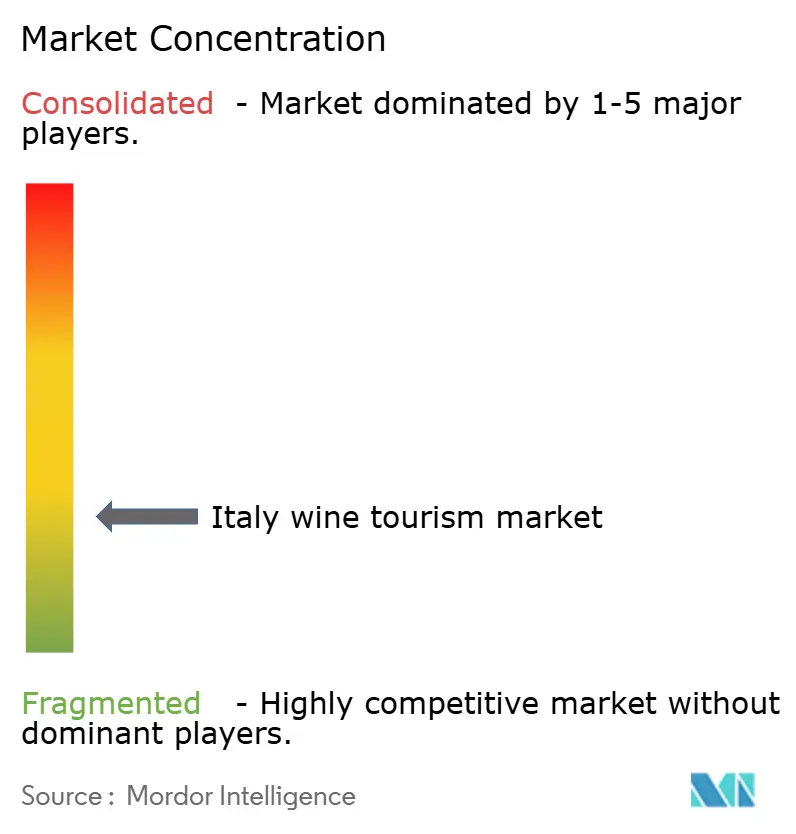
| Market Concentration | Low |
Major Players *Disclaimer: Major Players sorted in no particular order Image © Mordor Intelligence. Reuse requires attribution under CC BY 4.0. | |
Italy Wine Tourism Market Analysis by Mordor Intelligence
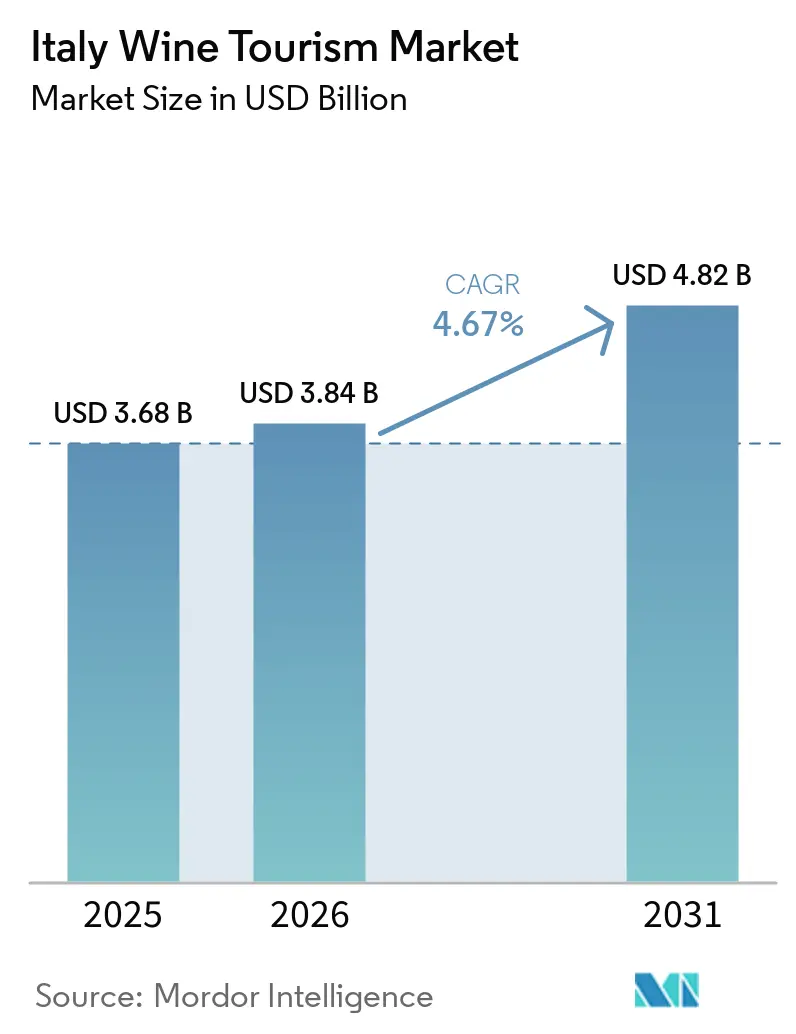
The Italy Wine Tourism Market size was valued at USD 3.68 billion in 2025 and is estimated to grow from USD 3.84 billion in 2026 to reach USD 4.82 billion by 2031, at a CAGR of 4.67% during the forecast period (2026-2031).
The Italian wine tourism market is benefiting from steady post-pandemic travel spending, as wine-led trips are now treated as planned leisure purchases rather than incidental activities. Italy recorded 139.6 million inbound tourism arrivals in 2024, which gives the country a very large travel base that can be converted into winery visits and longer rural stays[1]. The Italian wine tourism market is also supported by the global appeal of Italian denominations, the strength of agriturismo culture, and the pull of vineyard-based hospitality that is hard to replicate in urban destinations. Premium accommodation, digital trip discovery, and stronger inbound spending are widening the revenue pool, while climate stress and crowding in some flagship destinations are slowing the pace of supply expansion. The Italy wine tourism market, therefore, continues to grow on strong demand fundamentals, even though operational constraints at the estate and route levels still matter.
Key Report Takeaways
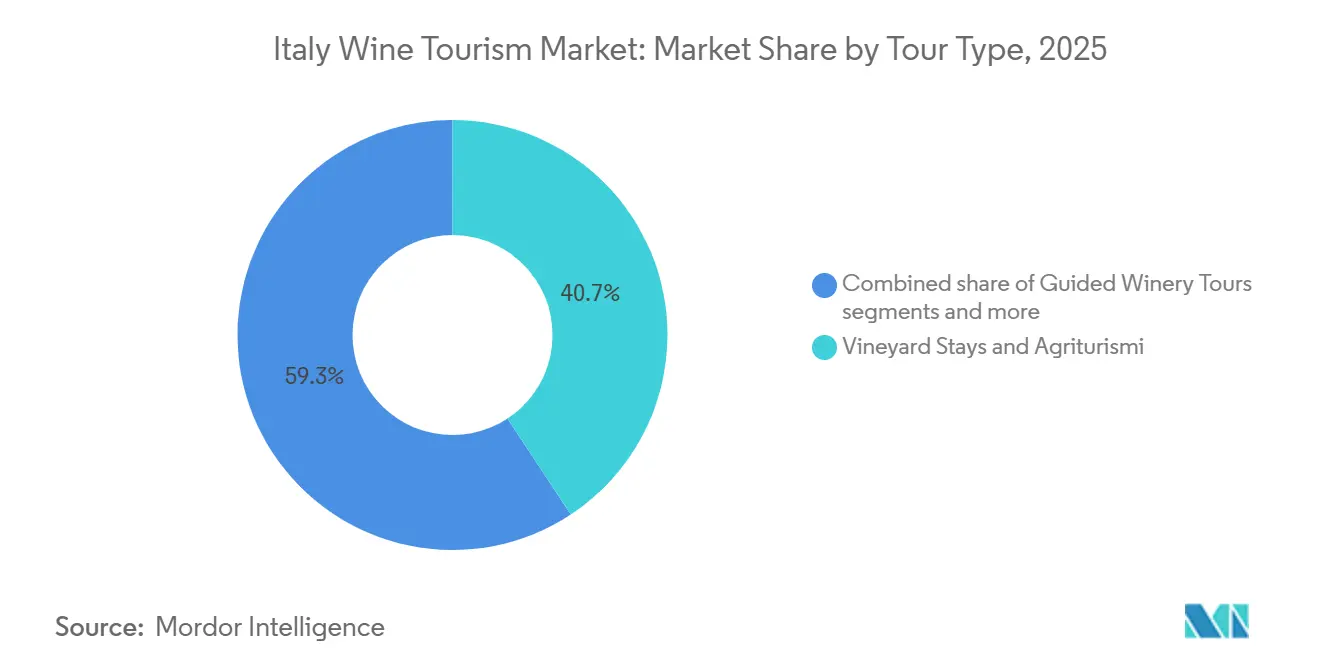
- By tour type, vineyard stays & agriturismi held 40.73% of the Italy wine tourism market share in 2025, while self-guided wine routes are projected to grow at a 4.93% CAGR through 2031.
- By visitor type, international tourists accounted for 56.81% of the Italy wine tourism market in 2025, while the same segment is forecast to expand at a 5.46% CAGR through 2031.
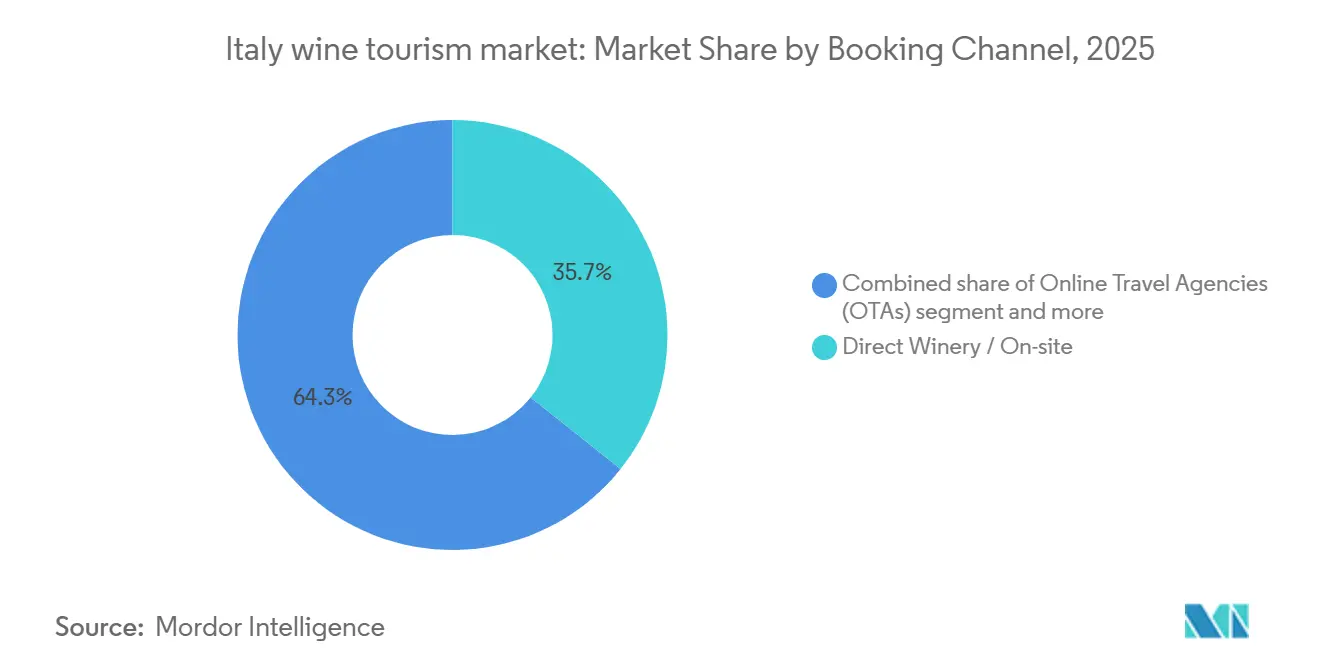
- By booking channel, direct winery or on-site held 35.72% of the Italy wine tourism market in 2025, while specialist wine-tour platforms are advancing at a 5.02% CAGR through 2031.
- By age group, the 35-54 cohort accounted for 42.91% of the Italy wine tourism market in 2025, while the 18-34 cohort is forecast to record the fastest growth at a 5.78% CAGR through 2031.
- By geography, Northern Italy accounted for 38.24% of the Italy wine tourism market in 2025, while Southern Italy and the Islands are forecast to grow at a 5.91% CAGR through 2031.
Note: Market size and forecast figures in this report are generated using Mordor Intelligence’s proprietary estimation framework, updated with the latest available data and insights as of January 2026.
Italy Wine Tourism Market Trends and Insights
Drivers Impact Analysis*
| Driver | (~) % Impact on CAGR Forecast | Geographic Relevance | Impact Timeline |
|---|---|---|---|
| Rising Demand for Experiential Travel Among Millennials and Gen Z | +1.4% | Concentrated in Northern and Central Italy as gateway regions | Short term (≤ 2 years) |
| Government-Led Rural Development and Wine-Route Initiatives | +0.6% | Central Italy, Veneto, Lazio | Medium term (2-4 years) |
| Expansion of Premium Vineyard-Stay Accommodation | +0.8% | Tuscany, Piedmont, Sicily, Veneto, with emerging pockets in Puglia and Campania | Medium term (2-4 years) |
| Growth in High-Spending Inbound Tourism from North America and Asia | +0.7% | National, with premium concentration in Montalcino, Chianti Classico, Etna, and Langhe | Short term (≤ 2 years) |
| Adoption of Immersive Digital Technologies | +0.5% | National, with earlier adoption in Tuscany and Sicily | Medium term (2-4 years) |
| Shift Toward Low-Carbon Slow-Travel Itineraries via Rail-Linked Routes | +0.3% | Central and Northern Italy rail corridors, with emerging relevance in Campania and Puglia | Long term (≥ 4 years) |
| Source: Mordor Intelligence | |||
Rising Demand for Experiential Travel among Millennials and Gen Z
The Italian wine tourism market is seeing a clear shift toward experience-first travel, especially among younger adults who want flexible, memorable trips. The 18-34 age group is projected to grow at a 5.78% CAGR through 2031, which makes it the fastest-expanding demand cohort in the country. This preference is already visible in the growth of self-guided routes, shorter regional circuits, and winery visits that feel personal rather than formal. These travelers tend to discover destinations through mobile search, peer reviews, and visual content, which puts pressure on estates to be easier to find and book. In the Italian wine tourism market, operators that continue to depend only on rigid, guide-led formats face a higher risk of losing younger visitors to more flexible routes and platform-led experiences.
Government-Led Rural Development & Wine-Route Initiatives
Public policy is widening the geographic base of the Italian wine tourism market by supporting rural routes, local promotion, and structured destination building. The Italian Ministry of Tourism launched the Vini e Cammini project at Vinitaly 2024 with USD 1,988,056 (EUR 1,690,078) in PSC-backed funding, linking slow-travel paths across Umbria, Lazio, Marche, Tuscany, and Emilia-Romagna with wine and gastronomy assets[2]. Veneto reinforced this direction through its 2025 grant call for wine route promotion, and ARSIAL opened a USD 470,524 (EUR 400,000) support program with non-repayable contributions of up to 80% for eno-tourism projects in Lazio[3]. The European Commission also kept rural development as a priority within the amended CAP Strategic Plan for Italy in November 2025, which supports investment continuity for smaller estates and interior regions. In the Italy wine tourism market, this matters because better route governance and shared promotion make it easier for smaller wineries to join packaged travel flows they could not build on their own.
Expansion of Premium Vineyard-Stay Accommodation
Premium accommodation has become one of the most important revenue levers in the Italian wine tourism market. Vineyard Stays and Agriturismi led with 40.73% of revenue in 2025, which shows that travelers are willing to pay more for an overnight estate experience than for a simple tasting stop. This format works well because it brings together lodging, dining, cellar-door purchases, and brand storytelling inside one property. Castello Banfi illustrates that model clearly through its integrated estate offering, which combines hospitality, dining, and wine-led visitor programming on a single destination property. The commercial logic is also visible in Tuscany, where the presence of Montalcino accommodation reached 233,000 in 2024, up 6.3% from 2023 and 30% above 2019 levels[4]. In Italy's wine tourism market, the expansion of vineyard stays is boosting total spend per visitor and strengthening direct relationships after the trip ends.
Growth in High-Spending Inbound Tourism from North America & Asia
High-spending inbound tourism remains a strong driver of the Italian wine tourism market. US travelers spent USD 4.46 billion (EUR 3.8 billion) in Italy via payment cards in 2024, accounting for 18.3% of total foreign card-based tourism spending in the country. In the first 8 months of 2025, arrivals from the United States reached 1.4 million, and average spend was USD 224.7 (EUR 191.1) per night, placing this segment among the country’s highest-value visitor groups. This spending profile supports premium wine regions that can package lodging, tastings, dining, and transport into a single trip. In the Italy wine tourism market, a stronger mix of North American and Asian visitors raises average booking value and often extends the length of stay in the best-known appellation zones.
Restraints Impact Analysis*
| Restraint | (~) % Impact on CAGR Forecast | Geographic Relevance | Impact Timeline |
|---|---|---|---|
| Climate Variability Disrupting Harvest Timing and Tour Scheduling | -0.6% | Southern Italy and the Islands most acutely, with spillover into Northern Italy and national event calendars | Medium term (2-4 years) |
| Overcrowding in Peak Season Diminishing Visitor Experience Quality | -0.4% | Northern and Central Italy, especially Verona, Bolzano, Trento, and the Florence-Chianti corridor | Short term (≤ 2 years) |
| Fragmented Online Booking Infrastructure Among Small Wineries | -0.5% | National, with stronger effects in small southern and inland estates | Medium term (2-4 years) |
| Rising Local Opposition to Overtourism Prompting License Limits | -0.3% | Tuscany, Piedmont, and Veneto wine towns | Long term (≥ 4 years) |
| Source: Mordor Intelligence | |||
Climate Variability Disrupting Harvest Timing and Tour Scheduling
Climate volatility is one of the clearest operating limits on the Italian wine tourism market. In 2024, a heat dome pushed temperatures to 45°C in parts of Puglia and Sicily, forcing earlier harvest timing in several southern areas. Italy’s total wine production reached 44.1 million hectoliters in 2024, up 15% from 2023 but still below the 5-year average, underscoring the uneven regional conditions that persisted. Peer-reviewed research published in Agricultural and Food Economics found that vine yields in Italy decline sharply when growing-season temperatures repeatedly exceed 31-33°C. In the Italian wine tourism market, this changes harvest calendars, creates rebooking risk for tour operators, and reduces the reliability of vendemmia-led packages that depend on timing.
Fragmented Online Booking Infrastructure among Small Wineries
Booking friction remains a structural brake on the Italian wine tourism market, especially among small family estates. The Direct Winery or On-site channel still accounted for 35.72% of revenue in 2025, underscoring the sector's continued reliance on local conversion and manual reservation handling. Many smaller producers still use static websites, email exchanges, and delayed confirmation rather than live inventory and instant payment. That gap sends some visitors toward larger estates and specialist platforms that can show real-time availability and combine several trip elements in one place. Unless smaller operators digitize faster, the Italian wine tourism market is likely to keep channeling a growing share of revenue toward the most organized estates rather than across the full winery base.
*Our forecasts treat driver/restraint impacts as directional, not additive. The impact forecasts reflect baseline growth, mix effects, and variable interactions.
Segment Analysis
By Tour Type: Overnight Immersion Anchors Revenue, Self-Guided Routes Accelerating
Vineyard stays and agriturismi accounted for 40.73% of Italy's wine tourism market share in 2025, making this the largest tour format in the country. This segment has a built-in revenue advantage because one guest can spend on accommodation, tastings, dining, and bottle purchases within the same stay. It also gives wineries more control over pricing, service, and brand presentation than shorter visit formats. The model is difficult to replicate outside working estates, which supports premium positioning in the Italian wine tourism market. Castello Banfi remains a strong example of this approach because its estate combines lodging, dining, and destination-led programming in a single property ecosystem.
Self-guided wine routes are projected to grow at a 4.93% CAGR through 2031, making them the fastest-growing tour type in the Italian wine tourism market. Their rise reflects a shift toward independent itinerary planning, mobile navigation, and shorter decision cycles. Younger travelers are helping this segment because they want autonomy over route design and stop selection. Guided Winery Tours still matter for first-time visitors and small groups that want expert explanation and a structured tasting flow. Culinary and wine-pairing experiences remain attractive for premium guests. At the same time, event-led tourism retains value as a niche format, even though it is more exposed to weather and harvest disruptions.
By Visitor Type: International Demand Sets the Pace, Domestic Market Deepens
International tourists accounted for 56.81% of the Italy wine tourism market in 2025 and are forecast to grow at a 5.46% CAGR through 2031. This makes foreign demand the main pace setter for pricing, estate positioning, and destination visibility. The segment is especially important in premium regions where visitors combine wine with food, accommodation, and cultural touring. United States travelers alone spent USD 4.46 billion (EUR 3.8 billion) in Italy in 2024, and their average spend per night reached USD 224.7 million (EUR 191.1 million) during the first 8 months of 2025. In the Italy wine tourism market, this inbound profile supports higher-value packages rather than simple tasting visits.
Domestic tourists remain strategically important because they support repeat visits, local route traffic, and off-peak occupancy in the Italy wine tourism market. Their value is not only in spend, but also in visit frequency and regional familiarity. Local visitors often return to estates within driving distance, which makes seasonal programming and loyalty tools more effective. This base also helps operators manage seasonality when international flows soften or shift. The domestic segment, therefore, deepens utilization across tasting rooms, agriturismi, and smaller regional routes even though its value share is lower than that of international visitors.
By Booking Channel: Direct Relationships Dominate, but Platforms Are Gaining Share
Direct winery or on-site booking accounted for 35.72% of the Italy wine tourism market in 2025, confirming how much conversion still occurs at the estate level. This channel remains strong because many visitors choose stays and tastings after arriving in a wine region rather than far in advance. It also reflects the large number of small wineries that continue to manage reservations by phone, email, or walk-in demand. Direct handling protects margin when it works well, but it can slow conversion when inventory is not visible in real time. In the Italian wine tourism market, the strength of this channel shows both the value of direct relationships and the limits of low digital readiness.
Specialist wine-tour platforms are forecast to grow at a 5.02% CAGR through 2031, the fastest rate among booking channels in the Italian wine tourism market. Their appeal lies in convenience, as they combine curation, payment, and itinerary support in a single booking path. This is especially useful for travelers who want to compare wineries across regions without having to exchange emails repeatedly. General OTAs still matter for larger package flows, especially among European leisure travelers, but they are less tailored to wine-specific trip design. Over time, the Italian wine tourism market is likely to reward platforms and collective regional portals that reduce friction for small estates while keeping discovery broad.
By Age Group: Mature Travelers Sustain Revenue, Young Adults Drive Future Volume
The 35-54 age group accounted for 42.91% of Italy's wine tourism market share in 2025 and remained the core revenue base for winery operators. This cohort usually spends more on guided tastings, curated pairings, and longer stays than younger groups. It also fits well with premium estate formats that combine comfort, education, and heritage. Operators have responded with stronger hospitality investment, improved food programs, and better lodging supply that aligns with mid-career spending power. In the Italian wine tourism market, this group continues to anchor profitability even as demand becomes more diversified.
The 18-34 cohort is projected to grow at a 5.78% CAGR through 2031, making it the fastest-growing age segment in the Italian wine tourism market. These travelers tend to discover destinations through digital search, social validation, and platform-led itineraries rather than through traditional tour planning. Their spend per visit can start lower, but their lifetime value is meaningful if wineries can convert them into repeat direct buyers. This group is also more open to self-guided formats and flexible scheduling, which supports alternative route models beyond classic guided tours. The 55+ segment remains important as well, especially in luxury agriturismi where comfort, service quality, and cultural depth shape the trip.
Geography Analysis
Northern Italy accounted for 38.24% of Italy's wine tourism market in 2025, the largest regional share. This zone benefits from recognized appellations, a robust hospitality infrastructure, and greater proximity to Central European source markets. The Langhe-Roero-Monferrato UNESCO viticultural landscape continues to support longer stays and a greater role for estate-based accommodation. Veneto has also kept the wine route promotion active through its 2025 regional grant call, which supports visitor service standards and place marketing across major denominations. These structural advantages help Northern Italy defend leadership in the Italian wine tourism market even as newer southern destinations gain visibility.
Central Italy remains the premium anchor of the Italian wine tourism market, and Tuscany still shapes much of its international identity. Montalcino accommodation presence reached 233,000 in 2024, up 6.3% from 2023 and 30% from 2019. Foreign visitors accounted for 71% of Montalcino demand, underscoring how strongly premium central appellations depend on international flows. The Vini e Cammini project strengthens this geography by linking inland routes across Umbria, Lazio, Marche, Tuscany, and Emilia-Romagna with wine and food tourism. ARSIAL’s grant fund also improves the prospects for structured winery programs in Lazio, which supports a broader spread of demand beyond the busiest Tuscan corridors.
Southern Italy and the Islands are forecast to expand at a 5.91% CAGR through 2031, the fastest geography in the Italy wine tourism market. Sicily is benefiting from the global pull of Etna and from producers that connect wine, accommodation, and landscape into a coherent destination story. This gives the south a strong narrative advantage as travelers look beyond the most crowded northern and central zones. Climate pressure remains more acute here, however, because heat stress and harvest disruption affect scheduling more directly in southern vineyards. The south still has room to gain share in the Italy wine tourism market as access, transfer services, and rural lodging continue to improve.
Competitive Landscape
The Italian wine tourism market is highly fragmented, and the top 5 operators accounted for less then 30% of revenue in 2025. This spread shows that no single player can shape the Italian wine tourism market on their own. It also shows a clear divide between a small group of integrated hospitality leaders and a very large base of family wineries with limited tourism infrastructure. Estates with lodging, food service, branded programming, and stronger digital systems are better positioned to capture premium demand.
Castello Banfi is a clear example of vertical integration in the Italian wine tourism market because it combines accommodation, dining, wine education, and formal operating standards on one estate. Planeta strengthened its destination model in March 2026 when La Foresteria Wine Resort reopened with landscape-led wellness and guest chef programming. The Marilisa Allegrini Group also consolidated Villa Della Torre, Poggio al Tesoro, and San Polo under a single corporate structure, with hospitality as a clear growth lever. These moves show that the best-positioned operators are building value through longer stays, curated programs, and tighter control over the guest journey. They also show that professionalized hospitality is becoming a stronger differentiator than vineyard reputation alone.
The largest whitespace in the Italian wine tourism market sits in self-guided routes, shared booking infrastructure, and practical service upgrades for smaller estates. Operators that solve transport, real-time availability, and itinerary packaging can grow faster than wineries that rely only on walk-in traffic. Sustainability credentials are also gaining importance when estates work with premium travel partners and formal hospitality channels. The broad field remains dispersed, which means competitive gains are still more likely to come from better service design than from scale alone. The Italy wine tourism market, therefore, rewards execution, location quality, and hospitality depth more than simple brand size.
Italy Wine Tourism Industry Leaders
-
Marchesi Antinori S.p.A.
-
Marchesi de’ Frescobaldi S.p.A.
-
Castello Banfi S.r.l.
-
Planeta S.r.l.
-
Allegrini Estates
- *Disclaimer: Major Players sorted in no particular order
Recent Industry Developments
- March 2026: Planeta Estate reopened La Foresteria Wine Resort in Menfi (Sicily) for the new hospitality season, centering the program on aromatic herbs and landscape-based wellbeing experiences. The estate simultaneously launched "I Forestieri" and activated a 30th-anniversary vertical tasting of Planeta Chardonnay as a curated wine tourism event.
- July 2025: Castello Banfi published its 2024 Sustainability Report, confirming consolidated turnover of EUR 64.3 million, ISO 45001 certification for worker health and safety at its Tuscan operations, and Equalitas Sustainable Organization certification for its Piedmontese operations. Castello Banfi's hospitality arm also held 1 Michelin Key and remained part of Relais & Châteaux.
- April 2024: The Italian Ministry of Tourism launched the "Vini e Cammini" project with USD 1,988,056 (EUR 1,690,078) in PSC-funded investment, connecting slow-travel routes across Umbria, Lazio, Marche, Tuscany, and Emilia-Romagna with regional wine denominations and gastronomy.
- March 2024: The Marilisa Allegrini Group was formally established as a new corporate entity, consolidating Villa Della Torre, Poggio al Tesoro, and San Polo under unified ownership. The group reported USD 12.3 million (EUR 10.5 million) in first-year turnover and set a 5-year plan to expand both wine and hospitality revenues.
Italy Wine Tourism Market Report Scope
| Guided Winery Tours |
| Self-Guided Wine Routes |
| Event-Based Wine Tourism (Festivals & Harvests) |
| Culinary & Wine-Pairing Experiences |
| Vineyard Stays & Agriturismi |
| Domestic Tourists |
| International Tourists |
| Direct Winery / On-site |
| Tour Operators & Destination Management Companies |
| Online Travel Agencies (OTAs) |
| Specialist Wine-Tour Platforms |
| 18–34 Years |
| 35–54 Years |
| 55+ Years |
| Northern Italy (Piedmont, Lombardy, Veneto, Trentino-AA, Friuli-VG) |
| Central Italy (Tuscany, Umbria, Marche, Lazio) |
| Southern Italy & Islands (Campania, Puglia, Basilicata, Calabria, Sicily, Sardinia) |
| By Tour Type | Guided Winery Tours |
| Self-Guided Wine Routes | |
| Event-Based Wine Tourism (Festivals & Harvests) | |
| Culinary & Wine-Pairing Experiences | |
| Vineyard Stays & Agriturismi | |
| By Visitor Type | Domestic Tourists |
| International Tourists | |
| By Booking Channel | Direct Winery / On-site |
| Tour Operators & Destination Management Companies | |
| Online Travel Agencies (OTAs) | |
| Specialist Wine-Tour Platforms | |
| By Age Group | 18–34 Years |
| 35–54 Years | |
| 55+ Years | |
| By Italian Region | Northern Italy (Piedmont, Lombardy, Veneto, Trentino-AA, Friuli-VG) |
| Central Italy (Tuscany, Umbria, Marche, Lazio) | |
| Southern Italy & Islands (Campania, Puglia, Basilicata, Calabria, Sicily, Sardinia) |
Key Questions Answered in the Report
How large is wine tourism in Italy in 2026?
The Italian wine tourism market is valued at USD 3.84 billion in 2026 and is forecast to reach USD 4.82 billion by 2031 at a 4.7% CAGR.
Which tour format generates the most revenue in Italy?
Vineyard stays and agriturismi are the leading format, accounting for 40.73% of revenue in 2025, as they combine lodging, tasting, dining, and direct wine sales.
Which visitor group is growing fastest in Italy’s winery travel space?
International tourists are growing faster than domestic visitors at a 5.46% CAGR through 2031, supported by high-spending inbound demand.
What is the strongest regional growth area for winery travel in Italy?
Southern Italy and the Islands are forecast to grow the fastest at a 5.91% CAGR through 2031, led by Sicily’s rising appeal and improving hospitality supply.
Why are specialist booking platforms gaining ground in Italy?
They reduce booking friction by combining curation, availability, payment, and itinerary support, which is valuable in a sector where many small estates still manage reservations manually.
What are the biggest risks affecting winery travel in Italy?
Climate variability and booking fragmentation are the main near-term constraints because they affect harvest scheduling, event timing, and the ease with which demand converts into confirmed visits.