
Italy Social Commerce Market Size and Share
Market Overview
| Study Period | 2020 - 2031 |
|---|---|
| Forecast Data Period | 2026 - 2031 |
| Base Year Market Size (2025) | USD 42.74 Billion |
| Market Size (2026) | USD 56.10 Billion |
| Market Size (2031) | USD 165.87 Billion |
| Growth Rate (2026 - 2031) | 24.21 % |
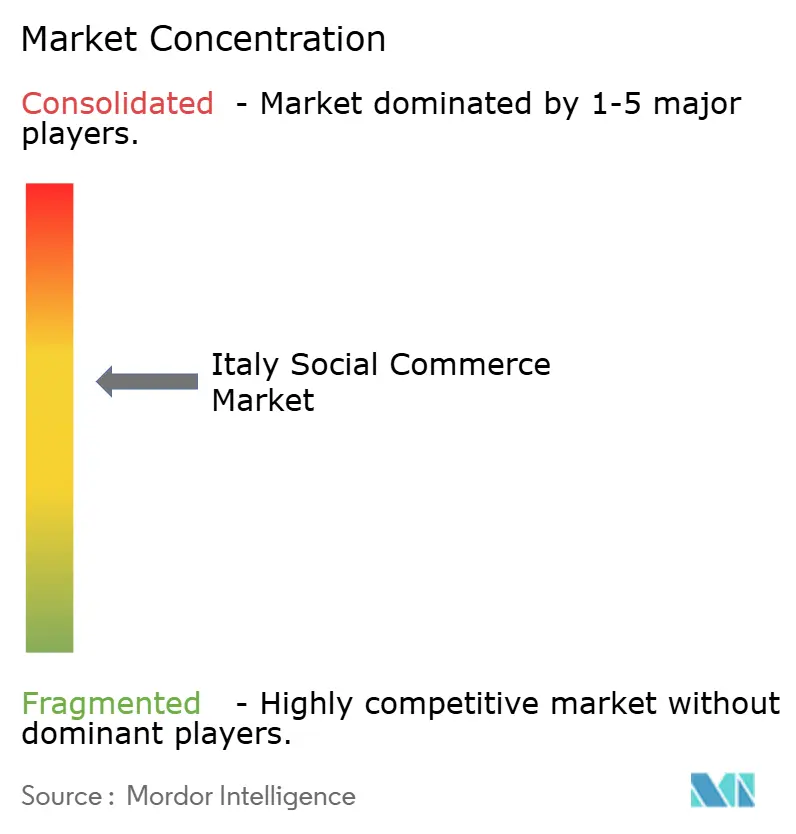
| Market Concentration | Medium |
Major Players *Disclaimer: Major Players sorted in no particular order Image © Mordor Intelligence. Reuse requires attribution under CC BY 4.0. | |
Italy Social Commerce Market Analysis by Mordor Intelligence
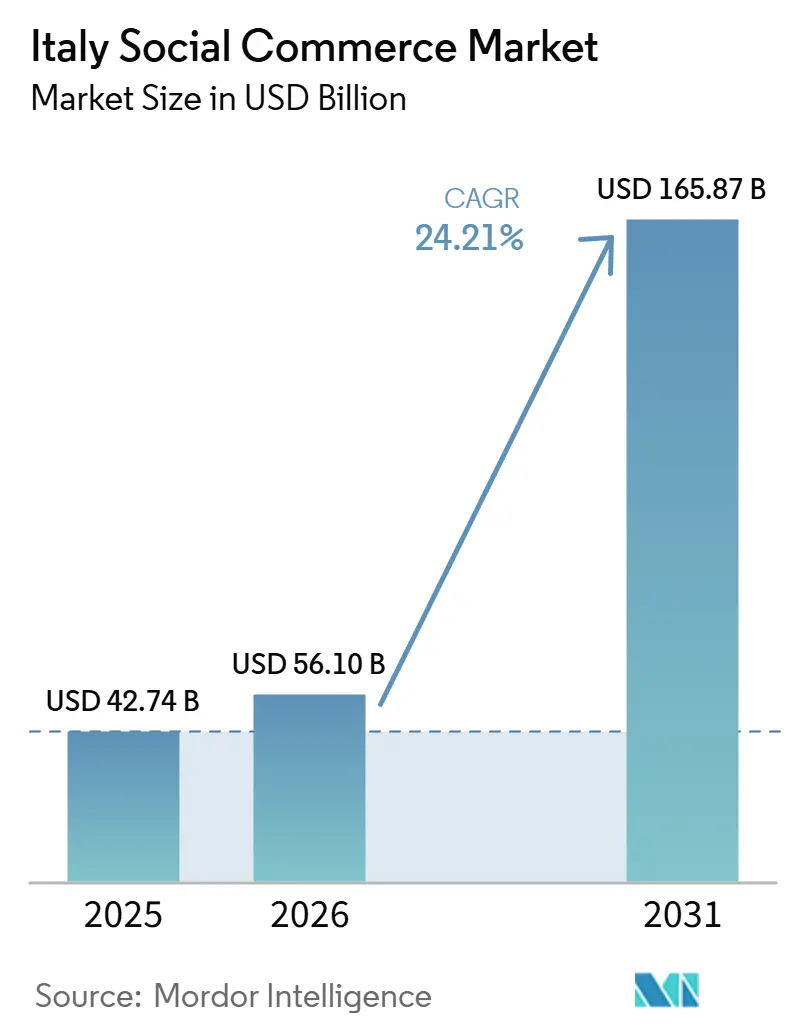
The Italy Social Commerce Market size was valued at USD 42.74 billion in 2025 and estimated to grow from USD 56.10 billion in 2026 to reach USD 165.87 billion by 2031, at a CAGR of 24.21% during the forecast period (2026-2031). Italy’s wider e-commerce turnover reached EUR 90.6 billion (USD 97.8 billion) in 2025, up 6%, creating a large retail base for transactions that begin on social platforms. The Italy Social Commerce Market benefits from extensive internet access, with 53.1 million internet users and 89.9% penetration reported for 2025. Faster mobile checkout, embedded wallets, and short-form product content are reducing the time between product discovery and payment. TikTok Shop’s arrival in March 2025 and Meta’s 2026 affiliate product-tag plans have made in-app conversion a more central part of platform strategy. The Italy Social Commerce Market remains fragmented among global platforms, marketplaces, and local sellers, which leaves room for brands that can combine trusted content, reliable fulfillment, and clear product information.
Key Report Takeaways
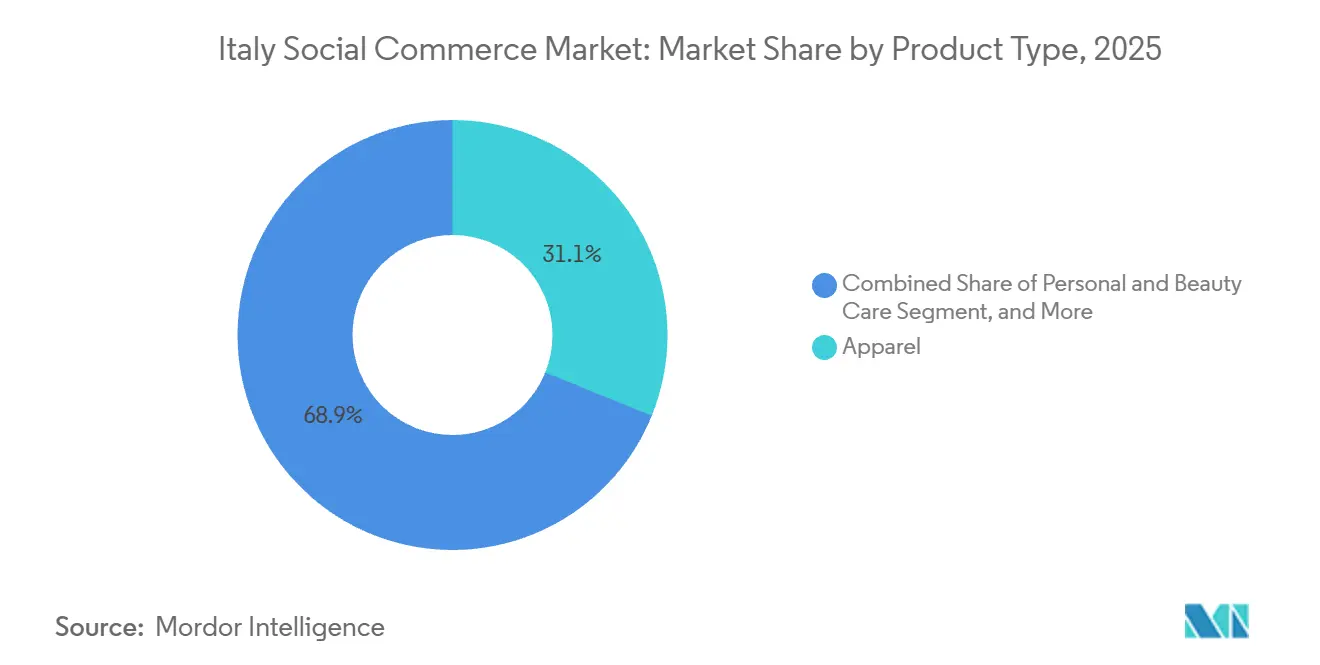
- By product type, apparel accounted for 31.12% of social commerce revenue in the Italy Social Commerce Market 2025, while personal and beauty care is projected to expand at a 24.91% CAGR through 2031.
- By device, smartphones accounted for 82.52% of transactions in 2025 and are projected to expand at a 25.02% CAGR through 2031.
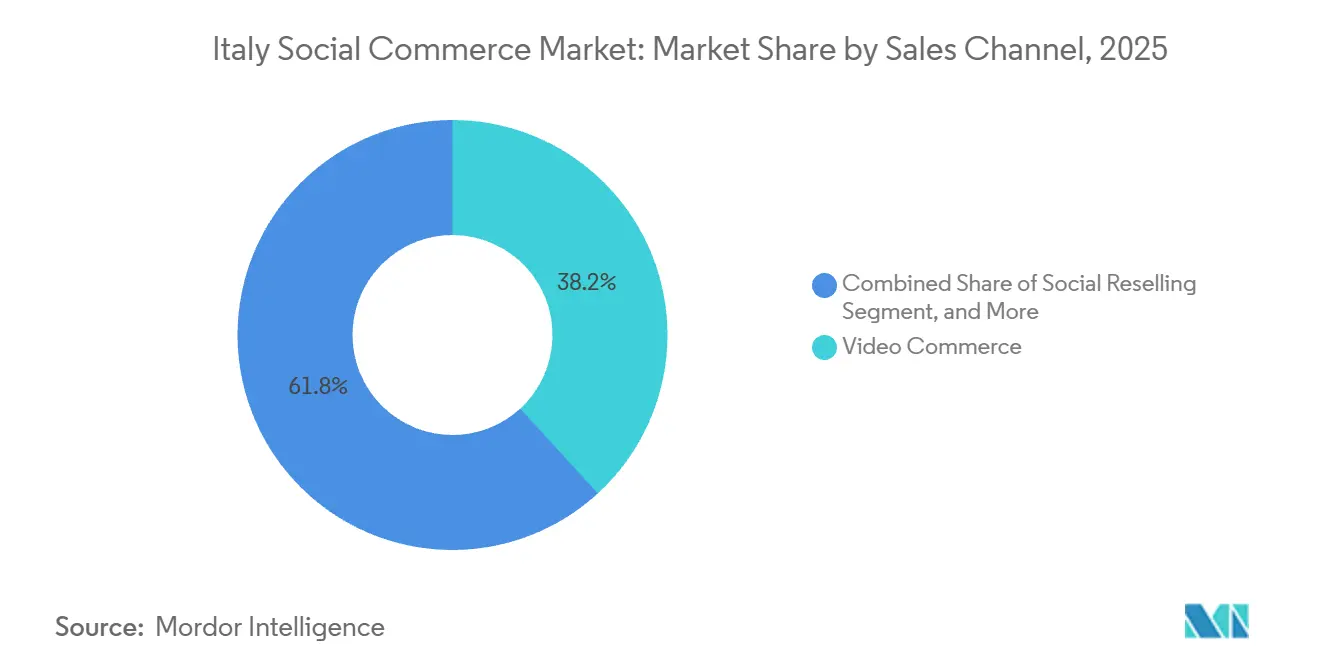
- By sales channel, video commerce accounted for 38.18% of social commerce revenue in the Italy Social Commerce Market 2025, while social reselling is projected to expand at a 26.12% CAGR through 2031.
Note: Market size and forecast figures in this report are generated using Mordor Intelligence’s proprietary estimation framework, updated with the latest available data and insights as of January 2026.
Italy Social Commerce Market Trends and Insights
Drivers Impact Analysis*
| Driver | (~) % Impact on CAGR Forecast | Geographic Relevance | Impact Timeline |
|---|---|---|---|
| One-Click Checkout and Embedded Wallet Adoption | +4.8% | National, with early gains concentrated in Milan, Turin, and Northern Italy’s digital-payment corridor | Short term (≤ 2 years) |
| Live Shopping and Shoppable Video Expansion | +4.3% | National, with strongest adoption in Rome, Milan, and Naples | Medium term (2-4 years) |
| Creator-Led Product Discovery and Affiliate Selling | +3.8% | National, with creator hubs in Milan, Rome, and Naples | Short term (≤ 2 years) |
| Social-First Direct-to-Consumer Brand Proliferation | +3.2% | National, with fashion and luxury clusters in Milan and Florence | Medium term (2-4 years) |
| Italian Micro-Brand Export Reach Through Social Platforms | +2.6% | National, with concentration in craft and artisan export districts in Marche, Carpi, and Tuscany | Long term (≥ 4 years) |
| Trust Transfer From Local Creators to Long-Tail Artisan Merchants | +2.0% | National, including Central and Southern Italy regional specialties | Long term (≥ 4 years) |
| Source: Mordor Intelligence | |||
One-Click Checkout and Embedded Wallet Adoption
Italy’s innovative payments volume reached EUR 84.9 billion (USD 91.7 billion) in 2025, increasing 45% from 2024. Digital wallets accounted for 30% of online purchases in 2025, making stored payment methods more common in mobile retail journeys. The number of Italians using a smartphone or wearable for payment rose from 10 million in 2024 to 14 million in 2025. This change reduces the number of checkout steps for purchases initiated through creator posts, product videos, and live sessions. Familiarity with instant payments also provides a practical alternative when card entry interrupts a mobile purchase. The Italy Social Commerce Market therefore, has a stronger payments base for converting impulse-led product discovery into completed orders.[1]
Live Shopping and Shoppable Video Expansion
Interactive video has moved social commerce beyond referral links and static product pages. TikTok Shop reported that shoppable video generated 38% of its Italian commerce revenue in 2025, while LIVE shopping added 20%. These formats account for 58% of platform commerce revenue and show why video is central to the Italy Social Commerce Market. Consumers older than 40 generated 41% of TikTok Shop Italy’s revenue value in 2025, indicating that demand is not limited to younger users. QVC Italy has extended its live retail approach to TikTok Shop, linking established broadcast-selling practices to mobile video. Meta’s affiliate product-tag plans for Instagram Reels also point to a more direct connection between content and in-app purchasing.[2]
Creator-Led Product Discovery and Affiliate Selling
Italy introduced ATECO code 73.11.03 for influencer activity in January 2025, giving creator work a clearer professional classification. The country had 40,000 professional creators under this code, while fashion and beauty accounted for 26% of influencer marketing activity in 2025. Many creators operate in narrow product categories such as regional fashion, personal care, and artisan food. This can make product recommendations more relevant to a defined audience than broad paid-media campaigns. TikTok Shop’s affiliate program has provided a direct route from creator content to product purchase. Meta’s planned affiliate product tags for Instagram Reels could increase competitive pressure on the Italy Social Commerce Market by giving creators another native sales option.[3]
Social-First Direct-to-Consumer Brand Proliferation
Italian fashion and lifestyle brands are increasingly using social channels for measurable sales outcomes rather than only brand communication. Zegna’s direct-to-consumer revenue increased 4.2% to EUR 1.45 billion (USD 1.57 billion) in 2025, and direct-to-consumer organic growth reached 9.6% in the fourth quarter. These results support the value of direct customer relationships for premium brands. Artisan clusters in Marche, Carpi, and Tuscany can also reach buyers through creator endorsements and social storefronts. This allows smaller brands to reduce dependence on traditional buyer and export-agent channels. The Italy Social Commerce Market can benefit when these businesses pair social reach with clear fulfillment and returns processes.[4]
Restraints Impact Analysis*
| Restraint | (~) % Impact on CAGR Forecast | Geographic Relevance | Impact Timeline |
|---|---|---|---|
| Privacy, Consent, and Platform Data Constraints | -3.6% | National, with elevated exposure in beauty, fashion, and health supplements | Medium term (2-4 years) |
| Rising Customer-Acquisition Costs on Mature Platforms | -2.9% | National, and most acute in Milan and Rome | Short term (≤ 2 years) |
| Fragmented Fulfillment and Returns for Micro-Merchants | -2.2% | National, with higher per-unit logistics costs in Southern Italy | Medium term (2-4 years) |
| Creator Disclosure and Product-Authenticity Risk | -1.7% | National, particularly in luxury accessories and supplements | Long term (≥ 4 years) |
| Source: Mordor Intelligence | |||
Privacy, Consent, and Platform Data Constraints
Privacy rules create a heavier compliance burden for smaller sellers in the Italy Social Commerce Market. Italy’s Garante ruled on June 4, 2025, that double opt-in is the minimum standard for marketing consent in the cited case. This requirement limits the speed at which merchants can build permission-based retargeting audiences. The Digital Services Act also requires platforms to verify trader information and display it publicly. Platforms must balance these controls with a simple onboarding experience for micro-sellers. Better-resourced operators are better able to invest in compliant customer data processes, which can widen the operational gap with small merchants.
Rising Customer-Acquisition Costs on Mature Platforms
The Italy Social Commerce Market faces greater pressure on merchant economics as more sellers compete for paid visibility. Advertising demand is especially high in Milan and Rome, where audiences command a premium over southern regions. This can make a national campaign less efficient for small sellers with limited budgets. TikTok Shop’s seller base exceeded 21,000 active vendors within 12 months of its Italian launch, increasing competition for attention. Merchants that relied on early organic traffic must now combine content production with paid promotion and platform fees. These conditions favor larger brands that can test creative, maintain inventory, and absorb higher acquisition costs.
*Our forecasts treat driver/restraint impacts as directional, not additive. The impact forecasts reflect baseline growth, mix effects, and variable interactions.
Segment Analysis
By Product Type: Apparel Anchors Scale, While Beauty Supports Discovery Commerce
Apparel held 31.12% of the Italy Social Commerce Market share in 2025. Clothing and footwear accounted for 23.6% of Italian e-commerce logistics shipments that year, making them the leading product category by volume. Fashion and beauty purchases reached 33.6 million Italian online buyers in 2025. Netcomm reported that 70% of these buyers combined online and offline touchpoints during the purchase journey. This pattern supports product discovery through social content, followed by purchase through a preferred channel.
Personal and beauty care is projected to grow at a 24.91% CAGR from 2026 to 2031. TikTok Shop reached third place among Italian beauty e-commerce operators by the first quarter of 2026, less than 14 months after its local launch. Beauty accounted for 14% of Italian TikTok Shop purchases and 41% of TikTok Shop FMCG value across Europe. Beauty e-commerce in Italy grew 9.8% in 2025 to EUR 1.4 billion (USD 1.5 billion). Product demonstrations, creator recommendations, and repeat purchasing give the category a clear fit with social selling.

By Device: Smartphones Lead Transactions and Continued Growth
Smartphones accounted for 82.52% of Italy Social Commerce Market transactions in 2025. In 2025, 35.4 million Italians browsed through mobile devices on an average day, an increase of 1.3% from the prior year. Desktop browsing fell 9.5% to 9.8 million daily users. This change reinforces the vertical mobile screen's central role in content-led product discovery. The Italy Social Commerce Market size for smartphone transactions is supported by checkout features that reduce the need to re-enter payment information.
Smartphones are projected to grow at a 25.02% CAGR from 2026 to 2031. Laptops and desktops retain a role for research-intensive or high-consideration purchases. That behavior complements, rather than replaces, mobile commerce conversion. Digital wallets and biometric authentication reduce friction when shoppers return to a product after research. The sustained lead in smartphone usage indicates that merchants need content, checkout, customer support, and returns information that works clearly on a small screen.
By Sales Channel: Video Commerce Leads Value, While Reselling Grows Faster
Video commerce held 38.18% of the Italy Social Commerce Market share in 2025. TikTok Shop’s shoppable video format accounted for 38% of its Italian commerce revenue, while LIVE shopping accounted for 20%. Instagram and Facebook storefronts remain a major social-network-led route to product discovery and conversion. Product review and discovery platforms often influence purchase decisions rather than directly closing the sale. Video commerce provides merchants with a way to demonstrate product use, answer questions, and connect products to checkout in a single customer journey.
Social reselling is projected to grow at a 26.12% CAGR from 2026 to 2031. Vinted reported EUR 10.8 billion (USD 11.7 billion) in global gross merchandise value in 2025, an increase of 47% from EUR 7.3 billion (USD 7.9 billion) in 2024. It also reported EUR 1.1 billion (USD 1.2 billion) in revenue, increasing 38% from EUR 813 million (USD 878 million) in 2024. In Italy, 28.2 million people bought or sold at least 1 second-hand item in 2025, an increase of 3.7%. The Italy Social Commerce industry also benefits when resale platforms make payment, shipping, and buyer protection simple for participants.
Geography Analysis
The Italy Social Commerce Market size is supported by 41.2 million active social media users and 44.1 million monthly unique internet users in a population of nearly 59 million. Italy’s total e-commerce turnover reached EUR 90.6 billion (USD 97.8 billion) in 2025, up 6%. Social commerce is projected to expand at a 24.21% CAGR, outpacing the broader e-commerce growth rate. TikTok Shop launched in Italy on March 31, 2025, alongside France and Germany, and later reported triple-digit daily gross merchandise value growth across its European launch markets.
Northern Italy, especially Milan, Turin, and the Po Valley, combines a dense base of fashion, beauty, and lifestyle brands with mature use of digital payments. Milan and Rome audiences commanded a 15-25% premium for Meta advertising inventory in 2026, indicating concentrated competition for high-intent buyers. Southern Italy and island regions have higher per-unit delivery costs and more complex last-mile conditions. These costs can reduce margins for micro-merchants selling low-value products. At the same time, regional food, ceramics, and craft fashion can benefit from trust-led creator discovery because their origins and product stories are part of the customer proposition.
Italy’s e-commerce shipment volume increased 8.7% to 883 million packages in 2025, with apparel, sport, and accessories accounting for 23.6% of shipments. This expansion improves the logistics base for the Italy Social Commerce Market, though fulfillment capacity has not fully removed regional cost differences. TikTok Shop expanded to Austria, Belgium, the Netherlands, and Poland in June 2026, adding to its existing European markets. Its cross-border selling tools allow Italian merchants to use a single storefront to reach buyers in additional countries. This creates a more practical export route for artisan sellers that meets platform, shipping, and customer service requirements.
Competitive Landscape
The Italy Social Commerce Market includes global platform operators, multi-category marketplaces, fashion platforms, and local specialists. Meta Platforms, ByteDance, and Pinterest provide important discovery and transaction infrastructure. Zalando, Vinted, eBay, Depop, Vestiaire Collective, Etsy, and Yoox Net-A-Porter compete for conversion within or alongside these platform environments. More than 21,000 active TikTok Shop sellers were operating in Italy within 12 months of the platform launch, illustrating a fragmented merchant base.
Competition centers on reducing friction across product discovery, payment, delivery, and returns. TikTok Shop expanded its European footprint in June 2026 and activated cross-border selling tools for merchants, including Italian sellers. Meta announced affiliate product tags for Instagram Reels in April 2026, allowing eligible creators to add up to 30 shoppable product links to a Reel without a platform commission. Vinted completed an EUR 880 million (USD 994 million) secondary share transaction at an EUR 8 billion (USD 9.0 billion) equity valuation in April 2026, supporting further investment in its recommendation, logistics, and payment capabilities. Zalando acquired ABOUT YOU in 2025 and planned EUR 240-300 million in technology investment in 2026, while its size-recommendation tools had reduced size-related returns by more than 8%.
The Italy Social Commerce Market has no reported participant with a decisive share across all channel formats. Platforms control traffic and product discovery, while marketplaces, brands, creators, and local merchants compete for completed purchases. Certified authenticity remains important for luxury and artisan products, where buyers need confidence in provenance and product claims. Sellers that combine transparent product information with reliable payment and returns processes are better placed to establish trust. These requirements may favor established operators, but they also leave space for specialized services that support smaller Italian merchants.
Italy Social Commerce Industry Leaders
-
Meta Platforms, Inc.
-
ByteDance Ltd.
-
Amazon.com, Inc.
-
Vinted, UAB
-
Pinterest, Inc.
- *Disclaimer: Major Players sorted in no particular order
Recent Industry Developments
- June 2026: TikTok Shop expanded its European footprint to Austria, Belgium, the Netherlands, and Poland, joining Italy, France, Germany, Spain, Ireland, and the UK. ByteDance cited triple-digit daily GMV growth across EU launch markets between August 2025 and February 2026 as evidence of structural demand, and activated cross-border selling tools allowing Italy-based merchants to reach buyers in new markets through shared logistics providers, directly expanding the addressable export opportunity for Italian social commerce sellers.
- May 2026: Meta announced native affiliate product tag functionality for Instagram Reels at Shoptalk 2026, enabling creators with 1,000 or more followers to embed up to 30 shoppable product links per Reel without paying platform commissions. The rollout was planned across 22 countries through spring 2026, representing a structural shift in how Italy’s 29.9 million Instagram users engage with creator-driven commerce.
- May 2026: NielsenIQ data confirmed that TikTok Shop reached third place in Italian beauty e-commerce by Q1 2026, surpassing established online beauty retailers in market share ranking, less than 14 months after its March 2025 Italian launch, and beauty accounts for 14% of total TikTok Shop purchases in Italy, reflecting the category’s outsized resonance with the platform’s short-form video format.
- January 2026: Vinted launched its US market entry targeting New York, the first expansion outside of Europe, while simultaneously strengthening its 26-country European network. The US entry leverages the recommendation algorithm and logistics infrastructure built across core European markets including Italy.
Italy Social Commerce Market Report Scope
The Italy social commerce market refers to the ecosystem of buying and selling goods and services directly through social media platforms, influencer networks, and community-driven channels within Italy. This market encompasses transactions facilitated via video commerce, social network-led storefronts, social reselling, group buying, and product discovery platforms across devices such as smartphones and desktops. By integrating e-commerce capabilities directly into Italian consumers' social media experiences, this market enables brands and retailers to shorten the customer journey from product discovery to purchase, leveraging interactive content, live streaming, and peer recommendations to drive sales of apparel, personal care, and other consumer goods.
The Italy Social Commerce Market Report is Segmented by Product Type (Apparel, Personal and Beauty Care, Accessories, Home Products, Health Supplements, Food and Beverages, and Other Product Types), Device (Laptops and Desktops, and Smartphone), and Sales Channel (Video Commerce, Social Network-Led Commerce, Social Reselling, Group Buying / Team Purchase, and Product Review and Discovery Platforms). The Market Forecasts are Provided in Terms of Value (USD).
| Apparel |
| Personal and Beauty Care |
| Accessories |
| Home Products |
| Health Supplements |
| Food and Beverages |
| Other Product Types |
| Laptops and Desktops |
| Smartphone |
| Video Commerce |
| Social Network-Led Commerce |
| Social Reselling |
| Group Buying / Team Purchase |
| Product Review and Discovery Platforms |
| By Product Type | Apparel |
| Personal and Beauty Care | |
| Accessories | |
| Home Products | |
| Health Supplements | |
| Food and Beverages | |
| Other Product Types | |
| By Device | Laptops and Desktops |
| Smartphone | |
| By Sales Channel | Video Commerce |
| Social Network-Led Commerce | |
| Social Reselling | |
| Group Buying / Team Purchase | |
| Product Review and Discovery Platforms |
Key Questions Answered in the Report
What is the size of the Italy Social Commerce Market?
The Italy Social Commerce Market was valued at USD 42.74 billion in 2025 and is estimated at USD 56.10 billion in 2026. It is forecast to reach USD 165.87 billion by 2031 at a 24.21% CAGR, supported by stronger use of mobile transactions and social-led product discovery.
Which product category leads social commerce in Italy?
Apparel led with 31.12% share in 2025. Its position reflects Italy's strong fashion demand, the large volume of fashion shipments, and the role of social content in product discovery.
Which sales channel is growing fastest in Italy?
Social reselling is projected to grow at a 26.12% CAGR from 2026 to 2031. The channel is supported by consumer participation in second-hand buying and selling, alongside platform tools for payment, shipping, and buyer protection.
Why are smartphones important for social selling in Italy?
Smartphones accounted for 82.52% of transactions in 2025 and are projected to grow at a 25.02% CAGR. Mobile devices support video discovery, wallet payments, biometric authentication, and in-app checkout.
What is supporting beauty sales through social platforms?
Personal and beauty care is projected to grow at a 24.91% CAGR through 2031. Product demonstrations, creator recommendations, repeat purchasing, and high consumer interest in cosmetics and haircare support demand.
What are the main challenges for sellers using social platforms?
Sellers face privacy and consent obligations, higher customer-acquisition costs, uneven fulfillment costs, and risks around creator disclosure and product authenticity. Smaller merchants can find these requirements harder to manage than established brands.