
Italy Seed Processing Machinery Market Size and Share
Market Overview
| Study Period | 2021 - 2031 |
|---|---|
| Forecast Data Period | 2026 - 2031 |
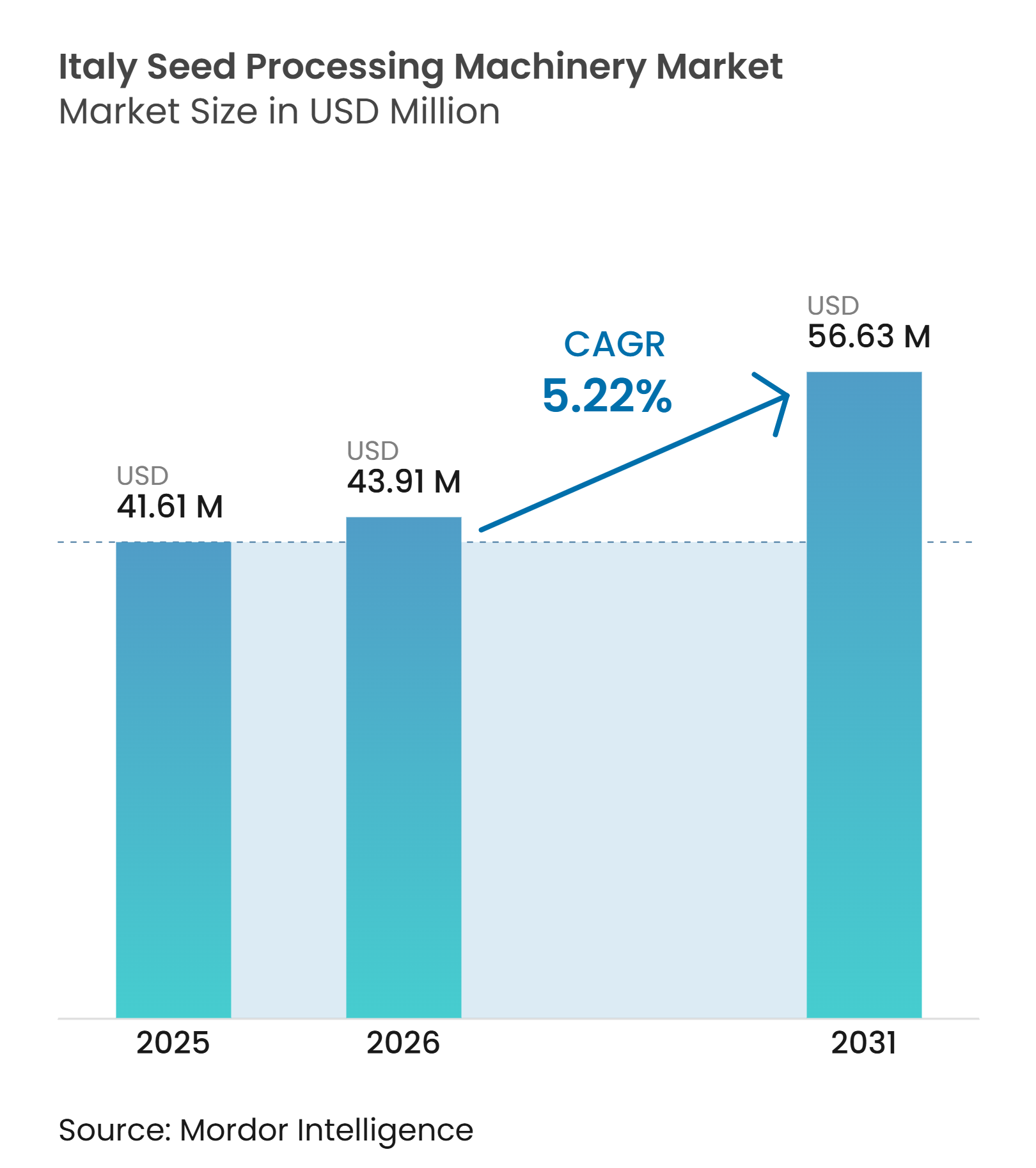
| Base Year Market Size (2025) | USD 41.61 Million |
| Market Size (2026) | USD 43.91 Million |
| Market Size (2031) | USD 56.63 Million |
| Growth Rate (2026 - 2031) | 5.22 % |
| Market Concentration | Medium |
Major Players *Disclaimer: Major Players sorted in no particular order Image © Mordor Intelligence. Reuse requires attribution under CC BY 4.0. | |
Italy Seed Processing Machinery Market Analysis by Mordor Intelligence
The Italy seed processing machinery market size was valued at USD 41.6 million in 2025 and is estimated to grow from USD 43.9 million in 2026 to reach USD 56.6 million by 2031, at a CAGR of 5.2% during the forecast period 2026-2031. The Italy seed processing machinery market serves a seed sector with annual turnover of EUR 1 billion (USD 1.1 billion) and more than 200,000 hectares of certified seed multiplication[1]. Italy ranked second in the European Union for approved field-crop seed production area in 2025, supporting demand across cereal, rice, forage, vegetable, and specialty seed lines. Equipment demand is shaped by the need to clean, grade, sort, treat, dry, and package multiple crop types within short seasonal windows. The Italian seed processing machinery market is also moving toward selective line upgrades, since smaller processors often need to add capacity without replacing an entire plant. Public support for connected machinery and the move toward lower-chemical treatment methods give suppliers a reason to offer modular, digitally enabled systems.
Key Report Takeaways
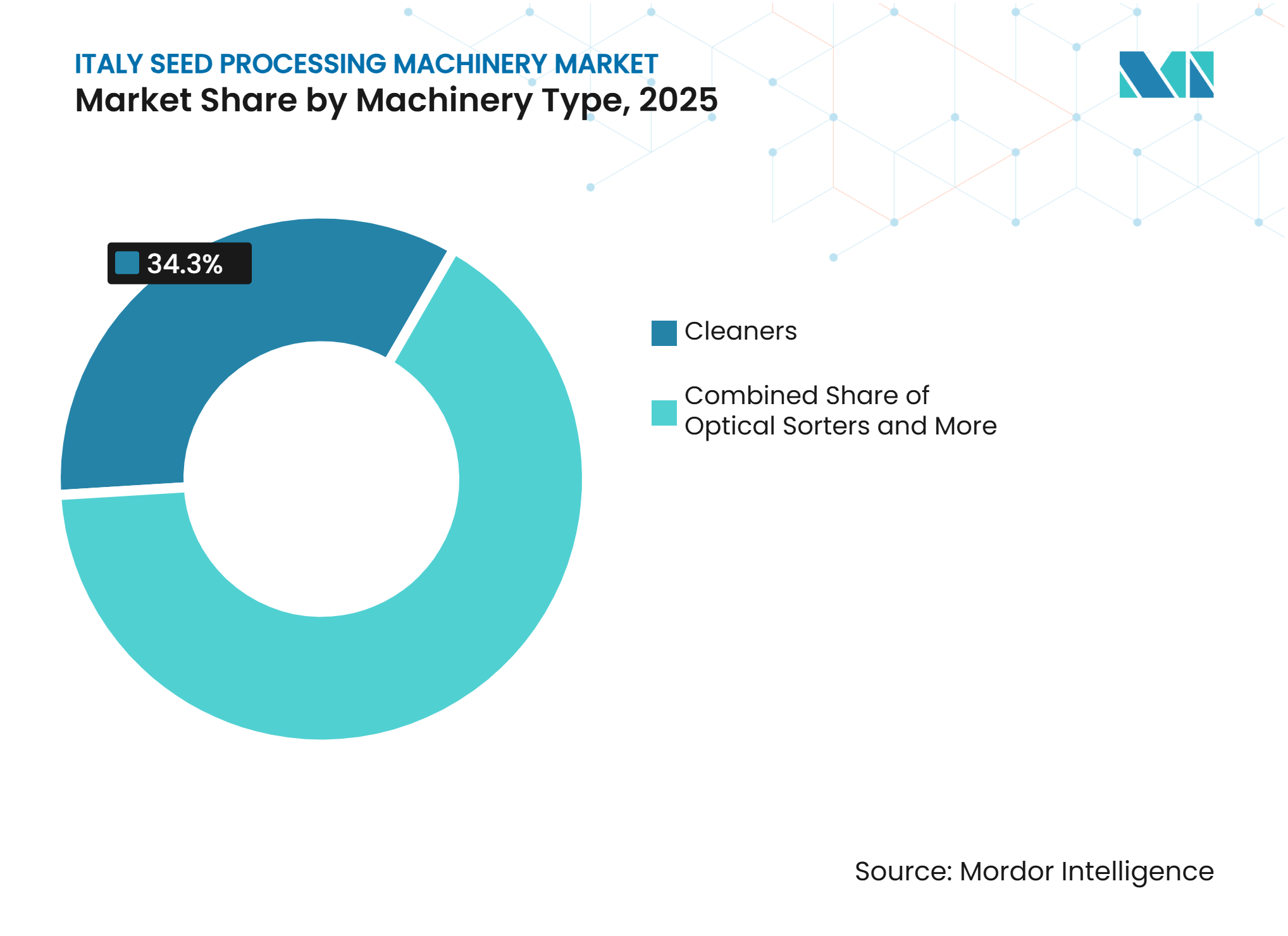
- By machinery type, cleaners held 34.3% of Italy seed processing machinery market share in 2025, while optical sorters are forecast to grow at the fastest CAGR of 7.0% from 2026 to 2031.
- By operation mode, automatic machinery held 69.4% of Italy seed processing machinery market size in 2025, while semi-automatic machinery is forecast to grow at the fastest CAGR of 6.5% from 2026 to 2031.
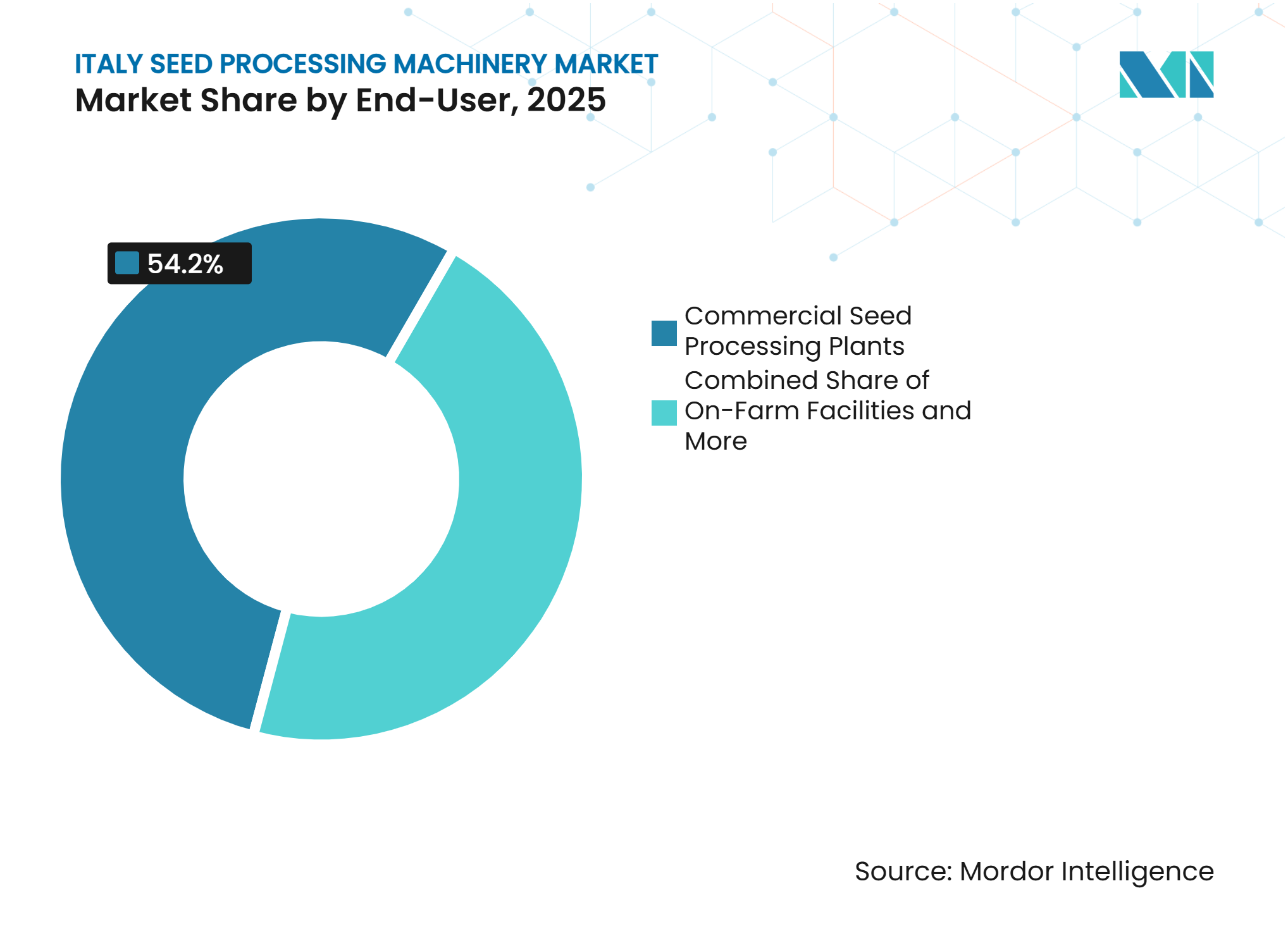
- By end-user, commercial seed processing plants held 54.2% of the market size in 2025, while on-farm facilities are forecast to grow at the fastest CAGR of 5.6% from 2026 to 2031.
Note: Market size and forecast figures in this report are generated using Mordor Intelligence’s proprietary estimation framework, updated with the latest available data and insights as of January 2026.
Market Trends and Insights
Drivers Impact Analysis of Italy Seed Processing Machinery Market*
| Driver | (~) % Impact on CAGR Forecast | Geographic Relevance | Impact Timeline |
|---|---|---|---|
| Demand for Certified, High-Purity Seed and Traceability | +1.3% | National, with strong relevance in major seed multiplication areas | Medium term (2-4 years) |
| Replacement and Modernization of Aging Seed-Processing Infrastructure | +1.0% | National, especially established grain-processing corridors | Medium term (2-4 years) |
| Expansion of Italy's Rice, Cereal, Pulse, Forage, and Specialty-Seed Processing | +0.8% | National, with crop-specific regional demand | Long term (≥ 4 years) |
| Adoption of Optical Sorting, Automation, and Digital Process Control | +1.0% | National, led by large northern commercial plants | Medium term (2-4 years) |
| CAP and Public Funding for Agricultural and Processing Modernization | +0.7% | National, subject to regional program implementation | Short term (≤ 2 years) |
| Need to Reduce Seed Losses, Labor Dependence, Energy Use, and Operating Costs | +0.8% | National, with high relevance for high-throughput facilities | Medium term (2-4 years) |
| Source: Mordor Intelligence | |||
Demand for Certified, High-Purity Seed and Traceability
Italy produced 541,000 tonnes of certified seed annually, requiring continuous cleaning, grading, optical sorting, and packaging activity. Durum wheat certification reached 185,050 tonnes in 2024/25, while rice certification reached 47,176 tonnes. Certified lots must meet physical purity standards before labels are issued, linking equipment accuracy to commercial release[2]. Reprocessing a rejected lot can disrupt a plant's schedule and add handling costs during the campaign. The Italian seed processing machinery market, therefore, benefits from demand for equipment that improves first-pass separation quality. Italy also accounted for 79% of the European Union's rice seed multiplication area in 2025, supporting the use of sorting configurations suited to rice defects and foreign material.
Expansion of Italy's Rice, Cereal, Pulse, Forage, and Specialty-Seed Processing
Certified seed multiplication covered nearly 225,000 hectares in 2024, compared with 206,200 hectares in 2023. CREA Italy processes rice, wheat, barley, forage, soybean, sugar beet, and vegetable seed, each with different separation and handling needs. Vegetable and aromatic seed multiplication occupied 42,500 hectares in 2024, with Emilia-Romagna, Puglia, Marche, and Molise among the leading areas. Small seeds require gentler handling, finer screens, and closer control of color and size variations. Italy held 51% of the European Union-certified alfalfa multiplication area, supporting demand for gravity tables, cylindrical separators, and treatment equipment. The Italian seed processing machinery market benefits from this crop mix because a single standard cereal line cannot address every seed category.
Adoption of Optical Sorting, Automation, and Digital Process Control
Optical sorters are forecast to grow at the fastest CAGR of 7.0% from 2026 to 2031. These systems can identify defects and impurities that are not reliably removed by air-screen cleaning alone. Their adoption also requires changes to the infeed, conveying, and vibration equipment to ensure seeds are consistently presented to the sensor. Bühler AG launched the SORTEX AI700 in 2025 with deep learning-based defect classification for optical sorting. Elica ASM S.r.l. supplies optical sorting equipment for seed applications, including systems developed in Italy. The Italy seed processing machinery market is likely to see suppliers compete on integration, access to service, and the ability to raise purity without increasing false rejects.
CAP and Public Funding for Agricultural and Processing Modernization
The Ministry of Agriculture, Food Sovereignty and Forestry allocated EUR 400 million (USD 432 million) through the National Recovery and Resilience Plan Investment 2.3 to modernize agricultural machinery. The program covers machinery that supports precision agriculture and connected operating practices. Eligible processing systems include equipment with digital connectivity, automatic adjustment, and data-recording functions. The funding framework can reduce the initial cost for an eligible buyer, although regional timetables determine when orders can be placed. In August 2024, EUR 25.0 million (USD 27.1 million) was reallocated to Basilicata, the Autonomous Province of Bolzano, and the Autonomous Province of Trento.
Restraints Impact Analysis of Italy Seed Processing Machinery Market*
| Restraint | (~) % Impact on CAGR Forecast | Geographic Relevance | Impact Timeline |
|---|---|---|---|
| High Upfront Capital Costs and Long Investment Payback Periods | -1.00% | National, particularly smaller and cooperative operators | Medium term (2-4 years) |
| Fragmented Customer Base and Limited Investment Capacity of Small and Medium-Sized Operators | -0.80% | National, with dispersed on-farm and cooperative facilities | Long term (≥ 4 years) |
| Compliance Costs Related to ATEX, CE Marking, Dust Control, and Sanitary Design | -0.60% | National, with greater exposure at older facilities | Medium term (2-4 years) |
| Shortage of Skilled Commissioning, Calibration, Integration, and Maintenance Personnel | -0.40% | National, especially remote facilities using advanced systems | Long term (≥ 4 years) |
| Source: Mordor Intelligence | |||
Fragmented Customer Base and Limited Investment Capacity of Small and Medium-Sized Operators
More than 210 companies are affiliated with Assosementi, alongside unaffiliated processors, on-farm facilities, and cooperatives. This buyer base produces a wide range of project sizes and can lengthen supplier sales cycles. Smaller operators may favor refurbished equipment, individual machine replacements, or additions made over several seasons. Such demand limits the number of full-line contracts even when seed processing activity remains stable. PETKUS Technologie GmbH displayed a modular seed plant concept in 2024 that uses prefabricated elements and is designed for fast assembly. The Italy seed processing machinery market benefits when suppliers offer scalable layouts, but fragmented investment capacity continues to limit larger orders.
Compliance Costs Related to ATEX, CE Marking, Dust Control, and Sanitary Design
Commercial cleaning, drying, conveying, and storage operations that handle combustible seed dust must comply with European Union machinery and ATEX requirements. Compliance can require protected electrical equipment, certified motors and panels, dust collection, and explosion-relief measures. These costs are especially material in brownfield facilities, where one new machine can trigger a review of the connected assembly. Italian workplace safety legislation also governs dust-control requirements in relevant operating environments[3]. Sanitary design requirements place greater emphasis on surfaces, drainage, and cleaning access for seed intended for food-related crop production. The Italy seed processing machinery industry must account for these costs in project planning because list prices alone do not reflect the full installation expense.
*Our forecasts treat driver/restraint impacts as directional, not additive. The impact forecasts reflect baseline growth, mix effects, and variable interactions.
Italy Seed Processing Machinery Market Segment Analysis
By Machinery Type:
Cleaners Provide the Broadest Installed BaseCleaners held 34.3% of the Italy seed processing machinery market size in 2025, making them the largest machinery type. They provide the first separation stage across commercial cereal, rice, forage, and vegetable seed lines. Air-screen cleaners and aspirators remove larger contaminants and lighter material before more precise sorting stages. Their installed base supports steady demand for replacement units and upgrades that improve dust management, throughput, or cleaning accuracy. Dryers also remain necessary in rice-producing and humid harvest areas because moisture must be controlled before treatment and packaging.
Optical sorters are forecast to grow at the fastest CAGR of 7.0% from 2026 to 2031. They are gaining importance where physical purity, color consistency, and defect removal cannot be achieved through conventional cleaning alone. Coaters and treaters must adapt to water-based biological products and thermal treatment processes that can change moisture and cycle requirements. Graders, separators, destoners, polishers, and seed packagers remain essential supporting categories because each contributes to lot preparation and commercial release. The Italy seed processing machinery industry is therefore moving toward lines where each machine is selected for a defined crop and quality task rather than used as a generic capacity addition.



By Operation Mode:
Automatic Systems Lead While Semi-Automatic Formats ExpandAutomatic machinery held 69.4% of the Italy seed processing machinery market in 2025 and was the largest operation-mode segment. Large multi-crop facilities need automated systems to maintain throughput during short processing windows. Connected equipment can also provide batch records and repeatable settings for traceability processes. Existing automatic lines now face refresh decisions driven by connectivity and data use, not only by mechanical wear. These conditions preserve demand for automatic equipment in high-volume commercial plants.
Semi-automatic machinery is forecast to grow at the fastest CAGR of 6.5% from 2026 to 2031. It offers an intermediate route for buyers who want to reduce manual work without financing an entire automated line. A semi-automatic cleaner or sorter can often be added to a plant with fewer changes to building layouts and material handling. This format is relevant to cooperatives, research users, and on-farm facilities with more limited annual volumes. The Italy seed processing machinery market also benefits from modular designs because they let customers align investment with seasonal cash flow and measured operating needs.
By End-User:
Commercial Plants Lead and On-Farm Sites Add Incremental DemandCommercial seed processing plants accounted for 54.2% of the Italy seed processing machinery market size in 2025, making them the largest end-user segment. These plants handle multiple species and require complete lines or major upgrades rather than only individual machines. They also face high requirements for separation accuracy, lot documentation, dust management, and packing consistency. Their scale supports demand for automatic cleaning, optical sorting, drying, treatment, and packaging systems. Certified seed multiplication across nearly 225,000 hectares in 2024 provides the underlying processing workload for this end-user group.
On-farm facilities are forecast to grow at the fastest CAGR of 5.6% from 2026 to 2031. Cereal and rice producers can use basic cleaning equipment to improve the seed lot condition for replanting or cooperative sale. Seed producers occupy a middle position because they may process material internally or contract with larger commercial plants. Research institutions need small-batch systems that prioritize precision and avoidance of cross-contamination over high throughput. Grain handling facilities can purchase basic cleaning equipment, but often remain more sensitive to grain storage conditions and equipment cost than to seed-specific quality requirements.

Geography Analysis
The Italy seed processing machinery market is country-specific, and demand follows the location of certified seed multiplication and commercial processing capacity. Northern Italy contains the largest concentration of equipment demand because Lombardy, Piedmont, Veneto, and Emilia-Romagna support rice, cereal, maize, forage, and vegetable seed activity. Rice certification reached 47,176 tonnes in 2024/25, supporting the importance of northern processing lines with drying and sorting capability. Emilia-Romagna contained 14,112 hectares of vegetable and aromatic seed multiplication in 2024, the highest regional area identified in the survey.
Puglia had 10,474 hectares of vegetable seed multiplication in 2024 and is a major southern demand center. Its operator base includes smaller producers and cooperative structures that can favor phased purchases, modular systems, and semi-automatic configurations. Central areas also support forage seed activity and demand for cleaning, gravity separation, coating, and drying equipment. Sales demand is shaped by regional crop differences, rather than a uniform national equipment specification. Smaller regional facilities may prioritize practical service access and compatibility with existing lines over
Specialty seed activity creates demand that crosses regional boundaries because sugar beet, alfalfa, soybean, and vegetable lines need crop-specific treatment, drying, and separation configurations. Italy held 58% of European Union certified sugar beet seed production area, 51% of alfalfa area, and 28% of soybean area in the source dataset. National Recovery and Resilience Plan support can extend modernization to regions where the certified seed base is smaller. The EUR 1 billion (USD 1.1 billion) turnover of the national seed sector supports a commercial base for machinery demand across all Italian regions.
Competitive Landscape
Market Concentration

The Italy seed processing machinery market has a moderate concentration profile, with a concentration score of 5 out of 10 in the source assessment. Suppliers compete across different categories, so no single company controls every stage of a commercial processing line. Grain & Protein Technologies, Elica ASM S.r.l., ZANIN s.r.l., Tecnoimpianti srl., Akyürek Group Technology, TOMRA Systems ASA, STOLZ GERICO ITALIA, Omas S.r.l., Bühler AG, Damas Seed Processing A/S, 3U Vision Srl, Satake Corporation, PETKUS Technologie GmbH, and Westrup ApS form the approved company universe. The competitive picture includes suppliers of optical sorting, cleaning, drying, separation, treatment, and integrated processing equipment. The Italian seed processing machinery market remains open to suppliers that can combine product capabilities with technical support and installation expertise.
Elica ASM S.r.l. competes in optical sorting for seed applications through products developed and supported in Italy. ZANIN s.r.l. serves seed-cleaning requirements through its cleaning-machinery portfolio. Bühler AG introduced its SORTEX AI700 optical sorting platform in 2025, adding a recent reference point for deep learning-based sorting capabilities. PETKUS Technologie GmbH presented a prefabricated modular seed plant design in 2024 for buyers who need staged capacity additions. These moves show that product differentiation is increasingly tied to automation, modularity, and application-specific performance.
Individual supplier shares cannot be allocated because the source material provides no validated company-level sales data. Competitive advantage instead depends on the ability to configure equipment for different seed types and to comply with dust, machinery, and traceability requirements. Domestic service proximity can matter for optical sorting calibration, commissioning, and responsive repair work. Global suppliers can compete through broad product portfolios, software capability, and established equipment designs. The Italy seed processing machinery industry remains sensitive to whether suppliers can make advanced systems accessible to smaller operators through modular equipment, integration assistance, and practical training.
Italy Seed Processing Machinery Industry Leaders
-
Grain & Protein Technologies
-
ZANIN s.r.l.
-
Bühler AG
-
Elica ASM S.r.l.
-
PETKUS Technologie GmbH
- *Disclaimer: Major Players sorted in no particular order
Italy Seed Processing Machinery Market Companies Covered in this Report
- Grain & Protein Technologies
- Elica ASM S.r.l.
- ZANIN s.r.l.
- Tecnoimpianti srl.
- Akyürek Group Technology
- TOMRA Systems ASA
- STOLZ GERICO ITALIA
- Omas S.r.l.
- Bühler AG
- Damas Seed Processing A/S
- 3U Vision Srl
- Satake Corporation
- PETKUS Technologie GmbH
- Westrup ApS
Recent Industry Developments in Italy Seed Processing Machinery Market
- May 2026: ZANIN s.r.l. exhibited at Agritechnica Asia 2026, extending its international commercial outreach while maintaining its domestic product portfolio of cleaners, dryers, conveyors, and seed processing systems relevant to the Italian agri-food sector.
- May 2025: Bühler AG launched the SORTEX AI700 optical sorter in London, deploying deep learning and neural network-based defect detection on a commercial platform, initially targeting the removal of gluten contamination in oat processing.
- January 2025: PETKUS Technologie GmbH signed a formal partnership with the International Seed Federation at the World Seed Congress in Rotterdam, committing to deliver training workshops on seed processing technology, seed hygiene, and AI-assisted sorting at the next three World Seed Congress events (2025-2028) through the PETKUS Academy, addressing the professional skills gap in seed processing commissioning across the European market, including Italy.
Italy Seed Processing Machinery Market Report Scope
Italy Seed processing machinery encompasses equipment used in agriculture to clean, sort, grade, dry, treat, and package seeds, improving their quality and viability for planting. These machines play a critical role in removing impurities, ensuring uniformity, and safeguarding seeds from pests and diseases. The seed processing machinery market report is segmented by machinery type (pre-cleaners, cleaners, dryers, graders, coaters and treaters, separators and destoners, polishers, optical sorters, seed packagers, and other specialized equipment), by operation mode (automatic and semi-automatic), and by end-user (commercial seed processing plants, seed producers, research institutions, on-farm facilities, and grain handling facilities). The market forecasts are provided in terms of value (USD).
Segmentation Overview
| Pre-cleaners |
| Cleaners |
| Dryers |
| Graders |
| Coaters and Treaters |
| Separators and Destoners |
| Polishers |
| Optical Sorters |
| Seed Packagers |
| Other Specialized Equipment |
| Automatic |
| Semi-Automatic |
| Commercial Seed Processing Plants |
| Seed Producers |
| Research Institutions |
| On-Farm Facilities |
| Grain Handling Facilities |
| By Machinery Type | Pre-cleaners |
| Cleaners | |
| Dryers | |
| Graders | |
| Coaters and Treaters | |
| Separators and Destoners | |
| Polishers | |
| Optical Sorters | |
| Seed Packagers | |
| Other Specialized Equipment | |
| By Operation Mode | Automatic |
| Semi-Automatic | |
| By End-User | Commercial Seed Processing Plants |
| Seed Producers | |
| Research Institutions | |
| On-Farm Facilities | |
| Grain Handling Facilities |
Key Questions Answered in the Report
What is the 2026 value of Italy seed processing machinery sales?
The value of Italy seed processing machinery sales is estimated at USD 43.9 million in 2026.
Which machinery type has the largest share in Italy?
Cleaners are the largest machinery type, with a 34.3% share in 2025, because cleaning is the first processing step for certified seed lines.
Which users purchase the most seed processing equipment in Italy?
Commercial seed processing plants are the largest end-user group, held 54.2% of sales value in 2025.
What constrains investment in advanced equipment?
High initial cost, long payback periods, compliance requirements, fragmented buyer capacity, and limited specialist service skills can delay upgrades.