
Italy Robotic Lawn Mower Market Size and Share
Market Overview
| Study Period | 2021 - 2031 |
|---|---|
| Forecast Data Period | 2026 - 2031 |
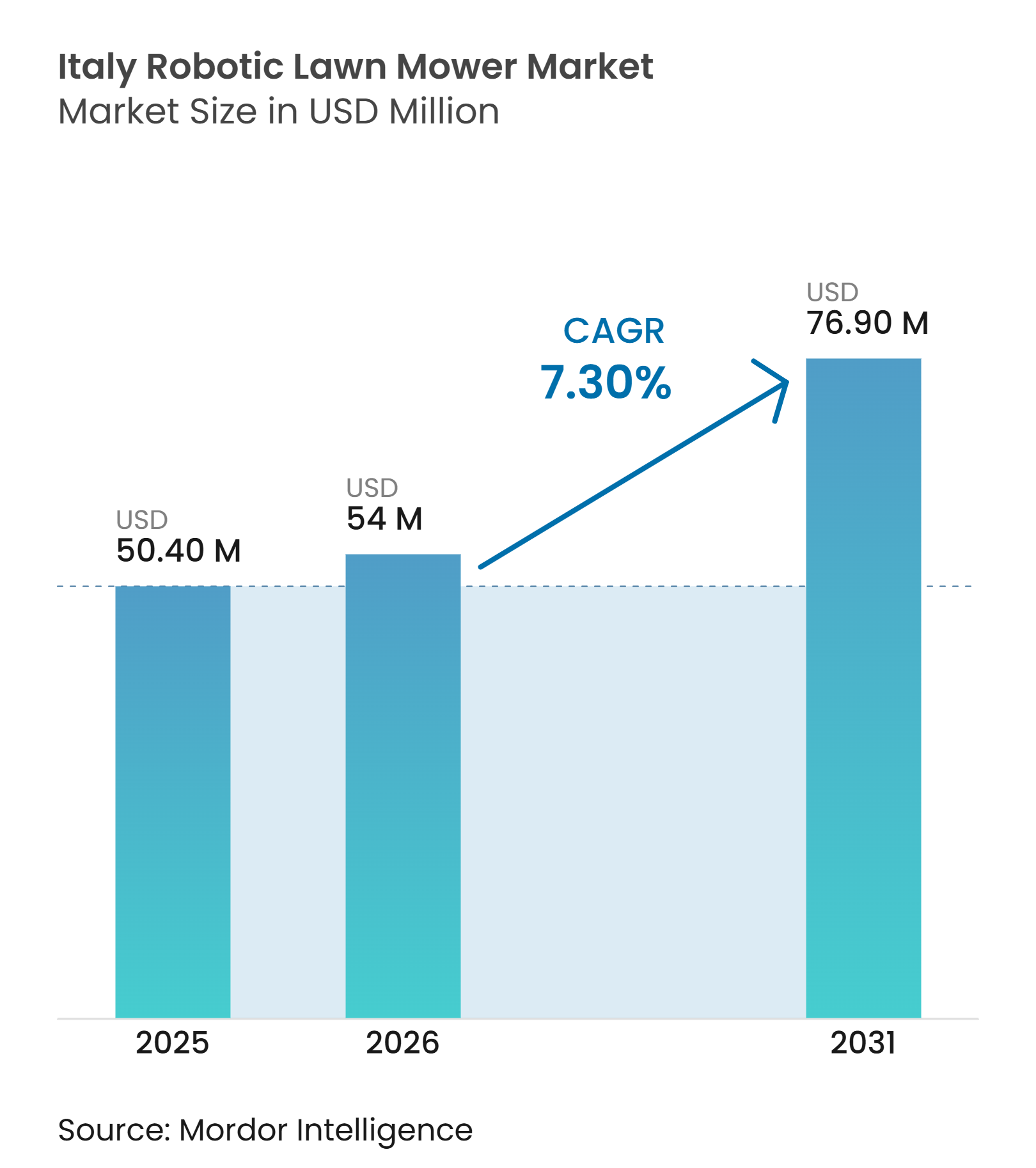
| Base Year Market Size (2025) | USD 50.40 Million |
| Market Size (2026) | USD 54 Million |
| Market Size (2031) | USD 76.90 Million |
| Growth Rate (2026 - 2031) | 7.30 % |
| Market Concentration | Low |
Major Players *Disclaimer: Major Players sorted in no particular order Image © Mordor Intelligence. Reuse requires attribution under CC BY 4.0. | |
Italy Robotic Lawn Mower Market Analysis by Mordor Intelligence
The Italy robotic lawn mower market was valued at USD 50.4 million in 2025 and is estimated to grow from USD 54 million in 2026 to reach USD 76.9 million by 2031, at a CAGR of 7.3% during the forecast period (2026-2031). The Italy robotic lawn mower market is driven by demand for labor-saving garden maintenance solutions and the growing adoption of connected home devices. Wire-free navigation is lowering installation barriers, particularly for gardens with irregular layouts. Dealer networks remain important, as buyers often require product demonstrations, installation support, and servicing. Italian manufacturers have an established presence in local distribution channels, while international brands are expanding their product offerings. Commercial users represent a separate growth avenue, as parks, golf courses, and landscaping firms evaluate autonomous equipment for routine maintenance.
Key Report Takeaways
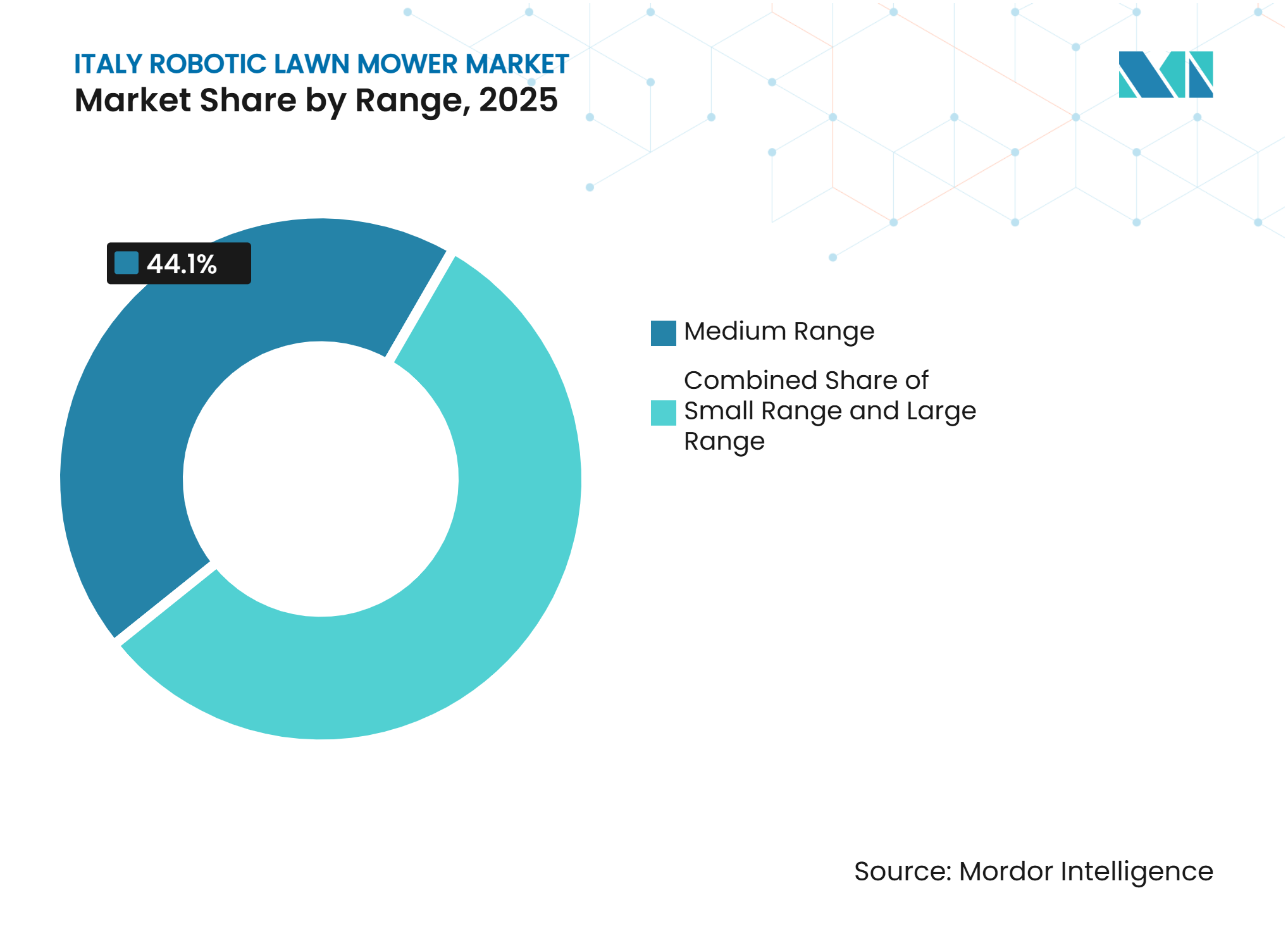
- By range, Medium Range held 44.1% of the Italy robotic lawn mower market size in 2025, while High Range is projected to grow fastest at a 15.5% CAGR through 2031.
- By battery capacity, 20 to 30 V held 50.3% of the Italy robotic lawn mower market share in 2025, while More Than 30 V is estimated to be the fastest growing segment at a 13.2% CAGR through 2031.
- By sales channel, Retailers held 58% revenue share in 2025, while Online is projected to grow the fastest at a 16.4% CAGR through 2031.
- By application, Residential held a 68.5% revenue share in 2025, while Commercial is the fastest-growing at an 11.9% CAGR through 2031.
- By end-user, Homeowners held a 64.5% revenue share in 2025, while Landscaping Companies is the fastest-growing segment at an 11.2% CAGR through 2031.
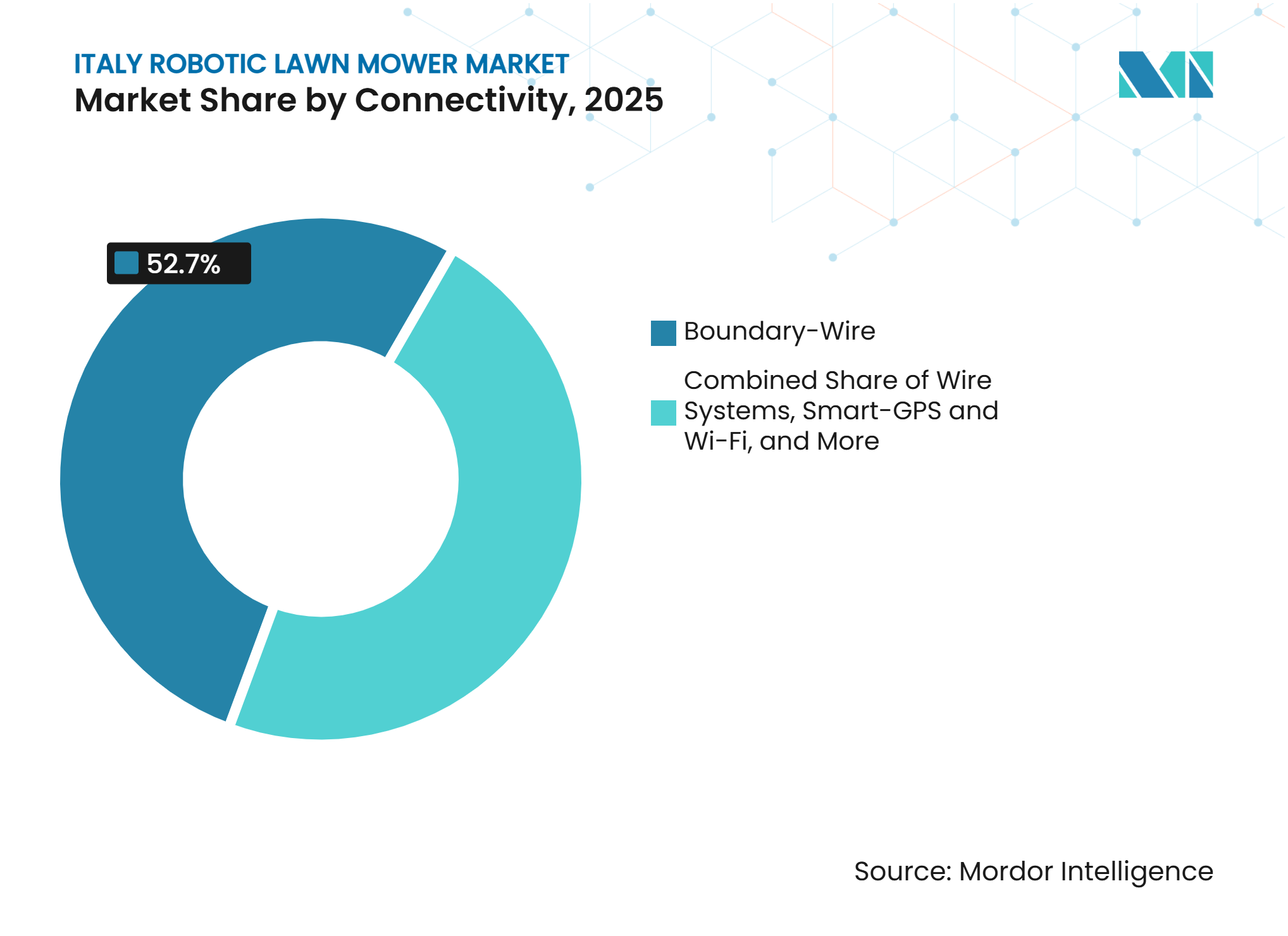
- By connectivity, Boundary-Wire held 52.7% revenue share in 2025, while Vision-Guided Camera and LiDAR are projected to grow fastest at a 19.1% CAGR through 2031.
Note: Market size and forecast figures in this report are generated using Mordor Intelligence’s proprietary estimation framework, updated with the latest available data and insights as of January 2026.
Market Trends and Insights
Drivers Impact Analysis of Italy Robotic Lawn Mower Market*
| Driver | (~) % Impact on CAGR Forecast | Geographic Relevance | Impact Timeline |
|---|---|---|---|
| Smart-Home Automation Adoption | + 1.20% | Northern and Central Italy, including Milan, Turin, and Rome corridors, with spillover into coastal tourism zones | Medium term (2-4 years) |
| Labor-Saving Lawn Maintenance Demand | + 1.50% | Northern Italy and professional landscaping centers in Lombardy, Veneto, and Emilia-Romagna | Short term (≤ 2 years) |
| Battery-Powered Low-Noise Equipment Demand | + 0.80% | Dense suburban areas, coastal tourism zones, and historic city peripheries | Medium term (2-4 years) |
| Wire-Free Navigation and On-Device AI Improvements | + 1.50% | Central and Northern Italy, with national relevance for commercial buyers | Medium term (2-4 years) |
| Expansion of Managed Green Spaces | + 0.60% | Lombardy, Lazio, Veneto, and Tuscany | Medium term (2-4 years) |
| Italian Manufacturing and Dealer-Service Differentiation | + 0.40% | Tuscany, Lombardy, and Veneto dealer networks serving premium residential and commercial users | Long term (≥ 4 years) |
| Source: Mordor Intelligence | |||
Smart-Home Automation Adoption is Reshaping Adoption Curves
Connected-home adoption is influencing how households evaluate robotic mowers in the Italy robotic lawn mower market. Buyers increasingly view app-controlled equipment as part of a connected-home setup rather than solely as garden equipment. This shifts greater emphasis to software usability, remote scheduling, and compatibility with other connected devices. The European Commission tracks the broader digital transition through its Digital Economy and Society Index[1]. In 2026, Husqvarna introduced AI Vision technology for robotic lawn mowers, featuring camera-based, wire-free operation. This reflects manufacturers' focus on buyers who expect connected control and simpler setup. As product interfaces become more familiar, sellers can position robotic mowing as part of household automation, supporting adoption in northern and central Italian areas where smart-home usage and dealer support are more developed.
Labor-Saving Demand in Lawn Maintenance Drives Professional Adoption
Labor availability is a practical challenge for landscaping firms and municipal maintenance operators in the Italy robotic lawn mower market. INPS labor market data indicates pressure in seasonal work and related occupations. Operators must maintain contracted green spaces even when staffing is difficult and labor costs rise. Autonomous equipment can shift staff away from repetitive mowing toward tasks that require direct attention. The commercial case is strongest in northern regions with established landscaping and facility management activity. The Toro Company reported that Gullane Golf Club saved 40 labor hours per week after deploying four Turf Pro 500 units. This European reference gives Italian operators a practical basis for assessing fleet use. Landscaping companies are therefore likely to evaluate robotics based on service reliability, labor allocation, and operating continuity rather than equipment specifications alone.
Wire-Free Navigation and Edge-AI Improvements Enable Market Expansion
The shift away from boundary wire is expanding the addressable market for robotic lawn mowers in Italy. Many Italian gardens have terraces, narrow routes, irregular edges, and dense planting that complicate wired installation. RTK and vision-based navigation can reduce the setup required before a mower begins operating. Ambrogio Robot presented the Ambrogio 4.50 AI at EIMA 2024, featuring dual satellite systems and wire-free navigation for areas up to 80,000 m². The product demonstrates how Italian suppliers are addressing varied garden formats through multiple positioning methods. Segway Navimow received TÜV Rheinland Lawn Care certification for the X420 and i206 AWD models in April 2026. Such certification and operating references can help buyers evaluate newer systems, particularly where formal procurement requires evidence of performance. These developments are especially relevant for commercial users and homeowners who previously found wired systems unsuitable.
Demand for Battery-Powered Low-Noise Equipment Accelerates Substitution
Noise is an important purchase consideration in dense urban and peri-urban settings. Local restrictions can limit the use of gasoline-powered garden equipment during morning and evening periods. The EU Environmental Noise Directive provides the broader policy context for managing environmental noise. Battery-powered robotic mowers operate at lower noise levels and can be scheduled for periods when the use of conventional equipment is restricted. This makes them relevant for suburban homes, tourism properties, and sites near historic urban areas. Honda announced the Miimo 1500i and 2200i for European markets, featuring wire-free RTK navigation and a 5-year warranty. The company's product direction aligns low-noise battery operation with simpler navigation. The Italy robotic lawn mower market stands to benefit where property managers require quieter maintenance without disrupting the use of outdoor spaces.
Restraints Impact Analysis of Italy Robotic Lawn Mower Market*
| Restraint | (~) % Impact on CAGR Forecast | Geographic Relevance | Impact Timeline |
|---|---|---|---|
| High Upfront Acquisition and Installation Cost | -1% | Price-sensitive households nationwide, with greatest pressure in Southern Italy and the Islands | Medium term (2-4 years) |
| Irregular, Sloped, and Tree-Obstructed Garden Performance | -0.70% | Liguria, Tuscany, the Apennine areas, and mature rural gardens in Central and Southern Italy | Medium term (2-4 years) |
| Limited Consumer Awareness Outside Specialist Channels | -0.50% | Southern Italy, the Islands, and areas with limited dealer coverage | Medium term (2-4 years) |
| Theft, Connectivity, and Data-Privacy Concerns | -0.40% | Dense urban and shared-housing areas in Milan, Rome, Naples, and other major cities | Long term (≥ 4 years) |
| Source: Mordor Intelligence | |||
High Upfront Acquisition and Installation Cost Limits Addressable Households
High initial costs remain a constraint on household adoption in the Italy robotic lawn mower market. Wire-free RTK models with advanced obstacle avoidance were sold through authorized Italian dealers for EUR 1,200 to EUR 6,500 (USD 1,290 to USD 6,990) at 2026 average exchange rates. These price levels place many models in the discretionary durable category for household budgets. ISTAT reported household income and expenditure data reflecting regional income differences across Italy. The north-south income divide concentrates the active buyer base in wealthier northern regions. Boundary-wire models may also require installation costs of EUR 200 to EUR 500 (USD 215 to USD 540), depending on garden complexity. Mid-tier wire-free products priced below EUR 1,500 (USD 1,615) can lower the entry barrier. Further price normalization is needed before the product becomes accessible to a broader middle-income segment.
Irregular Garden Geometry Remains a Navigation Reliability Constraint
Italian garden conditions can limit robotic mower performance even when advanced navigation is available. Terraces, narrow stone-lined passages, dense olive and cypress planting, and mature tree cover can restrict satellite reception. These conditions differ from the flatter, more open lawns that shaped many earlier product designs. Wiper's Climber AWD series is designed for slopes up to 75% inclination and uses four-wheel drive with ultrasonic ZCS obstacle sensors. This design reflects the relevance of terrain-specific products for peninsular Italy. Systems still need to perform in shade, under changing light, and in areas where satellite signals weaken. Buyers with complex gardens may delay purchases if they cannot confirm reliable operation before installation. These limitations will continue to constrain adoption in central and southern areas until vision-based and multi-sensor systems deliver more consistent performance in difficult conditions.
*Our forecasts treat driver/restraint impacts as directional, not additive. The impact forecasts reflect baseline growth, mix effects, and variable interactions.
Italy Robotic Lawn Mower Market Segment Analysis
By Range:
Premium Tiers Pull Disproportionate Revenue GrowthThe Medium Range segment held a 44.1% share in 2025, based on the European benchmark used for this comparison. This range serves core residential users with lawns from 800 m² to 2,000 m². It combines stronger specifications with a price point closer to broad household affordability. Products in this category increasingly include app connectivity and wire-free navigation. Husqvarna introduced the Automower 308V and 312V in 2026 for small and medium gardens[2]. These products reflect the effort to make camera-led operation available to a wider residential base. The tier suits many suburban and peri-urban gardens in northern and central Italy and benefits from dealer support, where buyers seek product guidance before purchasing.
The High Range segment is the fastest-growing and is projected to expand at a 15.5% CAGR through 2031. This category covers lawns larger than 2,000 m² and is relevant to larger homes and commercial properties. Growth is supported by landscaping firms and users requiring professional-grade coverage. Wire-free systems make the category more practical, where large wired installations would be difficult. The Low Range segment remains important for first-time equipment buyers and smaller gardens, though its price advantage is under pressure as Medium Range models gain features that were previously limited to premium products. Battery durability and energy efficiency are more critical in the Medium and High Range tiers, as users expect longer autonomous operating periods. Investment is therefore likely to remain focused on models that can justify a higher price through greater coverage area and reduced setup effort.



By Battery Capacity:
The 20-30 V Band Dominates, High-Voltage Platforms Gain FastBatteries in the 20-30 V category accounted for 50.3% of the market in 2025. This voltage range is common in residential robotic mower platforms introduced between 2019 and 2024. It provides adequate runtime and torque for gardens up to 1,500 m² under typical Italian conditions, making it a natural fit for the large residential user base. Some manufacturers offer battery systems compatible with other handheld power tools, which can reduce the perceived cost for buyers who already own a compatible battery pack. Bosch introduced the VISIMOW18V-100 and VISIMOW18V-200 in April 2026 as part of its 18V Power for All System. Shared platforms can help suppliers build value across multiple garden equipment categories.
The more than 30 V category is the fastest-growing battery tier, with the Italy robotic lawn mower market size for this segment forecast to grow at a 13.2% CAGR through 2031. Higher-capacity batteries are important for commercial equipment used on golf courses, municipal grounds, and large estates, where users require longer operating windows and sufficient power for demanding terrain. The shift toward fleet use increases the importance of extended runtime and battery management. High-voltage platforms also support larger cutting areas without frequent human intervention, and residential users with extensive properties can benefit from the same capabilities. This category does not replace lower-voltage products, as smaller gardens have different cost and runtime requirements. Instead, it broadens the product range available to professional and large-property buyers.
By Sales Channel:
Physical Retail Anchors Trust, Online Captures Tech-Forward BuyersRetailers held a 58% share in 2025. In-store demonstrations, specialist advice, and product trials remain important before buyers commit to a costly purchase. Retailers also connect customers with installation and service support, which is especially relevant for perimeter-wire models that require calibration. Italian dealer networks are concentrated in agricultural machinery centers across the Po Valley and in regional cooperative networks. Specialty stores rank second because customers value category expertise and installation support. The physical channel reduces uncertainty for buyers with complex lawn configurations and continues to serve as both a purchase point and a post-sale service route.
Online is the fastest-growing sales channel, projected to grow at a 16.4% CAGR through 2031. Wire-free products reduce dependence on dealers by eliminating the need for boundary-wire installation. Digital channels also support research-intensive purchases, where consumers compare technical features and user controls. In 2026, WORX introduced its Landroid Vision Cloud with AI and RTK Cloud precision, illustrating how suppliers are building products around app-guided setup. However, online sales still require clear information on site suitability, connectivity, and support. Regulatory disclosures for connected outdoor equipment add complexity for sellers. As a result, established suppliers with service-ready channel programs may retain an advantage as digital sales expand.
By Application:
Residential Scale and Commercial Dynamism CoexistResidential accounted for 68.5% share in 2025, based on the European benchmark that is directionally applied to Italy. Private gardens and a concentration of homeowners in suburban northern Italy provide the core demand base. Buyers value regular lawn care without direct weekly mowing. The growing availability of wire-free models below EUR 2,000 (USD 2,150) reduces the installation burden for residential users. STIGA introduced its Vista Technology range in 2026 with models priced from EUR 999 to EUR 6,999 (USD 1,075 to USD 7,530)[3]. The range targets users seeking advanced navigation without the complexity of professional installation. Residential demand remains fundamental because it accounts for most of the unit volume. Its progress will depend on affordability, ease of setup, and confidence in performance across varied gardens.
Commercial application is forecast to grow at an 11.9% CAGR through 2031. Municipalities, sports grounds, and private landscaping firms are moving from smaller trials toward larger deployments. Their needs differ from those of homeowners because they focus on coverage, labor allocation, and fleet control. Italy has managed parks, road verges, sports facilities, and golf sites that form a commercial addressable base. These locations require repeated maintenance and consistent grounds presentation. Large-area autonomous platforms can offer a practical alternative for routine cutting. Commercial users may also place greater weight on supplier service and formal equipment validation. This creates space for suppliers that can support fleet management and maintenance over the equipment life cycle.
By Connectivity:
Boundary-Wire's Legacy Resilience and Vision's Structural RiseBoundary-wire systems held a 52.7% share in 2025, based on the European benchmark. The installed base creates a replacement cycle, as many homeowners are familiar with existing setups and may prefer to continue using them. Wired systems remain suitable for gardens with stable layouts and owners who value familiar operation. Smart-GPS and Wi-Fi systems occupy a middle position by combining app-based scheduling with satellite positioning. They are appropriate for gardens with clear satellite visibility. Buyers may choose these systems when they want more functionality without moving to camera and LiDAR equipment. Connectivity choice will continue to depend on garden layout, installation preference, and price.
Vision-guided camera and LiDAR connectivity is forecast to grow at a 19.1% CAGR through 2031, the fastest rate among connectivity categories in the Italy robotic lawn mower market. Recent product development increasingly combines multiple positioning methods rather than relying on a single navigation system. Husqvarna's 2026 AI Vision range uses camera-led navigation for wire-free operation. STIGA's 2026 Vista Technology range also uses AI-driven camera navigation and antenna-free installation. These approaches are relevant for Italian gardens where light, terrain, planting, and satellite coverage can vary within a single property. Multi-sensor systems can improve product suitability in cases where a boundary wire or a single satellite signal is insufficient.

Geography Analysis
Italy is one of the major countries in Europe for the robotic lawn mower market. Lombardy, Piedmont, Emilia-Romagna, and Veneto account for a majority of residential unit sales. These northern regions benefit from stronger household purchasing power and more established dealer and service networks. Their suburban and peri-urban gardens form the primary base for residential demand. Lazio is the principal central Italian market, driven by Rome's suburban belt.
Italy combines irregular southern European garden conditions with higher-income areas in the north and domestic robotic mower manufacturing. The north-south income divide shapes the pace of household adoption across the country. Local manufacturers and dealer networks support buyers who require site assessment, installation guidance, and service support. This creates varying adoption conditions across Italian regions, even where the same products are available nationally.
Southern Italy and the Islands lag in adoption due to lower household incomes, thinner dealer networks, and hilly terrain that can limit satellite coverage. Terraces, slopes, dense planting, and mature tree cover also make navigation more difficult in central and southern areas. Italy's National Recovery and Resilience Plan includes broadband investment that can improve the connectivity required for cloud-assisted RTK operation. Better coverage can support product use in underserved areas. However, geographic expansion will continue to depend on price, local service availability, and reliable navigation in difficult terrain.
Competitive Landscape
Market Concentration
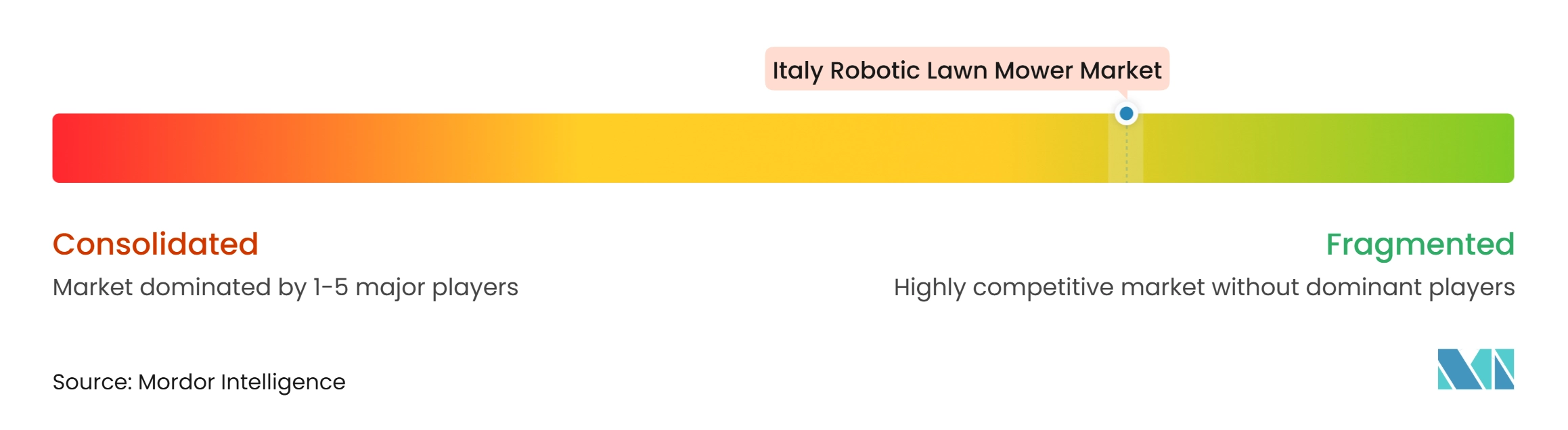
The Italy robotic lawn mower market has a fragmented competitive structure. The top 5 players are Husqvarna Group, Zucchetti Centro Sistemi S.p.a., Robert Bosch GmbH, Honda Motor Co., and Positec Tool Corporation. Husqvarna Group leads the market, supported by its Automower dealer network and EPOS satellite platform. The company introduced 7 AI Vision models in 2026 for residential and municipal uses. Zucchetti Centro Sistemi S.p.a. is leveraging Italian production and established dealer relationships. Its Ambrogio platform integrates multiple navigation technologies, 4G app connectivity, and coverage up to 80,000 m².
Competition is concentrated around 2 main product directions. Residential suppliers are focusing on wire-free navigation, obstacle avoidance, and automated edge handling. Commercial suppliers are emphasizing large-area coverage, fleet control, and serviceability. STIGA launched the APX Pro in 2026 for areas up to 27,000 m² per mowing cycle using 6 swappable ePower Pro batteries. Husqvarna launched the Automower 560 EPOS for municipalities, parks, schools, universities, and office parks, with a capacity for up to 1.5 acres per 24-hour period. Bosch added semi-autonomous models to its 18V Power for All System for gardens up to 200 m². These developments indicate that suppliers are addressing different garden sizes and buyer requirements rather than competing through a single product format.
Commercial fleet management remains a potential service area as professional adoption expands. Cloud monitoring, maintenance alerts, and scheduling can create an ongoing customer relationship after the initial equipment sale. Institutional buyers may also require safety certification before adding autonomous equipment to public maintenance tenders. Suppliers with strong dealer and service networks may be better positioned to meet these requirements. Local support remains important when a machine must operate across difficult terrain or large managed sites. International entrants can compete through rapid product releases and digital distribution, while domestic suppliers can compete through local manufacturing, installer relationships, and garden-specific expertise. The Italy robotic lawn mower market will remain competitive, as no single supplier holds enough share to control the category.
Italy Robotic Lawn Mower Industry Leaders
-
Husqvarna Group
-
Robert Bosch GmbH
-
Honda Motor Co.
-
Positec Tool Corporation
-
Zucchetti Centro Sistemi S.p.a.
- *Disclaimer: Major Players sorted in no particular order
Italy Robotic Lawn Mower Market Companies Covered in this Report
- Husqvarna Group
- Zucchetti Centro Sistemi S.p.A. (Ambrogio Robot)
- Robert Bosch GmbH (Gardena and Indego)
- Honda Motor Co., Ltd. (Miimo)
- Positec Tool Corporation (WORX Landroid)
- STIGA S.p.A.
- Deere and Company
- AL-KO Kober SE
- Segway Inc. (Navimow)
- Mammotion Technology Co., Ltd.
- Kress Robotik GmbH
- The Toro Company
- ANDREAS STIHL AG and Co. KG
- Makita Corporation
- Greenworks Tools
Recent Industry Developments in Italy Robotic Lawn Mower Market
- April 2026: Husqvarna Group launched its Automower AI Vision range with 7 new models, including the Aspire R6V, 308V, and 312V. The range uses camera-led AI navigation for wire-free installation and covers gardens from 400 m² to 7,500 m².
- April 2026: Robert Bosch GmbH launched the VISIMOW18V-100 and VISIMOW18V-200. These are the first semi-autonomous robot mowers in Bosch’s 18V Power for All System and do not require perimeter wires or external navigation beacons for gardens up to 200 m².
- March 2026: STIGA launched the APX Pro, an autonomous, battery-powered professional mower for areas up to 27,000 m² per mowing cycle, powered by 6 swappable ePower Pro batteries. The product targets sports facilities, municipalities, golf clubs, and large estates.
Italy Robotic Lawn Mower Market Report Scope
A robotic lawn mower is an autonomous, battery-powered machine designed to mow and maintain grass with minimal human intervention. It uses sensors, navigation systems, and intelligent controls to operate within a defined lawn area, avoid obstacles, maintain the desired grass height, and recharge automatically when required.
The Italy robotic lawn mower market report is segmented by range (low, medium, and high), by battery capacity(less than 20 V, 20 to 30 V, and more than 30 V), by sales channel(retailers, specialty stores, and online), by connectivity(boundary-wire, smart GPS and Wi-Fi, and vision-guided, camera, and LiDAR systems), and by end-user(homeowners, landscaping companies, sports grounds and parks, municipalities, golf courses, and others). Market forecasts are presented in terms of value in USD.
Segmentation Overview
| Low Range |
| Medium Range |
| High Range |
| Less Than 20 V |
| 20 to 30 V |
| More Than 30 V |
| Retailers |
| Specialty Stores |
| Online |
| Residential |
| Commercial |
| Homeowners |
| Landscaping Companies |
| Sports Grounds and Parks |
| Municipalities |
| Golf Courses |
| Other End-Users |
| Boundary-Wire |
| Smart-GPS and Wi-Fi |
| Vision-Guided, Camera and LiDAR |
| By Range | Low Range |
| Medium Range | |
| High Range | |
| By Battery Capacity | Less Than 20 V |
| 20 to 30 V | |
| More Than 30 V | |
| By Sales Channel | Retailers |
| Specialty Stores | |
| Online | |
| By Application | Residential |
| Commercial | |
| By End-User | Homeowners |
| Landscaping Companies | |
| Sports Grounds and Parks | |
| Municipalities | |
| Golf Courses | |
| Other End-Users | |
| By Connectivity | Boundary-Wire |
| Smart-GPS and Wi-Fi | |
| Vision-Guided, Camera and LiDAR |
Key Questions Answered in the Report
What is the projected value of the Italy robotic lawn mower market by 2031?
The Italy robotic lawn mower market is projected to reach USD 76.9 million by 2031, growing at a 7.3% CAGR from 2026.
Which product range leads demand in Italy?
Medium Range led with 44.1% share in 2025, while High Range is forecast to grow fastest at a 15.5% CAGR through 2031.
Why are wire-free robotic mowers gaining interest in Italy?
Wire-free RTK and camera-based systems reduce installation needs and can better address irregular gardens, narrow passages, and changing terrain.
Which sales channel is growing fastest for robotic lawn mowers in Italy?
Online sales are projected to grow at a 16.4% CAGR through 2031 as wire-free products reduce dependence on perimeter-wire installation.
Which end users offer the strongest growth opportunity?
Landscaping Companies are forecast to grow at an 11.2% CAGR as staffing constraints increase interest in autonomous mowing for contracted green spaces.