
Italy Outdoor Lighting Market Size and Share
Market Overview
| Study Period | 2020 - 2031 |
|---|---|
| Forecast Data Period | 2026 - 2031 |
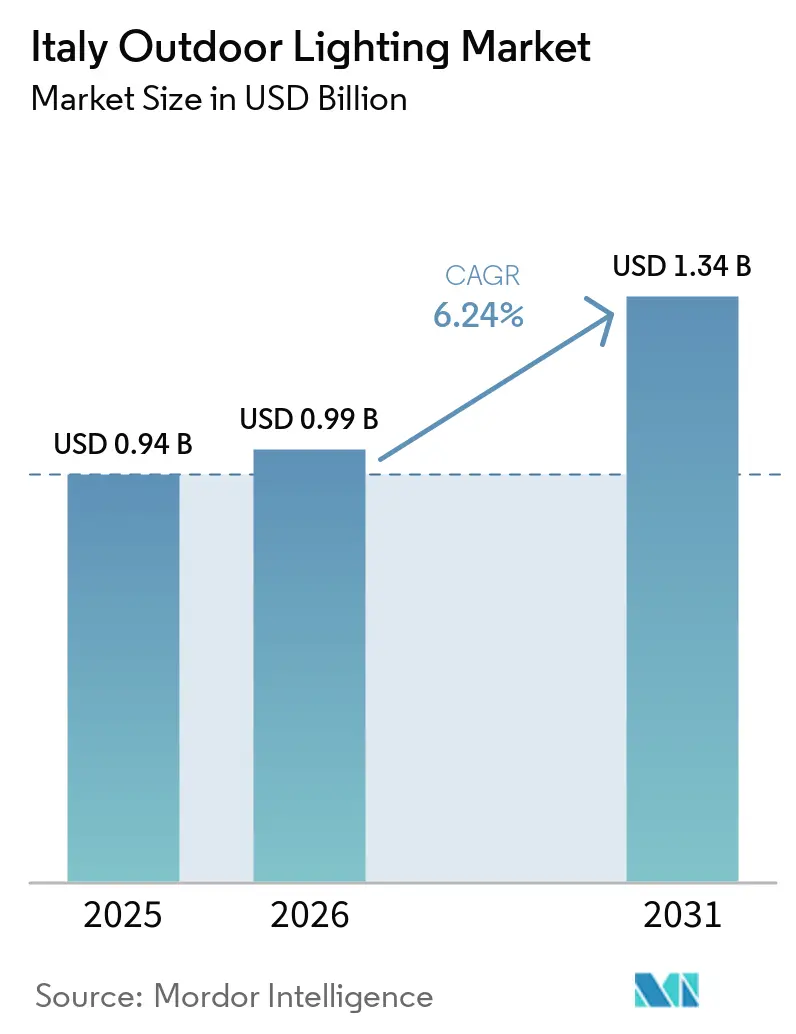
| Base Year Market Size (2025) | USD 0.94 Billion |
| Market Size (2026) | USD 0.99 Billion |
| Market Size (2031) | USD 1.34 Billion |
| Growth Rate (2026 - 2031) | 6.24 % |
| Market Concentration | Medium |
Major Players *Disclaimer: Major Players sorted in no particular order Image © Mordor Intelligence. Reuse requires attribution under CC BY 4.0. | |
Italy Outdoor Lighting Market Analysis by Mordor Intelligence
The Italy outdoor lighting market size was valued at USD 0.94 billion in 2025 and is estimated to grow from USD 1.0 billion in 2026 to reach USD 1.34 billion by 2031, at a CAGR of 6.24% during the forecast period (2026-2031). Municipal replacement programs remain the main source of demand because many public networks still use aging equipment and require lower energy use. Long-term performance contracts shift delivery and operating responsibility from municipalities to energy service providers, which makes large renewal projects easier to structure. European product rules also raise the case for durable, repairable, and traceable lighting equipment, placing more attention on lifecycle performance. Design-led demand from hospitality, heritage sites, and private outdoor spaces supports sales beyond public street lighting. The Italy outdoor lighting market, therefore combines public infrastructure renewal with a more selective market for architectural and residential products.
Key Report Takeaways
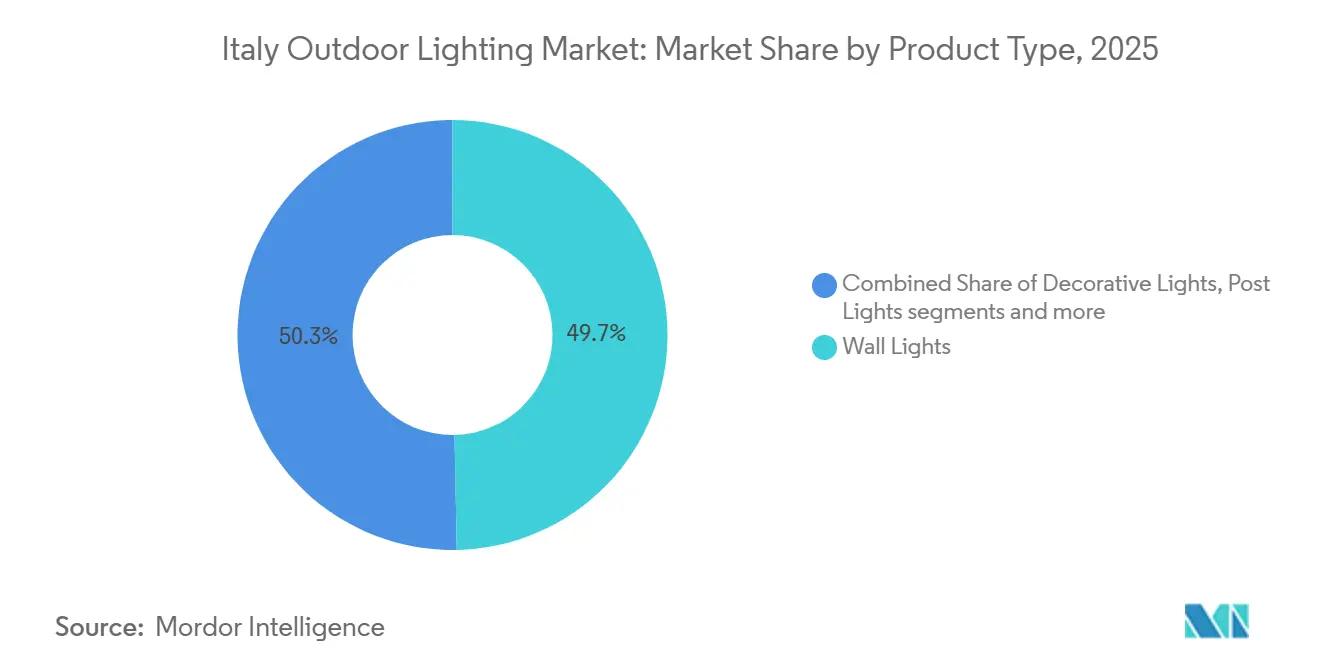
- By product type, wall lights held 49.7% revenue share in 2025, while path and step lights are forecast to grow at a 7.40% CAGR through 2031.
- By light source, LED held 46.3% revenue share in 2025, while other light sources are forecast to grow at a 7.20% CAGR through 2031.
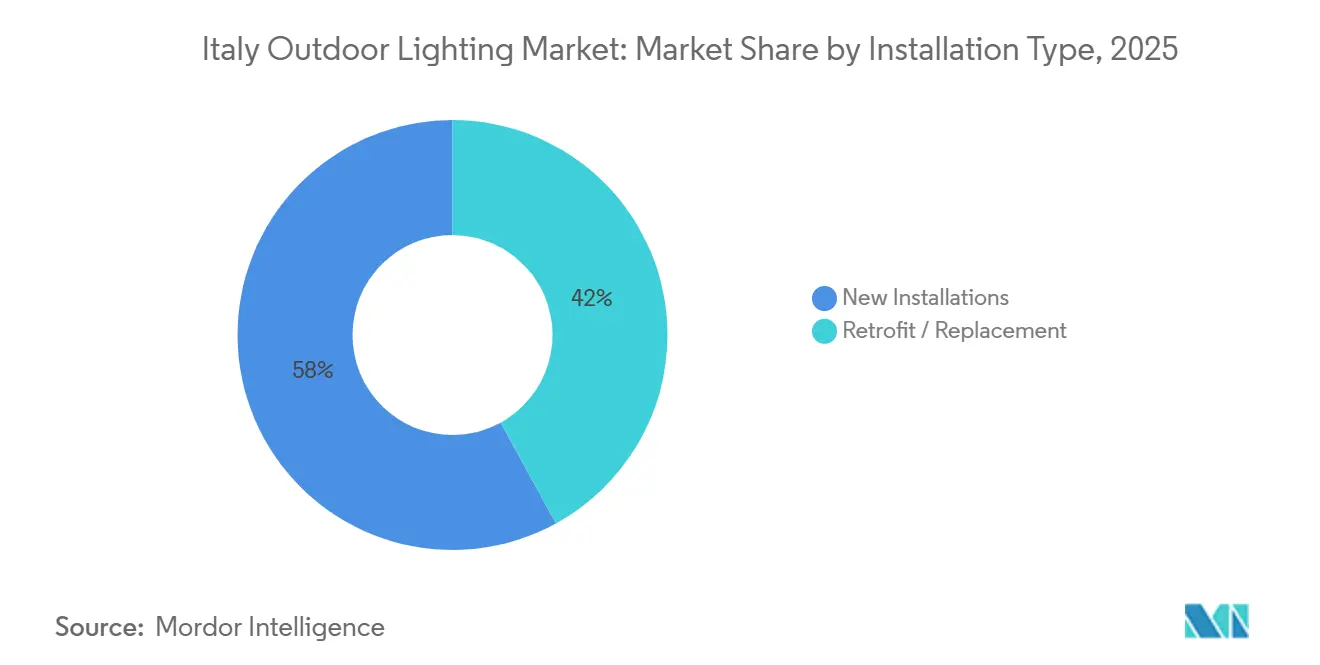
- By installation type, new installations held 58.0% revenue share in 2025, while retrofit and replacement are forecast to grow at a 7.80% CAGR through 2031.
- By application, residential held 50.4% revenue share in 2025 and is forecast to grow at a 6.90% CAGR through 2031.
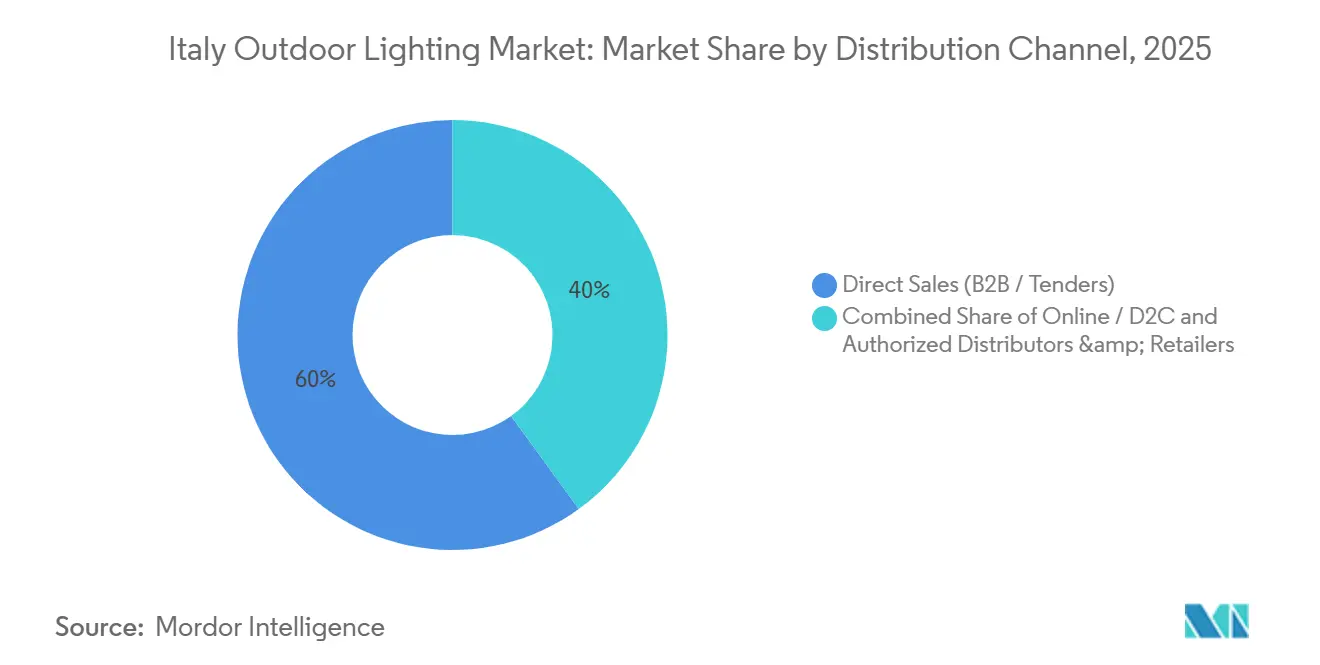
- By distribution channel, direct sales through B2B and tenders held 60.0% revenue share in 2025, while online and D2C channels are forecast to grow at an 8.80% CAGR through 2031.
- By geography, Northwest Italy held 31.0% revenue share in 2025, while South Italy is forecast to grow at a 7.10% CAGR through 2031.
Note: Market size and forecast figures in this report are generated using Mordor Intelligence’s proprietary estimation framework, updated with the latest available data and insights as of January 2026.
Italy Outdoor Lighting Market Trends and Insights
Drivers Impact Analysis*
| Driver | (~) % Impact on CAGR Forecast | Geographic Relevance | Impact Timeline |
|---|---|---|---|
| Municipal LED Retrofit and Energy-Savings Procurement | +1.8% | National, concentrated in North and Central Italy, accelerating in South Italy through PNRR | Short term (≤ 2 years) |
| Smart-City Lighting and Connected Control Adoption | +1.2% | Major cities, including Milan, Turin, Rome, and Bologna, with spillover to secondary cities | Medium term (2-4 years) |
| Outdoor Living, Hospitality, and Tourism-Led Aesthetic Demand | +0.9% | South Italy, Islands, coastal tourism locations, and premium residential areas nationally | Medium term (2-4 years) |
| EU Ecodesign and Legacy-Lamp Phase-Out | +0.7% | National, under an EU-wide compliance framework | Short term (≤ 2 years) |
| Solar Lighting for Rural, Heritage, and Grid-Constrained Sites | +0.4% | South Italy, Islands, and rural municipalities in alpine and Apennine areas | Medium term (2-4 years) |
| Circular and Low-Carbon Public-Infrastructure Procurement | +0.4% | National, with early adoption in Lombardy, Emilia-Romagna, and urban pilot municipalities | Long term (≥ 4 years) |
| Source: Mordor Intelligence | |||
Municipal LED Retrofit and Energy-Savings Procurement
The Italian outdoor lighting market is moving from direct municipal spending toward longer energy-performance contracts. These contracts transfer technology and performance responsibility from municipal balance sheets to energy service companies. Edison Next signed a nine-year EUR 3.9 million contract in Cittadella in January 2026. The project covers 5,800 LED conversions, 1,700 point-to-point telecontrol units, and 2 adaptive-lighting systems. Edison Next expects the work to reduce annual energy use by 70% and annual emissions by 750 tons of CO2[1]. The Italian outdoor lighting market benefits when concessions allow suppliers to combine equipment, controls, maintenance, and measured operating outcomes in one procurement package. UniCredit finalized EUR 73 million in green financing for Teike in January 2026, with an SACE green guarantee. The financing supports a public-lighting operator that manages around 160,000 light points across more than 110 municipalities[2]. Such financing confirms that 10-15-year concessions can attract institutional capital when contracts support predictable cash flow.
Smart-City Lighting and Connected Control Adoption
Connected lighting is becoming a standard requirement in large municipal tenders rather than a specialist option. Remote monitoring, adaptive dimming, and point-level control allow cities to manage power use and service issues across a larger asset base. PATRIZIA formed CiviSmart in 2025 by bringing together Ottima, Selettra, and Atlantico. The combined platform managed 500,000 Italian street-lighting points by July 2026, compared with 380,000 at launch. More than 50% of these points used remote monitoring and adaptive dimming, and around 20% used advanced single-point controls[3]. The Italy outdoor lighting market increasingly rewards suppliers that can provide interoperable controls with the fixture and an ongoing service model. Cities also use lighting poles as part of a wider digital infrastructure. CiviSmart has expanded its work into environmental monitoring, smart parking, and building efficiency programs. This use of the lighting network broadens the commercial case for connected systems. The requirements for LoRaWAN, DALI-2 interfaces, and open application programming interfaces are becoming more common in municipal specifications.
Outdoor Living, Hospitality, and Tourism-Led Aesthetic Demand
Tourism, hospitality, and private outdoor spaces support demand for products that combine functional and visual requirements. Italy recorded 476 million overnight stays in 2025, and outdoor dining has remained important since 2021. These conditions support demand for garden, terrace, bollard, and facade lighting in hotels, restaurants, and homes. Platek supplied the lighting for La Monastica Resort and SPA, a converted Tuscan convent in Buggiano Castello. The project used lighting across 9 terraced garden levels while respecting the medieval setting. The Italy outdoor lighting market gains higher-value specification opportunities when lighting must support guest circulation and heritage character together. iGuzzini introduced Cryso in 2026 for hospitality and residential outdoor settings. The product was designed by Alessandro Scandurra and uses dimmable light intended to work with architectural surfaces[4].
EU Ecodesign and Legacy-Lamp Phase-Out
Regulation (EU) 2024/1781 entered into force on July 18, 2024, and established a framework for ecodesign requirements that includes durability, repairability, and product information. The European Commission identified lighting as a priority product group in its 2025-2030 ESPR and Energy Labelling Working Plan. This creates a basis for further delegated requirements affecting lighting products. Commission Regulation (EU) 2019/2020 also applies ecodesign requirements to light sources and separate control gears. The Italy outdoor lighting market is affected because new specifications must meet stricter product and energy requirements. The rules encourage a shift away from older lamp technologies in new outdoor projects. They also place greater importance on documentation throughout the product lifecycle. Global suppliers with established traceability systems can meet these requirements with fewer changes to internal processes.
Restraints Impact Analysis*
| Restraint | (~) % Impact on CAGR Forecast | Geographic Relevance | Impact Timeline |
|---|---|---|---|
| Municipal Budget and Financing Constraints | -1.4% | South Italy, Islands, and small or rural municipalities nationally | Short term (≤ 2 years) |
| High Upfront Cost of Controls, Storage, and Full-System Retrofit | -1.1% | National, most acute in areas without Consip or PNRR coverage | Medium term (2-4 years) |
| Light-Pollution, Blue-Light, and Heritage-Site Compliance | -0.6% | Tuscany, Umbria, Lombardy, Lazio, Sicily, and Sardinia | Medium term (2-4 years) |
| Fragmented Ownership and Interoperability Across Lighting Assets | -0.5% | National, particularly mid-sized cities and historic centers | Long term (≥ 4 years) |
| Source: Mordor Intelligence | |||
Municipal Budget and Financing Constraints
Municipal fiscal pressure can delay the pace of lighting renewal even when the long-term operating case is clear. Smaller municipalities often need to combine PNRR, regional, national, and framework funding before a project can proceed. This increases the administrative burden on local authorities with limited internal capacity. Major energy service companies tend to focus on areas with stronger funding structures and larger project pipelines. Smaller regional markets can therefore depend on lower-cost installers whose work may focus on basic compliance. The Italy outdoor lighting market has demand in these locations, but it does not always translate into a fully integrated smart-lighting project. Long-term concession financing reduces the immediate capital burden for municipalities. The remaining constraint is often the ability to prepare, procure, and manage a complex project. This is particularly relevant for municipalities with annual budgets of EUR 5 million to EUR 50 million.
High Upfront Cost of Controls, Storage, and Full-System Retrofit
Smart controls add cost to a standard LED replacement because they require point-level equipment, communications nodes, adaptive dimming gear, and management software. These elements can add 20-40% to the capital cost of a standard LED replacement project. This can lead smaller municipalities to choose lamp replacement rather than a full network upgrade. Edison Next received a EUR 12 million smart-city concession for Alassio in August 2026. The project combines full LED renewal with advanced telecontrol and has a 12-year contract term. The Italian outdoor lighting market needs longer contract periods and reliable credit arrangements when projects include the full controls layer. Battery storage also increases the cost of rural and heritage-site solar products. The supplied material places the additional cost at EUR 200 to EUR 400 per unit compared with standard LED alternatives.
*Our forecasts treat driver/restraint impacts as directional, not additive. The impact forecasts reflect baseline growth, mix effects, and variable interactions.
Segment Analysis
By Product Type: Wall Lights Lead, Path and Step Fixtures Accelerating Fast
Wall lights held 49.7% of the Italy outdoor lighting market share by product-type revenue in 2025. This position reflects the large number of residential and commercial facades, terraces, courtyards, and entrance areas that need wall-mounted lighting. Wall products are used across private homes, hotels, retail sites, and public-facing buildings. Their broad use makes them a stable part of the Italy outdoor lighting market. Buyers also value products that work across different mounting settings and architectural styles. This favors product lines with coordinated wall, ceiling, and bollard options.
Path and step lights are forecast to grow at a 7.40% CAGR through 2031. Demand is supported by pedestrian projects in historic centers, landscape requirements at hotels and resorts, and layered lighting at private gardens. Garden lights, security lighting, and flood and spotlights serve commercial, institutional, and sports-facility needs. Flood and spotlights also benefit from heritage and monument lighting work under cultural programs. iGuzzini introduced Ribeira in March 2026 with ceiling, wall-mounted, and bollard configurations. The collection shows how a shared optical and mounting platform can simplify specification across several product uses.

By Light Source: LED Anchors Volume, Emerging Sources Signal Design Premium
LED held 46.3% of light-source revenue in 2025. Its leading position is supported by energy performance and by product rules that make older alternatives less suitable for new outdoor specifications. LED is used in road lighting, urban spaces, residential products, and commercial exterior projects. Its wide application makes it the central technology in public replacement programs. The Italy outdoor lighting market size for LED is supported by the need to replace sodium-vapor and fluorescent equipment. LED also provides the control compatibility needed for remote monitoring and adaptive dimming.
Other light sources are forecast to grow at a 7.20% CAGR through 2031. This category includes HID for high-mast and sports uses, OLED panels for hospitality facades, and laser-based accent lighting for monumental exteriors. These products serve cases where designers need specific optical effects or light distribution. Fluorescent and incandescent products continue to contract, while halogen retains a limited role in heritage-sensitive work. Schréder released IZYLUM NEO in March 2026 with modular LensoFlex4 optics and materials intended for long service life. The product reflects the effort to keep mainstream LED lines adaptable and maintainable.
By Installation Type: New Build Provides Volume Floor, Retrofit Drives Value Growth
New installations held 58% of installation revenue in 2025. Residential construction and commercial development create a basic requirement for exterior lighting as part of a compliant building system. New projects allow designers to plan fixture placement, cabling, control equipment, and visual treatment together. This supports consistent demand even when municipal replacement schedules change. The Italy outdoor lighting industry also benefits because new construction can specify integrated equipment from the start. New-build projects remain important for product manufacturers and distributors with architectural and contractor relationships.
Retrofit and replacement are forecast to grow at a 7.80% CAGR through 2031. This is the highest installation growth rate in the supplied data and reflects the aging sodium-vapor and fluorescent stock. City Green Light launched a EUR 1.65 million project in Noventa Padovana in April 2026. It includes 2,344 LED fixtures and 57 telecontrol systems, with a projected 54% reduction in municipal power demand. Retrofit contracts can carry higher revenue per fixture when they include controls, maintenance, and performance obligations rather than simple replacements.
By Application: Residential Leads, Both Volume and Growth
Residential applications held 50.4% of revenue in 2025 and are forecast to grow at a 6.90% CAGR through 2031. The segment leads in both current volume and forecast growth in the supplied data. Homeowners are investing more in terraces, gardens, entrances, and other usable exterior areas. This demand includes functional lighting for access and security, as well as decorative lighting for outdoor living. The Italy outdoor lighting market size for residential applications is supported by products that allow consumers to compare style, performance, and control features. Residential projects also create demand across wall, garden, deck, patio, and path lighting.
Commercial demand covers hospitality, sports centers, health care campuses, retail sites, institutional buildings, galleries, and museums. Hospitality is the most design-intensive part of this group because it combines guest experience with safety and operational requirements. Tourist locations can combine artistic illumination with functional street lighting. Sports centers and health care campuses also use adaptive illumination in safety and wellness-related specifications. These projects often rely on distributors that can provide technical support and product selection.
By Distribution Channel: B2B Tenders Anchor Revenue, D2C Reshapes Residential Access
Direct sales through B2B channels and tenders held 60% of distribution-channel revenue in 2025. This lead reflects the importance of concessions and framework contracts in public lighting. Consip Servizio Luce and similar procurement structures channel major projects through accredited energy service companies. These buyers require suppliers to meet technical, service, and documentation requirements. The Italy outdoor lighting market, therefore, depends heavily on professional sales relationships for large infrastructure projects. Direct sales remain especially important where contracts include equipment, controls, installation, and maintenance.
Online and D2C channels are forecast to grow at an 8.80% CAGR through 2031. Residential consumers and small contractors use digital channels to discover products, compare specifications, and purchase decorative or smart luminaires. iGuzzini launched a dedicated e-commerce channel for its Echoes heritage-reissue collection in 2026. The move shows that premium manufacturers see direct digital access as useful for selected product lines. Authorized distributors and retailers retain an important middle position because contractors still need local stock, technical advice, and credit arrangements.
Geography Analysis
Northwest Italy held 31% of 2025 revenue, the leading Italy outdoor lighting market share among the geographic areas listed. Lombardy, Piedmont, and Liguria have dense industrial, residential, and commercial building stock. Milan and Turin also have established specification communities and significant project pipelines. This creates predictable work for energy service providers and lighting suppliers. Turin targeted the replacement of 7,090 street luminaires, 12,000 traffic-signal lanterns, and more than 400 intersection controllers through its LED per Torino program. The program projected annual savings of more than 10.3 million kWh, 70% of prior consumption, and more than EUR 2 million in annual municipal electricity spending.
Northeast Italy has an important supply and technology role within the country. iGuzzini is based in Recanati, Platek is based in Mogliano Veneto, and City Green Light is based in Vicenza. Veneto metropolitan areas have been early users of telecontrol and adaptive-dimming technology. Central Italy has a different demand pattern that is closely tied to heritage cities, tourism, and cultural sites. Florence, Rome, Perugia, and smaller towns in Umbria and Le Marche need projects that balance public lighting with historic settings. Municipalities in this area can combine LED renewal, smart traffic systems, EV charging, and renewable electricity commitments in broader urban programs.
South Italy is forecast to grow at a 7.10% CAGR through 2031. PNRR funding and the need to address historic infrastructure gaps support this growth. Larger city programs indicate a shift from isolated replacement work toward broader network renewal. Sardinia and Sicily have seasonal tourism, strong solar resources, and fragmented municipal ownership. The Islands receive 1,600-1,900 kWh/m² of solar irradiance annually in the supplied material, which supports off-grid applications in rural, archaeological, and heritage locations. These conditions give the Italy outdoor lighting market a distinct requirement for solar systems and heritage-sensitive products.
Competitive Landscape
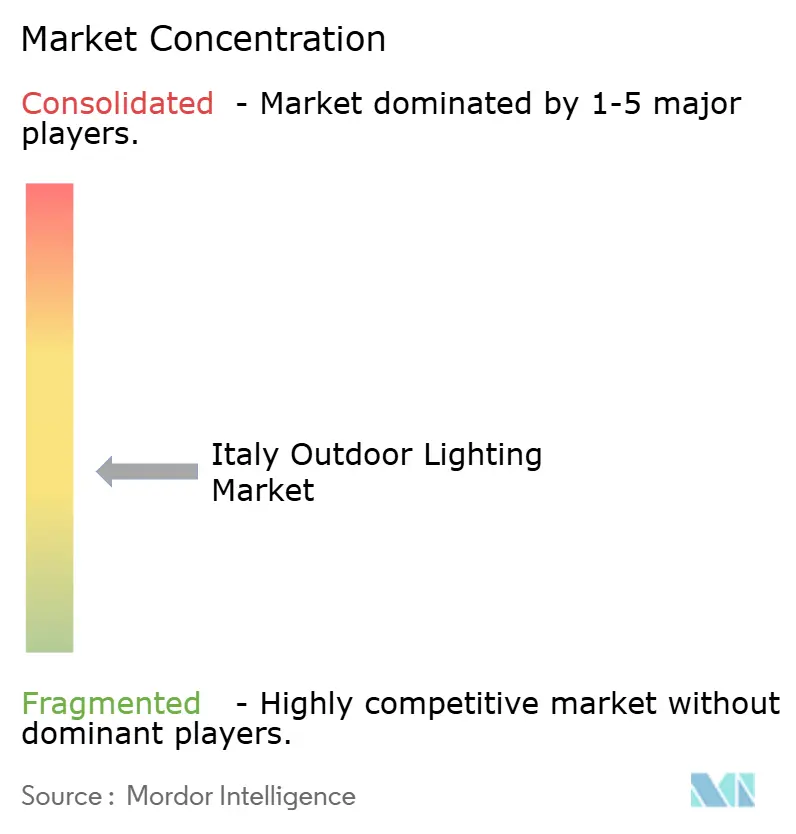
The Italian outdoor lighting market is moderate. Italian design-focused specialists hold established positions in mid- and premium-specification work, while pan-European suppliers compete strongly in municipal tenders and road lighting. iGuzzini, Disano, Neri, Targetti, and Platek compete alongside Signify and Schréder. Product choice increasingly rests on connected controls, serviceability, circular product design, and digital sales capability. Signify moved 22 European outdoor product families under the Signify brand in May 2026. The group included Iridium gen4 Mini for roadways, CitySoul gen2 LED Mini for urban applications, and OptiVision LED gen3.5 for sports lighting.
Schréder launched IZYLUM NEO in March 2026 for road and urban applications. The product uses modular photometric platforms and universal mounting designed for long-term asset management. Ambienta completed a majority acquisition of Disano Illuminazione in May 2026. Disano reported EUR 113 million in revenue in 2024, and the transaction points to investor interest in manufacturers with municipal relationships and established design capability. The Italy outdoor lighting market is therefore seeing consolidation at the manufacturer level alongside greater scale in service operations. These developments can give larger suppliers more resources for documentation, connected systems, and broader distribution.
Italian mid-tier manufacturers such as Lombardo, Linea Light, Litek, Duralite, and Simes compete through Italian production, customization, and shorter response times for smaller specification projects. City Green Light, GMR Enlights, and Niteko are active in energy-service and solar-lighting work, where contract delivery and grid independence matter as much as fixture design. iGuzzini’s Lander collection offers up to 120 lm/W with Optismart optics and supports end-of-life component recovery. This supports the shift toward maintainable products and recurring service activity. The Italy outdoor lighting industry has room for suppliers that can link product performance to maintenance and energy reporting.
Italy Outdoor Lighting Industry Leaders
-
Signify N.V.
-
iGuzzini Illuminazione S.p.A.
-
Disano Illuminazione S.p.A.
-
Schréder
-
Zumtobel Group AG
- *Disclaimer: Major Players sorted in no particular order
Recent Industry Developments
- August 2026: Edison Next was awarded the 12-year public-lighting and smart-city concession for Alassio, Liguria, valued at EUR 12 million, covering full LED network renewal and advanced telecontrol systems for the coastal municipality.
- May 2026: Signify moved 22 European outdoor product families, including Iridium gen4 Mini, CitySoul gen2 LED Mini, and OptiVision LED gen3.5, to the Signify brand, with further family rollouts scheduled for June, September, and October 2026.
- May 2026: Ambienta completed the majority acquisition of Disano Illuminazione S.p.A., Rozzano, Milan, which reported EUR 113 million in 2024 revenue, signaling continued private-equity consolidation among Italian outdoor lighting manufacturers.
- March 2026: iGuzzini launched the Lander and Ribeira outdoor collections. Ribeira, designed by David Chipperfield, offers ceiling, wall-mounted, and bollard configurations with Optidiamond micro-optics and fully disassemblable construction. Lander achieves up to 120 lm/W with Optismart optics.
Italy Outdoor Lighting Market Report Scope
| Decorative lighting | |
| Post lights | |
| Wall lights | Hanging lights |
| Chandeliers | |
| Others (flush mounts, etc.) | |
| Path & step lights | |
| Deck & patio lights | |
| Garden lights | |
| Security lighting | |
| Flood & spotlights | |
| Bollard | |
| Others (rope lights, string lights, etc.) |
| LED |
| Fluorescent |
| Incandescent |
| Halogen |
| Other Light Sources (HID, OLED, laser, etc.) |
| New Installations |
| Retrofit / Replacement |
| Residential |
| Commercial (HoReCa, Sports centers, Healthcare, Retail, Institutional, and Others (galleries/museums, corporates, etc.)) |
| Direct Sales (B2B / Tenders) |
| Online / D2C |
| Authorized Distributors & Retailers |
| Northwest Italy |
| Northeast Italy |
| Central Italy |
| South Italy |
| Islands |
| By Product Type | Decorative lighting | |
| Post lights | ||
| Wall lights | Hanging lights | |
| Chandeliers | ||
| Others (flush mounts, etc.) | ||
| Path & step lights | ||
| Deck & patio lights | ||
| Garden lights | ||
| Security lighting | ||
| Flood & spotlights | ||
| Bollard | ||
| Others (rope lights, string lights, etc.) | ||
| By Light Source | LED | |
| Fluorescent | ||
| Incandescent | ||
| Halogen | ||
| Other Light Sources (HID, OLED, laser, etc.) | ||
| By Installation Type | New Installations | |
| Retrofit / Replacement | ||
| By Application | Residential | |
| Commercial (HoReCa, Sports centers, Healthcare, Retail, Institutional, and Others (galleries/museums, corporates, etc.)) | ||
| By Distribution Channel | Direct Sales (B2B / Tenders) | |
| Online / D2C | ||
| Authorized Distributors & Retailers | ||
| By Geography | Northwest Italy | |
| Northeast Italy | ||
| Central Italy | ||
| South Italy | ||
| Islands | ||
Key Questions Answered in the Report
What is the forecast growth rate for outdoor lighting in Italy?
The Italy outdoor lighting market is forecast to grow at a 6.10% CAGR from 2026 to 2031 and to reach USD 1.33 billion by 2031. Municipal LED replacement, performance contracts, product rules, and demand from private exterior spaces support this outlook.
Which product category leads outdoor lighting revenue in Italy?
Wall lights led product-type revenue with a 49.7% share in 2025. Their wide use across facades, terraces, courtyard entrances, homes, hotels, retail properties, and public-facing buildings supports a stable role in product demand.
What is driving LED retrofit demand in Italy?
Aging sodium-vapor and fluorescent equipment, energy savings, and long-term performance contracts are driving retrofit and replacement activity. The supplied data shows that retrofit and replacement is forecast to expand at a 7.8% CAGR through 2031.
Which installation type is expanding fastest through 2031?
Retrofit and replacement is forecast to grow at a 7.80% CAGR through 2031, the highest installation growth rate in the supplied data. The work can include fixtures, remote controls, maintenance, and performance commitments under one contract.