
Italy Grapes Harvesters Market Size and Share
Market Overview
| Study Period | 2021 - 2031 |
|---|---|
| Forecast Data Period | 2026 - 2031 |
| Base Year Market Size (2025) | USD 110 Million |
| Market Size (2026) | USD 118.58 Million |
| Market Size (2031) | USD 172.63 Million |
| Growth Rate (2026 - 2031) | 7.80 % |
| Market Concentration | Medium |
Major Players *Disclaimer: Major Players sorted in no particular order Image © Mordor Intelligence. Reuse requires attribution under CC BY 4.0. | |
Italy Grapes Harvesters Market Analysis by Mordor Intelligence
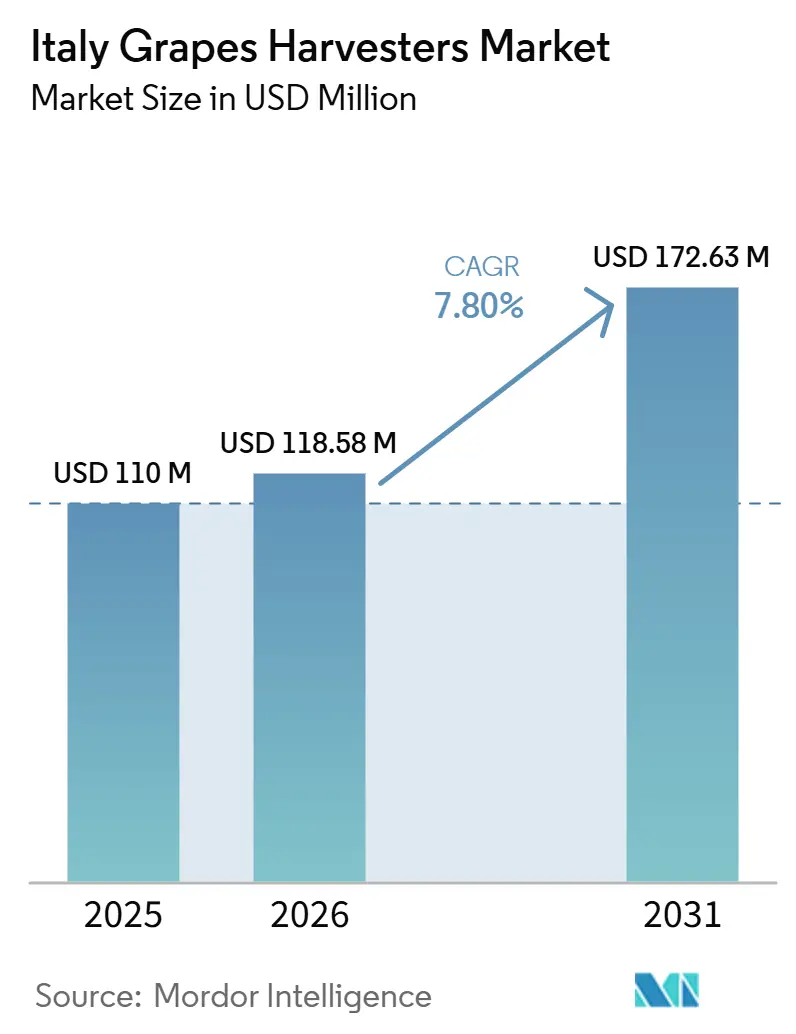
The Italy grape harvesters market was valued at USD 110.00 million in 2025 and is forecast to grow from USD 118.58 million in 2026 to USD 172.63 million by 2031, at a CAGR of 7.80% during the forecast period 2026–2031. The market is supported by producers seeking to reduce exposure to seasonal labor shortages and high hand-harvesting costs. Equipment purchases are also being shaped by public support for mechanization and vineyard restructuring, which can make machine-compatible layouts more accessible. Precision functions are becoming more important as yield, quality, and field data can be collected during harvesting rather than in separate passes. Fragmented plots, slopes, narrow rows, and premium-wine practices limit the adoption of standard machines, but they also create demand for specialized equipment. The Italy grape harvesters market therefore offers opportunities for manufacturers that combine terrain suitability, service support, and data functions without imposing an unsuitable operating model on smaller estates.
Key Report Takeaways
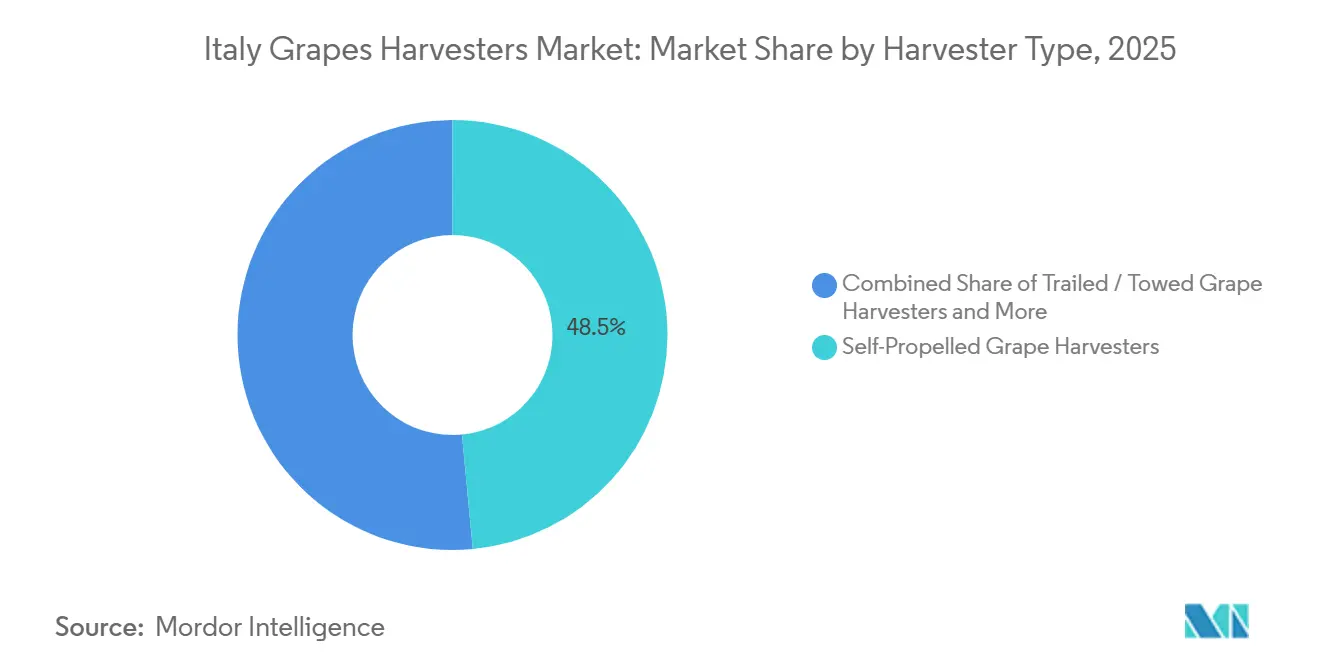
- By harvester type, self-propelled grape harvesters were the largest segment and held 48.5% of the Italy grapes harvesters market share in 2025, while tractor-mounted grape harvesters are the fastest-growing segment and are forecasted to expand at an 11.8% CAGR between 2026 and 2031.
- By mode of operation, assisted and precision-guided operation was the largest segment and held 54.2% of the Italy grapes harvester market size in 2025, while autonomous and semi-autonomous operation is the fastest-growing segment and is forecasted to expand at a 13.2% CAGR between 2026 and 2031.
- By power source, diesel-powered harvesters were the largest segment and held 66.8% of the market share in 2025, while electric harvesters are the fastest-growing segment and are forecasted to expand at a 14.0% CAGR between 2026 and 2031.
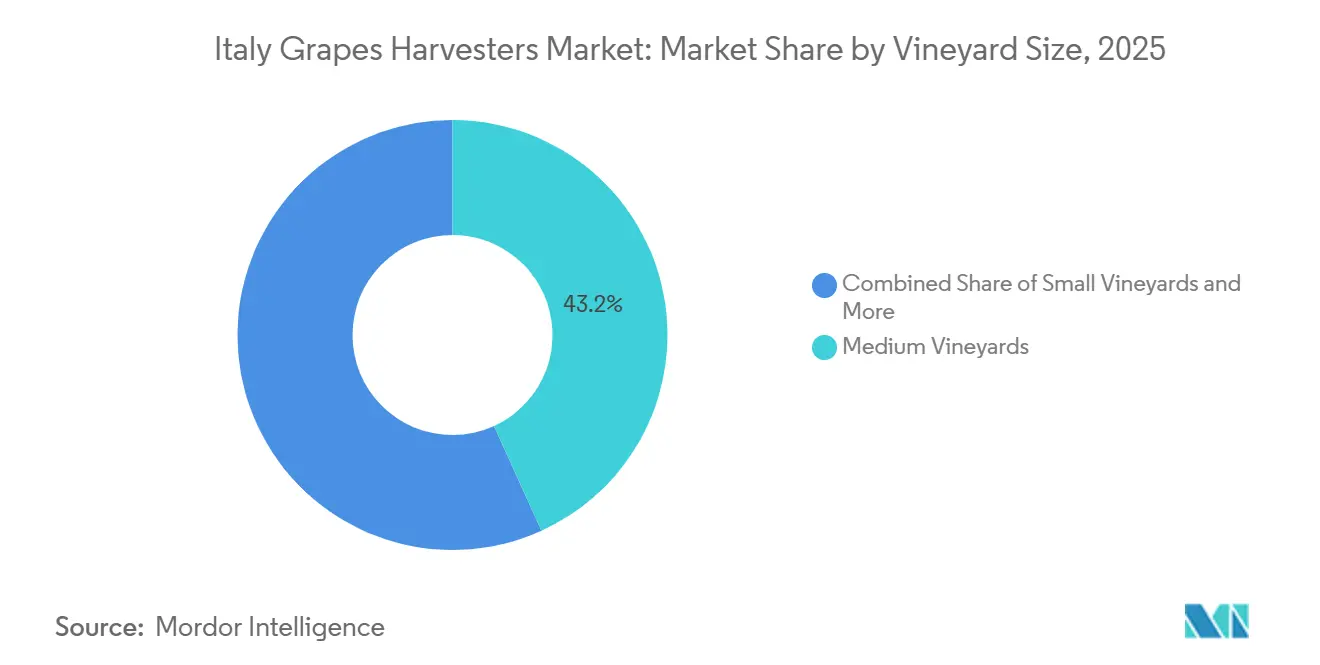
- By vineyard size, vineyards of 51-200 hectares were the largest segment and held 43.2% of the market share in 2025, while vineyards below 50 hectares are the fastest-growing segment and are forecasted to expand at a 12.4% CAGR between 2026 and 2031.
Note: Market size and forecast figures in this report are generated using Mordor Intelligence’s proprietary estimation framework, updated with the latest available data and insights as of January 2026.
Market Trends and Insights
Drivers Impact Analysis of Italy Grapes Harvesters Market*
| Driver | (~) % Impact on CAGR Forecast | Geographic Relevance | Impact Timeline |
|---|---|---|---|
| Vineyard Labor Shortages and Rising Harvest Costs | +2.0% | National, with strong relevance in Veneto, Tuscany, Piedmont, and Friuli-Venezia Giulia | Short term (≤ 2 years) |
| Italy’s Vineyard Restructuring and Mechanization Funding | +1.5% | National, with early gains in Veneto, Emilia-Romagna, and Puglia | Medium term (2-4 years) |
| Expansion of Precision Viticulture and Data-Ready Harvesting | +1.2% | National, with stronger adoption in Veneto, Emilia-Romagna, and Sicily commercial estates | Medium term (2-4 years) |
| Vineyard Consolidation Among Commercial Wine Producers | +0.8% | National, concentrated in Puglia, Emilia-Romagna, and Veneto | Medium term (2-4 years) |
| Mechanization Demand in Narrow, Steep and Terraced Vineyards | +0.9% | National, with concentrated relevance in Piedmont, Tuscany, and Friuli-Venezia Giulia | Long term (≥ 4 years) |
| Cooperative and Contractor-Based Harvester Access Models | +0.7% | National, with early adoption in Emilia-Romagna cooperatives and Puglia contractor fleets | Short term (≤ 2 years) |
| Source: Mordor Intelligence | |||
Vineyard Labor Shortages and Rising Harvest Costs
Seasonal labor shortages are increasing the cost and execution risk of manual grape harvesting in Italy. The short harvesting window makes the availability of workers particularly important, as delays can affect harvest timing and grape quality. A 2025 ProWein survey found that 57% of wine-growing companies anticipated further automation and digitalization, with labor shortages identified as the main trigger. The aging agricultural workforce further strengthens the case for mechanization among vineyards that can achieve sufficient annual machine utilization. Cooperative machinery fleets and harvesting contractors can extend access to mechanized equipment for smaller vineyards that may not be able to justify direct ownership. Consequently, labor availability and harvesting-cost pressures are supporting demand for grape harvesters in Italy, particularly where companies can combine machinery with flexible service, contracting, and shared-use models.
Italy’s Vineyard Restructuring and Mechanization Funding
Italy's vineyard restructuring and agricultural mechanization programs are supporting investment in vineyard layouts and equipment that can improve harvesting efficiency. Under Article 58 of Regulation (EU) 2021/2115, Italy implemented vineyard restructuring measures through MASAF Decree 635206 in December 2024. At the regional level, Veneto allocated EUR 13.14 million (USD 14.32 million) to its 2025–2026 vineyard restructuring program, with measures supporting vineyard configurations including Guyot and cordon systems[1]. Italy's National Recovery and Resilience Plan (PNRR) Investment 2.3 also provides financial support for agricultural mechanization, helping reduce the capital barrier associated with modern machinery and precision technologies. This funding environment can encourage vineyards to undertake structural changes that improve machine access while supporting investment in grape harvesters, particularly among commercial producers, cooperatives, and contractors. As mechanization becomes more economically accessible, demand can expand beyond large estates toward smaller and medium-sized vineyards that can access equipment through shared ownership or contracting services.
Expansion of Precision Viticulture and Data-Ready Harvesting
The Italy grapes harvesters market is increasingly shifting from single-purpose harvesting equipment toward machines that can integrate with digital vineyard-management systems. Global Navigation Satellite System (GNSS) guidance, International Organization for Standardization Bus (ISOBUS) connectivity, and geo-tagged crop-quality data can support precise machine positioning, real-time monitoring, and data exchange during harvesting. These technologies are particularly relevant for vineyards operating across variable terrain and multiple plots, where consistent machine control and digital records can improve harvesting coordination and operational planning. As precision-viticulture practices become more integrated with vineyard operations, equipment capable of connecting with farm-management platforms can provide greater value to commercial vineyards and harvesting contractors. The increasing adoption of digital vineyard-management tools is therefore supporting demand for grape harvesters with automation, connectivity, and data-management capabilities.
Mechanization Demand in Narrow, Steep and Terraced Vineyards
Narrow rows, steep slopes, and terraced vineyards create specialized equipment requirements within the Italy grapes harvesters market. These conditions can limit the suitability of standard high-capacity self-propelled harvesters and increase demand for compact, maneuverable, and tractor-mounted machinery. CREA's analysis of Italy's “heroic viticulture” found that vineyard establishment costs in steep, mountainous, terraced, and island production areas are at least 30% higher than in conventional vineyards and can exceed 44% when labor costs are included, reflecting the greater difficulty of vineyard management and the higher reliance on manual work in challenging terrain[2]. Difficult terrain also increases the importance of machine stability, maneuverability, and operator safety. The development of autonomous and robotic vineyard technologies further demonstrates the industry's focus on adapting mechanization to challenging vineyard environments. In September 2025, the Italian Institute of Technology (IIT) and JOiiNT LAB presented Frasky, an autonomous vineyard robot validated at the Le Corne vineyard in Grumello del Monte, Bergamo, for vineyard monitoring, grape-cluster recognition, and targeted treatment applications. These conditions create opportunities for companies offering compact harvesting equipment, autonomous systems, and specialized machinery capable of operating across Italy's varied vineyard topography.
Restraints Impact Analysis of Italy Grapes Harvesters Market*
| Restraint | (~) % Impact on CAGR Forecast | Geographic Relevance | Impact Timeline |
|---|---|---|---|
| High Acquisition Cost and Long Equipment Payback | -1.5% | National, most acute in Piedmont, Tuscany, and fragmented small-estate regions | Short term (≤ 2 years) |
| Operator, Maintenance and Specialized Technician Shortages | -0.9% | National, with limited service networks in southern Italy and rural interior areas | Medium term (2-4 years) |
| Limited Suitability for Italy’s Fragmented and Irregular Vineyards | -1.2% | National, concentrated in Piedmont, Tuscany, Friuli-Venezia Giulia, and historic protected designation of origin (PDO) areas | Long term (≥ 4 years) |
| Premium-Wine Quality Concerns and Selective Hand-Harvesting Preferences | -0.6% | Concentrated in Barolo, Brunello, Amarone, and Prosecco Superiore controlled and guaranteed designation of origin (DOCG) areas | Long term (≥ 4 years) |
| Source: Mordor Intelligence | |||
High Acquisition Cost and Long Equipment Payback
High acquisition costs can constrain the adoption of self-propelled grape harvesters, particularly among small and medium-sized Italian vineyards. The relatively short annual harvesting period can limit machine utilization and extend the payback period for producers that operate smaller vineyard areas. Vineyard restructuring or access modifications may also require additional investment before harvesting machinery can be used efficiently. These factors can make direct ownership less attractive compared with agricultural contractors, cooperatives, and shared-equipment arrangements, which allow producers to access mechanized harvesting without bearing the full capital cost. In addition, ownership involves ongoing expenditure on maintenance, operator training, specialized technicians, and seasonal servicing. Consequently, the total investment decision extends beyond the purchase price of the harvester to include vineyard suitability, utilization rates, maintenance, training, and local after-sales service, creating a restraint on market adoption where these costs cannot be spread across sufficiently large harvesting operations.
Limited Suitability for Italy’s Fragmented and Irregular Vineyards
Italy's fragmented vineyard structure and historical row layouts can limit the suitability of standard grape harvesters. Self-propelled machines require sufficient row spacing, turning areas, and relatively consistent vineyard geometry, which can restrict their use in irregular or constrained plots. CREA reported in April 2026 that the number of agricultural holdings in Italy's mountain areas had declined by 36% over recent decades, while agricultural utilized area decreased by 33% between 1980 and 2020, highlighting the structural changes affecting agricultural production in difficult-terrain areas[3]. A 2024 IEEE study of Veneto's DOCG vineyards also found that topography and row configuration affected the suitability of mechanical harvesting across portions of protected-designation-of-origin (PDO) vineyard areas. Replanting vineyards to accommodate mechanized harvesting can require changes in row orientation, spacing, training systems, and vineyard-management practices. These structural constraints limit the suitability of standard harvesting platforms and increase the relevance of compact, maneuverable, and steep-slope machines, while conversion of existing vineyards to machine-compatible layouts can require additional investment and planning.
*Our forecasts treat driver/restraint impacts as directional, not additive. The impact forecasts reflect baseline growth, mix effects, and variable interactions.
Italy Grapes Harvesters Market Segment Analysis
By Harvester Type:
Terrain-Suitable Tractor-Mounted Platforms Support New AccessSelf-propelled grape harvesters held 48.5% of the Italy grapes harvesters market in 2025, supported by their high harvesting efficiency and suitability for medium and large vineyards with relatively regular row configurations. Their multi-purpose carrier platforms can also support activities such as spraying and other vineyard operations, improving equipment utilization beyond the harvest period. Trailed and towed harvesters provide a lower-capital alternative for contractors, cooperatives, and producers that do not require a dedicated self-propelled fleet. PELLENC S.A.S. updated its Grapes'Line range with shaker arms and the SELECTIV'PROCESS 2 sorting head, with the company reporting a 99.82% clean-harvest rate for the range[4]. These configurations provide different pathways to mechanization based on vineyard size, terrain, and investment capacity.
Tractor-mounted grape harvesters are forecast to be the fastest-growing harvester type, expanding at an 11.8% CAGR between 2026 and 2031. Their growth is supported by demand from narrow-row, steep-slope, and irregular vineyards where larger self-propelled machines may have limited access. CRF Costruzioni S.r.l. and Andreoli Engineering S.r.l. offer compact harvesting solutions designed for more constrained vineyard conditions, allowing producers and contractors to use existing tractor fleets and reduce the need for a dedicated harvesting carrier. Their smaller format can also improve maneuverability in vineyards where headland space and row access are restricted. Consequently, tractor-mounted platforms are gaining relevance as a specialized mechanization option for difficult terrain and smaller commercial vineyards, while self-propelled harvesters remain important for larger, accessible vineyard blocks.



By Mode of Operation:
Assisted Systems Lead While Autonomous Functions DevelopAssisted/ precision-guided operation held 54.2% of the Italy grapes harvesters market in 2025, reflecting the growing adoption of technologies that improve machine control and harvesting consistency. Global Positioning System (GPS) row tracking, International Organization for Standardization Bus (ISOBUS) connectivity, and automated shaker adjustment are increasingly incorporated into modern grape harvesters. Grégoire's 2026 GL and GX families, ERO's Grapeliner 8000, and New Holland Agriculture's Braud 9.80N illustrate the integration of guidance, connectivity, and automated harvesting functions into commercial equipment. These technologies support repeatable harvesting passes and facilitate data exchange across vineyard-management systems. Manual operation remains relevant among older equipment fleets and smaller producers, making compatibility with existing machinery and farm-management systems an important consideration in equipment replacement decisions.
Autonomous/ semi-autonomous operation is forecast to be the fastest-growing mode, expanding at a 13.2% CAGR between 2026 and 2031. Growth is supported by increasing interest in autonomous vineyard technologies, particularly among larger commercial operations, contractors, and cooperatives seeking to address labor constraints. In 2025, the Italian Institute of Technology (IIT) and JOiiNT LAB validated Frasky, an autonomous vineyard robot, at the Le Corne vineyard in Grumello del Monte, Bergamo, for plant monitoring, grape-cluster recognition, and targeted treatment applications. These developments indicate that autonomy is progressing from research toward practical vineyard applications, although harvesting deployment still requires dependable machine control, operator oversight, safety systems, and field validation. Consequently, autonomous functions are likely to develop alongside assisted and precision-guided systems rather than immediately replace conventional operator-controlled harvesting across Italy's diverse vineyard conditions.
By Power Source:
Electric Models Add a Low-Emission OptionDiesel-powered harvesters held 66.8% of the Italy grapes harvesters market in 2025, supported by their established use in commercial vineyards, long operating ranges, existing refueling infrastructure, and established dealer-service networks. Diesel equipment must comply with the applicable Stage V emissions requirements for non-road mobile machinery, encouraging manufacturers to improve engine efficiency and emissions performance. Poclain Hydraulics Hybrid systems provide an intermediate option where producers seek lower fuel consumption without relying entirely on charging infrastructure. Diesel-powered machines are likely to remain important for vineyards requiring long operating periods and harvesting across dispersed plots, where charging logistics can be challenging.
Electric harvesters are forecast to be the fastest-growing power-source segment, expanding at a 14.0% CAGR between 2026 and 2031. Their adoption is supported by the industry's movement toward lower-emission machinery and the availability of agricultural mechanization incentives that can support equipment replacement and modernization. Electric systems can also reduce local exhaust emissions and operating noise, which can be relevant around wineries and other closely managed production facilities. However, charging infrastructure, battery operating duration, terrain, and harvesting-window requirements remain important considerations for commercial adoption. Consequently, Italy's grape harvesting machinery market is likely to retain a mix of diesel, hybrid, and electric technologies, with the choice of power source depending on vineyard size, terrain, daily operating requirements, infrastructure availability, and the economics of equipment replacement.
By Vineyard Size:
Shared Access Broadens Use Among Smaller EstatesMedium vineyards of 51–200 hectares held 43.2% of the Italy grapes harvesters market in 2025, reflecting their ability to justify direct investment in harvesting machinery through sufficient operating area and utilization. These medium-sized and larger commercial vineyards can support self-propelled harvesters with higher capacity, automated functions, and data connectivity, while also maintaining dedicated operator and maintenance capabilities. Vineyards above 200 hectares remain established users of mechanized harvesting equipment, although their higher level of mechanization creates a more mature replacement-driven market. This makes the 51–200 hectare segment an important customer base for new equipment purchases and fleet upgrades.
Small vineyards below 50 hectares are forecast to be the fastest-growing size segment, expanding at a 12.4% CAGR between 2026 and 2031. Adoption in this segment is increasingly supported by shared-access models rather than direct ownership alone. A 2026 precision-mechanization study found that a 65% subsidy reduced the minimum viable area for full precision mechanization from 25.81 hectares to 18.98 hectares, improving the economic feasibility of mechanization for smaller operations[5]. Cooperative fleets and agricultural contractors can further improve equipment utilization by deploying harvesters across multiple vineyards during the concentrated harvesting period. Consequently, rental, contracting, cooperative ownership, and service-based models can broaden access to grape harvesters among smaller Italian vineyards, although adoption remains dependent on compatible vineyard layouts, local equipment availability, and the ability to coordinate harvesting schedules

Geography Analysis
Veneto is an important regional market for grape harvesting machinery, supported by its large and diverse wine-producing base, including Prosecco, Valpolicella, and Soave DOC and DOCG areas. The region combines vineyards suitable for high-throughput mechanization with more terrain-constrained production areas, creating demand for different harvesting configurations. The POTA.RAZIO project continued work on smart mechanization in Veneto viticulture in 2025, supporting the development of technology-oriented vineyard management. Fleet replacement is also influenced by emissions requirements and growing interest in equipment with digital monitoring and data-management capabilities. This combination makes Veneto an important market for both replacement equipment and precision-enabled grape harvesters.
Emilia-Romagna benefits from cooperative production structures and vineyard restructuring toward Guyot and cordon training systems, which can improve access to mechanized harvesting for smaller producers. Puglia provides opportunities for high-throughput harvesting and contractor-based operations, supported by relatively accessible vineyard layouts in many production areas. Sicily also provides opportunities for mechanical harvesting where labor availability and harvesting costs create pressure to improve field efficiency. A University of Palermo study examined the economic and operational implications of mechanized harvesting for Chardonnay and Nero d'Avola vineyards. These regional differences indicate that demand is influenced not only by vineyard area but also by row configuration, terrain, labor conditions, and the organization of local production.
Tuscany and Piedmont maintain demand for equipment capable of supporting quality-focused and selective harvesting practices, although terrain and premium-wine production requirements can limit the use of standard high-capacity machines in some areas. Friuli-Venezia Giulia and Trentino-Alto Adige require harvesting solutions adapted to quality-oriented DOC production and more challenging vineyard terrain. Lombardy provides opportunities associated with vineyard restructuring and machinery modernization, while Abruzzo, Campania, Marche, Umbria, and Lazio can support contractor- and cooperative-based harvesting demand. Across these regions, adoption is increasingly determined by the compatibility of harvesting equipment with vineyard layout, terrain, production practices, and the availability of local dealers and service networks.
Competitive Landscape
Market Concentration
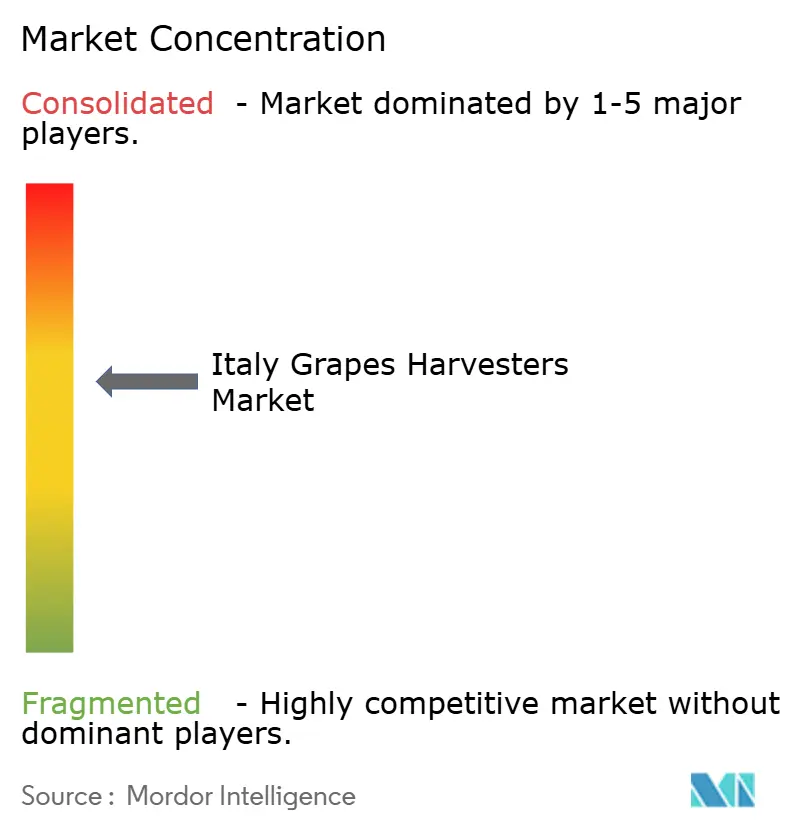
The Italy grape harvesters market is moderately concentrated, with the leading players competing across harvesting capacity, precision functions, terrain adaptability, automation, and after-sales support. Pellenc S.A.S., New Holland Agriculture – Braud, Grégoire S.A.S., ERO GmbH, and CRF Costruzioni S.r.l. represent the major players. Global players maintain strong positions in self-propelled and technology-enabled harvesting equipment, while Italian specialists such as CRF Costruzioni S.r.l. focus on compact solutions for narrow-row and difficult-terrain vineyards. This creates competition between broad equipment portfolios and specialized machinery designed for specific vineyard conditions.
Leading players are increasingly differentiating their equipment through precision guidance, automated harvesting functions, sorting, leveling, and data connectivity. Pellenc S.A.S.'s Grapes'Line range incorporates shaker arms, the SELECTIV'PROCESS 2 sorting head, and ACTIV' row tracking, highlighting the industry's movement toward improved harvesting control and product-quality management. New Holland Agriculture – Braud, Grégoire S.A.S., and ERO GmbH similarly compete through self-propelled platforms incorporating automation, guidance, and operator-assistance technologies. These developments are increasing the importance of machine productivity, harvesting accuracy, data integration, and equipment versatility in purchasing decisions.
Competition also varies according to vineyard structure and operating conditions. ERO GmbH emphasizes harvesting solutions suited to road mobility, slopes, and operator protection, while CRF Costruzioni S.r.l. addresses more constrained vineyard environments with compact harvesting equipment. Smaller vineyards and contractor-operated fleets provide opportunities for players offering lower-capital or specialized configurations, particularly where full-size self-propelled machines are less practical. At the same time, established players benefit from dealer networks, technical support, operator training, and maintenance capabilities, which remain important considerations during the short harvesting season. Consequently, competitive differentiation extends beyond machine specifications to terrain suitability, service coverage, precision capabilities, operating flexibility, and total cost of ownership.
Italy Grapes Harvesters Industry Leaders
-
Pellenc S.A.S.
-
New Holland Agriculture – Braud (CNH Industrial N.V.)
-
Grégoire S.A.S. (SDF S.p.A.)
-
ERO GmbH
-
CRF Costruzioni S.r.l.
- *Disclaimer: Major Players sorted in no particular order
Italy Grapes Harvesters Market Companies Covered in this Report
- Pellenc S.A.S.
- New Holland Agriculture – Braud (CNH Industrial N.V.)
- Grégoire S.A.S. (SDF S.p.A.)
- ERO GmbH
- CRF Costruzioni S.r.l.
- Volentieri Pellenc S.r.l. (Pellenc S.A.S.)
- Andreoli Engineering S.r.l.
- Oxbo International Corporation (Ploeger Oxbo Group B.V.)
Recent Industry Developments in Italy Grapes Harvesters Market
- November 2025: New Holland Agriculture introduced the Braud 9.50L, 9.70L, and 9.70M high-capacity grape harvesters at SITEVI 2025. The models incorporate the new Vari-Control automatic leveling system, which continuously adjusts leveling and hopper-unloading speed according to machine movement. New Holland also upgraded the Braud 9.80N narrow-vineyard harvester with an improved cab, front axle for better terrain compensation, and a refined harvesting head.
- October 2025: Poclain Hydraulics published a case study on October 21, 2025, covering ERO's Grapeliner 8000. The machine uses Poclain hydraulic motors and a CT200 electronic control unit for cruise control and engine protection, with a stated road speed of up to 40 km/h and gradeability of 35%.
- September 2025: Italian Institute of Technology (IIT) announced Frasky, an autonomous vineyard robot, on September 18, 2025. Developed by IIT's Soft Robotics for Human Cooperation and Rehabilitation Lab in collaboration with the JOiiNT LAB ecosystem, the prototype can autonomously navigate vineyards and perform plant monitoring, grape-cluster recognition, and targeted treatment application.
Italy Grapes Harvesters Market Report Scope
A grape harvesting machine is a mechanized device used in vineyards to detach grapes from vines and collect them efficiently during harvest, reducing manual labor and increasing harvesting speed. The Italy grapes harvesters market report is segmented by harvester type (self-propelled, trailed or towed, and tractor mounted), by mode of operation (manual steering, assisted or precision-guided, and autonomous or semi autonomous), by power source (diesel, hybrid, and electric), and by vineyard size (small vineyards (below 50 hectares), medium vineyards (51-200 hectares) and large vineyards (above 200 hectares)). The market forecasts are provided in USD (value).
Segmentation Overview
| Self-Propelled Grape Harvesters |
| Trailed/ Towed Grape Harvesters |
| Tractor-Mounted Grape Harvesters |
| Manual Steering and Operation |
| Assisted/ Precision-Guided Operation |
| Autonomous and Semi-Autonomous Operation |
| Diesel-Powered Harvesters |
| Hybrid Harvesters |
| Electric Harvesters |
| Small Vineyards Below 50 Hectares |
| Medium Vineyards 51 to 200 Hectares |
| Large Vineyards Above 200 Hectares |
| By Harvester Type | Self-Propelled Grape Harvesters |
| Trailed/ Towed Grape Harvesters | |
| Tractor-Mounted Grape Harvesters | |
| By Mode of Operation | Manual Steering and Operation |
| Assisted/ Precision-Guided Operation | |
| Autonomous and Semi-Autonomous Operation | |
| By Power Source | Diesel-Powered Harvesters |
| Hybrid Harvesters | |
| Electric Harvesters | |
| By Vineyard Size | Small Vineyards Below 50 Hectares |
| Medium Vineyards 51 to 200 Hectares | |
| Large Vineyards Above 200 Hectares |
Key Questions Answered in the Report
What is the Italy grape harvesters market size in 2026?
The Italy grape harvesters market is valued at USD 118.58 million in 2026 and is forecast to reach USD 172.63 million by 2031 at a 7.80% CAGR.
Which grape harvester type led sales in Italy?
Self-propelled equipment was the largest harvester type, holding 48.5% in 2025, while tractor-mounted equipment had the highest forecasted growth at an 11.8% CAGR between 2026 and 2031.
Why are growers adopting mechanized grape harvesting?
Labor availability and harvesting costs are major factors. A 2025 Italian case reported EUR 25 per quintal for hand harvesting against EUR 3.40 per quintal for mechanical harvesting.
What power source is growing fastest for grape harvesters in Italy?
Electric harvesters are forecasted to expand at a 14.0% CAGR between 2026 and 2031, supported by replacement incentives and the need to reduce noise and exhaust emissions.