
Italy Fresh Herbs Market Size and Share
Market Overview
| Study Period | 2021 - 2031 |
|---|---|
| Forecast Data Period | 2026 - 2031 |
| Base Year Market Size (2025) | USD 191.86 Million |
| Market Size (2026) | USD 203.14 Million |
| Market Size (2031) | USD 270.31 Million |
| Growth Rate (2026 - 2031) | 5.88 % |
| Market Concentration | Low |
Major Players *Disclaimer: Major Players sorted in no particular order Image © Mordor Intelligence. Reuse requires attribution under CC BY 4.0. | |
Italy Fresh Herbs Market Analysis by Mordor Intelligence
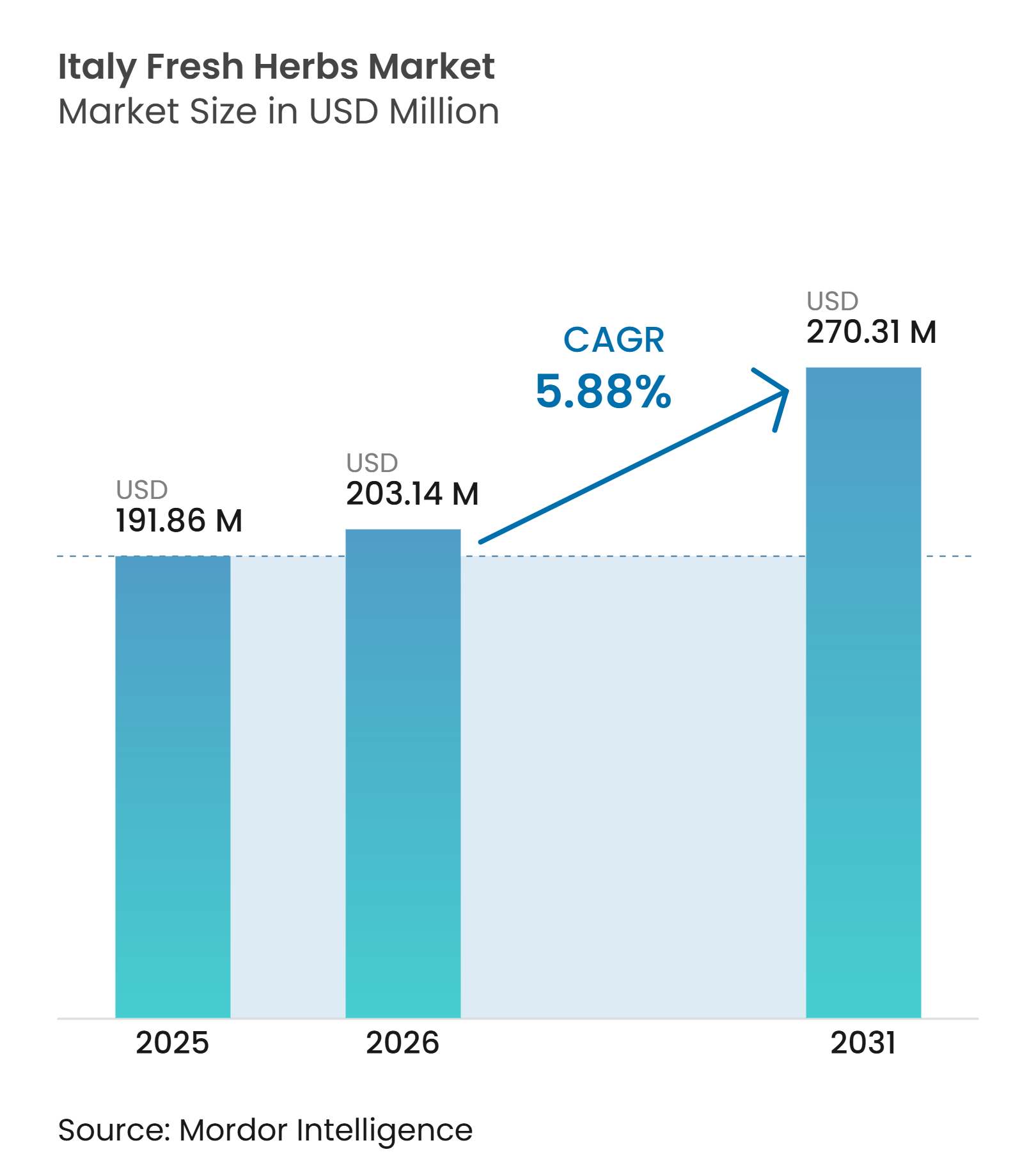
The Italy fresh herbs market was valued at USD 191.86 million in 2025 and is projected to grow from USD 203.14 million in 2026 to USD 270.31 million by 2031, at a CAGR of 5.88% during the forecast period (2026-2031). Italy's established agricultural sector and favorable Mediterranean climate support fresh herb production and market growth. Demand comes from household cooking, foodservice, food processing, and nutraceutical applications, providing the market with multiple demand channels. Mediterranean cuisine and export-oriented food production support recurring procurement of fresh herbs. Suppliers are responding by adopting protected cultivation, pursuing organic certification, improving packaging, and implementing more reliable logistics. The market also faces constraints due to perishability, cold-chain requirements, rising operating costs, and a fragmented producer base.
Key Report Takeaways
- By product type, basil accounted for the largest 45.7% of the Italy fresh herbs market share in 2025, while parsley is projected to grow at the fastest CAGR of 7.1% from 2026 to 2031.
- By category, conventional accounted for the largest share at 74.0% in 2025, while the Italy fresh herbs market size for organic is projected to grow at the fastest CAGR of 9.5% from 2026 to 2031.
- By cultivation method, open-field cultivation accounted for the largest share at 52.0% in 2025, while hydroponic cultivation is projected to grow at the fastest CAGR of 11.0% from 2026 to 2031.
- By end user, food retail accounted for the largest share at 41.2% in 2025 and is projected to grow at the fastest CAGR of 7.4% from 2026 to 2031.
Note: Market size and forecast figures in this report are generated using Mordor Intelligence’s proprietary estimation framework, updated with the latest available data and insights as of January 2026.
Market Trends and Insights
Drivers Impact Analysis of Italy Fresh Herbs Market*
| Driver | (~) % Impact on CAGR Forecast | Geographic Relevance | Impact Timeline |
|---|---|---|---|
| Expansion of Retail Fresh-Produce Assortments | 1.2% | National, with the strongest relevance in large-scale distribution chains in Lombardy, Piedmont, and Veneto | Short term (≤ 2 years) |
| Growth of Home Cooking and Mediterranean Cuisine | 1.0% | National, with strong relevance in central and southern Italy | Medium term (2-4 years) |
| Demand for Organic and Traceable Herbs | 1.5% | National, with export demand from Germany, France, Belgium, the Netherlands, and Luxembourg | Medium term (2-4 years) |
| Year-Round Availability From Controlled-Environment Production | 0.8% | National, concentrated in Liguria, Veneto, Lazio, and Emilia-Romagna | Short term (≤ 2 years) |
| Protected Genovese Basil Identity and Premiumization | 0.6% | Liguria production base and national premium retail distribution | Long term (≥ 4 years) |
| Hydroponic Cultivation Enabling Low-Nickel and Nutrient-Enriched Basil | 0.5% | National, especially northern urban retail and health-food channels | Long term (≥ 4 years) |
| Source: Mordor Intelligence | |||
Expansion of Retail Fresh-Produce Assortments
Italian retailers are expanding access to fresh produce, creating more opportunities for fresh herbs to reach household consumers through grocery channels. According to the Institute of Services for the Agricultural and Food Market (ISMEA), in the first half of 2025, volumes of fresh vegetables purchased by Italian households increased by 4.9% year over year. This growth supports retailers' ability to maintain and expand fresh herb assortments. Greater retail availability improves consumer access, encourages repeat purchases, and strengthens the role of fresh herbs in Italy's retail food market, thereby supporting market growth.
Growth of Home Cooking and Mediterranean Cuisine
Mediterranean-style cooking relies on fresh culinary herbs to add flavor and aroma to everyday meals, creating consistent household demand. This established culinary practice supports a stable consumption base and drives repeat purchases through grocery and food retail channels. The Italian Society of Human Nutrition (SINU), in its 2025 update of the Mediterranean diet pyramid, recommends using spices and aromatic herbs to flavor foods, thereby reinforcing their role in Mediterranean dietary practices[1]. The continued integration of herbs into everyday cooking supports regular consumption and contributes to market growth.
Year-Round Availability From Controlled-Environment Production
Controlled-environment production allows fresh herb growers to maintain consistent cultivation conditions and continuity of supply despite seasonal and weather-related variability. These systems regulate temperature and irrigation, helping producers maintain production schedules that support consistent deliveries to retailers and other commercial buyers. Società Agricola Simonato S.r.l. operates 40,000 square meters of equipped greenhouses with heating and ebb-and-flow irrigation systems, supporting year-round production of organic aromatic herbs[2]. This controlled production capability improves supply reliability and enables suppliers to meet recurring orders, supporting market growth.
Protected Genovese Basil Identity and Premiumization
Protected designation strengthens the identity of Genovese basil by linking eligible production to a defined geographic origin and specific production requirements, helping producers differentiate their products and build buyer confidence. The Fondazione Qualivita reported in 2025 that the Basilico Genovese DOP supply chain had 50 producers, representing 98% of the sector. This broad participation indicates strong adoption of the protected designation within the certified supply chain and strengthens the product's recognition among commercial buyers. Consequently, protected-origin positioning supports differentiated procurement and contributes to market growth.
Restraints Impact Analysis of Italy Fresh Herbs Market*
| Restraint | (~) % Impact on CAGR Forecast | Geographic Relevance | Impact Timeline |
|---|---|---|---|
| Short Shelf Life and Cold-Chain Losses | -0.9% | National, with heightened exposure on southern distribution routes | Short term (≤ 2 years) |
| Labor, Energy, and Input-Cost Inflation | -0.8% | National, with greenhouse producers in Liguria and Veneto particularly exposed | Medium term (2-4 years) |
| Fragmented Producer Base and Limited Contract Coordination | -0.6% | National, most acute in smaller inland production areas | Long term (≥ 4 years) |
| Basil Disease Risk in Reused Hydroponic Water and Protected Cultivation | -0.5% | National, concentrated in greenhouse and hydroponic districts | Medium term (2-4 years) |
| Source: Mordor Intelligence | |||
Short Shelf Life and Cold-Chain Losses
Fresh herbs have strict postharvest handling requirements because their quality and safety can deteriorate during processing and distribution. These requirements increase operational complexity and can raise costs for producers and distributors. In 2025, the European Food Safety Authority (EFSA) identified fresh and frozen fruits, vegetables, and herbs as requiring dedicated process-water management plans, including measures such as disinfection and water replenishment. Such requirements increase supply chain complexity, particularly for fresh products, limiting operational efficiency and constraining market growth.
Labor, Energy, and Input-Cost Inflation
Fresh herb production incurs labor, energy, packaging, and other operating costs, particularly for growers who use controlled cultivation and frequent postharvest handling. According to the Italian National Institute of Statistics (Istat), in 2025, prices of goods and services used in Italian agriculture fell by 4.5% in 2024, indicating that overall input costs did not increase uniformly[3]. However, individual cost components can still increase production costs and put pressure on grower margins, particularly for energy-intensive operations. These cost pressures can limit investment capacity and profitability, constraining market growth.
*Our forecasts treat driver/restraint impacts as directional, not additive. The impact forecasts reflect baseline growth, mix effects, and variable interactions.
Italy Fresh Herbs Market Segment Analysis
By Product Type:
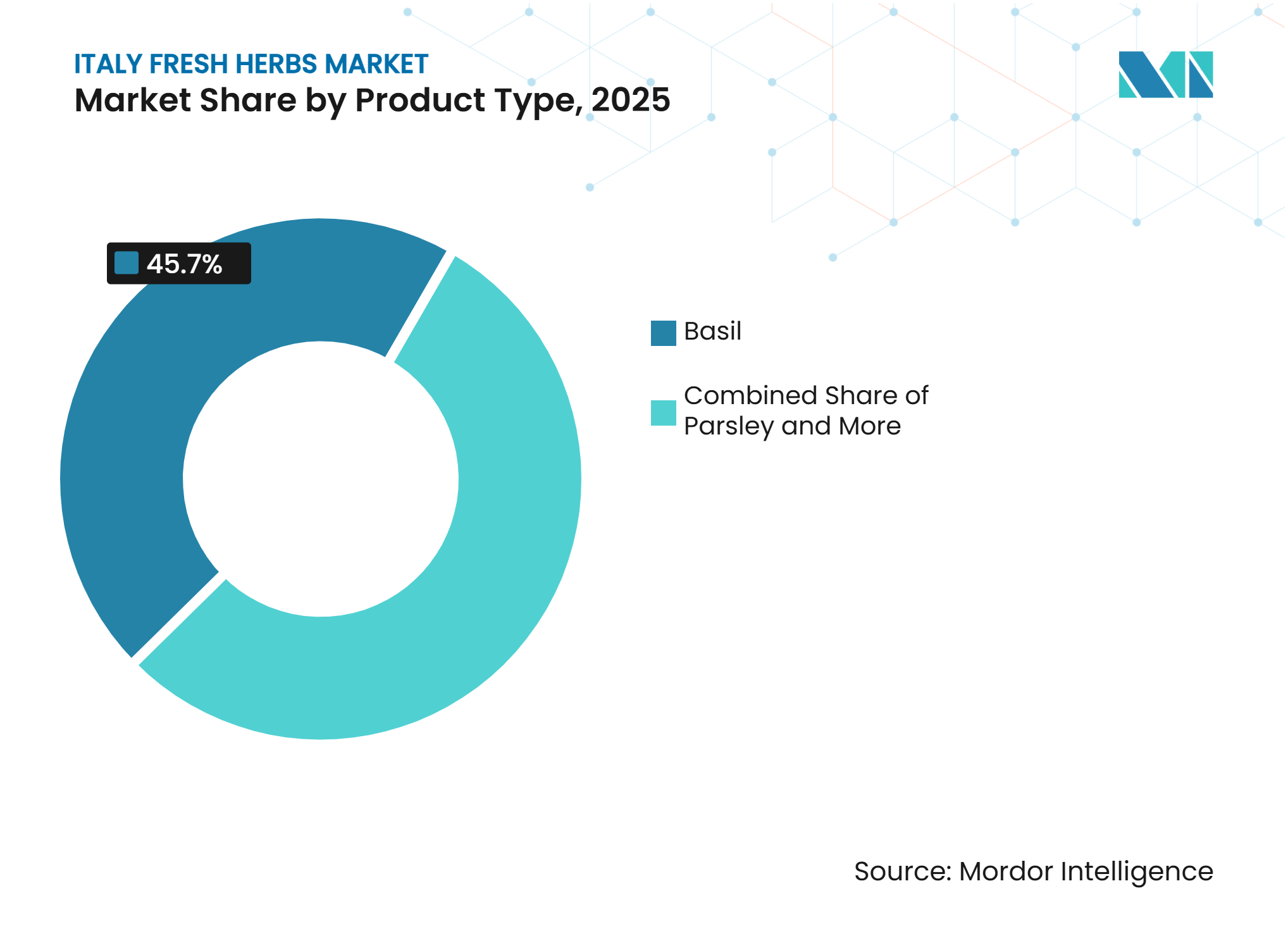
Basil Leads While Parsley Expands Across End UsesBasil accounted for the largest share of the Italy fresh herbs market at 45.7% in 2025. Its established culinary role supports demand across household cooking, foodservice, and food processing applications. Basil remains closely associated with pesto and prepared foods, giving suppliers access to both retail and industrial customers. Its use across multiple applications supports recurring procurement and product availability. Producers can also differentiate basil through cultivation practices, packaging, origin credentials, and quality specifications. This broad application base supports basil's leading position and provides a stable foundation for continued market development.
Parsley is projected to grow at the fastest CAGR of 7.1% from 2026 to 2031, supported by its use across household cooking, foodservice, prepared foods, marinades, meal kits, and fresh-trim applications. Its broad culinary use allows suppliers to serve multiple customer groups rather than relying on a single application. Parsley can also support botanical and nutraceutical applications where processors require consistent raw material characteristics. Greater standardization in cultivation, harvesting, packaging, and supply can improve access to organized retail and commercial food customers. These factors provide opportunities for parsley suppliers to broaden demand across the Italian fresh herb supply chain.



By Category:
Conventional Supply Retains Scale While Organic Gains ValueConventional herbs accounted for the largest share at 74.0% in 2025, supported by broad availability across retail and foodservice channels. Conventional cultivation provides suppliers with established production and distribution structures that serve recurring demand from household consumers, restaurants, and food manufacturers. Retailers can source conventional herbs in formats suited to different purchasing requirements, including packaged and bulk products. This established supply base supports consistent market access while allowing producers to respond to mainstream consumption patterns. Conventional supply, therefore, remains an important foundation for the overall development of fresh herb distribution in Italy.
Organic herbs are projected to grow at the fastest CAGR of 9.5% from 2026 to 2031, supported by certified production, traceability requirements, and demand for differentiated agricultural products. Organic certification gives producers a recognized framework for cultivation and enables retailers to communicate production attributes to consumers. Italian suppliers are also developing packaging formats that align with sustainability requirements and organic positioning. Società Agricola Simonato S.r.l. introduced its Bio and Paperpack line for potted organic aromatic plants, demonstrating how certification and packaging can be combined to strengthen product differentiation. These developments create additional opportunities for organic fresh herb suppliers.
By Cultivation Method:
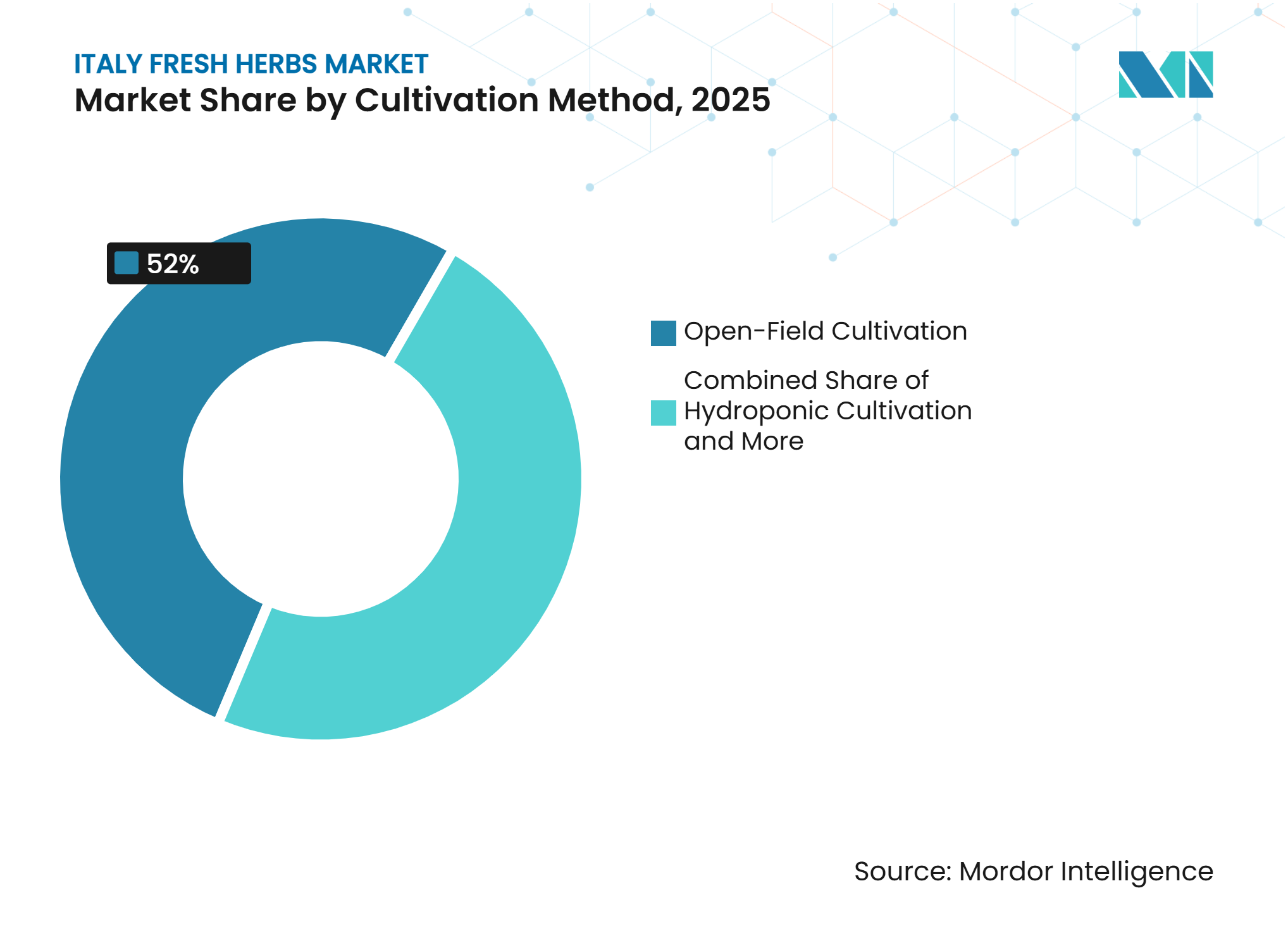
Open-Field Scale Is Complemented by Hydroponic ControlOpen-field cultivation accounted for the largest share at 52.0% in 2025, reflecting its established role in producing seasonal culinary herbs. Field production enables growers to cultivate herbs across suitable agricultural areas while supporting established harvesting and distribution practices. The method remains relevant for suppliers serving retail, foodservice, and processing customers that require regular access to fresh products. Producers can complement field cultivation with greenhouse production to manage seasonal availability and product continuity. This combination allows suppliers to maintain established production practices while responding to differing customer requirements across the fresh herbs supply chain.
Hydroponic cultivation is projected to grow at the fastest CAGR of 11.0% from 2026 to 2031, supported by controlled nutrient delivery, water management, and growing conditions. Hydroponic systems can help producers manage production cycles more precisely and reduce dependence on soil conditions. They can also support differentiated cultivation strategies where growers target specific product characteristics or a consistent year-round supply. Research and commercial activity in controlled cultivation are increasing opportunities for technology-based herb production in Italy. Greater adoption can strengthen supply consistency and create additional production options for retailers and processors requiring dependable fresh herb availability.

By End User:
Food Retail Leads Demand While Processing Supports Supply ContractsFood retail accounted for the largest share at 41.2% in 2025 and is projected to grow at the fastest CAGR of 7.4% from 2026 to 2031, supported by the broader availability of packaged, potted, conventional, and organic fresh herbs. Retailers provide consumers with recurring access and require consistent quality, packaging, replenishment, and delivery. These requirements encourage investment in postharvest handling and distribution capabilities, strengthening food retailers' role in the commercialization of fresh herbs across Italy.
Food processing, pharmaceutical and nutraceutical, and other end users provide additional demand channels for fresh herbs and herb-derived ingredients. Food processors use basil, parsley, and other herbs in pesto, sauces, prepared foods, and convenience products, creating recurring procurement requirements. Pharmaceutical and nutraceutical applications use botanical materials and extracts where consistent raw material characteristics are important. Other applications provide additional outlets for specialized products and ingredients. Together, these end users broaden demand beyond household consumption and provide suppliers with opportunities to diversify customer relationships, improve production planning, and strengthen the overall commercial development of fresh herbs in Italy.
Geography Analysis
Northern Italy serves as an important commercial and production base for fresh herbs, supported by developed agricultural systems, organized food retail, foodservice networks, and proximity to major urban consumption centers. Regions such as Lombardy, Veneto, Emilia-Romagna, Piedmont, and Liguria provide established horticultural and distribution infrastructure that facilitates the regular movement of perishable products. Controlled-environment cultivation and greenhouse production support consistent availability where land, technology, and logistics are integrated. The concentration of organized retailers and foodservice operators creates recurring procurement requirements that support the commercialization of basil, parsley, mint, and other fresh herbs.
Central and Southern Italy offer significant opportunities due to diverse agricultural conditions, extensive horticultural activity, and strong links between agricultural production and domestic food consumption. Tuscany, Lazio, Campania, Puglia, Sicily, and other regions contribute to Italy's broader agricultural supply base, while regional climatic differences support production across different growing periods. The southern regions also contain a large concentration of agricultural enterprises, creating a broad supplier base for fresh produce. Retail expansion, foodservice demand, processing applications, and improved distribution networks can strengthen commercialization opportunities for fresh herbs across Central and Southern Italy.
Regional agricultural performance provides an important foundation for fresh herb availability, as herbs compete for resources within the broader horticultural system. The Italian National Institute of Statistics (ISTAT) reported that agricultural production volume increased by 1.4% in 2024, while fresh vegetable production increased by 3.8%, indicating favorable conditions for the broader vegetable supply base. This environment supports opportunities for the production, sourcing, and distribution of fresh herbs, although regional differences in climate, farm structures, technology adoption, and logistics continue to influence market development across Italy.
Competitive Landscape
Market Concentration
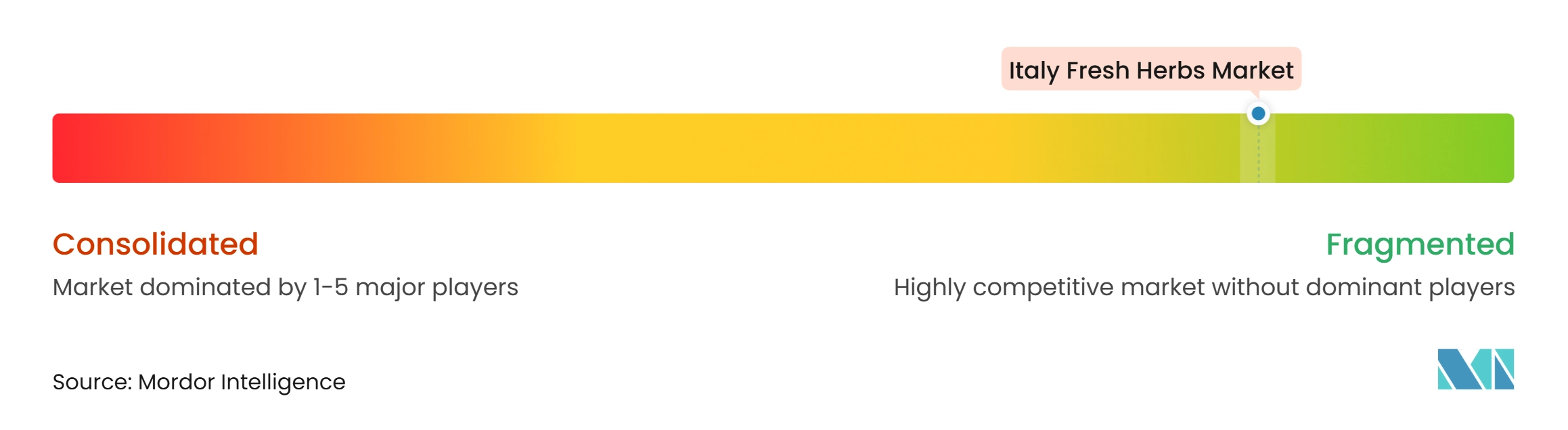
The Italy fresh herbs market is fragmented in 2025, with Magnani S.r.l., L'Insalata dell'Orto S.r.l., L'Ortofrutticola Società Agricola Cooperativa, Azienda Agricola Biologica Vio Giobatta (BioVio), and Società Agricola Simonato S.r.l. among the key players. Established producers compete on product variety, cultivation methods, organic certification, packaging capabilities, distribution networks, and supply consistency. Companies serve retail, foodservice, wholesale, and food-processing customers through different product formats and cultivation approaches. Competitive differentiation depends on product quality, year-round availability, traceability, packaging flexibility, organic positioning, and the ability to meet varied customer requirements.
Competition is shaped by differences in cultivation scale, product specialization, packaging capabilities, organic positioning, and access to distribution channels. Magnani focuses on fresh aromatic herbs and dedicated packaging, including different formats and private-label solutions. Simonato specializes in certified organic aromatic plants and supplies large-scale retail and the food industry, while BioVio combines open-field and greenhouse cultivation with daily shipments of fresh, packaged, and bulk herbs. These approaches allow companies to differentiate through product consistency, assortment, packaging flexibility, organic credentials, and supply reliability rather than cultivation capacity alone.
The competitive environment is also influenced by producers' ability to connect agricultural production with organized retail and broader European distribution. L'Ortofrutticola's cooperative structure provides access to a large network of agricultural suppliers, and its operations include the production of potted aromatic plants and fresh-cut aromatic herbs. Daily product collection, packaging, and logistics are also part of its commercial model. These capabilities support supplier relationships and consistent availability across customer channels. Competitive differentiation therefore depends on integrated production, packaging, logistics, and certification, as well as the ability to meet varied requirements from retailers and professional buyers.
Italy Fresh Herbs Industry Leaders
-
Magnani S.r.l.
-
L'Insalata dell'Orto S.r.l.
-
L'Ortofrutticola Società Agricola Cooperativa
-
Azienda Agricola Biologica Vio Giobatta (BioVio)
-
Società Agricola Simonato S.r.l.
- *Disclaimer: Major Players sorted in no particular order
Italy Fresh Herbs Market Companies Covered in this Report
- Azienda Agricola Ricci Siro e Figli S.S.
- Società Agricola Simonato S.r.l.
- L'Ortofrutticola Società Agricola Cooperativa
- L'Orto Del Fucino
- SG Vivai Società Agricola a Responsabilità Limitata
- Pastor Luigi Società Semplice Agricola degli Eredi Pastor
- Azienda Agraria Anfossi
- Magnani S.r.l.
- L'Insalata dell'Orto S.r.l.
- Azienda Agricola Biologica Vio Giobatta (BioVio)
- Ludan Fresh Supplies S.r.l.s.
- Aromi e Profumi S.r.l.
Recent Industry Developments in Italy Fresh Herbs Market
- April 2026: Società Agricola Simonato S.r.l. launched its Bio Paper Pack, a plastic-free packaging system made from water-resistant paper and recycled cardboard, designed specifically for organic potted aromatic plants such as fresh herbs.
- September 2024: L'Insalata dell'Orto S.r.l. announced a EUR 1.5 million (USD 1.7 million) investment in refrigerated cells, a photovoltaic system, and greenhouses to support its fresh-produce infrastructure and controlled cultivation activities.
- September 2024: Italy's Ministry of Agriculture, Food Sovereignty and Forestry (MASAF) launched a funding call to support research and development in organic aromatic and medicinal plant cultivation under its dedicated development fund, directly supporting Italy's organic fresh herb supply chain.
Italy Fresh Herbs Market Report Scope
Fresh herbs are edible aromatic plants harvested primarily for their leaves, stems, or tender shoots. They are used fresh to enhance the flavor, aroma, appearance, and nutritional value of food and beverages.
The Italy fresh herbs market report is segmented by product type (basil, cilantro/coriander, mint, parsley, chives, oregano, rosemary, thyme, sage, dill, and other fresh herbs), by category (conventional and organic), by cultivation method (open-field cultivation, greenhouse cultivation, hydroponic cultivation, aeroponic cultivation, and vertical indoor cultivation), and by end user (foodservice, food retail, food processing, pharmaceutical and nutraceutical, and other). The market forecasts are provided in terms of value (USD).
Segmentation Overview
| Basil |
| Cilantro/Coriander |
| Mint |
| Parsley |
| Chives |
| Oregano |
| Rosemary |
| Thyme |
| Sage |
| Dill |
| Other Fresh Herbs |
| Conventional |
| Organic |
| Open-Field Cultivation |
| Greenhouse Cultivation |
| Hydroponic Cultivation |
| Aeroponic Cultivation |
| Vertical Indoor Cultivation |
| Foodservice |
| Food Retail |
| Food Processing |
| Pharmaceutical and Nutraceutical |
| Other |
| By Product Type | Basil |
| Cilantro/Coriander | |
| Mint | |
| Parsley | |
| Chives | |
| Oregano | |
| Rosemary | |
| Thyme | |
| Sage | |
| Dill | |
| Other Fresh Herbs | |
| By Category | Conventional |
| Organic | |
| By Cultivation Method | Open-Field Cultivation |
| Greenhouse Cultivation | |
| Hydroponic Cultivation | |
| Aeroponic Cultivation | |
| Vertical Indoor Cultivation | |
| By End User | Foodservice |
| Food Retail | |
| Food Processing | |
| Pharmaceutical and Nutraceutical | |
| Other |
Key Questions Answered in the Report
What is the forecast market size for fresh herbs in Italy in 2031?
The Italy fresh herbs market is forecast to grow at a 5.88% CAGR from 2026 and 2031, reaching USD 270.31 million by 2031.
Which fresh herb holds the largest share in Italy?
Basil segment held the largest share at 45.7% in 2025.
Which cultivation method is growing fastest for Italian fresh herbs?
Hydroponic cultivation is forecast to grow at the fastest CAGR of 11.0% from 2026 to 2031.
What is the leading end-user channel for fresh herbs in Italy?
Food retail held the largest share at 41.2% in 2025.