
Isomalto Oligosaccharide Market Size and Share
Market Overview
| Study Period | 2022 - 2032 |
|---|---|
| Market Size (2027) | USD 0.09 Billion |
| Market Size (2032) | USD 0.13 Billion |
| Growth Rate (2027 - 2032) | 7.21 % |
| Fastest Growing Market | Asia-Pacific |
| Largest Market | North America |
| Market Concentration | Medium |
Major Players *Disclaimer: Major Players sorted in no particular order Image © Mordor Intelligence. Reuse requires attribution under CC BY 4.0. | |
Isomalto Oligosaccharide Market Analysis by Mordor Intelligence
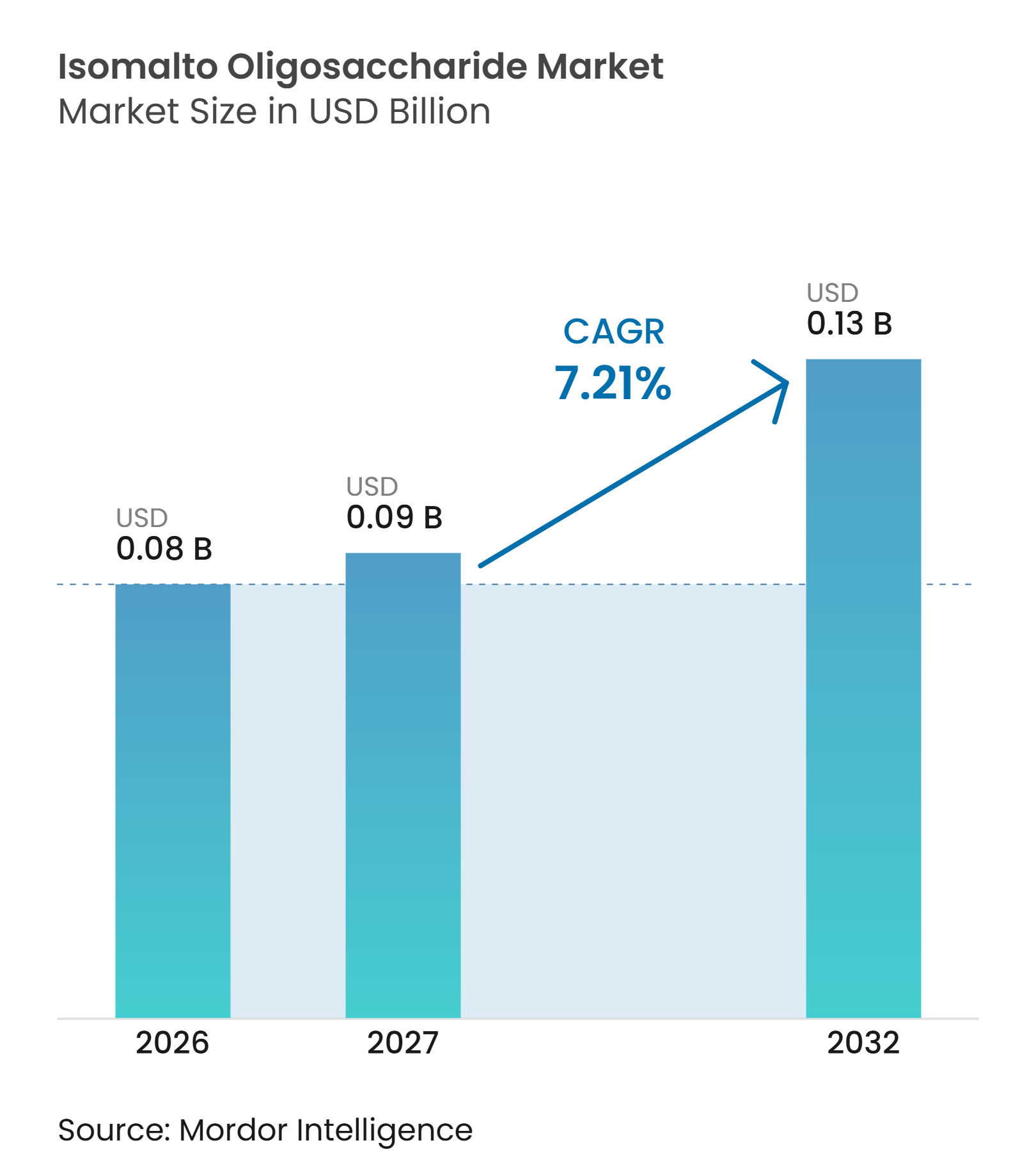
The isomalto oligosaccharide market size is expected to grow from USD 0.08 billion in 2026 to USD 0.09 billion in 2027 and is forecast to reach USD 0.13 billion by 2032 at a 7.21% CAGR over 2027-2032. Demand is supported by growing interest in ingredients that promote digestive health, enable sugar reduction, and enhance texture in food and beverage formulations. The multifunctional properties of isomalto-oligosaccharides, including mild sweetness, soluble fiber, and prebiotic functionality, make them suitable for a wide range of applications. Increasing focus on ingredient quality, purity, safety, and regulatory compliance is encouraging the adoption of IMO across food and dietary supplement formulations. Greater regulatory clarity is further supporting market development and creating opportunities for manufacturers to expand their product applications and customer base.
Key Report Takeaways
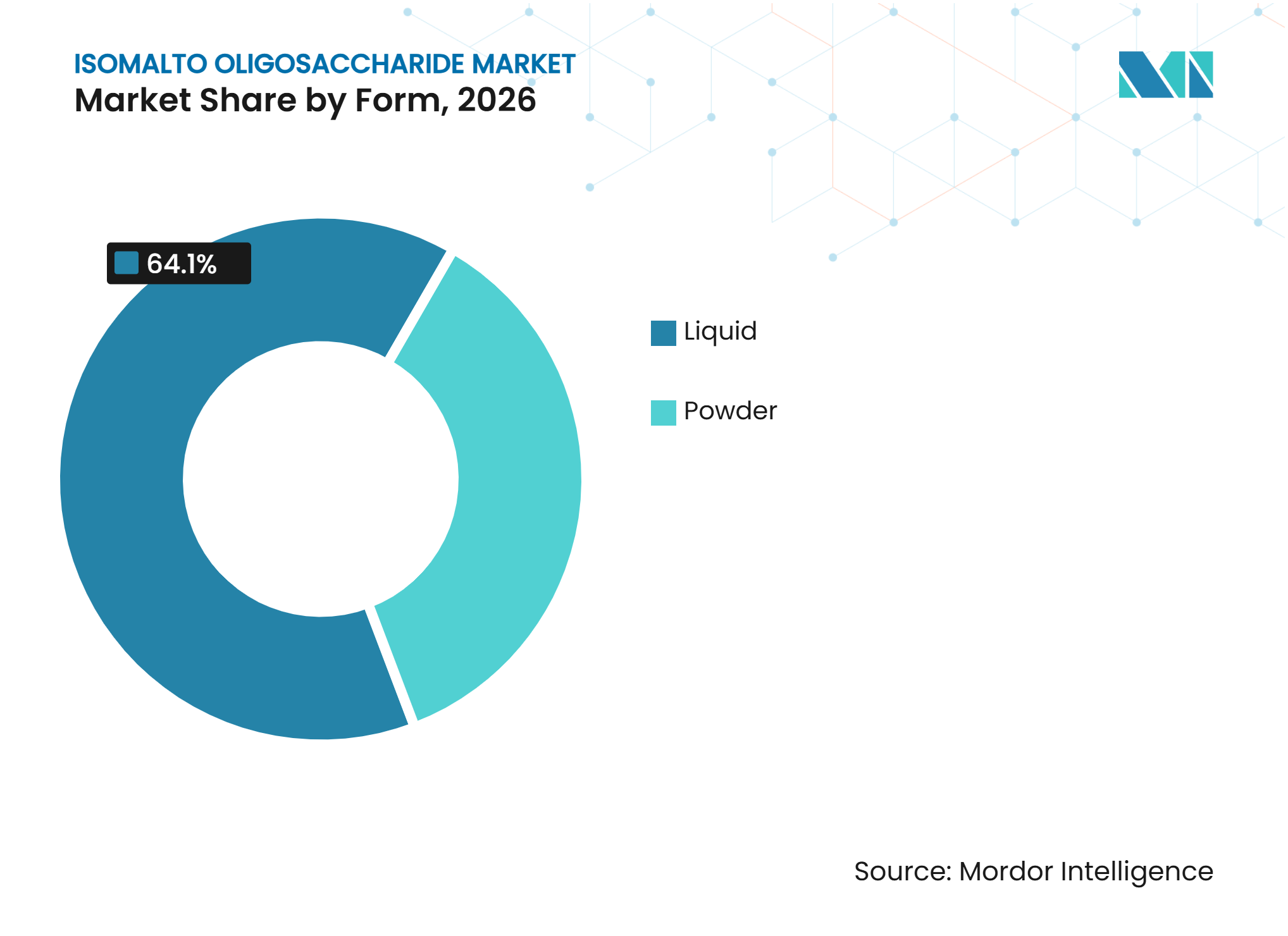
• By form, liquid held 64.12% of the isomalto oligosaccharide market share in 2026, while powder is forecast to expand at a CAGR of 7.84% through 2032.
• By source, corn held 42.12% of the isomalto oligosaccharide market share in 2026, while tapioca is forecast to expand at a CAGR of 7.68% through 2032.
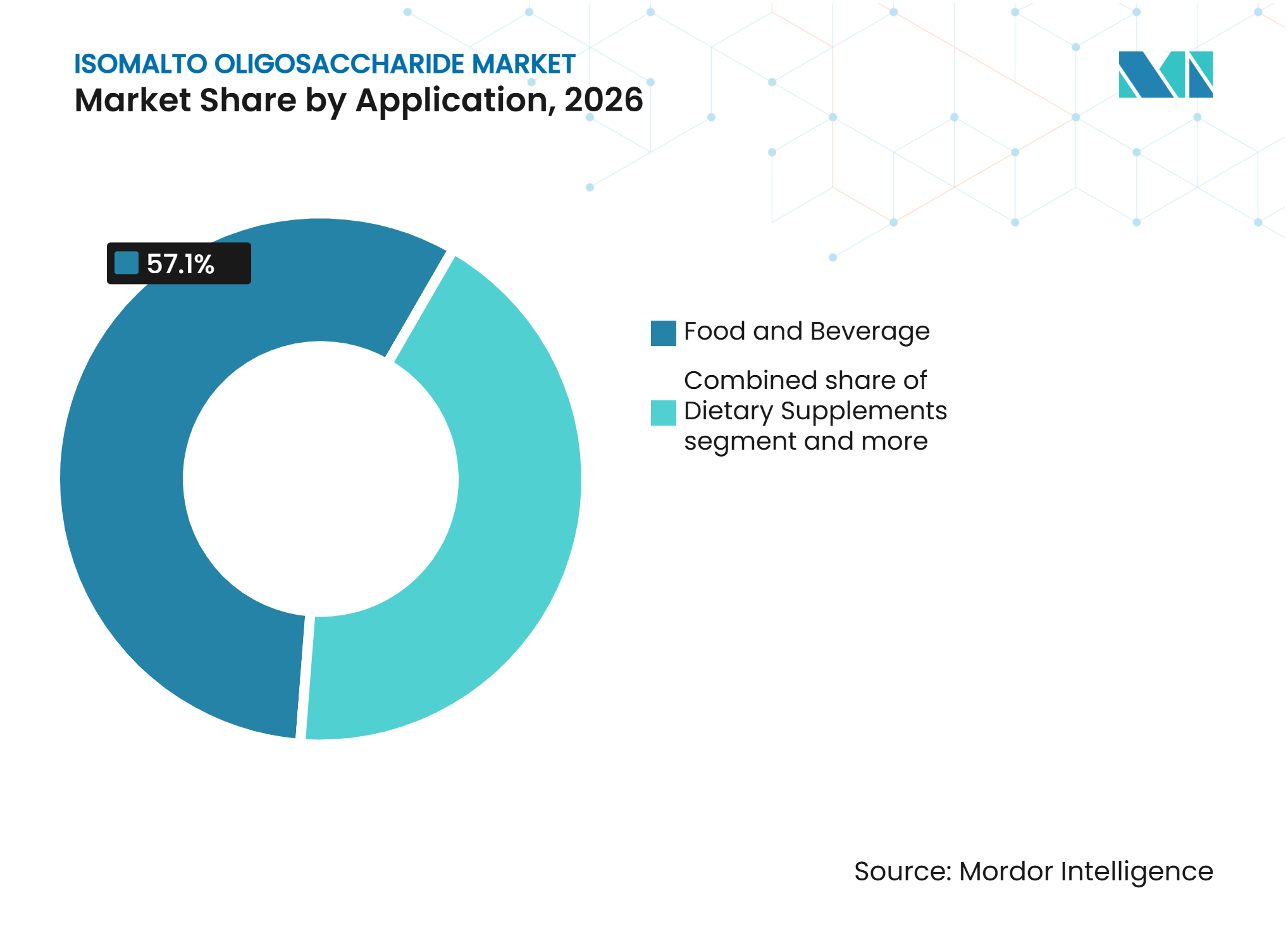
• By application, food and beverage accounted for 57.14% of the isomalto oligosaccharide market share in 2026, while dietary supplements are forecast to expand at a CAGR of 8.01% through 2032.
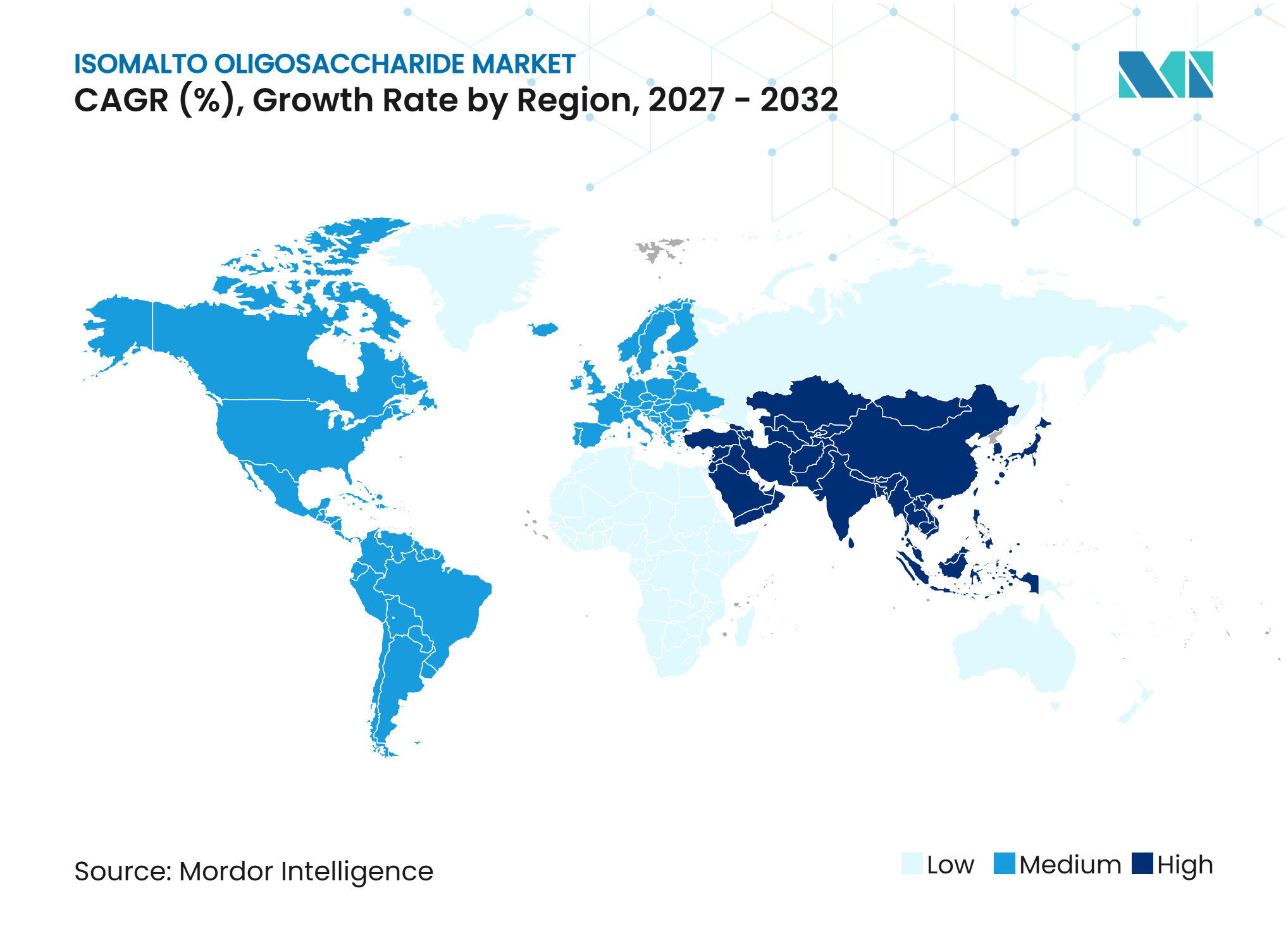
• By geography, North America held 43.21% of the isomalto oligosaccharide market share in 2026, while Asia-Pacific is forecast to expand at a CAGR of 8.29% through 2032.
Note: Market numbers in this report are based on Mordor Intelligence's proprietary estimation framework, which combines nine months of actuals with Q4 projections for base year 2026.
Market Trends and Insights
Drivers Impact Analysis of Isomalto Oligosaccharide Market*
| Driver | (~) % Impact on CAGR Forecast | Geographic Relevance | Impact Timeline |
|---|---|---|---|
| Growing demand for gut-health and digestive-wellness ingredients | Global, particularly North America, Europe, Japan | Long term (≥ 4 years) | |
| Increasing use of IMO in sugar-reduction and sweetener-reformulation applications | North America and EU | Medium term (2-4 years) | |
| Functional food and beverage expansion | Global, led by Asia Pacific and North America | Medium term (2-4 years) | |
| Advancements in enzymatic production and high-purity IMO grades | China, North America, Japan | Long term (≥ 4 years) | |
| Growing demand for prebiotic ingredients in dietary supplements | North America, Europe | Medium term (2-4 years) | |
| Increasing use of IMO in animal feed formulations | Asia Pacific core, with spillover to Europe | Long term (≥ 4 years) | |
| Source: Mordor Intelligence | |||
Growing Demand for Gut-health and Digestive-Wellness Ingredients
Growing consumer awareness of digestive health is driving the incorporation of prebiotic ingredients into everyday food and confectionery products. For instance, in August 2026, according to the International Food Information Council survey, 64% of Americans consider gut health a high or extremely high priority, while 30% have increased fiber intake through food to support digestive wellness. This creates opportunities for isomalto-oligosaccharides (IMO), which offer prebiotic functionality and sweetness properties [1]. Baolingbao highlighted the use of IMO in Koochikoo's watermelon lollipop, launched in April 2025, as well as low-sugar probiotic almond nougat and red ginger-and-lemon hard candy. These applications demonstrate IMO's versatility in functional confectionery, supporting its adoption in products targeting digestive health.
Increasing Use of IMO in Sugar-Reduction and Sweetener-Reformulation Applications
Increasing focus on sugar reduction is encouraging manufacturers to adopt ingredients that provide sweetness, bulk, and texture while supporting reformulation goals. Isomalto-oligosaccharides (IMO), which provide approximately 40–60% of sucrose's sweetness, offer potential to reduce conventional sugar use while maintaining product characteristics. For instance, in October 2025, according to BIO Web of Conferences on soft milk candy, replacing 50% of sucrose with IMO maintained sensory scores comparable to the original formulation while reducing sugar content [2]. Supporting this application, SmartSweets relaunched four core candy products with an improved formulation that replaced allulose and increased IMO content to support its low-sugar confectionery positioning. These developments indicate the potential of the IMO to reformulate confectionery products while balancing sweetness, taste, and texture.
Functional Food and Beverage Expansion
The expansion of functional foods and beverages across snack bars, dairy products, bakery items, and beverages is creating opportunities for isomalto-oligosaccharides (IMO) as a multifunctional ingredient. For instance, in 2025, IOPScience evaluated IMO as a honey substitute and identified a formulation containing 50% IMO and 50% honey as providing the most balanced sensory profile. Supporting its broader food applications, the European Commission's Regulation (EU) 2025/97 authorized the use of IMO at maximum levels of 2.5% in yogurts, 5% in milk-based drinks, and 10% in breakfast cereals [3]. These regulatory approvals provide food manufacturers with additional opportunities to incorporate IMO into diverse product categories while supporting functional ingredient and product reformulation strategies.
Advancements in Enzymatic Production and High-Purity IMO Grades
Advancements in enzymatic production technologies are improving the efficiency, consistency, and quality of isomalto-oligosaccharide (IMO) manufacturing. Improved enzyme selection and process optimization enable manufacturers to achieve better control over carbohydrate composition, purity, and functional properties. Growing demand for high-purity IMO grades is encouraging producers to strengthen production capabilities and develop ingredients that meet food safety, quality, and regulatory requirements. These advancements are supporting wider adoption of IMO across food, beverage, and dietary supplement applications, while creating opportunities for manufacturers to offer specialized grades tailored to different formulation requirements.
Restraints Impact Analysis of Isomalto Oligosaccharide Market*
| Restraint | (~) % Impact on CAGR Forecast | Geographic Relevance | Impact Timeline |
|---|---|---|---|
| Regulatory uncertainty regarding dietary-fiber classification and health claims | -1.5% | North America and EU | Medium term (2-4 years) |
| High production and processing costs | -1.1% | Global | Short term (≤ 2 years) |
| Digestive tolerance limitations at higher IMO consumption levels | -0.7% | Global | Long term (≥ 4 years) |
| Dependence on specialised IMO manufacturing and enzymatic processing capabilities | -0.5% | Global, especially North America and Europe | Medium term (2-4 years) |
| Source: Mordor Intelligence | |||
Regulatory Uncertainty Regarding Dietary-Fiber Classification and Health Claims
Differences in regulatory approaches to dietary fiber classification and health claims across regions create challenges for isomalto-oligosaccharide (IMO) manufacturers. Variations in ingredient definitions, purity requirements, labeling standards, and permitted health claims can affect product formulation, market entry, and commercial positioning. Manufacturers must align their IMO products with region-specific food regulations and substantiation requirements when communicating digestive health and prebiotic benefits. These differences can increase regulatory compliance efforts and create uncertainty around the acceptance and marketing of IMO across international food and beverage markets.
High Production and Processing Costs
The production of isomalto-oligosaccharides (IMO) involves specialized enzymatic processes, controlled fermentation or conversion conditions, purification, and quality management, all of which contribute to overall manufacturing costs. Maintaining consistent carbohydrate composition, product purity, and microbiological quality requires specialized equipment, technical expertise, and continuous process monitoring. Investments in production optimization, raw material sourcing, and quality assurance further influence manufacturing economics. These cost factors may undermine pricing competitiveness and limit smaller manufacturers' ability to expand production capacity and serve diverse food and beverage applications.
*Our forecasts treat driver/restraint impacts as directional, not additive. The impact forecasts reflect baseline growth, mix effects, and variable interactions.
Isomalto Oligosaccharide Market Segment Analysis
By Form:
Liquid IMO Leads While Powder Supports Premium Product DevelopmentLiquid accounted for 64.12% of the isomalto-oligosaccharide market share in 2026. The leading position of liquid IMO is supported by its easy solubility and compatibility with beverages, dairy products, sauces, bakery items, and confectionery formulations. Its syrup consistency provides binding and moisture-retention properties while allowing convenient handling, mixing, and integration into large-scale food-processing operations. Established manufacturing capabilities and supply networks further support the availability of liquid grades for industrial applications. Its processing stability across varying acidity levels and elevated temperatures also makes it suitable for formulations that require heat treatment and consistent product quality. These functional and processing advantages support the widespread adoption of liquid IMO across food and beverage manufacturing applications.
Powder is forecast to expand at a CAGR of 7.84% through 2032. Powdered IMO is gaining adoption in dietary supplements, sports nutrition, protein blends, and other dry food formulations due to its convenient handling, accurate dosing, and storage advantages. Its lower moisture content supports shelf stability and efficient transportation, making it suitable for manufacturers developing dry-mix products and portion-controlled formulations. The growing availability of alternative raw material sources and non-GMO ingredient options is further supporting product development across food and nutrition applications. Regulatory recognition of powdered IMO under defined composition and quality requirements is also providing manufacturers with a clearer framework for developing and supplying powder grades across international markets.



By Source:
Corn Provides Scale While Tapioca Supports Clean Label DemandCorn held 42.12% of the isomalto-oligosaccharide market share in 2026. Corn starch holds a prominent position as a raw material for IMO production due to its established processing infrastructure, widespread availability, and suitability for enzymatic conversion. Its consistent supply and compatibility with large-scale manufacturing processes support cost-efficient production and reliable ingredient quality for food and nutrition applications. Rice starch also serves as an alternative substrate, particularly in markets with established rice-processing industries and confectionery applications. Potato and wheat starches provide additional sourcing options where regional availability and processing capabilities support their use. The availability of multiple starch sources enables manufacturers to optimise raw material procurement and maintain production flexibility across different applications.
Tapioca is forecast to expand at a CAGR of 7.68% through 2032. Cassava starch provides an alternative raw material for IMO production, offering sourcing flexibility and supporting the development of clean-label and allergen-conscious food formulations. Its suitability for specialized food and dietary supplement applications makes it relevant to manufacturers seeking diversified starch sources and differentiated ingredient grades. Government initiatives to strengthen domestic tapioca starch production are further encouraging local processing capabilities and expanding the availability of raw materials. Growing investments in starch processing and supply-chain development can support consistent procurement, production efficiency, and wider adoption of cassava-derived ingredients across food and nutrition applications.
By Application:
Food and Beverage Remains the Main Outlet While Dietary Supplements Grow FasterFood and beverage accounted for 57.14% of the isomalto oligosaccharide market share in 2026. Functional food represents a prominent application area for isomalto-oligosaccharides (IMO), owing to their ability to provide sweetness, improve texture, and offer prebiotic functionality in a single formulation. Infant formula is another specialized application in which strict nutritional standards and ingredient quality requirements guide the use of functional ingredients. Dairy products also provide strong opportunities for IMO adoption through the development of prebiotic-fortified yogurts and milk-based drinks. Growing use across confectionery and other food applications further expands the ingredient's role in product development. The presence of IMO across diverse food categories supports a broad base of applications and creates opportunities for continued market growth.
Dietary supplements are forecast to expand at a CAGR of 8.01% through 2032. The segment is supported by growing interest in gut health, sports nutrition, healthy aging, and functional nutritional products. Powder formats offer convenient handling, accurate dosing, and flexibility for incorporation into protein blends and other nutritional formulations. IMO's water solubility and mild flavor support its use in prebiotic powders and functional nutrition products. Demand for high-purity ingredients is also encouraging manufacturers to focus on consistent quality, product transparency, and suitability for specialized dietary applications. Animal feed additives provide an additional application opportunity, as IMO's prebiotic properties support digestive health and beneficial gut microbiota in livestock. Growing interest in gut health and nutritional alternatives in animal feed further supports the diversification of IMO applications.

Geography Analysis
North America
North America accounted for 43.21% of the isomalto-oligosaccharide market in 2026. North America benefits from established demand for dietary supplements, nutrition bars, functional beverages, and specialty dairy products. The United States represents a major regional market, supported by a developed functional food and nutrition industry. Regulatory requirements for dietary fiber classification also encourage manufacturers to focus on ingredient composition, product formulation, and clear labeling practices. Canada further strengthens the regional supply base through local IMO production capabilities and access to alternative starch sources. These manufacturing capabilities support supply-chain development, sourcing flexibility, and the availability of IMO for food, beverage, and dietary supplement applications. Together, established consumer demand, regulatory frameworks, and regional production capabilities support the growth of the North American IMO market.
Asia-Pacific
Asia-Pacific is forecast to expand at a CAGR of 8.29% through 2032. Asia Pacific benefits from a strong manufacturing base, established starch-processing capabilities, and growing demand for functional foods across major regional markets. Japan has a mature market for oligosaccharide-based products, supported by consumer familiarity with health-oriented food ingredients and an established regulatory framework. Rising interest in digestive wellness and functional nutrition across India, South Korea, and Southeast Asia is further supporting market development. The region's agricultural resources and ingredient-processing infrastructure also provide opportunities to strengthen raw material sourcing and production capabilities. These advantages support a consistent supply of ingredients and the wider adoption of IMO across food, beverage, and dietary supplement applications.
Europe, South America, Middle East and Africa
Europe benefits from an established functional food and dietary supplement industry, supported by a regulatory framework that provides opportunities for wider IMO adoption across food and supplement applications. Strong retail channels and consumer interest in health-oriented products further support market development in countries such as Germany and the United Kingdom. South America offers growth opportunities as demand for functional foods and digestive wellness ingredients continues to grow across Brazil and Argentina. In the Middle East and Africa, increasing interest in specialized food ingredients and halal-certified products creates opportunities for IMO adoption, particularly in Saudi Arabia and the United Arab Emirates. Turkey also benefits from its established starch-processing and food-export industries, supporting regional ingredient supply. Regulatory alignment, product quality, traceable sourcing, and relevant certifications will support IMO's expansion across these regions.
Competitive Landscape
Market Concentration
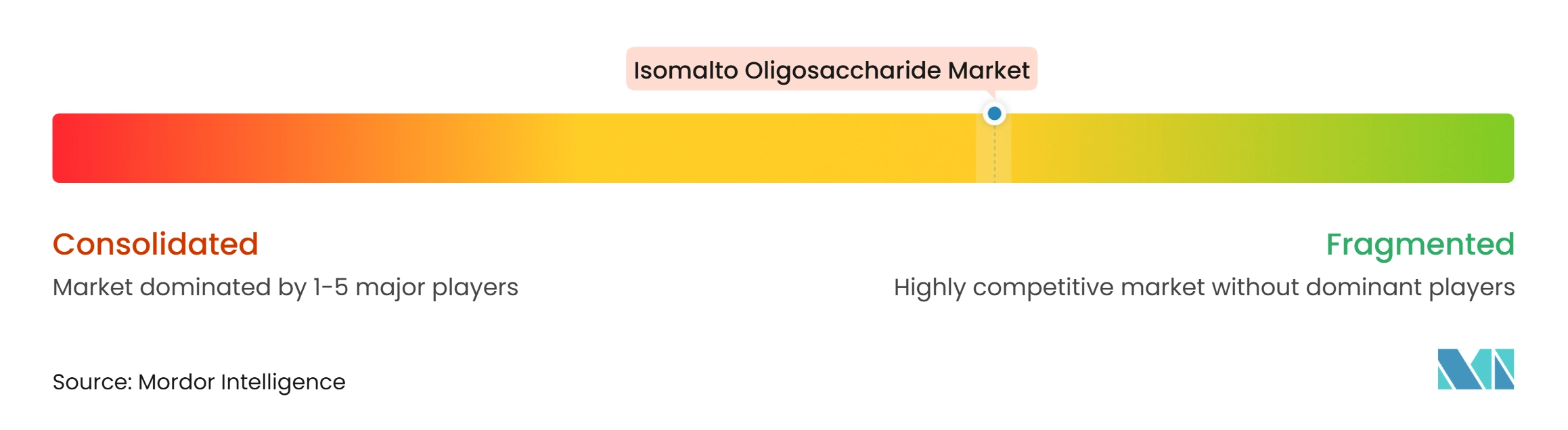
The isomalto-oligosaccharide (IMO) market is fragmented, with key participants including Baolingbao Biology, Shandong Bailong Chuangyuan Bio-Tech, and BioNeutra Global Corporation. Chinese manufacturers benefit from established production capabilities, large-scale operations, and long-standing supply relationships across food and beverage applications. Competition is shaped by manufacturing capacity, product purity, carbohydrate composition, quality certifications, and the ability to maintain consistent product specifications.
BioNeutra differentiates itself through high-purity IMO grades, North American manufacturing capabilities, and regulatory recognition for food and supplement applications. Its focus on pea-starch-based production also supports alternative raw material sourcing and regional supply development. Shandong Bailong Chuangyuan is strengthening its international manufacturing presence through overseas expansion, supporting its access to additional regional markets.
The market also presents opportunities for suppliers offering specialized powder grades, organic and non-GMO options, and ingredients suitable for emerging applications such as animal nutrition. Smaller manufacturers and distributors contribute to the competitive landscape by serving specialized customer requirements and regional markets. Overall, competition is influenced by production scale, product quality, regulatory compliance, technical capabilities, and supply chain reliability, thereby supporting a moderately fragmented market structure.
Isomalto Oligosaccharide Industry Leaders
-
Baolingbao Biology Co., Ltd.
-
Shandong Bailong Chuangyuan Bio-Tech Co., Ltd.
-
BioNeutra Global Corporation
-
Dong Xiao Biotechnology Co., Ltd.
-
Hangzhou Natur Foods Co., Ltd.
- *Disclaimer: Major Players sorted in no particular order
Isomalto Oligosaccharide Market Companies Covered in this Report
- Baolingbao Biology Co., Ltd.
- Shandong Bailong Chuangyuan Bio-Tech Co., Ltd.
- BioNeutra Global Corporation
- Dong Xiao Biotechnology Co., Ltd.
- Hangzhou Natur Foods Co., Ltd.
- Nagase & Co., Ltd. (Nagase Viita Co., Ltd.)
- FUJIFILM Holdings Corporation (FUJIFILM Wako Pure Chemical Corporation)
- Top Health Ingredients, Inc.
- Shandong Guoqitang Biotechnology Co., Ltd.
- Shandong Benon Bio-Technology Co., Ltd.
- Dancheng Caixin Sugar Industry Co., Ltd.
- Guangzhou Shuangqiao Company Ltd.
- Shandong Tianjiu Industrial Group Co., Ltd. (Shandong Tianmei Biotech Co., Ltd.)
- Jiangxi E&C Sugar Alcohol Co., Ltd.
- Shandong Saigao Group Corporation
- Anhui Elite Industrial Co., Ltd.
- Shandong Tianjiu Industrial Group Co., Ltd. (Shandong Tianjiao Biotech Co., Ltd.)
- Van Wankum Ingredients
- American International Chemical, LLC
- COFCO Rongshi Biotechnology Co., Ltd.
Recent Industry Developments in Isomalto Oligosaccharide Market
- April 2025: Koochikoo introduced its watermelon lollipop in Australia as a sugar-free, low-calorie confectionery product that uses isomalto-oligosaccharides (IMO) as its primary sweetener. The product also contains vitamin C, natural watermelon flavour, and plant-based colors, demonstrating the application of IMO in confectionery formulations
- January 2025: BioNeutra North America scaled up production of pea starch-derived IMO in Canada to strengthen its domestic manufacturing capabilities. The initiative supported the use of locally sourced yellow pea starch and aims to expand the availability of plant-based prebiotic ingredients for food and dietary supplement manufacturers.
- March 2024: SmartSweets reformulated its confectionery portfolio by replacing allulose with a starch-based oligosaccharide ingredient, including IMO, to improve the products' sensory profile. The ingredient also serves as a sweetener and bulking agent, supporting the brand's focus on better-for-you confectionery products.
Global Isomalto Oligosaccharide Market Report Scope
The isomalto-oligosaccharide (IMO) market includes prebiotic ingredients used in food and beverages, dietary supplements, and animal feed applications. The market is segmented by Form, Source, Application, and Geography. Based on Form, it is segmented into Liquid and Powder. Based on Source, it is segmented into Corn, Tapioca, Rice, Potatoes, and Other Sources. Based on Application, it is segmented into Food and Beverage, Dietary Supplements, and Animal Feed Additives. Food and Beverage is further segmented into Functional Food, Infant Formula, Dairy Products, Confectionery, and Other Applications. By geography, the market is segmented into North America, Europe, Asia-Pacific, South America, and the Middle East and Africa. Market forecasts are provided in terms of value (USD).
Segmentation Overview
| Liquid |
| Powder |
| Corn |
| Tapioca |
| Rice |
| Potatoes |
| Other Sources |
| Food and Beverage | Functional Food |
| Infant Formula | |
| Dairy Products | |
| Confectionery | |
| Other food and beverage applications. | |
| Dietary Supplements | |
| Animal Feed Additives |
| North America | United States |
| Canada | |
| Mexico | |
| Rest of North America | |
| Europe | Germany |
| United Kingdom | |
| Italy | |
| France | |
| Spain | |
| Netherlands | |
| Rest of Europe | |
| Asia-Pacific | China |
| India | |
| Japan | |
| Australia | |
| Rest of Asia-Pacific | |
| South America | Brazil |
| Argentina | |
| Rest of South America | |
| Middle East and Africa | South Africa |
| Saudi Arabia | |
| United Arab Emirates | |
| Turkey | |
| Rest of Middle East and Africa |
| By Form | Liquid | |
| Powder | ||
| By Source | Corn | |
| Tapioca | ||
| Rice | ||
| Potatoes | ||
| Other Sources | ||
| By Application | Food and Beverage | Functional Food |
| Infant Formula | ||
| Dairy Products | ||
| Confectionery | ||
| Other food and beverage applications. | ||
| Dietary Supplements | ||
| Animal Feed Additives | ||
| By Geography | North America | United States |
| Canada | ||
| Mexico | ||
| Rest of North America | ||
| Europe | Germany | |
| United Kingdom | ||
| Italy | ||
| France | ||
| Spain | ||
| Netherlands | ||
| Rest of Europe | ||
| Asia-Pacific | China | |
| India | ||
| Japan | ||
| Australia | ||
| Rest of Asia-Pacific | ||
| South America | Brazil | |
| Argentina | ||
| Rest of South America | ||
| Middle East and Africa | South Africa | |
| Saudi Arabia | ||
| United Arab Emirates | ||
| Turkey | ||
| Rest of Middle East and Africa | ||
Key Questions Answered in the Report
What is the market size of isomalto oligosaccharide market?
The isomalto-oligosaccharide (IMO) market is estimated at USD 0.08 billion in 2026 and is projected to reach approximately USD 0.13 billion by 2032, growing at a CAGR of 7.21% during 2027–2032.
Which IMO form has the largest share?
Liquid led with 64.12% share in 2026 as it dissolves easily and works well in beverage, dairy, sauce, and bakery processing.
Why is powder IMO growing faster?
Powder is projected to expand at a CAGR of 7.84% through 2032 as supplements and sports nutrition products require accurate dosing and stable dry formats.
Which region is growing the fastest?
Asia Pacific is forecast to expand at a CAGR of 8.29% through 2032, supported by regional manufacturing capacity and functional food demand.