
Iran Kiwi Market Size and Share
Iran Kiwi Market Analysis by Mordor Intelligence
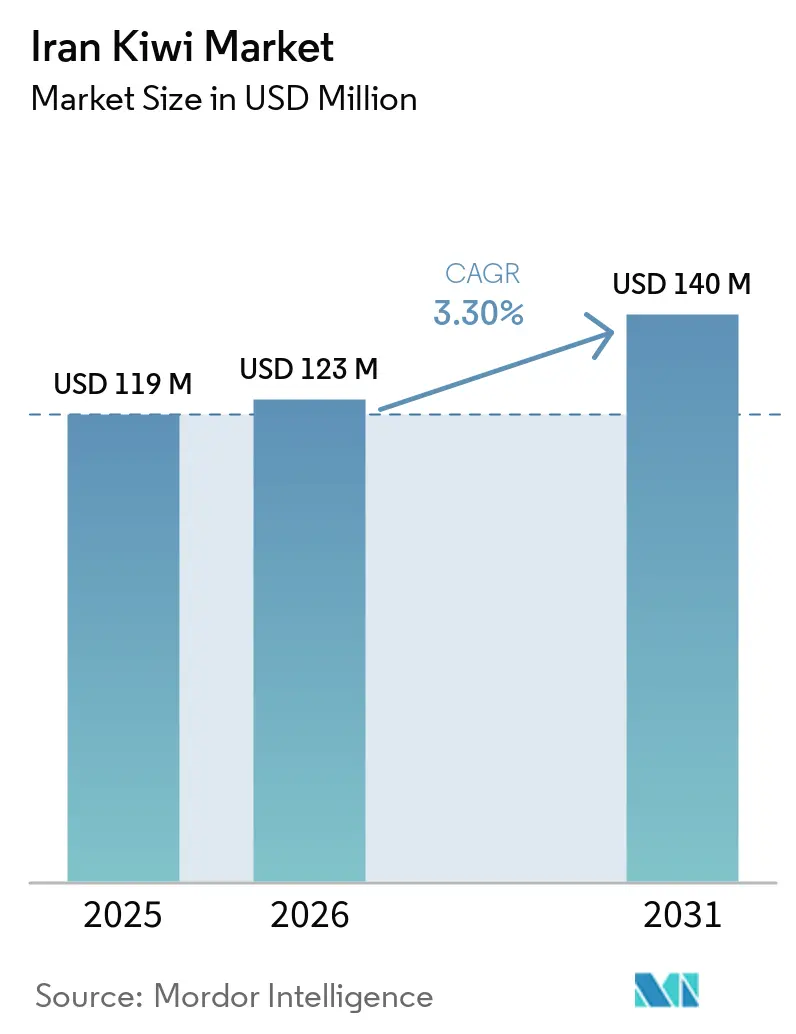
The Iran kiwi market was valued at USD 123.00 million in 2026 and is projected to grow from USD 127.06 million in 2027 to USD 149.45 million by 2032, at a CAGR of 3.30% during the forecast period 2027 to 2032. Iran is among the world's top kiwifruit-producing countries, with Mazandaran and Gilan forming the core supply base. Orchard conditions in these regions support stable Hayward fruit quality and large harvest volumes. The Iran kiwi market is increasingly export-focused as cold storage, controlled-atmosphere handling, and packhouse practices improve across the northern belt. A significant development came in November 2025, when China approved fresh kiwifruit imports from Iran under formal phytosanitary protocols, opening a large new outlet for certified Iranian shipments. The market continues to face pressure from recurring disease risk, water stress, and uneven cold-chain access, which limit value capture even when production is strong. The competitive landscape remains fragmented, and exporters that improve traceability, packaging, and shelf-life management are better positioned to secure higher-value contracts in Russia, India, the Gulf, and China.
Key Report Takeaways
- By production analysis, Northern Iran held 60.0% of the Iranian kiwi production in 2025, while wider adoption of improved T-bar trellising and suitable rootstocks is expected to support orchard expansion through 2032 by enhancing yield potential, fruit quality, and orchard productivity.
Note: Market numbers in this report are based on Mordor Intelligence's proprietary estimation framework, which combines nine months of actuals with Q4 projections for base year 2026.
Iran Kiwi Market Trends and Insights
Drivers Impact Analysis*
| Driver | (~) % Impact on CAGR Forecast | Geographic Relevance | Impact Timeline |
|---|---|---|---|
| Expanding Demand for Nutrient-Dense Fresh Fruit | +0.7% | Global demand centers, with stronger pull from the Gulf and South Asia | Medium term (2-4 years) |
| Rising Exportable Orchard Surplus in Northern Iran | +0.9% | Mazandaran and Gilan, with export impact on Russia, India | Short term (≤ 2 years) |
| Yield Gains from Improved Orchard Training Systems and Rootstock Selection | +0.5% | Northern Iran orchard belts, especially Ramsar and Talash clusters | Medium term (2-4 years) |
| Cold-Chain and Controlled Atmosphere Handling Extending Transit Windows | +0.6% | Astara and Bandar Amirabad corridors, with spillover into India | Medium term (2-4 years) |
| Premiumization of High-Brix and Yellow-Fleshed Kiwi Varieties | +0.4% | Urban Iran retail, United Arab Emirates re-export, and selected premium import channels | Long term (≥ 4 years) |
| Trade Diversion Opportunities from Competing Supplier Disruptions | +0.5% | Russia, Iraq, India, and the newly opened China route | Short term (≤ 2 years) |
| Source: Mordor Intelligence | |||
Expanding Demand for Nutrient-Dense Fresh Fruit
Demand for fresh fruit with strong nutritional profiles continues to support the Iran kiwi market across both domestic and export channels. Kiwifruit remains attractive to buyers due to its association with high vitamin C, fiber, and antioxidant content, which allows it to compete effectively in health-focused fruit baskets across urban retail chains. Iranian Hayward kiwi benefits from a clear nutritional profile, with vitamin C content reported above 90 mg per 100 g in export promotion communications. This demand pattern is particularly relevant for the Iran kiwi market, as Gulf and South Asian buyers are increasing purchases of premium fresh produce alongside the expansion of organized retail. India's April 2025 kiwi policy in Uttarakhand indicated that domestic supply is still being built from a low base, keeping import demand relevant over the forecast period even as domestic planting increases. Post-harvest research further supports the quality case, as a 2024 study demonstrated that abscisic acid regulation during cold storage helps Hayward fruit retain firmness, supporting shelf appeal across longer trade routes. As a result, the Iran kiwi market is positioned to benefit when buyers seek fruit that combines nutrition, shelf life, and competitive pricing.
Rising Exportable Orchard Surplus in Northern Iran
A growing orchard surplus in the Caspian belt is one of the clearest volume drivers for the Iran kiwi market. Mazandaran exported more than 25,000 metric tons of kiwifruit in the first 7 months of the Iranian calendar year 1404, indicating how quickly saleable output can move when the harvest is strong and export channels are open. The same trend was evident later in 2025, when official reporting showed more than 17,000 metric tons of kiwi exports from Mazandaran in 8 months and a 308% rise in Bandar Amirabad port shipments, reflecting improvements in logistics planning and a higher available supply. Higher volumes alone do not guarantee better returns, but they give exporters a larger base to serve repeat buyers in Russia, India, Iraq, and the Gulf. Packaging discipline also plays a role, as a 2024 study found that each additional level of compliance with packaging standards raised kiwi export value by 0.53%, indicating that volume and presentation now move together in trade performance. The Iran kiwi market, therefore, benefits from orchard surplus when supply growth is matched by certification, grading, and shipment control. If that alignment improves further, exportable volume should translate into steadier contract execution rather than only larger spot-market flows.
Yield Gains from Improved Orchard Training Systems and Rootstock Selection
Yield improvement is a practical growth lever for the Iran kiwi market, as it increases output without relying solely on new acreage. Research presented at the International Society for Horticultural Science showed that orchard management advances increased average yields in northern Iran from 30 to 40 metric tons per hectare, confirming that agronomic improvements are already producing commercial results. Better canopy control, improved male-to-female vine balance, and more precise timing of growth inputs help growers increase the share of fruit reaching exportable size grades. Rootstock renewal offers an additional avenue, as the 2025 SOS-KIWI work from the University of Udine identified resistant rootstocks that can support orchard recovery in areas facing vine decline pressure. This is relevant to the Iran kiwi market because orchard renewal can protect output continuity in productive northern clusters where replacement costs are otherwise high. The Ministry of Agriculture Jihad's packaging and phytosanitary requirements also create a stronger incentive to invest in orchard practices that yield cleaner, more uniform fruit. Over the forecast period, growers who align agronomy upgrades with export program requirements should be better positioned to expand both volume and product quality.
Cold-Chain and Controlled Atmosphere Handling Extending Transit Windows
Cold-chain improvement is one of the most direct quality and trade enablers for the Iran kiwi market. Controlled-atmosphere storage at temperatures between -0.5°C and 0°C, paired with 90% to 95% relative humidity and low ethylene conditions, can extend kiwi shelf life from 2 to 3 months to 5 to 7 months, which materially changes shipment timing and destination reach[1]. This longer storage window allows fruit harvested in October to remain commercially viable well into the late winter and spring demand period. That timing is particularly relevant for the Iran kiwi market, as it creates the opportunity to supply buyers before Southern Hemisphere volumes are fully available. Astara already has 11 active cold storage facilities serving the export corridor, but inland coverage remains uneven across some orchard districts, leaving logistics quality uneven. A 2025 review on horticultural engineering in Gilan estimated that precision post-harvest systems can reduce losses by up to 30%, indicating the extent of value that can still be recovered through better storage and handling. The Iran kiwi market should therefore see the strongest benefit where storage investment is linked to packhouse sorting, border transit coordination, and export calendar planning.
Restraints Impact Analysis*
| Restraint | (~) % Impact on CAGR Forecast | Geographic Relevance | Impact Timeline |
|---|---|---|---|
| Pseudomonas Syringae pv. Actinidiae Recurrence Risk | -0.4% | Humid northern orchards, especially parts of Gilan | Short term (≤ 2 years) |
| Post-Harvest Losses from Incomplete Cold-Chain Coverage | -0.3% | Rural producing zones in Mazandaran and Gilan that are distant from export hubs | Medium term (2-4 years) |
| Water Stress and Frost Exposure in Key Orchard Zones | -0.4% | Northern and central orchard areas exposed to drought and seasonal weather shocks | Long term (≥ 4 years) |
| Border Inspection and Sanitary Barrier Volatility in Destination Markets | -0.2% | Russia, India, and China import routes | Short term (≤ 2 years) |
| Source: Mordor Intelligence | |||
Pseudomonas Syringae pv. Actinidiae Recurrence Risk
Disease pressure remains a significant restraint on the Iran kiwi market, with Pseudomonas syringae pv. actinidiae (Psa), representing the most prominent biological threat. The humid Caspian climate supports kiwi cultivation, but the same conditions can promote bacterial canker recurrence where orchard sanitation and treatment practices are inadequate. A 2026 study in Frontiers in Microbiology confirmed that copper-resistant Psa strains are now widespread in major Chinese producing provinces. This is relevant because production systems with similar characteristics can face comparable resistance challenges[2]. A 2025 study in BMC Plant Biology identified quantitative trait loci associated with Psa resistance in Actinidia crosses, but this breeding approach will require considerable time before it influences commercial orchard renewal in Iran. Many smallholder growers continue to rely on older control practices and may lack the capital required for broad biosecurity upgrades. This leaves the Iran kiwi market exposed to yield losses and reputational risk if importing countries respond to any reported outbreak. Even localized disease events can disrupt trade across a wider producing area, as buyers and inspectors often apply controls at the provincial rather than the orchard level.
Post-Harvest Losses from Incomplete Cold-Chain Coverage
Incomplete cold-chain coverage continues to limit value realization in the Iran kiwi market. Some export corridors already have meaningful storage capacity, but inland orchard zones lack equal access to pre-cooling, controlled-atmosphere rooms, or stable handling conditions. This gap is significant because kiwi is highly sensitive to temperature, humidity, and ethylene management during storage and transport. When fruit moves through inconsistent facilities, losses can increase through softening, dehydration, and grade slippage before shipments reach the border. A 2025 engineering review for Gilan estimated that precision post-harvest systems can reduce losses by up to 30%, indicating the commercial cost of incomplete adoption. The Iran kiwi market is further affected when smaller growers must sell quickly through conventional channels because they cannot hold fruit long enough to achieve better timing or pricing. This reduces exporter flexibility and reinforces the commodity pattern that already pressures margins. Until storage quality is more evenly distributed across producing districts, a portion of the crop will continue to lose value before reaching premium buyers.
*Our forecasts treat driver/restraint impacts as directional, not additive. The impact forecasts reflect baseline growth, mix effects, and variable interactions.
Geography Analysis
Northern Iran led the Iran kiwi market in production terms in 2025, confirming that the Caspian belt remains the core geography for commercial kiwifruit. Mazandaran is the leading province with exports exceeding 25,000 metric tons in the first seven months of the 2025 Iranian calendar year. Gilan is the second-largest producing province, and Astara serves as the main logistics gateway due to its cold storage infrastructure and border access. A 2024 study of kiwi orchards in Gilan recorded wind power density, supporting the case for renewable irrigation systems in this production zone. Golestan remains a smaller producer but serves as a secondary production area within the same northern band.
Climate risk is also geographically defined. Iran's five-year drought pattern has increased pressure on agriculture, but the humid Caspian strip still offers a more resilient environment for kiwi cultivation than central or eastern zones[3]. Even within the north, orchards at higher altitudes or with weaker irrigation systems remain vulnerable to stress and frost. As a result, the Iran kiwi market is likely to become more concentrated in well-watered and well-connected microclimates. Therefore, influences not only output levels but also the future cost position of growers.
On the export side, Russia and the wider CIS (Commonwealth of Independent States) continue to dominate the destination map. Russia absorbed 37% of export value in 2025, and nearby CIS (Commonwealth of Independent States) markets remain attractive due to access via Caspian shipping and regional road links. South Asia is projected to grow through 2031, making it the fastest-expanding external geography in the Iran kiwi market. India is the primary driver within this cluster, as it continues to rely on imports while domestic orchard development is still expanding. The Gulf region also represents a significant market, particularly for direct consumption demand tied to seasonal retail purchasing. China has emerged as a consequential new destination following its November 2025 import approval, and its significance will depend on how quickly Iranian exporters can scale compliant shipments.
Competitive Landscape
The Iran kiwi market remains highly fragmented at the orchard, cold storage, and primary packing levels. In 2025, no single vertically integrated packer-exporter held more than a low single-digit share of national volume, limiting pricing power and leaving a large share of trade concentrated in clusters rather than in dominant brands. The typical operating model combines smallholder orchards, independent cold stores, and export hubs in Astara, Talash, and Bandar Amirabad. While this structure allows broad market participation, it also makes uniform quality control difficult to enforce. Consequently, the Iran kiwi market tends to compete on availability and price rather than brand or format.
International competitors demonstrate the value of stronger market positioning. Zespri returned NZD 3.56 billion (USD 2.1 billion) to New Zealand growers after the 2025 season, reflecting the income advantage created by branding, premium positioning, and coordinated supply programs. Jingold reported EUR 102 million (USD 112 million) in 2025 turnover, supported by growth in golden kiwi volumes, demonstrating the commercial strength of premium cultivar management. Seeka committed NZD 10 million to NZD 15 million (USD 6 million to USD 9 million) to automation in 2025, reflecting a broader shift toward more efficient packhouse handling. These examples are relevant because the Iran kiwi market now faces the same fundamental challenge: converting a strong crop base into more reliable value per metric ton.
Strategic developments in 2025 and 2026 indicate the direction of competition. China's formal approval of Iranian kiwifruit imports opened a new trade route, but also increased the need for disciplined registration, packhouse control, and cold treatment execution. For the Iran kiwi market, the most effective response is not scale expansion alone. A more productive approach involves building stronger traceability, more consistent packhouse grading, and improved cold storage management so exporters can access better channels. Premium cultivar licensing remains a barrier, as many global competitors work with protected varieties while Iranian supply continues to center on open-licensed Hayward. This leaves room for market growth, but realizing that potential will depend on operational improvements rather than harvest expansion alone.
Recent Industry Developments
- July 2026: Del Monte Corporation, formerly known as Fresh Del Monte Produce Inc., launched a range of fruit-derived extracts, including kiwi, for beverage applications in partnership with Treatt for the global market, including Iran.
- November 2025: China's customs authority issued phytosanitary requirements allowing imports of fresh Iranian kiwifruit. This marked a significant diversification opportunity beyond Iran's traditional export markets and opened access to one of the world's largest fruit import markets
- October 2025: Iranian exporters reported stable export volumes for Hayward green kiwi despite higher production costs. The weaker rial helped offset cost increases, allowing Iranian fruit to remain competitively priced in export markets such as India and Russia.
Iran Kiwi Market Report Scope
A kiwi (or kiwifruit) is an oval-shaped berry with fuzzy, brown skin and bright green or golden flesh packed with tiny, edible black seeds.
The Iran kiwi market report includes Production Analysis (Volume), Consumption Analysis (Value and Volume), Import Analysis (Value and Volume), Export Analysis (Value and Volume), Wholesale Price Trend Analysis and Forecast, and List of Key Players. The market forecasts are provided in terms of value (USD) and volume (metric tons).
| Production Volume |
| Area Harvested and Yield |
| Import Market Analysis | Import Value and Volume |
| Key Supplying Markets | |
| Export Market Analysis | Export Value and Volume |
| Key Destinations Markets |
| Production Analysis | Production Volume | |
| Area Harvested and Yield | ||
| Trade Analysis (Value and Volume) | Import Market Analysis | Import Value and Volume |
| Key Supplying Markets | ||
| Export Market Analysis | Export Value and Volume | |
| Key Destinations Markets | ||
Key Questions Answered in the Report
What is the Iran kiwi market size?
The Iran kiwi market was valued at USD 123.00 million in 2026 and is projected to grow from USD 127.06 million in 2027 to USD 149.45 million by 2032, at a CAGR of 3.30% during the forecast period 2027 to 2032.
Which part of Iran leads kiwifruit production?
Northern Iran led kiwifruit production, accounting for 60.0% of Iran’s kiwifruit production in 2025.
Why is China important for Iranian kiwifruit exporters now?
China approved fresh kiwifruit imports from Iran in November 2025, which opened a large new destination for exporters that can meet orchard, packhouse, and cold treatment registration rules.
What are the key constraints affecting the Iran kiwi market?
The key constraints are Pseudomonas syringae pv. actinidiae recurrence risk, post-harvest losses from incomplete cold-chain coverage, water stress and frost exposure in key orchard zones, and border inspection and sanitary barrier volatility in destination markets.