
Investor Relations Communication Services Market Size and Share
Market Overview
| Study Period | 2020 - 2031 |
|---|---|
| Market Size (2026) | USD 15.92 Billion |
| Market Size (2031) | USD 26.65 Billion |
| Growth Rate (2026 - 2031) | 10.85 % |
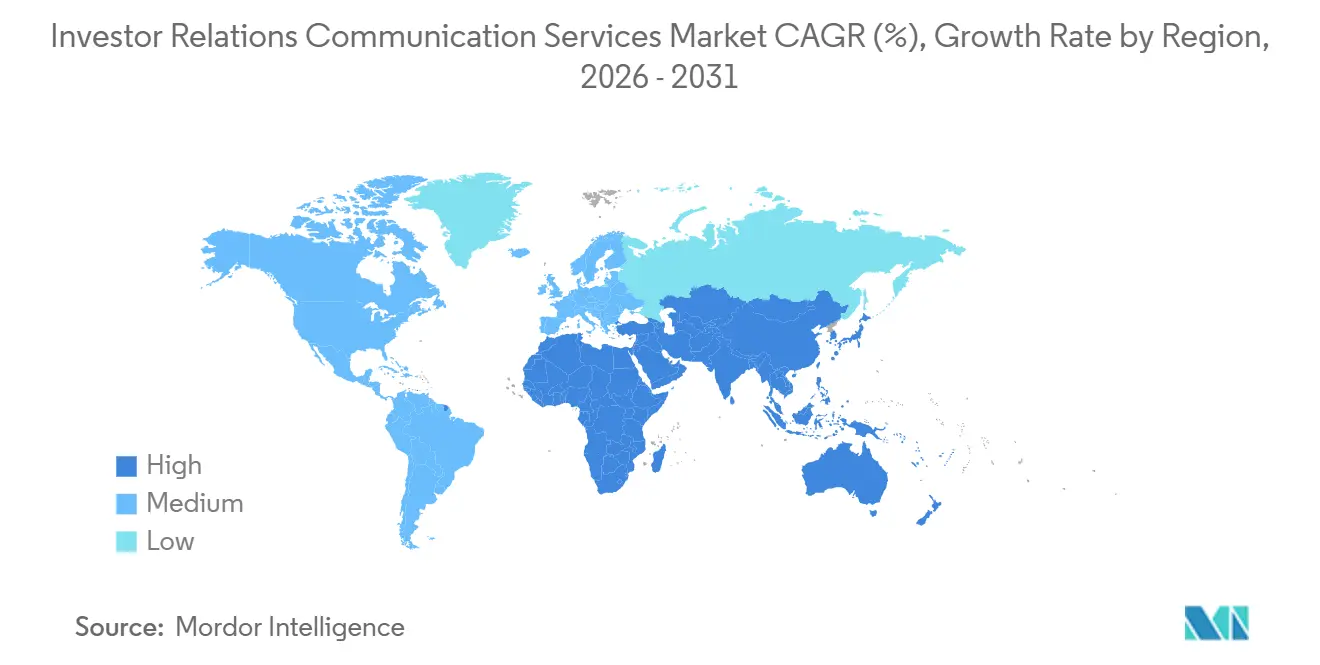
| Fastest Growing Market | Asia-Pacific |
| Largest Market | North America |
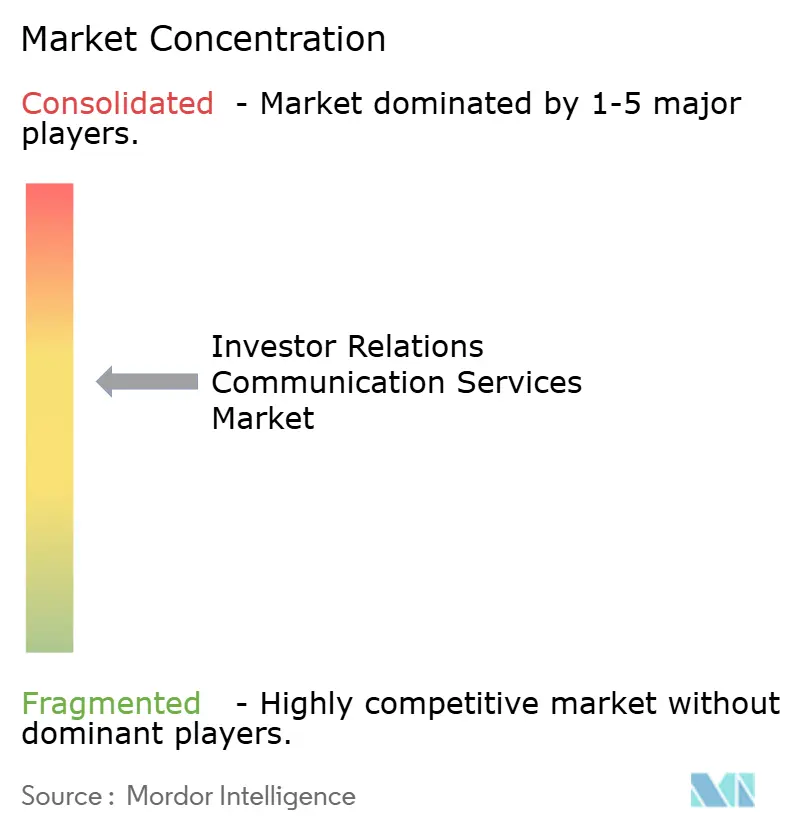
| Market Concentration | Medium |
Major Players *Disclaimer: Major Players sorted in no particular order Image © Mordor Intelligence. Reuse requires attribution under CC BY 4.0. | |
Investor Relations Communication Services Market Analysis by Mordor Intelligence
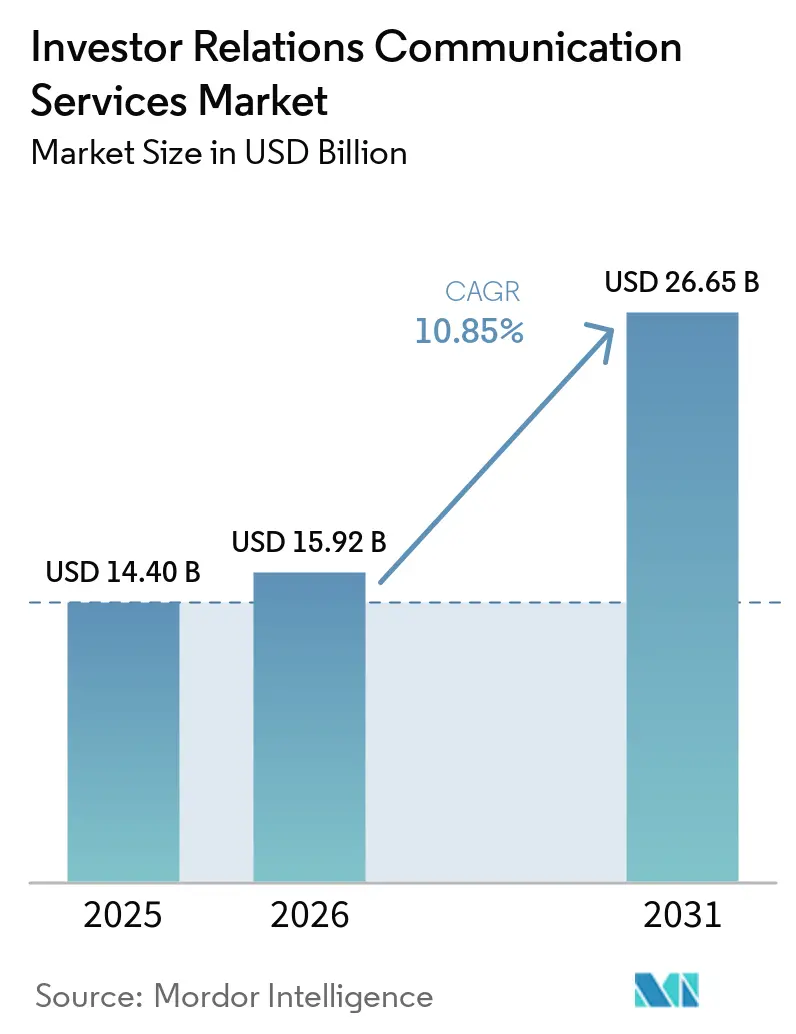
The investor relations communication services market size is projected to expand from USD 14.40 billion in 2025 and USD 15.92 billion in 2026 to USD 26.65 billion by 2031, registering a CAGR of 10.85% between 2026 and 2031. Investor relations budgets are increasingly treated as part of risk management because they affect shareholder confidence, disclosure discipline, and the cost of capital. A growing listed-company base and a heavier disclosure workload are supporting demand through different market cycles. Companies are also moving from periodic reporting toward continuous contact with investors. AI-based targeting, virtual event systems, and cross-border disclosure support are extending services beyond proxy and earnings communication. Providers that combine advice, compliance controls, and data tools are better positioned to respond to these needs.
Key Report Takeaways
- By service type, Investor Relations Advisory and Consulting held 28.73% of the investor relations communication services market share in 2025, while Investor Events and Webcasting is projected to expand at an 11.32% CAGR through 2031.
- By engagement model, retainer-based engagements accounted for 60.72% in 2025, while hybrid models among the other engagement models segment are projected to grow at an 11.98% CAGR through 2031.
- By client type, public listed companies held 50.72% in 2025, while pre-IPO and recently listed companies are projected to expand at a 12.06% CAGR through 2031.
- By industry vertical, Healthcare and Life Sciences accounted for 25.83% in 2025 and are projected to grow at an 11.78% CAGR through 2031.
- By geography, North America held 36.93% in 2025, while Asia-Pacific is projected to expand at a 12.21% CAGR through 2031.
Note: Market size and forecast figures in this report are generated using Mordor Intelligence’s proprietary estimation framework, updated with the latest available data and insights as of January 2026.
Market Trends and Insights
Drivers Impact Analysis of Investor Relations Communication Services Market*
| Driver | (~) % Impact on CAGR Forecast | Geographic Relevance | Impact Timeline |
|---|---|---|---|
| Rising Regulatory Disclosure Requirements | +2.1% | Global, strongest in North America and Europe | Short term (≤ 2 years) |
| AI-Enabled Investor Targeting and Sentiment Analytics | +2.0% | Global, early adoption in North America and Asia-Pacific | Medium term (2-4 years) |
| Expansion of Virtual Investor Days and Earnings Webcasts | +1.8% | Global, rapid uptake in Asia-Pacific and Middle East | Short term (≤ 2 years) |
| Always-On Shareholder Communication Expectations | +1.6% | Global, most acute in North America and Europe | Medium term (2-4 years) |
| Cross-Border Disclosure Orchestration Complexity | +1.2% | Asia-Pacific core, spillover to Europe and Middle East | Long term (≥ 4 years) |
| Activism, ESG Scrutiny, and Reputation Risk | +1.0% | North America and Europe | Short term (≤ 2 years) |
| Source: Mordor Intelligence | |||
Rising Regulatory Disclosure Requirements
The SEC’s 2026 rulemaking agenda included disclosure practices and proxy solicitation rules, with proposals scheduled for October 2026. The Commission also proposed a semiannual Form 10-S for smaller reporting companies in place of quarterly Form 10-Q filings. This change would require investor relations teams to focus closely on disclosure quality, materiality, and the development of clear narratives. The investor relations communication services market, therefore, supports companies that need advice on what information is material under a less prescriptive framework. European-listed companies face a similarly broad compliance burden under the Corporate Sustainability Reporting Directive and the Market Abuse Regulation. The investor relations communication services market supports demand for external disclosure and investor relations support across reporting cycles.
AI-Enabled Investor Targeting and Sentiment Analytics
Natural language processing is being used to review earnings calls, press releases, and sell-side commentary. Q4 introduced its Q IRO Agent in July 2025, with functions for earnings script drafting, peer sentiment monitoring, and investor targeting. In April 2026, Q4 added an AI-native CRM that lets teams query investor engagement data in natural language across a database of more than 1,000,000 contacts.[1] These tools can reduce the time required for manual investor intelligence work. The investor relations communication services market is therefore shifting advisory work toward interpretation, message development, and crisis response. Firms without proprietary data or specialized advice may find it harder to distinguish their services.
Expansion of Virtual Investor Days and Earnings Webcasts
Hybrid investor events are driving recurring demand for webcasting and event management services. Listed companies use virtual meetings to expand access for investors who cannot attend in person. Lumi Global reported that its streaming technology can reduce broadcast delay to less than 2 seconds and support structured question-and-answer processes. These features help companies provide a more consistent experience for remote and in-person participants. The investor relations communication services market is moving beyond isolated event assignments toward continuing platform relationships. Companies that treat webcasts as basic logistics risk creating a weaker remote shareholder experience.
Always-On Shareholder Communication Expectations
Institutional investors increasingly expect contact beyond quarterly reporting dates. In 2025, Computershare reported that 85% of surveyed institutional investors said client engagement influenced their proxy voting. This expectation makes investor relations a continuing relationship function rather than a reporting-only activity. Retainer engagements and automated communication tools help companies maintain message consistency between formal reporting events. The investor relations communication services market benefits when mid-cap internal teams need additional capacity to meet recurring engagement demands. Outsourced support can also help these teams prepare for questions arising from material developments.
Restraints Impact Analysis of Investor Relations Communication Services Market*
| Restraint | (~) % Impact on CAGR Forecast | Geographic Relevance | Impact Timeline |
|---|---|---|---|
| Data Privacy and Information Leakage Risk | -1.3% | Global, particularly acute in North America and Europe under GDPR and CCPA | Short term (≤ 2 years) |
| Legacy Workflow Integration and Fragmented Tech Stacks | -1.1% | Global, most severe at mid-cap issuers in North America and Europe | Medium term (2-4 years) |
| Limited In-House IR Communications Talent | -0.8% | Global, especially in Asia-Pacific and South America | Long term (≥ 4 years) |
| Budget Compression in Non-Core Communication Functions | -0.6% | Global, cyclically amplified in North America during earnings downturns | Short term (≤ 2 years) |
| Source: Mordor Intelligence | |||
Data Privacy and Information Leakage Risk
AI use in investor relations creates risks around confidential financial and transaction information. Harmonic Security found that 4.37% of prompts and 22% of files submitted to generative AI tools from April through June 2025 contained sensitive information. Such information can include merger documents and internal financial data that may be material non-public information. The investor relations communication services market must address this risk through clear platform governance and controlled data handling. A disclosure failure can create enforcement exposure and weaken the trust that investor relations programs are intended to build. GDPR and CCPA requirements also add cost and operational limits to cross-border data processing.
Legacy Workflow Integration and Fragmented Tech Stacks
Many mid-cap investor relations teams use separate systems for disclosure, shareholder tracking, events, and media monitoring. This arrangement can lead to data delays, version-control issues, and unnecessary analyst work. KPMG’s 2025 Audit Committee Survey identified cybersecurity, data privacy, and AI governance as key board oversight gaps, and 69% of respondents named cybersecurity as their most critical concern. Enterprise buyers increasingly assess whether a provider can connect systems rather than just compare individual features. Many platforms developed before 2020 lack API-native designs for real-time integration with compliance systems. The investor relations communication services market faces slower adoption, where integration requires major custom development.
*Our forecasts treat driver/restraint impacts as directional, not additive. The impact forecasts reflect baseline growth, mix effects, and variable interactions.
Investor Relations Communication Services Market Segment Analysis
By Service Type:
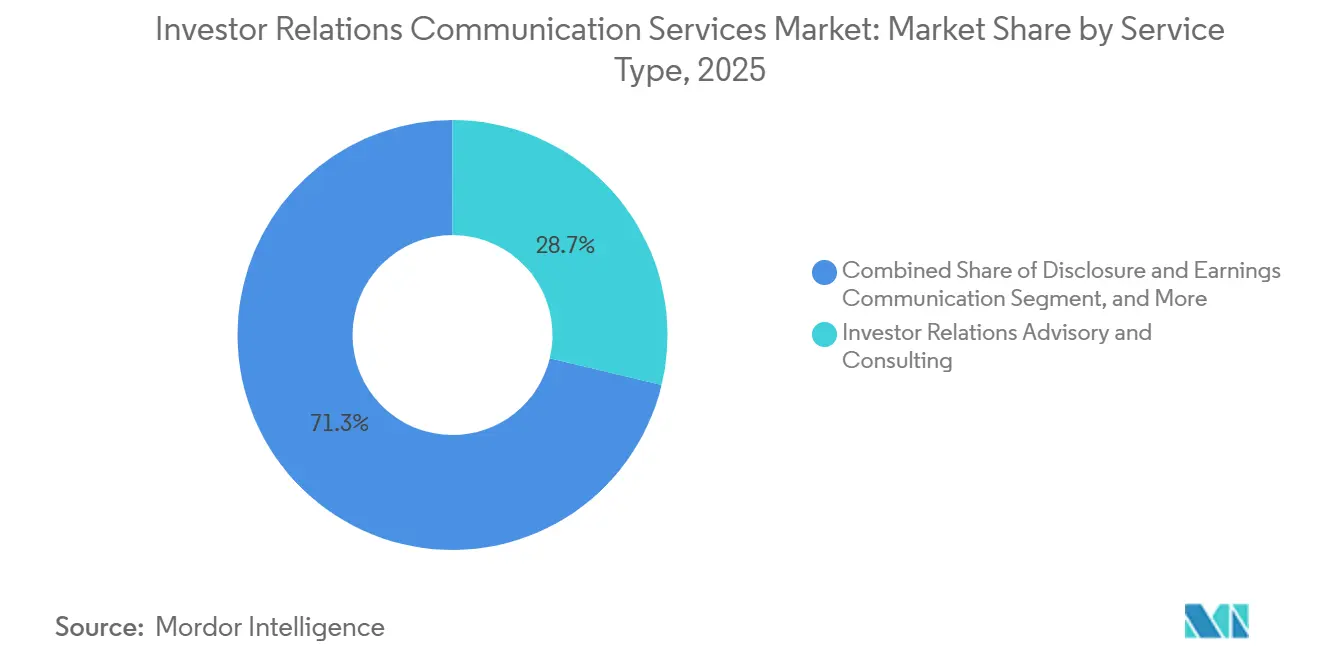
Advisory Leads While Event Platforms ExpandInvestor Relations Advisory and Consulting accounted for 28.73% of the investor relations communication services market in 2025. The segment remains important because activist defense, crisis communication, and earnings guidance require senior judgment and trusted relationships. Donnelley Financial Solutions reported 8.7% growth in software solutions net sales in 2025, while Venue and ActiveDisclosure each grew nearly 20% in the fourth quarter. Technology-enabled offerings are replacing purely manual models, particularly in disclosure, earnings communication, investor targeting, and research. Shareholder communication, proxy solicitation, and annual general meeting services remain supported by mandatory governance calendars.
Investor Events and Webcasting are projected to grow at an 11.32% CAGR from 2026 to 2031. Hybrid investor days and low-latency annual general meeting systems are supporting the investor relations communication services market. Q4 launched Answer Engine Optimization for IR Web in March 2026 to help companies maintain visibility in AI-generated investor research results. Event and web services must now work across additional research channels, rather than solely supporting an isolated meeting. Annual platform contracts can replace one-time event billing and connect event delivery with website content, investor data, and disclosure coordination.

By Engagement Model:
Retainers Remain Central While Hybrid Work GrowsRetainer-based engagements held 60.72% in 2025. Companies value predictable costs and continuing access to advisors who understand their shareholder base, institutional investors, sell-side analysts, and proxy advisors. The model fits the expectation that issuer engagement should continue throughout the year. Project work remains important for initial public offerings, secondary offerings, activist situations, and other discrete events. Retainers provide continuity when companies move between routine reporting and high-pressure communication periods.
Hybrid engagement models are projected to grow at an 11.98% CAGR through 2031. They combine a standing advisory relationship with extra capacity during earnings seasons, proxy campaigns, and capital markets transactions. The format gives clients flexibility while retaining access to advisors familiar with their circumstances. It can support boutiques with deep sector expertise, but similar pricing structures can make basic responsiveness less distinctive. The investor relations communication services market rewards providers that pair flexible staffing with proprietary investor data or specialized knowledge.
By Client Type:
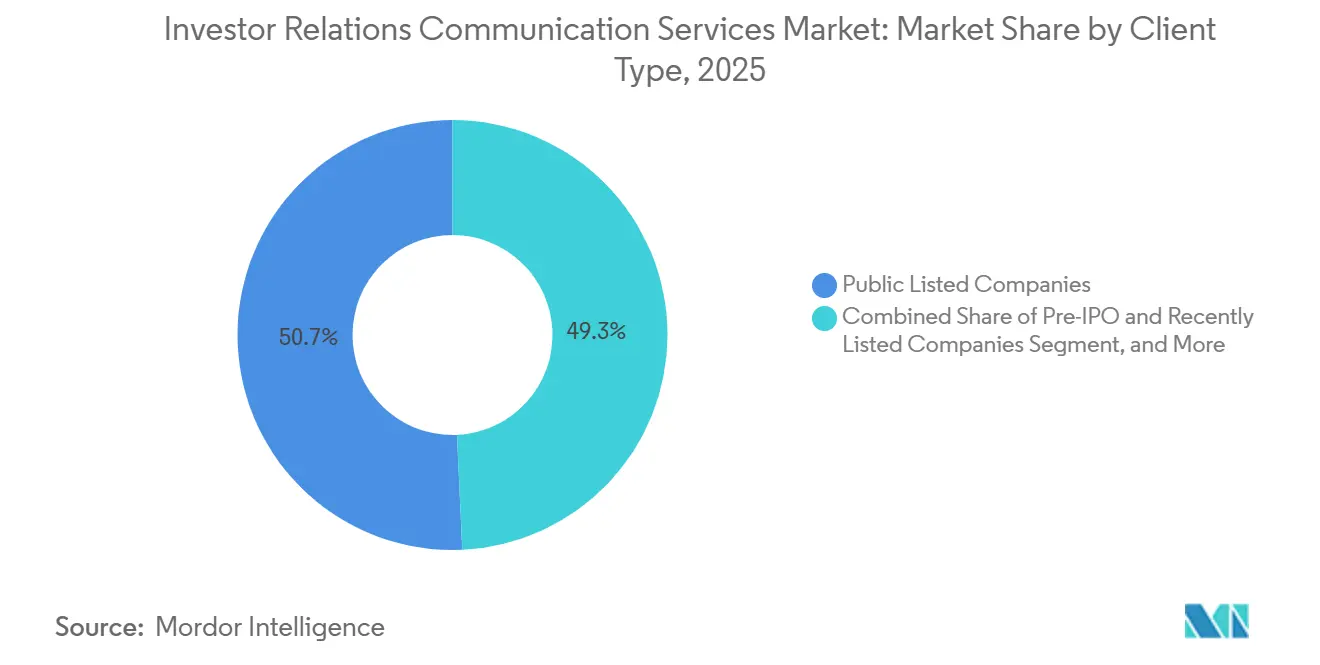
Public Companies Form the Base as New Issuers Gain PacePublicly listed companies accounted for 50.72% of the investor relations communication services market in 2025. Their demand is supported by recurring disclosure, proxy, and institutional engagement obligations across the reporting calendar. Financial institutions and asset managers form a separate client group because investor communications intersect with regulatory reporting. Private equity-backed companies are expanding the customer base, particularly in Europe, as they prepare for initial public offerings and exits. Listed issuers remain the core customer base because their investor communication duties extend beyond financing events.
Pre-IPO and recently listed companies are projected to grow at a 12.06% CAGR from 2026 to 2031. Goodwin Law reported that life sciences entered 2026 with an initial public offering backlog of 21 companies, after the XBI index rose 35% in 2025.[2] The source also reported more than USD 150 billion in announced pharmaceutical merger and acquisition activity. New issuers must build an investor base, sell-side relationships, and repeatable processes within 12 to 18 months after listing. Smaller firms can appeal to founders seeking direct senior access, while enterprise platforms can provide broader technology and compliance support.
By Industry Vertical:
Healthcare and Life Sciences Holds Scale and GrowthHealthcare and Life Sciences held 25.83% in 2025. The vertical combines a large public-company base with active transactions and communications around regulatory milestones, clinical trials, and pipeline valuation. Silicon Valley Bank reported nearly USD 18 billion in U.S. and European healthcare AI venture investment in 2025, with AI representing 46% of sector investment. The investor relations communication services market gains from activity that creates a pipeline of companies that may need support as they approach public capital markets. Specialized healthcare practices can retain a pricing advantage because generalist advisors may lack scientific fluency.
Healthcare and Life Sciences are projected to grow at an 11.78% CAGR through 2031. Investor relations communication services in this vertical require timely explanations of scientific milestones, changing pipeline assumptions, and transaction outcomes for financial audiences. BFSI holds the second-largest vertical share because banks and insurers are subject to ongoing disclosure requirements across jurisdictions. Retail and e-commerce, media and entertainment, travel and hospitality, and consumer goods occupy the middle of the vertical mix. In 2026, consumer goods companies need more guidance communication as tariff-related cost uncertainty affects planning.
Geography Analysis
North America Investor Relations Communication Services Market
North America accounted for 36.93% in 2025 and remains the largest regional market for investor relations communication services. The region has a dense public-company base and extensive obligations under SEC Regulation FD, Form 10-K, and Form 8-K. The SEC’s 2026 agenda is reshaping how advisors support companies using a principles-based materiality framework. Governance proposals received an average of 31.4% support in the 2026 proxy season, the highest across proposal categories, supporting continued engagement with institutional shareholders and proxy advisors. Canada’s small-cap mining, energy, and technology issuers support a dense boutique network, while Mexico’s cross-listed issuers require bilingual investor relations services.
APAC Investor Relations Communication Services Market
Asia-Pacific is projected to grow at a 12.21% CAGR through 2031, the fastest rate in the investor relations communication services market. Equity and equity-linked issuance excluding Japan reached USD 259.7 billion in 2025, its highest annual level since 2022. In the first half of 2026, initial public offering proceeds, excluding Japan, rose 41.8% year over year to USD 29.2 billion, with China accounting for 61.7% of those proceeds. These listings expand the investor relations communication services market and create a wider group of companies that need ongoing investor communication and disclosure coordination. The ASIFMA and KPMG survey found that 66% of firms planned regional expansion over the next 3 years, compared with 40% in 2023-2024.
EMEA and South America Investor Relations Communication Services Market
Europe is the second-largest regional investor relations communication services market, with Market Abuse Regulation and Corporate Sustainability Reporting Directive duties layered onto national listing rules. The investor relations communication services market benefits because this multi-jurisdiction work favors specialized platforms, and EQS Group serves more than 8,000 companies through its IR COCKPIT platform.[3] Germany, the United Kingdom, and France anchor demand, while Brazil, Chile, and Argentina are strengthening investor relations functions to reach international capital. The Middle East and Africa offer further opportunity through Saudi Arabia’s Vision 2030 privatization pipeline and South Africa’s listed-company base.
Competitive Landscape
The investor relations communication services market has moderate consolidation among large enterprise providers. Computershare, Nasdaq, and Donnelley Financial Solutions compete through data, technology integration, and international reach. Nasdaq reported USD 4.0 billion in Solutions revenue in 2025, including USD 2.137 billion from Capital Access Platforms. This scale gives integrated exchange and technology groups an advantage, while the middle tier remains fragmented across regional advisors, proxy specialists, and governance firms. The investor relations communication services market still provides room for specialists whose sector expertise and senior relationships meet needs that broad platforms cannot.
AI automation and data-network effects are becoming more important across the investor relations communication services market. EQS Group introduced Q by EQS in June 2026 to add AI-native intelligence to compliance and investor relations workflows. Computershare acquired Fitzcores in May 2026 to expand investor-targeting analytics, and in April 2026, introduced tokenized shares for U.S. issuers with Securitize.[4] These moves extend its role from registry services into data-led engagement and digital securities infrastructure. Providers with investor-intent data and certified regulatory distribution may command stronger pricing as basic advisory tasks become more automated.
Digital proxy-voting infrastructure is another competitive area in the investor relations communication services market. Proxymity and Euroclear announced a strategic investment in February 2026 to develop Vote Connect and support international expansion. Proxymity also expanded cross-border voting through work with Taiwan Depository and Clearing Corporation. Buyers assess security controls with advisory and data functions, and SOC 2 Type II certification is becoming an important enterprise procurement expectation.
Investor Relations Communication Services Industry Leaders
-
Computershare Limited
-
Equiniti Group Limited
-
Donnelley Financial Solutions, Inc.
-
Nasdaq, Inc.
-
Q4 Inc.
- *Disclaimer: Major Players sorted in no particular order
Investor Relations Communication Services Market Companies Covered in this Report
- Computershare Limited
- Equiniti Group Limited
- Donnelley Financial Solutions, Inc.
- Nasdaq, Inc.
- Q4 Inc.
- Sodali & Co LLC
- Cision Ltd.
- Business Wire, Inc.
- EQS Group AG
- Euronext Corporate Solutions
- Proxymity Limited
- Lumi Global Limited
- ISS Corporate Solutions, Inc.
- Brunswick Group LLP
- ICR, LLC
- FGS Global LLC
- APCO Worldwide LLC
- FTI Consulting, Inc.
Recent Industry Developments in Investor Relations Communication Services Market
- July 2026: EQS Group expanded its Privacy Cockpit with AI governance capabilities to support EU AI Act readiness, enabling companies to document AI use cases, assess risk classifications, and maintain compliance audit trails in a single platform. This positions EQS Group ahead of EU AI Act obligations taking effect progressively through 2026 and 2027.
- June 2026: Donnelley Financial Solutions introduced AI-powered iXBRL tagging for SEC filings, automating structured-data tagging for regulatory submissions and reducing manual tagging time and error rates. The capability supports DFIN's strategy to grow software solutions as a proportion of total revenue.
- June 2026: EQS Group launched "Q by EQS," an AI-native intelligence layer bringing agentic AI workflows to enterprise compliance and IR programs, automating compliance monitoring, disclosure scheduling, and regulatory change alerting.
- March 2026: Q4 Inc. launched Answer Engine Optimization (AEO) for IR Web, enabling public companies to optimize investor relations materials for visibility in AI-generated investor research outputs.
Global Investor Relations Communication Services Market Report Scope
The investor relations communication services market covers solutions and services that help publicly listed companies, private firms preparing for public offerings, and investment-focused organizations communicate effectively with shareholders, analysts, institutional investors, regulators, and other financial stakeholders. The scope of the report includes services such as financial communications, earnings call support, shareholder communications, regulatory and disclosure communications, investor presentations, annual report communications, digital investor relations platforms, media relations, and strategic advisory services to support transparent and compliant investor engagement.
The Investor Relations Communication Services Market Report is Segmented by Service Type (Disclosure and Earnings Communication, Investor Relations Advisory and Consulting, Investor Events and Webcasting, Investor Targeting and Research, Shareholder Communications, Proxy Solicitation, and AGM Services, and Crisis and Special Situations Communication), Engagement Model (Retainer-Based, Project-Based, and Other Engagement Models), Client Type (Public Listed Companies, Pre-IPO and Recently Listed Companies, Private Equity-Backed Companies, and Financial Institutions and Asset Managers), Industry Vertical (BFSI, Retail and E-commerce, Media and Entertainment, Healthcare and Life Sciences, Travel and Hospitality, Consumer Goods, and Other Industry Verticals), and Geography (North America, South America, Europe, Asia-Pacific, Middle East, and Africa). The Market Forecasts are Provided in Terms of Value (USD).
Segmentation Overview
| Disclosure and Earnings Communication |
| Investor Relations Advisory and Consulting |
| Investor Events and Webcasting |
| Investor Targeting and Research |
| Shareholder Communications, Proxy Solicitation, and AGM Services |
| Crisis and Special Situations Communication |
| Retainer-Based |
| Project-Based |
| Other Engagement Models |
| Public Listed Companies |
| Pre-IPO and Recently Listed Companies |
| Private Equity-Backed Companies |
| Financial Institutions and Asset Managers |
| BFSI |
| Retail and E-commerce |
| Media and Entertainment |
| Healthcare and Life Sciences |
| Travel and Hospitality |
| Consumer Goods |
| Other Industry Verticals |
| North America | United States |
| Canada | |
| Mexico | |
| South America | Brazil |
| Argentina | |
| Chile | |
| Rest of South America | |
| Europe | Germany |
| United Kingdom | |
| France | |
| Italy | |
| Spain | |
| Rest of Europe | |
| Asia-Pacific | China |
| Japan | |
| India | |
| South Korea | |
| Australia | |
| Rest of Asia-Pacific | |
| Middle East | Saudi Arabia |
| United Arab Emirates | |
| Qatar | |
| Rest of Middle East | |
| Africa | South Africa |
| Egypt | |
| Nigeria | |
| Rest of Africa |
| By Service Type | Disclosure and Earnings Communication | |
| Investor Relations Advisory and Consulting | ||
| Investor Events and Webcasting | ||
| Investor Targeting and Research | ||
| Shareholder Communications, Proxy Solicitation, and AGM Services | ||
| Crisis and Special Situations Communication | ||
| By Engagement Model | Retainer-Based | |
| Project-Based | ||
| Other Engagement Models | ||
| By Client Type | Public Listed Companies | |
| Pre-IPO and Recently Listed Companies | ||
| Private Equity-Backed Companies | ||
| Financial Institutions and Asset Managers | ||
| By Industry Vertical | BFSI | |
| Retail and E-commerce | ||
| Media and Entertainment | ||
| Healthcare and Life Sciences | ||
| Travel and Hospitality | ||
| Consumer Goods | ||
| Other Industry Verticals | ||
| By Geography | North America | United States |
| Canada | ||
| Mexico | ||
| South America | Brazil | |
| Argentina | ||
| Chile | ||
| Rest of South America | ||
| Europe | Germany | |
| United Kingdom | ||
| France | ||
| Italy | ||
| Spain | ||
| Rest of Europe | ||
| Asia-Pacific | China | |
| Japan | ||
| India | ||
| South Korea | ||
| Australia | ||
| Rest of Asia-Pacific | ||
| Middle East | Saudi Arabia | |
| United Arab Emirates | ||
| Qatar | ||
| Rest of Middle East | ||
| Africa | South Africa | |
| Egypt | ||
| Nigeria | ||
| Rest of Africa | ||
Key Questions Answered in the Report
How large is investor relations communication services in 2026?
The sector is USD 15.92 billion in 2026 and is projected to reach USD 26.65 billion by 2031 at a 10.85% CAGR.
What services are included in investor relations communication services?
Services include advisory and consulting, disclosure and earnings communications, investor targeting and research, shareholder communications, proxy solicitation, annual general meeting support, events, and webcasting.
Which service type leads investor relations communication services?
Investor Relations Advisory and Consulting led with 28.73% share in 2025, while Investor Events and Webcasting is projected to grow at an 11.32% CAGR through 2031.
Which client group is growing fastest for investor relations providers?
Pre-IPO and recently listed companies are projected to expand at a 12.06% CAGR through 2031 as they build investor bases and repeatable reporting processes after listing.
Which region is growing fastest for investor relations communication services?
Asia-Pacific is projected to grow at a 12.21% CAGR through 2031, supported by higher equity issuance and a growing base of listed companies.
Why are companies adopting AI tools for investor relations?
AI tools can support investor targeting, sentiment monitoring, meeting preparation, and access to investor engagement data, although companies must manage confidential-data risks.