
Interest Rate Risk Management Services Market Size and Share
Market Overview
| Study Period | 2021 - 2032 |
|---|---|
| Market Size (2027) | USD 0.75 Trillion |
| Market Size (2032) | USD 1.06 Trillion |
| Growth Rate (2027 - 2032) | 7.20 % |
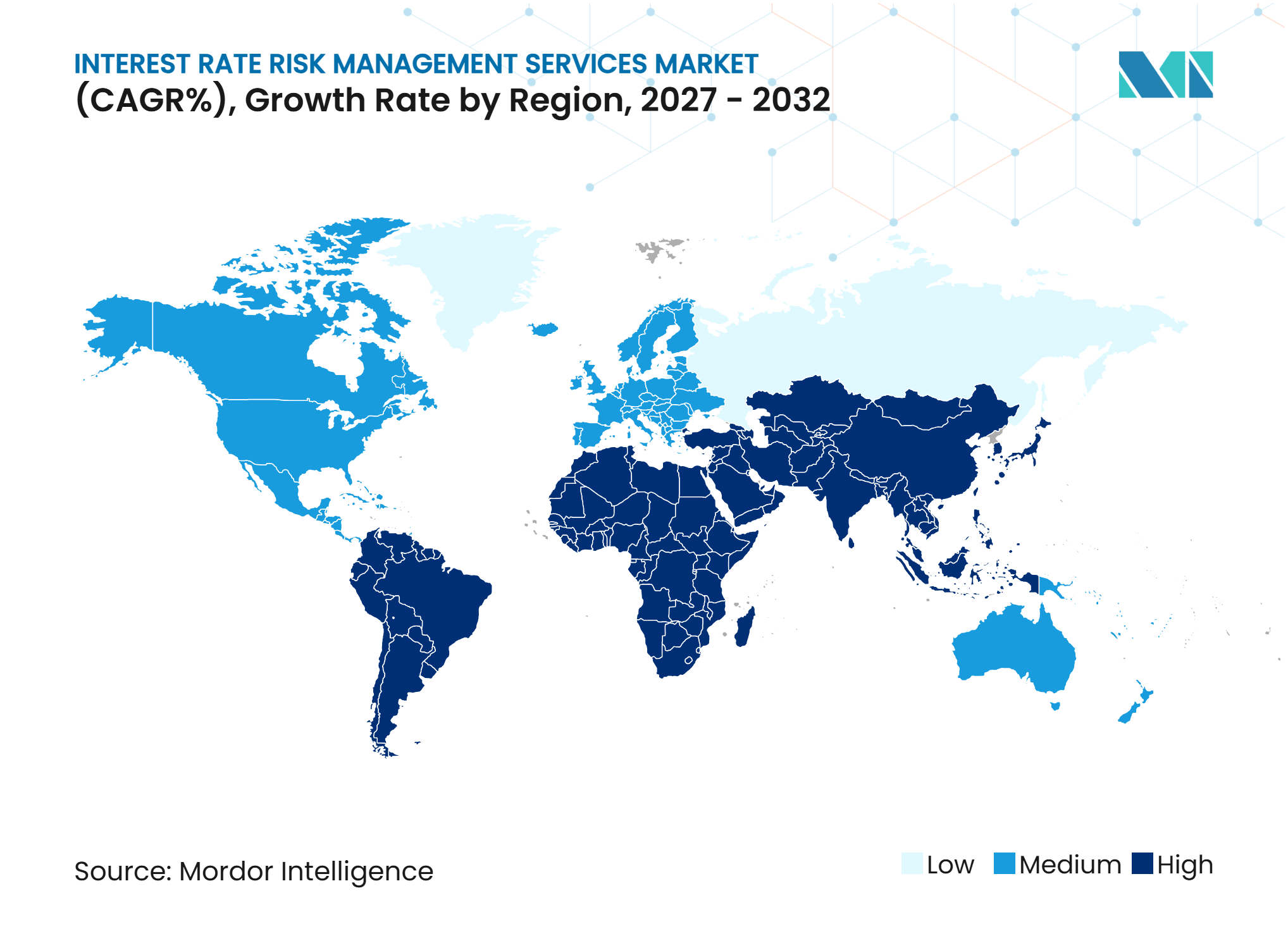
| Fastest Growing Market | Asia-Pacific |
| Largest Market | North America |
| Market Concentration | Medium |
Major Players *Disclaimer: Major Players sorted in no particular order Image © Mordor Intelligence. Reuse requires attribution under CC BY 4.0. | |
Interest Rate Risk Management Services Market Analysis by Mordor Intelligence
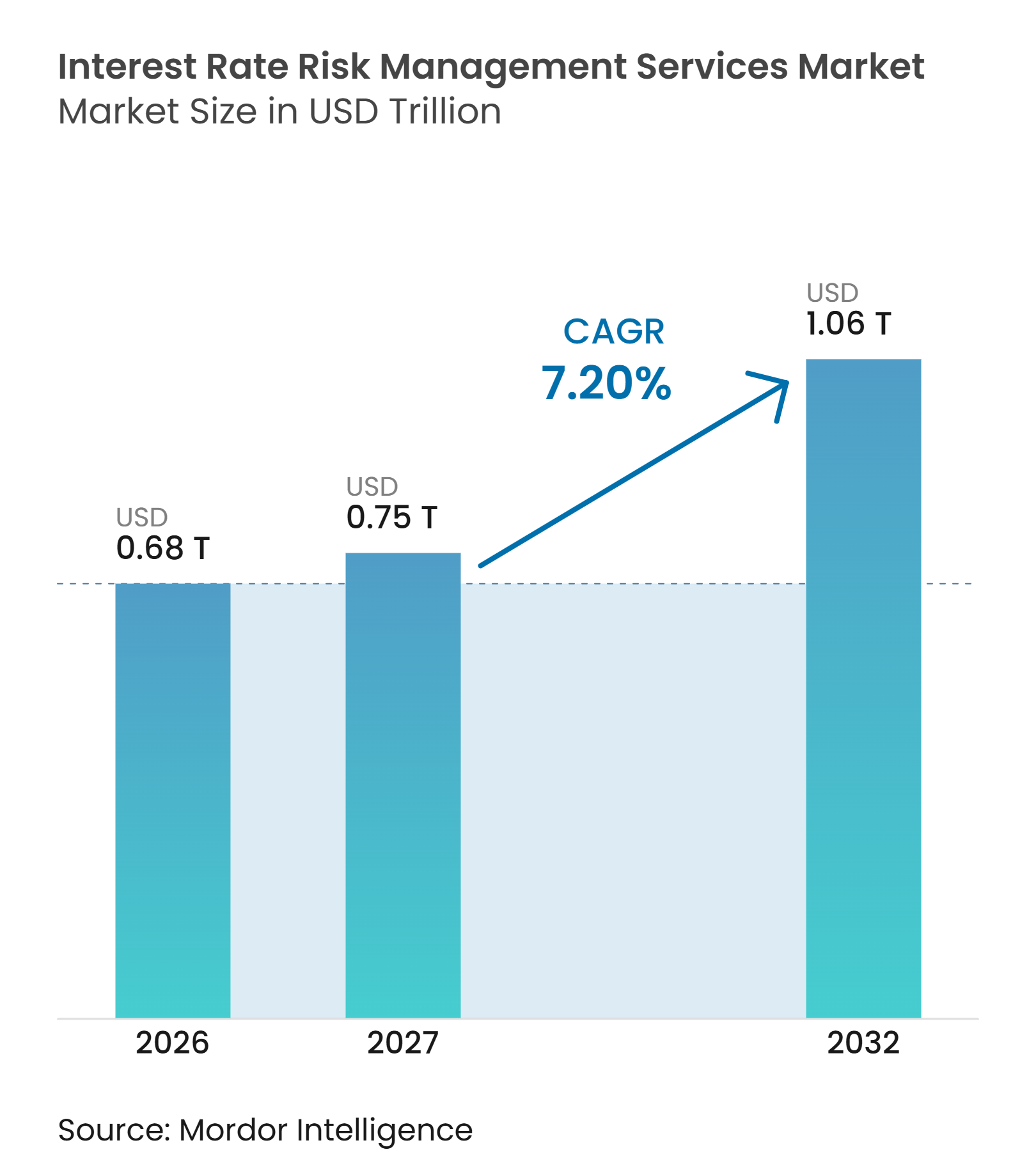
The Interest Rate Risk Management Services Market size is projected to be USD 0.68 trillion in 2026, USD 0.75 trillion in 2027, and reach USD 1.06 trillion by 2032, growing at a CAGR of 7.20% from 2027 to 2032.
The market is moving beyond a simple response to changing policy rates because banks now need stronger controls over both earnings sensitivity and economic value. Recent rate volatility exposed weaknesses in balance sheet measurement, model governance, and securities portfolio management. Supervisory changes are converting these weaknesses into defined implementation programs with fixed reporting and validation requirements. Cloud delivery and managed services are also making specialist capabilities more accessible to institutions that cannot maintain large internal teams. This creates opportunities for providers that can combine regulatory knowledge, data integration, scenario analysis, and practical implementation support.
Key Report Takeaways
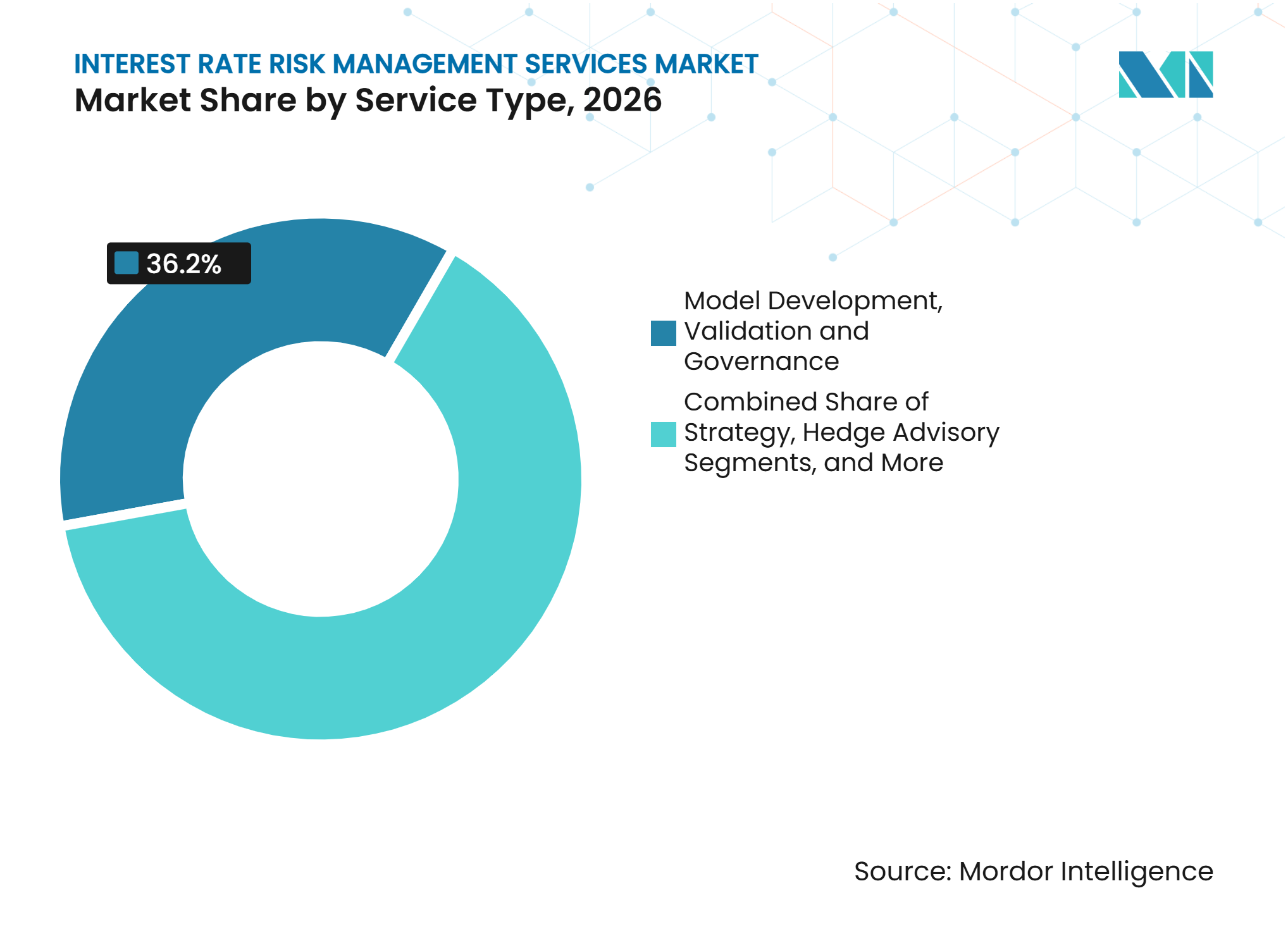
- By service type, Model Development, Validation & Governance held 36.2% of the interest rate risk management services market share in 2026, while Managed/Outsourced IRR Services is forecast to grow at a 10.5% CAGR through 2032.
- By end user, Commercial and Investment Banks held 50.8% of the interest rate risk management services market size in 2026, while Other Non-Bank Financial Institutions are forecast to grow at a 9.8% CAGR through 2032.
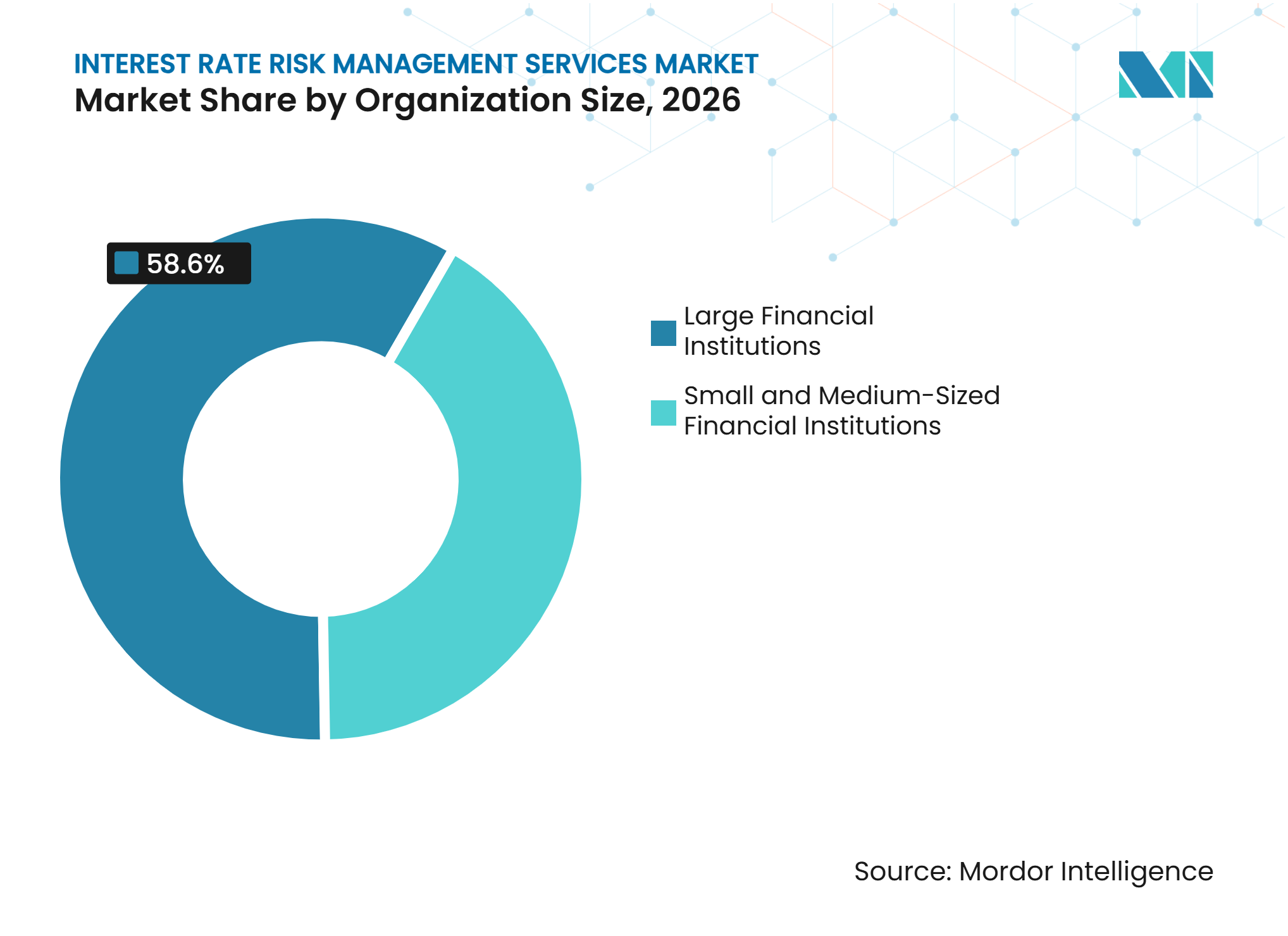
- By organization size, Large Financial Institutions held 58.6% of the interest rate risk management services market share in 2026, while Small and Medium-Sized Financial Institutions are forecast to grow at an 8.6% CAGR through 2032.
- By geography, North America held 46.1% of the interest rate risk management services market share in 2026, while Asia-Pacific is forecast to grow at an 11.2% CAGR through 2032.
Note: Market numbers in this report are based on Mordor Intelligence's proprietary estimation framework, which combines nine months of actuals with Q4 projections for base year 2026.
Market Trends and Insights
Drivers Impact Analysis of Interest Rate Risk Management Services Market*
| Driver | (~) % Impact on CAGR Forecast | Geographic Relevance | Impact Timeline |
|---|---|---|---|
| Increasing Regulatory Requirements for IRRBB Compliance and Supervisory Reporting | +2.1% | Global, with concentrated near-term pressure in EU, Australia, and Canada | Short term (≤ 2 years) |
| Rising Interest Rate Volatility and Banking-Book Exposure to NII and EVE Fluctuations | +1.4% | Global, most acute in North America and UK | Medium term (2-4 years) |
| Accelerating Digitalization and Cloud Migration of Treasury and IRR Management Infrastructure | +1.2% | APAC core, spillover to MEA | Medium term (2-4 years) |
| Growing Demand for Integrated ALM, Liquidity and Capital Risk Analytics | +0.9% | Global, most prominent in North America and Europe | Long term (≥ 4 years) |
| Increasing Adoption of AI-Driven Scenario Analysis, Stress Testing and Risk Forecasting | +0.8% | North America and EU, with gradual APAC expansion | Long term (≥ 4 years) |
| Rising Focus on Deposit Pricing Optimization, NIM Protection and Balance-Sheet Resilience | +0.5% | North America and EU | Medium term (2-4 years) |
| Source: Mordor Intelligence | |||
Regulatory Requirements for IRRBB Compliance Are Reshaping Procurement Cycles
The interest rate risk management services market is gaining support from regulatory deadlines that require institutions to improve governance, measurement, and reporting. The Basel framework, effective from January 2026, applies supervisory outlier tests and requires stronger treatment of economic value of equity, net interest income, and internal capital assessment[1]. The Basel Committee’s November 2026 consultation adds proposed guidance on model risk management, stress testing, embedded gains and losses, and supervisory information, which extends the work beyond the initial implementation period. Australia’s APS 117 brought Pillar 1 capital requirements for IRRBB into effect for authorized deposit-taking institutions from October 2025, with related quarterly reporting under ARS 117.0 and ARS 117.1[2]. Canada’s final Guideline B-12 takes effect in January 2027, creating a new compliance cycle for banks, trust companies, and loan companies[3]. These changes favor providers that can translate regulatory text into models, controls, reporting processes, and evidence that can withstand supervisory review.
Interest Rate Volatility Generates a Durable Service Demand Signal
The interest rate risk management services market is supported by the need to manage earnings and value effects under different rate paths. Recent rate volatility showed that fixed-rate securities losses and changing deposit behavior could affect capital, profitability, and supervisory attention at the same time. In the United States, net interest margin fell to 3.22% in the first quarter of 2026 from 3.30% in the fourth quarter of 2025 as loan yields declined for a second quarter. This environment increases the need for deposit modeling, hedge monitoring, sensitivity analysis, and reporting that connects net interest income with economic value of equity. Banks must test rate movements in both directions because lower policy rates do not remove long-duration assets, deposit repricing uncertainty, or funding pressures. Demand therefore remains tied to continuous balance sheet management rather than a single rate cycle.
Cloud Migration of Treasury Infrastructure Compresses Deployment Timelines
Cloud migration is changing how institutions obtain IRRBB capabilities and how vendors package their services. LSEG reported in 2025 that 83% of surveyed financial services firms using cloud specifically for risk management had completed their migration, the highest completion rate among the surveyed use cases[4]. Murex expanded managed-service delivery under its September 2025 collaboration with AWS, supporting consumption of treasury and risk capabilities without equivalent on-premises infrastructure requirements. FIS also introduced its Quantum Cloud Edition in April 2025 with real-time cash management and risk visibility capabilities. Faster provisioning can reduce the gap between a regulatory mandate and a functioning calculation environment. It also allows smaller banks to consider subscription-based services where a full internal implementation would have been impractical.
Demand for Integrated ALM, Liquidity, and Capital Analytics Redefines Service Scope
The interest rate risk management services market is shifting from isolated measurement assignments toward broader balance sheet work. Institutions need to understand how an interest rate scenario affects funding, liquidity, capital, hedging, and financial reporting rather than treat each outcome as a separate task. This requires common data, consistent assumptions, and controls that allow treasury, finance, risk, and senior management to work from the same result. The demand for integration also strengthens interest in managed operating models that bring hedging, cash management, liquidity, and reporting into a single service. EY’s Managed Treasury Service, launched with FIS in June 2026, combines these functions through a cloud-based outsourced model. AI-supported scenario analysis can reduce manual handling in these workflows, but firms still need explainable models, traceable assumptions, and accountable human review. Greater attention to deposit pricing and margin protection further links daily commercial decisions with the wider interest rate risk program.
Restraints Impact Analysis of Interest Rate Risk Management Services Market*
| Restraint | (~) % Impact on CAGR Forecast | Geographic Relevance | Impact Timeline |
|---|---|---|---|
| Legacy Banking-System Integration, Fragmented Risk Data and Model Interoperability Challenges | -1% | Global, most acute in South America and MEA | Medium term (2-4 years) |
| High Implementation Costs and Shortage of Specialized IRR and Quantitative Modeling Professionals | -0.8% | Global, with highest scarcity in APAC and MEA | Medium term (2-4 years) |
| Behavioral Modeling Uncertainty in Non-Maturity Deposits, Loan Prepayments and Customer Rate Sensitivity | -0.6% | Global | Long term (≥ 4 years) |
| Complex Regulatory Model Validation, Governance and Assumption-Calibration Requirements | -0.5% | EU, Australia, and North America | Short term (≤ 2 years) |
| Source: Mordor Intelligence | |||
Legacy System Fragmentation Creates Integration Cost and Timeline Overruns
Legacy banking systems can slow the interest rate risk management services market because institutions must prepare usable data before they can benefit from advanced analytics. Data may sit in separate core banking, treasury, loan, deposit, and reporting systems with different definitions and update cycles. These gaps can make it difficult to connect balances, cash flows, behavioral assumptions, and hedges in one controlled calculation process. Smaller institutions can be affected more severely because they have limited budgets for mapping, cleaning, and reconciling data. Fragmentation also makes model outputs harder to explain when a risk, finance, or audit team challenges the result. Providers therefore need implementation services that address data lineage and integration alongside the risk model itself.
Talent Scarcity in Quantitative Modeling Constrains Service Delivery Capacity
Interest rate risk programs require professionals who understand quantitative modeling, banking products, regulation, and operating processes. Non-maturity deposit behavior, loan prepayments, customer rate sensitivity, and hedge effectiveness cannot be addressed through generic risk skills alone. The shortage affects both buyers and providers because multiple institutions may need validation, recalibration, and documentation support during the same compliance window. Automation can reduce repetitive preparation work, but it cannot replace ownership of assumptions or informed challenge of model outcomes. Firms must also retain people who can explain results to asset and liability committees, senior management, and supervisors. This constraint can extend project schedules and increase the cost of deploying a full IRRBB capability.
*Our forecasts treat driver/restraint impacts as directional, not additive. The impact forecasts reflect baseline growth, mix effects, and variable interactions.
Interest Rate Risk Management Services Market Segment Analysis
By Service Type:
Model Governance Anchors Revenue While Outsourcing Leads GrowthModel Development, Validation & Governance held 36.2% of the interest rate risk management services market share in 2026. This segment is central to supervisory expectations because institutions must support the assumptions behind earnings and economic value measures. Independent validation, model documentation, periodic recalibration, and board-level governance create recurring work even after the initial implementation is complete. The Basel framework requires banks to measure and manage IRRBB through robust internal processes and supervisory assessment. Hedge Advisory & Execution Support remains relevant for institutions extending structural hedges and responding to changing deposit and lending behavior. Implementation, Configuration & Integration Services also gain demand when a regulatory requirement prompts replacement or modernization of an ALM platform.
Managed/Outsourced IRR Services is projected to grow at a 10.5% CAGR through 2032, the fastest-growing service category in the interest rate risk management services market. The segment appeals to mid-market banks that need a complete risk process but do not have the staffing capacity to operate it internally. Managed delivery can package scenario analysis, reporting, model monitoring, and operational support into a recurring service. Murex’s managed-services program illustrates how larger platform providers are expanding beyond traditional software licensing. EY’s June 2026 service launch also shows how treasury, hedging, liquidity, and reporting can be bundled into an outsourced workflow. Strategy, Policy & ALCO Advisory and Training, Documentation & Knowledge Transfer continue to support institutions that need policies, governance evidence, and internal capability alongside technology.



By End User:
Commercial Banks Dominate but Non-Bank Segments Accelerate FastCommercial and Investment Banks accounted for 50.8% of 2026 demand in the interest rate risk management services market. Their balance sheets combine retail deposits, wholesale funding, loan portfolios, securities, hedges, and reporting responsibilities. This scale creates a need for services that link behavioral assumptions with scenario design, valuation, hedge strategy, and disclosures. Banks also face direct supervisory scrutiny under IRRBB frameworks, which increases demand for defensible calculations and clear governance. Large commercial institutions often procure several service categories at once because their needs include platform integration, model validation, and ongoing risk reporting. Credit unions, building societies, and cooperative banks are also acquiring specialist platforms as their supervisory treatment and reporting expectations become more aligned with those of commercial banks.
Other Non-Bank Financial Institutions are forecast to grow at a 9.8% CAGR through 2032. This category includes specialty finance firms, payment institutions, and comparable entities that may be obtaining banking licenses or moving into more closely supervised activities. Many of these organizations need their first structured IRRBB program, rather than an update to a long-standing model. Insurance companies and asset and wealth managers require a different service emphasis because duration matching and liability-driven investment approaches shape their interest rate exposure. Corporate treasuries remain a smaller user group and primarily seek hedging advice and cash flow forecasting. Superbank’s March 2025 deployment of ElysianNxt’s platform processed daily liquidity calculations for 3 million contracts in 12 minutes through an ISO 27001-certified SaaS architecture. This example shows how digital-native firms can adopt cloud-first risk systems without the same legacy integration burden as established banks.
By Organization Size:
Large Institution Dominance Coexists With SMI Growth MomentumLarge Financial Institutions held 58.6% of the interest rate risk management services industry share in 2026. Their demand reflects multi-currency exposure, cross-jurisdiction reporting, formal internal approvals, and detailed behavioral modeling programs. These organizations often need several service types in parallel, including consulting, validation, software configuration, hedge support, and managed execution. Their contracts can be large because the underlying risk program must connect many entities, portfolios, and reporting lines. The interest rate risk management services industry benefits from this spending because large institutions require regular model review and governance refreshes rather than a single deployment. Their buying pattern tends to favor integrated platforms and multi-year service arrangements that can support broad balance sheet management.
Small and Medium-Sized Financial Institutions are forecast to grow at an 8.6% CAGR through 2032. Subscription models are lowering the cost of obtaining advanced stress testing, reporting, and risk management functions. Derivative Path introduced its ALM Strategy Builder in May 2026 for banks and credit unions, with real-time stress testing, comparison of hedging strategies, and an AI assistant for plain-language queries. These institutions generally prefer modular capabilities and external support over complex internal platform programs. Their adoption can be slowed by limited data quality and scarce specialist staff, but cloud delivery improves the practical case for modernization. The result is room for established vendors and specialist providers to serve different institutional needs without using the same delivery model.

Geography Analysis
North America
North America accounted for 46.1% of the 2026 interest rate risk management services market size. The region has a mature procurement environment for banking analytics, treasury systems, and regulatory reporting. The United States rate cycle raised the importance of measuring both net interest income and economic value effects across commercial banks, credit unions, and thrifts. Net interest margin declined to 3.22% in the first quarter of 2026 from 3.30% in the previous quarter as loan yields continued to decline. This condition supports demand for proactive margin management, duration analysis, and hedging advice. FIS launched its Quantum Cloud Edition in April 2025, showing continued investment in cloud-based treasury and risk delivery in the region. Canada’s Guideline B-12, effective in January 2027, adds compliance pressure for Canadian financial institutions. North American providers are therefore competing on the ability to combine established risk controls with faster cloud deployment and clearer evidence for supervisors.
Asia-Pacific
Asia-Pacific is forecast to grow at an 11.2% CAGR through 2032, making it the fastest-growing regional segment in the interest rate risk management services market. Growth comes from new Basel-aligned rules that are creating first-time demand across institutions with different sizes and levels of digital maturity. Australia’s APS 117 introduced Pillar 1 capital treatment for IRRBB and related quarterly reporting obligations from October 2025. Malaysia’s proposed IRRBB alignment and Hong Kong’s Basel-aligned shock scenarios have also increased attention to model development and system implementation. Airstar Bank adopted Bloomberg MARS in February 2025 to support IRRBB stress testing and daily market risk management. Digital banks and fintech-backed lenders in Southeast Asia create greenfield demand because many are building formal frameworks for the first time. The region rewards services that can adapt common regulatory principles to local data quality, products, and operating capacity.
Europe and Other Regions
Europe has stable demand because its mature regulatory environment requires continuing reporting, model review, and data-process work. The interest rate risk management services market share for Europe is not provided, but its recurring-service profile is supported by close supervisory attention to reporting and outsourcing. The European Central Bank has identified risk-function outsourcing as a growing part of external service use by banks. The United Kingdom remains active as banks maintain structural hedges and require ongoing advice around earnings visibility. South America is at an earlier stage, with Brazil and Argentina leading adoption for local-currency exposure management while data and infrastructure constraints slow projects. The Middle East and Africa are supported by banking-sector expansion in Saudi Arabia and the United Arab Emirates, with modernization programs creating targeted service demand. These mixed regions require flexible delivery because regulatory maturity, data availability, and institutional capability vary materially across markets.
Competitive Landscape
Market Concentration
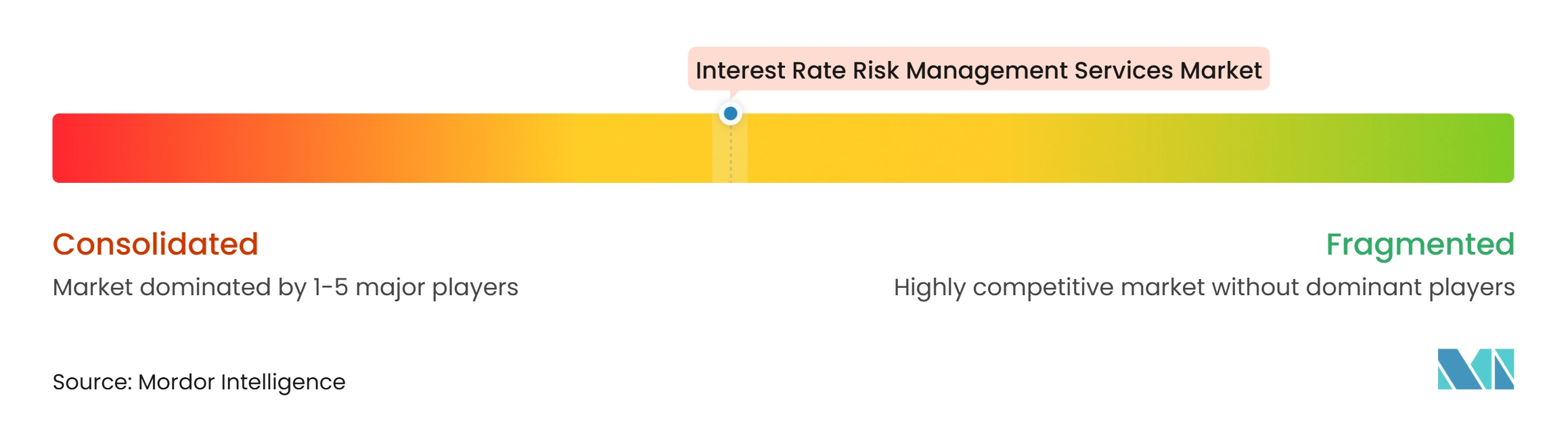
The interest rate risk management services market has moderate concentration among large institutions, where Oracle, FIS, Wolters Kluwer, Murex, and Bloomberg have established client relationships in treasury management and regulatory reporting. These providers compete on platform depth, data integration, calculation capability, and delivery capacity. Behavioral modeling for non-maturity deposits and loan prepayments has become an important point of differentiation because it affects the credibility of interest rate risk results. The Basel Committee’s November 2026 consultation reinforces the importance of model governance, stress testing, and clear supervisory information. Providers are increasingly expected to offer explainability, audit trails, and implementation support rather than only a calculation engine. This favors firms that can make complex outputs useful for risk teams, senior management, and supervisors.
Murex expanded its managed-services strategy through a September 2025 AWS collaboration that supports MXSaaS and XVA as a Service. FIS launched Treasury and Risk Manager Quantum Cloud Edition in April 2025, adding cloud-native delivery and a Liquidity Hub for real-time cash management analysis. EY entered the managed treasury space with an outsourced service built with FIS in June 2026. These moves show that competition is shifting toward recurring managed outcomes and not only software ownership. The interest rate risk management services industry also includes specialist firms that focus on validation, behavioral modeling, and advisory work where experienced professional judgment remains important. Their position is strongest when a client needs a tailored response rather than a standardized platform configuration.
The market has open areas at both ends of the institutional spectrum. Community banks need deposit models and hedging tools that reflect local customer concentration and product structures, while large institutions need broader integration across interest rate, liquidity, capital, and emerging risk scenarios. Delfi, Derivative Path, ALMIS International, and ElysianNxt are among the specialist providers serving parts of this demand. ElysianNxt’s deployment at Superbank demonstrates the appeal of a real-time SaaS approach for a digital banking environment. The interest rate risk management services market will reward suppliers that can offer controlled implementation, explainable outputs, and a delivery model suited to the buyer’s internal resources. The interest rate risk management services market remains dependent on reliable data and transparent governance. Regulatory requirements are raising the value of proven governance and documentation. At the same time, modular services give challengers a path into institutions that do not need a full enterprise platform.
Interest Rate Risk Management Services Industry Leaders
-
Oracle Corporation
-
Moody’s Corporation
-
FIS (Fidelity National Information Services, Inc.)
-
SAS Institute Inc.
-
Wolters Kluwer N.V.
- *Disclaimer: Major Players sorted in no particular order
Interest Rate Risk Management Services Market Companies Covered in this Report
- Oracle Corporation
- Moody's Corporation
- FIS (Fidelity National Information Services, Inc.)
- SAS Institute Inc.
- Wolters Kluwer N.V.
- Murex S.A.S.
- Nasdaq, Inc.
- BlackRock, Inc.
- Bloomberg L.P.
- Numerix LLC
- QRM (Quantitative Risk Management, Inc.)
- Empyrean Solutions, Inc.
- SS&C Technologies Holdings, Inc.
- SAP SE
- Infosys Limited
- Intellect Design Arena Limited
- MSCI Inc.
- Prometeia S.p.A.
- RiskSpan, Inc.
- Accenture plc
Recent Industry Developments in Interest Rate Risk Management Services Market
- November 2026: The Basel Committee issued a consultation proposing additional Pillar 2 guidance for IRRBB, strengthening expectations for model risk management, stress testing, embedded gains and losses in securities portfolios, and supervisory reporting, with comments due by 9 February 2027.
- November 2026: Crown Agents Bank partnered with ALMIS International to implement a multi-currency interest rate swap hedging program using Cobalt TMS and ALMIS Hedge Accounting, becoming operational within approximately four months and reducing the bank's interest rate sensitivity.
- September 2026: Canada's OSFI published the final Guideline B-12 (2027), strengthening and clarifying IRRBB management expectations for federally regulated banks, trust companies and loan companies.
- June 2026: Y launched its FIS-powered Managed Treasury Service, a cloud-based Treasury-as-a-Service offering covering cash and liquidity management, interest rate and FX risk management, payments, intercompany activities and regulatory reporting.
Global Interest Rate Risk Management Services Market Report Scope
The Interest Rate Risk Management Services Market comprises advisory and analytical services that help financial institutions and businesses identify, measure, monitor, and mitigate exposure to interest rate fluctuations through risk modelling, stress testing, asset-liability management, hedging strategies, and regulatory compliance.
The Interest Rate Risk Management Services Report is Segmented by Service Type (ALCO Advisory, Model Development and Validation, Hedge Advisory, Implementation, Managed IRR, Training), End User (Commercial Banks, Credit Unions, Insurance Companies, Asset Managers, Non-Bank FIs, and Others), Organization Size (Large; Small and Medium-Sized Financial Institutions), and Geography. Forecasts are Provided in Terms of Value (USD).
Segmentation Overview
| Strategy, Policy & ALCO Advisory |
| Model Development, Validation & Governance |
| Hedge Advisory & Execution Support |
| Implementation, Configuration & Integration Services |
| Managed / Outsourced IRR Services |
| Training, Documentation & Knowledge Transfer |
| Commercial and Investment Banks |
| Credit Unions, Building Societies & Cooperative Banks |
| Insurance Companies |
| Asset and Wealth Managers |
| Other Non-Bank Financial Institutions (Specialty Finance, Payment Institutions, etc.) |
| Corporate Treasuries |
| Large Financial Institutions |
| Small and Medium-Sized Financial Institutions |
| North America | United States |
| Canada | |
| Mexico | |
| South America | Brazil |
| Argentina | |
| Rest of South America | |
| Europe | United Kingdom |
| Germany | |
| France | |
| Italy | |
| Spain | |
| Rest of Europe | |
| Asia-Pacific | China |
| Japan | |
| India | |
| South Korea | |
| Australia | |
| Indonesia | |
| Thailand | |
| Malaysia | |
| Singapore | |
| Vietnam | |
| Rest of Asia-Pacific | |
| Middle East and Africa | Saudi Arabia |
| United Arab Emirates | |
| Turkey | |
| South Africa | |
| Egypt | |
| Rest of Middle East and Africa |
| By Service Type | Strategy, Policy & ALCO Advisory | |
| Model Development, Validation & Governance | ||
| Hedge Advisory & Execution Support | ||
| Implementation, Configuration & Integration Services | ||
| Managed / Outsourced IRR Services | ||
| Training, Documentation & Knowledge Transfer | ||
| By End User | Commercial and Investment Banks | |
| Credit Unions, Building Societies & Cooperative Banks | ||
| Insurance Companies | ||
| Asset and Wealth Managers | ||
| Other Non-Bank Financial Institutions (Specialty Finance, Payment Institutions, etc.) | ||
| Corporate Treasuries | ||
| By Organization Size | Large Financial Institutions | |
| Small and Medium-Sized Financial Institutions | ||
| By Geography | North America | United States |
| Canada | ||
| Mexico | ||
| South America | Brazil | |
| Argentina | ||
| Rest of South America | ||
| Europe | United Kingdom | |
| Germany | ||
| France | ||
| Italy | ||
| Spain | ||
| Rest of Europe | ||
| Asia-Pacific | China | |
| Japan | ||
| India | ||
| South Korea | ||
| Australia | ||
| Indonesia | ||
| Thailand | ||
| Malaysia | ||
| Singapore | ||
| Vietnam | ||
| Rest of Asia-Pacific | ||
| Middle East and Africa | Saudi Arabia | |
| United Arab Emirates | ||
| Turkey | ||
| South Africa | ||
| Egypt | ||
| Rest of Middle East and Africa | ||
Key Questions Answered in the Report
What is the projected value of the interest rate risk management services market by 2032?
The interest rate risk management services market is projected to reach USD 1,058.4 million by 2032, growing at a 7.2% CAGR from 2027.
Which service category is growing the fastest?
Managed/Outsourced IRR Services is forecast to expand at a 10.5% CAGR through 2032 as institutions seek external operating support.
Why are banks increasing investment in IRRBB capabilities?
Basel-aligned rules require stronger measurement, governance, stress testing, and reporting, while changing rates continue to affect earnings and economic value.
Which end users account for the greatest demand?
Commercial and Investment Banks accounted for 50.8% of demand in 2026 because of their complex balance sheets and supervisory obligations.
Which region is forecast to grow the fastest?
Asia-Pacific is forecast to grow at an 11.2% CAGR through 2032 as regulators introduce or strengthen Basel-aligned requirements.
How are cloud platforms changing interest rate risk management?
Cloud-based delivery can shorten deployment cycles, support managed services, and give smaller institutions access to risk capabilities through subscription models.