
Intelligent Medical Software Market Size and Share
Market Overview
| Study Period | 2020 - 2031 |
|---|---|
| Market Size (2026) | USD 5.21 Billion |
| Market Size (2031) | USD 11.26 Billion |
| Growth Rate (2026 - 2031) | 16.64 % |
| Fastest Growing Market | Asia-Pacific |
| Largest Market | North America |
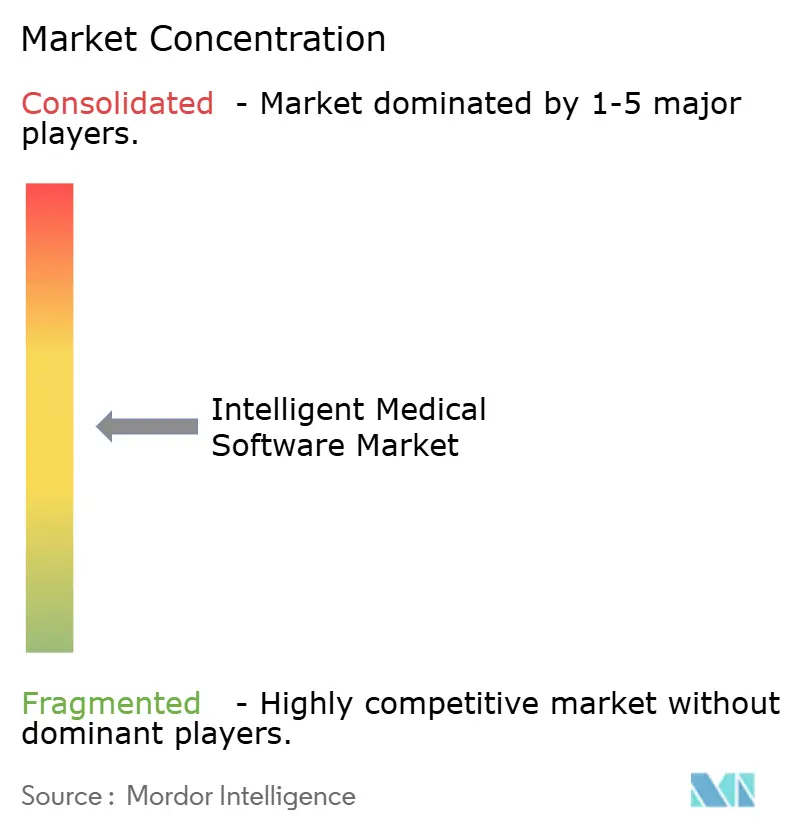
| Market Concentration | Medium |
Major Players *Disclaimer: Major Players sorted in no particular order Image © Mordor Intelligence. Reuse requires attribution under CC BY 4.0. | |
Intelligent Medical Software Market Analysis by Mordor Intelligence
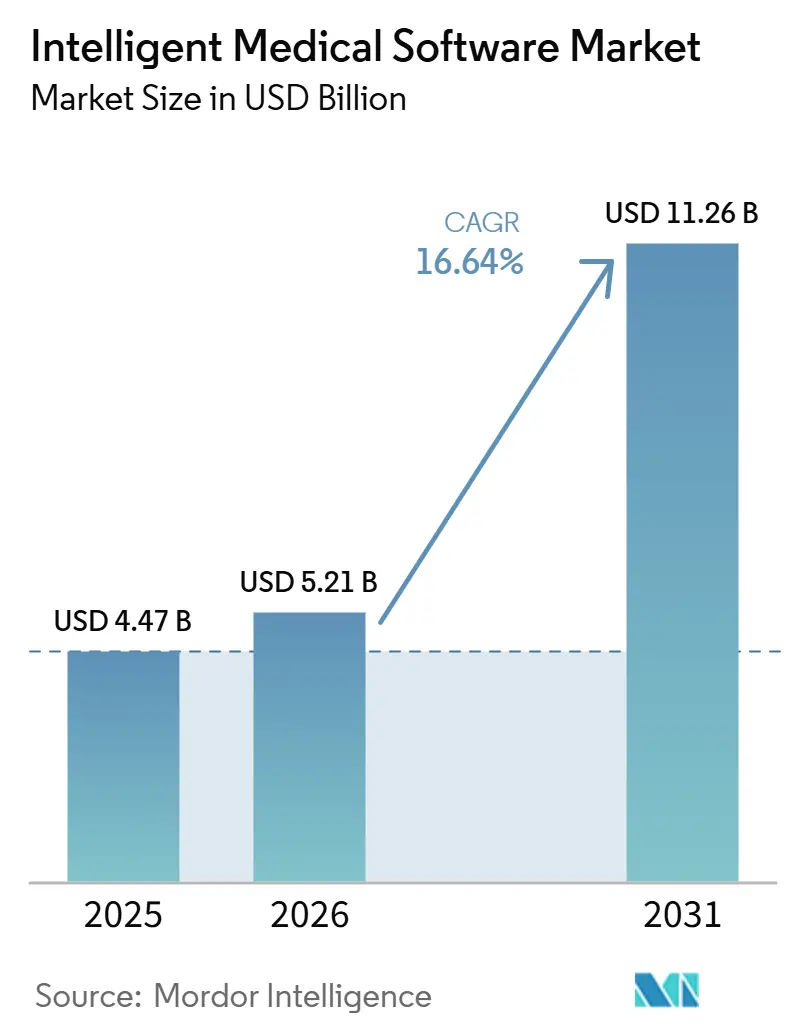
The Intelligent Medical Software Market size was valued at USD 4.47 billion in 2025 and is estimated to grow from USD 5.21 billion in 2026 to reach USD 11.26 billion by 2031, at a CAGR of 16.64% during the forecast period (2026-2031).
Demand is moving beyond administrative support because providers now use software more often in clinical decisions and care delivery. A global shortage of diagnostic specialists increases the need for tools that improve throughput without a matching increase in clinical headcount. Linked health records, imaging archives, genomic profiles, and monitoring data also give developers more useful data for clinical models. Reimbursement pathways in the United States, Europe, and parts of Asia-Pacific are reducing procurement risk for AI-assisted care. The intelligent medical software market is also becoming harder for new vendors to enter because health systems increasingly require prospective or randomized clinical evidence before large deployments.
Key Report Takeaways
- By software function, diagnostic and screening software held 33.22% of the intelligent medical software market share in 2025, while therapeutic and treatment-planning software is projected to grow at a 20.93% CAGR through 2031.
- By technology, machine learning and predictive models held 56.23% revenue share in 2025, while generative AI and large language models was the fastest-growing technology category through 2031.
- By clinical specialty, radiology and medical imaging held 39.34% revenue share in 2025, while cardiology and vascular medicine is projected to grow at a 21.98% CAGR through 2031.
- By deployment, cloud-based solutions held 52.88% revenue share in 2025, while hybrid deployment is projected to grow at a 19.34% CAGR through 2031.
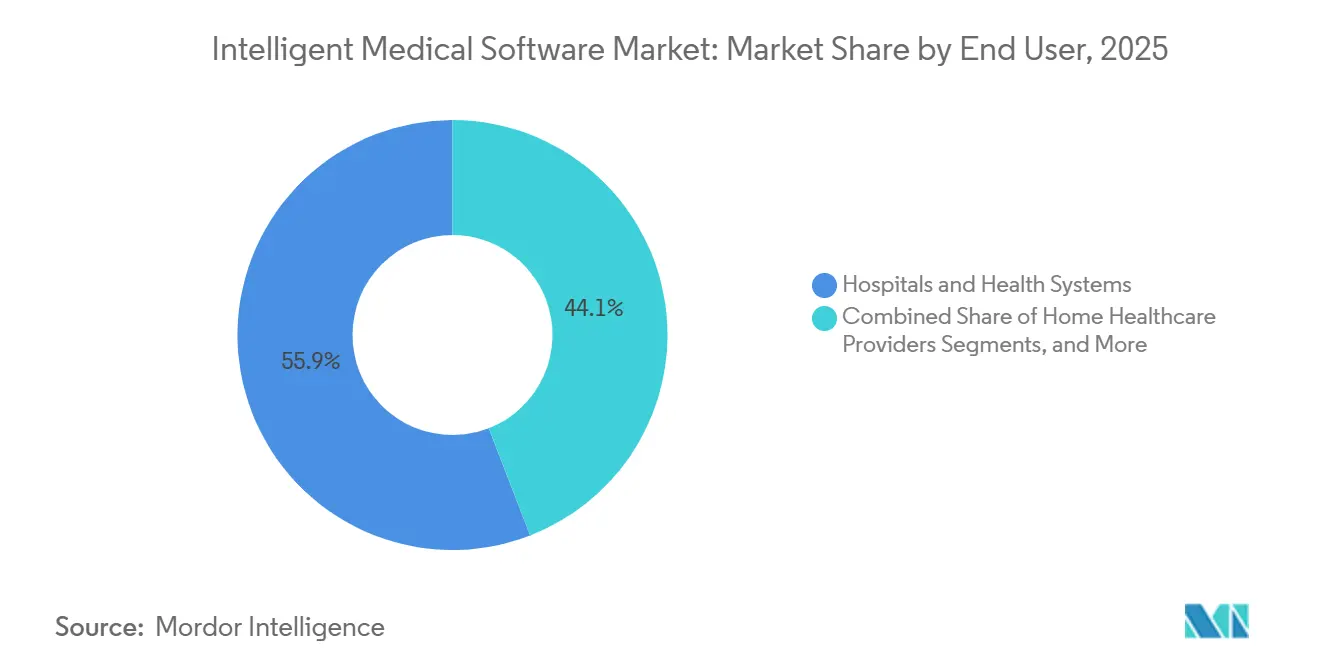
- By end user, hospitals and health systems accounted for 55.89% of revenue in 2026, while diagnostic laboratories and imaging centers is projected to grow at a 20.45% CAGR through 2031.
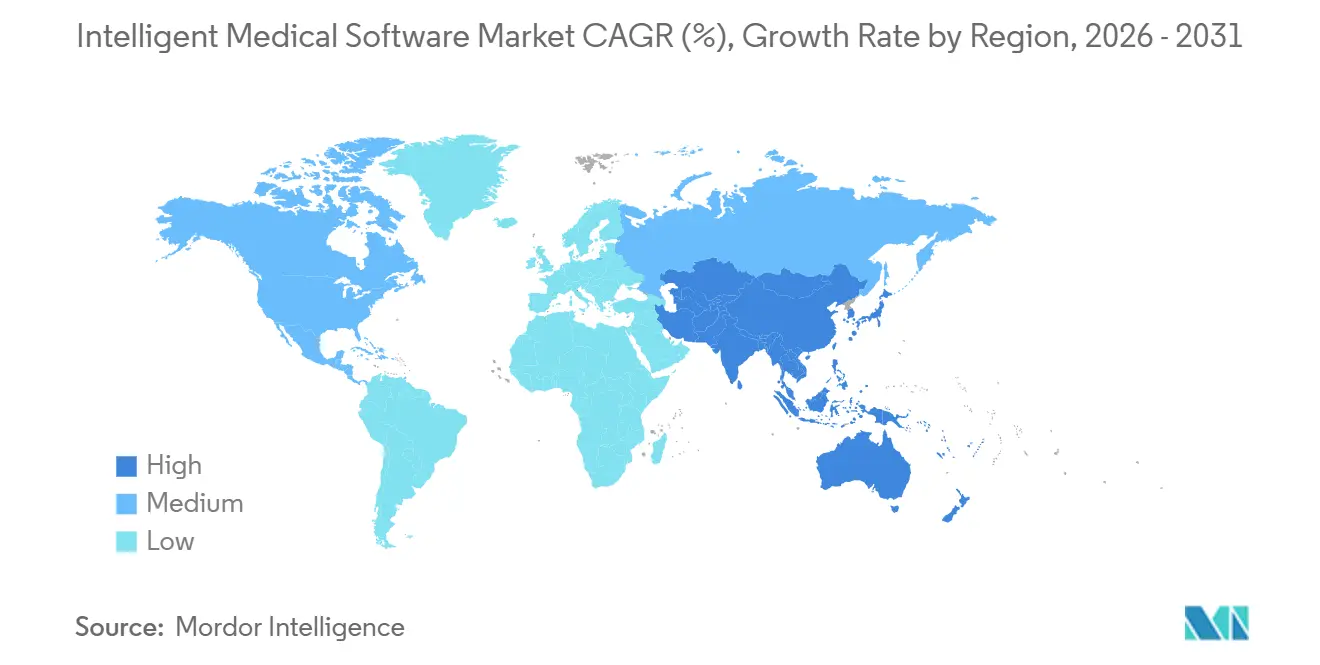
- By geography, North America held 41.76% revenue share in 2025, while Asia-Pacific is projected to grow at a 19.56% CAGR through 2031.
Note: Market size and forecast figures in this report are generated using Mordor Intelligence’s proprietary estimation framework, updated with the latest available data and insights as of January 2026.
Market Trends and Insights
Drivers Impact Analysis of Intelligent Medical Software Market*
| DRIVER | (~) % IMPACT ON CAGR FORECAST | GEOGRAPHIC RELEVANCE | IMPACT TIMELINE |
|---|---|---|---|
| Clinical documentation and administrative automation demand | +3.2% | Global, with peak deployment in North America and Western Europe | Short term (≤ 2 years) |
| Multimodal healthcare data expansion | +2.8% | Global, with the highest data density in North America, the EU, and East Asia | Medium term (2-4 years) |
| Shortage of clinicians and diagnostic specialists | +2.5% | Global, with critical pressure in Asia-Pacific, the Middle East and Africa, and rural North America | Medium term (2-4 years) |
| Regulatory and reimbursement maturation for AI-enabled SaMD | +2.1% | North America and the EU, with spillover to South Korea, Japan, and Australia | Medium term (2-4 years) |
| Hospital modernization and AI-ready data infrastructure | +2.0% | North America, the EU, and urban Asia-Pacific | Medium term (2-4 years) |
| Narrow-workflow AI with faster evidence-to-deployment cycles | +1.9% | North America and the EU | Medium term (2-4 years) |
| Source: Mordor Intelligence | |||
Clinical Documentation and Administrative Automation Demand
Clinical documentation accounted for 35-55% of a physician’s working day in hospital settings. Electronic health records added structure to medical records but did not eliminate this workload. Ambient AI scribing moved from early testing to enterprise deployment during 2025 and 2026. Oracle Health reported that its Clinical AI Agent saved more than 200,000 physician hours across U.S. deployments in a little over one year after launch, while Waystar reported USD 15.5 billion in prevented revenue-cycle denials and a 90% reduction in denial-management time through its AltitudeAI capabilities. As clinical notes became more structured and machine-readable, the intelligent medical software market benefited from better training data for diagnostic and prognostic applications.
Multimodal Healthcare Data Expansion
Clinical AI shifted from single-data-source pattern recognition to models that combined imaging, genomics, electronic health record time series, and pathology slides. The CLIMB dataset contained 19.01 terabytes of data and 4.51 million patient samples across 2D imaging, 3D video, time series, and molecular graphs. Its 2025 study found that multitask pretraining on varied clinical data improved performance on understudied modalities by up to 29%. Tempus AI presented a multimodal foundation model initiative based on more than 500 petabytes of molecularly grounded data, 45 million de-identified patient journeys, and more than 400,000 oncology records with genomic, transcriptomic, and imaging coverage. However, linked, time-stamped, consented, and well-annotated data remained difficult to assemble, making hospital partnerships as important as computing capacity for vendors in the intelligent medical software market.
Shortage of Clinicians and Diagnostic Specialists
The Lancet Oncology Commission estimated in 2026 that the global health workforce faced a shortage of 16 million diagnostic specialists, with radiology and pathology facing the most severe gaps. The American Hospital Association also identified shortages in cardiology, anesthesia, and allied health professions. These specialties recorded wider adoption of clinical software tools as longer imaging interpretation times increased pressure on departments and made AI triage tools more relevant to routine operations. The intelligent medical software market created demand for managed deployment services, as understaffed departments needed support to validate, implement, and govern the software they purchased.
Regulatory and Reimbursement Maturation for AI-Enabled SaMD
The U.S. Food and Drug Administration finalized its Predetermined Change Control Plan guidance in December 2024. The framework allowed manufacturers to define certain algorithm modifications in advance instead of submitting a separate 510(k) application for each approved change, reducing model update timelines from months to weeks when the approved change plan applied. The International Medical Device Regulators Forum published its N89 Reliance Playbook in February 2026, supporting more structured reliance across regulatory jurisdictions.[1]American Hospital Association, “2026 Health Care Workforce Scan,” American Hospital Association, aha.org These developments lowered multi-market regulatory costs for smaller vendors in the intelligent medical software market and improved their ability to pursue domestic and international commercialization simultaneously.
Restraints Impact Analysis of Intelligent Medical Software Market*
| RESTRAINT | (~) % IMPACT ON CAGR FORECAST | GEOGRAPHIC RELEVANCE | IMPACT TIMELINE |
|---|---|---|---|
| Cybersecurity, privacy, and data-integrity exposure | -1.8% | Global, with the greatest regulatory intensity in the EU and the United States | Short term (≤ 2 years) |
| Clinical validation and generalizability across populations | -1.5% | Global, with the greatest challenge in low- and middle-income settings and diverse populations | Medium term (2-4 years) |
| Model drift and silent performance decay after deployment | -1.2% | Global | Medium term (2-4 years) |
| Liability allocation across vendors, providers, and clinicians | -1.0% | North America and the EU, with emerging relevance in Asia-Pacific | Long term (≥ 4 years) |
| Source: Mordor Intelligence | |||
Cybersecurity, Privacy and Data-Integrity Exposure
Healthcare remains a major target for cyberattacks. In December 2024, the U.S. Department of Health and Human Services proposed an update to the HIPAA Security Rule, requiring health care organizations to maintain technology asset inventories that identify AI software handling electronic protected health information. These requirements increase the need for audit-ready product design, stronger vendor oversight, and early integration of security controls in the intelligent medical software market. Federated learning and on-premises inference may gain traction as providers seek to keep patient health information within controlled systems, influencing cloud and hybrid deployment architectures, patient-data processing workflows, and system controls.
Clinical Validation and Generalizability Across Populations
A 2025 JAMA Network Open analysis reported that 4.8% of cleared AI and machine-learning devices had been recalled, with recalls concentrated among products that lacked published clinical studies. A JAMA Health Forum study also found that AI device recalls occurred at nearly twice the rate of conventional 510(k) devices in the first 12 months after clearance. These findings indicate that regulatory clearance does not eliminate the need for real-world clinical validation.[2]Clinical Large Language Model Centered on Electronic Medical Records,” npj Digital Medicine, nature.com The FDA’s January 2025 draft guidance requires manufacturers to assess performance across clinically relevant subpopulations, while providers serving diverse patient populations may delay broad deployments when evidence does not demonstrate consistent performance across their care settings.
*Our forecasts treat driver/restraint impacts as directional, not additive. The impact forecasts reflect baseline growth, mix effects, and variable interactions.
Intelligent Medical Software Market Segment Analysis
By Software Function:
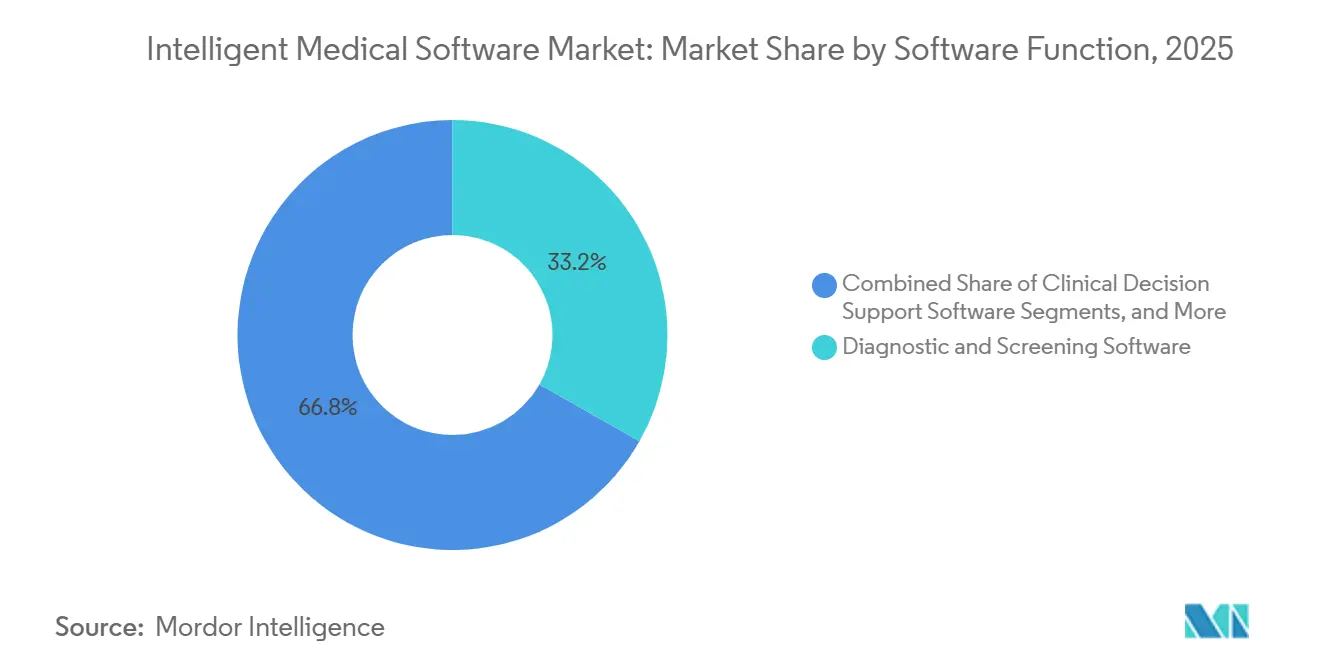
Diagnostic Tools Lead, but Therapeutic Platforms Set the PaceDiagnostic and Screening Software held 33.22% revenue share in 2025. Radiology, pathology, and ophthalmology departments have long used imaging and pathology AI, supported by structured DICOM data, defined endpoints, and prior regulatory experience. The FDA authorized 295 AI-enabled medical devices in 2025, with radiology accounting for 73%. High procedural volumes and existing hospital workflow integration supported the intelligent medical software market size for diagnostic tools.
Therapeutic and Treatment-Planning Software is forecast to grow at a 20.93% CAGR through 2031. AI-guided radiotherapy target delineation, personalized drug dosing, and surgical navigation are supporting adoption. GE HealthCare received FDA 510(k) clearance for MIM Contour ProtégéAI+ 2.0 in June 2026 for radiation oncology planning. Clinical Decision Support Software can expand through EHR integration, while workflow software benefits from ambient scribing and revenue-cycle automation. Tempus AI reported USD 1.1 billion in total contract value for its data agreements in December 2025.



By Technology:
Machine Learning Anchors Deployments as Generative AI Reshapes the FrontierMachine Learning and Predictive Models held 56.23% revenue share in 2025. Validated use in diagnostic imaging, risk stratification, and population health management supported this installed base. Health systems are adding retraining and feedback processes to production workflows. Generative AI and Large Language Models is the fastest-growing technology category through 2031, while deep learning, computer vision, and natural language processing remain essential across radiology, pathology, surgical robotics, documentation, coding, and prior authorization.
A June 2026 npj Digital Medicine paper introduced AI4Doc-LLM for medical-record understanding, clinical decision support, and documentation generation. A 2026 Nature publication evaluated MIRA on selected electronic medical record tasks in a sandboxed environment. Both publications increased provider interest in agent-based workflows. These systems still require human oversight, clear clinical validation, and usable regulatory pathways. The intelligent medical software market will retain established machine-learning tools while generative applications enter defined clinical roles.
By Clinical Specialty:
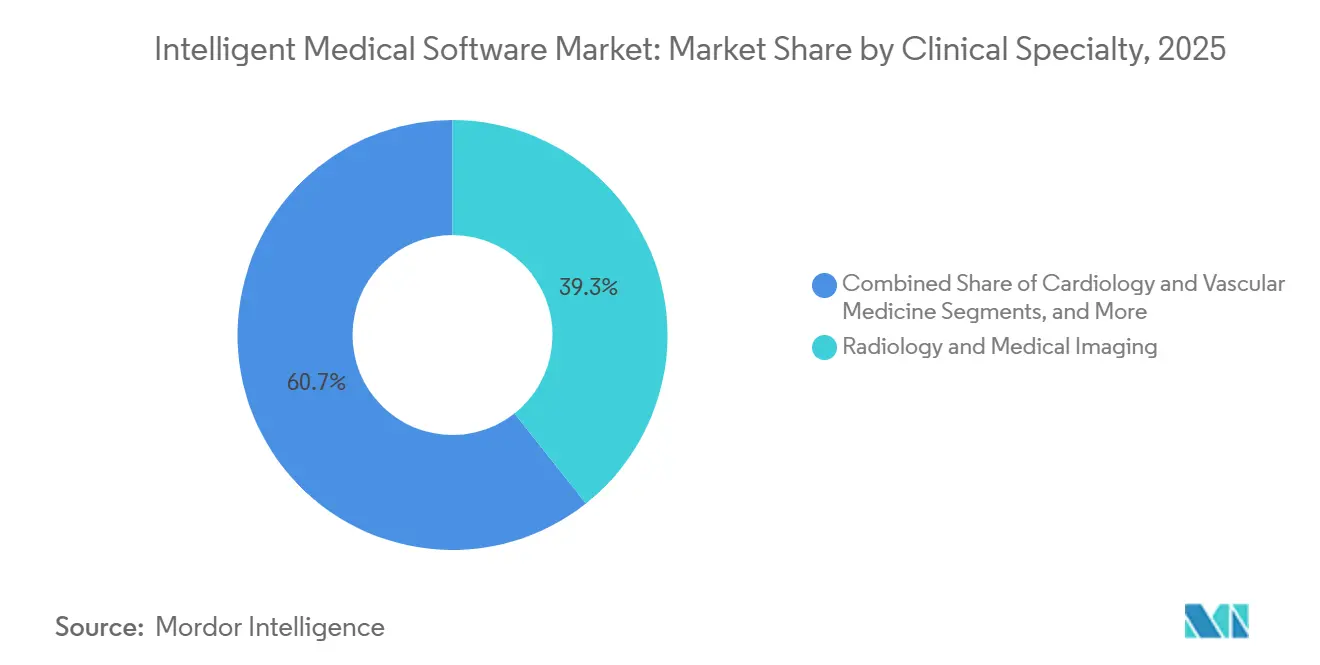
Imaging Holds the Largest Base While Cardiology AcceleratesRadiology and Medical Imaging commanded 39.34% of clinical specialty revenue in 2025. Extensive DICOM archives provide data to train clinical models, while imaging accounts for a substantial share of FDA authorizations for AI-enabled devices. These conditions supported early adoption in routine diagnostic workflows. Hospitals can connect imaging tools with established picture archiving and communication systems.
Cardiology and Vascular Medicine is projected to grow at a 21.98% CAGR through 2031. AI-ECG systems, CT angiography analytics, and multiparameter monitoring are supporting this expansion. Heartflow launched Plaque Staging within Heartflow One at SCCT 2026, using total plaque volume and up to 16 years of follow-up data. Viz.ai presented Cardio Suite data at ACC.26 in March 2026 on faster hypertrophic cardiomyopathy detection and improved patient follow-up. Oncology, neurology, ophthalmology, women’s health, and obstetrics use image analysis to support treatment planning and screening.
By Deployment:
Cloud Commands the Installed Base as Hybrid Becomes the Enterprise PreferenceCloud-based deployment held 52.88% revenue share in 2025. Cloud systems support continuous model updates and deployment across several sites. Hospital networks can use common software across distributed facilities through centralized orchestration. Demand for speed, scalability, and ongoing model maintenance supported the installed base, while privacy, data residency, and cybersecurity requirements shaped cloud procurement in the intelligent medical software market.
Hybrid deployment is projected to grow at a 19.34% CAGR from 2026 to 2031. It separates patient-data inference from non-sensitive training and orchestration workloads. EU requirements and national data rules can make this a practical compliance configuration. Oracle Health provides cloud-native clinical AI agents through hospital-controlled virtual private cloud environments. On-premises systems remain relevant in air-gapped government hospitals, defense health systems, and high-security research settings.
By End User:
Hospitals Anchor Spend as Diagnostic Laboratories AccelerateHospitals and Health Systems accounted for 55.89% of intelligent medical software revenue in 2026. Large networks can integrate software across radiology, emergency medicine, pathology, documentation, and revenue-cycle workflows. Their procurement scale supports broader enterprise agreements. Broad workflow integration and governance capabilities supported the intelligent medical software market size in this group. Hospitals also have infrastructure that connects models with electronic health records and imaging systems.
Diagnostic Laboratories and Imaging Centers are forecast to grow at a 20.45% CAGR through 2031. Consolidation is creating imaging chains with more standardized procurement processes. AI-assisted reads can help manage overnight and weekend volume without proportional increases in specialist staffing. Aidoc reported that its aiOS platform supports nearly 2,000 hospitals and has analyzed more than 120 million patient cases. Specialty clinics, physician groups, surgical centers, and home health providers are also adopting focused software tools.
Geography Analysis
North America Intelligent Medical Software Market
North America held a 41.76% revenue share in 2025. The United States has a large base of digitized health records and cleared AI-enabled medical devices, supporting development, validation, and implementation. Canada finalized premarket guidance for machine-learning-enabled medical devices in April 2026, while Canadian health systems selected Oracle Health’s Clinical AI Agent for documentation pilots.
Europe Intelligent Medical Software Market
Europe is the second-largest regional market, led by Germany, the United Kingdom, and France. The EU AI Act places high-risk obligations on AI embedded in Class IIa and higher medical devices, with staged requirements running through August 2027. These rules raised compliance costs and favored vendors with CE-marked portfolios and established quality systems, while Germany’s Bundesnetzagentur and BfDI issued a joint compliance roadmap in July 2026.
APAC, MEA and South America Intelligent Medical Software Market
Asia-Pacific is projected to grow at a 19.56% CAGR through 2031. China, India, Japan, South Korea, and Australia followed different investment and regulatory paths. South Korea’s Digital Medical Products Act took effect in January 2025, and a generative-AI medical device was approved there in April 2026. China is expanding radiology analytics in tier-one hospitals, while Japan’s PMDA DASH for SaMD2 program supports post-market update mechanisms. The Middle East and Africa and South America are smaller but strategic, supported by public investment, centralized UAE approval from January 2025, Brazil’s July 2026 WHO status, and South Africa’s September 2025 communication.

Competitive Landscape
The intelligent medical software market has a hybrid competitive structure, with broad enterprise platforms at one end and specialized clinical suppliers at the other. Large EHR platforms, imaging companies, and cloud providers capture a significant share of enterprise contract value, while condition-specific AI developers compete for specialized deployments. Epic Systems, Oracle Health, and Veeva are embedding AI into existing workflow layers. Workflow integration, clinical evidence, and implementation support now play a significant role in enterprise purchasing decisions.
GE HealthCare expanded its collaboration with NVIDIA to support autonomous X-ray and ultrasound development using Isaac for Healthcare, Cosmos, and Holoscan. This strategy combines device sales with recurring software and AI subscriptions. Oracle Health and Theator announced a surgical intelligence collaboration in June 2026 to analyze surgical video and generate billing-optimized reports. Microsoft and Mayo Clinic also announced a healthcare foundation model using Mayo Clinic knowledge and anonymized patient data.
Aidoc, Viz.ai, and HeartFlow differentiate themselves through prospective clinical evidence and focused workflow design. Aidoc closed a USD 150 million Series E financing round in April 2026 and received a second FDA Breakthrough Device Designation within 12 months. Siemens Healthineers launched Syngo Flexinity to provide scalable imaging software access across distributed hospital networks. Regulatory requirements, including the EU AI Act, ISO/IEC 42001 certification, and Predetermined Change Control Plans, favor suppliers with quality systems, clinical partnerships, and post-deployment model maintenance capabilities.
Intelligent Medical Software Industry Leaders
Aidoc Medical Ltd.
GE HealthCare Technologies Inc.
Koninklijke Philips N.V.
Medtronic plc
Siemens Healthineers AG
- *Disclaimer: Major Players sorted in no particular order
Intelligent Medical Software Market Companies Covered in this Report
- Abbott Laboratories
- Aidoc Medical Ltd.
- Butterfly Network, Inc.
- Dassault Systemes
- DeepHealth, Inc.
- Epic Systems
- Roche
- GE HealthCare Technologies Inc.
- Health Catalyst, Inc.
- HeartFlow, Inc.
- Hologic
- IBM
- Intuitive Surgical, Inc.
- IQVIA
- Koninklijke Philips
- Mckesson
- Medtronic
- Merative, Inc.
- Microsoft
- NVIDIA
- Optum
- Oracle
- Qure.ai Technologies Private Limited
- RadNet, Inc.
- Siemens Healthineers
- Tempus AI, Inc.
- Veeva Systems
- Veradigm Inc.
- Viz.ai, Inc.
- Waystar Holding Corp.

Recent Industry Developments in Intelligent Medical Software Market
- July 2026: Tempus AI announced a definitive agreement to acquire Personalis, Inc., expanding minimal residual disease monitoring capabilities and strengthening its precision oncology platform, with closing expected in late 2026 or early 2027.
- July 2026: Viz.ai announced support for the MINUTE Trial, which evaluated the SCUBA technique for ultra-early intracerebral hemorrhage evacuation and used Viz ICH and Viz ICH Plus for patient identification, triage, and care coordination.
- July 2026: Heartflow launched Heartflow Plaque Staging at SCCT 2026, introducing a coronary artery disease staging system based on total plaque volume and supported by up to 16 years of prospective follow-up data.
- June 2026: Oracle Health and Theator partnered to deploy AI-powered surgical intelligence solutions that analyzed surgical video through Oracle Cloud Infrastructure and generated automated billing-optimized surgical reports.
- June 2026: Microsoft and Mayo Clinic announced the development of a health care foundation model that combined Mayo Clinic’s medical knowledge and anonymized patient data with Microsoft’s engineering and AI capabilities.


Global Intelligent Medical Software Market Report Scope
As per the scope of the report, Intelligent Medical Software (IMS) is an all-in-one Electronic Health Records (EHR), practice management, and medical billing platform. It helps doctors manage patient care, schedules, and office work in one place.
The intelligent medical software market is segmented by software function, technology, clinical specialty, deployment, end user, and geography. By software function, the market includes diagnostic and screening software, therapeutic and treatment planning software, clinical decision support software, monitoring and predictive analytics software, workflow, documentation, and revenue cycle software, and research and life sciences software. By technology, the market is segmented into machine learning and predictive models, deep learning and neural networks, natural language processing, computer vision, and generative AI and large language models. By clinical specialty, the market is categorized into radiology and medical imaging, cardiology and vascular medicine, oncology, neurology and neurosurgery, pathology and laboratory medicine, ophthalmology, women’s health and obstetrics, and other clinical specialties. By deployment, the market is segmented into cloud-based, on-premises, and hybrid. By end user, the market is segmented into hospitals and health systems, ambulatory surgical centers and physician groups, diagnostic laboratories and imaging centers, specialty clinics, home healthcare providers, and others. By geography, the market is analyzed across North America, Europe, Asia-Pacific, the Middle East and Africa, and South America. The report also covers the estimated market sizes and trends for 17 countries across major regions globally. The report offers the market sizes and forecasts in terms of value (USD) for the above segments.
| Diagnostic and Screening Software |
| Therapeutic and Treatment-Planning Software |
| Clinical Decision Support Software |
| Monitoring and Predictive Analytics Software |
| Workflow, Documentation and Revenue-Cycle Software |
| Research and Life-Sciences Software |
| Machine Learning and Predictive Models |
| Deep Learning and Neural Networks |
| Natural Language Processing |
| Computer Vision |
| Generative AI and Large Language Models |
| Radiology and Medical Imaging |
| Cardiology and Vascular Medicine |
| Oncology |
| Neurology and Neurosurgery |
| Pathology and Laboratory Medicine |
| Ophthalmology |
| Women's Health and Obstetrics |
| Other Clinical Specialties |
| Cloud-Based |
| On-Premises |
| Hybrid |
| Hospitals and Health Systems |
| Ambulatory Surgical Centers and Physician Groups |
| Diagnostic Laboratories and Imaging Centers |
| Specialty Clinics |
| Home Healthcare Providers |
| Others |
| North America | United States |
| Canada | |
| Mexico | |
| Europe | Germany |
| United Kingdom | |
| France | |
| Italy | |
| Spain | |
| Rest of Europe | |
| Asia-Pacific | China |
| India | |
| Japan | |
| Australia | |
| South Korea | |
| Rest of Asia-Pacific | |
| Middle East and Africa | GCC |
| South Africa | |
| Rest of Middle East and Africa | |
| South America | Brazil |
| Argentina | |
| Rest of South America |
| By Software Function | Diagnostic and Screening Software | |
| Therapeutic and Treatment-Planning Software | ||
| Clinical Decision Support Software | ||
| Monitoring and Predictive Analytics Software | ||
| Workflow, Documentation and Revenue-Cycle Software | ||
| Research and Life-Sciences Software | ||
| By Technology | Machine Learning and Predictive Models | |
| Deep Learning and Neural Networks | ||
| Natural Language Processing | ||
| Computer Vision | ||
| Generative AI and Large Language Models | ||
| By Clinical Specialty | Radiology and Medical Imaging | |
| Cardiology and Vascular Medicine | ||
| Oncology | ||
| Neurology and Neurosurgery | ||
| Pathology and Laboratory Medicine | ||
| Ophthalmology | ||
| Women's Health and Obstetrics | ||
| Other Clinical Specialties | ||
| By Deployment | Cloud-Based | |
| On-Premises | ||
| Hybrid | ||
| By End User | Hospitals and Health Systems | |
| Ambulatory Surgical Centers and Physician Groups | ||
| Diagnostic Laboratories and Imaging Centers | ||
| Specialty Clinics | ||
| Home Healthcare Providers | ||
| Others | ||
| By Geography | North America | United States |
| Canada | ||
| Mexico | ||
| Europe | Germany | |
| United Kingdom | ||
| France | ||
| Italy | ||
| Spain | ||
| Rest of Europe | ||
| Asia-Pacific | China | |
| India | ||
| Japan | ||
| Australia | ||
| South Korea | ||
| Rest of Asia-Pacific | ||
| Middle East and Africa | GCC | |
| South Africa | ||
| Rest of Middle East and Africa | ||
| South America | Brazil | |
| Argentina | ||
| Rest of South America | ||


Key Questions Answered in the Report
What is the projected value of intelligent medical software by 2031?
The intelligent medical software market size is forecast to reach USD 11.26 billion by 2031, from USD 5.21 billion in 2026, at a 16.64% CAGR.
Which software function holds the largest revenue position?
Diagnostic and Screening Software held 33.22% revenue share in 2025, supported by established imaging and pathology AI workflows.
Which clinical specialty is growing fastest for intelligent medical software?
Cardiology and Vascular Medicine is projected to grow at a 21.98% CAGR through 2031, supported by AI-ECG, CT angiography, and monitoring applications.
Why are hospitals the largest end users of intelligent medical software?
Hospitals and Health Systems accounted for 55.89% of revenue in 2026 because they can deploy software across multiple clinical and administrative workflows.
What deployment model is growing fastest?
Hybrid deployment is projected to grow at a 19.34% CAGR through 2031 because it combines local patient-data inference with selected cloud functions.
Which region is expected to grow fastest?
Asia-Pacific is forecast to grow at a 19.56% CAGR through 2031 as regional markets advance through distinct investment and regulatory pathways.
Page last updated on:





