
Insurance-Linked Securities Market Size and Share
Market Overview
| Study Period | 2021 - 2032 |
|---|---|
| Market Size (2027) | USD 165.80 Billion |
| Market Size (2032) | USD 247 Billion |
| Growth Rate (2027 - 2032) | 8.30 % |
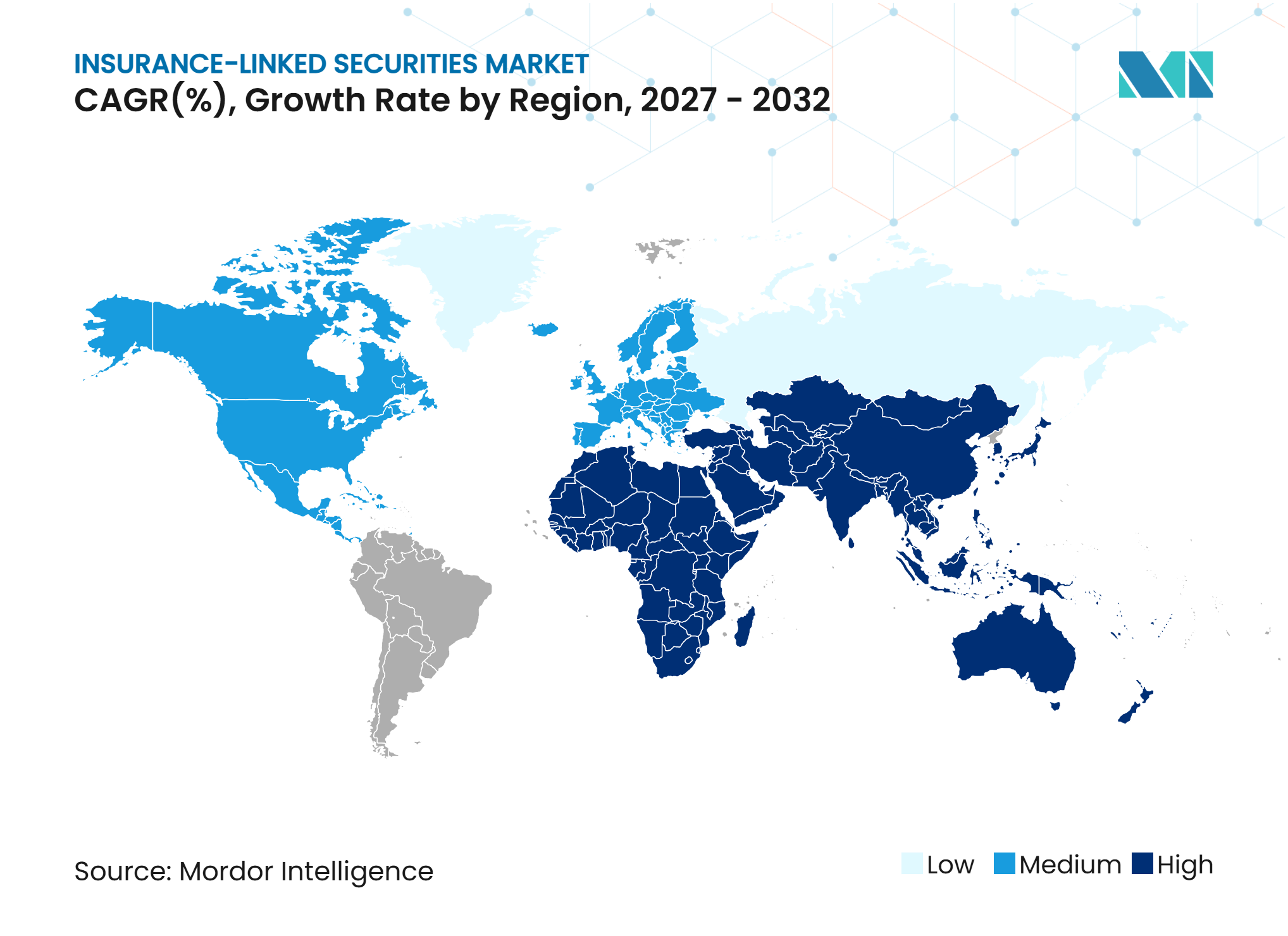
| Fastest Growing Market | Asia-Pacific |
| Largest Market | North America |
| Market Concentration | Low |
Major Players *Disclaimer: Major Players sorted in no particular order Image © Mordor Intelligence. Reuse requires attribution under CC BY 4.0. | |
Insurance-Linked Securities Market Analysis by Mordor Intelligence
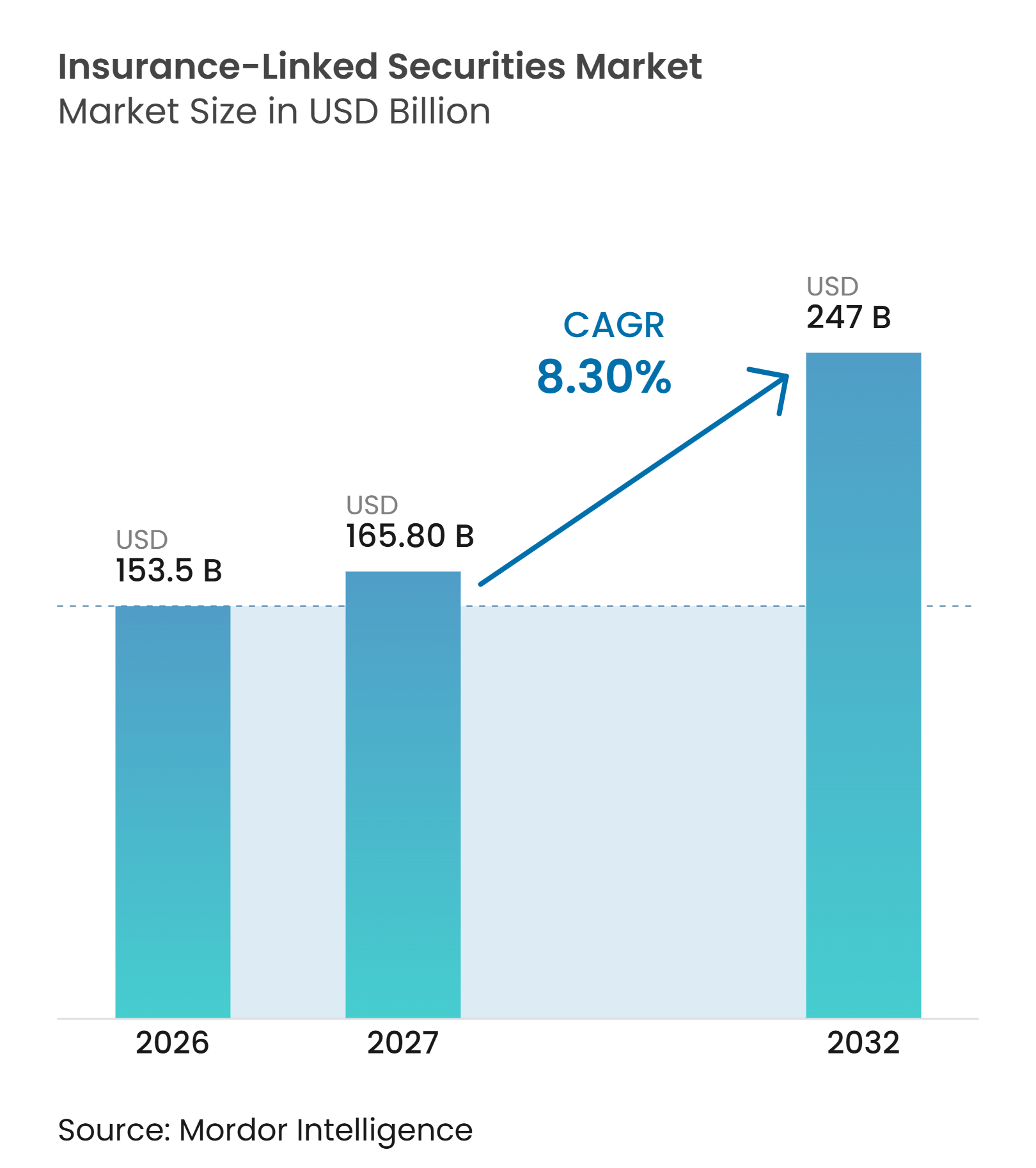
The Insurance-Linked Securities Market size was valued at USD 153.5 billion in 2026 and is estimated to grow from USD 165.80 billion in 2027 to reach USD 247 billion by 2032, at a CAGR of 8.30% during the forecast period (2027-2032).
Rising catastrophe losses are increasing the need for capital that can absorb losses outside insurers' and reinsurers' balance sheets. Global natural catastrophes caused USD 220 billion in economic losses and USD 107 billion in insured losses in 2025, leaving a substantial protection gap. This gap supports demand for structures that transfer peak and secondary-peril exposures to institutional investors. The Insurance-linked securities market also benefits from established catastrophe bond issuance, new public-sector sponsors, and broader use of parametric triggers. However, tighter pricing, model uncertainty, and collateral constraints continue to shape investor selection and transaction design.
Key Report Takeaways
- By product type, catastrophe bonds captured 43.8% of the insurance-linked securities market share in 2026, while reinsurance sidecars and quota-share vehicles are projected to grow at a 12.5% CAGR through 2032.
- By trigger type, indemnity triggers held 75.3% of the insurance-linked securities market share in 2026, while parametric triggers are projected to grow at an 11.8% CAGR through 2032.
- By underlying risk type, natural catastrophe risk captured 85.6% of the insurance-linked securities market share in 2026, while specialty and man-made risk is projected to grow at a 13.5% CAGR through 2032.
- By sponsor type, primary insurance companies held 65.1% of the insurance-linked securities market share in 2026, while government and public-sector entities are projected to grow at a 12.1% CAGR through 2032.
- By geography, North America captured 75.6% of the insurance-linked securities market share in 2026, while Asia-Pacific is projected to grow at an 11.5% CAGR through 2032.
Note: Market numbers in this report are based on Mordor Intelligence's proprietary estimation framework, which combines nine months of actuals with Q4 projections for base year 2026.
Market Trends and Insights
Drivers Impact Analysis of Insurance-Linked Securities Market*
| Driver | (~) % Impact on CAGR Forecast | Geographic Relevance | Impact Timeline |
|---|---|---|---|
| Rising Catastrophe Exposure and Persistent Insurance Protection Gaps | +2.1% | Global, with strong relevance in Asia-Pacific, Latin America, and sub-Saharan Africa | Long term (≥ 4 years) |
| Increasing Insurer and Reinsurer Demand for Alternative Risk-Transfer Capacity | +1.6% | North America, Europe, and Bermuda | Medium term (2-4 years) |
| Growing Institutional Investor Demand for Diversified, Low-Correlation Returns | +1.4% | North America and Europe | Long term (≥ 4 years) |
| Attractive Risk-Adjusted Yields and Floating-Rate Collateral Investment Returns | +1.1% | Global | Short term (≤ 2 years) |
| Expansion of ILS Coverage Across Secondary Perils, Cyber, and Specialty Risks | +0.9% | North America, Europe, and emerging Asia-Pacific | Medium term (2-4 years) |
| Growing Public-Sector Participation and Access for New ILS Sponsors | +0.7% | Asia-Pacific, Latin America, the Caribbean, and Central Asia | Long term (≥ 4 years) |
| Source: Mordor Intelligence | |||
Rising Catastrophe Exposure and Persistent Insurance Protection Gaps
The global natural catastrophe protection gap widened to USD 424 billion in 2025, compared with USD 395 billion in 2024, according to Swiss Re Institute's June 2026 analysis[1]. Its Natural Catastrophe Insurance Resilience Index stood at 27.3%, indicating that insurance covered approximately 27.3% of estimated protection needs. Separately, natural catastrophes generated USD 220 billion in economic losses and USD 107 billion in insured losses in 2025, representing a 49% insured share of actual losses. Severe convective storms and wildfires were major contributors, with secondary perils accounting for a record 92% of insured catastrophe losses. Persistent protection gaps and growing exposure are increasing demand for catastrophe bonds, multi-peril structures, and other alternative risk-transfer solutions.
Increasing Insurer and Reinsurer Demand for Alternative Risk-Transfer Capacity
Insurers and reinsurers are increasingly integrating insurance-linked securities into their capital management and reinsurance strategies. Aon reported that 78 unique sponsoring entities accessed the catastrophe bond market during the 12 months ending June 30, 2026, including 16 first-time issuers[2]. Insurers represented 65% of sponsoring entities, followed by reinsurers at 17%, governments at 16%, and corporate entities at 1.5%. Catastrophe bond issuance reached a record USD 24.9 billion during the period, while outstanding catastrophe bond capital increased to USD 63.4 billion. Sidecar capital also reached approximately USD 23 billion across property and casualty lines. These developments demonstrate the growing use of alternative capital to supplement traditional reinsurance, diversify risk transfer, and expand underwriting capacity.
Growing Institutional Investor Demand for Diversified, Low-Correlation Returns
Institutional investor demand for insurance-linked securities (ILS) continues to support alternative reinsurance capital formation. Swiss Re reported that catastrophe bonds maintained low correlation with broader equity and fixed-income markets during periods of macroeconomic uncertainty in the first half of 2026, reinforcing their portfolio diversification benefits. Aon reported that its Catastrophe Bond Total Return Index delivered 12.5% over the 12 months ending June 30, 2026, supported primarily by coupon income and reinvestment. Growing issuance volumes and expanding exposure to different catastrophe perils are broadening investment opportunities. However, investors continue to evaluate catastrophe exposure, expected losses, peril concentration, and potential collateral lock-up following major events.
Attractive Risk-Adjusted Yields and Floating-Rate Collateral Investment Returns
Catastrophe bonds generally offer floating-rate coupons comprising a reference interest rate, typically SOFR for USD-denominated transactions, and a risk spread reflecting the underlying catastrophe exposure. This structure allows investors to earn collateral investment income alongside compensation for assuming insurance risk. Swiss Re's Cat Bond Total Return Index delivered 11.4% in 2025, supported by high running coupons and limited direct catastrophe losses affecting outstanding bonds. The return demonstrates the contribution of coupon income and collateral investment performance to overall ILS returns[3]. However, investors must assess risk spreads, expected losses, attachment points, and potential principal impairment, as major catastrophe events can materially affect returns and extend collateral lock-up periods.
Restraints Impact Analysis of Insurance-Linked Securities Market*
| Restraint | (~) % Impact on CAGR Forecast | Geographic Relevance | Impact Timeline |
|---|---|---|---|
| Intensifying Capital Inflows and Catastrophe Bond Pricing Compression | -0.9% | Global, with strong relevance in North American peak-peril exposures | Short term (≤ 2 years) |
| Catastrophe Model Uncertainty, Basis Risk, and Increasing Climate Volatility | -0.6% | Global, especially emerging Asia-Pacific and secondary-peril categories | Long term (≥ 4 years) |
| Collateral Trapping, Extended Loss Development, and Limited Investment Liquidity | -0.5% | North American wildfire and hurricane corridors and Caribbean sovereign bonds | Medium term (2-4 years) |
| Structural Complexity and Limited Data for Emerging Risk Securitization | -0.4% | Global, especially cyber, casualty, and longevity ILS | Long term (≥ 4 years) |
| Source: Mordor Intelligence | |||
Intensifying Capital Inflows and Catastrophe Bond Pricing Compression
The growing supply of alternative reinsurance capital is intensifying competition among investors and creating pressure on catastrophe bond pricing. Aon reported that global alternative capital reached a record USD 144.5 billion by June 30, 2026, supported by increased catastrophe bond issuance and continued institutional investment. While expanding capacity improves risk-transfer options for insurers and reinsurers, strong investor competition can compress spreads and reduce the risk-adjusted returns available on new transactions. This may encourage investors to pursue higher-risk layers, less-established perils or more complex structures to maintain return targets. Consequently, disciplined risk selection, pricing adequacy and diversification remain important for sustaining investor participation in the ILS market.
Catastrophe Model Uncertainty, Basis Risk and Increasing Climate Volatility
Catastrophe model uncertainty, limited historical data, and basis risk continue to constrain the expansion of ILS into emerging perils and geographically diverse markets. In May 2025, NOAA announced the retirement of its Billion-Dollar Weather and Climate Disasters database, with no updates beyond calendar year 2024. Climate Central subsequently launched a successor database in October 2025 to continue tracking these events. This transition highlights the importance of reliable, independently verifiable catastrophe data for risk assessment and trigger validation. Peak Re's USD 50 million Black Kite II catastrophe bond, launched in April 2025, illustrates the challenge of designing triggers across territories with different data availability and market maturity. The transaction used industry-loss triggers for Japanese risks and location-specific parametric triggers for China and India. Differences in hazard characteristics, data quality, and model assumptions can create basis risk, making accurate trigger calibration and transparent modeling essential for broader ILS adoption.
*Our forecasts treat driver/restraint impacts as directional, not additive. The impact forecasts reflect baseline growth, mix effects, and variable interactions.
Insurance-Linked Securities Market Segment Analysis
By Product Type:
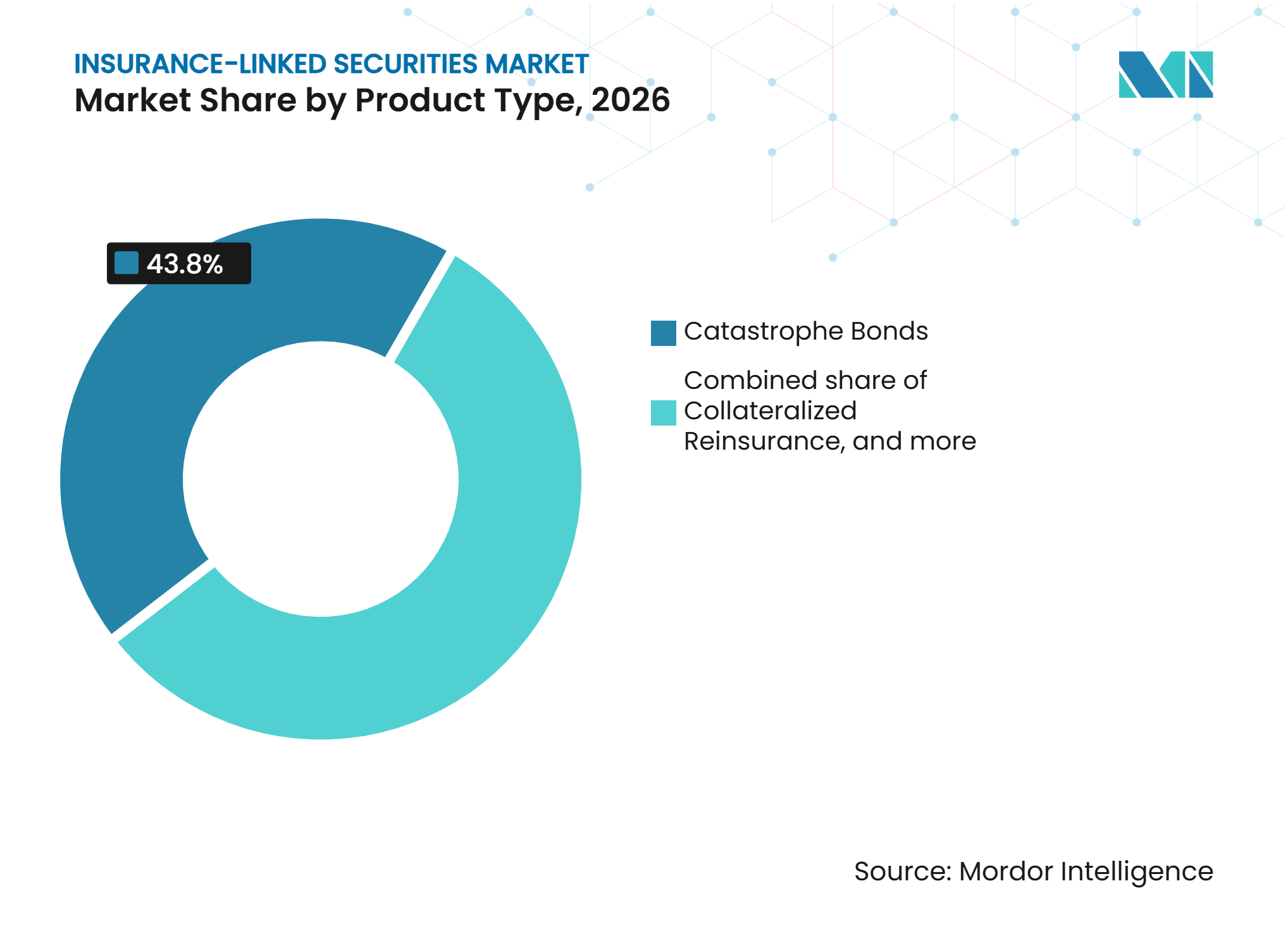
Catastrophe Bonds Remain Core While Sidecars GrowCatastrophe bonds accounted for 43.8% of the insurance-linked securities market in 2026, supported by their established issuance frameworks, defined risk-transfer structures, and growing institutional investor participation. Aon reported USD 24.9 billion in catastrophe bond issuance during the 12 months ending June 30, 2026, while outstanding catastrophe bond capital reached a record USD 63.4 billion. By November 17, 2026, Artemis reported that settled issuance across tracked Rule 144A and private catastrophe bonds had exceeded USD 20.37 billion, with outstanding catastrophe bond risk capital surpassing USD 66 billion for the first time. These instruments allow sponsors to transfer clearly defined catastrophe exposures through structures specifying covered perils, attachment points, and payout conditions. Their established market infrastructure and investor familiarity continue to support their central role in the ILS market.
Reinsurance sidecars and quota-share vehicles are projected to grow at a 12.5% CAGR through 2032, supported by demand for flexible collateralized capacity and proportional risk-sharing arrangements. Aon estimated outstanding sidecar capital at approximately USD 23 billion across property and casualty lines as of June 30, 2026, representing approximately 50% growth from year-end 2024. Collateralized reinsurance and industry loss warranties also provide sponsors with alternative structures for transferring property catastrophe and retrocession exposures. Compared with publicly issued catastrophe bonds, these private arrangements can offer greater structural flexibility but generally involve more bespoke contractual terms, collateral arrangements, and loss-development considerations.


By Trigger Type:
Indemnity Structures Lead While Parametric Use BroadensIndemnity triggers accounted for 75.3% of the insurance-linked securities market in 2026, reflecting sponsor preference for protection linked to actual portfolio losses. Aon reported that indemnity triggers represented 80.9% of catastrophe bond issuance by notional during the 12 months ending June 30, 2026, followed by industry index triggers at 16.5%, parametric triggers at 2.4%, and dual triggers at 0.2%. Indemnity structures help insurers align recoveries with their actual claims experience, although they generally involve greater reporting and loss-settlement requirements. Industry-loss triggers remain relevant where sponsors and investors prefer an independently measured industry-wide loss benchmark.
Parametric triggers are projected to grow at an 11.8% CAGR through 2032, supported by demand for faster and more transparent disaster-related payouts. In May 2026, the World Bank priced a USD 200 million parametric catastrophe bond providing Jamaica with hurricane protection through May 2030. The transaction uses predefined storm-track and intensity parameters to determine payouts, avoiding the need for complete claims settlement before funds become available. This followed the full USD 150 million payout from Jamaica's previous World Bank-backed catastrophe bond after Hurricane Melissa in October 2025. Improvements in satellite observation, meteorological monitoring, and event verification can support parametric structures, although basis risk remains a consideration when actual sponsor losses differ from the predefined trigger measurements.
By Underlying Risk Type:
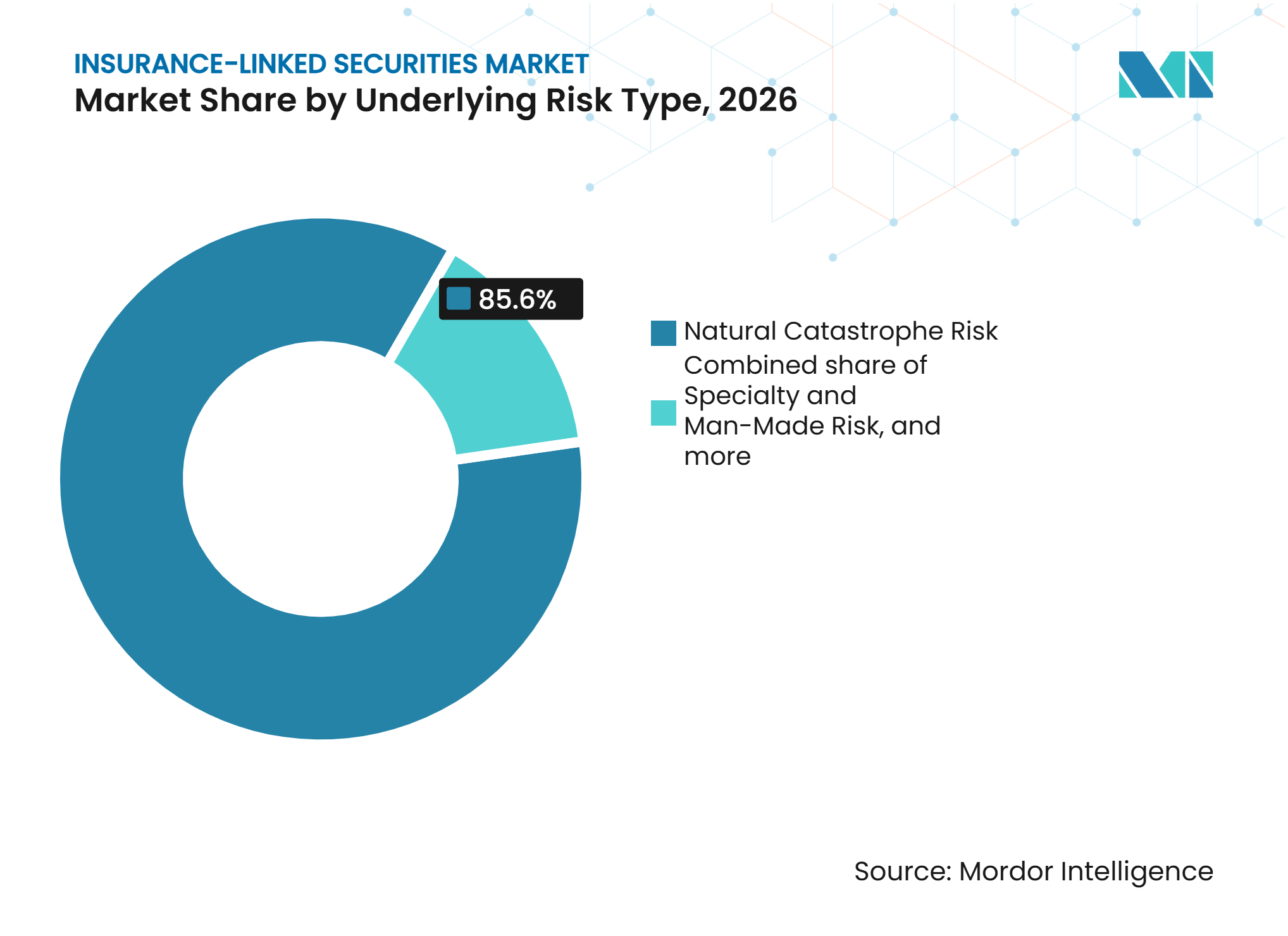
Natural Catastrophe Risk Has Scale While Specialty Risks AdvanceNatural catastrophe risks accounted for 85.6% of the insurance-linked securities market in 2026, reflecting the established role of property catastrophe protection in ILS issuance. United States wind, earthquake, and multi-peril exposures remain important sources of catastrophe bond activity, supported by established risk models, historical loss data, and investor familiarity. Aon reported that North American perils represented 90.1% of catastrophe bond issuance during the 12 months ending June 30, 2026. However, market activity is gradually extending beyond traditional peak perils to include wildfire, European floods, and severe convective storms. This expansion is increasing the importance of secondary-peril modeling, geographic diversification, and more comprehensive risk assessment.
Specialty and man-made risks are projected to grow at a 13.5% CAGR through 2032, supported by opportunities to transfer cyber, mortality, longevity, health, and terrorism exposures into capital markets. In March 2026, Pool Re, the UK's government-backed terrorism reinsurer, completed a GBP 100 million (USD 134 million) catastrophe bond through United Kingdom-domiciled Baltic PCC Limited. The transaction provided collateralized retrocession protection against terrorism-related losses and increased Pool Re's total ILS-backed capacity to GBP 200 million (USD 268 million). This demonstrates the extension of capital-market risk transfer beyond natural catastrophes. However, specialty transactions require clearly defined loss triggers, reliable exposure data, and robust aggregation methodologies to address the complexity of non-property risks.

By Sponsor Type:
Insurers Lead While Public-Sector Sponsors ExpandPrimary insurance companies accounted for 65.1% of the insurance-linked securities market in 2026, reflecting their significant role in transferring accumulated catastrophe exposures and securing additional reinsurance capacity. Aon reported that insurers represented 65% of catastrophe bond sponsoring entities during the 12 months ending June 30, 2026, followed by reinsurers at 17%, governments at 16%, and corporate entities at 1.5%. Insurers use catastrophe bonds and collateralized reinsurance to manage peak-peril exposures, diversify protection sources, and secure multi-year coverage. Reinsurers also access ILS to manage retrocession requirements and underwriting volatility, while corporate sponsors provide additional opportunities for risk transfer beyond traditional insurance markets.
Government and public-sector entities are projected to grow at a 12.1% CAGR through 2032, supported by increasing demand for pre-arranged disaster financing and fiscal risk management. In October 2026, Nepal and the World Bank signed a mandate agreement to explore the development of an earthquake catastrophe bond, which could provide rapid access to funds following a major seismic event. The initiative remains at the feasibility and structuring assessment stage rather than representing a completed bond issuance. Jamaica's USD 200 million World Bank-backed catastrophe bond, priced in May 2026, provides another example of sovereign access to capital-market protection through predefined parametric triggers. Such transactions demonstrate the growing role of multilateral institutions in helping governments transfer disaster risks to international investors.
Geography Analysis
North America: The Dominant Hub of Insurance-Linked Capital
North America remains the largest regional hub for the insurance-linked securities market, supported by the scale of United States property catastrophe exposures, established catastrophe modelling capabilities, and access to institutional investors through Rule 144A transactions. Aon reported that North American perils accounted for 90.1% of catastrophe bond issuance by notional during the 12 months ending June 30, 2026, reinforcing the region's dominance in risk transferred to capital markets. In February 2026, SageSure and Sure secured a USD 670 million Gateway Re 2026-1 catastrophe bond, providing reinsurance protection for multiple catastrophe perils affecting their property insurance portfolios. The transaction illustrates the continued use of capital-market structures by specialty insurers to diversify reinsurance capacity. Repeat issuance by insurers, reinsurers, and public-sector sponsors further strengthens North America's position as the principal ILS issuance and investment hub.
Asia-Pacific: Regulatory Scaffolding Supports Regional Expansion
Asia-Pacific is projected to expand at an 11.5% CAGR through 2032, supported by regulatory incentives, rising catastrophe exposure, and growing interest in alternative risk-transfer solutions. Hong Kong has extended its Pilot ILS Grant Scheme through 2028, providing financial incentives to eligible onshore and offshore sponsors issuing ILS through the jurisdiction. In April 2025, Peak Re completed its USD 50 million Black Kite Re 2025-1 catastrophe bond through Hong Kong's special-purpose insurer framework. The transaction covered Japanese earthquake and typhoon risks and introduced parametric earthquake protection for mainland China and India, marking the first Rule 144A catastrophe bond to include Indian earthquake exposure. In October 2026, Nepal and the World Bank signed a mandate agreement to explore an earthquake catastrophe bond, indicating growing interest in capital-market disaster protection across emerging Asian economies. These developments strengthen the region's potential as an alternative ILS issuance hub, although market depth remains below that of North America and Europe.
Europe, Latin America, the Middle East, and Africa: Diversified Routes to ILS Access
European ILS activity is expanding beyond traditional property catastrophe protection into terrorism and specialty risk transfer structures. In March 2026, Pool Re completed a GBP 100 million (USD 134 million) catastrophe bond through United Kingdom-domiciled Baltic PCC Limited, bringing its total capital markets-backed protection to GBP 200 million (USD 268 million). The transaction provides collateralized retrocession against terrorism-related losses and demonstrates the use of ILS for non-natural catastrophe exposures. In Latin America and the Caribbean, sovereign and regional parametric insurance arrangements provide an established route to alternative risk transfer. The Caribbean Catastrophe Risk Insurance Facility (CCRIF) provides parametric coverage to Caribbean and Central American governments, utilities and other entities. In May 2026, the World Bank also priced a new USD 200 million hurricane catastrophe bond for Jamaica, replacing the previous USD 150 million coverage that was fully paid out following Hurricane Melissa in 2025. The Middle East and Africa remain comparatively less developed in catastrophe bond issuance, with opportunities linked to sovereign disaster risk financing, multilateral development support, and parametric insurance solutions.
Competitive Landscape
Market Concentration
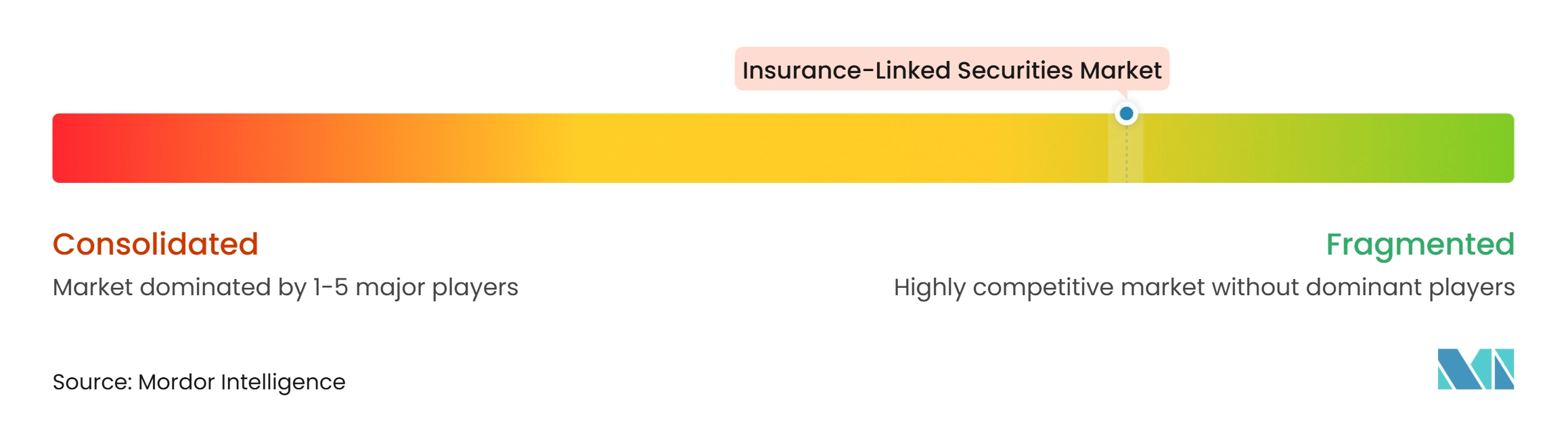
The insurance-linked securities market is fragmented, with competition distributed across specialized ILS asset managers, reinsurer-affiliated investment platforms, capital-market intermediaries, and institutional investors. Aon recorded 78 unique catastrophe bond sponsors in the 12 months ending June 30, 2026. Fermat Capital Management, Twelve Securis, RenaissanceRe Capital Partners, and Nephila Capital are established participants. Twelve Capital and Securis Investment Partners completed their merger in February 2025 to create Twelve Securis, which reported USD 8.5 billion in assets under management. Competition is driven by investment scale, underwriting expertise, portfolio diversification, and access to public and private ILS strategies.
Leading firms are expanding their product offerings while strengthening operational capabilities. Nephila Capital selected SEI as its global strategic operations partner in September 2025, supporting reconciliation, payment processing, and investor onboarding across North America and the United Kingdom. Generali Global Corporate and Commercial, Descartes Underwriting, and Twelve Capital launched the Lumyna Twelve Capital Parametric ILS Fund in February 2025. These developments highlight increasing competition through technology integration, specialized transaction structures, parametric risk assessment, and investor servicing capabilities.
The competitive landscape also includes capital-market platforms and ILS divisions of established reinsurers, including Swiss Re Capital Markets, AXA XL ILS Capital Management, AXIS ILS, and RenaissanceRe Capital Partners. Aon reported that global alternative capital reached a record USD 144.5 billion by June 30, 2026. The expanding capital base supports competition across catastrophe bonds, sidecars, collateralized reinsurance, and parametric structures. Casualty, longevity, and corporate non-indemnity risk transfer also present opportunities for specialist managers to differentiate their offerings.
Insurance-Linked Securities Industry Leaders
-
Fermat Capital Management, LLC
-
Stone Ridge Asset Management
-
RenaissanceRe Capital Partners
-
Twelve Securis
-
Nephila Capital
- *Disclaimer: Major Players sorted in no particular order
Insurance-Linked Securities Market Companies Covered in this Report
- Aon Securities
- GC Securities
- Swiss Re Capital Markets
- Stone Ridge Asset Management
- Gallagher Securities
- Fermat Capital Management
- RenaissanceRe Capital Partners
- Twelve Securis
- Nephila Capital
- Leadenhall Capital Partners
- LGT Capital Partners – Insurance-Linked Strategies
- Schroders Capital – Insurance-Linked Securities
- SCOR Investment Partners
- AXA XL ILS Capital Management
- Howden Capital Markets & Advisory
- Aeolus Capital Management
- Pillar Capital Management
- Integral ILS
- AXIS ILS
- Tangency Capital Ltd.
Recent Industry Developments in Insurance-Linked Securities Market
- October 2026: Nepal and the World Bank signed a mandate agreement to explore a parametric catastrophe bond for earthquake risk management. The partnership follows the World Bank’s Jamaica program, which delivered a full USD 150 million payout after Hurricane Melissa.
- August 2026: Aon Securities published its 20th ILS Annual Report and stated that alternative capital reached USD 144.5 billion. Catastrophe bond issuance reached USD 24.9 billion in the 12 months to June 30, 2026. Outstanding sidecar capital reached USD 23 billion. The report also recorded 78 unique sponsoring entities in the catastrophe bond market during that period.
- May 2026: The World Bank priced a USD 200 million parametric hurricane catastrophe bond for Jamaica. The country’s prior World Bank-backed bond triggered a full USD 150 million payout following Hurricane Melissa in October 2025.
- February 2026: SageSure and SureChoice Underwriters Reciprocal Exchange closed the USD 670 million Gateway Re 2026-1 catastrophe bond. The issuance expanded peril coverage beyond named storms to include earthquakes, severe thunderstorms, winter storms, and wildfires.
Global Insurance-Linked Securities Market Report Scope
Segmentation Overview
| Catastrophe Bonds |
| Collateralized Reinsurance |
| Industry Loss Warranties (ILWs) |
| Reinsurance Sidecars & Quota-Share Vehicles |
| Other Insurance-Linked Securities |
| Indemnity Trigger |
| Industry Loss Index Trigger |
| Parametric Trigger |
| Modeled Loss Trigger |
| Hybrid / Multi-Trigger Structures |
| Natural Catastrophe Risk |
| Specialty and Man-Made Risk |
| Mortality Risk |
| Longevity Risk |
| Health and Medical Risk |
| Other Insurance Risk |
| Primary Insurance Companies |
| Reinsurance Companies |
| Government and Public-Sector Entities |
| Corporates and Non-Insurance Risk Sponsors |
| North America | United States |
| Canada | |
| Mexico | |
| South America | Brazil |
| Argentina | |
| Rest of South America | |
| Europe | United Kingdom |
| Germany | |
| France | |
| Italy | |
| Spain | |
| Rest of Europe | |
| Asia-Pacific | China |
| Japan | |
| India | |
| South Korea | |
| Australia | |
| Indonesia | |
| Thailand | |
| Malaysia | |
| Singapore | |
| Vietnam | |
| Rest of Asia-Pacific | |
| Middle East and Africa | Saudi Arabia |
| United Arab Emirates | |
| Turkey | |
| South Africa | |
| Egypt | |
| Rest of Middle East and Africa |
| By Product Type | Catastrophe Bonds | |
| Collateralized Reinsurance | ||
| Industry Loss Warranties (ILWs) | ||
| Reinsurance Sidecars & Quota-Share Vehicles | ||
| Other Insurance-Linked Securities | ||
| By Trigger Type | Indemnity Trigger | |
| Industry Loss Index Trigger | ||
| Parametric Trigger | ||
| Modeled Loss Trigger | ||
| Hybrid / Multi-Trigger Structures | ||
| By Underlying Risk Type | Natural Catastrophe Risk | |
| Specialty and Man-Made Risk | ||
| Mortality Risk | ||
| Longevity Risk | ||
| Health and Medical Risk | ||
| Other Insurance Risk | ||
| By Sponsor (Cedent) Type | Primary Insurance Companies | |
| Reinsurance Companies | ||
| Government and Public-Sector Entities | ||
| Corporates and Non-Insurance Risk Sponsors | ||
| By Geography | North America | United States |
| Canada | ||
| Mexico | ||
| South America | Brazil | |
| Argentina | ||
| Rest of South America | ||
| Europe | United Kingdom | |
| Germany | ||
| France | ||
| Italy | ||
| Spain | ||
| Rest of Europe | ||
| Asia-Pacific | China | |
| Japan | ||
| India | ||
| South Korea | ||
| Australia | ||
| Indonesia | ||
| Thailand | ||
| Malaysia | ||
| Singapore | ||
| Vietnam | ||
| Rest of Asia-Pacific | ||
| Middle East and Africa | Saudi Arabia | |
| United Arab Emirates | ||
| Turkey | ||
| South Africa | ||
| Egypt | ||
| Rest of Middle East and Africa | ||
Key Questions Answered in the Report
What is driving growth in insurance-linked securities?
The sector is projected to grow at an 8.3% CAGR from 2027 to 2032. Rising catastrophe losses, a USD 424 billion protection gap, and insurer demand for additional risk-transfer capacity are supporting demand.
Which insurance-linked security product has the largest share?
Catastrophe bonds held 43.8% share in 2026. Liquidity, standardized terms, and a well-established investor base support their leading role.
Why are reinsurance sidecars growing quickly?
Reinsurance sidecars and quota-share vehicles are projected to grow at a 12.5% CAGR through 2032. They offer proportional exposure and can align capital with cedent underwriting results.
Which trigger type is most widely used in ILS?
Indemnity triggers held 75.3% share in 2026. They are used widely because they are designed to correspond to a cedent’s covered portfolio losses.
Which region leads the global ILS sector?
North America held 75.6% share in 2026. Mature catastrophe models, Rule 144A execution, and a large pool of property catastrophe exposures support its leading role.
Why is Asia-Pacific attracting ILS activity?
Asia-Pacific is projected to grow at an 11.5% CAGR through 2032. Hong Kong’s policy framework and multi-territory transactions are strengthening regional issuance capabilities.