
Insulation Market Size and Share
Market Overview
| Study Period | 2021 - 2031 |
|---|---|
| Market Size (2026) | USD 82.76 Billion |
| Market Size (2031) | USD 113.86 Billion |
| Growth Rate (2026 - 2031) | 6.59 % |
| Fastest Growing Market | Asia-Pacific |
| Largest Market | Europe |
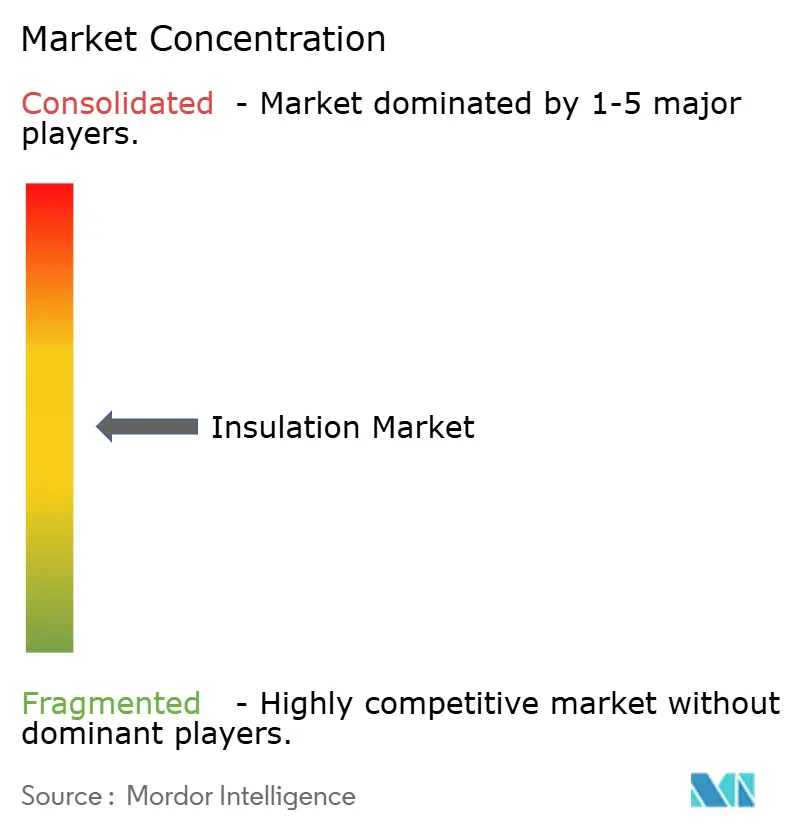
| Market Concentration | Medium |
Major Players *Disclaimer: Major Players sorted in no particular order Image © Mordor Intelligence. Reuse requires attribution under CC BY 4.0. | |
Insulation Market Analysis by Mordor Intelligence
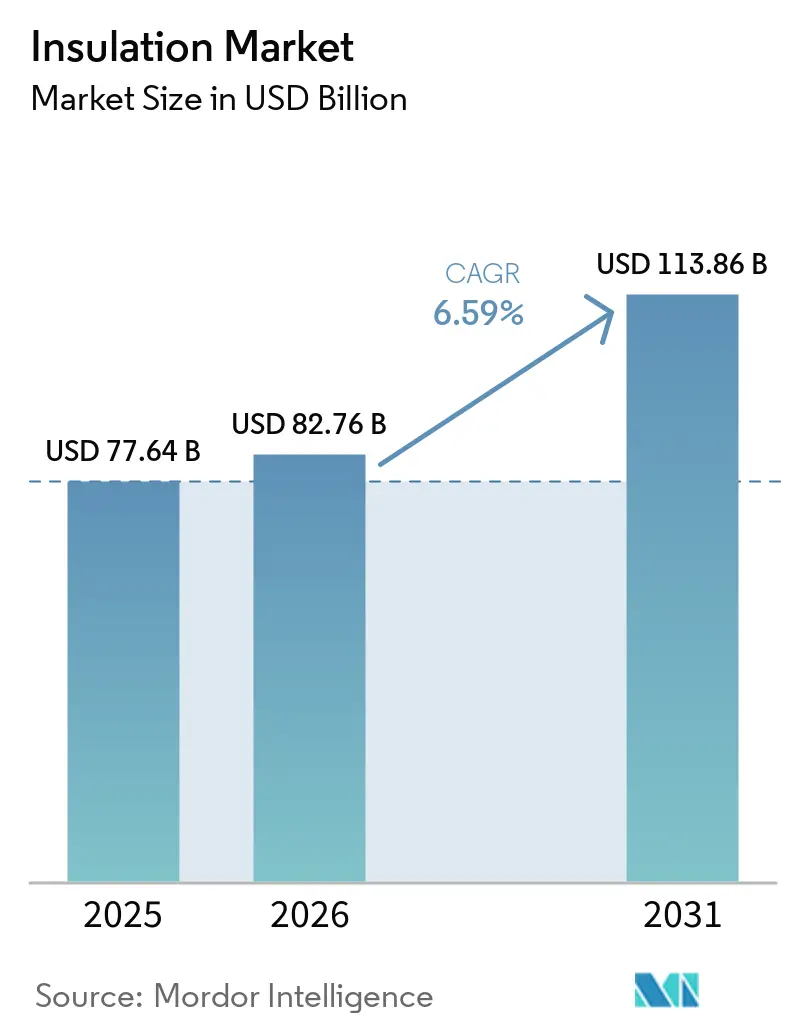
The Insulation Market size was valued at USD 77.64 billion in 2025 and is estimated to grow from USD 82.76 billion in 2026 to reach USD 113.86 billion by 2031, at a CAGR of 6.59% during the forecast period (2026-2031). Building energy rules are making envelope performance a more consistent requirement in both new construction and renovation work. The revised European Energy Performance of Buildings Directive requires national renovation planning and focuses action on poor-performing buildings. California’s 2025 Energy Code took effect on January 1, 2026, and increased envelope efficiency requirements for multifamily and non-residential buildings. The insulation market also benefits from industrial energy management, cold-chain investment, and demand for thinner thermal barriers in electric vehicles. Competition increasingly centers on certified performance, local production capacity, and lower-carbon manufacturing processes. Input-cost swings and shortages of experienced installers can delay projects despite firm renovation demand.
Key Report Takeaways
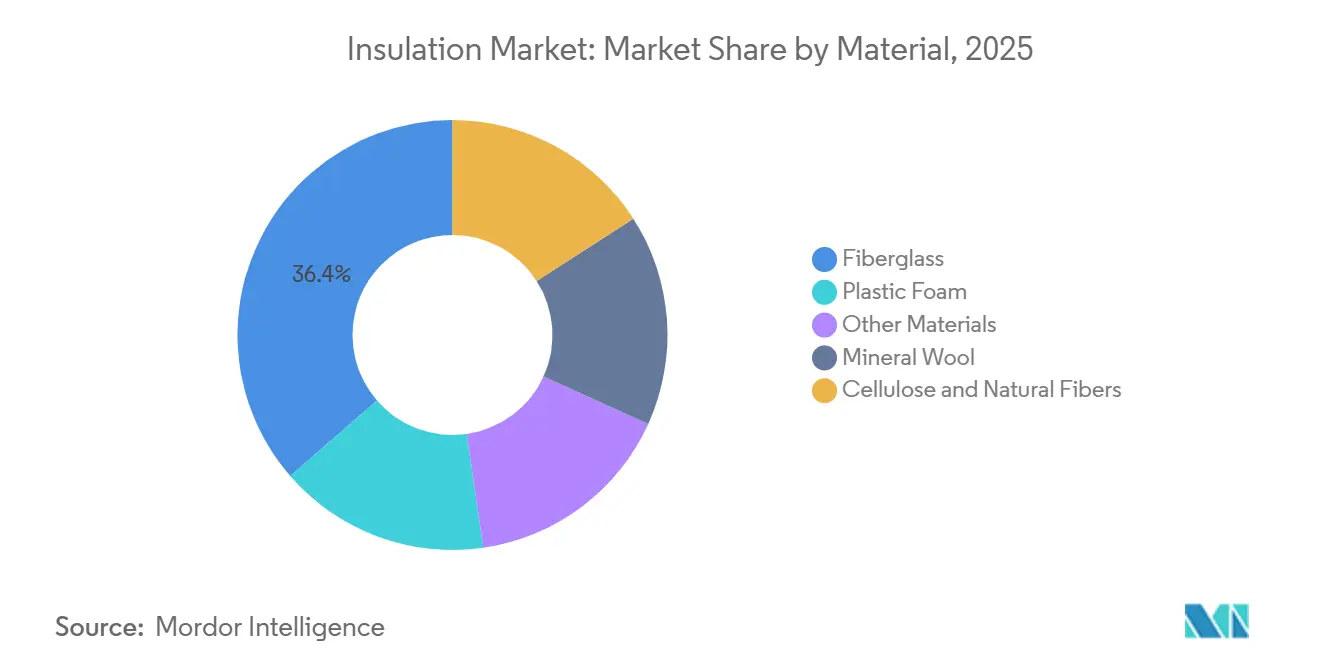
- By material, fiberglass held 36.38% of the insulation market share in 2025, while plastic foam is projected to advance at a 7.12% CAGR through 2031.
- By insulation function, thermal insulation held 60.72% of the insulation market share in 2025, while acoustic insulation is projected to advance at a 7.65% CAGR through 2031.
- By application, roof insulation held 29.64% of the insulation market share in 2025, while wall insulation is projected to advance at a 7.33% CAGR through 2031.
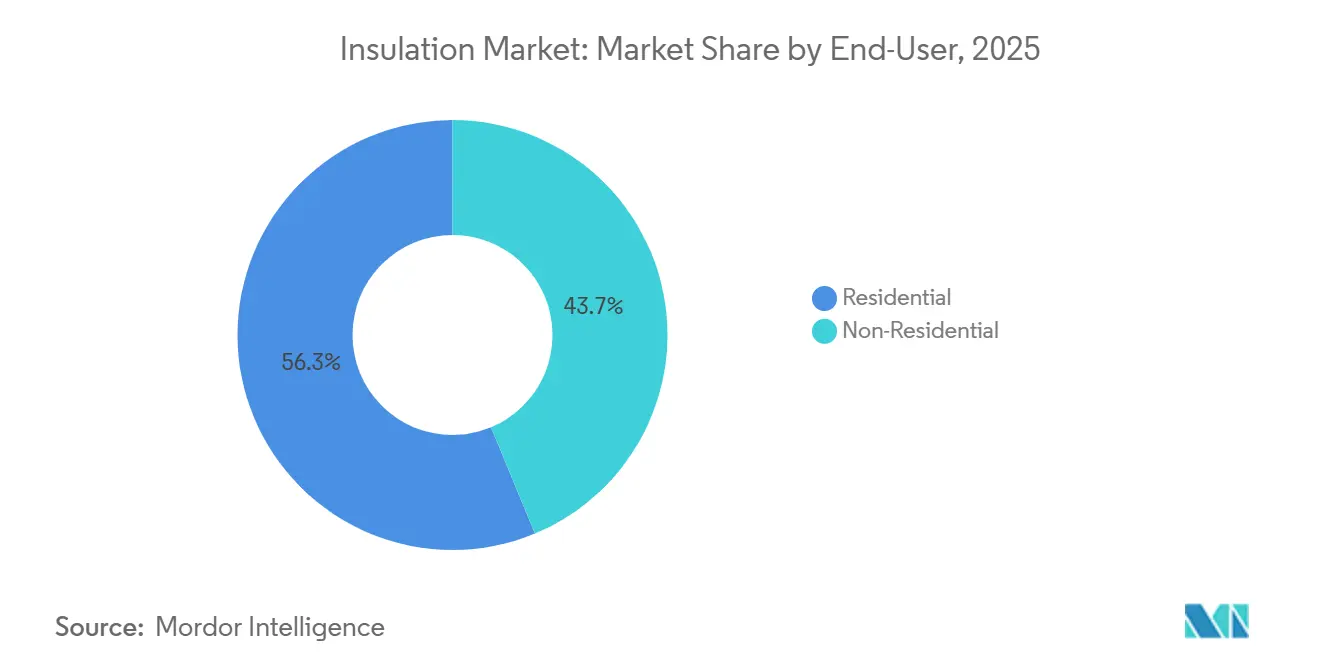
- By end-user, residential held 56.27% of the insulation market share in 2025, while non-residential is projected to advance at a 7.86% CAGR through 2031.
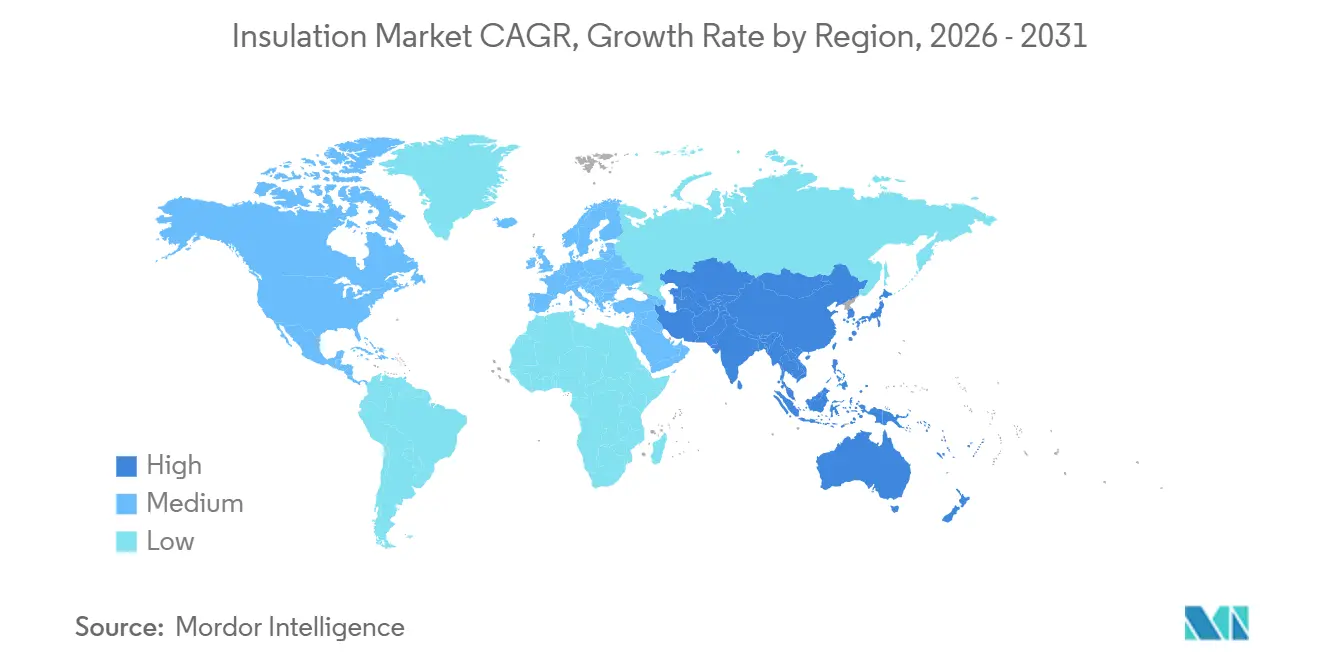
- By geography, Europe held 36.93% of the insulation market share in 2025, while Asia-Pacific is projected to advance at a 7.75% CAGR through 2031.
Note: Market size and forecast figures in this report are generated using Mordor Intelligence’s proprietary estimation framework, updated with the latest available data and insights as of January 2026.
Global Insulation Market Trends and Insights
Drivers Impact Analysis*
| Driver | (~) % Impact on CAGR Forecast | Geographic Relevance | Impact Timeline |
|---|---|---|---|
| Tightening Building Energy-Performance Standards | +2.3% | Global, strongest in EU & North America | Medium term (2-4 years) |
| Building Energy Retrofit Incentives and Renovation Programs | +1.7% | Europe, North America | Medium term (2-4 years) |
| Asia-Pacific Construction and Infrastructure Expansion | +1.4% | APAC core, spillover to MEA | Long term (≥ 4 years) |
| EV Battery Thermal Management and Lightweighting | +1.0% | Global, early gains in APAC & North America | Short term (≤ 2 years) |
| Industrial Decarbonization and Process-Energy Optimization | +0.7% | Global, EU & North America | Long term (≥ 4 years) |
| Source: Mordor Intelligence | |||
Tightening Building Energy-Performance Standards
Building codes have shifted from voluntary guidance toward enforceable performance requirements. The European directive requires member states to prepare National Building Renovation Plans[1]European Commission, “Energy Performance of Buildings Directive,” European Commission, energy.ec.europa.eu. Poor-performing buildings often need envelope improvements before mechanical upgrades become cost-effective. This ordering puts insulation early in many renovation budgets. Washington’s Clean Buildings Performance Standard began compliance deadlines on June 1, 2026, for covered commercial buildings. California’s code changes also strengthen the regulatory basis for insulation in multifamily and non-residential work.
Building Energy Retrofit Incentives and Renovation Programs
Retrofit programs are becoming a central demand source in mature construction markets. The European Union’s Renovation Wave seeks to at least double annual renovation rates and renovate 35 million building units by 2030. Insulation reduces heating demand before renewable heating equipment is installed. This sequencing can improve the effectiveness of later building upgrades. The Inflation Reduction Act supports state-administered Home Energy Rebate programs for household efficiency measures. The Home Electrification and Appliance Rebates program includes up to USD 1,600 for insulation for eligible households. These programs can extend renovation activity into older multifamily housing where project economics were previously difficult.
Asia-Pacific Construction and Infrastructure Expansion
Asia-Pacific construction activity supports insulation demand across housing, commercial buildings, and logistics facilities. India’s Energy Conservation Building Code provides a policy basis for more efficient building envelopes. Japan’s building energy policies also support stronger thermal performance in commercial structures. Cold-chain operators are upgrading warehouse envelopes to meet food and pharmaceutical temperature requirements. Green building frameworks are also increasing demand for higher-performance materials in selected projects. Singapore’s Green Mark framework supports resource-efficient building design and operation. These changes widen the insulation market beyond conventional building construction.
EV Battery Thermal Management and Lightweighting
Electric vehicle battery systems create demand for materials that limit heat transfer and help manage thermal events. These applications favor thin and lightweight products with verified performance. Aspen Aerogels reported record Thermal Barrier revenue from European original equipment manufacturers in the first quarter of 2026. The company also received a PyroThin supply award for two Jaguar Land Rover vehicle architectures. Production for those vehicles is expected to begin in 2027. The insulation market can gain higher-value applications as vehicle platforms adopt more demanding battery designs. Producers with qualified local capacity may be better placed to serve vehicle programs.
Restraints Impact Analysis*
| Restraint | (~) % Impact on CAGR Forecast | Geographic Relevance | Impact Timeline |
|---|---|---|---|
| Volatility in Polymer, Mineral Fiber, and Energy Input Costs | -1.6% | Global | Short term (≤ 2 years) |
| High Installation Costs and Skilled-Installer Shortages | -1.1% | North America & EU | Medium term (2-4 years) |
| End-of-Life and Recycling Constraints for Composite Systems | -0.8% | Global, EU most stringent | Long term (≥ 4 years) |
| Source: Mordor Intelligence | |||
Volatility in Polymer, Mineral Fiber, and Energy Input Costs
Input costs can pressure margins across the insulation supply chain. Glass fiber and mineral wool manufacturing require substantial energy for furnace operations. Polyurethane foams are exposed to changes in methylene diphenyl diisocyanate (MDI) and toluene diisocyanate (TDI) costs. Producers with fossil-based melting processes face both commodity exposure and pressure from lower-carbon alternatives. Knauf Insulation began operating an electric melting line in Croatia during 2026. The line uses electricity from guaranteed low-carbon sources and can use up to 50% recycled raw material. Such process changes may reshape cost competitiveness over time.
High Installation Costs and Skilled-Installer Shortages
Labor availability can limit the pace of insulation installation work. The Associated General Contractors reported that 72% of specialty trade contractors had difficulty filling craft positions in 2025. Experienced insulation installers took 38 days to fill in metro markets during 2026, compared with 27 days in 2023. The Bureau of Labor Statistics projects 5,700 average annual openings for insulation workers through 2034[2]Bureau of Labor Statistics, “Insulation Workers Occupational Outlook Handbook,” Bureau of Labor Statistics, bls.gov. Retrofit programs can create concentrated local demand that permanent apprenticeship capacity cannot quickly meet. Contractors may select products that require less installation time when labor is constrained. This can limit revenue gains from higher-performing specifications.
*Our forecasts treat driver/restraint impacts as directional, not additive. The impact forecasts reflect baseline growth, mix effects, and variable interactions.
Segment Analysis
By Material: Fiberglass Leads While Plastic Foam Sets the Fastest Pace
Fiberglass held 36.38% of the insulation market share in 2025. It benefits from established production, contractor familiarity, and competitive costs in roof, wall, and heating, ventilation, and air conditioning applications. Mineral wool serves projects requiring fire resistance or acoustic performance. Cellulose and natural fibers support selected renovation projects, especially older buildings suited to blow-in installation. Plastic foam is projected to advance at a 7.12% CAGR through 2031. Its performance per unit of thickness supports demand in walls, cold-chain facilities, and battery systems. Aerogel-infused polyurethane can provide a smaller and lighter thermal barrier for vehicle applications.
The insulation market size for fiberglass remains supported by residential batts and blown-in uses. Plastic foam formats, including polyisocyanurate and extruded polystyrene, are increasingly used in continuous wall insulation. Continuous insulation reduces thermal bridging through structural framing. Updated building codes in North America and Europe reinforce this application. Covestro’s AdiP technology can reduce steam use by up to 40% and electricity use by 25% per metric ton of MDI produced. ARMACELL supplies elastomeric foam and aerogel products for heating, ventilation, and air conditioning and industrial pipes.



By Insulation Function: Thermal Insulation Anchors Demand While Acoustic Insulation Rises
Thermal insulation held 60.72% of the insulation market share in 2025. It is used across buildings, industrial equipment, appliances, and transport systems. The category includes fiberglass, mineral wool, plastic foam, and aerogel products. Acoustic insulation is projected to advance at a 7.65% CAGR through 2031. Urban density and multifamily construction support demand for sound-control materials. Environmental noise is a recognized public health concern in Europe. Dual thermal-acoustic solutions can meet more than one requirement through a single installation.
The insulation market size for thermal products reflects their role in building codes and industrial standards. Fire-protective, cryogenic, and vapor-retarding systems serve more specialized process applications. Cryogenic products are gaining attention in liquefied natural gas infrastructure and cold-process operations. ROCKWOOL A/S and Knauf Insulation offer mineral wool products with thermal and acoustic characteristics. Kingspan Group introduced Troldtekt A-Class acoustic ceiling solutions in Denmark during 2025. The company also reported continued activity in acoustic solutions in its 2026 trading update. Broader certification portfolios can help suppliers serve combined thermal and acoustic specifications.
By Application: Roof Insulation Anchors Demand While Wall Insulation Advances
Roof insulation held 29.64% of the insulation market share in 2025. Reroofing cycles in mature economies and new construction in Asia-Pacific support this position. Commercial flat roofs often use high R-value rigid foam beneath waterproofing membranes. These assemblies create demand for polyisocyanurate and extruded polystyrene products. Wall insulation is projected to advance at a 7.33% CAGR through 2031. Continuous exterior insulation is moving into standard specifications for multifamily and commercial buildings. It reduces thermal bridging and can help projects meet building energy requirements.
The insulation market size for wall applications is supported by code changes in North America and Europe. External thermal insulation composite systems remain relevant for renovation activity in France, Italy, and Central and Eastern Europe. Floor and basement insulation is smaller but stable. Slab-edge requirements in several European codes are supporting gradual demand in ground-floor construction. Kingspan Group is developing roofing and insulation facilities in Oklahoma and Maryland. This approach supports integrated insulation and waterproofing offerings. GAF Materials and Atlas Roofing serve specialized roof insulation demand in North America. Johns Manville supplies fiberglass, mineral wool, and foam board products to specification-led contractors.
By End-User: Residential Leads While Non-Residential Demand Quickens
Residential held 56.27% of the insulation market share in 2025. Its scale reflects the persistent energy-performance gap in global housing stock. New construction across Asia-Pacific also supports residential material demand. Non-residential is projected to advance at a 7.86% CAGR through 2031. Commercial energy requirements, industrial decarbonization, and data center construction support this pace. Kingspan Group’s Advnsys business reported 28% year-over-year sales growth in the first quarter of 2026. Its order intake was more than double the level from the same period in 2025.
Residential installations often use standard fiberglass batts and blown-in products. These products generally have lower installed value per square meter than commercial specifications. Non-residential growth can, therefore, increase average revenue per unit across the insulation market. Industrial insulation is important for process equipment and pipelines. The European Industrial Insulation Foundation estimates that upgraded European industrial insulation could save 14 million metric tons of oil equivalent. This equals 160 TWh and the annual energy use of 10 million households. Cold-chain warehouses also require improved envelopes for food and pharmaceutical distribution. Carlisle Companies and GAF Materials serve commercial roofing and envelope projects in North America.
Geography Analysis
Europe held 36.93% of the insulation market share in 2025. The region has a mature regulatory framework and a broad retrofit pipeline. The European Union’s renovation policies and directive requirements support envelope upgrades. Germany, France, the United Kingdom, and Nordic countries remain important revenue contributors. France’s and Italy’s renovation incentives support high-performance insulation use. Central and Eastern European countries can benefit from European funding for building renovation. These countries include Poland, Czechia, and Romania. Advanced insulation demand is also increasing in Nordic countries with strong national decarbonization programs.
Asia-Pacific is projected to advance at a 7.75% CAGR through 2031. China remains the region’s revenue anchor, and India is becoming a more dynamic national market. India’s building code framework supports better envelope performance. Japan and South Korea continue to raise energy-efficiency specifications. ASEAN construction activity supports demand in Vietnam, Thailand, and Indonesia. Cold-chain retrofits add industrial demand beyond new construction.
North America retains a stable and significant role in the insulation market. The United States drives regional demand through rebates, commercial construction, and industrial projects. Canada and Mexico add commercial and industrial demand. South America offers longer-term potential as residential standards and industrial activity develop. Brazil and Argentina are central to this opportunity. The Middle East and Africa are supported by construction activity and HVAC-intensive building needs. Saudi Arabia’s Vision 2030 program and South Africa’s industrial base support regional demand. Lower penetration levels can create a favorable foundation for further insulation adoption.

Competitive Landscape
The insulation market is moderately concentrated, with the top five players including Kingspan Group, Saint-Gobain, Owens Corning, ROCKWOOL A/S, and Knauf Insulation. Many regional and specialist producers continue to serve local construction and industrial requirements. Leaders pursue both geographic expansion and product differentiation. Kingspan Group invested EUR 751.9 million (approximately USD 880 million) in acquisitions and capital expenditure during 2025 across 278 global sites. It is also developing large roofing and insulation facilities in Oklahoma and Maryland. These investments strengthen its integrated building-envelope offering.
ROCKWOOL A/S completed its full acquisition of ScanArc Plasma Technologies AB in 2025. The company is implementing electric melting technology at its Roermond facility in the Netherlands. This move supports lower-carbon mineral wool production. Owens Corning completed the sale of its glass reinforcements business in April 2026 for an enterprise value of USD 645 million. The divestiture focuses the company on building products in North America and Europe. These decisions show how major suppliers are aligning capital with insulation and related building systems.
High-performance aerogel insulation offers opportunities in electric vehicles and industrial projects. Aspen Aerogels, Inc. has strong product positions, although its East Providence facility incident affected manufacturing conditions in the second quarter of 2026. Bio-based and recycled-content products may gain relevance as embodied-carbon disclosure expands. Integrated systems can combine insulation, waterproofing, and energy generation. Kingspan Group’s PowerPanel 2.0 combines photovoltaic technology with QuadCore insulated panels. Covestro AG and Huntsman International LLC influence foam producers through MDI chemistry and related inputs. CNBM INTERNATIONAL CORP. and Johns Manville use domestic proximity and contractor relationships to defend regional positions.
Insulation Industry Leaders
Kingspan Group
Saint-Gobain
Owens Corning
ROCKWOOL A/S
Knauf Insulation
- *Disclaimer: Major Players sorted in no particular order

Recent Industry Developments
- July 2026: Novi Marof, Croatia plant following an investment of more than EUR 120 million. The new line adds 60,000 metric tons of annual capacity and supports the production of lower-embodied-carbon insulation products for applications such as flat roofs and sandwich panels.
- April 2026: ROCKWOOL A/S broke ground on a USD 175 million stone wool insulation manufacturing facility in Wallula, Washington, featuring its proprietary electric melting technology. The facility is expected to begin commercial production in 2028, expanding regional insulation capacity to meet growing demand for energy-efficient and sustainable building materials.


Global Insulation Market Report Scope
Insulation materials are used to reduce the transfer of heat, sound, and other forms of energy through building structures and systems. They help improve indoor comfort, energy efficiency, and building performance while supporting temperature and noise control.
The Insulation Market is segmented by material, insulation function, application, end-user, and geography. By material, the market is segmented into fiberglass, mineral wool, plastic foam, cellulose and natural fibers, and other materials. By insulation function, the market is segmented into thermal insulation, acoustic insulation, and other insulation functions. By application, the market is segmented into roof insulation, wall insulation, floor and basement insulation, and other applications. By end-user, the market is segmented into residential and non-residential. The report also covers the market size and forecasts for insulation in 15 countries across major regions. For each segment, the market sizing and forecasts have been done on the basis of value (USD).
| Fiberglass |
| Mineral Wool |
| Plastic Foam |
| Cellulose and Natural Fibers |
| Other Materials |
| Thermal Insulation |
| Acoustic Insulation |
| Other Insulation Functions |
| Roof Insulation |
| Wall Insulation |
| Floor and Basement Insulation |
| Other Applications |
| Residential |
| Non-Residential |
| Asia-Pacific | China |
| India | |
| Japan | |
| South Korea | |
| ASEAN Countries | |
| Rest of Asia-Pacific | |
| North America | United States |
| Canada | |
| Mexico | |
| Europe | Germany |
| United Kingdom | |
| France | |
| Italy | |
| NORDIC Countries | |
| Rest of Europe | |
| South America | Brazil |
| Argentina | |
| Rest of South America | |
| Middle East and Africa | Saudi Arabia |
| South Africa | |
| Rest of Middle East and Africa |
| By Material | Fiberglass | |
| Mineral Wool | ||
| Plastic Foam | ||
| Cellulose and Natural Fibers | ||
| Other Materials | ||
| By Insulation Function | Thermal Insulation | |
| Acoustic Insulation | ||
| Other Insulation Functions | ||
| By Application | Roof Insulation | |
| Wall Insulation | ||
| Floor and Basement Insulation | ||
| Other Applications | ||
| By End-User | Residential | |
| Non-Residential | ||
| By Geography | Asia-Pacific | China |
| India | ||
| Japan | ||
| South Korea | ||
| ASEAN Countries | ||
| Rest of Asia-Pacific | ||
| North America | United States | |
| Canada | ||
| Mexico | ||
| Europe | Germany | |
| United Kingdom | ||
| France | ||
| Italy | ||
| NORDIC Countries | ||
| Rest of Europe | ||
| South America | Brazil | |
| Argentina | ||
| Rest of South America | ||
| Middle East and Africa | Saudi Arabia | |
| South Africa | ||
| Rest of Middle East and Africa | ||


Key Questions Answered in the Report
What is the size of the insulation market?
The insulation market stands at USD 82.76 billion in 2026 and is projected to reach USD 113.86 billion by 2031.
What is driving demand for insulation products?
Building energy codes, renovation programs, industrial efficiency requirements, cold-chain projects, and electric vehicle thermal management support demand.
Which material had the highest market share in 2025?
Fiberglass held 36.38% of the market share in 2025, supported by established manufacturing and broad contractor familiarity.
Which application is expected to grow fastest through 2031?
Wall insulation is projected to advance at a 7.33% CAGR through 2031 as continuous insulation becomes more common.
Page last updated on:





