
Innovation Pipeline Intelligence Market Size and Share
Market Overview
| Study Period | 2020 - 2031 |
|---|---|
| Market Size (2026) | USD 617.34 Million |
| Market Size (2031) | USD 911.02 Million |
| Growth Rate (2026 - 2031) | 8.09 % |
| Fastest Growing Market | Asia-Pacific |
| Largest Market | North America |
| Market Concentration | Medium |
Major Players *Disclaimer: Major Players sorted in no particular order Image © Mordor Intelligence. Reuse requires attribution under CC BY 4.0. | |
Innovation Pipeline Intelligence Market Analysis by Mordor Intelligence
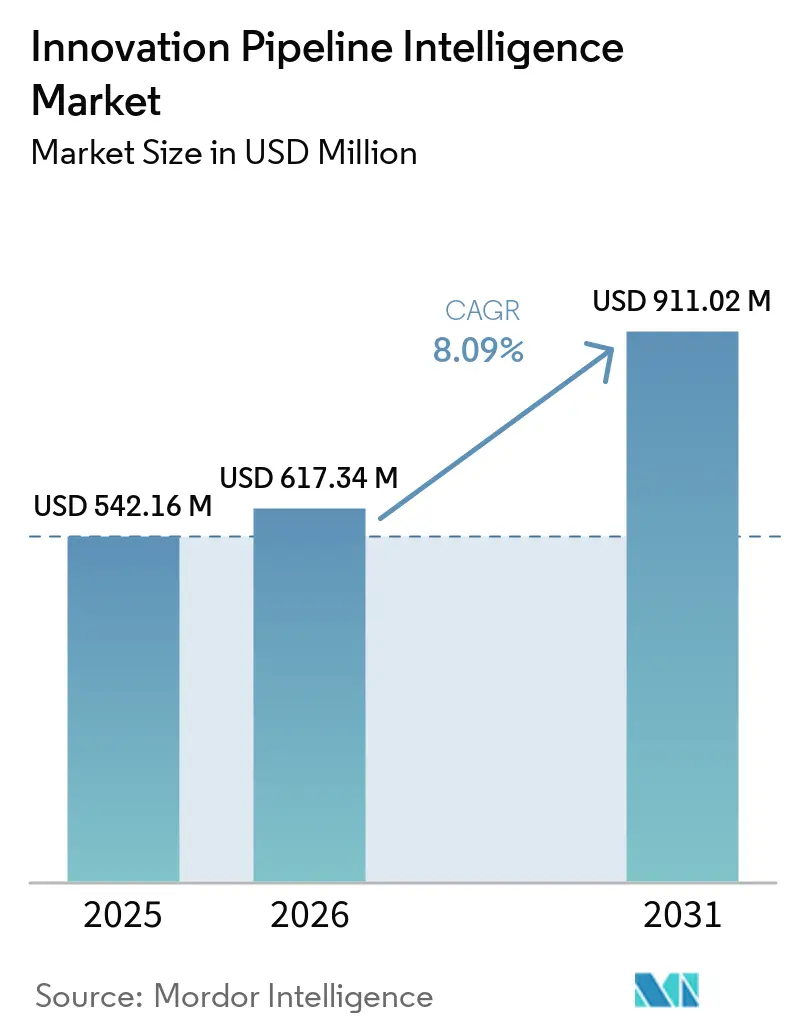
The Innovation Pipeline Intelligence Market size is projected to expand from USD 542.16 million in 2025 to USD 617.34 million in 2026, and to USD 911.02 million by 2031, registering a CAGR of 8.09% between 2026 and 2031. Growth reflects the replacement of informal idea tracking, scattered files, and unconnected review processes with platforms that document evaluation, funding, implementation, and commercialization decisions across the full life of a proposal. Corporate R&D spending increased in real terms during 2025, supporting demand for stronger visibility across research portfolios and more disciplined choices when several projects compete for the same funding and technical expertise. Buyers are increasingly viewing these tools as governance systems, as senior leaders need clear records of how projects were selected, who approved key decisions, and whether intended benefits were achieved. Generative AI is expanding the role of the Innovation Pipeline Intelligence Market from idea collection to portfolio assessment, but it also increases the need for reliable validation, transparent scoring methods, and appropriate controls over sensitive information. Platform vendors are therefore combining software, analytics, implementation support, training, and outcome reporting to demonstrate results that can be linked to business priorities and sustained program participation.
Key Report Takeaways
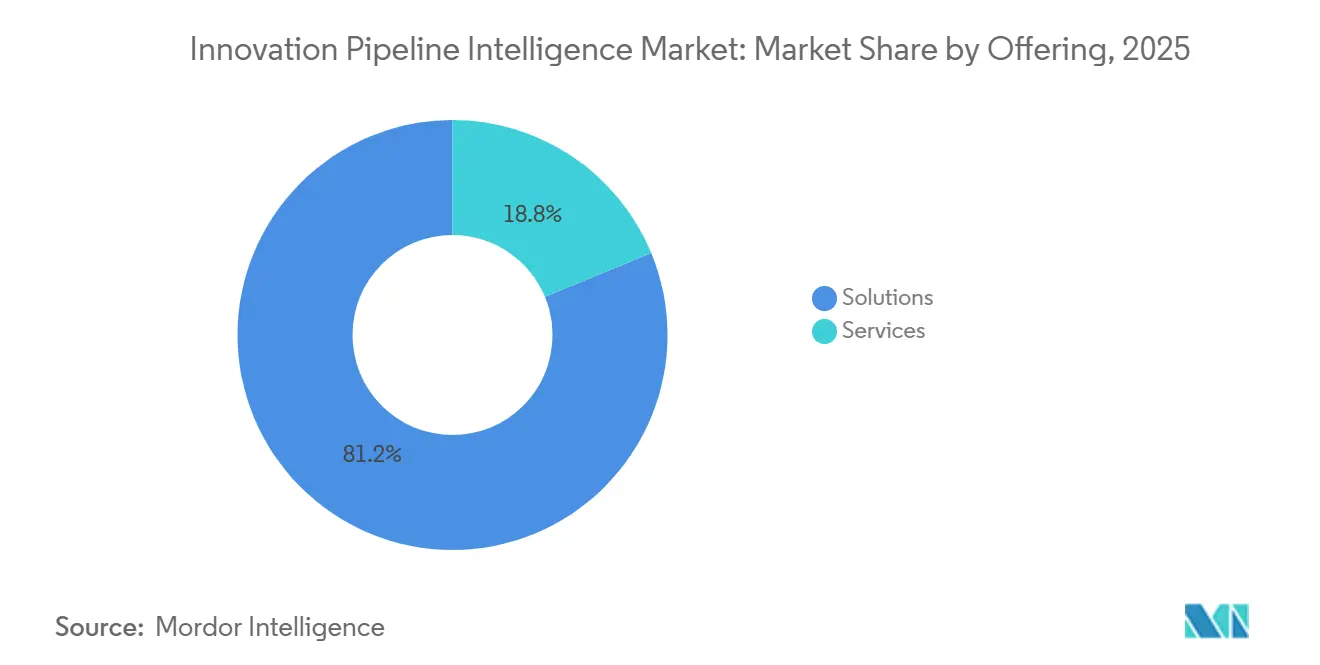
- By offering, Solutions held 81.23% of the Innovation Pipeline Intelligence Market share in 2025, while Services is forecast to grow at an 8.12% CAGR through 2031.
- By deployment model, Cloud-Native SaaS accounted for 76.42% of the Innovation Pipeline Intelligence Market size in 2025, while Hybrid deployment is forecast to grow at an 8.34% CAGR through 2031.
- By organization size, Large Enterprises held 73.21% of revenue in 2025, while Small and Medium-Sized Enterprises are forecast to grow at an 8.47% CAGR through 2031.
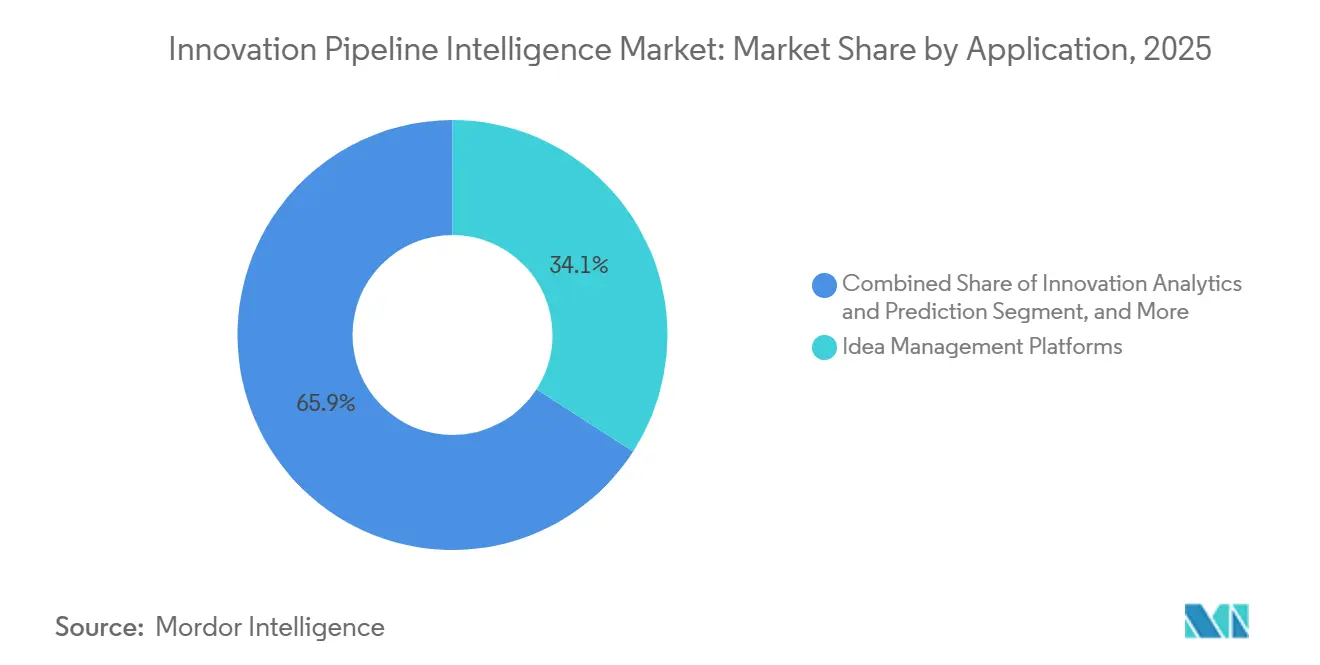
- By application, Idea Management Platforms accounted for 34.12% of Innovation Pipeline Intelligence Market revenue in 2025, while Innovation Analytics and Prediction Platforms are forecast to grow at a 9.62% CAGR through 2031.
- By industry vertical, Technology and Telecommunications held 26.14% of revenue in 2025, while Healthcare and Life Sciences are forecast to grow at a 9.87% CAGR through 2031.
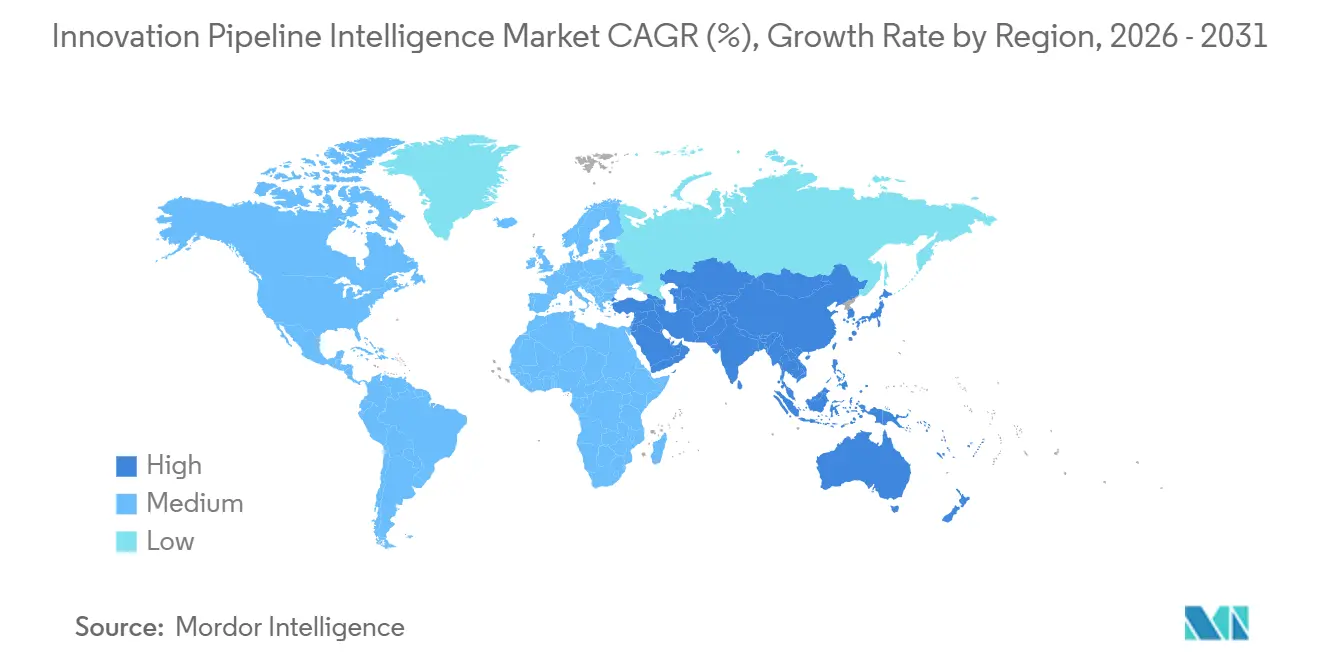
- By geography, North America held 38.42% of Innovation Pipeline Intelligence Market revenue in 2025, while Asia-Pacific is forecast to grow at a 9.94% CAGR through 2031.
Note: Market size and forecast figures in this report are generated using Mordor Intelligence’s proprietary estimation framework, updated with the latest available data and insights as of January 2026.
Market Trends and Insights
Drivers Impact Analysis of Innovation Pipeline Intelligence Market*
| Driver | (~) % Impact on CAGR Forecast | Geographic Relevance | Impact Timeline |
|---|---|---|---|
| Enterprise Demand for Structured Innovation Pipelines | +2.8% | Global, with concentration in North America and Europe | Short term (≤ 2 years) |
| Generative AI for Idea Evaluation and Portfolio Decisions | +2.0% | Global, led by North America and Asia-Pacific | Medium term (2-4 years) |
| Cloud-First Procurement and Subscription Economics | +1.6% | North America and Europe, with expansion to Asia-Pacific | Short term (≤ 2 years) |
| Rising R&D Intensity and Ecosystem-Based Innovation | +1.2% | Asia-Pacific core, with expansion to North America and Europe | Medium term (2-4 years) |
| Pressure to Demonstrate Innovation ROI | +0.8% | Global | Medium term (2-4 years) |
| Regulated-Industry Demand for Traceable Innovation Governance | +0.5% | Europe and North America | Long term (≥ 4 years) |
| Source: Mordor Intelligence | |||
Enterprise Demand for Structured Innovation Pipelines
Organizations increasingly view unmanaged idea generation as a source of weak selection, duplicated work, and limited accountability. The Innovation Pipeline Intelligence Market addresses this concern through stage gates, evaluation criteria, portfolio records, and common workflows. These capabilities track proposals from submission through feasibility review, funding, implementation, and commercialization. Leaders need more than an idea repository because they must compare feasibility, resourcing, risk, strategic fit, and expected value. A documented decision trail becomes a procurement requirement when innovation leaders are accountable for returns. This makes governance platforms valuable even when software budgets are constrained.
Generative AI for Idea Evaluation and Portfolio Decisions
Generative AI can organize ideas, identify duplicates, support early screening, and model scenarios. The Innovation Pipeline Intelligence Market benefits when these functions increase review capacity without extending decision cycles. Greater idea volume shifts the constraint from generating proposals to judging their quality and feasibility. Vendors must demonstrate that AI-supported scoring is transparent, traceable, and useful for resource allocation. This is especially important when executives or compliance teams later review decisions. Wazoku uses its Expected Value algorithm to assess ideas across quantitative dimensions.[1]
Cloud-First Procurement and Subscription Economics
Subscription delivery lowers the cost and technical effort of adopting innovation software. It lets buyers start with operating budgets and test smaller programs before wider adoption. Cloud delivery also provides regular updates, analytics improvements, AI functions, and collaboration features. Vendors must then demonstrate value at renewal through participation, decision quality, and business outcomes. The Innovation Pipeline Intelligence Market is placing greater emphasis on dashboards that connect activity, project progress, and results. Buyers also seek flexible terms as programs expand across functions or regions.
Rising R&D Intensity and Ecosystem-Based Innovation
Business R&D spending among the largest global investors increased by 6% in inflation-adjusted terms during 2025, following 3% growth in 2024. Higher research budgets increase the need for consistent evaluation and clear priorities. Organizations are also linking internal research with startups, universities, suppliers, and specialist networks. The Innovation Pipeline Intelligence Market supports these arrangements by recording external submissions and their relation to internal portfolios. Larger R&D budgets still face pressure to show returns and to stop projects without a clear path. Portfolio discipline is therefore important as organizations expand research and external collaboration.[2]
Restraints Impact Analysis of Innovation Pipeline Intelligence Market*
| Restraint | (~) % Impact on CAGR Forecast | Geographic Relevance | Impact Timeline |
|---|---|---|---|
| Integration Complexity Across Fragmented Enterprise Systems | -1.3% | Global, highest in large-enterprise segments | Medium term (2-4 years) |
| Low Conversion from Ideas to Commercialized Outcomes | -0.8% | Global | Long term (≥ 4 years) |
| Data Residency and Confidentiality Constraints | -0.6% | Europe and Asia-Pacific core | Medium term (2-4 years) |
| Change-Management Friction and Weak Executive Sponsorship | -0.4% | Global | Long term (≥ 4 years) |
| Source: Mordor Intelligence | |||
Integration Complexity Across Fragmented Enterprise Systems
Integration is challenging because large organizations use separate systems for finance, customer data, projects, human resources, collaboration, and product development. Innovation tools need this data to show project costs, resourcing needs, and business value. The Innovation Pipeline Intelligence Market can face longer deployments when connections require custom design, testing, security review, or IT approval. Innovation teams may buy platforms before assessing their place within existing architecture. Incomplete links weaken reporting when platform data cannot be compared with financial or execution data. Reliable integrations can shorten implementation and improve portfolio reporting.
Low Conversion From Ideas to Commercialized Outcomes
A high volume of submitted ideas does not ensure more commercialized products or services. Many programs struggle to connect selection with funding, development, launches, and later performance measures. The Innovation Pipeline Intelligence Market must address this gap, as low conversion rates reduce participation and executive confidence. Return on investment is difficult to measure when responsibility moves across innovation, product, finance, and operating teams. Poor outcomes can reduce sponsorship, lower platform use, and weaken evaluation data. Links between ideas, funded projects, launches, and milestones can improve the connection between ideation and execution.
*Our forecasts treat driver/restraint impacts as directional, not additive. The impact forecasts reflect baseline growth, mix effects, and variable interactions.
Innovation Pipeline Intelligence Market Segment Analysis
By Offering:
Solutions Lead While Services Gain ImportanceSolutions accounted for 81.23% of Innovation Pipeline Intelligence Market revenue in 2025. This lead reflects the established use of idea management, portfolio management, and technology scouting software by dispersed enterprise teams. Organizations choose integrated solutions for shared workflows, data standards, reporting, and ownership across innovation programs. The software supports intake, review, prioritization, funding requests, collaboration, and decision records. It also helps leaders manage projects across business units and locations.
Services are forecast to grow at an 8.12% CAGR from 2026 to 2031. Buyers often need help with program design, adoption, training, governance, and outcome measurement. Support is important when innovation processes must align with established project management and approval practices. Vendors increasingly use services to improve adoption and define useful metrics. The Innovation Pipeline Intelligence industry rewards providers that combine product capability with effective delivery.
By Deployment Model:
Cloud-Native SaaS Leads While Hybrid Use ExpandsCloud-Native SaaS represented 76.42% of Innovation Pipeline Intelligence Market revenue in 2025. Its lead reflects lower upfront costs, faster implementation, more frequent updates, and a reduced need for internal upgrades. Cloud systems offer a common service across different IT environments and locations. This is useful for smaller buyers who do not want to maintain specialized infrastructure. Updates can make new analytics, security controls, and AI functions available faster.
Hybrid deployment is forecast to grow at an 8.34% CAGR between 2026 and 2031. Regulated organizations may need sensitive research, product, personal, or confidential data to remain within defined locations. The EU AI Act is fully applicable in August 2026 and emphasizes documentation, governance, and traceability for AI systems. Hybrid environments retain control over sensitive workloads while using cloud services for collaboration. The Innovation Pipeline Intelligence Market must support flexible architectures rather than a single cloud model.[3]
By Organization Size:
Large Enterprises Remain the Revenue Base While SMEs ExpandLarge Enterprises accounted for 73.21% of the Innovation Pipeline Intelligence Market revenue in 2025. They have complex portfolios, larger R&D budgets, and formal approval requirements. Their operations across business units and regions increase the need for common methods and consolidated decision records. Large accounts often require configurable workflows, controlled permissions, audit records, and integrations. Earlier adoption has made them the main revenue base for established vendors.
Small and Medium-Sized Enterprises are forecast to grow at an 8.47% CAGR through 2031. Subscription-priced cloud software reduces the burden of infrastructure, purchasing, and implementation. SMEs often prioritize speed, ease of use, and simple reporting over deep customization. They can favor integrations with Microsoft Teams and Slack, ready-to-use reporting, and AI-assisted scoring. The Innovation Pipeline Intelligence industry has room for suppliers designed for smaller teams and simpler workflows.
By Application:
Idea Management Leads While Analytics Gains MomentumIdea Management Platforms accounted for 34.12% of the Innovation Pipeline Intelligence Market revenue in 2025. They are often the first part of a formal program because they structure the collection, review, and development of proposals. Administrators can involve employees, partners, suppliers, and external communities while applying common evaluation criteria. Organizations may add portfolio management or technology scouting tools as programs mature. This makes idea management a practical entry point for new buyers.
Innovation Analytics and Prediction Platforms are forecast to expand at a 9.62% CAGR from 2026 to 2031. Buyers want to assess potential, compare options, and identify relevant signals rather than only record status. These applications combine scenario modeling, patent intelligence, scientific publications, and other sources. Ezassi reports that its 3DScout platform processes more than 360 million records across patents, publications, grants, clinical trials, and company data.[4] The Innovation Pipeline Intelligence Market is moving toward data-led applications that retain a basis for human review.

By Industry Vertical:
Technology Leads While Healthcare and Life Sciences Grows FasterTechnology and Telecommunications accounted for 26.14% of the Innovation Pipeline Intelligence Market revenue in 2025. Short product cycles and recurring technology shifts make portfolio visibility important. These companies often set expectations for AI functions, analytics, integration, and collaboration. Manufacturing and Automotive companies use platforms for supplier collaboration and process improvement. Financial Services and Insurance organizations use technology scouting to monitor financial technology offerings.
Healthcare and Life Sciences are forecast to grow at a 9.87% CAGR between 2026 and 2031. Drug development and clinical work require clear records of decisions, supporting data, and risk assessment. In January 2026, the European Medicines Agency and the U.S. Food and Drug Administration published joint principles for good AI practice in drug development. This supports demand for traceable innovation processes. Consumer Goods and Retail, Energy and Utilities, and Government and Education use platforms for product ideation, R&D portfolio management, and research planning.
Geography Analysis
North America Innovation Pipeline Intelligence Market
North America accounted for 38.42% of Innovation Pipeline Intelligence Market revenue in 2025, led by the United States, driven by established enterprise software purchasing, platform suppliers, cloud adoption, and formal innovation programs. Canada has supported adoption through AI research linked to universities in Toronto, Montreal, and Vancouver, while Mexico is gaining demand from multinational deployments. North American buyers often shape vendor road maps for AI-assisted evaluation, analytics, and integrations with Microsoft 365 and Salesforce.
Europe and the Americas Innovation Pipeline Intelligence Market
Europe is a mature, regulation-sensitive region for the Innovation Pipeline Intelligence Market. Germany, the United Kingdom, and France lead in adoption across manufacturing, financial services, pharmaceuticals, research networks, and public-sector demand. Qmarkets became an accredited supplier on UGAP, France’s national public procurement agency, in October 2025. The EU AI Act will be fully applicable in August 2026 and has drawn attention to AI governance. Italy, Spain, and the Nordic countries are growing markets, while demand in South America is concentrated in Brazil and Mexico.
APAC and MEA Innovation Pipeline Intelligence Market
Asia-Pacific is forecast to grow at a 9.94% CAGR through 2031, the fastest regional rate in the Innovation Pipeline Intelligence Market. China, India, Japan, and South Korea combine to expand R&D activity, cloud infrastructure, and public support for innovation. China’s private technology firms are increasing structured innovation practices. India’s growth is linked to Startup India and Digital India programs, while IT services firms are adding AI and machine learning to internal programs. Japan is digitizing product-development governance, and demand in the Middle East is supported by transformation programs in the UAE and Saudi Arabia. Africa remains in its early stages, with South Africa and Nigeria as the main centers of adoption.
Competitive Landscape
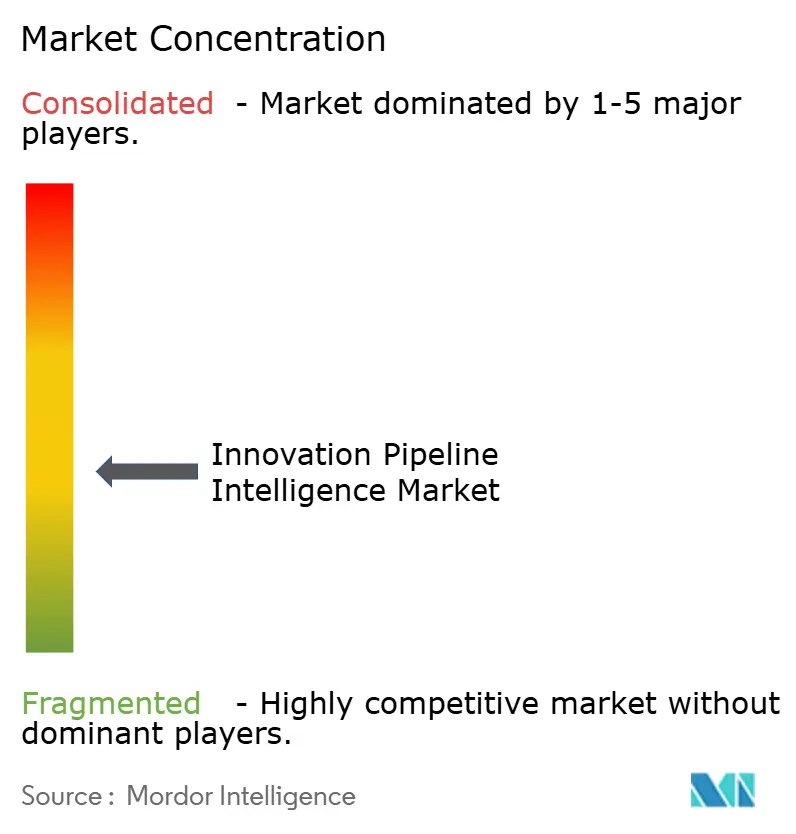
The Innovation Pipeline Intelligence Market is moderately fragmented, with specialist vendors competing alongside broader portfolio management providers. Brightidea, HYPE Innovation, IdeaScale, Qmarkets, and Wazoku compete through ideation, open innovation, and portfolio assessment capabilities. Planview bundles innovation functions with program execution and product development tools. Buyers assess workflow fit, implementation support, AI capability, integrations, data controls, and governance records.
Consolidation has broadened vendor offerings. Wellspring acquired Sopheon in February 2024, combining technology transfer, intellectual property management, and innovation governance. Planview acquired Sciforma in February 2025, strengthening its presence in European project portfolio management. These transactions link innovation planning more closely with execution and commercialization. Focused suppliers can still offer clearer experiences for specific workflows or customer groups.
AI capability is a major area of product competition within the Innovation Pipeline Intelligence Market. Wazoku introduced an Expected Value algorithm, while Qmarkets launched Iris as an AI-powered intelligence layer. IdeaScale introduced Model Conversational Processing in August 2025 for natural-language queries against campaign and pipeline data. Ideanote, CrowdWorx, and AEVO Innovate emphasize simpler experiences for SMEs and mid-market buyers. Competition also centers on tiered pricing, data residency, and controls for AI-assisted evaluations.
Innovation Pipeline Intelligence Industry Leaders
-
Brightidea Inc.
-
HYPE Innovation GmbH
-
IdeaScale Inc.
-
Qmarkets Ltd.
-
Wazoku Ltd.
- *Disclaimer: Major Players sorted in no particular order
Innovation Pipeline Intelligence Market Companies Covered in this Report
- Brightidea Inc.
- HYPE Innovation GmbH
- IdeaScale Inc.
- Qmarkets Ltd.
- Wazoku Ltd.
- Sopheon plc
- Planbox Inc.
- InnovationCast B.V.
- Ideanote ApS
- Agorize SAS
- Accept Mission B.V.
- Viima Solutions Oy
- AEVO Innovate
- Vianeo SAS
- Exago S.L.
- Nosco ApS
- Crowdicity Ltd.
- Innosabi GmbH
- ITONICS GmbH
- CrowdWorx GmbH
- Catapult Innovations Ltd.
- Ezassi, Inc.
- Questel SAS
- Planview, Inc.
- Collaboration.Ai, Inc.
Recent Industry Developments in Innovation Pipeline Intelligence Market
- July 2026: Brightidea launched its Summer 2026 platform release, introducing a Model Context Protocol server that connects the Brightidea innovation platform directly to AI agents including Claude, ChatGPT, Microsoft Copilot, and AWS Bedrock. The integration enables AI agents to query innovation pipelines, summarize submissions, and pull engagement data, marking a significant architectural step toward agentic innovation workflows in enterprise settings
- January 2026: Planview announced new CEO Matt Zilli and a refreshed leadership team to accelerate an AI-first platform strategy, following 2025 expected revenues approaching USD 500 million. The company linked this direction with the Sciforma acquisition and the addition of more than 120 net new customers in the first half of 2025
- January 2026: The European Medicines Agency and the U.S. Food and Drug Administration jointly released Guiding Principles of Good AI Practice in Drug Development. The principles set voluntary but influential expectations for data governance, documentation, risk classification, and AI lifecycle management in pharmaceutical and biotechnology workflows
- October 2025: Qmarkets received accreditation on UGAP, France’s national public procurement agency. The accreditation enables French ministries, hospitals, universities, and regional authorities to buy Qmarkets innovation management software through a secure national framework
Global Innovation Pipeline Intelligence Market Report Scope
The innovation pipeline intelligence market refers to the ecosystem of software solutions and professional services that help organizations systematically capture, evaluate, manage, and track new ideas, projects, and technologies from conception through commercialization. This market encompasses platforms for idea management, innovation portfolio and project management, technology scouting and open innovation, and advanced analytics and predictive modeling. Deployed via cloud-native, hybrid, or on-premises models, these solutions cater to organizations of all sizes across diverse industries, including technology, manufacturing, healthcare, and financial services. By providing data-driven insights and streamlining the end-to-end innovation workflow, innovation pipeline intelligence empowers enterprises to optimize resource allocation, reduce time-to-market for new products, identify disruptive technologies early, and foster a structured, profitable approach to corporate innovation.
The Innovation Pipeline Intelligence Market Report is Segmented by Offering (Solutions, and Services), Deployment Model (Cloud-Native, Hybrid, and On-Premises), Organization Size (Large Enterprises, and Small and Medium-Sized Enterprises), Application (Idea Management Platforms, Portfolio and Project Management Platforms, Technology Scouting and Open Innovation Platforms, Innovation Analytics and Prediction Platforms, and Other Applications), Industry Vertical (Technology and Telecommunications, Manufacturing and Automotive, Financial Services and Insurance, Healthcare and Life Sciences, Consumer Goods and Retail, Energy and Utilities, and Government and Education), and Geography (North America, South America, Europe, Asia-Pacific, Middle East, and Africa). The Market Forecasts are Provided in Terms of Value (USD).
Segmentation Overview
| Solutions |
| Services |
| Cloud-Native |
| Hybrid |
| On-Premises |
| Large Enterprises |
| Small and Medium-Sized Enterprises |
| Idea Management Platforms |
| Portfolio and Project Management Platforms |
| Technology Scouting and Open Innovation Platforms |
| Innovation Analytics and Prediction Platforms |
| Other Applications |
| Technology and Telecommunications |
| Manufacturing and Automotive |
| Financial Services and Insurance |
| Healthcare and Life Sciences |
| Consumer Goods and Retail |
| Energy and Utilities |
| Government and Education |
| North America | United States |
| Canada | |
| Mexico | |
| South America | Brazil |
| Argentina | |
| Chile | |
| Rest of South America | |
| Europe | Germany |
| United Kingdom | |
| France | |
| Italy | |
| Spain | |
| Rest of Europe | |
| Asia-Pacific | China |
| Japan | |
| India | |
| South Korea | |
| Australia | |
| Rest of Asia-Pacific | |
| Middle East | United Arab Emirates |
| Saudi Arabia | |
| Qatar | |
| Rest of Middle East | |
| Africa | South Africa |
| Egypt | |
| Nigeria | |
| Rest of Africa |
| By Offering | Solutions | |
| Services | ||
| By Deployment Model | Cloud-Native | |
| Hybrid | ||
| On-Premises | ||
| By Organization Size | Large Enterprises | |
| Small and Medium-Sized Enterprises | ||
| By Application | Idea Management Platforms | |
| Portfolio and Project Management Platforms | ||
| Technology Scouting and Open Innovation Platforms | ||
| Innovation Analytics and Prediction Platforms | ||
| Other Applications | ||
| By Industry Vertical | Technology and Telecommunications | |
| Manufacturing and Automotive | ||
| Financial Services and Insurance | ||
| Healthcare and Life Sciences | ||
| Consumer Goods and Retail | ||
| Energy and Utilities | ||
| Government and Education | ||
| By Geography | North America | United States |
| Canada | ||
| Mexico | ||
| South America | Brazil | |
| Argentina | ||
| Chile | ||
| Rest of South America | ||
| Europe | Germany | |
| United Kingdom | ||
| France | ||
| Italy | ||
| Spain | ||
| Rest of Europe | ||
| Asia-Pacific | China | |
| Japan | ||
| India | ||
| South Korea | ||
| Australia | ||
| Rest of Asia-Pacific | ||
| Middle East | United Arab Emirates | |
| Saudi Arabia | ||
| Qatar | ||
| Rest of Middle East | ||
| Africa | South Africa | |
| Egypt | ||
| Nigeria | ||
| Rest of Africa | ||
Key Questions Answered in the Report
What is the projected value of the Innovation Pipeline Intelligence Market by 2031?
The Innovation Pipeline Intelligence Market is forecast to reach USD 911.02 million by 2031, after rising from USD 617.34 million in 2026. The forecast CAGR is 8.09% for 2026 to 2031, reflecting growing use of platforms that manage innovation decisions from submission through commercialization.
Which offering generates the most revenue in innovation pipeline intelligence?
Solutions led with 81.23% of revenue in 2025 because buyers value integrated software for idea intake, evaluation, portfolio management, and reporting. Services is forecast to grow faster at an 8.12% CAGR through 2031 as customers seek help with implementation, training, governance, and outcome measurement.
Why are organizations adopting innovation pipeline intelligence platforms?
Organizations use these platforms to organize ideas, assess projects, record decisions, and connect innovation activity to commercialization and governance needs. They are especially useful when programs involve several business units, external partners, formal funding reviews, or a need to explain why specific projects received priority.
Which deployment model is most widely used for innovation pipeline intelligence software?
Cloud-Native SaaS held 76.42% of revenue in 2025 because it lowers upfront costs and supports faster deployment, regular updates, and access across distributed teams. Hybrid deployment is also expanding because regulated organizations may need greater control over research, personal, and commercially sensitive data.
Which region will grow fastest through 2031?
Asia-Pacific is forecast to grow at a 9.94% CAGR, supported by R&D activity, cloud infrastructure, and government-backed innovation programs. China, India, Japan, and South Korea provide the principal sources of demand, while organizations across the region increase the use of structured portfolio and product-development processes.
How is generative AI changing innovation pipeline intelligence platforms?
Generative AI can support idea clustering, duplicate detection, early evaluation, and scenario modeling, which shifts attention toward evaluation quality and traceable decisions. The technology can shorten routine review work, but users still need controls that make scoring understandable and useful when funds, people, and development capacity are allocated.