
Ink and Toner Cartridge Market Size and Share
Market Overview
| Study Period | 2021 - 2031 |
|---|---|
| Market Size (2026) | USD 22.94 Billion |
| Market Size (2031) | USD 30.42 Billion |
| Growth Rate (2026 - 2031) | 5.81 % |
| Fastest Growing Market | Asia-Pacific |
| Largest Market | Asia-Pacific |
| Market Concentration | Low |
Major Players *Disclaimer: Major Players sorted in no particular order Image © Mordor Intelligence. Reuse requires attribution under CC BY 4.0. | |
Ink and Toner Cartridge Market Analysis by Mordor Intelligence
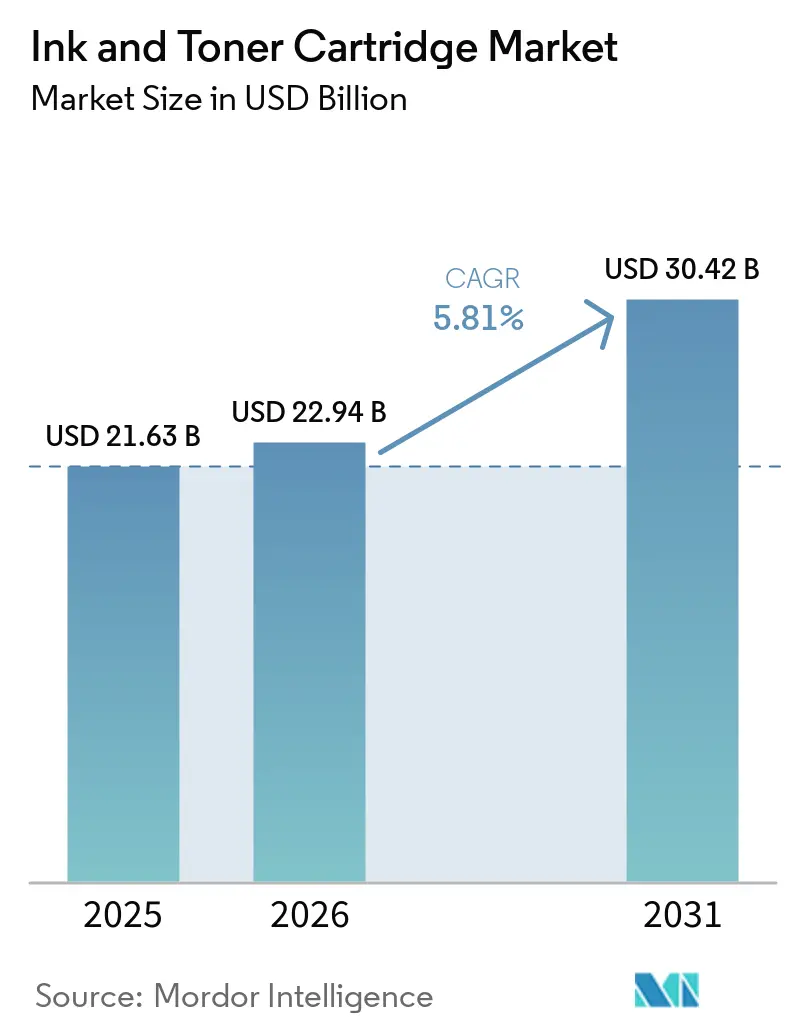
The ink and toner cartridge market size was valued at USD 21.63 billion in 2025 and estimated to grow from USD 22.94 billion in 2026 to reach USD 30.42 billion by 2031, at a CAGR of 5.81% during the forecast period (2026-2031). The installed base of printers sustains replenishment demand, even as users print fewer pages. Managed print services and subscriptions are shifting revenue toward recurring supply arrangements. E-commerce is making cartridge selection and repeat ordering easier for buyers. Original Equipment Manufacturers (OEMs) are responding with service plans, authentication systems, and products with recycled content. The ink and toner cartridge market also presents opportunities in commercial, specialty, and verified circular supply channels.
Key Report Takeaways
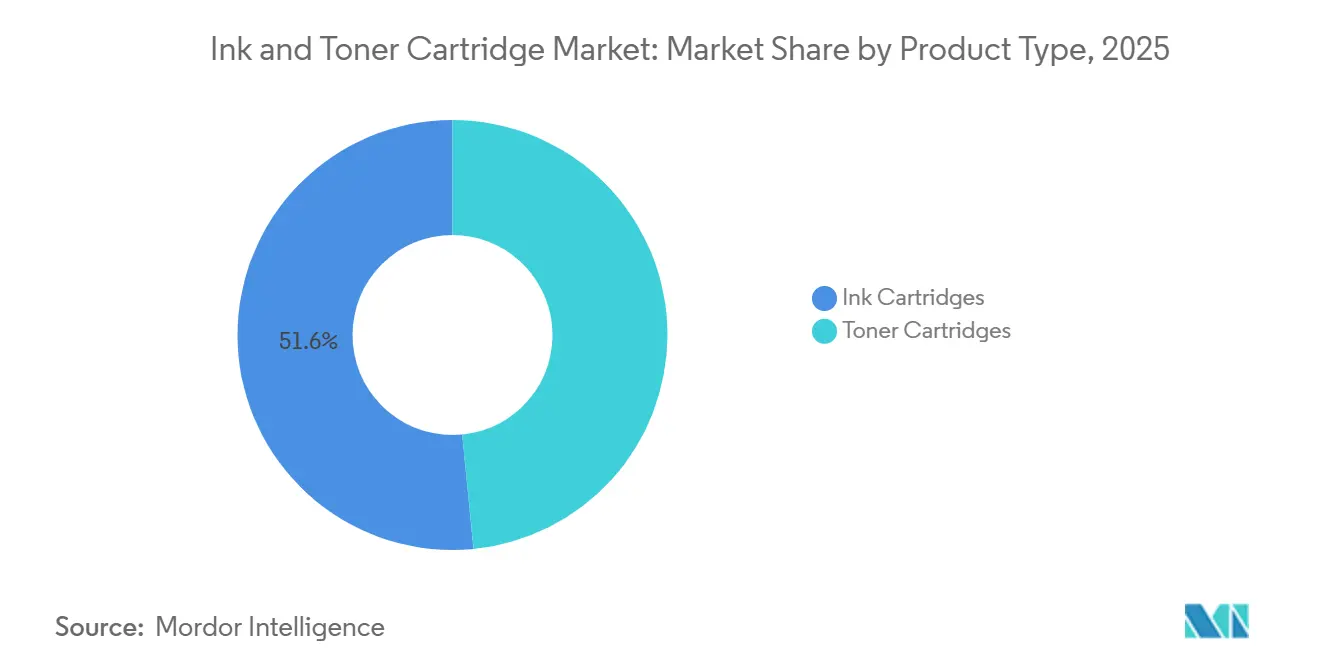
- By product type, ink cartridges held 51.56% revenue share in 2025, while toner cartridges are projected to expand at a CAGR of 6.83% through 2031.
- By cartridge type, OEM cartridges held 55.08% of the ink and toner cartridge market share in 2025, while compatible cartridges are projected to expand at a CAGR of 7.01% through 2031.
- By printer technology, inkjet printers held 54.89% revenue share in 2025, while laser printers are projected to expand at a CAGR of 6.72% through 2031.
- By ink and toner formulation, toner held 52.14% revenue share in 2025, while pigment-based ink is projected to expand at a CAGR of 7.22% through 2031.
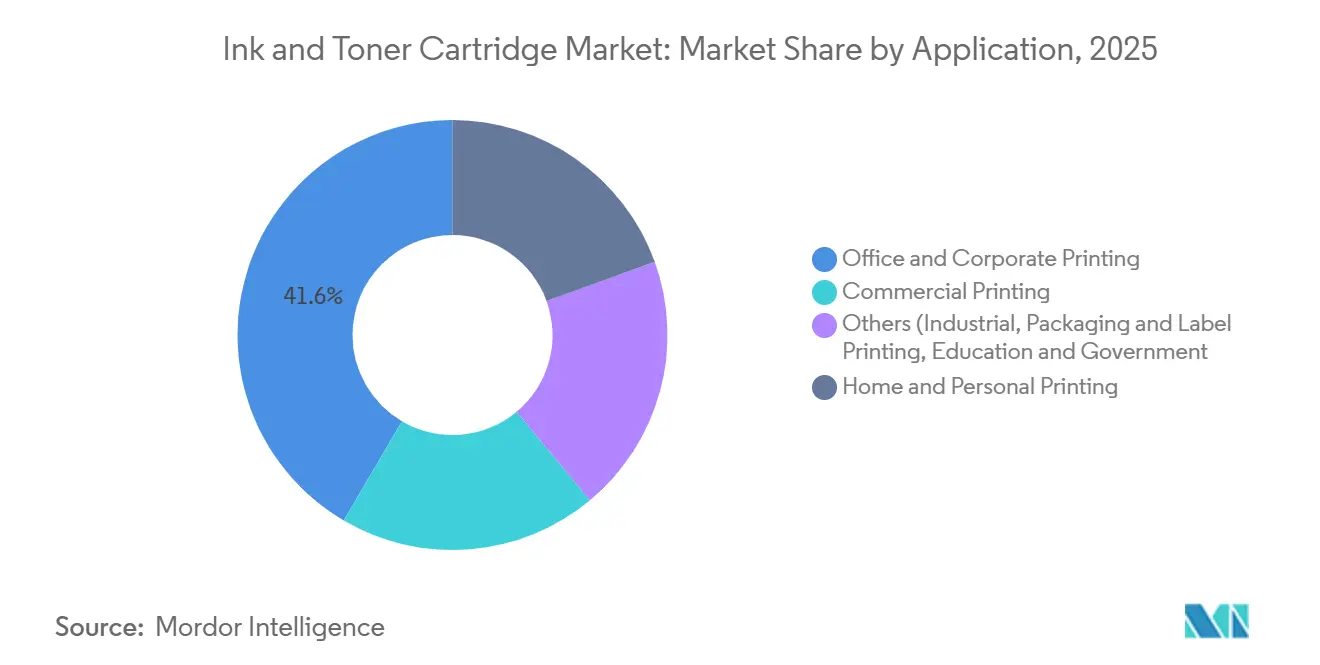
- By application, office and corporate printing held 41.57% revenue share in 2025, while commercial printing is projected to expand at a CAGR of 6.69% through 2031.
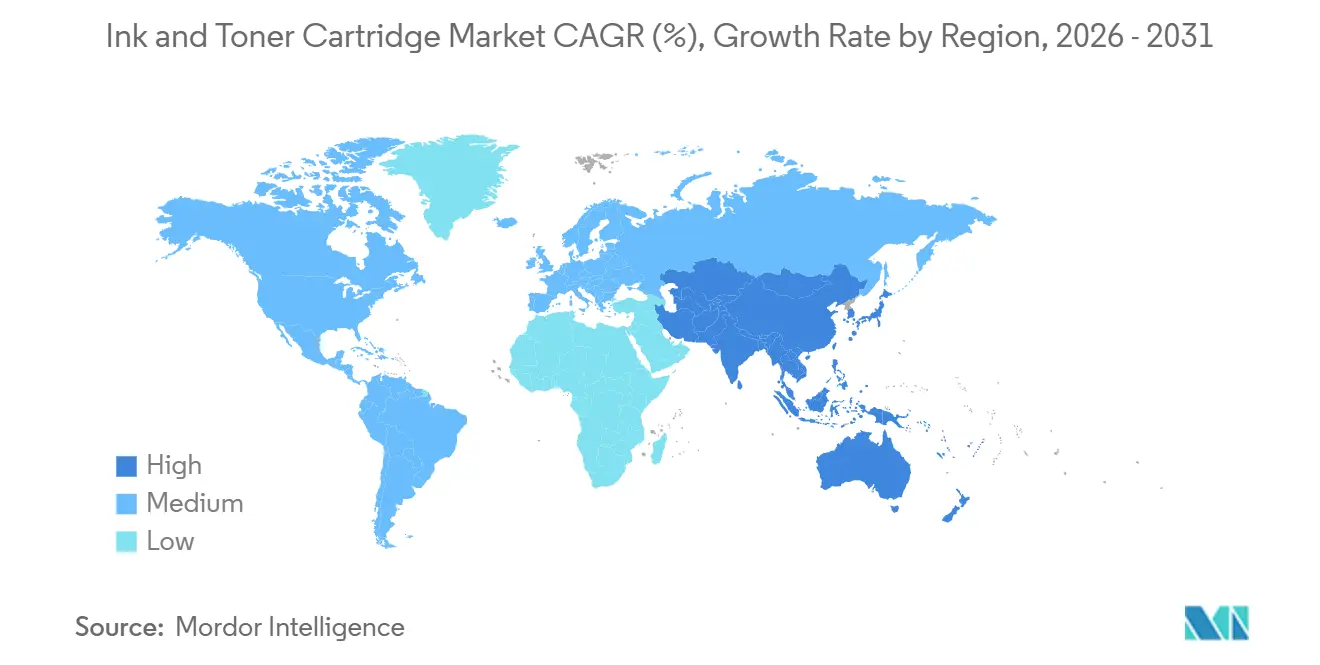
- By geography, Asia-Pacific held 42.04% of the ink and toner cartridge market share in 2025 and was projected to expand at the highest regional CAGR of 6.28% through 2031.
Note: Market size and forecast figures in this report are generated using Mordor Intelligence’s proprietary estimation framework, updated with the latest available data and insights as of January 2026.
Market Trends and Insights
Drivers Impact Analysis of Ink and Toner Cartridge Market*
| Drivers | (~) % Impact on CAGR Forecast | Geographic Relevance | Impact Timeline |
|---|---|---|---|
| Managed Print Services and Subscription Replenishment | +1.1% | Global, with the strongest penetration in North America and Western Europe, and growing adoption in the Asia-Pacific enterprises | Medium term (2-4 years) |
| E-Commerce and Digital Cartridge Discovery | +0.9% | Global, with concentrated impact in Asia-Pacific, China, India, and North America | Short term (≤ 2 years) |
| Sustainability-Led Demand for Refillable and Remanufactured Supplies | +0.9% | European Union-led, with influence extending to North America and the Asia-Pacific | Medium term (2-4 years) |
| High-Yield Consumables for Commercial and Specialized Printing | +0.7% | Global, especially commercial print centers in Asia-Pacific, North America, and Germany | Short term (≤ 2 years) |
| Verifiable Circular-Procurement Requirements | +0.5% | European Union and selected national markets, with early momentum in Germany, the Netherlands, and Belgium | Long term (≥ 4 years) |
| Source: Mordor Intelligence | |||
Managed Print Services and Subscription Replenishment: Institutionalize Recurring Demand
Managed print service contracts have shifted demand in the ink and toner cartridge market from one-time purchases to longer supply arrangements across large enterprise fleets and smaller distributed work locations. This model separates printer ownership from consumable supply, giving procurement teams a greater role in supplier selection. Cost-per-page measurements carry more weight than brand familiarity in this context. This creates an opening for compatible and remanufactured options where contracts permit them. HP expanded its All-In Plan in 2025 to include high-capacity Smart Tank tiers and an Instant Paper option. Canon also maintained its PIXMA Print Plan as a subscription route for consumer printing supplies.
E-Commerce and Digital Cartridge Discovery Restructure Channel Economics
Online sales play a larger role in how customers identify, compare, and reorder cartridges, particularly when buyers need a specific product quickly without visiting a specialist retailer. This shift makes pricing more visible and reduces reliance on traditional store distribution. It also allows smaller compatible brands to reach customers without established distributor relationships. Alibaba and JD.com operate broad online retail and procurement ecosystems that support repeat purchases and the discovery of digital sellers in China. Costco ended in-store ink sales in May 2025, reflecting the reduced role of physical retail in this category. As a result, the ink and toner cartridge market places greater value on search visibility, direct fulfillment, and straightforward reorder processes.
Sustainability-Led Demand Elevates Remanufactured and Refillable Cartridges
Sustainability requirements have strengthened the position of refillable and remanufactured supplies in the ink and toner cartridge market, particularly where procurement teams require evidence that products have been collected and processed responsibly. Brother reported certified remanufacturing activity for toner and inkjet cartridges and described carbon-neutral operations at its UK and Slovakia facilities[1]. Ricoh has identified remanufactured products and recycled materials as measures supporting its 2030 Scope 3 objectives. European rules also give public buyers a stronger basis to consider reuse and circular procurement. These conditions favor suppliers that can document collection, reuse, recycled content, and product traceability. Circular procurement requirements may become more important as public tenders place greater value on verified environmental performance.
High-Yield Consumables Shift Commercial Printing Economics
High-yield cartridges have changed purchasing patterns in commercial and specialized printing by reducing replacement frequency for users who run high-duty-cycle devices throughout the working day. Buyers with high printer use can compare supplies through page-yield tests and cost-per-page measures. ISO/IEC 24711 provides a common framework for evaluating ink cartridge yield claims. G&G launched its Dual-Eco inkjet series in April 2026, with page yields up to 150% higher than OEM equivalents for selected Epson platforms and stated savings of up to 65%. This positioning gives compatible suppliers a stronger offer for small and medium-sized businesses. The ink and toner cartridge market consequently rewards suppliers that link high yield to dependable performance and lower total printing costs.
Restraints Impact Analysis of Ink and Toner Cartridge Market*
| Restraints | (~) % Impact on CAGR Forecast | Geographic Relevance | Impact Timeline |
|---|---|---|---|
| Paperless Workflows and Declining Page Volumes | -1.4% | Global, with the greatest pressure in Japan, Western Europe, and corporate North America | Medium term (2-4 years) |
| OEM Price Premiums and Aftermarket Price Competition | -0.9% | Global, with strong effects in South America, Southeast Asia, and the small- and medium-sized enterprise segments | Short term (≤ 2 years) |
| Firmware Authentication and Smart-Chip Lockouts | -0.5% | Global, with compliance friction concentrated in the European Union | Short term (≤ 2 years) |
| Source: Mordor Intelligence | |||
Paperless Workflows Compress Office Print Volumes
Digital document management continues to structurally limit routine office printing, as many internal files can now be reviewed, signed, distributed, and retained without a physical copy. Electronic records rules in Japan have accelerated the shift toward digital storage since January 2024[2]. This pressure is most visible in general office documents that can be reviewed, approved, or stored electronically. Physical output remains necessary for contracts, identity documents, packaging labels, marketing materials, and some administrative tasks. As a result, commercial and specialized printing remains more resilient than general office printing. Participants in the ink and toner cartridge market can reduce exposure by focusing on use cases where a printed document remains part of the operating process.
OEM Price Premiums, Aftermarket Competition, and Authentication Friction
The price difference between OEM and compatible cartridges is prompting more buyers to compare supply options before replacement, particularly when product listings provide clear yield and compatibility information. HP announced price changes for selected ink and toner offerings in 2025, and Canon also communicated imaging-supplies price adjustments during 2025. Higher OEM prices can encourage price-sensitive customers to consider compatible or remanufactured supplies. Firmware authentication can limit that shift by preventing some third-party cartridges from operating in certain devices. Proposed European Ecodesign requirements for imaging equipment place attention on product design, repairability, and cartridge reuse.
*Our forecasts treat driver/restraint impacts as directional, not additive. The impact forecasts reflect baseline growth, mix effects, and variable interactions.
Ink and Toner Cartridge Market Segment Analysis
By Product Type:
Ink Cartridges Lead While Toner Cartridges Grow FasterInk cartridges accounted for 51.56% of the ink and toner cartridge market share in 2025. Their position reflects the large installed base of inkjet devices in homes and small businesses, where users require color printing for documents, forms, labels, and occasional photo output. Inkjet printers remain widely used for personal documents, color output, and photo printing. Ink-tank systems also support ongoing demand for ink, although they shift spending from cartridges toward refill bottles. Epson introduced ReadyPrint in the United States in August 2025, combining EcoTank hardware with unlimited color printing and automatic ink replacement. This approach retains consumables revenue through a service fee rather than a separate cartridge purchase.
Toner cartridges recorded the fastest growth outlook, with the ink and toner cartridge market size for this segment projected to expand at a CAGR of 6.83% through 2031. Commercial laser installations support this outcome because laser equipment offers a lower cost per page at higher print volumes, which matters for teams that regularly print invoices, reports, records, and customer materials. Enterprise procurement teams can assess those claims through standard yield testing. Toner use is also supported by corporate multifunction printers and specialized commercial print operations. The product split is shifting toward higher-quantity printing needs without displacing the broad base of inkjet demand.

By Cartridge Type:
OEM Cartridges Retain Scale as Compatible Supplies GainOEM cartridges held 55.08% of total category revenue in 2025. Their position is supported by printer authentication systems, managed print contracts, and buyers who value print-quality assurances, predictable technical support, and consistent output for internal business documents. Proprietary chips can limit third-party access to supplies in certain printer models. Subscription plans also give OEMs a recurring relationship with users after the printer purchase, reducing the need for consumers to actively compare each replacement purchase. OEM suppliers are also using recycled-content product lines to address sustainability requirements while retaining their quality and service position.
Compatible cartridges are forecast to grow at a 7.01% CAGR through 2031, the fastest rate among cartridge types. Price sensitivity, improved quality, and online availability are supporting demand among households, small businesses, and procurement teams that can compare multiple suppliers during the same purchase process. Remanufactured and refilled cartridges serve a separate need by combining reuse with a cost alternative. Their scale is constrained when cartridge design makes disassembly or chip resetting difficult. G&G stated that its global recycling program collected and recycled 17,923,003 used cartridges in 2025. The ink and toner cartridge market size for compatible supplies is driven by customers seeking lower supply costs without changing their existing printers.
By Printer Technology:
Inkjet Printers Lead While Laser Printers ExpandInkjet printers represented 54.89% of total category revenue in 2025. They retain a strong position in households, personal offices, and photo-printing settings, where compact devices, color capability, and lower initial hardware costs remain important purchase considerations. Their installed base continues to generate demand for cartridges, ink bottles, and subscription services. Ink-tank platforms have broadened the choice of refill formats for these customers. Inkjet demand is sustained by convenience, color capability, and a large existing device base.
Laser printers are expected to grow at a CAGR of 6.72% through 2031. Their appeal is strongest in corporate, commercial, and specialized printing settings that require predictable cost per page, stable output quality, and dependable performance during sustained use. The segment also benefits from greater adoption of compact A4 laser multifunction printers in emerging Asian markets. Pantum and Canon are among suppliers active in the broader laser printing category. Laser systems are particularly relevant where printer use is frequent, and document output is operationally important. The ink and toner cartridge market benefits from this shift because laser installations require regular toner replenishment, supporting demand for high-capacity supplies.
By Ink/Toner Formulation:
Toner Holds the Largest Position as Pigment-Based Ink AdvancesToner accounted for 52.14% of total revenue in 2025. Its position is linked to the installed base of laser printers in office and commercial settings, where fast output and orderly document handling are central to routine printing work. Toner supports the output speed and cost efficiency required for many high-quantity document applications. Dye-based ink continues to serve home and photo printing because it offers a wide color range and lower material cost. However, it has a more limited role in applications requiring resistance to fading or moisture. The broader formulation mix reflects the different output standards required by consumer, office, and commercial users.
Pigment-based ink is expected to grow at a CAGR of 7.22% through 2031. Commercial graphics, archival documents, wide-format work, and packaging applications drive demand for this formulation because these uses place greater emphasis on output life, color stability, and moisture resistance. G&G expanded EverBrite Art pigment ink coverage for Canon and Epson large-format desktop printers in July 2025. Japan's Ecomark criteria for toner cartridges also address reduced total volatile organic compound (TVOC) content and recycling provisions. The ink and toner cartridge industry has a higher-value opportunity in specialized formulations where physical output remains essential.
By Application:
Office and Corporate Printing Leads While Commercial Printing AcceleratesOffice and corporate printing held 41.57% of total category revenue in 2025. Enterprise laser multifunction printers and managed print contracts support this position across corporate offices, shared service centers, and locations where standardized document processes remain necessary. These contracts can maintain fleet use even as each employee's printed page count declines. Office users also require secure, reliable document output for certain administrative and legal processes. At the same time, cloud workflows, e-signatures, and digital review tools are reducing routine print activity. The segment remains large but faces more pressure than printing uses tied to physical production requirements.
Commercial printing is forecast to grow at a CAGR of 6.69% through 2031. Short-run and on-demand work is driving demand for digital printing, pigment inks, and specialty toners, particularly where customers require fast turnaround and customized physical materials. Packaging, labels, industrial uses, education, and government printing remain within the other application group. These activities often require physical output because it is built into an operating, regulatory, or customer-facing process. In 2024, Spain's Ecofimática system handled more than 1 million cartridges, totaling 659,229 kg through organized take-back activities. The ink and toner cartridge market is more resilient in applications where printed materials cannot be fully replaced by digital alternatives.
Geography Analysis
APAC Ink and Toner Cartridge Market
Asia-Pacific held 42.04% of total category revenue in 2025 and is projected to grow at a CAGR of 6.28% through 2031. The region combines an expanding commercial printing base with growing printer use in homes and small offices, generating demand for entry-level printers, business equipment, and compatible replacement supplies. China serves as both a major cartridge production center and an important consumer market. Alibaba and JD.com operate large digital commerce platforms that support online discovery and repeat purchasing. India benefits from rising disposable incomes, expanding small-business activity, and wider access to e-commerce. Japan faces greater pressure from electronic recordkeeping and corporate digitization, though the ink and toner cartridge market retains demand for specialized, legal, and commercial printing needs.
North America Ink and Toner Cartridge Market
North America is the second-largest regional market, supported by a substantial base of enterprise laser printers and established managed print services, which provide suppliers with predictable contracted replenishment quantities. The United States is shifting further toward direct, subscription, and online replenishment models. Costco's withdrawal from in-store ink sales in 2025 reflected the declining role of physical retail in this product category. In March 2026, HP announced the consolidation of its Boise, Idaho, site, with a planned exit by the end of fiscal year 2027. Canada broadly mirrors the United States in managed print adoption, while Mexico offers manufacturing advantages in regional supply strategies. Xerox identified its Mexico manufacturing facility in supply chain planning following its acquisition of Lexmark.
EMEA and South America Ink and Toner Cartridge Market
Europe has mature printing demand and some of the strictest compliance requirements for cartridge supply chains, affecting product design, collection arrangements, chemical information, and evidence of reuse. European Union Waste Electrical and Electronic Equipment (WEEE) policy, circular-economy planning, and chemical labeling rules increase the value of verified reuse and traceability. South America, the Middle-East, and Africa remain smaller but relevant geographies for the ink and toner cartridge market. Brazil and Argentina are supported by demand from retail, financial services, and government documentation. Saudi Arabia and South Africa represent important demand bases within the Middle-East and Africa. Lower digital substitution in several public-sector and small-business settings supports continued use of affordable cartridges across these regions.
Competitive Landscape
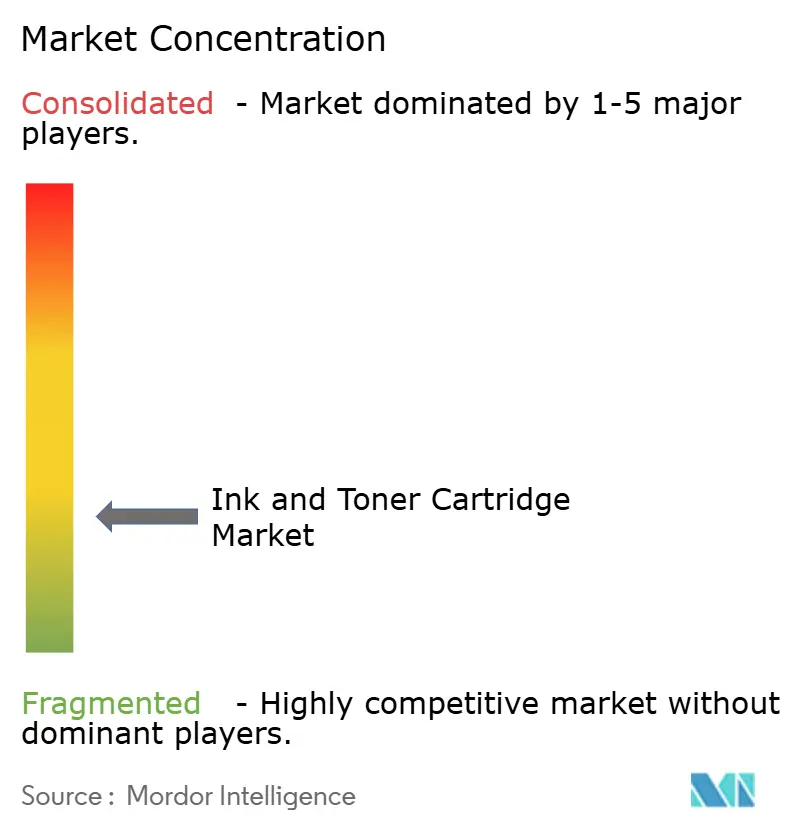
The ink and toner cartridge market is fragmented among Original Equipment Manufacturer (OEM) suppliers, while the aftermarket includes numerous compatible cartridge manufacturers, remanufacturers, and chip suppliers serving different countries and price points. HP, Canon, Epson, and Brother rely on subscriptions, product quality commitments, and device-linked supply programs to defend their market positions. HP's All-In Plan shifts the customer relationship toward a service model covering hardware and consumables. Canon's PIXMA Print Plan similarly offers a subscription model for eligible printer users. OEMs also use authentication systems to control access to proprietary cartridge ecosystems. This approach can protect supply revenue but may also drive buyer interest in alternative options where compatible products remain accessible.
Xerox completed its USD 1.5 billion acquisition of Lexmark International in July 2025. The transaction expanded Xerox's presence across print categories, A4 devices, and Asia-Pacific operations, while adding an established manufacturer with a broad enterprise customer base and distribution network. Pantum Technology, formerly Ninestar Corporation, is directing resources toward semiconductors, consumables, and China's secure-printing market following its Lexmark divestment. This strengthens its role in the compatible supply ecosystem, including through chip-related capabilities. The ink and toner cartridge market also presents opportunities for subscription infrastructure that compatible brands can use without owning printer hardware. Certified remanufacturing networks hold similar potential in markets where circular procurement rules are still developing.
Sustainability has become part of competitive positioning in enterprise procurement, where customers increasingly evaluate suppliers on collection programs, recycled materials, repairability, and documented environmental management. Brother's remanufacturing program illustrates how an OEM can combine cartridge reuse with formal environmental operations. Ricoh has incorporated remanufactured products and recycled materials into its approach to reducing relevant Scope 3 emissions by 2030. G&G has also used recycling initiatives to differentiate its compatible supply offering. These actions indicate that environmental documentation is becoming a relevant factor alongside price, page yield, and print quality.
Ink and Toner Cartridge Industry Leaders
-
HP Inc.
-
Canon Inc.
-
Seiko Epson Corporation
-
Brother Industries, Ltd.
-
Xerox Corporation
- *Disclaimer: Major Players sorted in no particular order
Ink and Toner Cartridge Market Companies Covered in this Report
- Brother Industries, Ltd.
- Canon Inc.
- Fujifilm Business Innovation Co., Ltd.
- HP Inc.
- Konica Minolta, Inc.
- Kyocera Corporation
- Lexmark International, Inc.
- Ninestar Corporation
- OKI Electric Industry Co., Ltd.
- Pantum International Limited
- Ricoh Company, Ltd.
- Seiko Epson Corporation
- Sharp Corporation
- Toshiba Tec Corporation
- Xerox Corporation
Recent Industry Developments in Ink and Toner Cartridge Market
- April 2026: G&G launched its Dual-Eco inkjet series targeting small and medium enterprise (SME) customers. The series delivers page yields 130%–150% higher than OEM equivalents for Canon MAXIFY and Epson WorkForce Pro printers, with cost savings of up to 65% compared to original cartridges. The range was rolled out across EMEA and Asia-Pacific simultaneously, reflecting G&G's expansion of its value-positioned compatible product tier.
- January 2026: Brother Industries launched four new A4 color laser printers and multifunction printers (MFPs) designed around a seven-year product durability lifecycle with ultra-high-capacity toner cartridges. The company simultaneously launched five A3 business inkjet MFPs featuring MAXIDRIVE technology. Both launches were positioned around total cost of ownership rather than hardware price, signaling to enterprise procurement that durability and cartridge longevity are core product features.
Global Ink and Toner Cartridge Market Report Scope
Ink and toner cartridges are printing supplies that differ in their core function: ink cartridges use liquid ink for inkjet printers to print photos and graphics, while toner cartridges use a fine plastic powder for laser printers to produce sharp text documents quickly and efficiently.
The ink and toner cartridge market is segmented by product type, cartridge type, printer technology, ink/toner formulation, application, and geography. By product type, the market is segmented into ink cartridges and toner cartridges. By cartridge type, the market is segmented into OEM cartridges, compatible cartridges, remanufactured and refilled cartridges, and others (refillable ink-tank bottles, specialty and photo cartridges). By printer technology, the market is segmented into inkjet printers and laser printers. By ink/toner formulation, the market is segmented into dye-based ink, pigment-based ink, toner, and others (UV-curable ink, solvent-based ink, sublimation ink, specialty toners). By application, the market is segmented into home and personal printing, office and corporate printing, commercial printing, and others (industrial, packaging and label printing, education and government printing). The report also covers market size and forecasts for ink and toner cartridges across 16 countries in major regions. The market sizes and forecasts are provided in terms of value (USD).
Segmentation Overview
| Ink Cartridges |
| Toner Cartridges |
| OEM Cartridges |
| Compatible Cartridges |
| Remanufactured and Refilled Cartridges |
| Others (Refillable Ink-Tank Bottles, Specialty and Photo Cartridges) |
| Inkjet Printers |
| Laser Printers |
| Dye-Based Ink |
| Pigment-Based Ink |
| Toner |
| Others (UV-Curable Ink, Solvent-Based Ink, Sublimation Ink, Specialty Toners) |
| Home and Personal Printing |
| Office and Corporate Printing |
| Commercial Printing |
| Others (Industrial, Packaging and Label Printing, Education and Government Printing) |
| Asia-Pacific | China |
| India | |
| Japan | |
| South Korea | |
| Rest of Asia-Pacific | |
| North America | United States |
| Canada | |
| Mexico | |
| Europe | Germany |
| United Kingdom | |
| France | |
| Italy | |
| Rest of Europe | |
| South America | Brazil |
| Argentina | |
| Rest of South America | |
| Middle-East and Africa | Saudi Arabia |
| South Africa | |
| Rest of Middle-East and Africa |
| By Product Type | Ink Cartridges | |
| Toner Cartridges | ||
| By Cartridge Type | OEM Cartridges | |
| Compatible Cartridges | ||
| Remanufactured and Refilled Cartridges | ||
| Others (Refillable Ink-Tank Bottles, Specialty and Photo Cartridges) | ||
| By Printer Technology | Inkjet Printers | |
| Laser Printers | ||
| By Ink/Toner Formulation | Dye-Based Ink | |
| Pigment-Based Ink | ||
| Toner | ||
| Others (UV-Curable Ink, Solvent-Based Ink, Sublimation Ink, Specialty Toners) | ||
| By Application | Home and Personal Printing | |
| Office and Corporate Printing | ||
| Commercial Printing | ||
| Others (Industrial, Packaging and Label Printing, Education and Government Printing) | ||
| By Geography | Asia-Pacific | China |
| India | ||
| Japan | ||
| South Korea | ||
| Rest of Asia-Pacific | ||
| North America | United States | |
| Canada | ||
| Mexico | ||
| Europe | Germany | |
| United Kingdom | ||
| France | ||
| Italy | ||
| Rest of Europe | ||
| South America | Brazil | |
| Argentina | ||
| Rest of South America | ||
| Middle-East and Africa | Saudi Arabia | |
| South Africa | ||
| Rest of Middle-East and Africa | ||
Key Questions Answered in the Report
What is current market size of Ink and Toner Cartridge Market?
The ink and toner cartridge market size was valued at USD 21.63 billion in 2025 and estimated to grow from USD 22.94 billion in 2026 to reach USD 30.42 billion by 2031, at a CAGR of 5.81% during the forecast period (2026-2031).
Which cartridge product is growing fastest?
Within the ink and toner cartridge market, toner cartridges are projected to grow at a CAGR of 6.83% through 2031, supported by demand for commercial laser printing.
Why are compatible cartridges gaining adoption?
In the ink and toner cartridge market, compatible cartridges are projected to grow at a 7.01% CAGR as buyers seek lower costs, wider online availability, and improved product quality.
Which printer technology has the strongest growth outlook?
For the ink and toner cartridge market, laser printers are projected to grow at a CAGR of 6.72% through 2031, aided by commercial and corporate printing requirements.