
Size and Share of Injector Springs Market For Hydrogen Engine
Market Overview
| Study Period | 2021 - 2031 |
|---|---|
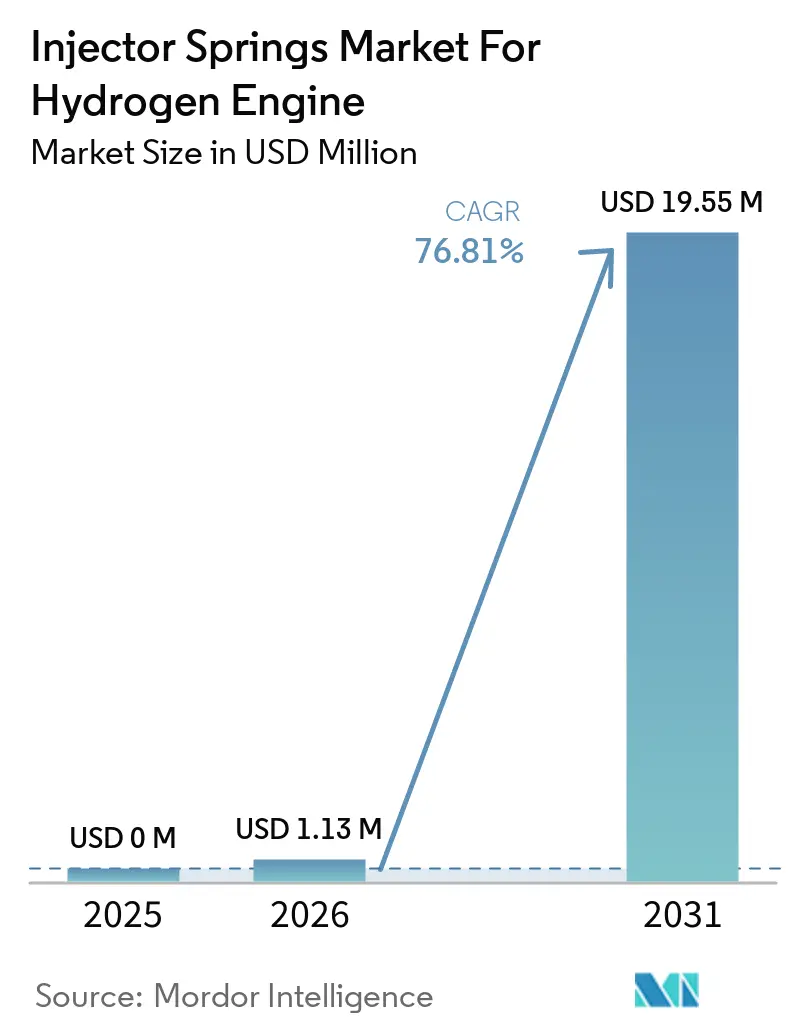
| Market Size (2026) | USD 1.13 Million |
| Market Size (2031) | USD 19.55 Million |
| Growth Rate (2026 - 2031) | 76.81 % |
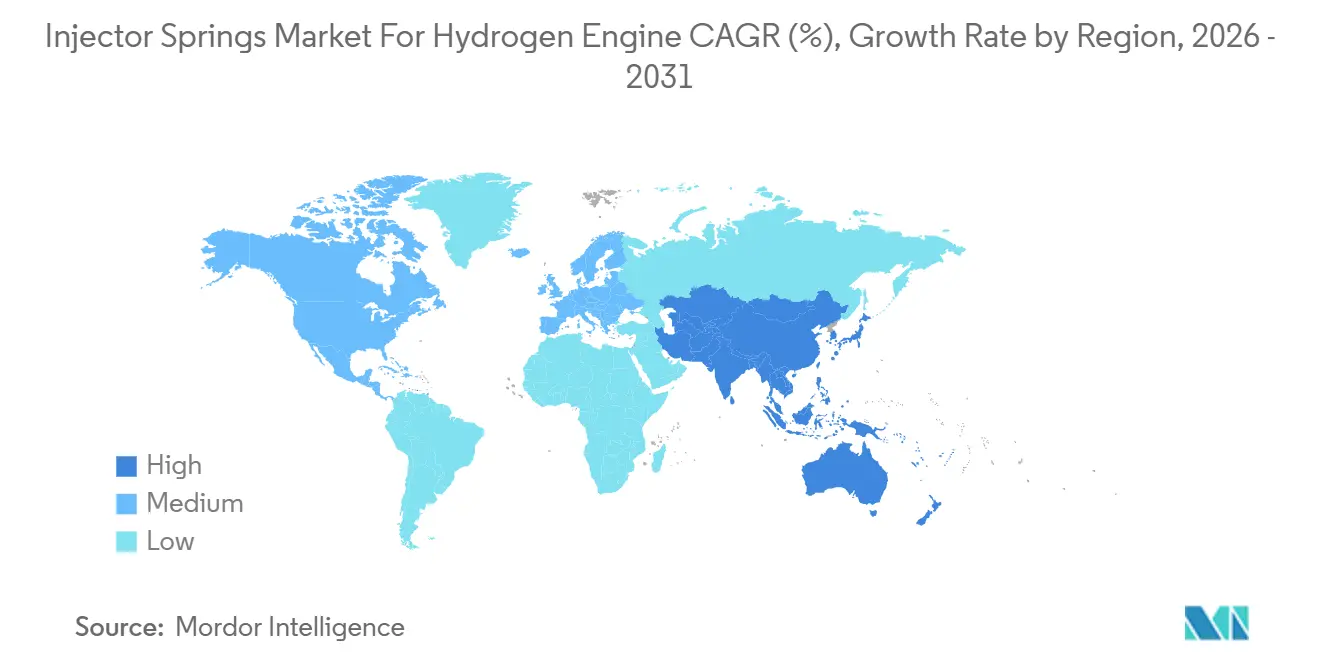
| Fastest Growing Market | Asia-Pacific |
| Largest Market | Asia-Pacific |
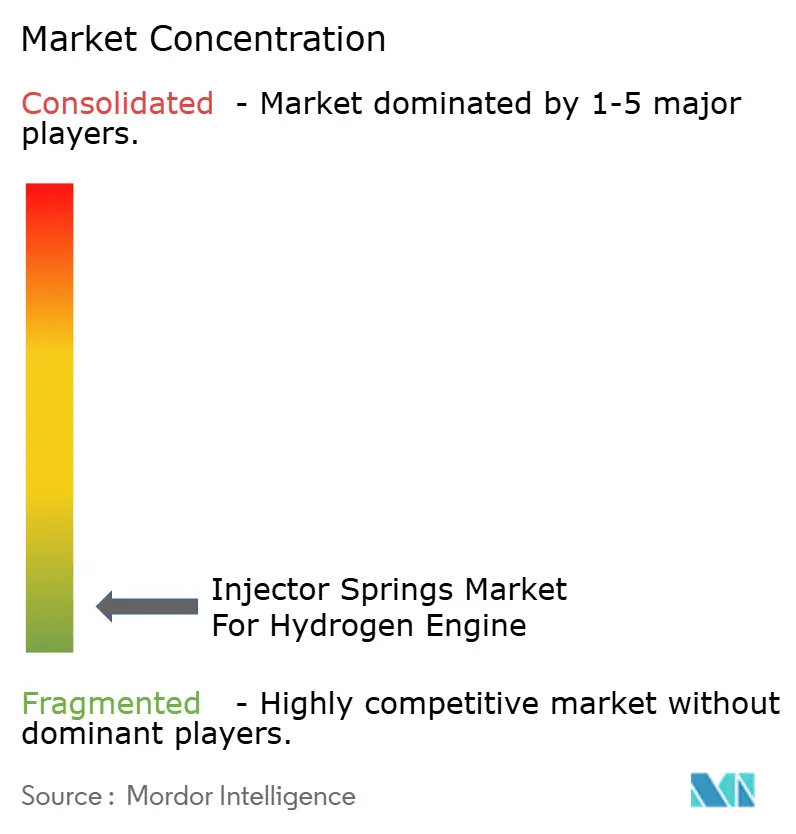
| Market Concentration | Low |
Major Players *Disclaimer: Major Players sorted in no particular order Image © Mordor Intelligence. Reuse requires attribution under CC BY 4.0. | |
Analysis of Injector Springs Market For Hydrogen Engine by Mordor Intelligence
The Injector Springs Market For Hydrogen Engine Industry size is projected to be USD 1.13 million in 2026, and reach USD 19.55 million by 2031, growing at a CAGR of 76.81% from 2026 to 2031. The 2025 base was effectively zero because hydrogen internal-combustion engine fleets remained at a pre-commercial stage. Demonstration programs are now moving into daily logistics use, which creates demand for injector springs that meet rigorous durability requirements. Hydrogen direct injection places more pressure on spring materials, coatings, and dimensional control than conventional fuel-injection applications. Existing diesel engine platforms can shorten the route to hydrogen powertrains because manufacturers can retain established production assets and supplier relationships. The hydrogen engine injector springs market, therefore, depends on qualification activity before repeat replacement demand becomes material.
Key Report Takeaways
- By type, multi-layer springs are expected to grow at an 89.7% CAGR through 2031.
- By material, nickel alloys are expected to grow at an 88.3% CAGR through 2031.
- By coating or surface treatment, nitriding and nitrocarburizing are expected to grow at an 78.5% CAGR through 2031.
- By application, stationary hydrogen power systems are expected to grow at an 90.3% CAGR through 2031.
- By end user, automotive OEMs are expected to grow at an 75.1% CAGR through 2031.
- By geography, the Asia-Pacific is expected to grow at an 99.2% CAGR through 2031.
Note: Market size and forecast figures in this report are generated using Mordor Intelligence’s proprietary estimation framework, updated with the latest available data and insights as of January 2026.
Market Trends and Insights
Drivers Impact Analysis of Injector Springs Market For Hydrogen Engine*
| Driver | % Impact on CAGR Forecast | Geographic Relevance | Impact Timeline |
|---|---|---|---|
| Expansion of Hydrogen Internal-Combustion Engines in Heavy-Duty and Off-Highway Fleets | +18.50% | Global, with early gains in Europe, Japan, and China | Short term (≤ 2 years) |
| High-Pressure Direct Injection Increasing Injector Spring Duty Cycles | +14.20% | Global | Short term (≤ 2 years) |
| Hydrogen-Compatible Spring Materials and Coatings Improving Injector Service Life | +12.80% | Europe, Japan, APAC core | Medium term (2-4 years) |
| Reuse of Established Engine Manufacturing Capacity for Hydrogen Powertrains | +10.10% | Europe, Japan, North America | Medium term (2-4 years) |
| Hydrogen Engine Demonstration Fleets Converting Prototype Demand Into Qualification Orders | +8.60% | Germany, Japan, China, India | Short term (≤ 2 years) |
| Localization Mandates Accelerating Precision Spring Manufacturing in Asia | +9.30% | APAC core, spill-over to India and South Korea | Medium term (2-4 years) |
| Source: Mordor Intelligence | |||
Expansion of Hydrogen Combustion Fleets and Qualification Orders
The hydrogen engine injector springs market is supported by the transition from funded demonstrations to daily commercial operations. IAV and DEUTZ placed 2 road-approved 18-ton trucks into logistics work at DEUTZ and BMW facilities in March 2026[1]. Southwest Research Institute completed development of a spark-ignited, medium-duty hydrogen engine with diesel-equivalent torque in August 2026[2]. These developments place injector components within active vehicle development programs. Spring suppliers must enter qualification programs before fleet deployment reaches scale. Injector durability validation can require 12 to 18 months before series procurement. The hydrogen engine injector springs market can therefore receive qualification orders before fleets create a meaningful replacement cycle.
High-Pressure Direct Injection Raises Injector Spring Duty
Hydrogen direct-injection systems operate at 30 to 200 bar, depending on the injection strategy. Higher pressure can improve combustion control, but it also increases the mechanical demands placed on the injector return spring. A 2025 study of cam-driven outward-opening hydrogen injectors found that stiffness of 160 to 200 N/mm and preload of 560 to 600 N govern valve-lift behavior[3]. The study attributed 5.4% of injection quantity variation to spring stiffness and 30% to preload force. In the hydrogen engine injector springs market, tolerance control becomes part of fuel-metering performance rather than a secondary component attribute. Higher rail pressures also raise the importance of material purity, surface treatment, and fatigue validation.
Hydrogen-Compatible Materials and Production Reuse Improve Readiness
The hydrogen engine injector springs market benefits from materials work that addresses hydrogen exposure and from the reuse of established engine manufacturing assets. A 2025 study found that a nitrided layer on AISI 4140 steel can reduce the harmful response of the material to hydrogen embrittlement. A separate 2025 comparison found that QPQ nitrocarburizing improved corrosion resistance by 42.3%, compared with 13.4% for gas nitriding. These treatments can support longer spring life under demanding service conditions. Platform conversion also gives suppliers a shorter path into hydrogen programs. Daimler Truck’s HICE.40 uses the Mercedes-Benz Actros L platform, and Volvo’s hydrogen combustion program is based on its heavy-truck engineering base.
Asian Localization Broadens the Supply Base
Asia-Pacific activity adds another source of demand for the hydrogen engine injector springs market. Japan’s hydrogen programs support domestic development of hydrogen hardware and marine engine systems. A consortium including Kawasaki Heavy Industries, Yanmar Power Solutions, and Japan Engine Corporation achieved land-based operation of a marine hydrogen engine in 2025. China’s heavy-truck policy framework supports the deployment of new-energy vehicles, including a target for 40% new-energy heavy-truck penetration by 2030. Local production requirements can encourage regional component qualification. Indian hydrogen-engine pilots also give local manufacturers a route to develop production capability. The resulting supply base may add local alternatives to incumbent European and Japanese spring producers.
Restraints Impact Analysis of Injector Springs Market For Hydrogen Engine*
| Restraint | % Impact on CAGR Forecast | Geographic Relevance | Impact Timeline |
|---|---|---|---|
| Limited Commercial Volume of Hydrogen Engines and Replacement Injectors | -4.50% | Global | Short term (≤ 2 years) |
| Hydrogen-Induced Embrittlement and Premature Fracture in High-Strength Spring Steels | -3.20% | Global | Medium term (2-4 years) |
| Dry Hydrogen, Galling, and Poor Internal Lubricity Increasing Failure Risk | -2.80% | Global | Medium term (2-4 years) |
| High Validation Cost for Multi-Billion-Cycle Injector Durability | -2.10% | Global | Long term (≥ 4 years) |
| Source: Mordor Intelligence | |||
Limited Commercial Engine Volume Delays Replacement Demand
The hydrogen engine injector springs market begins from an effectively zero 2025 base, which makes its forecast sensitive to fleet deployment schedules. Most near-term demand comes from prototypes and qualification orders instead of replacement components. Hydrogen truck programs are beginning to enter road use, but broad fleet adoption is still developing. IAV and DEUTZ’s March 2026 delivery shows that hydrogen combustion trucks have entered daily logistics service in Germany. Volvo plans a commercial European launch for its hydrogen combustion trucks before 2030. Replacement demand will lag original equipment demand because injectors must complete long service intervals before being replaced. Fleet fuel costs and refueling availability can also determine whether prototype activity becomes recurring component volume.
Hydrogen Exposure and Validation Costs Limit Qualification Speed
Hydrogen-induced embrittlement is a central technical restraint for the hydrogen engine injector springs market. A 2025 study found grain-boundary cracking and intragranular voids in Inconel 718 after hydrogen flame charging. The same work showed that flame-charging effects can differ from results obtained through electrochemical charging. Research on nickel and nickel-chromium alloys also found that chromium additions can increase intergranular fracture susceptibility through changes in dislocation behavior. Dry hydrogen can increase galling and reduce the benefit of conventional lubricant films. Suppliers must also validate springs over very long actuation lives, which raises development cost and slows approval. These constraints favor suppliers that can provide material data and platform-specific durability evidence.
*Our forecasts treat driver/restraint impacts as directional, not additive. The impact forecasts reflect baseline growth, mix effects, and variable interactions.
Injector Springs Market For Hydrogen Engine Segment Analysis
By Type:
Multi-layer Springs Increase Precision Within Tight Injector PackagesMulti-layer springs record the fastest growth within the type segment at an 89.7% CAGR through 2031. Their ability to provide tunable stiffness within a limited axial space suits outward-opening hydrogen injectors. The hydrogen engine injector springs market requires designs that counter needle lift against rail pressure and back pressure. The 2025 injector study showed that stiffness and preload together influence injection quantity variation. This relationship makes repeatable geometry and force control important selection criteria. Multi-layer designs can address the packaging limits of advanced injector bodies. They also give manufacturers a route to tailor force response without enlarging the injector package.
Coil springs remain the conventional choice for port-injection systems and lower-duty hydrogen applications. They can retain relevance where rail pressures remain within validated diesel-derived limits. Belleville and disc springs serve different roles, including sealing and preload within injector body assemblies. Disc springs are also used in electrolyzers and stationary fuel-cell stack assemblies because they combine compact dimensions with high stiffness[4]. The hydrogen engine injector springs industry can draw on this wider hydrogen equipment experience as suppliers serve several related applications. Type selection will remain linked to injection pressure, available space, and the required actuation life.
By Material:
Nickel Alloys Set a Higher Hydrogen-Service StandardNickel alloys are the fastest-growing material segment at an 88.3% CAGR through 2031. The hydrogen engine injector springs market size for nickel-alloy applications is expanding because high-pressure direct injection places material reliability ahead of conventional cost priorities. Standard spring steels can face embrittlement risk when sustained stress and hydrogen partial pressure occur together. Inconel 718 showed hydrogen-related cracking and void formation under flame charging in 2025 testing. This evidence shows why tensile strength and corrosion resistance alone cannot establish fitness for hydrogen injector use. Material choice must reflect hydrogen diffusion, cyclic loading, and real operating conditions. Nickel-alloy specifications can therefore become a necessary qualification requirement for demanding injector programs.
Stainless steel retains a role in lower-stress configurations and port-injection designs. Its suitability declines as stress and hydrogen exposure rise within the injector. Precipitation-hardening steels can provide a middle ground for elevated-temperature spring duties where a different balance of performance and cost is needed. Advanced composites and hybrid materials remain early-stage options for nonmagnetic or weight-sensitive applications. Greater field history will be needed before these alternatives can support critical dynamic injector functions. Certification to spring-material standards can raise the entry threshold for suppliers that currently serve conventional fuel systems. The strongest material programs will combine laboratory evidence with component-level durability testing.
By Coating or Surface Treatment:
Nitriding Addresses Hydrogen Ingress and WearNitriding and nitrocarburizing record the fastest coating-segment growth at a 78.5% CAGR through 2031. The hydrogen engine injector springs market benefits when the treated surface slows hydrogen ingress into the spring substrate. Nitrided layers contain iron nitride phases that can improve surface hardness while limiting hydrogen permeability. In 2025 testing, QPQ nitrocarburizing achieved a 42.3% improvement in corrosion resistance compared with untreated steel. Standard gas nitriding delivered a 13.4% improvement in the same comparison. These results support the use of surface treatment as a functional part of spring design rather than a finishing step.
PVD and CVD hard coatings can address friction and galling where hydrogen reduces conventional boundary lubrication. Diamond-like carbon and titanium nitride are relevant examples for high-wear contact points. Ceramic and DLC coatings can provide strong tribological performance, but their cost can limit use in high-volume applications. Shot peening and residual-stress treatments can delay crack initiation under cyclic loading. The hydrogen engine injector springs market will often use these mechanical treatments alongside chemical surface layers rather than as a substitute. Coating decisions need to account for hydrogen resistance, spring force stability, and manufacturing cost. Suppliers that can validate the complete material and coating combination can reduce uncertainty for OEM engineering teams.
By Application:
Stationary Systems Lead Growth While On-road Engines Set VolumeStationary hydrogen power systems are the fastest-growing application at a 90.3% CAGR through 2031. This part of the hydrogen engine injector springs market can advance quickly because stationary systems often have shorter certification routes than on-road vehicles. Honda began a stationary fuel-cell power-station demonstration using by-product hydrogen at a Shunan City data center in August 2025. Toyota Hydrogen Solutions received ANSI/CSA FC 1 and FC 6 certifications for commercial fuel-cell units that can support 1 MW stationary generator integration in April 2026. Stationary platforms require hydrogen metering components and may bring purchasing programs forward. They also provide a practical setting for component durability experience before large vehicle fleets reach maturity.
On-road hydrogen engines represent the largest addressable volume over a 3 to 5 year horizon. China’s policy plan targets 40% new-energy penetration in heavy trucks by 2030 and provides a large policy setting for commercial vehicle transition. Component suppliers can benefit if hydrogen combustion engines form part of that transition. Off-road engines in mining, construction, and agriculture are also relevant because they operate under heavy duty cycles. Their procurement timing may be faster than on-road platforms where type approval adds more steps. Each application requires a different balance of injector pressure, service interval, and certification evidence. This segmentation means no single application will define all component specifications.
By End User:
Automotive OEMs Control the Qualification PathAutomotive OEMs are the fastest-growing end-user segment at a 75.1% CAGR through 2031. The hydrogen engine injector springs market is shaped by OEM durability requirements because their injector specifications define the approval path for component suppliers. These specifications can require long actuation testing at operating temperature and pressure. OEM decisions influence material grade, coating, dimensional tolerance, and traceability requirements. Toyota’s hydrogen work continues to support several powertrain pathways, including hydrogen combustion and fuel-cell systems. This creates separate development needs across platforms with different injection architectures. Suppliers that align early with OEM validation plans can gain a stronger position in the hydrogen engine injector springs market.
Heavy-duty engine manufacturers offer another route into component procurement. A qualification on one engine architecture can create supply opportunities across several vehicle brands that use that engine. Industrial engine OEMs and hydrogen power-system integrators add demand from stationary power applications. Their purchasing cycles can be shorter than automotive approval programs, but they still require evidence of stable performance. Suppliers must therefore manage several distinct customer groups rather than rely only on vehicle manufacturers. Each group evaluates durability, cost, and production readiness differently. A balanced customer base can reduce dependence on the timing of a single vehicle platform launch.
Geography Analysis
North America Injector Springs Market for Hydrogen Engine
North America is an important research base for the hydrogen engine injector springs market. Southwest Research Institute completed a medium-duty spark-ignited hydrogen engine with diesel-equivalent torque in August 2026. The program validates the technical path for hydrogen combustion in U.S. commercial vehicles. Toyota Hydrogen Solutions also achieved fuel-cell certifications for commercial stationary units that can support 1 MW generators in April 2026. Canada and Mexico can participate through supply-chain links with U.S. engine and spring producers. Near-term component orders will depend on the conversion of development programs into fleet deployment.
Europe Injector Springs Market for Hydrogen Engine
Europe is the most active regulatory setting for the hydrogen engine injector springs market. Euro 7 applies to new heavy-duty vehicle models from May 2028 and establishes extended lifetime emissions performance requirements. IAV and DEUTZ began daily logistics work with hydrogen trucks in Germany during March 2026. Daimler Truck and KEYOU target a 2027 European launch for the HICE.40. Volvo Trucks has begun road testing and plans commercial availability before 2030. The region gives suppliers a clear but demanding route from demonstration vehicles to platform approval.
APAC, South America and MEA Injector Springs Market for Hydrogen Engine
Asia-Pacific records the fastest regional growth at a 99.2% CAGR through 2031. Japan’s hydrogen programs support hardware development across transport and marine uses. The 2025 land-based marine hydrogen-engine operation brought together Kawasaki Heavy Industries, Yanmar Power Solutions, and Japan Engine Corporation. China’s policy goal of 40% new-energy heavy-truck penetration by 2030 broadens the addressable environment for component suppliers. India’s hydrogen localization effort can create opportunities for domestic engine and precision-component production. South America and the Middle East and Africa remain early-stage markets within the forecast period. Their long-term potential is tied to hydrogen infrastructure and commercial-vehicle deployment.
Competitive Landscape
The hydrogen engine injector springs market is fragmented and remains at an early stage of competitive formation. No supplier has a documented dominant position in hydrogen-specific injector-spring qualification as of mid-2026. Competition includes large multi-product manufacturers with automotive OEM relationships, specialty producers with alloy and coating knowledge, and smaller precision-spring firms serving prototype programs. NHK Spring and SCHERDEL have established automotive approval relationships that may be useful as hydrogen platforms move forward. Mubea has shown interest in hydrogen-related spring applications across energy and mobility settings. The supplier group also includes MW Components, RPK S. Coop, and Microspring Products. The absence of a clear leader leaves room for qualification wins to shape positions through at least 2028.
Materials and coating capability matter more than production scale in the hydrogen engine injector springs market. Suppliers must demonstrate resistance to hydrogen embrittlement under customer-specific validation procedures. The 2025 evidence on Inconel 718 and nickel-chromium alloys shows why general material claims cannot replace dedicated test work. A High-pressure injection also makes spring force and preload central to injection accuracy. This favors firms that can combine material selection, coating development, precision forming, and durability testing. It also gives mid-sized specialists an opening where they can provide evidence that a larger general-purpose producer cannot.
Specific company actions show how this capability race is developing. Volvo Trucks began on-road tests of heavy hydrogen combustion trucks using high-pressure direct injection in March 2026. Daimler Truck and KEYOU signed an agreement to bring the Actros L-based HICE.40 to Europe from 2027. IAV and DEUTZ moved their HyCET vehicles into daily logistics operations in Germany. These actions bring component qualification needs closer to production programs. Asia-Pacific localization can also introduce domestic suppliers as alternatives to European and Japanese incumbents.
Leaders of Injector Springs Market For Hydrogen Engine
-
NHK Spring Co., Ltd.
-
RPK, S. Coop.
-
Mubea
-
Microspring Products
-
MW Components
- *Disclaimer: Major Players sorted in no particular order
Injector Springs Market For Hydrogen Engine Companies Covered in this Report
- Barnes Group Inc.
- Lee Spring
- Microspring Products
- Mubea
- MW Components
- NHK Spring Co., Ltd.
- RPK, S. Coop.
- SCHERDEL GmbH
Recent Industry Developments in Injector Springs Market For Hydrogen Engine
- August 2026: Southwest Research Institute successfully completed development of a multi-cylinder, diesel-torque-equivalent spark-ignited hydrogen ICE for medium-duty commercial vehicles, concluding a multi-year program with a commercial OEM client and selected Tier-1 suppliers. The engine demonstrated near-zero tailpipe CO2 and sufficient torque to compete with diesel-fueled truck platforms.
- June 2026: Hitachi Energy launched HyFlex Compact, a hybrid hydrogen fuel cell and battery generator providing zero-emission off-grid electricity for construction and critical infrastructure, combining PEM fuel cells with integrated lithium-ion batteries in a portable enclosure.
- April 2026: Toyota Hydrogen Solutions earned ANSI/CSA FC 1 and FC 6 certification for its commercial fuel cell units, enabling integration into 1 MW stationary generator applications through a collaboration with Rehlko.
- March 2026: IAV and DEUTZ delivered 2 road-approved, 18-ton hydrogen combustion trucks for daily logistics duty at DEUTZ and BMW facilities, under the HyCET project funded by Germany's Federal Ministry for Transport. The trucks are based on the Daimler Econic platform with DEUTZ hydrogen engines.
Scope of Report on Injector Springs Market For Hydrogen Engine
The injector springs market for hydrogen engines covers precision-engineered springs used within hydrogen fuel injectors. These springs control the movement, closing, opening, and sealing of the injector valve or needle in hydrogen internal combustion engines (H₂-ICEs). They provide the mechanical force required to keep the injector closed when not energized and enable accurate, repeatable fuel injection when activated by the engine control system.
The Injector Springs for Hydrogen Engine Market is segmented by type, material, coating/surface treatment, application, end-user, and geography. By type, the market is segmented into coil springs, Belleville/disc springs, and multi-layer springs. By material, the market is segmented into stainless steel, nickel alloys, precipitation hardening steels, and advanced composites & hybrids. By coating/surface treatment, the market is segmented into PVD/CVD hard coatings, nitriding & nitrocarburizing, ceramic & DLC coatings, and shot peening & residual stress treatments. By application, the market is segmented into on-road hydrogen engines, off-road hydrogen engines, and stationary hydrogen power systems. By end-user, the market is segmented into automotive OEMs, heavy-duty engine manufacturers, industrial engine OEMs, and hydrogen power system integrators. The report also covers the market size and forecasts for the global Injector Springs for Hydrogen Engine Market across 19 countries in key regions. For each segment, the market sizing and forecasts have been provided on the basis of value (USD).
Segmentation Overview
| Coil Springs |
| Belleville / Disc Springs |
| Multi-layer Springs |
| Stainless Steel |
| Nickel Alloys |
| Precipitation Hardening Steels |
| Advanced Composites & Hybrids |
| PVD/CVD Hard Coatings |
| Nitriding & Nitrocarburizing |
| Ceramic & DLC Coatings |
| Shot Peening & Residual Stress Treatments |
| On-road Hydrogen Engines |
| Off-road Hydrogen Engines |
| Stationary Hydrogen Power Systems |
| Automotive OEMs |
| Heavy-duty Engine Manufacturers |
| Industrial Engine OEMs |
| Hydrogen Power System Integrators |
| North America | United States |
| Canada | |
| Mexico | |
| Europe | United Kingdom |
| Germany | |
| France | |
| Spain | |
| Nordic Countries | |
| Russia | |
| Rest of Europe | |
| Asia-Pacific | China |
| India | |
| Japan | |
| South Korea | |
| ASEAN Countries | |
| Rest of Asia-Pacific | |
| South America | Brazil |
| Argentina | |
| Colombia | |
| Rest of South America | |
| Middle East and Africa | United Arab Emirates |
| Saudi Arabia | |
| South Africa | |
| Egypt | |
| Rest of Middle East and Africa |
| By Type | Coil Springs | |
| Belleville / Disc Springs | ||
| Multi-layer Springs | ||
| By Material | Stainless Steel | |
| Nickel Alloys | ||
| Precipitation Hardening Steels | ||
| Advanced Composites & Hybrids | ||
| By Coating/Surface Treatment | PVD/CVD Hard Coatings | |
| Nitriding & Nitrocarburizing | ||
| Ceramic & DLC Coatings | ||
| Shot Peening & Residual Stress Treatments | ||
| By Application | On-road Hydrogen Engines | |
| Off-road Hydrogen Engines | ||
| Stationary Hydrogen Power Systems | ||
| By End-user | Automotive OEMs | |
| Heavy-duty Engine Manufacturers | ||
| Industrial Engine OEMs | ||
| Hydrogen Power System Integrators | ||
| By Geography | North America | United States |
| Canada | ||
| Mexico | ||
| Europe | United Kingdom | |
| Germany | ||
| France | ||
| Spain | ||
| Nordic Countries | ||
| Russia | ||
| Rest of Europe | ||
| Asia-Pacific | China | |
| India | ||
| Japan | ||
| South Korea | ||
| ASEAN Countries | ||
| Rest of Asia-Pacific | ||
| South America | Brazil | |
| Argentina | ||
| Colombia | ||
| Rest of South America | ||
| Middle East and Africa | United Arab Emirates | |
| Saudi Arabia | ||
| South Africa | ||
| Egypt | ||
| Rest of Middle East and Africa | ||
Key Questions Answered in the Report
What is driving demand for hydrogen engine injector springs?
Hydrogen combustion truck testing, daily logistics deployments, and the need for qualified high-pressure injector components are driving early demand.
How large will injector-spring demand for hydrogen engines become by 2031?
The hydrogen engine injector springs market is projected to reach USD 19.55 million by 2031 from USD 1.13 million in 2026, at a 76.81% CAGR.
Which spring type is expected to grow fastest?
Multi-layer springs are projected to grow at an 89.7% CAGR through 2031 because they can provide tunable stiffness in limited injector space.
Why are nickel alloys important for hydrogen injectors?
Nickel alloys address reliability concerns under sustained stress and hydrogen exposure, although their behavior still requires dedicated validation.
Which application is expected to expand fastest?
Stationary hydrogen power systems are projected to grow at a 90.3% CAGR through 2031, supported by shorter certification paths and active stationary programs.
Which region is expected to grow fastest?
Asia-Pacific is projected to grow at a 99.2% CAGR through 2031, supported by Japanese hydrogen programs and China’s heavy-truck policy framework.