
Infant Radiant Warmer Market Size and Share
Market Overview
| Study Period | 2020 - 2031 |
|---|---|
| Market Size (2026) | USD 1.84 Billion |
| Market Size (2031) | USD 2.39 Billion |
| Growth Rate (2026 - 2031) | 5.32 % |
| Fastest Growing Market | Asia-Pacific |
| Largest Market | North America |
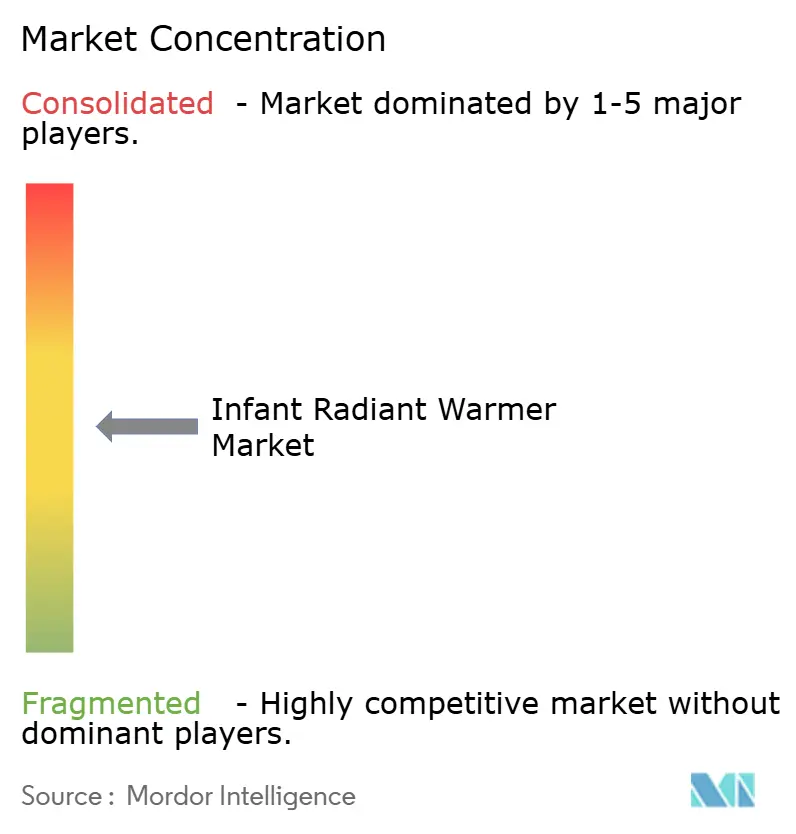
| Market Concentration | Medium |
Major Players *Disclaimer: Major Players sorted in no particular order Image © Mordor Intelligence. Reuse requires attribution under CC BY 4.0. | |
Infant Radiant Warmer Market Analysis by Mordor Intelligence
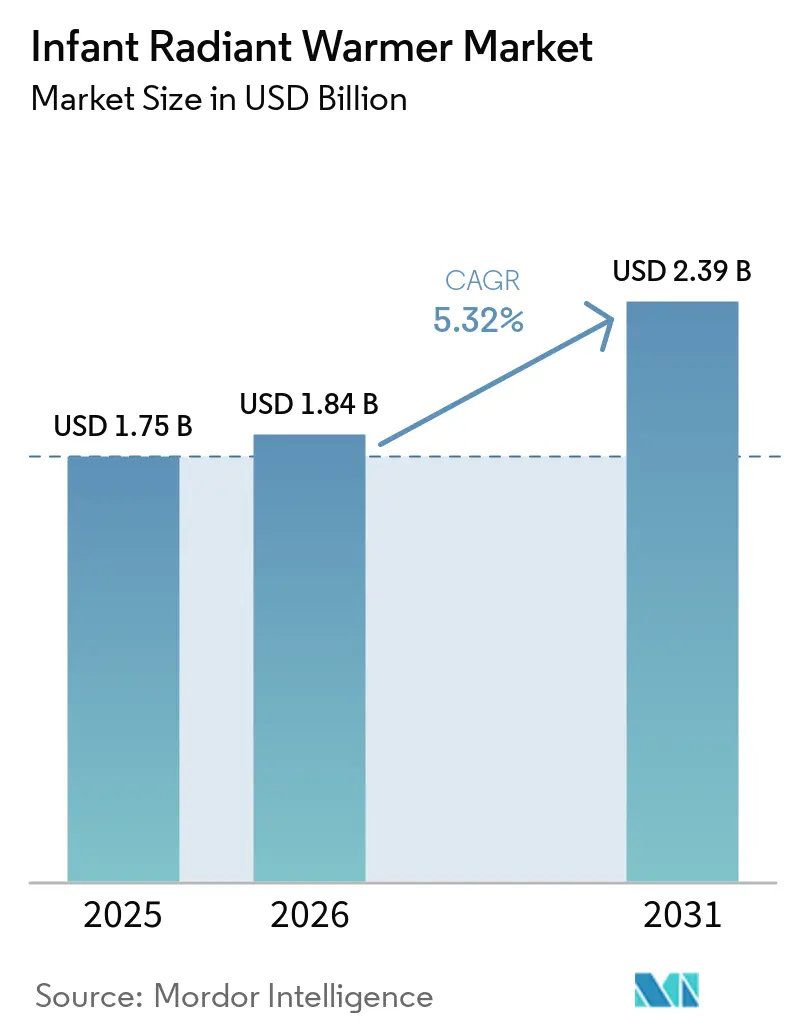
The Infant Radiant Warmer Market size is expected to grow from USD 1.75 billion in 2025 to USD 1.84 billion in 2026 and is forecast to reach USD 2.39 billion by 2031 at 5.32% CAGR over 2026-2031.
The need for thermal care is linked to a large and continuing clinical need, since the World Health Organization reported 13.4 million preterm births in 2020, nearly 1 in 10 births worldwide, and identifies preterm birth as a leading cause of death in children under 5 years old. Low birth weight also remains a major care need, with more than 20 million newborns worldwide born weighing less than 2,500 grams each year. Purchasing, therefore, follows newborn patient volumes and facility readiness rather than discretionary spending alone. New NICU capacity, neonatal transport networks, and digital public procurement systems are widening the settings that require warming equipment. Product design is also moving toward integrated monitoring and more reliable sensor systems. At the same time, compliance requirements favor suppliers able to support validation, service, and maintenance over the full life of the equipment.
Key Report Takeaways
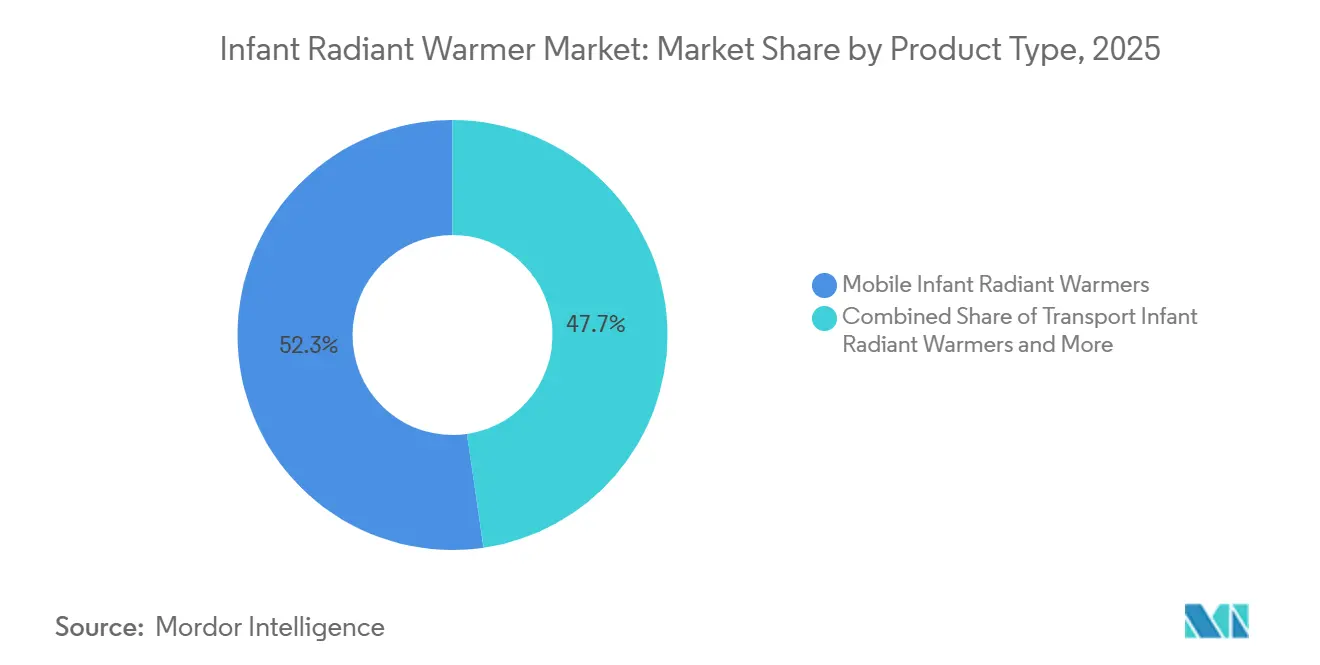
- By product type, mobile infant radiant warmers held 52.31% of the infant radiant warmer market share in 2025, while transport infant radiant warmers are expected to have a CAGR at 7.65% through 2031.
- By operating mode, servo-controlled warmers held 68.24% of the infant radiant warmer market share in 2025 and are projected to have a CAGR at 7.22% through 2031.
- By technology, infrared heating technology accounted for 64.14% of the infant radiant warmer market size in 2025, while combination heating systems are projected to grow at a 7.42% CAGR through 2031.
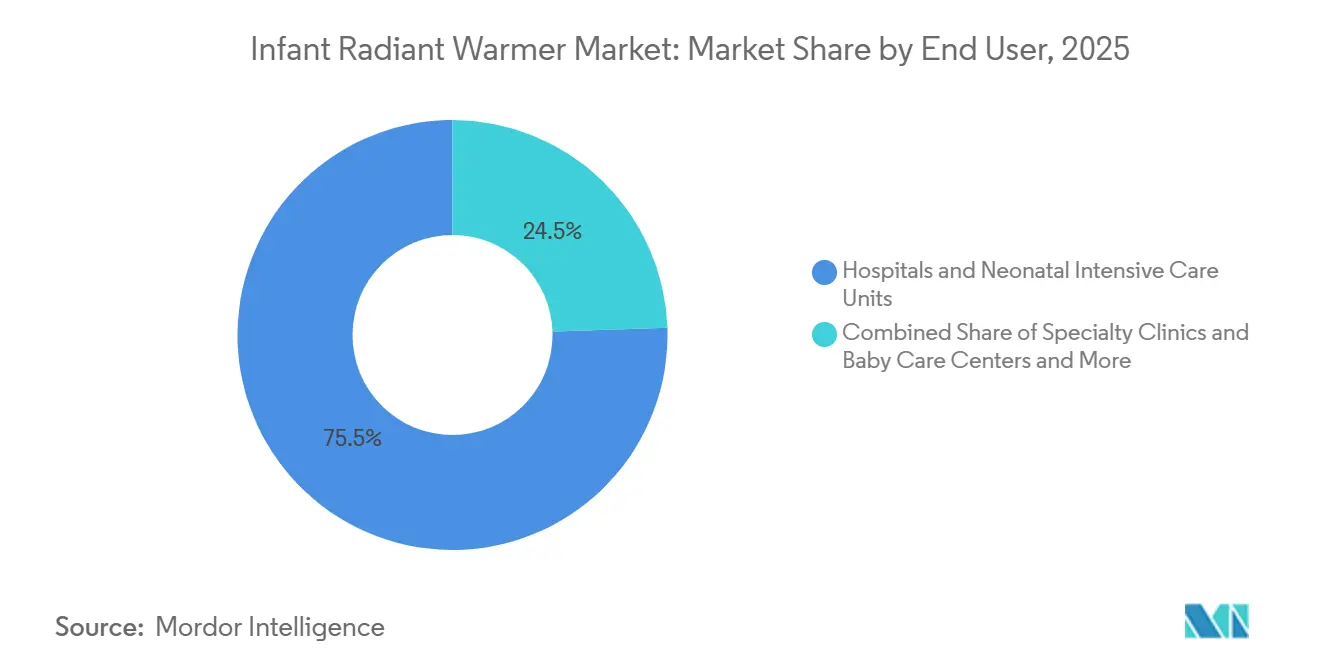
- By end user, hospitals and NICUs accounted for 75.54% of revenue in 2025, while specialty clinics and baby care centers are projected to grow at a 6.12% CAGR through 2031.
- By distribution channel, direct institutional sales accounted for 72.44% of revenue in 2025, while online and e-procurement sales are projected to grow at an 8.25% CAGR through 2031.
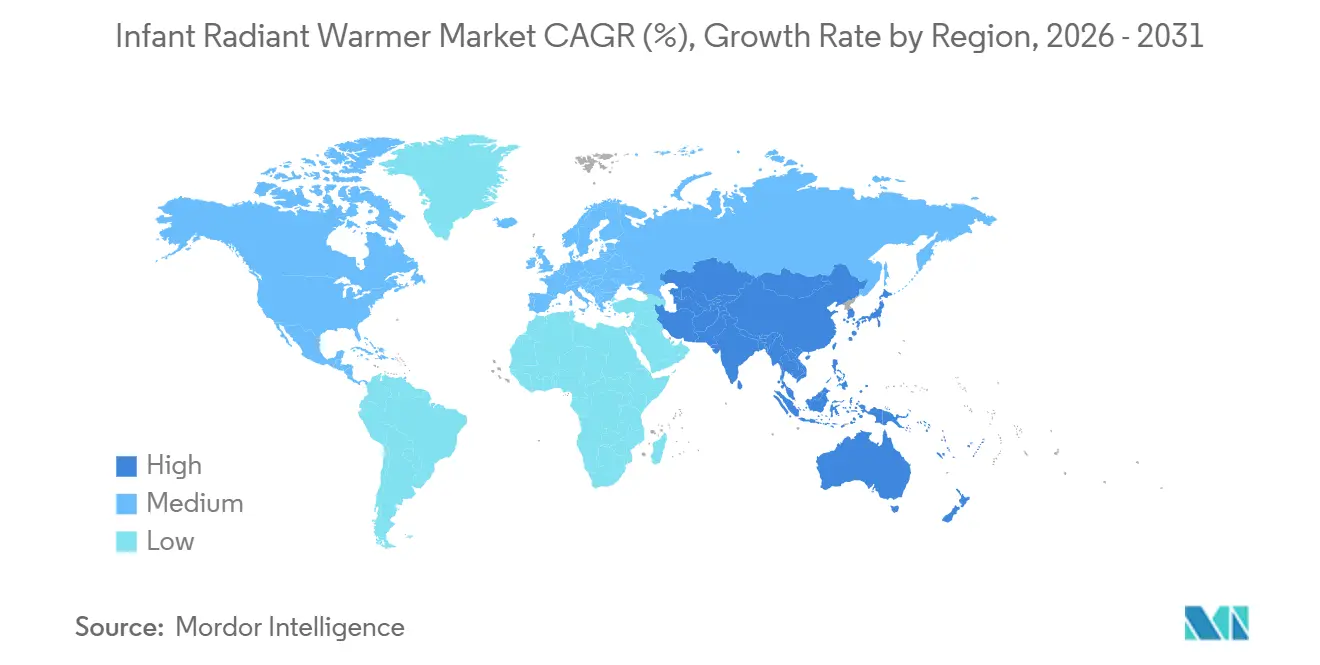
- By geography, North America held 34.61% of revenue in 2025, while Asia-Pacific is projected to grow at a CAGR of 7.65% through 2031.
Note: Market size and forecast figures in this report are generated using Mordor Intelligence’s proprietary estimation framework, updated with the latest available data and insights as of January 2026.
Market Trends and Insights
Drivers Impact Analysis of Infant Radiant Warmer Market*
| Driver | (~) % Impact on CAGR Forecast | Geographic Relevance | Impact Timeline |
|---|---|---|---|
| Rising Preterm and Low-Birth-Weight Infant Care Demand | +1.3% | Global, with concentrated impact in South Asia, Sub-Saharan Africa, and Southeast Asia | Long term (≥ 4 years) |
| Expansion of NICU and Delivery-Room Infrastructure | +1.1% | North America and Europe for replacement cycles, Asia-Pacific and Middle East and Africa for first procurement | Medium term (2-4 years) |
| Smart Servo-Control and Integrated Monitoring Adoption | +0.8% | North America, Europe, and Japan, with expansion into the GCC and urban India | Medium term (2-4 years) |
| Government and Donor Investment in Neonatal Care | +0.7% | Sub-Saharan Africa, South Asia, and Southeast Asia, with secondary relevance in South America | Medium term (2-4 years) |
| Neonatal Transport and Stabilization Networks | +0.5% | North America, United Kingdom, India, and Brazil | Medium term (2-4 years) |
| Heat-Profile and Sensor-Placement Standardization as an Unmet Need | +0.3% | Global, with early gains in North America and Europe through regulatory compliance | Long term (≥ 4 years) |
| Source: Mordor Intelligence | |||
Rising Preterm and Low-Birth-Weight Infant Care Demand
The infant radiant warmer market is supported by the need to care for preterm and low-birth-weight newborns. The CDC reported a U.S. preterm birth rate of 10.41% in 2023, while early-term births at 34 to 36 weeks reached 29.84% of all births. This larger group increases the number of babies who may need active temperature management after delivery. It also brings maternity wards and step-down units into equipment planning that once focused largely on high-acuity NICUs. WHO data show that low birth weight affects more than 20 million newborns each year, with a high burden in South Asia and Sub-Saharan Africa. The infant radiant warmer market consequently has demand across both advanced neonatal centers and facilities building basic newborn care capacity.
Expansion of NICU and Delivery-Room Infrastructure
The infant radiant warmer market benefits when hospitals add or renovate newborn care capacity. Private-room and family-centered NICU designs require equipment in more individual care spaces than older open-bay layouts. VCU Health opened a 20-bed NICU at the Children’s Tower in January 2026, adding to the 40-bed NICU on its adjacent campus[1]. The opening illustrates how a facility project can create a concentrated equipment purchasing cycle around commissioning. New delivery-room and NICU capacity also requires equipment that supports stabilization immediately after birth. These projects support demand for radiant warmers, monitoring systems, and related service arrangements within the infant radiant warmer market.
Smart Servo-Control and Integrated Monitoring Adoption
The infant radiant warmer market is moving toward systems that combine thermal management with monitoring and resuscitation support. The FDA cleared Dräger’s BabyRoo TN300 infant radiant warmer through 510(k) K243606 in January 2025. This type of clearance is important because infant radiant warmers are regulated as Class 2 devices in the United States. Integrated platforms can raise the technical requirements used by hospitals in equipment selection. They also increase the importance of validated performance, replacement sensors, software support, and service capability. The result is a stronger demand for suppliers that can support the installed base after the initial sale.
Government and Donor Investment in Neonatal Care
Public funding and donor programs can extend the infant radiant warmer market into facilities that have not previously purchased advanced newborn equipment. The Global Financing Facility reported that its Deliver the Future campaign had reached USD 568 million by November 2024, including USD 115 million in new partner commitments. The facility states that its co-investment approach can mobilize World Bank financing alongside partner commitments. Kenya’s Newborn Investment Case for 2025 to 2030 identifies equipment needs within the scale-up of Special Newborn Care Units[2]. Such planning can make neonatal equipment requirements more visible in public procurement pipelines. This supports the infant radiant warmer market, where facilities are expanding access to organized newborn care.
Restraints Impact Analysis of Infant Radiant Warmer Market*
| Restraint | (~) % Impact on CAGR Forecast | Geographic Relevance | Impact Timeline |
|---|---|---|---|
| High Acquisition, Maintenance, and Calibration Costs | -1.1% | Global, most acute in Sub-Saharan Africa, South Asia, and rural Southeast Asia | Long term (≥ 4 years) |
| Limited Availability of Trained Biomedical Service Personnel | -0.8% | Sub-Saharan Africa and rural South Asia, with a secondary impact in rural Latin America | Long term (≥ 4 years) |
| Probe Detachment, Measurement Error, and Thermal-Injury Liability | -0.5% | Global, with greater relevance in North America and Western Europe | Medium term (2-4 years) |
| Power Instability and Backup-Energy Requirements in Low-Resource Facilities | -0.4% | Sub-Saharan Africa, rural South Asia, and parts of Southeast Asia | Long term (≥ 4 years) |
| Source: Mordor Intelligence | |||
High Acquisition, Maintenance, and Calibration Costs
The infant radiant warmer market faces a cost barrier when buyers must account for service, calibration, and safety obligations in addition to the purchase price. The FDA posted a Class 2 recall for selected GE HealthCare Giraffe and Panda iRes warmers in September 2024 after incomplete electrical safety testing raised a potential leakage-current concern. The event shows why maintenance and safety documentation remain material parts of ownership costs. Premium integrated platforms can require a larger initial commitment and recurring calibration support. These costs can strain district hospitals, where operating budgets have limited room after initial procurement. In such settings, missed maintenance can reduce device usefulness and delay replacement or upgrade decisions.
Limited Availability of Trained Biomedical Service Personnel
The availability of trained service staff can limit the effective use of equipment within the infant radiant warmer market. A 2024 study on neonatal transport preparedness in southern Nigeria found that 85.7% of facilities relied on private vehicles for transfers and 7.2% had ambulances with transport incubators. The findings point to wider gaps in transport infrastructure and technical capacity. Servo-controlled equipment requires correct probe use and regular clinical checks to maintain safe temperature management. The Royal Children’s Hospital Melbourne provides clinical guidance on neonatal thermoregulation and the importance of careful temperature monitoring. Where service capability does not grow with facility capacity, equipment may be installed but not used to its full clinical potential.
*Our forecasts treat driver/restraint impacts as directional, not additive. The impact forecasts reflect baseline growth, mix effects, and variable interactions.
Infant Radiant Warmer Market Segment Analysis
By Product Type:
Mobile Warmers Lead While Transport Warmers AccelerateMobile infant radiant warmers held 52.31% of product-type revenue in 2025. Their wheeled design supports movement among delivery rooms, step-down bays, and intermediate care wards. This flexibility allows hospitals to use equipment across several care settings within one facility. Standard warmers remain relevant for fixed, high-acuity NICU installations, while wall-mounted models serve maternity units with limited floor space in Europe and Asia.
Transport infant radiant warmers are projected to grow at a 7.65% CAGR from 2026 to 2031. The infant radiant warmer market size for this subtype is supported by spoke-and-hub referral systems that require newborn stabilization during transfer. Johns Hopkins Medicine’s 2024 transport vehicle deployment demonstrates the operational model behind this need. Equipment used in transport must sustain thermal performance during vibration and movement. These higher specifications distinguish transport systems from many stationary models and support their use as referral care expands.

By Operating Mode:
Servo Control Reshapes Clinical ExpectationsServo-controlled warmers held 68.24% of the operating-mode segment in 2025. They are also projected to grow at a 7.22% CAGR from 2026 to 2031, showing that the leading mode continues to gain adoption. A 2025 randomized controlled trial reported 91% cooling-time compliance for servo control compared with 68% for manual methods. The trial found no temperature deviations below the 32°C safety threshold in the servo-control group. These results support clinical interest in more consistent, automated thermal management.
Manual warmers still have a role in the infant radiant warmer market where facilities have limited infrastructure and technical support. Their simpler design can fit rural settings in Sub-Saharan Africa and remote South Asia. The FDA’s Class 2 classification requires U.S. manufacturers to demonstrate substantial equivalence through the 510(k) process. This requirement reinforces the focus on validated servo performance among regulated suppliers. Manufacturers are adding sensor-detection features that halt heating after probe displacement, responding to safety concerns in North American and European procurement specifications.
By Technology:
Infrared Dominant as Combination Systems Set the Performance BenchmarkInfrared heating technology accounted for 64.14% of the technology segment in 2025. Its leading position reflects clinical familiarity, simpler device design, and cost-effective manufacturing. Chinese and Indian producers can supply these systems to mid-tier purchasers in Asia-Pacific, Latin America, and Sub-Saharan Africa. Convection-assist technology provides a secondary option where supplemental airflow can reduce heat differences across the mattress surface. It has relevance in European NICUs that prioritize quiet and low-draft care environments.
Combination heating systems are projected to grow at a 7.42% CAGR from 2026 to 2031. Dräger’s Babyleo TN500 IncuWarmer combines convective heating, dual radiant warming, and a heated mattress in one system. The company describes modes that support open care, incubator care, transport, and patient weaning without a thermal interruption. Combination systems, therefore, set a performance reference for procurement teams, even where the final purchase remains a conventional infrared unit. Conductive heating mattress systems continue to address specialized therapeutic hypothermia needs outside standard warming-at-birth care.
By End User:
NICUs Anchor Volume as Specialty Clinics Emerge as the Growth EngineHospitals and NICUs accounted for 75.54% of end-user revenue in 2025. This concentration reflects the high number of critically ill and preterm newborns managed in tertiary settings. Level III and Level IV units require high device density across several beds and care areas. Maternity and delivery centers form the second-largest end-user group because newborn stabilization is needed immediately after delivery. Community health centers in Japan and rural facilities in India remain smaller users, with demand linked to changing reimbursement and care-delivery arrangements.
Specialty clinics and baby care centers are projected to grow at a 6.12% CAGR from 2026 to 2031. The decentralization of neonatal step-down care from tertiary NICUs supports the infant radiant warmer market size in this segment. India’s Ministry of Health and Family Welfare reported continued work through the National Health Mission on newborn-care services[3]. Phoenix Medical Systems presents its Embrace Infant Warmer for newborn care settings and lists ISO 13485 and CE-related product information. These facilities bridge advanced NICUs and basic community care, widening the purchaser base beyond large tertiary hospitals.
By Distribution Channel:
Institutional Direct Sales Lead as E-Procurement Reshapes Market AccessDirect institutional sales accounted for 72.44% of distribution revenue in 2025. Capital equipment purchases often require clinical demonstrations, service commitments, and long-term vendor support. These needs favor direct relationships between OEMs and hospital procurement teams. Distributors and dealers retain an important role in fragmented hospital systems. In Southeast Asia, Latin America, and Sub-Saharan Africa, local partners provide regulatory support, logistics, and in-country service.
Online and e-procurement sales are projected to grow at an 8.25% CAGR from 2026 to 2031. Public e-tendering can make purchasing processes more visible to qualified suppliers and change the route to institutional buyers. Ningbo David Medical states that it has pursued international regulatory certifications for its infant-care products. Such credentials can help manufacturers participate in government tenders where regulatory acceptance is required. International suppliers may still need domestic distributor-importers for local certification, service, and access, but e-procurement can broaden tender participation in the infant radiant warmer market.
Geography Analysis
North America Infant Radiant Warmer Market
North America held 34.61% of the infant radiant warmer market in 2025. The market in the United States is supported by a mature NICU network and continuing facility investment. VCU Health opened 20 additional NICU beds in January 2026, bringing its related campus capacity to 60 beds and creating equipment demand when care spaces became operational. Canada remains in a measured replacement cycle, while Mexico is directing resources toward maternal health infrastructure in secondary cities.
EMEA Infant Radiant Warmer Market
North America’s established regulatory pathway favors suppliers with validated product lines and quality systems. Infant radiant warmers are Class 2 devices under 21 CFR 880.5130 and require 510(k) clearance before U.S. marketing. Europe is the second-largest region, led by Germany, the United Kingdom, France, Italy, and Spain. France is upgrading public hospital fleets toward servo-controlled platforms, while Spain and Italy are in active replacement cycles. The Middle East and Africa sub-region is led by Saudi Arabia, the United Arab Emirates, and South Africa, where newer tertiary hospitals procure premium systems, and African facilities need portable, battery-backed models.
APAC and South America Infant Radiant Warmer Market
Asia-Pacific is projected to grow at a 7.65% CAGR from 2026 to 2031. India’s preterm birth rate exceeded 13% of live births, while the National Health Mission activity is supporting district-hospital newborn care, and AIIMS-Patna expanded its NICU from 8 beds to 24 beds in October 2024. China’s 14th Five-Year Plan is supporting provincial hospital upgrades beyond major coastal clusters. Japan continues to require premium servo-controlled equipment despite its declining birth rate. Brazil’s SUS network leads South American growth, while Fanem’s South-South cooperation approach indicates wider emerging-market neonatal equipment activity.
Competitive Landscape
The infant radiant warmer market has moderate consolidation in its premium tier. GE HealthCare, Drägerwerk, and Koninklijke Philips have strong installed bases in North American and European NICUs. Their systems combine warming with functions such as oxygen-saturation monitoring, ECG, and resuscitation support. GE HealthCare’s Panda Warmer with ResusView integrates a 3-lead ECG during resuscitation. This integrated design can raise switching costs because facilities may value the combined workflow and monitoring functions.
Dräger received FDA 510(k) clearance for the BabyRoo TN300 in January 2025. The clearance provides a regulatory credential that can matter in institutional and public tenders. Dräger also offers the Babyleo TN500 IncuWarmer, which integrates convective, radiant, and mattress heating functions. These moves show how premium suppliers use integrated platforms and regulatory readiness to compete.
Chinese and Indian OEMs are increasing competition in price-sensitive and emerging markets, while Ningbo David Medical reports international regulatory certifications that can support participation beyond its domestic base. Shenzhen Comen Medical’s BQ80 combines thermoregulation, respiratory resuscitation, jaundice treatment, and blood-gas monitoring in a neonatal station. Phoenix Medical Systems, nice Neotech, and AVI Healthcare benefit from Make in India preferences in domestic tenders and pursue activity across Southeast Asia and Africa. The infant radiant warmer market combines established premium suppliers with a broader group of regional manufacturers.
Infant Radiant Warmer Industry Leaders
-
GE HealthCare
-
Drägerwerk AG & Co. KGaA
-
Atom Medical Corporation
-
Natus Medical Incorporated
-
Fanem Ltda.
- *Disclaimer: Major Players sorted in no particular order
Infant Radiant Warmer Market Companies Covered in this Report
- Atom Medical
- AVI Healthcare Pvt. Ltd.
- Bıçakcılar Medical Devices
- Dragerwerk
- Fanem Ltda.
- Fisher & Paykel Healthcare
- GE Healthcare
- Ginevri S.r.l.
- Heal Force Bio-Meditech Holdings Limited
- IndoSurgicals Private Limited
- Koninklijke Philips
- Médipréma
- nice Neotech Medical Systems Pvt. Ltd.
- Ningbo David Medical Device
- Phoenix Medical Systems
- Shenzhen Comen Medical Instruments Co., Ltd.
- Weyer GmbH
- Zhengzhou Dison Instrument and Meter Co., Ltd.
Recent Industry Developments in Infant Radiant Warmer Market
- January 2026: VCU Health opened a new 20-bed NICU on the fourth level of the Children’s Tower in Richmond, Virginia, as part of a USD 28 million expansion project. The unit complements the existing 40-bed NICU on the adjacent campus and is designed to serve high-risk infants immediately following delivery, representing a significant procurement event for warming and monitoring equipment in the US Mid-Atlantic region.
- September 2025: Medisys unveiled its Made in India, Patient First, next-generation neonatal technologies. The new neonatology equipment, Infant Warmer, was also introduced. With these, Medisys aims to strengthen its presence in NICU setups in hospitals with a comprehensive neonatal range.
Global Infant Radiant Warmer Market Report Scope
As per the scope of the report, an infant radiant warmer is a medical device used to provide controlled, consistent warmth to newborn infants, especially those who are premature or ill. It consists of a transparent enclosure or incubator that delivers radiant heat through specialized panels or lamps, helping to maintain the infant's body temperature, prevent hypothermia, and promote stability during initial care and treatment.
The infant radiant warmer market is segmented by product type into standard infant radiant warmers, mobile infant radiant warmers, wall-mounted infant radiant warmers, transport infant radiant warmers, and integrated infant radiant warmers; by operating mode into manual warmers and servo-controlled warmers; by technology into infrared heating technology, convection-assisted technology, combination heating systems, and other technologies; by end user into hospitals and neonatal intensive care units, maternity and delivery centers, specialty clinics and baby care centers, and other end users; by distribution channel into direct institutional sales, distributor and dealer sales, and online and e-procurement sales; and by geography into North America, Europe, Asia-Pacific, the Middle East and Africa, and South America. The market report also covers the estimated market sizes and trends for 17 countries across major regions globally. For each segment, the market size and forecast are provided in terms of value (USD).
Segmentation Overview
| Standard Infant Radiant Warmers |
| Mobile Infant Radiant Warmers |
| Wall-Mounted Infant Radiant Warmers |
| Transport Infant Radiant Warmers |
| Integrated Radiant Warmer |
| Manual Warmers |
| Servo-Controlled Warmers |
| Infrared Heating Technology |
| Convection-Assist Technology |
| Combination Heating Systems |
| Other Technologies |
| Hospitals and Neonatal Intensive Care Units |
| Maternity and Delivery Centers |
| Specialty Clinics and Baby Care Centers |
| Other End Users |
| Direct Institutional Sales |
| Distributor and Dealer Sales |
| Online and E-Procurement Sales |
| North America | United States |
| Canada | |
| Mexico | |
| Europe | Germany |
| United Kingdom | |
| France | |
| Italy | |
| Spain | |
| Rest of Europe | |
| Asia-Pacific | China |
| Japan | |
| India | |
| Australia | |
| South Korea | |
| Rest of Asia-Pacific | |
| Middle East and Africa | GCC |
| South Africa | |
| Rest of Middle East and Africa | |
| South America | Brazil |
| Argentina | |
| Rest of South America |
| By Product Type | Standard Infant Radiant Warmers | |
| Mobile Infant Radiant Warmers | ||
| Wall-Mounted Infant Radiant Warmers | ||
| Transport Infant Radiant Warmers | ||
| Integrated Radiant Warmer | ||
| By Operating Mode | Manual Warmers | |
| Servo-Controlled Warmers | ||
| By Technology | Infrared Heating Technology | |
| Convection-Assist Technology | ||
| Combination Heating Systems | ||
| Other Technologies | ||
| By End User | Hospitals and Neonatal Intensive Care Units | |
| Maternity and Delivery Centers | ||
| Specialty Clinics and Baby Care Centers | ||
| Other End Users | ||
| By Distribution Channel | Direct Institutional Sales | |
| Distributor and Dealer Sales | ||
| Online and E-Procurement Sales | ||
| By Geography | North America | United States |
| Canada | ||
| Mexico | ||
| Europe | Germany | |
| United Kingdom | ||
| France | ||
| Italy | ||
| Spain | ||
| Rest of Europe | ||
| Asia-Pacific | China | |
| Japan | ||
| India | ||
| Australia | ||
| South Korea | ||
| Rest of Asia-Pacific | ||
| Middle East and Africa | GCC | |
| South Africa | ||
| Rest of Middle East and Africa | ||
| South America | Brazil | |
| Argentina | ||
| Rest of South America | ||
Key Questions Answered in the Report
What is the projected value of the infant radiant warmer market by 2031?
The infant radiant warmer market is projected to reach USD 2.39 billion by 2031, from USD 1.84 billion in 2026, at a 5.32% CAGR.
Which product type leads infant radiant warmer sales?
Mobile infant radiant warmers led product-type revenue with a 52.31% share in 2025.
Which infant radiant warmer product type is growing fastest?
Transport infant radiant warmers are forecast to grow at a 7.65% CAGR from 2026 to 2031 as neonatal referral networks expand.
Why are servo-controlled radiant warmers increasingly used?
Servo-controlled warmers held 68.24% of their segment in 2025 and are supported by demand for more consistent thermal monitoring and control.
Which end users account for most demand for radiant warmers?
Hospitals and NICUs accounted for 75.54% of end-user revenue in 2025 because tertiary units manage a high share of critically ill and preterm newborns.
Which region is growing fastest for infant radiant warmers?
Asia-Pacific is projected to grow at a 7.65% CAGR from 2026 to 2031, supported by newborn-care capacity growth in India and China.