
Infant Phototherapy Devices Market Size and Share
Market Overview
| Study Period | 2020 - 2031 |
|---|---|
| Market Size (2026) | USD 271.71 Million |
| Market Size (2031) | USD 329.79 Million |
| Growth Rate (2026 - 2031) | 3.95 % |
| Fastest Growing Market | Asia-Pacific |
| Largest Market | North America |
| Market Concentration | Medium |
Major Players *Disclaimer: Major Players sorted in no particular order Image © Mordor Intelligence. Reuse requires attribution under CC BY 4.0. | |
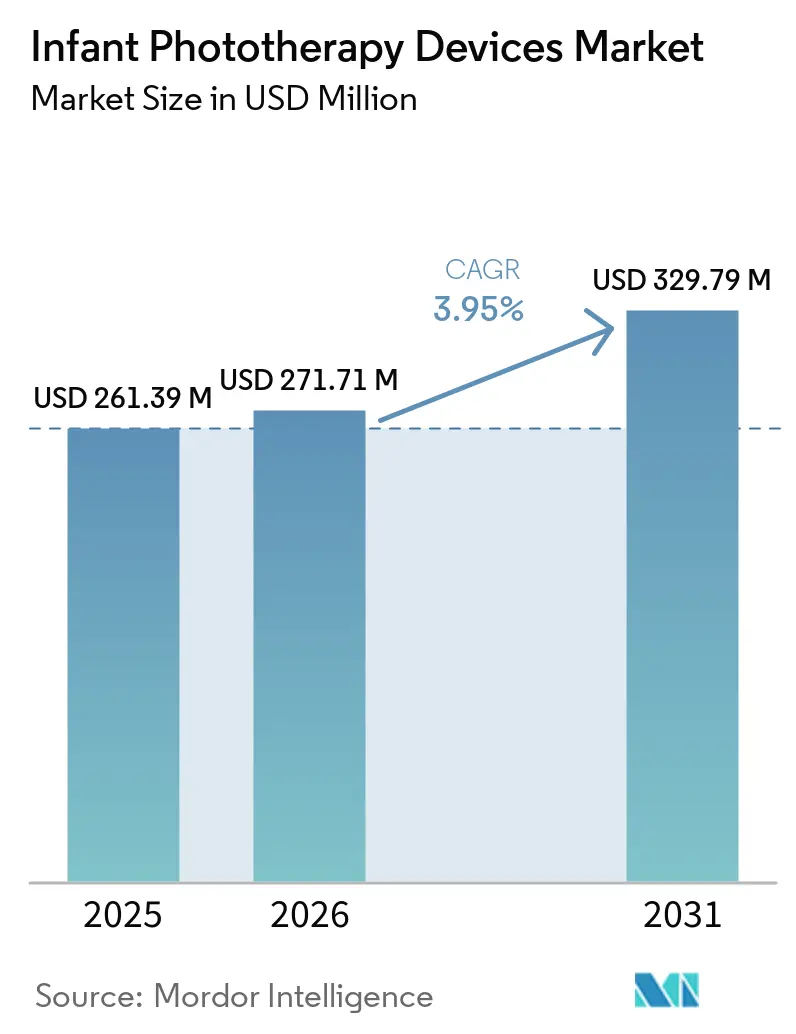
Infant Phototherapy Devices Market Analysis by Mordor Intelligence
The Infant Phototherapy Devices Market size is projected to be USD 261.39 million in 2025, USD 271.71 million in 2026, and reach USD 329.79 million by 2031, growing at a CAGR of 3.95% from 2026 to 2031.
The infant phototherapy devices market is supported by the persistent clinical need to manage neonatal jaundice and by a continuing move away from fluorescent systems. A 2025 global analysis projected that prevalent neonatal jaundice and hemolytic disease cases will reach 2.89 million by 2050, which points to a broader treatment need as neonatal survival improves. LED equipment is becoming more central because it can provide effective light treatment with less heat than older systems. Hospital capacity additions continue to create equipment purchasing needs, while structured home programs are expanding the use of portable and wearable formats. The infant phototherapy devices market also faces a change in purchasing priorities, as providers seek to free high-acuity beds for complex cases and use home treatment for eligible low-risk newborns.
Key Report Takeaways
- By light source, light-emitting diodes held 48.31% revenue share in 2025 and are forecast to expand at a 5.65% CAGR through 2031.
- By care setting, hospitals and NICUs held 75.24% of the market share in 2025, while homecare settings are expected to have the highest CAGR at 5.22% through 2031.
- By treatment intensity, standard-intensity phototherapy held 44.14% share in 2025, while combined overhead and fiber-optic phototherapy is forecast to grow at a 5.42% CAGR through 2031.
- By clinical use, physiological jaundice accounted for 49.54% of the infant phototherapy devices market share in 2025, while jaundice in preterm infants is expected to advance at a 5.12% CAGR through 2031.
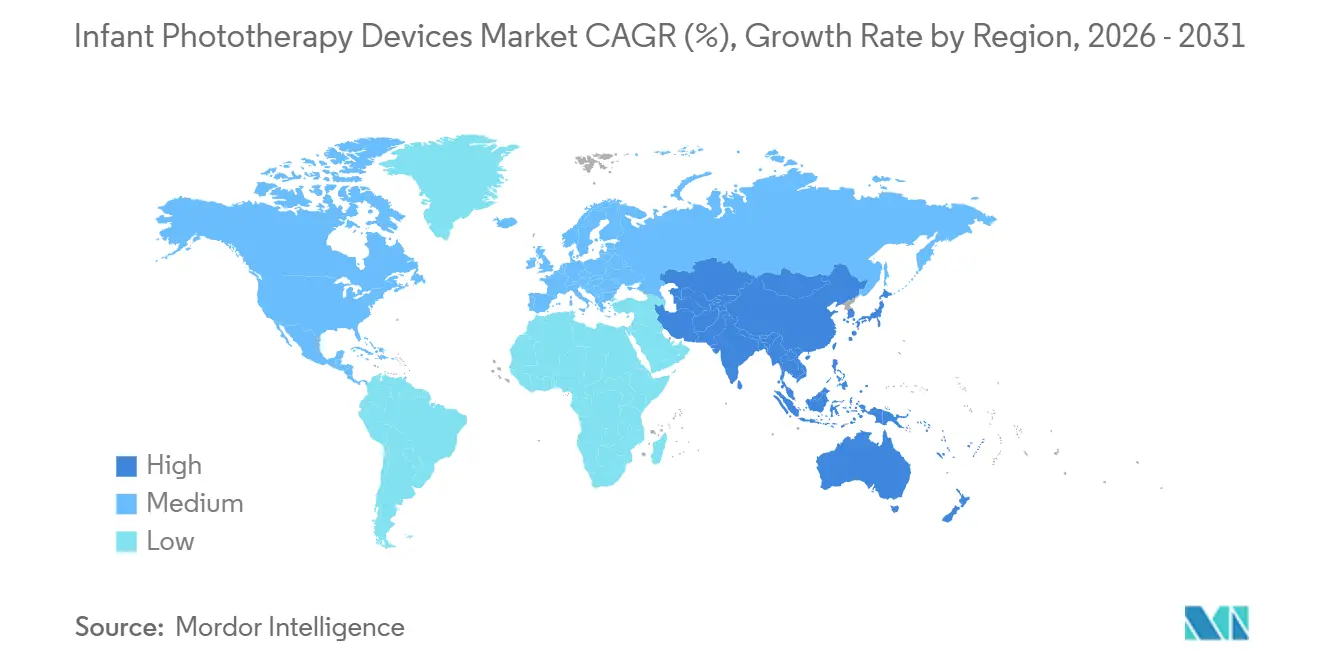
- By geography, North America held 36.61% of revenue in 2025, while Asia-Pacific is projected to grow at a CAGR of 5.65% through 2031.
Note: Market size and forecast figures in this report are generated using Mordor Intelligence’s proprietary estimation framework, updated with the latest available data and insights as of January 2026.
Market Trends and Insights
Drivers Impact Analysis of Infant Phototherapy Devices Market*
| Driver | (~) % Impact on CAGR Forecast | Geographic Relevance | Impact Timeline |
|---|---|---|---|
| High Incidence of Neonatal Jaundice | +1.0% | Global, highest in South Asia and sub-Saharan Africa | Long term (≥ 4 years) |
| Rising Preterm and Low-Birth-Weight Deliveries | +0.8% | Southern Asia, sub-Saharan Africa, spill-over to MEA | Long term (≥ 4 years) |
| Expansion of Neonatal Intensive Care Capacity | +0.7% | North America and Europe core, APAC rapid build-out | Medium term (2-4 years) |
| Shift Toward Energy-Efficient LED Systems | +0.9% | Global, accelerating in APAC and South America | Short term (≤ 2 years) |
| Home Phototherapy and Early Hospital Discharge Programs | +0.6% | North America, Europe, and expanding to APAC | Medium term (2-4 years) |
| Demand for Parent-Infant Contact During Treatment | +0.4% | Global, particularly high-income markets | Short term (≤ 2 years) |
| Source: Mordor Intelligence | |||
High Incidence of Neonatal Jaundice Sustains Device Demand
Neonatal jaundice affects 60% of term newborns and up to 80% of preterm infants globally during the first week of life. This clinical burden keeps phototherapy relevant across neonatal settings and provides the infant phototherapy devices market with a sustained treatment base. An estimated 10% of neonates require active phototherapy, which equates to 13-14 million infants each year based on WHO live-birth estimates. Severe neonatal jaundice among hospital admissions ranges from 0.73% to 3.34% across WHO regions, with the highest incidence reported in African and South-East Asian regions. The geographic pattern places greater weight on device affordability and dependable supply in these settings. It also supports demand for equipment that can perform reliably where clinical resources are constrained.
Rising Preterm and Low-Birth-Weight Deliveries Widen the Clinical Indication Base
Preterm and low-birth-weight infants have a higher risk of severe hyperbilirubinemia, expanding the number of newborns that may need phototherapy. This risk profile matters for the infant phototherapy devices market because preterm newborns often need longer treatment and stronger irradiance. They may also require double-surface treatment, increasing device use for each episode of care. A 2026 network meta-analysis found that double-surface phototherapy in preterm infants achieved higher total serum bilirubin reduction than single-surface treatment. This evidence supports the demand for systems that combine overhead light with a fiber-optic blanket. It also favors designs that can be used safely around medically fragile infants in incubators within the infant phototherapy devices market.
Expansion of Neonatal Intensive Care Capacity Unlocks Capital Equipment Procurement
NICU expansions in North America and Asia-Pacific support equipment procurement in the infant phototherapy devices market. Texas Children’s in Austin announced a USD 39 million NICU expansion in August 2026 that will increase its room count from 14 to 31[1]. The project is expected to serve up to 300 additional patient episodes annually when completed in fall 2027. New beds require phototherapy equipment, irradiance meters, and bilirubin monitoring tools as part of neonatal care operations. Capacity growth, therefore, creates a direct connection between facility investment and device purchasing. The effect is strongest where hospitals are upgrading both physical space and clinical workflows at the same time.
LED Technology Displacement Reshapes Device Economics
The replacement of fluorescent and quartz-halogen systems with LED units is changing purchasing decisions in the infant phototherapy devices market. A 2025 study found that LED phototherapy produced bilirubin reduction comparable with compact fluorescent lamp systems and was associated with fewer adverse effects. The same study reported peak bilirubin reductions of 28-43% within 48-96 hours for modern LED units. Blue LED systems operating at 450-475 nm align with bilirubin’s peak absorption wavelength under American Academy of Pediatrics guidance. LED lamps also have operating lives exceeding 10,000 hours, compared with 500-1,000 hours for conventional fluorescent tubes. These operating characteristics support replacement demand across the infant phototherapy devices market, although lower-cost LED retrofits can place pressure on the prices of fully integrated systems.
Restraints Impact Analysis of Infant Phototherapy Devices Market*
| Restraint | (~) % Impact on CAGR Forecast | Geographic Relevance | Impact Timeline |
|---|---|---|---|
| High Upfront Cost of Advanced Devices | -0.8% | Emerging markets, including South Asia, sub-Saharan Africa, and South America | Long term (≥ 4 years) |
| Need for Continuous Bilirubin and Irradiance Monitoring | -0.5% | Global, most acute in rural and low-resource settings | Medium term (2-4 years) |
| Caregiver Compliance and Follow-Up Risk in Homecare | -0.4% | North America and Europe, where home phototherapy programs are active | Short term (≤ 2 years) |
| Inconsistent Device Performance and Irradiance Measurement | -0.4% | Global, most acute in middle-income settings | Medium term (2-4 years) |
| Source: Mordor Intelligence | |||
High Upfront Cost of Advanced Devices Constrains Emerging-Market Procurement
Advanced LED systems can strain public procurement budgets in emerging markets. Double-surface units and systems with integrated monitoring have higher acquisition requirements than basic overhead equipment. Hospitals in South Asia and sub-Saharan Africa may continue using single fluorescent units when capital budgets are limited. This can reduce irradiance performance and leave clinical needs less fully addressed. Total ownership costs also include irradiance measurement tools, eye protection supplies, and replacement lamps for non-LED equipment. Manufacturers in the infant phototherapy devices market are responding with modular and battery-compatible systems, but tender-based buying processes can extend sales cycles and limit margins.
Monitoring Requirements Create a Dual Infrastructure Burden
Effective phototherapy depends on the device as well as reliable serum bilirubin measurement and irradiance verification. The American Academy of Pediatrics’ 2024 guidance bases treatment adjustments on total serum bilirubin measurement. IEC 60601-2-50 also specifies irradiance requirements at the patient surface. These requirements create operational burdens where testing tools and trained staff are not consistently available. Inconsistent measurement can lead to therapy ending too early or continuing longer than necessary. The infant phototherapy devices market must therefore accommodate facilities that need dependable hardware while also building their monitoring processes.
*Our forecasts treat driver/restraint impacts as directional, not additive. The impact forecasts reflect baseline growth, mix effects, and variable interactions.
Infant Phototherapy Devices Market Segment Analysis
By Light Source:
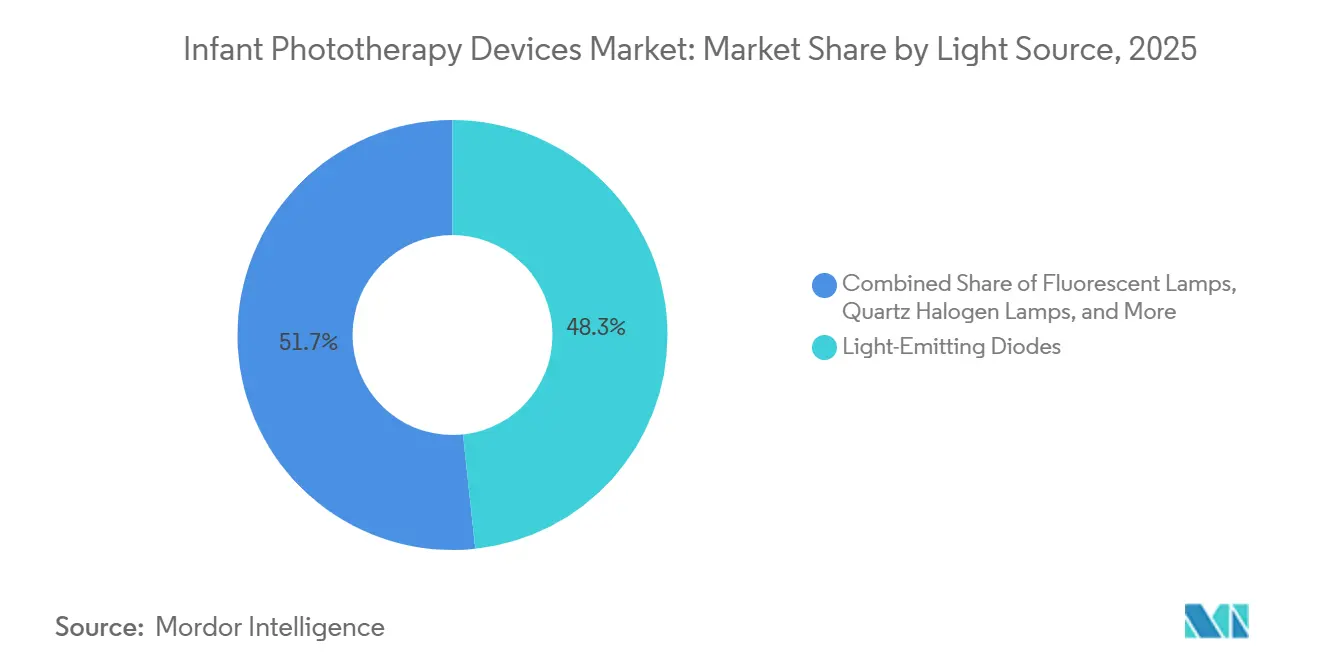
LED Efficiency Reshapes Device EconomicsLight-emitting diodes held 48.31% of the light-source segment in 2025 and are forecast to expand at a 5.65% CAGR through 2031. LED systems work within the 450-475 nm range that aligns with bilirubin absorption requirements. Modern units achieved bilirubin reductions of 28-43% within 48-96 hours in a 2025 study. They also generated less heat and fewer adverse events than fluorescent alternatives in the reported comparison. The infant phototherapy devices industry is placing more value on energy efficiency, lamp durability, and consistent light output.
Fluorescent lamps retained an installed base in lower-resource settings where the initial price remains important. Their shorter operating life creates recurring maintenance requirements compared with LED equipment. Quartz-halogen lamps are declining because high heat can increase insensible water loss in newborns. Gas discharge tubes retain a narrower role in specialized combined systems. IEC 62471 safety requirements and clinical irradiance guidance increasingly support LED-centered designs in the infant phototherapy devices market.

By Care Setting:
NICUs Anchor Volume While Homecare Drives the Growth CurveHospitals and NICUs represented 75.24% of the infant phototherapy devices market size by care setting in 2025. Institutional care can provide irradiance monitoring, serum bilirubin testing, and continuous nursing oversight. These capabilities remain necessary for newborns with neurotoxicity risk factors. The American Academy of Pediatrics identifies preterm infants below 38 weeks of gestation and newborns with hemolytic disease as patients requiring careful management. Ongoing NICU projects in North America and Asia-Pacific will continue to support institutional procurement through 2031.
Homecare settings are forecast to grow at a 5.22% CAGR from 2026 to 2031. Structured programs allow suitable low-risk term newborns to receive treatment outside an inpatient bed. A 2026 systematic review found comparable total serum bilirubin reduction for selected home and in-hospital patients. It also reported a 3.5% readmission rate and 70% lower cost for home phototherapy in structured hospital-at-home programs. Singapore’s KKH@Home program recruited 134 patients from April through December 2024 and saved 200 inpatient bed-days, reinforcing the role of compact fiber-optic, portable, and wearable equipment in the infant phototherapy devices market[2].
By Treatment Intensity:
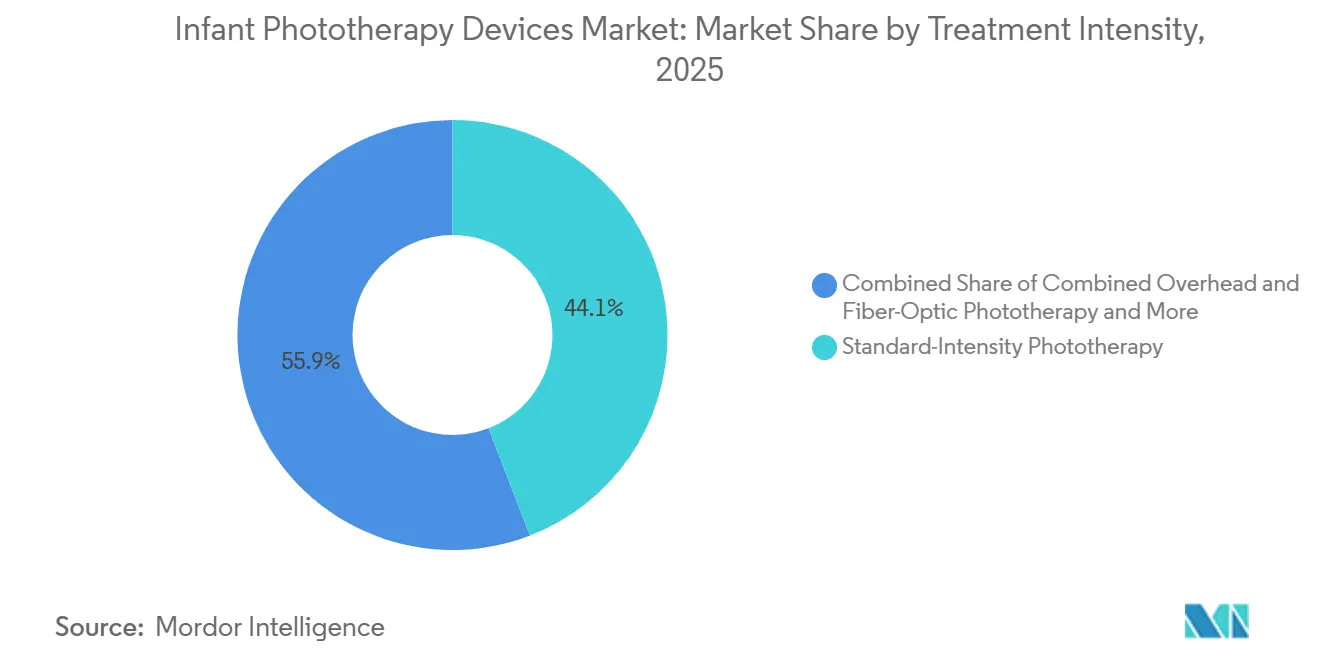
Standard Protocols Hold Share, Combination Systems Lead GrowthStandard-intensity phototherapy held the largest treatment-intensity share at 44.14% in 2025. It remains the first treatment option for physiological and mild neonatal hyperbilirubinemia in term infants. Major clinical protocols use standard overhead phototherapy before escalation when clinical needs require it. Single-surface LED units are widely suited to this established care pathway. This broad clinical role gives standard-intensity equipment a stable position in the infant phototherapy devices market.
Combined overhead and fiber-optic phototherapy is projected to grow at a 5.42% CAGR from 2026 to 2031. This configuration exposes the dorsal surface through overhead irradiance and the ventral surface through an under-blanket device. It can increase the treated body surface area without repeatedly repositioning the infant. A 2026 analysis confirmed higher total serum bilirubin reduction from double-surface treatment. Intensive devices for Level III and IV NICUs must meet the American Academy of Pediatrics threshold of 30 µW/cm²/nm, separating premium systems from basic units.
By Clinical Use:
Physiological Jaundice Anchors Volume, Preterm Cases Fuel InnovationPhysiological jaundice accounted for 49.54% of the clinical-use segment in 2025. It is the most common cause of neonatal hyperbilirubinemia in the first days of life. This clinical use supports continuing demand for standard treatment equipment. Breast milk jaundice affects 15% of exclusively breastfed infants beyond 3 weeks of life, but it generally involves lower bilirubin elevations. The infant phototherapy devices industry continues to rely on physiological jaundice as its largest routine treatment need.
Jaundice in preterm infants is forecast to grow at a 5.12% CAGR from 2026 to 2031. Preterm newborns are treated at lower bilirubin thresholds and may need higher irradiance levels. They also more frequently need combined-surface delivery than term newborns. These care requirements increase device use for each treated infant. A 2025 pilot study of the Jauni wearable phototherapy romper involved 10 neonates and reported a total serum bilirubin reduction rate of 1.6 µmol/L/h while enabling parental holding.
Geography Analysis
North America Infant Phototherapy Devices Market
North America held 36.61% of the regional share in 2025. The region benefits from extensive NICU infrastructure and strong procurement of higher-specification equipment. Texas Children’s announced its USD 39 million Austin expansion in August 2026, with room capacity set to rise from 14 to 31. The project is expected to serve up to 300 additional patient episodes annually when completed in fall 2027. These expansions create continuing purchase needs for phototherapy systems and related monitoring equipment in the infant phototherapy devices market.
Europe Infant Phototherapy Devices Market
Europe held the second-largest geographic share in 2025. Germany, the United Kingdom, and France account for a significant portion of regional revenue. German practice uses age-stratified bilirubin thresholds, including a 20 mg/dL trigger for healthy term infants aged 72 hours or more. German neonatal units have adopted LED systems at a high rate because of strict photobiological safety expectations. Universitätsmedizin Halle tested a phototherapy sleeping-bag system that supports breastfeeding and skin-to-skin contact during treatment.
APAC Infant Phototherapy Devices Market
Asia-Pacific is the fastest-growing regional area at a 5.65% CAGR from 2026 to 2031. China’s NICU capacity expanded by 7-8% annually from 2020 to 2025 under Healthy China 2030, supporting domestic equipment demand. The installed base of phototherapy machines in China is projected to exceed 200,000 units by 2030. India’s increasing institutional deliveries and neonatal screening requirements also support regional demand in the infant phototherapy devices market.
Competitive Landscape
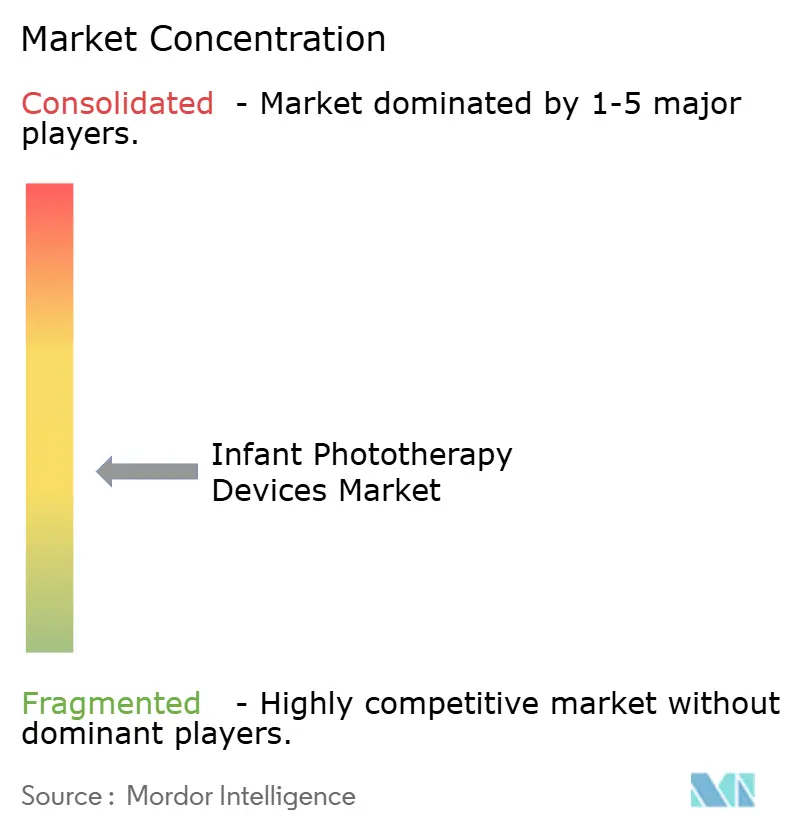
The infant phototherapy devices market is moderately fragmented, with global integrated suppliers competing alongside regional specialists. GE HealthCare, Koninklijke Philips, and Drägerwerk use established hospital relationships and service networks to compete for institutional accounts. GE HealthCare’s BiliSoft 2.0 and Giraffe Blue Spot PT Lite systems are designed for NICU, pediatric, and home settings. The company positions these products to meet or exceed the American Academy of Pediatrics intensive-phototherapy guidance. Larger suppliers are seeking to combine clinical workflow support with equipment performance.
NeoLight received a Premier KIINDO Breakthrough Technology Agreement for its Skylife system in November 2024[3]. The agreement provided a route into accounts often served by multi-product medical equipment suppliers. The company stated that Skylife was deployed across 90% of America’s top children’s hospitals. This category-focused approach contrasts with the broader equipment portfolios of integrated suppliers. Wearable systems remain an area of active product development in the infant phototherapy devices market.
Regional companies, including BPL Medical Technologies, Phoenix Medical Systems, Ningbo David Medical Device, and Nice Neotech Medical Systems, compete through lower device costs and public-tender access. Their approach is especially relevant in India, China, Brazil, the Middle East, Africa, and South-East Asia. The largest opportunity areas span wearable systems for family-centered care and affordable systems for resource-constrained facilities. Device performance remains a competitive issue because inconsistent patient-surface irradiance can result in inadequate bilirubin reduction.
Infant Phototherapy Devices Industry Leaders
-
GE HealthCare
-
Natus Medical Incorporated
-
Drägerwerk AG & Co. KGaA
-
Atom Medical Corporation
-
Koninklijke Philips N.V.
- *Disclaimer: Major Players sorted in no particular order
Infant Phototherapy Devices Market Companies Covered in this Report
- Atom Medical
- BabyBloom Healthcare B.V.
- Bistos Co., Ltd.
- BPL Medical Technologies Pvt. Ltd.
- Dragerwerk
- Fanem Ltda
- GE Healthcare
- Heal Force Bio-Meditech Holdings Limited
- Ibis Medical Equipment and Systems Pvt. Ltd.
- Koninklijke Philips
- Natus Medical
- NeoLight LLC
- NeoMedLight
- Nice Neotech Medical Systems Pvt. Ltd.
- Ningbo David Medical Device
- Phoenix Medical Systems
- Shenzhen Comen Medical Instruments Co., Ltd.
- Zhengzhou Dison Instrument and Meter Co., Ltd.
Recent Industry Developments in Infant Phototherapy Devices Market
- February 2026: Natus Sensory, an ARCHIMED portfolio company with a global presence in sensory and newborn care, acquired TheraB Medical and its SnugLit Wearable Phototherapy System. The acquisition expanded Natus's portfolio with wearable, family-centered phototherapy solutions. Natus also leveraged its established relationships in more than 90 countries to expand SnugLit distribution.
- September 2025: Medisys unveiled its Made in India, Patient First, next-generation neonatal technologies. These solutions aimed to improve patient safety and comfort while supporting faster recovery in critical care settings. Medisys also introduced new neonatology equipment, including LED phototherapy systems and infant warmers.
Global Infant Phototherapy Devices Market Report Scope
As per the scope of the report, infant phototherapy devices are specialized medical equipment used to treat neonatal jaundice by exposing the infant's skin to specific wavelengths of light. This light helps to break down excess bilirubin in the baby's blood, facilitating its elimination through the liver and intestines. These devices typically include light-emitting units such as fluorescent lamps, LED panels, or fiberoptic blankets designed to deliver safe and effective phototherapy to newborns.
The infant phototherapy devices market is segmented by light source into fluorescent lamps, light-emitting diodes (LEDs), quartz halogen lamps, and gas discharge tubes; by care setting into hospitals and neonatal intensive care units, neonatal clinics and maternity centers, home care settings, and other care settings; by treatment intensity into standard-intensity phototherapy, intensive phototherapy, and combined overhead and fiber-optic phototherapy; by clinical use into physiological jaundice, breast milk jaundice, jaundice in preterm infants, and other clinical uses; and by geography into North America, Europe, Asia-Pacific, the Middle East and Africa, and South America. The market report also covers the estimated market sizes and trends for 17 countries across major regions globally. For each segment, the market size and forecast are provided in terms of value (USD).
Segmentation Overview
| Fluorescent Lamps |
| Light-Emitting Diodes |
| Quartz Halogen Lamps |
| Gas Discharge Tubes |
| Hospitals and Neonatal Intensive Care Units |
| Neonatal Clinics and Maternity Centers |
| Homecare Settings |
| Other Care Settings |
| Standard-Intensity Phototherapy |
| Intensive Phototherapy |
| Combined Overhead and Fiber-Optic Phototherapy |
| Physiological Jaundice |
| Breast Milk Jaundice |
| Jaundice in Preterm Infants |
| Other Clinical Uses |
| North America | United States |
| Canada | |
| Mexico | |
| Europe | Germany |
| United Kingdom | |
| France | |
| Italy | |
| Spain | |
| Rest of Europe | |
| Asia-Pacific | China |
| Japan | |
| India | |
| Australia | |
| South Korea | |
| Rest of Asia-Pacific | |
| Middle East and Africa | GCC |
| South Africa | |
| Rest of Middle East and Africa | |
| South America | Brazil |
| Argentina | |
| Rest of South America |
| By Light Source | Fluorescent Lamps | |
| Light-Emitting Diodes | ||
| Quartz Halogen Lamps | ||
| Gas Discharge Tubes | ||
| By Care Setting | Hospitals and Neonatal Intensive Care Units | |
| Neonatal Clinics and Maternity Centers | ||
| Homecare Settings | ||
| Other Care Settings | ||
| By Treatment Intensity | Standard-Intensity Phototherapy | |
| Intensive Phototherapy | ||
| Combined Overhead and Fiber-Optic Phototherapy | ||
| By Clinical Use | Physiological Jaundice | |
| Breast Milk Jaundice | ||
| Jaundice in Preterm Infants | ||
| Other Clinical Uses | ||
| By Geography | North America | United States |
| Canada | ||
| Mexico | ||
| Europe | Germany | |
| United Kingdom | ||
| France | ||
| Italy | ||
| Spain | ||
| Rest of Europe | ||
| Asia-Pacific | China | |
| Japan | ||
| India | ||
| Australia | ||
| South Korea | ||
| Rest of Asia-Pacific | ||
| Middle East and Africa | GCC | |
| South Africa | ||
| Rest of Middle East and Africa | ||
| South America | Brazil | |
| Argentina | ||
| Rest of South America | ||
Key Questions Answered in the Report
What is driving demand for infant phototherapy devices?
Persistent neonatal jaundice, the higher care needs of preterm infants, and the replacement of fluorescent equipment with LED systems support demand.
How large is the infant phototherapy device market?
The sector is estimated at USD 271.71 million in 2026 and is forecast to reach USD 329.79 million by 2031 at a 3.95% CAGR.
Why are LED phototherapy systems preferred?
LED systems can operate in the bilirubin absorption range, produce less heat, and achieved 28-43% bilirubin reductions within 48-96 hours in a 2025 study.
Which care setting is growing fastest for infant phototherapy?
Homecare settings are projected to grow at a 5.22% CAGR through 2031 as structured early-discharge programs expand.
Which region is expanding fastest for infant phototherapy equipment?
Asia-Pacific is forecast to grow at a 5.65% CAGR from 2026 to 2031, supported by capacity growth in China and higher institutional delivery rates in India.
What limits the adoption of advanced phototherapy equipment?
Upfront device costs, the need for bilirubin and irradiance monitoring, and follow-up requirements in homecare can limit adoption.