
Size and Share of Industry-Specific RAG Implementation Services Market
Market Overview
| Study Period | 2020 - 2031 |
|---|---|
| Market Size (2026) | USD 1.31 Billion |
| Market Size (2031) | USD 3.37 Billion |
| Growth Rate (2026 - 2031) | 20.80 % |
| Fastest Growing Market | Asia-Pacific |
| Largest Market | North America |
| Market Concentration | Low |
Major Players *Disclaimer: Major Players sorted in no particular order Image © Mordor Intelligence. Reuse requires attribution under CC BY 4.0. | |
Analysis of Industry-Specific RAG Implementation Services Market by Mordor Intelligence
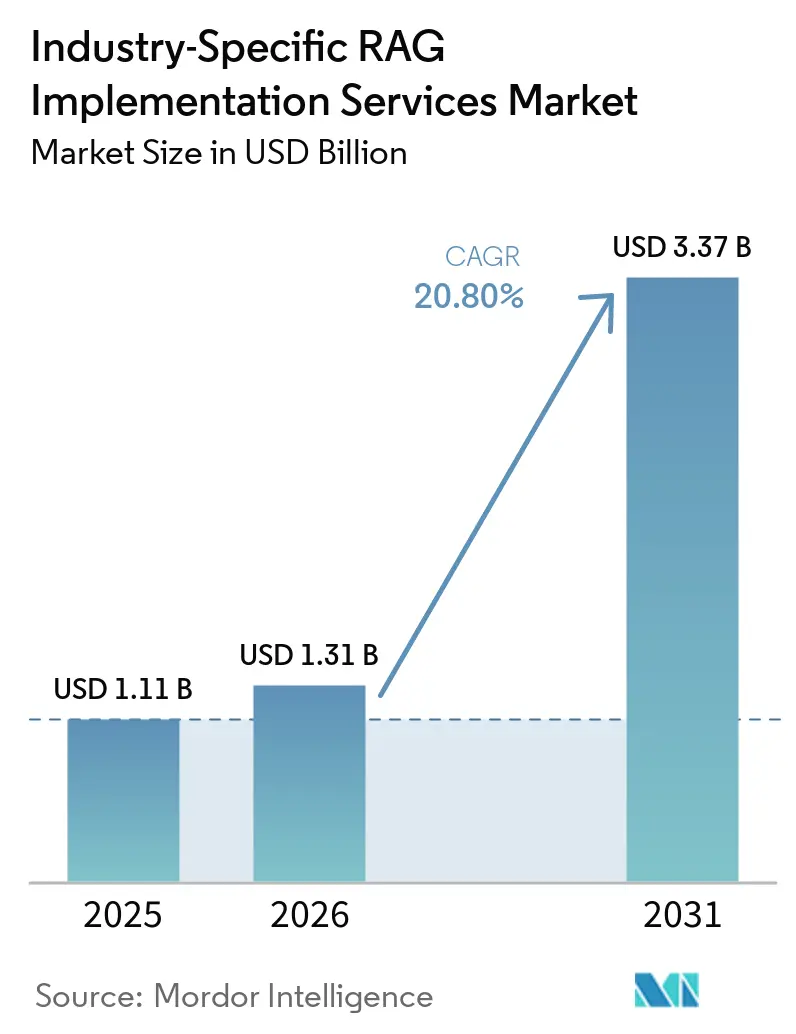
The Industry-Specific RAG Implementation Services Market size is expected to increase from USD 1.11 billion in 2025 to USD 1.31 billion in 2026 and reach USD 3.37 billion by 2031, growing at a CAGR of 20.80% over 2026-2031. The Industry-Specific RAG Implementation Services Market is moving from pilot work toward production systems that can identify the sources behind generated answers. This shift matters most in regulated settings, where reviewable outputs and documented controls are part of the buying decision. The EU AI Act is fully applicable from August 2026, strengthening the need for logging, traceability, and human oversight in applicable high-risk systems. Providers are responding by adopting vertical delivery models, adopting reusable evaluation methods, and partnering with cloud platforms. The Industry-Specific RAG Implementation Services Market also benefits from lower infrastructure costs make deployments feasible for more organizations
Key Report Takeaways
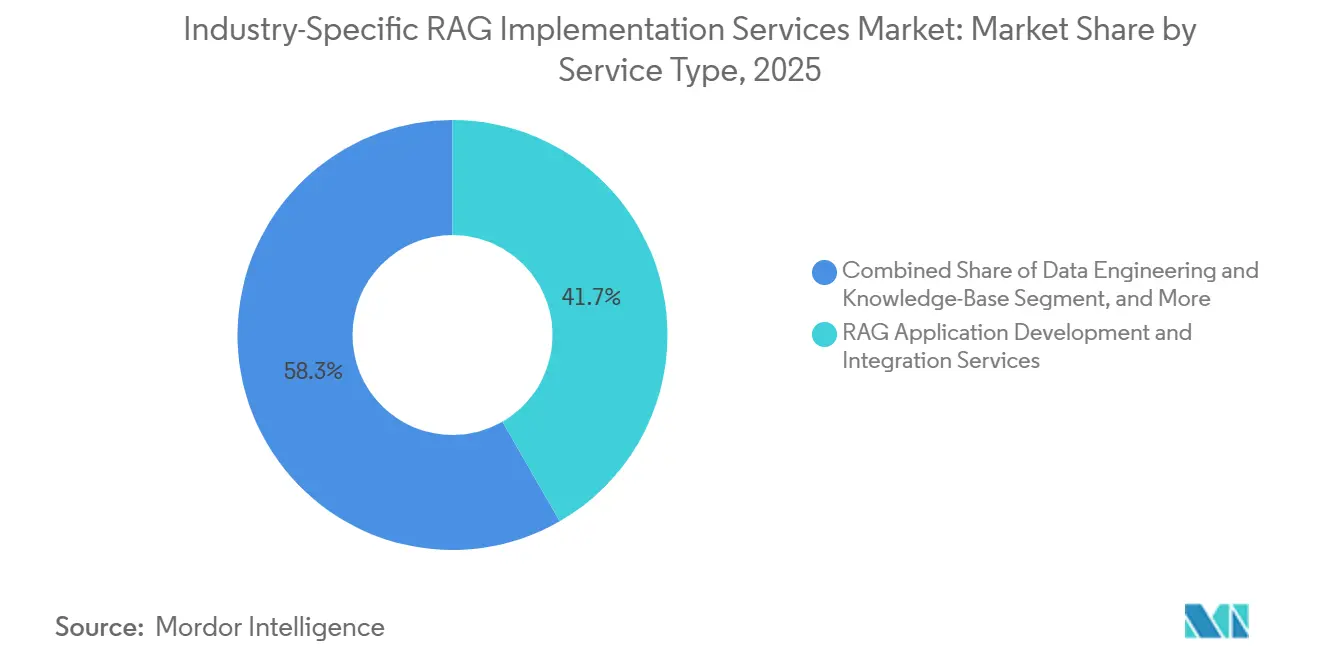
- By service type, RAG Application Development and Integration Services held 41.68% of the Industry-Specific RAG Implementation Services Market share in 2025, while Data Engineering and Knowledge-Base Services are forecast to grow at a 21.45% CAGR through 2031.
- By industry vertical, Financial Services and Insurance held 25.93% of the Industry-Specific RAG Implementation Services Market share in 2025, while Healthcare and Life Sciences are forecast to grow at a 21.63% CAGR through 2031.
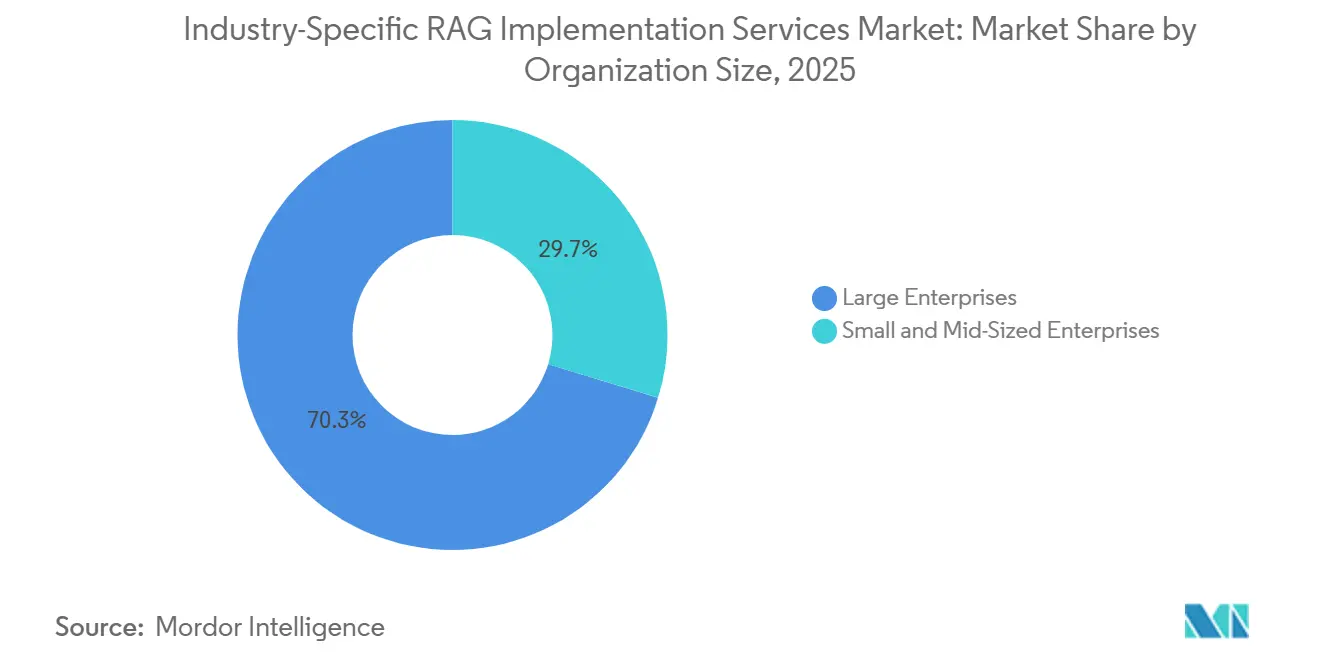
- By organization size, large enterprises held 70.28% of revenue in 2025, while small and mid-sized enterprises are forecast to grow at a 21.72% CAGR through 2031.
- By deployment model, cloud deployment accounted for 70.23% of revenue in 2025, while on-premises deployment is forecast to grow at a 21.55% CAGR through 2031.
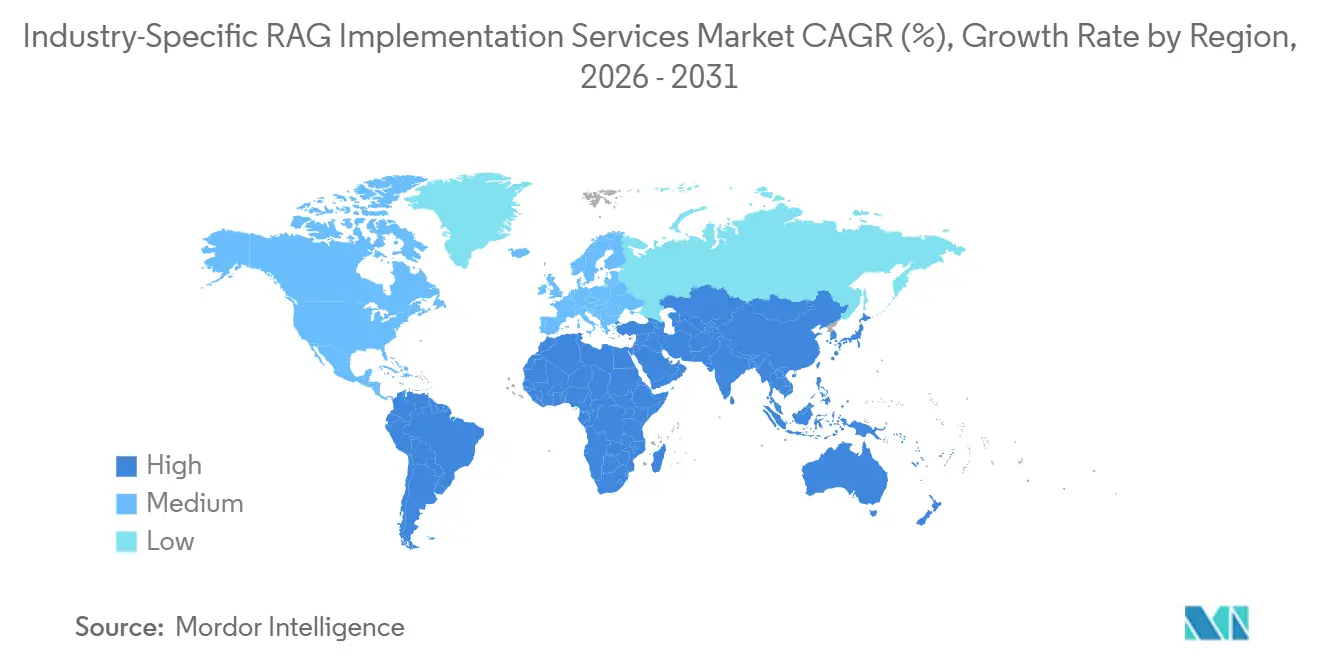
- By geography, North America held 38.49% of revenue in 2025, while Asia-Pacific is forecast to grow at a 21.83% CAGR through 2031.
Note: Market size and forecast figures in this report are generated using Mordor Intelligence’s proprietary estimation framework, updated with the latest available data and insights as of January 2026.
Market Trends and Insights
Drivers Impact Analysis of Industry-Specific RAG Implementation Services Market*
| Driver | (~) % Impact on CAGR Forecast | Geographic Relevance | Impact Timeline |
|---|---|---|---|
| Enterprise Demand for Grounded and Auditable AI Outputs | +5.2% | Global | Short term (≤ 2 years) |
| Regulatory Pressure for Traceable AI Decisions | +4.0% | North America and Europe, with spillover to Asia-Pacific | Medium term (2-4 years) |
| Declining Cost of Managed Vector Search and Foundation Models | +3.5% | Global | Short term (≤ 2 years) |
| Expansion of Industry-Specific Data and Workflow Copilots | +3.0% | North America, Europe, and Asia-Pacific | Medium term (2-4 years) |
| Retrieval-Aware Operating Models for Multimodal Industrial Data | +2.5% | Asia-Pacific, with spillover to North America and Europe | Long term (≥ 4 years) |
| Compliance-Ready RAG as a Faster Alternative to Model Retraining | +2.0% | Global, with early concentration in North America and Europe | Medium term (2-4 years) |
| Source: Mordor Intelligence | |||
Enterprise Demand for Grounded and Auditable AI Outputs
The Industry-Specific RAG Implementation Services Market is supported by enterprises that need generated answers tied to documented source material. Production deployments require more than an effective language model because users must review the evidence used in a response. Financial institutions apply formal model governance, including validation, documentation, and assigned ownership, to systems that influence business decisions. That requirement broadens the scope of delivery work to include retrieval design, testing, access control, and ongoing monitoring. Retrieval quality, therefore, becomes a durable service need, rather than a one-time software selection exercise. It also creates demand for evaluation and tuning work after the first deployment.
Regulatory Pressure for Traceable AI Decisions
The EU AI Act requires applicable high-risk systems to support record-keeping, traceability, and human oversight. The Industry-Specific RAG Implementation Services Market benefits from this requirement, as retrieval systems can document the sources used to prepare an answer.[1] Credit assessment, clinical support, and legal research may require careful classification and governance to ensure compliance with relevant rules. Implementation teams must configure logs, permissions, and review processes as part of the operating model. This work is active in 2026 because the Act is fully applicable from August. Multinational organizations also seek common controls across jurisdictions when their AI-generated communications are subject to review.
Declining Cost of Managed Vector Search and Foundation Models
Lower vector search costs are broadening the buyer base for the Industry-Specific RAG Implementation Services Market. Microsoft stated in 2025 that Azure AI Search compression could reduce monthly vector index costs by up to 92.5% and index storage by 99% while retaining 99% to 100% of baseline retrieval quality.[2] Amazon Web Services launched S3 Vectors in July 2026 for Amazon Bedrock Knowledge Bases and stated that it can reduce vector upload, storage, and query costs by up to 90% against conventional configurations. Databricks reported 7x lower cost at billion-scale following an AI Search infrastructure rebuild in 2025. These changes shift provider differentiation toward corpus preparation, evaluation, and workflow integration. They also make smaller deployments more viable without removing the need for specialized implementation support.
Expansion of Industry-Specific Data and Workflow Copilots
Domain-focused copilots are driving increased demand for Industry-Specific RAG Implementation Services because high-stakes workflows require reliable sourcing. Financial institutions, healthcare providers, manufacturers, retailers, and legal teams use different document sets, permissions, and review practices. A 2026 financial-services study reported that FinRAG-12B was deployed at more than 40 financial institutions and improved query resolution by 7.1 percentage points.[3] Manufacturing deployments often need access to equipment manuals and maintenance records in locations with limited connectivity. Retail implementations must handle detailed product catalogs and long-tail product queries. These requirements extend delivery work into corpus curation and maintenance, which can support recurring service relationships.
Restraints Impact Analysis of Industry-Specific RAG Implementation Services Market*
| Restraint | (~) % Impact on CAGR Forecast | Geographic Relevance | Impact Timeline |
|---|---|---|---|
| Shortage of RAG Evaluation and MLOps Specialists | -3.2% | Global, most acute in North America, Europe, and India | Short term (≤ 2 years) |
| Latency and Cost Penalties in Multi-Hop Retrieval | -2.5% | Global | Medium term (2-4 years) |
| Copyright and Licensing Friction for Proprietary Corpora | -2.0% | North America and Europe | Medium term (2-4 years) |
| Prompt Injection and Permission-Leakage Exposure | -1.5% | Global | Short term (≤ 2 years) |
| Source: Mordor Intelligence | |||
Shortage of RAG Evaluation and MLOps Specialists
The Industry-Specific RAG Implementation Services Market faces a shortage of specialists capable of managing corpus ingestion, retrieval tuning, testing, and monitoring. The Linux Foundation reported in 2025 that 68% of surveyed organizations were understaffed in AI and machine learning engineering. A delivery team without evaluation expertise can produce retrieval pipelines that do not meet the requirements of regulated use cases.[4] This increases remediation work and can delay production acceptance. The shortage also raises labor costs for providers and their clients. Providers with established testing methods and experienced teams are better placed to manage this constraint.
Latency and Cost Penalties in Multi-Hop Retrieval
Multi-hop retrieval can improve answers that require evidence from several documents, but it adds processing time and cost. Each additional retrieval pass, reranking step, and generation call creates another engineering trade-off. Large vector indexes can introduce material response delays before generation begins. Complex architectures can also raise token usage compared with a single-pass design. The Industry-Specific RAG Implementation Services Market, therefore, needs specialists who can route queries and balance response quality with operating cost. This issue is more important for cost-sensitive buyers and workflows where users expect fast responses.
*Our forecasts treat driver/restraint impacts as directional, not additive. The impact forecasts reflect baseline growth, mix effects, and variable interactions.
Industry-Specific RAG Implementation Services Market Segment Analysis
By Service Type:
Application Development Leads, Data Engineering AcceleratesRAG Application Development and Integration Services accounted for 41.68% of the Industry-Specific RAG Implementation Services Market in 2025. Organizations are allocating a large part of their spending to production build work, including permissioned retrieval, evaluation, and workflow integration. These projects require connecting document stores, search infrastructure, language models, and enterprise systems. Strategy and Advisory Services remain relevant at the start of an engagement because buyers need to assess use cases and data readiness. Architecture and Design Services address retrieval flow, vector store choice, access controls, and content chunking before implementation begins. The Industry-Specific RAG Implementation Services Market favors providers that can resolve these decisions before a system reaches production. Weak early design choices can be expensive to correct after deployment. This creates room for specialist consulting in regulated settings.
Data Engineering and Knowledge-Base Services are forecast to grow at a 21.45% CAGR from 2026 to 2031. The segment reflects the importance of document quality, version control, permission synchronization, and embedding updates to retrieval performance. Organizations deploying systems across several functions need continuous content ingestion and maintenance. That work turns an initial project into an ongoing service relationship. Other Services include evaluation consulting, observability services, and RAG operations support. The Industry-Specific RAG Implementation Services Market draws more demand for these services once a client moves beyond its first deployment. The service mix is shifting from discrete builds to longer-term managed engagements. Providers with domain benchmarks can strengthen their position against firms offering general AI consulting.

By Industry Vertical:
Financial Services Anchors Demand, Healthcare AcceleratesFinancial Services and Insurance accounted for 25.93% of the Industry-Specific RAG Implementation Services Market in 2025. The sector handles large volumes of regulatory, policy, and customer communication documents. It also has model governance requirements that make source-linked outputs valuable. Federal Reserve guidance requires banking organizations to apply sound model risk management practices, including robust development, validation, and governance. Legal and Compliance teams have similar needs because research results must remain traceable to precedents and source documents. RAG can retrieve information without using proprietary corpus content to retrain a general model. This distinction is relevant as copyright disputes over AI training data continue. Financial services deployments consequently require strong controls for records, permissions, and review.
Healthcare and Life Sciences are forecast to grow at a 21.63% CAGR from 2026 to 2031. Clinical decision support, formulary management, and regulatory submission assistants are moving from pilot work toward production use. These applications require careful handling of protected health information and defensible audit trails. The HIPAA Privacy Rule sets conditions for the use and disclosure of protected health information, including the minimum necessary standard. This raises the value of providers with healthcare-specific controls rather than broad implementation skills alone. Manufacturing users are applying RAG to technician support and equipment documentation, often with offline deployment needs. Retail, information technology, and telecommunications users apply similar methods to product support, incident response, and customer service. These verticals each require different corpus structures and workflow connections.
By Organization Size:
Large Enterprises Lead, SMEs Gain GroundLarge enterprises accounted for 70.28% of revenue in 2025. They can fund several use cases, assign dedicated data teams, and support the longer implementation cycles needed for production systems. They often have centralized document management, access control, and data governance practices that reduce preparation work. Global systems integrators use their existing enterprise relationships to add RAG services to broader cloud programs. Databricks lists Accenture, Capgemini, Deloitte, Infosys, and Wipro as integration partners for Agent Bricks. Such partner networks connect platform adoption with complex delivery services. Large organizations also have a greater need to standardize controls across multiple business units. This helps sustain demand for structured implementation programs.
Small and mid-sized enterprises are forecast to grow at a 21.72% CAGR from 2026 to 2031. Lower managed search costs reduce the infrastructure threshold for smaller deployments. Packaged RAG services also help organizations without dedicated AI engineering teams. In the Industry-Specific RAG Implementation Services Market, these buyers generally value deployment speed, practical operations, and clear cost controls. The Industry-Specific RAG Implementation Services Market offers boutique providers an opportunity to deliver focused implementations for this group. The segment can support recurring service revenue where a provider manages content refreshes and system monitoring. Smaller clients remain sensitive to latency and token costs, especially where queries require complex retrieval. Providers must therefore simplify the operating model while preserving access and data controls.
By Deployment Model:
Cloud Dominates, On-Premise Gains UrgencyCloud deployment held 70.23% of revenue in 2025. Managed services from Amazon Web Services, Microsoft, and Google Cloud combine search, embeddings, and orchestration tools. This reduces the infrastructure work required of an implementation team. It allows providers to focus on content engineering, evaluation, permissions, and business workflow integration. Hybrid designs are also gaining relevance for clients who need to retain sensitive data in local environments. These designs can keep sensitive retrieval activity on-premise while using cloud computing for selected inference tasks. The Industry-Specific RAG Implementation Services Market needs providers capable of designing controls across both environments. This is especially important in financial services, healthcare, defense, and critical infrastructure.
On-premise deployment is forecast to grow at a 21.55% CAGR from 2026 to 2031. Data sovereignty, air-gap requirements, and local deployment options are supporting this growth. Cohere released Command A+ under the Apache 2.0 license in August 2026 for RAG, agentic workflows, and multilingual document processing across 48 languages. Locally deployable models can reduce dependence on per-token application programming interfaces. European and Asian organizations are also assessing local deployment to meet data transfer and jurisdictional requirements. The choice reflects more than just the EU AI Act's traceability rules, as it concerns where proprietary data remains during processing. Implementation providers must address this issue early, as it can determine the client's chosen architecture.
Geography Analysis
North America Industry-Specific RAG Implementation Services Market
North America held 38.49% of revenue in 2025. The United States has a high concentration of large enterprise technology buyers, generative AI investment, and regulated financial services users. Federal Reserve model risk guidance increases the need for validation, documentation, and ongoing monitoring in relevant financial applications. Canada contributes to demand in financial services and healthcare, where data residency can support hybrid delivery models. The region also hosts major platform suppliers, including Pinecone, Databricks, Cohere, LangChain, and LlamaIndex, whose partner programs and professional services extensions influence project delivery.
APAC Industry-Specific RAG Implementation Services Market
Asia-Pacific is forecast to grow at a 21.83% CAGR from 2026 to 2031. Japan is applying retrieval-based systems to industrial and field-service use cases. GMO Prime Strategy launched GMO AI RAG Enterprise in June 2026 with cloud and on-premise deployment support. India remains a cost-competitive delivery base, though talent availability can limit high-complexity project throughput, while China has a domestic large language model ecosystem that enables enterprise deployments without Western model application programming interfaces. South Korea and Australia support adoption in financial services, government, and healthcare, creating demand for local expertise where language, hosting, and governance requirements differ.
EMEA and South America Industry-Specific RAG Implementation Services Market
AI governance requirements and data residency expectations shape Europe. The Industry-Specific RAG Implementation Services Market benefits from the EU AI Act's focus on record-keeping and human oversight in applicable high-risk systems, while Germany has demand for on-premise and private cloud models that retain data within local control. The United Kingdom has a concentrated legal-services opportunity because law firms manage extensive case-law and internal precedent collections, while South America remains at an earlier stage, with Brazil leading activity alongside Chile and Argentina in financial services and retail. The Middle East and Africa show uneven adoption, with the United Arab Emirates and Saudi Arabia advancing government knowledge-management use cases while South Africa and Nigeria show early activity in financial inclusion and telecommunications.
Competitive Landscape
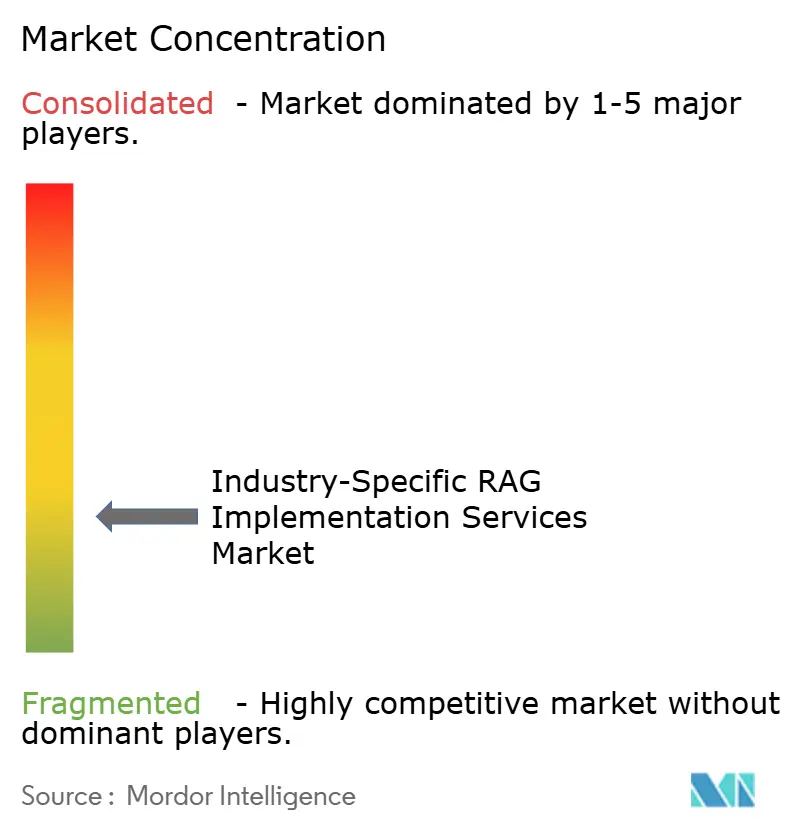
The Industry-Specific RAG Implementation Services Market is fragmented globally, while competition is more concentrated within individual sectors and regions. Accenture, Deloitte, Capgemini, Tata Consultancy Services, Infosys, and NTT DATA compete for large enterprise projects. Their offers combine sector knowledge, compliance frameworks, retrieval accelerators, and cloud partnerships. Accenture launched its Microsoft Forward Deployed Engineering practice in March 2026 to embed joint teams and accelerate AI deployments using Microsoft tools. IBM introduced Enterprise Advantage in January 2026 to support the delivery of governed, agentic AI with OpenRAG on watsonx. data, showing how leading integrators are productizing repeatable delivery components and pursuing recurring cloud use.
Infrastructure vendors increasingly offer services that overlap with implementation work. Pinecone, Weaviate, Cohere, and Databricks can act as platform partners while competing for parts of the retrieval and operating stack. Databricks lists Accenture, Capgemini, Deloitte, Infosys, and Wipro as Agent Bricks integration partners, placing it in both enabling and competitive roles. The Industry-Specific RAG Implementation Services Market, therefore, rewards providers that retain a clear role in corpus preparation, evaluation, and workflow integration. Weaviate's Engram entered general availability in 2025 as a managed memory and context service that can reduce some custom retrieval work while creating a platform for specialized deployments.
Open opportunities remain in healthcare and financial services evaluation methods, air-gapped systems, and multilingual corpus engineering, all of which require knowledge of local rules, domain-specific documents, and language-specific retrieval behavior. Microsoft disclosed 2 remote code execution vulnerabilities in its Semantic Kernel agent framework in May 2026, underscoring the need for security measures that limit prompt injection and prevent permission leakage. Intellectual property related to permissioned retrieval and governance can strengthen a provider's position alongside its delivery experience, and LangChain and LlamaIndex remain enabling framework vendors rather than primary professional services providers. ThoughtWorks, Slalom, DataStax, and Quantiphi are closer alternatives where buyers seek implementation delivery, leaving room for both global integrators and specialized regional firms.
Leaders of Industry-Specific RAG Implementation Services Market
-
Accenture plc
-
International Business Machines Corporation
-
Capgemini SE
-
Deloitte Touche Tohmatsu Limited
-
Tata Consultancy Services Limited
- *Disclaimer: Major Players sorted in no particular order
Industry-Specific RAG Implementation Services Market Companies Covered in this Report
- Accenture plc
- Amazon Web Services, Inc.
- Microsoft Corporation
- Alphabet Inc.
- International Business Machines Corporation
- Oracle Corporation
- Databricks, Inc.
- Cohere Inc.
- Pinecone Systems, Inc.
- Weaviate B.V.
- LangChain, Inc.
- LlamaIndex, Inc.
- Deloitte Touche Tohmatsu Limited
- Capgemini SE
- Tata Consultancy Services Limited
- Infosys Limited
- Wipro Limited
- HCL Technologies Limited
- NTT DATA Corporation
- ScalaCode
- Uvik Software
- Nimap Infotech
- Perimattic
Recent Industry Developments in Industry-Specific RAG Implementation Services Market
- August 2026: Cohere released Command A+ as open-source software under Apache 2.0 license, a mixture-of-experts model optimized for RAG, agentic workflows, and multilingual document processing across 48 languages. The release gives implementation partners a commercially deployable foundation model for on-premise RAG architectures without per-token API costs.
- July 2026: Amazon Web Services launched Amazon S3 Vectors in preview, integrated with Amazon Bedrock Knowledge Bases, enabling enterprises to reduce vector upload, storage, and query costs by up to 90% relative to prior configurations. The launch further commoditizes managed vector search infrastructure, directing implementation-provider differentiation toward corpus quality, evaluation methodology, and domain expertise rather than retrieval engineering.
- June 2026: GMO Prime Strategy launched GMO AI RAG Enterprise on June 30, 2026, a corporate RAG product for the Japanese market that supports both cloud and on-premises deployment, with an open-source release planned for autumn 2026. The product reflects the growing Japanese enterprise preference for domestically hosted RAG solutions compliant with the Act on Protection of Personal Information.
- May 2026: Microsoft Security Blog disclosed 2 remote code execution vulnerabilities, CVE-2026-25592 and CVE-2026-26030, in the Semantic Kernel AI agent framework, demonstrating that prompt injection in RAG-connected agents can escalate to unauthorized code execution. The disclosure accelerated enterprise demand for specialist RAG security assessment services and reinforced the need for permissioned retrieval architectures with least-privilege access controls.
Scope of Report on Industry-Specific RAG Implementation Services Market
The Industry-Specific RAG Implementation Services Market refers to specialized consulting and development services that design, build, and integrate Retrieval-Augmented Generation (RAG) systems tailored to the unique data and compliance needs of specific sectors. These services encompass strategy, architecture design, data engineering, and application development to create customized, secure knowledge bases. Deployed across cloud, on-premises, or hybrid environments, they help enterprises in healthcare, finance, legal, and other industries leverage their proprietary data accurately to enhance AI outputs while maintaining regulatory compliance.
The Industry-Specific RAG Implementation Services Market Report is Segmented by Service Type (Strategy and Advisory Services, Architecture and Design Services, Data Engineering and Knowledge-Base Services, RAG Application Development and Integration Services, and Other Services), Industry Vertical (Financial Services and Insurance, Healthcare and Life Sciences, Legal and Compliance, Manufacturing and Industrial, Retail and E-Commerce, Information Technology and Telecommunications, and Other Industry Verticals), Organization Size (Large Enterprises, and Small and Mid-Sized Enterprises), Deployment Model (Cloud, On-Premises, and Hybrid), and Geography (North America, South America, Europe, Asia-Pacific, Middle East, and Africa). The Market Forecasts are Provided in Terms of Value (USD).
Segmentation Overview
| Strategy and Advisory Services |
| Architecture and Design Services |
| Data Engineering and Knowledge-Base Services |
| RAG Application Development and Integration Services |
| Other Service Types |
| Financial Services and Insurance |
| Healthcare and Life Sciences |
| Legal and Compliance |
| Manufacturing and Industrial |
| Retail and E-Commerce |
| Information Technology and Telecommunications |
| Other Industry Verticals |
| Large Enterprises |
| Small and Mid-Sized Enterprises |
| Cloud |
| On premise |
| Hybrid |
| North America | United States |
| Canada | |
| Mexico | |
| South America | Brazil |
| Argentina | |
| Chile | |
| Rest of South America | |
| Europe | Germany |
| United Kingdom | |
| France | |
| Italy | |
| Spain | |
| Rest of Europe | |
| Asia-Pacific | China |
| Japan | |
| India | |
| South Korea | |
| Australia | |
| Rest of Asia-Pacific | |
| Middle East | United Arab Emirates |
| Saudi Arabia | |
| Qatar | |
| Rest of Middle East | |
| Africa | South Africa |
| Egypt | |
| Nigeria | |
| Rest of Africa |
| By Service Type | Strategy and Advisory Services | |
| Architecture and Design Services | ||
| Data Engineering and Knowledge-Base Services | ||
| RAG Application Development and Integration Services | ||
| Other Service Types | ||
| By Industry Vertical | Financial Services and Insurance | |
| Healthcare and Life Sciences | ||
| Legal and Compliance | ||
| Manufacturing and Industrial | ||
| Retail and E-Commerce | ||
| Information Technology and Telecommunications | ||
| Other Industry Verticals | ||
| By Organization Size | Large Enterprises | |
| Small and Mid-Sized Enterprises | ||
| By Deployment Model | Cloud | |
| On premise | ||
| Hybrid | ||
| By Geography | North America | United States |
| Canada | ||
| Mexico | ||
| South America | Brazil | |
| Argentina | ||
| Chile | ||
| Rest of South America | ||
| Europe | Germany | |
| United Kingdom | ||
| France | ||
| Italy | ||
| Spain | ||
| Rest of Europe | ||
| Asia-Pacific | China | |
| Japan | ||
| India | ||
| South Korea | ||
| Australia | ||
| Rest of Asia-Pacific | ||
| Middle East | United Arab Emirates | |
| Saudi Arabia | ||
| Qatar | ||
| Rest of Middle East | ||
| Africa | South Africa | |
| Egypt | ||
| Nigeria | ||
| Rest of Africa | ||
Key Questions Answered in the Report
What is the size of the Industry-Specific RAG Implementation Services Market?
The market is projected to grow from USD 1.31 billion in 2026 to USD 3.37 billion by 2031, at a CAGR of 20.80%.
What services are most in demand for RAG implementations?
RAG Application Development and Integration Services led with 41.68% share in 2025, while Data Engineering and Knowledge-Base Services is forecast to grow at a 21.45% CAGR.
Which sector is adopting RAG services most rapidly?
Healthcare and Life Sciences is forecast to expand at a 21.63% CAGR through 2031, supported by clinical and regulatory use cases.
Why do regulated organizations use RAG systems?
RAG systems can link generated responses to source material, which supports review, record-keeping, permissions, and governance requirements.
Why is on-premise RAG deployment growing?
On-premise deployment is forecast to grow at a 21.55% CAGR through 2031 because some clients need data sovereignty, local processing, or air-gapped architecture.
Which region is growing fastest for RAG implementation services?
Asia-Pacific is forecast to grow at a 21.83% CAGR through 2031, supported by demand in Japan, India, China, South Korea, and Australia.