
Industrial Tapes Market Size and Share
Market Overview
| Study Period | 2021 - 2031 |
|---|---|
| Market Size (2026) | USD 58.43 Billion |
| Market Size (2031) | USD 77.55 Billion |
| Growth Rate (2026 - 2031) | 5.83 % |
| Fastest Growing Market | Asia-Pacific |
| Largest Market | Asia-Pacific |
| Market Concentration | Medium |
Major Players *Disclaimer: Major Players sorted in no particular order Image © Mordor Intelligence. Reuse requires attribution under CC BY 4.0. | |
Industrial Tapes Market Analysis by Mordor Intelligence
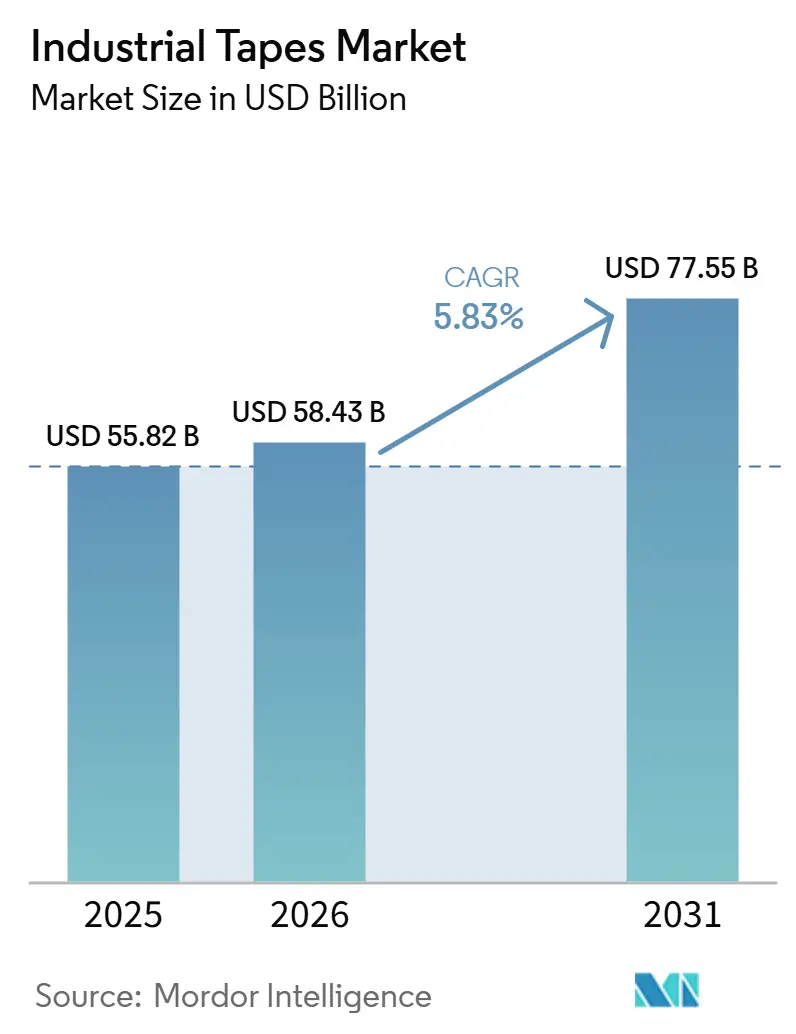
The Industrial Tapes Market was valued at USD 55.82 billion in 2025 and is estimated to grow from USD 58.43 billion in 2026 to reach USD 77.55 billion by 2031, at a CAGR of 5.83% during the forecast period (2026–2031). Growth is supported by manufacturing investment, electric vehicle production, electronic device production, and tighter environmental requirements. Tapes are increasingly specified for bonding, insulation, thermal management, shielding, sealing, and surface protection, rather than being treated as a standard consumable. This shift gives suppliers more scope to compete through application-specific materials and automated formats. Demand is also moving toward products that reduce weight, meet low-Volatile Organic Compounds (VOC) requirements, or support repair and recycling. Feedstock disruption and compliance costs remain material constraints, especially for smaller converters serving price-sensitive applications.
Key Report Takeaways
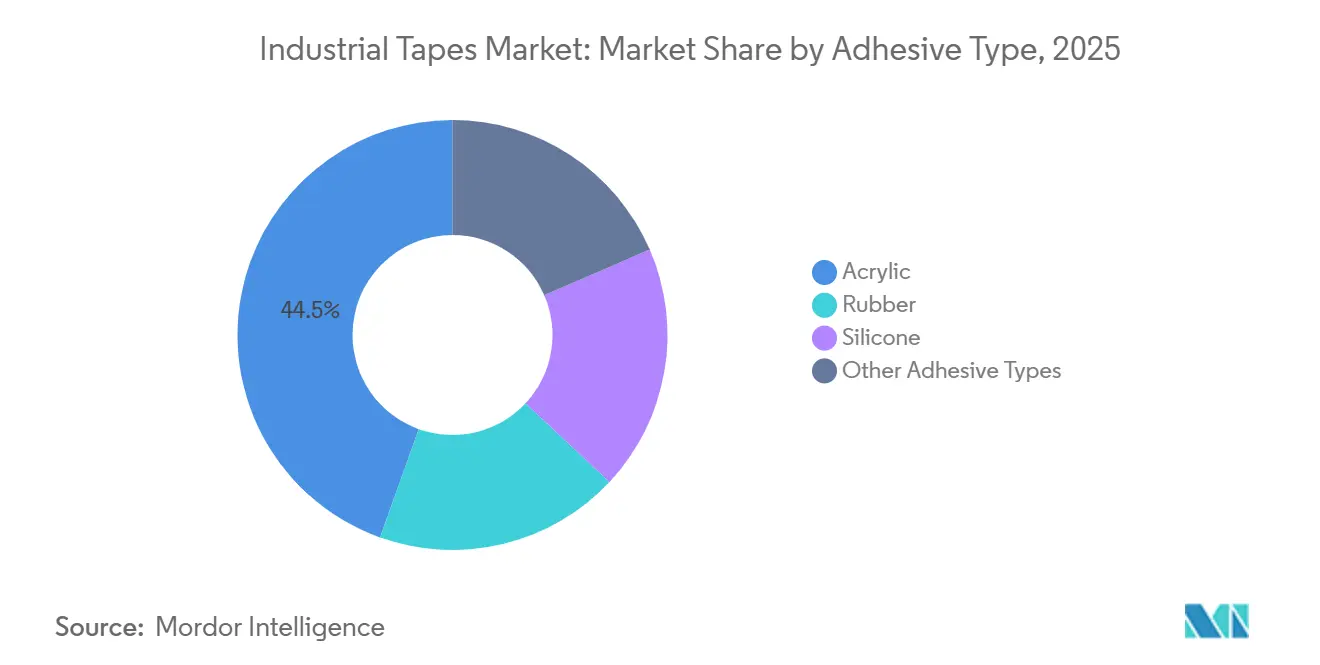
- By adhesive type, acrylic adhesives held 44.52% of the industrial tapes market share in 2025, while silicone adhesives are forecast to grow at a 6.93% CAGR through 2031.
- By product, duct tapes held 29.85% of the industrial tapes market share in 2025, while adhesive transfer tapes are forecast to grow at a 6.87% CAGR through 2031.
- By adhesive technology, pressure-sensitive adhesives held 49.41% of the industrial tapes market share in 2025, while water-based adhesives are forecast to grow at a 6.61% CAGR through 2031.
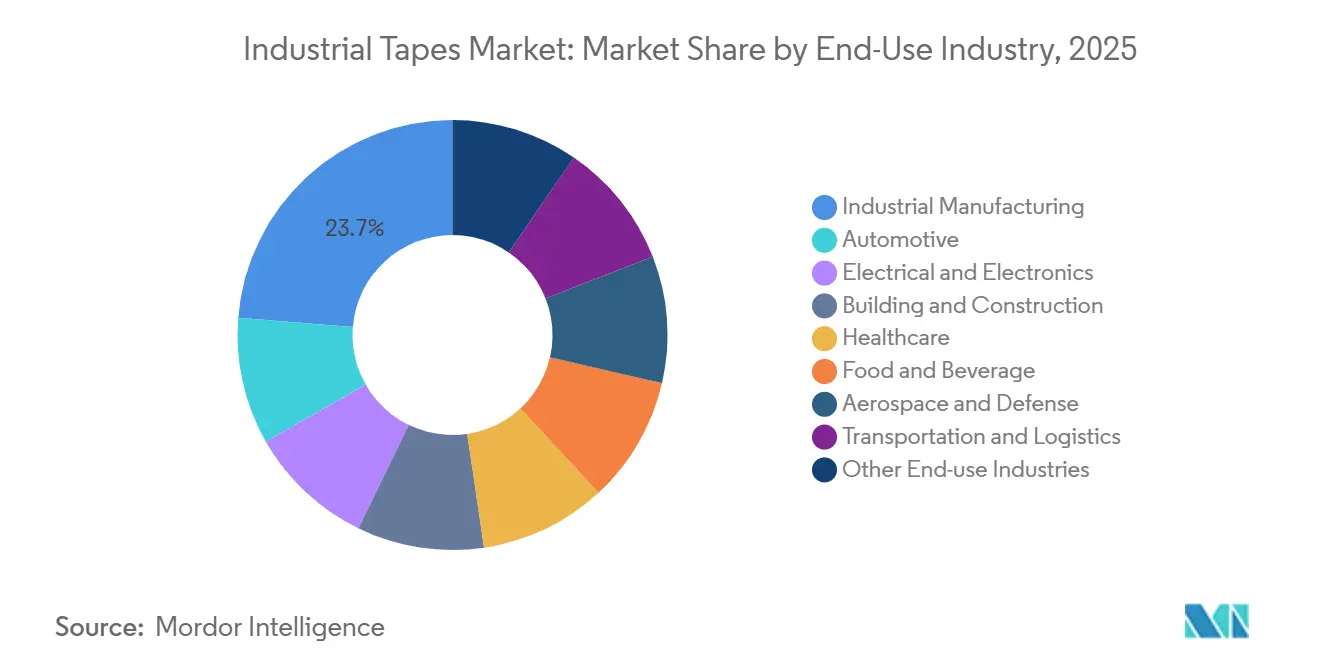
- By end-use industry, industrial manufacturing held 23.72% of the industrial tapes market share in 2025, while electrical and electronics is forecast to grow at a 7.04% CAGR through 2031.
- By geography, Asia-Pacific held 42.94% of the industrial tapes market share in 2025 and is forecast to grow at a 6.45% CAGR through 2031.
Note: Market size and forecast figures in this report are generated using Mordor Intelligence’s proprietary estimation framework, updated with the latest available data and insights as of January 2026.
Market Trends and Insights
Drivers Impact Analysis of Industrial Tapes Market*
| Driver | (~) % Impact on CAGR Forecast | Geographic Relevance | Impact Timeline |
|---|---|---|---|
| Increasing Adoption of Industrial Tapes in Electric Vehicle Battery Assembly and Thermal Management | +1.4% | Global, with concentration in China, South Korea, Germany, and United States | Medium term (2-4 years) |
| Growing Demand for Lightweight Bonding Solutions as Alternatives to Mechanical Fasteners | +1.2% | North America & EU, spill-over to APAC premium segments | Long term (≥ 4 years) |
| Rising Miniaturization of Electronic Devices Driving Demand for High-Precision Tapes | +0.9% | APAC core (Japan, South Korea, Taiwan, China), spill-over to North America | Short term (≤ 2 years) |
| Growing Preference for Low-VOC and Environmentally Sustainable Adhesive Tape Solutions | +0.7% | EU-led, expanding to North America and APAC | Medium term (2-4 years) |
| Increasing Automation in Manufacturing and Robotic Tape Application Processes | +0.6% | Global, concentrated in North America, APAC, and EU | Medium term (2-4 years) |
| Source: Mordor Intelligence | |||
Increasing Adoption of Industrial Tapes in Electric Vehicle Battery Assembly and Thermal Management
Electric vehicle battery assembly is creating demand for functional tapes across bonding, insulation, thermal management, fire protection, electromagnetic shielding, and compressive sealing. These applications require materials that can perform several functions within a limited battery-pack space. Henkel introduced Bergquist TGF 2030APS in May 2026 as a silicone-free thermal gap filler with 1.7 W/(m·K) conductivity and room-temperature cure. The company also introduced Loctite TLB 9270APS, a polyurethane-based thermally conductive adhesive with 2 W/(m·K) conductivity for cell-to-pack designs. As cell-to-pack designs reduce the number of discrete components, tape selection carries more structural and safety responsibility.
Growing Demand for Lightweight Bonding Solutions as Alternatives to Mechanical Fasteners
Manufacturers are using tapes in place of rivets, screws, and welds in selected automotive and aerospace assemblies. Tapes can bond dissimilar materials without the localized stress concentrations associated with mechanical fasteners. At Automotive Engineering Expo 2026, tesa presented its ProSeal automated hole-cover system, which replaces conventional resin plugs. The system can save an average of 280 g per vehicle through weight reduction of up to 80%. Henkel also launched the Teroson EP 52 Series in May 2026 to replace bitumen sheets in body-in-white production while providing vibration damping. Supplier approvals for structural tape applications can strengthen the position of manufacturers that secure design specifications early in a vehicle program.
Rising Miniaturization of Electronic Devices Driving Demand for High-Precision Tapes
Smaller electronic components are increasing the requirements for tapes used in wafer handling, die attachment, and advanced packaging. A 2025 European Microelectronics Packaging Conference paper described a carrier tape for direct transfer bonding that achieved a 97% bonding ratio with 10 μm-thick chips in heterogeneous 3D integration. Such applications depend on repeatable handling, clean removal, and controlled adhesion. Advanced packaging and flexible-display production, therefore, require more specialized tape constructions than general assembly operations. Silicone and UV-release tapes serve high-temperature and release-critical processes that standard pressure-sensitive materials may not meet. This supports demand for suppliers that can qualify materials for semiconductor manufacturing and high-precision electronics applications.
Growing Preference for Low-VOC and Environmentally Sustainable Adhesive Tape Solutions
Sustainability requirements are changing tape specifications in automotive, furniture, construction, and interior applications. Avery Dennison offers a solvent-free UV acrylic pressure-sensitive adhesive platform designed for low-VOC requirements. Its materials address requirements associated with M1, EC1+, and Nordic Swan Ecolabel standards. 3M reported that its VHB LVO Tape Family reduced VOCs by 85% and fog emissions by 80% compared with common acrylic foam tapes. The German Adhesives Industry Association reported that circular-economy requirements are increasing interest in debondable, reversible, and recyclable adhesive solutions. Suppliers must also maintain current compliance documentation as product requirements change.
Restraints Impact Analysis of Industrial Tapes Market*
| Restraint | (~) % Impact on CAGR Forecast | Geographic Relevance | Impact Timeline |
|---|---|---|---|
| Volatility in Raw Material Prices Affecting Adhesive and Backing Material Costs | -0.9% | Global, most acute in Europe and APAC; heightened exposure from Hormuz supply disruptions | Short term (≤ 2 years) |
| Stringent Environmental and Regulatory Compliance Requirements, Including REACH and RoHS | -0.5% | EU & global export supply chains; regulatory influence strongest in Germany, France, Nordics | Medium term (2-4 years) |
| Competition from Mechanical Fastening and Alternative Bonding Technologies in Heavy-Duty Applications | -0.4% | Heavy industrial and structural segments globally | Long term (≥ 4 years) |
| Source: Mordor Intelligence | |||
Volatility in Raw Material Prices Affecting Adhesive and Backing Material Costs
Adhesive tape production depends on acrylic, silicone, synthetic rubber, solvents, films, and other inputs whose prices can change quickly. Feedstock constraints can raise costs for acrylic adhesives, silicone tapes, synthetic-rubber compounds, and solvent-based systems. These changes can shorten quotation periods and complicate material planning for converters. Smaller regional companies may have less ability to secure feedstock through longer supply contracts. Their working capital can come under pressure during periods of higher material prices. This can limit capacity expansion even when customers are seeking additional supply, especially in standard tape categories.
Stringent Environmental and Regulatory Compliance Requirements, Including REACH and RoHS
European requirements create ongoing formulation and documentation work for tape manufacturers. The European Chemicals Agency requires suppliers to communicate when articles contain more than 0.1% of a candidate-list substance of very great concern by weight[1]European Chemicals Agency, “Candidate List of Substances of Very High Concern for Authorization,” European Chemicals Agency, echa.europa.eu. AFERA stated in April 2026 that tape producers must track the Packaging and Packaging Waste Regulation, REACH restrictions, the EU Deforestation Regulation, microplastics and per- and polyfluoroalkyl substances (PFAS) policies, and supply-chain due diligence requirements. Customers increasingly expect safety data sheets, life-cycle data, REACH declarations, and lot traceability as part of the supplier package. This requirement can favor established suppliers with regulatory resources and formal quality systems. It can also raise entry barriers in the European automotive, electronics, and other regulated applications.
*Our forecasts treat driver/restraint impacts as directional, not additive. The impact forecasts reflect baseline growth, mix effects, and variable interactions.
Industrial Tapes Market Segment Analysis
By Adhesive Type:
Acrylic Leads While Silicone Serves High-Performance ApplicationsAcrylic accounted for 44.52% of the industrial tapes market share in 2025. Their position reflects UV resistance, broad compatibility with substrates, and use in water-based adhesive systems. Water-based acrylic materials align with the shift away from higher-solvent formulations in Europe, North America, and Japan. Lohmann offers DuploCOLL TC thermally conductive acrylic transfer tapes with thermal conductivity of up to 2 W/(m·K), tested under ASTM D 5470. These products show that acrylic systems can serve applications once more closely associated with silicone formulations. Rubber adhesives continue to support packaging, duct tape, and general maintenance applications, where their familiar performance and cost position remain relevant.
Silicone is forecast to grow at a 6.93% CAGR through 2031. It serves extreme-temperature settings such as EV battery modules, semiconductor masking, and aerospace applications. Silicone systems are used where performance requirements exceed the operating range of many acrylic or rubber products. Demand from foldable screens, wearables, and sensor applications also broadens their end-use base. Polyurethane and hot-melt hybrid formulations support smaller structural-bonding and automotive-sealing uses. The industrial tapes industry continues to require several adhesive chemistries because no single formulation meets every temperature, substrate, release, and durability requirement.



By Product:
Duct Tapes Retain Broad Use While Transfer Tapes Gain From AutomationDuct tapes held 29.85% of the industrial tapes market share in 2025. They remain common in construction, heating, ventilation, and air conditioning (HVAC), maintenance, repair, and general industrial work. Their utility comes from tear resistance, conformability, and hand-tearability across varied operating conditions. These characteristics support demand across a wider product range than many specialized tapes. Aluminum tapes retain use in HVAC, thermal insulation, and aerospace ducting. Filament tapes also support transportation, logistics, and palletizing, where tensile reinforcement is required with adhesion.
Adhesive transfer tapes are forecast to expand at a 6.87% CAGR through 2031. Their adhesive-film construction supports accurate robotic application and can reduce backing material waste. This suits electronics, body-in-white assembly, and medical-device production. 3M Adhesive Transfer Tape 966NP meets NASA low-outgassing specifications under ASTM E 595 for demanding aerospace and semiconductor environments. 3M also offers Electrically Debondable Tape 1100-050, which releases from conductive surfaces under electrical stimulus and supports rework without solvent exposure. Debondable formats can support repair-oriented product designs as circularity requirements become more important.
By Adhesive Technology:
Pressure-Sensitive Adhesives Lead While Water-Based Materials Grow FastestPressure-sensitive adhesives held 49.41% of the industrial tapes market share in 2025. They bond on contact, can allow repositioning before the final set, and work with automated dispensing and lamination equipment. These features support their use in manufacturing operations that need short processing times. Solvent-based adhesives retain roles in offshore, chemical-processing, and high-temperature applications where alternatives may not meet all specifications. Hot-melt adhesives serve packaging, woodworking, and product assembly applications that benefit from processing speed. Their higher application temperature can limit use with sensitive electronic components.
Water-based adhesives are forecast to grow at a 6.61% CAGR through 2031. Their expansion is tied to lower-VOC requirements and improving performance in demanding applications. Avery Dennison identifies Nordic VOC limits and EC1+ certification as factors supporting solvent-free pressure-sensitive tapes in furniture, construction, and interior applications. Gergonne documents SEA tech water-based acrylic chemistry with very low VOC, fogging, and odor levels. Performance on low-surface-energy substrates remains important because polypropylene and polyethylene are widely used in consumer and industrial products. Suppliers that improve this capability can address replacement demand from solvent-based systems.
By End-Use Industry:
Industrial Manufacturing Anchors Demand While Electrical and Electronics Leads GrowthIndustrial manufacturing accounted for 23.72% of the industrial tapes market share in 2025. This segment includes metal bonding, masking, surface protection, cable bundling, sealing, and reinforcement. Its wide application base supports stable demand across many manufacturing subsectors. Demand is increasingly supported by structural bonding in composite production and robotic pressure-sensitive tape application. Automotive, construction, and health care are also established uses with diverse requirements. Transportation and logistics continue to require filament and strapping tapes for shipping-related applications.
Electrical and electronics is forecast to grow at a 7.04% CAGR through 2031. Demand is linked to OLED display assembly, data-center thermal management, advanced semiconductor packaging, and EV power electronics. Each use requires specialized solutions for heat, electrical insulation, controlled release, or precise placement. Aerospace and defense require application-specific qualification requirements. According to tesa, tesa 4965 Original Next Gen carries Airbus AIMS/AIPS 10-05-031 qualification and DIN EN 45545-2 certification. Health care applications also require biocompatible and skin-safe adhesive formulations for wound care, device assembly, and wearable sensors.
Geography Analysis
APAC Industrial Tapes Market
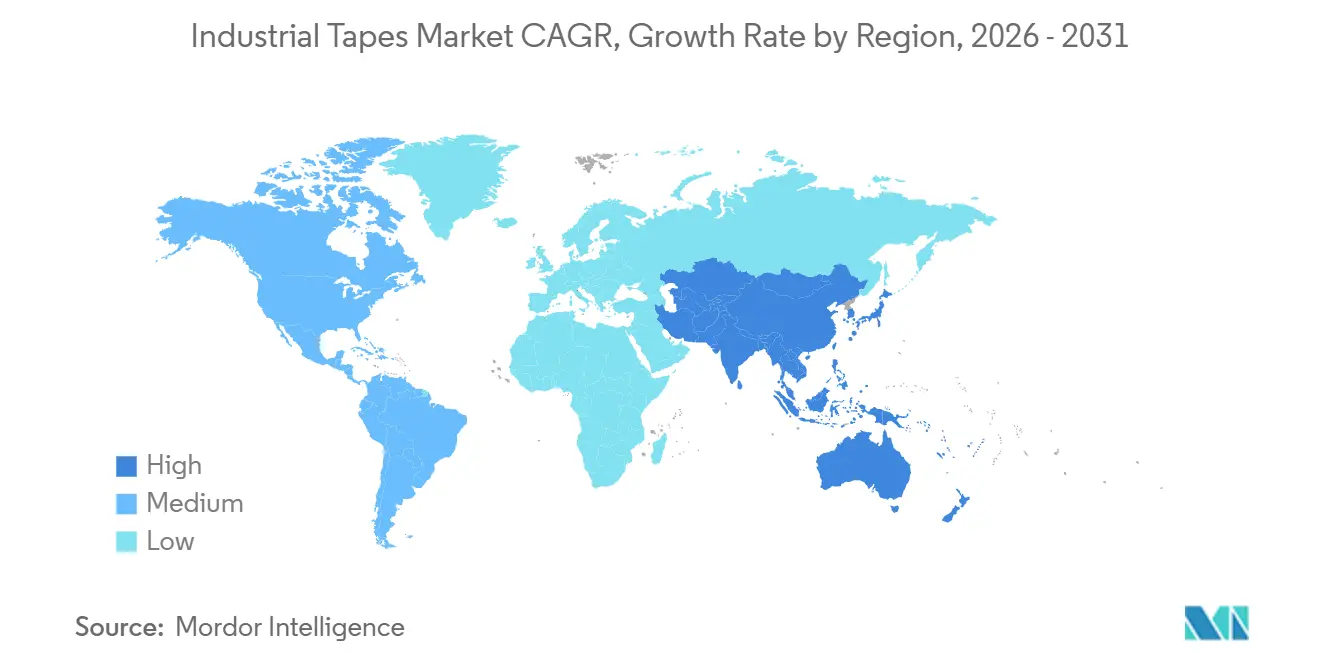
Asia-Pacific held 42.94% of the industrial tapes market share in 2025 and is forecast to grow at a 6.45% CAGR through 2031. The region combines battery manufacturing, consumer-electronics assembly, semiconductor fabrication, and automotive capacity. China is driving demand because of its scale in vehicle and electronics production. China produced 7.02 million new energy vehicles in 2024, up 35.8% from the prior year[2]China Association of Automobile Manufacturers, “New Energy Vehicle Production Statistics,” China Association of Automobile Manufacturers, caam.org.cn. Japan and South Korea have important positions in specialty tape production and high-performance materials. Vietnam, Thailand, and Indonesia are also adding electronics assembly capacity as supply chains diversify within the region.
North America Industrial Tapes Market
North America supports high-value demand from aerospace, automotive, defense, and life sciences manufacturing. The Great Lakes industrial belt concentrates automotive original equipment manufacturers, suppliers, and battery assembly operations. Environmental and worker-safety frameworks encourage water-based and solvent-free tape adoption in manufacturing corridors. Mexico adds demand through automotive and electronics production integrated with the United States and Canada. Automation investment also supports pressure-sensitive and adhesive-transfer tape use. The industrial tapes market has scope to grow where manufacturers use automated applications to improve production consistency and reduce manual assembly steps.
EMEA and South America Industrial Tapes Market
Europe is characterized by a high-value product mix shaped by sustainability requirements and premium OEM specifications. Germany, France, and the United Kingdom remain important demand centers for automotive, industrial, and electronics applications. Industrieverband Klebstoffe (IVK) reported that demand for debondable, recyclable, and bio-based adhesive formats is rising within circular-economy-oriented product development. South America is smaller, with Brazil and Argentina supported by automotive, packaging, and construction demand. In the Middle-East and Africa, infrastructure programs support longer-term demand for construction, HVAC, and maintenance tapes.

Competitive Landscape
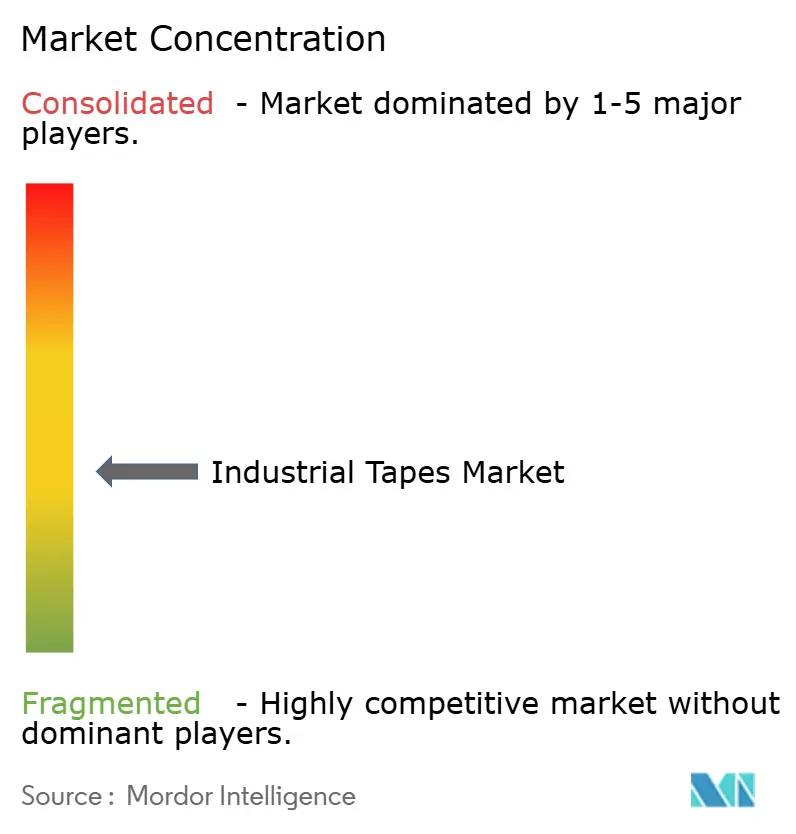
The industrial tapes market is moderately concentrated. 3M, tesa SE, Nitto Denko, Avery Dennison, and Henkel compete in EV battery tapes, semiconductor process tapes, and structural-bonding formats. The wider category remains fragmented because regional converters compete in duct, masking, packaging, and other standard tapes. Product capability, customer qualification, service, and delivery reliability shape competition alongside price. Leading suppliers are focusing on EV-specific functional materials, automation-ready formats, and lower-impact product designs. This leaves room for regional suppliers that offer die-cut or pre-laminated components for direct assembly-line use.
3M reported Industrial Adhesives and Tapes revenue of USD 1,246 million in the first half of 2026, up 12.1% from USD 1,111 million in the first half of 2025. Its second-quarter 2026 revenue for the segment was USD 642 million. Tesa launched tesa 4965 Original Next Gen in 2025 with a 40% reduction in product carbon footprint and a 90% post-consumer recycled polyethylene terephthalate (PET) backing. Henkel presented its Battery Specialty Tapes portfolio at Battery Show Europe 2026, covering bonding, insulation, electromagnetic shielding, protection, and thermal management. These actions show how suppliers are linking material performance with automotive electrification, automation, and environmental requirements.
Debondable and reworkable tapes are a developing area for battery circularity and repair applications. Such products require adhesive systems that can release through electrical, UV, or other controlled methods. Application-engineered formats also offer opportunities where tapes are pre-cut, pre-laminated, or pre-bonded for direct installation. These formats can simplify assembly and reduce handling at customer sites. Product development is increasingly linked with automation equipment and surface-treatment methods that improve bonding on difficult substrates.
Industrial Tapes Industry Leaders
3M
Avery Dennison Corporation
tesa SE
Nitto Denko Corporation
Saint-Gobain
- *Disclaimer: Major Players sorted in no particular order
Industrial Tapes Market Companies Covered in this Report
- 3M
- Advance Tapes International
- American Biltrite Inc.
- Avery Dennison Corporation
- CCT Coating and Converting Technologies, LLC
- Henkel AG and Co. KGaA
- IPG
- LINTEC Corporation
- Lohmann
- Nitto Denko Corporation
- ORAFOL Europe GmbH
- Saint-Gobain
- Scapa
- Shurtape Technologies, LLC
- tesa SE

Recent Industry Developments in Industrial Tapes Market
- June 2026: Superior Tape & Label completed its third identical Weigang flexographic press installation, finishing three major setups within a 12-month period to expand pressure-sensitive tape production in Gresham, Oregon. The company specializes in pressure-sensitive labels and custom label solutions for a range of industries, including food and beverage, healthcare, industrial products, and consumer goods.
- February 2026: Vybond launched the Polyken 790 Clear Flash and Seam Tape, a premium-grade acrylic sealing solution designed for all-weather performance and a clear, inspection-friendly finish at the building envelope. The tape could be installed at temperatures as low as 20ºF without primer and could maintain performance through heat, moisture, and extended exposure during construction.


Global Industrial Tapes Market Report Scope
Industrial tapes are heavy-duty, pressure-sensitive adhesive or specialized non-adhesive materials designed for structural bonding, packaging, and thermal insulation. They serve as efficient alternatives to traditional mechanical fasteners such as screws, rivets, and welds.
The Industrial Tapes Market is segmented by adhesive type, product, adhesive technology, end-use industry, and geography. By adhesive type, the market is segmented into acrylic, rubber, silicone, and other adhesive types. By product, the market is segmented into duct tapes, aluminum tapes, filament tapes, adhesive transfer tapes, and other products. By adhesive technology, the market is segmented into pressure-sensitive adhesives, solvent-based adhesives, water-based adhesives, and hot melt adhesives. By end-use industry, the market is segmented into industrial manufacturing, automotive, electrical and electronics, building and construction, healthcare, food and beverage, aerospace and defense, transportation and logistics, and other end-use industries. The report also covers the market size and forecasts for industrial tapes in 16 countries across major regions. For each segment, the market sizing and forecasts have been done on the basis of value (USD).
| Acrylic |
| Rubber |
| Silicone |
| Other Adhesive Types |
| Duct Tapes |
| Aluminum Tapes |
| Filament Tapes |
| Adhesive Transfer Tapes |
| Other Products |
| Pressure-Sensitive Adhesives |
| Solvent-Based Adhesives |
| Water-Based Adhesives |
| Hot Melt Adhesives |
| Industrial Manufacturing |
| Automotive |
| Electrical and Electronics |
| Building and Construction |
| Healthcare |
| Food and Beverage |
| Aerospace and Defense |
| Transportation and Logistics |
| Other End-use Industries |
| Asia-Pacific | China |
| India | |
| Japan | |
| South Korea | |
| Rest of Asia-Pacific | |
| North America | United States |
| Canada | |
| Mexico | |
| Europe | Germany |
| United Kingdom | |
| France | |
| Italy | |
| Russia | |
| Rest of Europe | |
| South America | Brazil |
| Argentina | |
| Rest of South America | |
| Middle-East and Africa | Saudi Arabia |
| South Africa | |
| Rest of Middle-East and Africa |
| By Adhesive Type | Acrylic | |
| Rubber | ||
| Silicone | ||
| Other Adhesive Types | ||
| By Product | Duct Tapes | |
| Aluminum Tapes | ||
| Filament Tapes | ||
| Adhesive Transfer Tapes | ||
| Other Products | ||
| By Adhesive Technology | Pressure-Sensitive Adhesives | |
| Solvent-Based Adhesives | ||
| Water-Based Adhesives | ||
| Hot Melt Adhesives | ||
| By End-Use Industry | Industrial Manufacturing | |
| Automotive | ||
| Electrical and Electronics | ||
| Building and Construction | ||
| Healthcare | ||
| Food and Beverage | ||
| Aerospace and Defense | ||
| Transportation and Logistics | ||
| Other End-use Industries | ||
| By Geography | Asia-Pacific | China |
| India | ||
| Japan | ||
| South Korea | ||
| Rest of Asia-Pacific | ||
| North America | United States | |
| Canada | ||
| Mexico | ||
| Europe | Germany | |
| United Kingdom | ||
| France | ||
| Italy | ||
| Russia | ||
| Rest of Europe | ||
| South America | Brazil | |
| Argentina | ||
| Rest of South America | ||
| Middle-East and Africa | Saudi Arabia | |
| South Africa | ||
| Rest of Middle-East and Africa | ||


Key Questions Answered in the Report
What is the size of the industrial tapes market?
The industrial tapes market stands at USD 58.43 billion in 2026 and is projected to reach USD 77.55 billion by 2031.
Which adhesive type led the demand in 2025?
Acrylic led with a 44.52% share in 2025, supported by broad substrate compatibility and UV resistance. Water-based acrylic systems also align with lower-VOC material preferences across the industrial tapes market.
Which industrial tapes market product segment is expected to grow fastest?
Adhesive transfer tapes are forecast to grow at a 6.87% CAGR through 2031 as automated assembly expands. Their liner-less construction supports accurate bond placement and reduces backing-material waste.
Which end-use industry is expected to grow fastest?
Electrical and electronics is forecast to grow at a 7.04% CAGR through 2031, supported by displays, semiconductor packaging, and EV power electronics. High-specification products address heat, insulation, release, and precise placement needs.
Page last updated on:





