
Industrial Nitrogen Gas Generators Market Size and Share
Market Overview
| Study Period | 2021 - 2031 |
|---|---|
| Market Size (2026) | USD 3.58 Billion |
| Market Size (2031) | USD 4.67 Billion |
| Growth Rate (2026 - 2031) | 5.46 % |
| Fastest Growing Market | Asia-Pacific |
| Largest Market | Asia-Pacific |
| Market Concentration | Medium |
Major Players *Disclaimer: Major Players sorted in no particular order Image © Mordor Intelligence. Reuse requires attribution under CC BY 4.0. | |
Industrial Nitrogen Gas Generators Market Analysis by Mordor Intelligence
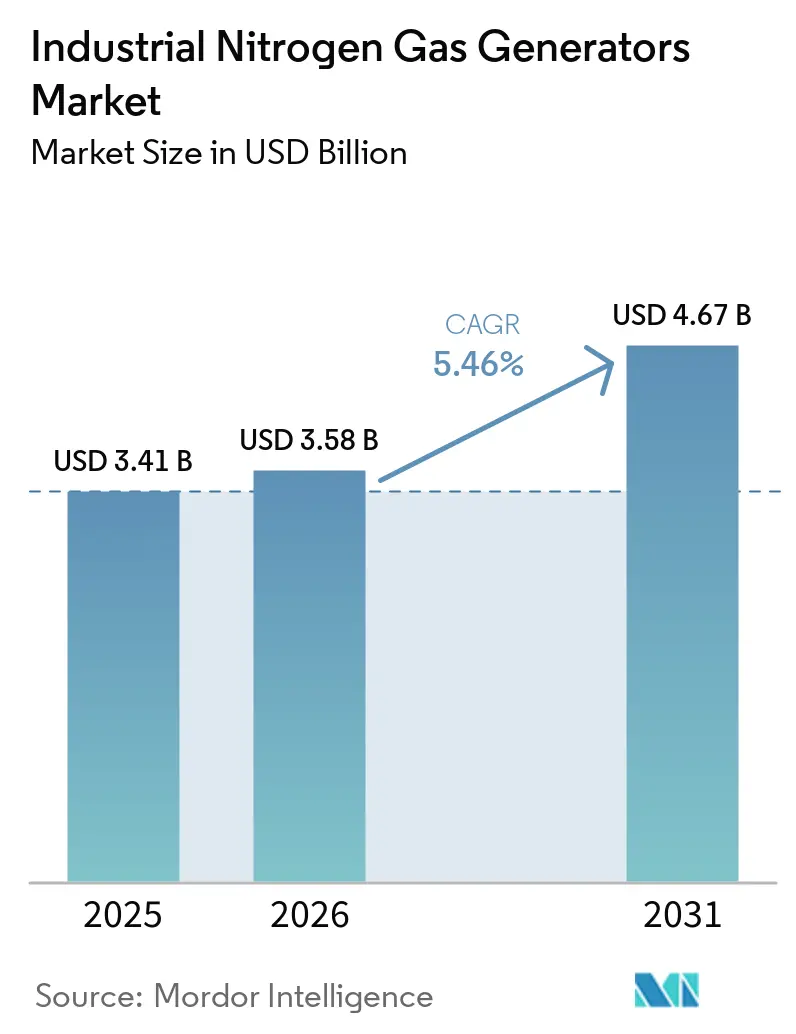
The Industrial Nitrogen Gas Generators Market size is expected to increase from USD 3.41 billion in 2025 to USD 3.58 billion in 2026 and reach USD 4.67 billion by 2031, at a CAGR of 5.46% over 2026-2031. Growth reflects a broad move from delivered gas toward on-site production, especially where continuous operations depend on dependable nitrogen availability. Buyers increasingly treat self-generation as a supply-security decision because it avoids cylinder logistics and bulk-liquid delivery dependencies. The industrial nitrogen gas generators market also benefits when users need stable purity at the point of use and seek a clearer view of operating costs. Semiconductor investment, food packaging demand, and wider manufacturing activity support equipment orders across several applications. Competition is moving beyond equipment supply toward service coverage, engineering support, monitoring tools, and financing models that can lower adoption barriers.
Key Report Takeaways
- By equipment type, PSA systems held 53.5% of industrial nitrogen gas generators market share in 2025, while the same segment is forecast to grow at a 5.7% CAGR through 2031.
- By capacity, units up to 1,000 SCFH held 45.4% of revenue in 2025, while the 1,000-5,000 SCFH segment is forecast to expand at a 5.9% CAGR through 2031.
- By end-use industry, food and beverage held 30.1% of revenue in 2025 and is forecast to grow at a 6.4% CAGR through 2031.
- By geography, Asia-Pacific held 38.7% of revenue in 2025 and is forecast to grow at a 5.7% CAGR through 2031.
Note: Market size and forecast figures in this report are generated using Mordor Intelligence’s proprietary estimation framework, updated with the latest available data and insights as of January 2026.
Market Trends and Insights
Drivers Impact Analysis of Industrial Nitrogen Gas Generators Market*
| Driver | (~) % Impact on CAGR Forecast | Geographic Relevance | Impact Timeline |
|---|---|---|---|
| Delivered-Gas Substitution and Supply Autonomy | +1.30% | Global | Short term (≤ 2 years) |
| Industrial Electronics and Semiconductor Purity Requirements | +1.00% | Asia-Pacific core (China, South Korea, Japan); spill-over to US, EU | Medium term (2–4 years) |
| Food and Beverage Shelf-Life and Packaging Control | +1.00% | Global; highest growth in APAC and South America | Short term (≤ 2 years) |
| Modularization and Plug-and-Play Deployment | +0.70% | Global | Medium term (2–4 years) |
| Remote, Offshore, and Mobile Nitrogen Demand | +0.50% | Middle East, North America, North Sea, Southeast Asia | Medium term (2–4 years) |
| Digital Purity and Energy Optimization | +0.40% | Global; early adoption in EU and North America | Long term (≥ 4 years) |
| Source: Mordor Intelligence | |||
Delivered-Gas Substitution and Supply Autonomy
The industrial nitrogen gas generators market benefits because on-site generation has a strong financial case for many mid-sized and large industrial users. A well-specified PSA system can recover its capital cost within 6-18 months when it replaces cylinders or bulk liquid. After payback, the main recurring costs are electricity and scheduled maintenance. The industrial nitrogen gas generators market gains from this shift because users reduce exposure to gas-price changes and external delivery schedules. In chemicals, electronics assembly, and refining, a nitrogen interruption can stop a production line and cost more than the gas itself. The compressor and generator setup, therefore, serves both as equipment and as protection against supply interruptions.
Industrial Electronics and Semiconductor Purity Requirements
The industrial nitrogen gas generators market requires very high nitrogen purity for semiconductor manufacturing and creates demand for advanced on-site systems. Advanced fabs require nitrogen at 99.999% purity or more, while oxygen and moisture must remain at very low levels. At the 2-nanometer node, point-of-use oxygen must stay at or below 1 part per million, and dew points can reach −70°C or lower[1]. Large fab consumption makes certified cylinder supply at these specifications costly. Air Liquide announced investments of more than USD 170 million in Indiana for SK hynix’s first United States advanced chip-packaging facility in July 2026. It also committed nearly EUR 200 million, reported as USD 232 million, for a nitrogen unit serving SK hynix’s HBM packaging facility in South Korea.
Food and Beverage Shelf-Life and Packaging Control
The industrial nitrogen gas generators market is supported when modified atmosphere packaging replaces oxygen in food packs with nitrogen across meat, dairy, bakery, and ready-meal products. It is established in Europe and North America and continues to expand in Southeast Asia and South America. The European Industrial Gases Association updated its food-use guidance in July 2024 for PSA, membrane, and cryogenic technologies, HACCP requirements, and nitrogen E941 certification pathways[2]. These requirements favor documented systems that can meet audit and traceability needs. Food producers using generator-produced nitrogen must meet the same quality requirements as buyers of certified cylinder gas. On-site production can also reduce emissions associated with nitrogen transport, which matters where retailer procurement rules include sustainability requirements.
Modularization and Plug-and-Play Deployment
The industrial nitrogen gas generators market benefits when skid-mounted and containerized systems lower the engineering burden of adopting on-site nitrogen. These units arrive preassembled and may need only electrical connection at the customer site. Containerized PSA systems designed to ISO 8573-1:2010 can provide purity up to 99.9999% in weather-resistant enclosures. This format fits outdoor oilfields, construction sites, and distributed manufacturing locations. Atlas Copco completed its first commercial LC N2 installation at Swedish stainless-steel fabricator IS Plåt in December 2025[3]. The system combined nitrogen generation, boosting, filtration, and high-pressure storage for laser cutting in one skid, which illustrates the practical value of modular equipment for smaller users.
Restraints Impact Analysis of Industrial Nitrogen Gas Generators Market*
| Restraint | (~) % Impact on CAGR Forecast | Geographic Relevance | Impact Timeline |
|---|---|---|---|
| High Upfront Integration Cost for SMEs | -0.80% | Global; most acute in Southeast Asia, South America, MEA | Short term (≤ 2 years) |
| Compressor Energy Exposure at High Purity | -0.50% | Europe (high electricity tariffs), East Asia | Medium term (2–4 years) |
| Feed-Air Quality and Adsorbent Degradation | -0.40% | APAC (humid climates), MEA, South America | Medium term (2–4 years) |
| Skilled Commissioning and Reliability-Critical Service Gaps | -0.30% | MEA, South America, Southeast Asia | Long term (≥ 4 years) |
| Source: Mordor Intelligence | |||
High Upfront Integration Cost for SMEs
Small and medium-sized enterprises in the industrial nitrogen gas generators market often face a high initial cost for an on-site system. A complete installation can include a compressor, dryer, multistage filtration, generator, oxygen analyzer, and buffer storage. Moderate-flow PSA systems can require USD 20,000-100,000 or more before commissioning. This cost can extend buying cycles even when the long-term ownership case is favorable. Gas-as-a-Service models convert equipment spending into a monthly operating payment and can reduce this barrier. These models are more developed in Western Europe and North America than in Southeast Asia, South America, and the Middle East, which limits uptake in several faster-growing locations.
Compressor Energy Exposure at High Purity
Compressed air is the feed gas for on-site nitrogen generation, so electricity remains a central operating cost. Specific energy use rises sharply above 99.5% purity because more compressed air is required for each unit of nitrogen. This issue is important for users that need purity at or above 99.9%. Variable-frequency drives and adaptive cycle controls can improve load matching and adsorption control. Smaller operators may lack the capital and technical support needed to install and commission these tools. Feed-air quality, adsorbent wear, and limited service capability in some regions add further reliability concerns for the industrial nitrogen gas generators market, especially where local operating conditions are difficult.
*Our forecasts treat driver/restraint impacts as directional, not additive. The impact forecasts reflect baseline growth, mix effects, and variable interactions.
Industrial Nitrogen Gas Generators Market Segment Analysis
By Equipment Type:
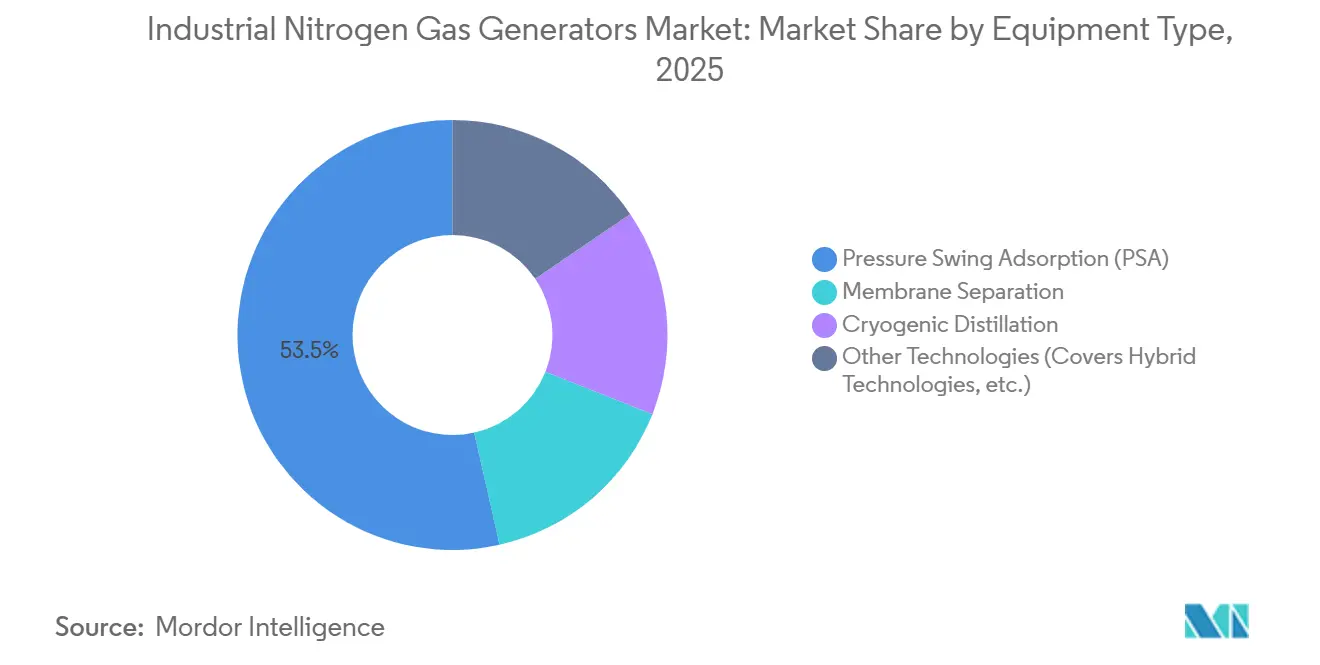
PSA Systems Consolidate Across Purity TiersPSA systems held 53.5% of equipment-type revenue in 2025, making them the leading equipment category in the industrial nitrogen gas generators market. Their range extends from 95% nitrogen for pipeline purging and laser cutting to 99.999% nitrogen for semiconductor cleanrooms. PSA technology uses carbon molecular sieve beds that preferentially adsorb oxygen from compressed air. Twin-tower designs allow uninterrupted production by alternating the adsorption cycle. This technical flexibility supports use in food processing, pharmaceuticals, electronics, chemicals, and metal fabrication.
The PSA segment in the industrial nitrogen gas generators market is forecast to expand at a 5.7% CAGR from 2026 to 2031. Membrane systems have simpler construction and lower initial cost, but their usual purity limit below 99.5% restricts use to applications such as tire inflation, fire prevention, and pipeline blanketing. Cryogenic distillation remains relevant where throughput is very large and liquid nitrogen production is justified, especially at chemical complexes and steel mills. Air Liquide’s TCN nitrogen platform offers modular advanced versions for faster semiconductor-fab commissioning with output from 4,000-65,000 Nm³/hour[4]. Real-time cycle control and predictive maintenance can support lower energy use and slower adsorbent degradation over the equipment life.

By Capacity:
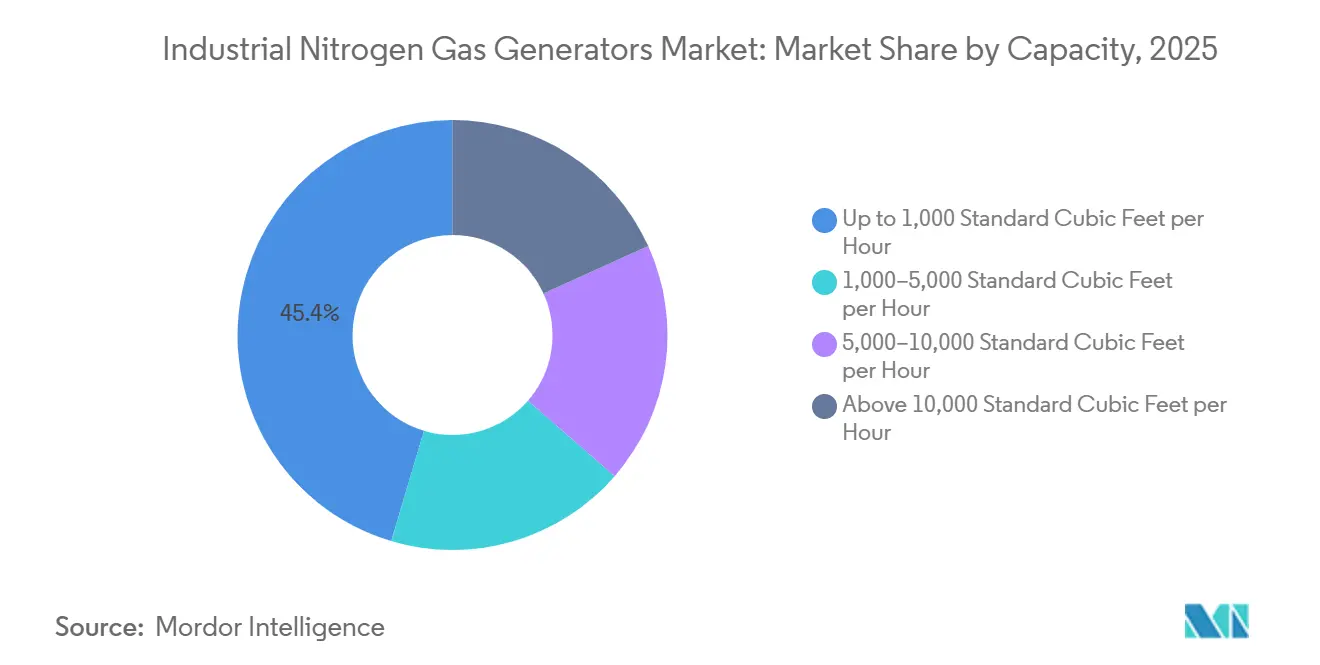
Mid-Range Units Attract the Most Active UpgradersThe up-to-1,000 SCFH tier accounted for 45.4% of the industrial nitrogen gas generators market size in 2025. Small food processors, medical facilities, and metalworking shops form a large installed base for these light-duty or intermittent systems. The category is commercially mature and available from many suppliers. It has broad use where users are beginning to replace cylinders, but do not need high continuous flow. Its large installed base reflects the accessibility of small dual-tower PSA equipment.
The 1,000-5,000 SCFH tier in the industrial nitrogen gas generators market is forecast to grow at a 5.9% CAGR from 2026 to 2031. Mid-sized food, chemical, and electronics manufacturers in this range are moving from delivered gas to self-generation because use is high enough to justify a generator but too modest for cryogenic economics. The 5,000-10,000 SCFH tier supports larger pharmaceutical active-ingredient producers and metal fabricators. Units above 10,000 SCFH are common at chemical complexes and semiconductor fabs that use multiple generators. Ingersoll Rand acquired Advanced Gas Technologies in April 2025 for a combined transaction value of USD 27 million with G&D Chillers, strengthening access to gas-generation customers in metal fabrication, food packaging, pharmaceuticals, and chemicals, while rental and flexible leasing create a lower-commitment entry path for project-based demand.
By End-Use Industry:
Food and Beverage Anchors Demand While Electronics Drives ValueFood and beverage accounted for 30.1% of end-use revenue in 2025 and held the largest industrial nitrogen gas generators market share among end-use categories. It is also projected to grow at a 6.4% CAGR through 2031. Modified atmosphere packaging and tank blanketing are the main nitrogen applications in this sector. The EIGA food-use framework supports standardized equipment design, purity documentation, and operating practices. Multi-site food companies can use certified generator platforms to support consistent quality control across facilities.
Medical and pharmaceutical users need nitrogen for cleanroom pressurization, anaerobic biologics manufacturing, and cryogenic product storage. Traceability requirements in regulated production favor systems with continuous monitoring and automated quality records. Chemicals and petrochemicals use nitrogen for tank blanketing, reactor inerting, and pipeline pressure testing. Electronics and electrical users in the industrial nitrogen gas generators market include wafer fabrication, reflow soldering, and cleanroom pressurization, where purity needs are particularly demanding. Oil and gas operators use containerized generators for pipeline inerting, well completion, and fire suppression, while metal and mining users need gas for laser-cutting and heat treatment, and GENERON shipped a 4,000 SCFM mobile unit at 95% purity to a European oil-service customer in January 2025.
Geography Analysis
APAC Industrial Nitrogen Gas Generators Market
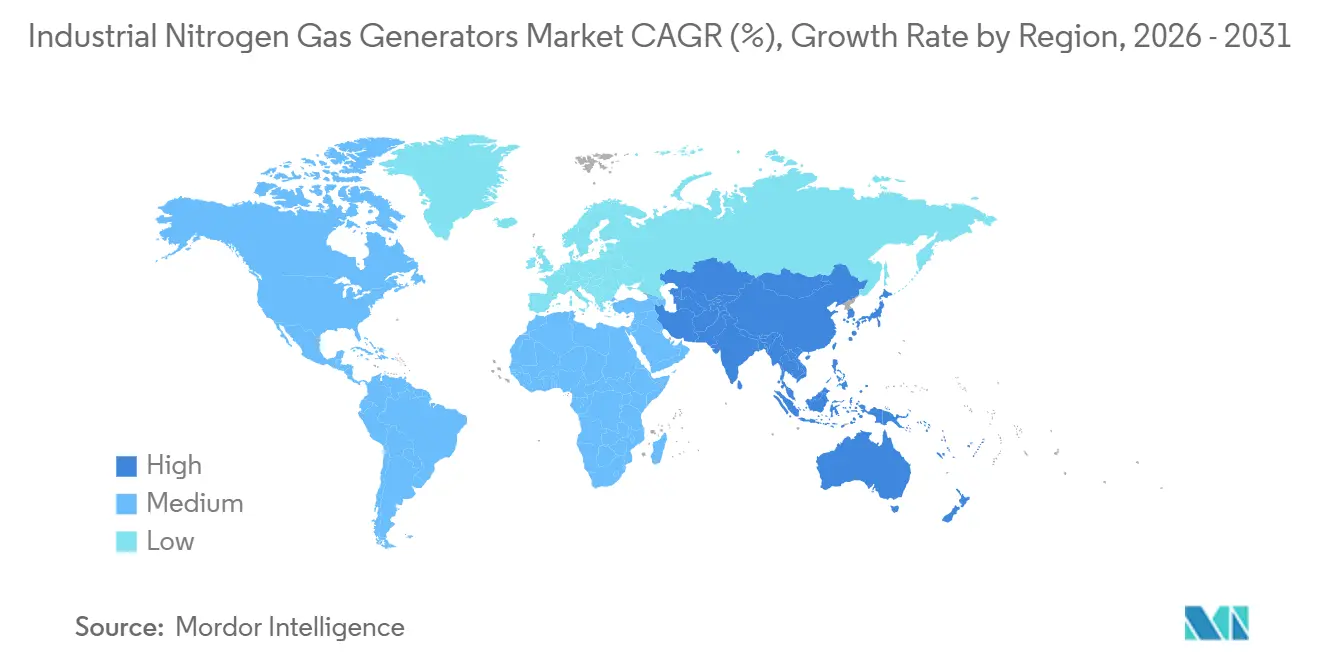
Asia-Pacific held 38.7% of revenue in 2025 and is forecast to grow at a 5.7% CAGR through 2031. China is the region’s largest demand center, with nitrogen use across electronics, automotive, petrochemicals, and food processing. Semiconductor self-sufficiency programs support investment in ultra-high-purity on-site capacity. Air Liquide committed more than RMB 800 million, reported as USD 110 million, for 4 nitrogen production units in the Yangtze River Delta and Pearl River Delta, with combined capacity exceeding 100,000 Nm³/hour and commissioning targeted from late 2027 to early 2028.
India and South Korea Industrial Nitrogen Gas Generators Market
India is the fastest-growing country market in the industrial nitrogen gas generators market. Kelington Group’s Ace Gases Technologies began development of a USD 29.3 million, 300-tonne-per-day merchant air separation unit in Maharashtra in August 2026. INOX Air Products also signed supply agreements serving solar, battery-material, and semiconductor customers. South Korean advanced-memory investments drew nearly USD 400 million in combined Air Liquide nitrogen-production commitments during 2026, linking regional demand to chip packaging, solar manufacturing, food processing, and wider manufacturing expansion.
The Americas and EMEA Industrial Nitrogen Gas Generators Market
North America is the second-largest regional block in the industrial nitrogen gas generators market, supported by semiconductor supply-chain investment in the United States. Air Liquide announced more than USD 160 million for a large-scale nitrogen and specialty-gas facility in Arizona in July 2026. Food and beverage, oil and gas, and small-to-mid-capacity installations remain important in the United States and Canada. Europe combines high-purity demand from specialty chemicals, pharmaceuticals, and metalworking with sensitivity to electricity costs in Germany, Italy, and Benelux, while Brazil leads South American demand through food processing, petrochemicals, and mining. The Middle East and Africa start from a smaller base, although petrochemicals, semiconductor packaging, pharmaceuticals, and food processing create demand, and Gas-as-a-Service and rental models can help users avoid high initial costs.
Competitive Landscape
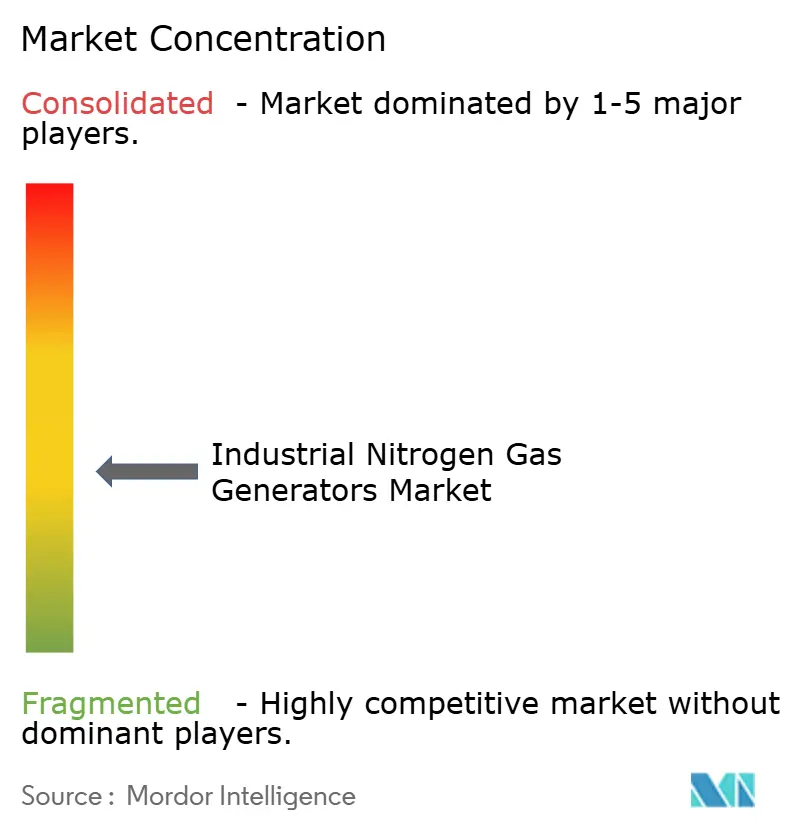
The industrial nitrogen gas generators market is moderately consolidated worldwide. Air Liquide, Linde, Atlas Copco, Ingersoll Rand, and Parker Hannifin compete with application-focused original equipment manufacturers and regional suppliers. No supplier leads across every equipment type, capacity range, purity level, and geography, so technical fit, application engineering, service coverage, and reliability remain important points of differentiation. Large industrial companies are extending compressor service networks into nitrogen-generator aftermarket contracts, creating recurring service relationships that can reduce customer switching.
Atlas Copco used acquisitions and product development to address geographic and application needs. Its 2024 Metalplan acquisition added gas-generation and air-treatment manufacturing in Brazil. Its LC N2 launch and December 2025 installation at IS Plåt added a plug-and-play system aimed at laser-cutting users. Ingersoll Rand expanded its position in the industrial nitrogen gas generators market through the October 2024 acquisition of Blutek S.r.l. as part of a USD 135 million set of acquisitions, followed by the April 2025 AGT acquisition that broadened its gas-generation portfolio and Canadian channel presence.
Opportunities in the industrial nitrogen gas generators market remain in monitoring services for older installed generators and financing for capital-constrained small and medium-sized enterprises. Suppliers in the industrial nitrogen gas generators market that monitor purity, carbon molecular sieve performance, and energy use across large fleets can build a differentiated aftermarket offering. Documentation is also becoming more important in food and semiconductor applications, where E941 food-use records and high-purity requirements can influence contract renewals. The industrial nitrogen gas generators industry also rewards providers that can combine compressor and generator maintenance under a single contract. The absence of a dominant supplier across the full market is consistent with a concentration score of 3 out of 10 because leading companies do not hold a documented combined share of 30% or more.
Industrial Nitrogen Gas Generators Industry Leaders
-
Parker Hannifin Corporation
-
Air Products and Chemicals, Inc.
-
Atlas Copco AB
-
Air Liquide
-
Linde plc
- *Disclaimer: Major Players sorted in no particular order
Industrial Nitrogen Gas Generators Market Companies Covered in this Report
- Air Liquide
- Air Products and Chemicals, Inc.
- AirSep Corporation
- Atlas Copco AB
- BOGE Compressors
- Claind S.r.l.
- Compressed Gas Technologies, Inc.
- GENERON IGS, Inc.
- Hitachi Industrial Equipment Systems Co., Ltd.
- Holtec Gas Systems
- Ingersoll Rand Inc.
- INMATEC GaseTechnologie GmbH & Co. KG
- Linde plc
- NOVAIR SAS
- Noxerior S.r.l.
- On Site Gas Systems, Inc.
- OXYMAT A/S
- Parker Hannifin Corporation
- PCI Gases
- Peak Scientific Instruments Ltd.
- South-Tek Systems
- Taiyo Nippon Sanso Corporation
Recent Industry Developments in Industrial Nitrogen Gas Generators Market
- August 2026: Kelington Group's subsidiary Ace Gases Technologies initiated development of a USD 29.3 million, 300-tonne-per-day merchant air separation unit in Maharashtra, India, targeting Q3 2028 completion to supply nitrogen, oxygen, and argon across semiconductor, healthcare, and manufacturing sectors, marking the group's entry into Indian industrial gases supply.
- July 2026: Air Liquide announced investments exceeding USD 170 million in Indiana, United States, to build and operate 2 on-site production units supplying ultra-pure nitrogen, oxygen, argon, and hydrogen to SK hynix's first United States advanced chip-packaging facility, with commissioning targeted at end-2028.
- July 2026: Air Liquide announced an investment of over USD 160 million in Arizona to build a large-scale nitrogen and specialty gas production facility for a leading advanced semiconductor manufacturer, with operations commencing in 2028.
- June 2026: Air Liquide signed a long-term contract with SK hynix, committing nearly EUR 200 million, reported as USD 232 million, to build and operate a nitrogen production unit for SK hynix's P&T7 HBM chip-packaging fab in Cheongju, South Korea, building on its earlier 2026 acquisition of DIG Airgas.
Global Industrial Nitrogen Gas Generators Market Report Scope
Industrial nitrogen gas generators are on-site equipment systems that produce nitrogen gas by separating it from atmospheric air and removing oxygen and other gases to achieve the required purity level. They typically use Pressure Swing Adsorption (PSA), membrane separation, or other gas-separation technologies for high-purity applications. These generators provide a continuous and controlled supply of nitrogen, reducing or eliminating the need for delivered nitrogen cylinders or bulk liquid nitrogen. They are widely used across industries, including oil and gas, chemicals, food and beverage, pharmaceuticals, electronics, metals, power generation, and manufacturing, for applications such as inerting, blanketing, purging, packaging, heat treatment, and preventing oxidation or combustion.
The Industrial Nitrogen Gas Generators Market is segmented by equipment type, capacity, end use, and geography. By equipment type, the market is segmented into PSA (Pressure Swing Adsorption), membrane, cryogenic, and other types. By capacity, the market is segmented into up to 1,000 SCFH, 1,000–5,000 SCFH, 5,000–10,000 SCFH, and above 10,000 SCFH. By end use, the market is segmented into food & beverage, medical & pharmaceutical, chemicals, electronics, oil & gas, metal & mining, and other end uses. The report also covers the market size and forecasts for the global industrial nitrogen gas generators market across 26 countries in key regions. For each segment, the market sizing and forecasts have been provided on the basis of value (USD).
Segmentation Overview
| Pressure Swing Adsorption (PSA) |
| Membrane Separation |
| Cryogenic Distillation |
| Other Technologies (Covers Hybrid Technologies, etc.) |
| Up to 1,000 Standard Cubic Feet per Hour |
| 1,000–5,000 Standard Cubic Feet per Hour |
| 5,000–10,000 Standard Cubic Feet per Hour |
| Above 10,000 Standard Cubic Feet per Hour |
| Food & Beverage |
| Medical & Pharmaceutical |
| Chemicals & Petrochemicals |
| Electronics & Electricals |
| Oil & Gas |
| Metal & Mining |
| Other End Users |
| North America | United States |
| Canada | |
| Mexico | |
| Europe | Germany |
| France | |
| Italy | |
| Spain | |
| United Kingdom | |
| Poland | |
| Russia | |
| Rest of Europe | |
| Asia-Pacific | China |
| India | |
| Japan | |
| South Korea | |
| Australia | |
| Indonesia | |
| Vietnam | |
| Thailand | |
| Rest of Asia-Pacific | |
| South America | Brazil |
| Argentina | |
| Chile | |
| Rest of South America | |
| Middle East and Africa | Saudi Arabia |
| United Arab Emirates | |
| Egypt | |
| South Africa | |
| Morocco | |
| Rest of Middle East and Africa |
| By Equipment Type | Pressure Swing Adsorption (PSA) | |
| Membrane Separation | ||
| Cryogenic Distillation | ||
| Other Technologies (Covers Hybrid Technologies, etc.) | ||
| By Capacity | Up to 1,000 Standard Cubic Feet per Hour | |
| 1,000–5,000 Standard Cubic Feet per Hour | ||
| 5,000–10,000 Standard Cubic Feet per Hour | ||
| Above 10,000 Standard Cubic Feet per Hour | ||
| By End-use Industry | Food & Beverage | |
| Medical & Pharmaceutical | ||
| Chemicals & Petrochemicals | ||
| Electronics & Electricals | ||
| Oil & Gas | ||
| Metal & Mining | ||
| Other End Users | ||
| By Geography | North America | United States |
| Canada | ||
| Mexico | ||
| Europe | Germany | |
| France | ||
| Italy | ||
| Spain | ||
| United Kingdom | ||
| Poland | ||
| Russia | ||
| Rest of Europe | ||
| Asia-Pacific | China | |
| India | ||
| Japan | ||
| South Korea | ||
| Australia | ||
| Indonesia | ||
| Vietnam | ||
| Thailand | ||
| Rest of Asia-Pacific | ||
| South America | Brazil | |
| Argentina | ||
| Chile | ||
| Rest of South America | ||
| Middle East and Africa | Saudi Arabia | |
| United Arab Emirates | ||
| Egypt | ||
| South Africa | ||
| Morocco | ||
| Rest of Middle East and Africa | ||
Key Questions Answered in the Report
What is the projected value of the industrial nitrogen gas generators market by 2031?
The value is projected to reach USD 4.67 billion by 2031, expanding at a 5.46% CAGR from 2026.
Which equipment type leads industrial nitrogen generation?
PSA systems led equipment revenue with 53.5% in 2025 and are forecast to grow at a 5.7% CAGR through 2031.
Why do manufacturers install on-site nitrogen generators?
On-site units can reduce dependence on cylinder and bulk-liquid deliveries while supporting stable supply and required purity.
Which end-use sector is growing fastest for industrial nitrogen generators?
Food and beverage is the fastest-growing end-use sector at a 6.4% CAGR through 2031 and held 30.1% of revenue in 2025.
Which region has the largest demand for industrial nitrogen generators?
Asia-Pacific led with 38.7% of revenue in 2025 and is forecast to grow at a 5.7% CAGR through 2031.
What limits adoption by smaller industrial users?
Initial system cost, high-purity electricity use, feed-air quality, and limited local service support can slow adoption.