
Industrial Imaging Test and Validation Services Market Size and Share
Market Overview
| Study Period | 2020 - 2031 |
|---|---|
| Market Size (2026) | USD 0.78 Billion |
| Market Size (2031) | USD 1.24 Billion |
| Growth Rate (2026 - 2031) | 9.71 % |
| Fastest Growing Market | Asia-Pacific |
| Largest Market | North America |
| Market Concentration | Low |
Major Players *Disclaimer: Major Players sorted in no particular order Image © Mordor Intelligence. Reuse requires attribution under CC BY 4.0. | |
Industrial Imaging Test and Validation Services Market Analysis by Mordor Intelligence
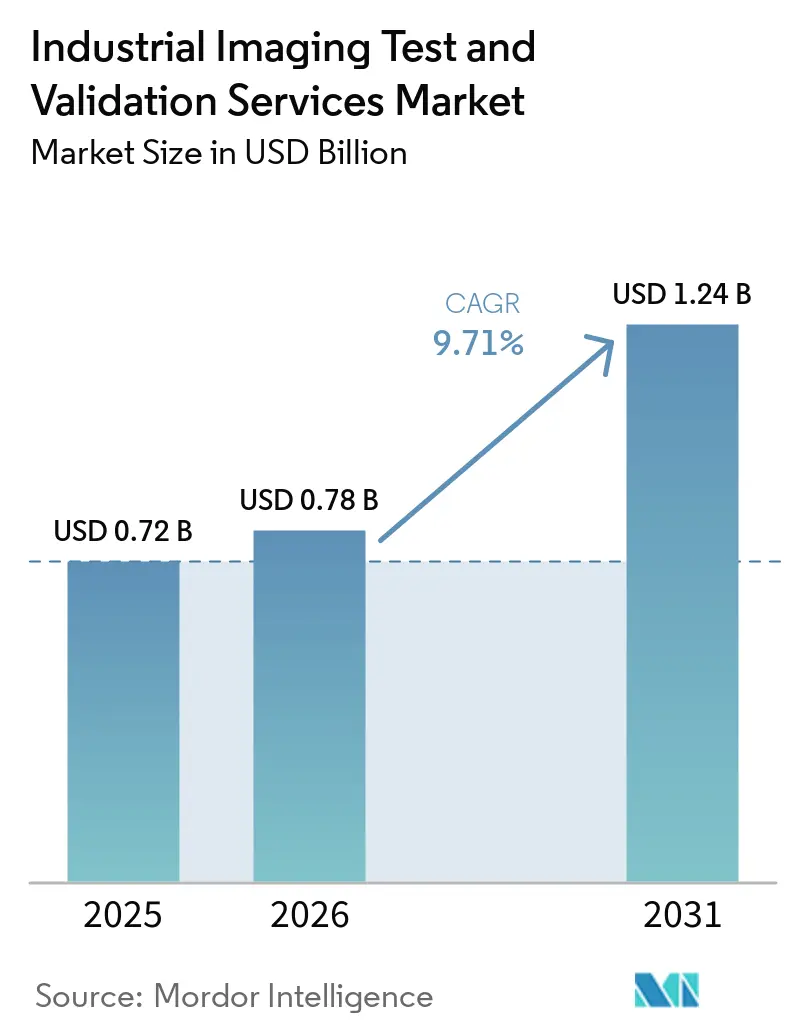
The industrial imaging test and validation services market size was valued at USD 0.72 billion in 2025 and estimated to expand from USD 0.78 billion in 2026 to reach USD 1.24 billion by 2031, at a CAGR of 9.71% during the forecast period (2026-2031). Manufacturers are increasing inspection coverage as automated lines place more quality decisions in the hands of vision systems. Battery production, semiconductor packaging, and complex vehicle assemblies require testing that can verify equipment performance under operating conditions. Digital records are also becoming more important when buyers need traceable evidence for audits and supplier qualification. Providers are responding with remote diagnostic tools, AI model evaluation, and services that support multi-site manufacturing programs.
Key Report Takeaways
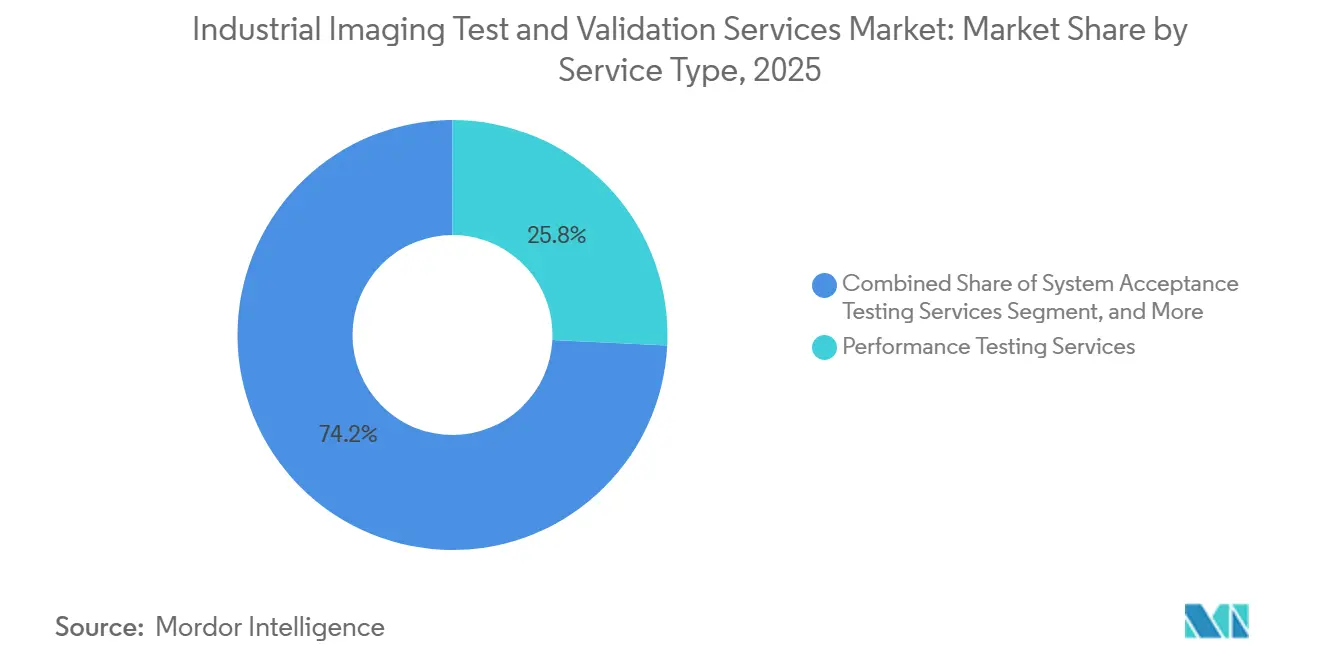
- By service type, Performance Testing Services held 25.78% share in 2025 for the industrial imaging test and validation services market, while Compliance and Certification Testing Services are projected to expand at an 11.12% CAGR through 2031.
- By imaging modality, 2D Imaging held 56.79% share in 2025, while Multispectral and Hyperspectral Imaging are projected to expand at an 11.56% CAGR through 2031.
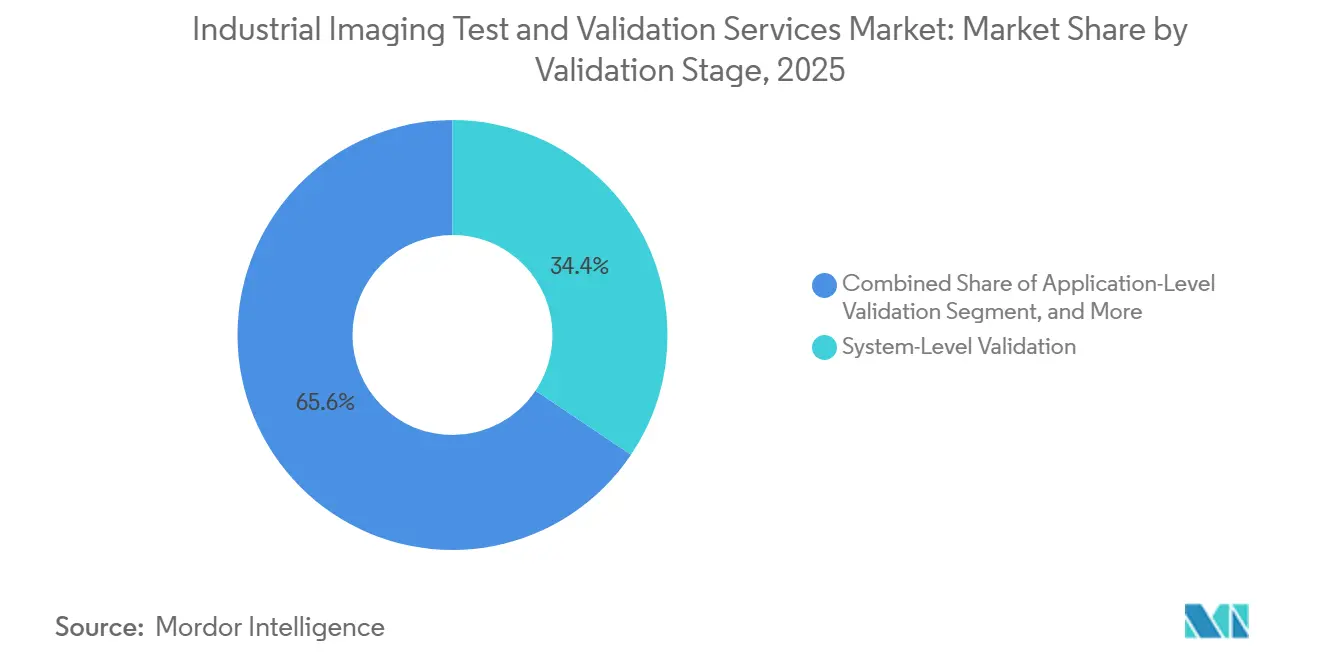
- By the validation stage, System-Level Validation held 34.41% share in 2025, while Application-Level Validation is projected to expand at a 10.89% CAGR through 2031.
- By delivery model, On-Site Testing held 47.55% share in 2025, while Remote and Software-Based Testing is projected to expand at an 11.78% CAGR through 2031.
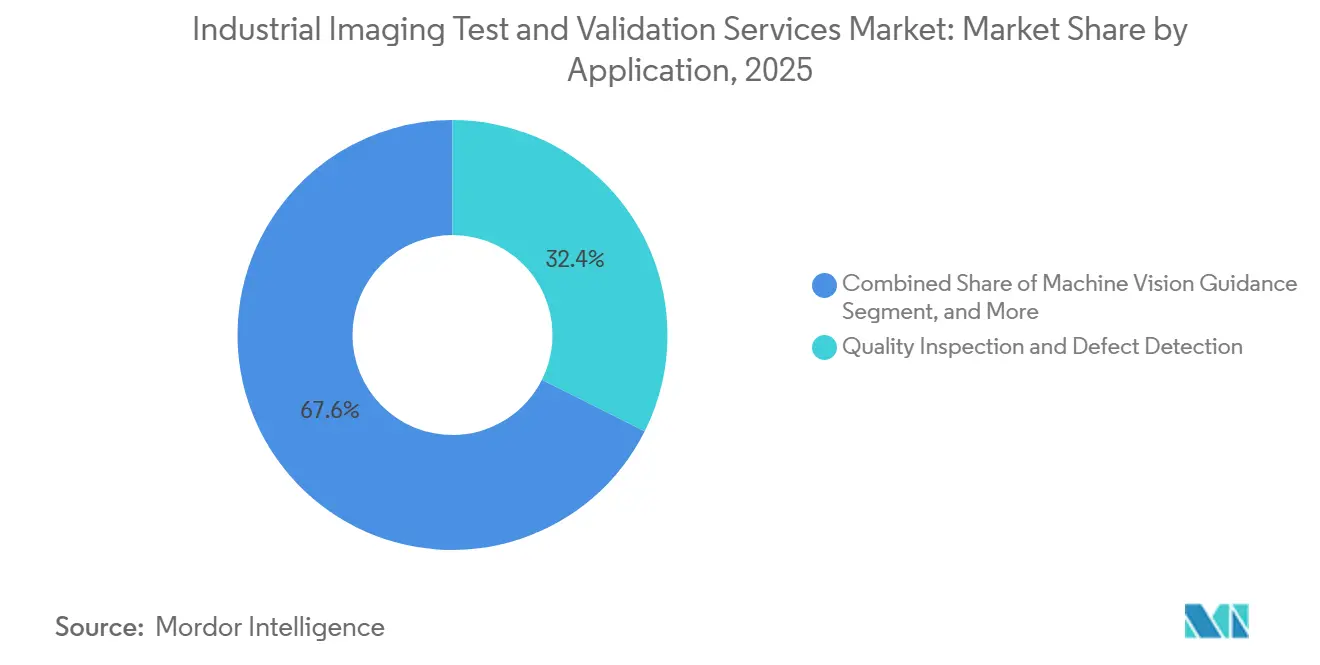
- By application, Quality Inspection and Defect Detection held 32.29% share in 2025, while Machine Vision Guidance is projected to expand at a 11.22% CAGR through 2031.
- By industry vertical, Automotive and Mobility held 23.21% share in 2025, while Electronics and Semiconductors are projected to expand at a 10.81% CAGR through 2031.
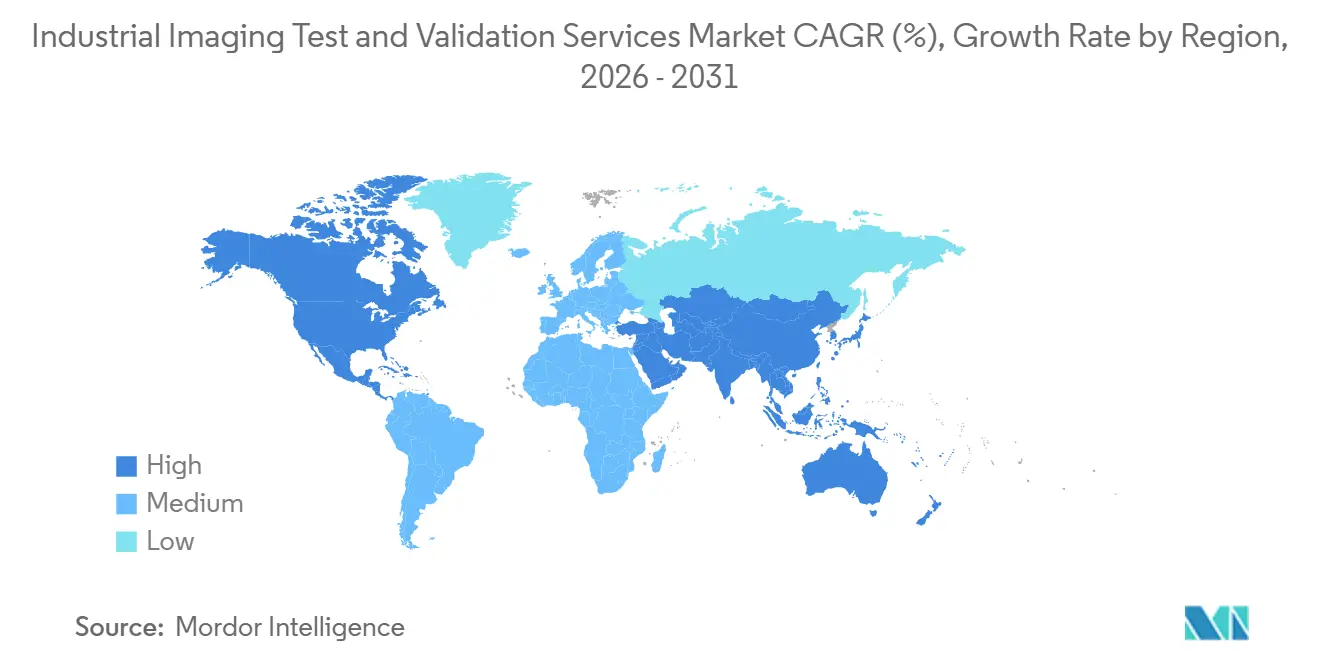
- By geography, North America held 32.21% share of the industrial imaging test and validation services market in 2025, while Asia-Pacific is projected to expand at a 12.11% CAGR through 2031.
Note: Market size and forecast figures in this report are generated using Mordor Intelligence’s proprietary estimation framework, updated with the latest available data and insights as of January 2026.
Market Trends and Insights
Drivers Impact Analysis of Industrial Imaging Test and Validation Services Market*
| Driver | (~) % Impact on CAGR Forecast | Geographic Relevance | Impact Timeline |
|---|---|---|---|
| Rising Demand for Defect-Free Automated Production | +2.6% | Global, with highest intensity in North America and Europe | Short term (≤ 2 years) |
| Expansion of AI-Enabled and Edge-Based Inspection | +2.0% | Global, with early adoption in Asia-Pacific core, spill-over to Middle East and Africa | Medium term (2-4 years) |
| Electrification and Miniaturization Requiring 100% Imaging Validation | +1.4% | North America, Europe, and Asia-Pacific, including China, South Korea, and Japan | Medium term (2-4 years) |
| Stricter Traceability and Digital Quality Evidence Requirements | +1.0% | North America and EU, export-driven uptake in Asia-Pacific | Short term (≤ 2 years) |
| Increasing Outsourcing of Specialized Imaging Test Capacity | +0.7% | Global, with fastest outsourcing growth in Asia-Pacific | Long term (≥ 4 years) |
| Interoperability Testing for Multi-Vendor Vision Stacks | +0.4% | North America and Europe | Medium term (2-4 years) |
| Source: Mordor Intelligence | |||
Rising Demand for Defect-Free Automated Production
Automated production lines are reducing the use of sampling-based inspection across many manufacturing settings. Vision systems must meet throughput and accuracy requirements before a line can be qualified. The International Federation of Robotics reported 542,000 industrial robot installations worldwide in 2024.[1]International Federation of Robotics, “World Robotics 2025 Report,” International Federation of Robotics, ifr.org Each added robotic cell can require validated imaging for alignment, part placement, and weld inspection. This expands recurring work for providers serving the industrial imaging test and validation services market. Firms with high-throughput test cells and established robotic-vision protocols can serve these programs more consistently.
Expansion of AI-Enabled and Edge-Based Inspection
AI tools are broadening the range of conditions that machine vision systems can inspect. Edge inference can classify defects at line speed using models trained on site-specific data. Each model update can require a functional review before deployment in a production setting. A 2026 Scientific Reports study described autonomous fault localization for aero-engine blade inspection using deep learning and robotic equipment. This shifts validation attention from the individual operator toward model performance and acceptance rules. Providers with documented AI model testing procedures are well placed as the industrial imaging test and validation services market adopts more software-led inspection.
Electrification and Miniaturization Requiring 100% Imaging Validation
Battery cell production and advanced semiconductor packaging require close inspection of small or internal features. These processes often need full imaging coverage because sampling can miss safety or yield-related defects. Onto Innovation launched its Dragonfly G5 system in March 2026 for sub-micron 2D and 3D macro defect inspection. The system combines multi-mode illumination with AI-based defect classification for advanced chip production. New equipment programs create demand for performance testing before wider factory deployment. This connection gives the industrial imaging test and validation services market exposure to electronics and battery capacity additions.
Stricter Traceability and Digital Quality Evidence Requirements
Manufacturers increasingly need inspection records that can be retrieved and reviewed during audits. The U.S. Food and Drug Administration made its Quality Management System Regulation effective on February 2, 2026. The rule increases the importance of controlled inspection records and approved model changes in medical device facilities. NIST IR 8536 described a structured framework for recording and retrieving supply chain traceability information. Testing providers can respond through version-controlled model logs and structured data handoffs. These capabilities make the industrial imaging test and validation services market more relevant to customers building digital quality systems.
Restraints Impact Analysis of Industrial Imaging Test and Validation Services Market*
| Restraint | (~) % Impact on CAGR Forecast | Geographic Relevance | Impact Timeline |
|---|---|---|---|
| Shortage of Qualified Imaging and Metrology Specialists | -1.3% | Global, most acute in North America, emerging in India and Southeast Asia | Long term (≥ 4 years) |
| High Cost of Calibrated Test Infrastructure | -0.9% | Global, most pronounced in Middle East and Africa and South America | Medium term (2-4 years) |
| Data Sovereignty and Cybersecurity Constraints | -0.5% | EU and Asia-Pacific core, spill-over to North America | Short term (≤ 2 years) |
| Non-Uniformity of Application-Specific Acceptance Criteria | -0.3% | Global | Long term (≥ 4 years) |
| Source: Mordor Intelligence | |||
Shortage of Qualified Imaging and Metrology Specialists
Qualified staff are needed to calibrate equipment, execute tests, and interpret imaging results. The Metrology Institute reported that 60% of advanced manufacturers could not find qualified calibration technicians. It also reported that 72% of employers considered existing training programs inadequate or outdated.[2]Metrology Institute, “Advancing America’s Metrology Workforce,” Metrology Institute, metrologyinstitute.org The shortfall can limit laboratory capacity even when manufacturers outsource more work. It can also increase lead times for specialized engagements in the industrial imaging test and validation services market. Training programs and AI-supported testing can help providers make better use of scarce specialists.
High Cost of Calibrated Test Infrastructure
Imaging laboratories need controlled chambers, precise positioning stages, calibrated light sources, and reference artifacts. Maintaining traceability also requires recurrent calibration and documented quality controls. These requirements make it costly for smaller independent providers to establish accredited facilities. They can also deter manufacturers from developing internal test capacity. The constraint is particularly relevant for smaller manufacturers in South America, the Middle East, and Africa. The resulting cost structure supports laboratory and remote service models but can limit adoption in cost-sensitive parts of the industrial imaging test and validation services market.
*Our forecasts treat driver/restraint impacts as directional, not additive. The impact forecasts reflect baseline growth, mix effects, and variable interactions.
Industrial Imaging Test and Validation Services Market Segment Analysis
By Service Type:
Compliance Testing Is Reshaping Revenue DistributionPerformance Testing Services held 25.78% of the industrial imaging test and validation services market share in 2025, reflecting its central role in benchmarking throughput, resolution, and accuracy before vision equipment is approved for production use. The work supports procurement decisions for cameras, lighting, processing hardware, and integrated inspection systems, because customers need comparable evidence that equipment meets specified operating requirements. System Acceptance Testing Services checks whether an installed system meets agreed-upon requirements, while Functional and Capability Validation Services assess operating limits under expected production conditions. Reliability and Stability Testing Services examine whether results remain consistent over time, while Environmental Testing Services evaluate operation during temperature variation, vibration, and changing illumination. Together, these service categories give the industrial imaging test and validation services market a broad revenue base that is not dependent on a single technical activity.
Compliance and Certification Testing Services is projected to expand at an 11.12% CAGR through 2031, as manufacturers increasingly include formal certification requirements in tenders for industrial vision systems and related equipment. This shift moves testing from a post-award activity to a market-entry requirement, especially when customers must demonstrate documented control over automated quality decisions and equipment changes. Medical device, automotive, and electronics buyers need structured records that connect test results, approved model versions, and customer acceptance conditions throughout the deployment process. The FDA QMSR became effective in 2026 and reinforced the importance of controlled quality records for medical device operations. Accredited providers can offer traceable evidence of technical results, enabling repeat work after initial qualification and strengthening the role of the industrial imaging test and validation services industry in regulated manufacturing workflows.



By Imaging Modality:
2D Imaging Remains Established While Spectral Imaging Advances2D Imaging accounted for 56.79% of the industrial imaging test and validation services market in 2025 because area-scan and line-scan cameras remain widely used for high-volume surface inspection in automotive, electronics, pharmaceutical, and consumer product manufacturing. Camera cost-per-pixel economics, mature supplier networks, and standardized calibration targets make this modality the default for many applications where surface defects are the primary concern. Testing providers can apply established charts and repeatable procedures to check resolution, lighting behavior, contrast, and inspection reliability across these conventional installations. 3D Imaging addresses applications that require volumetric or dimensional data, including automotive powertrain components and electric vehicle battery assemblies, for which surface images alone are insufficient. Thermal and Infrared Imaging remains a specialist option for electronics thermal profiling, structural composite inspection, and battery thermal characterization, all of which require controlled conditions to assess sensor baselines.
Multispectral and Hyperspectral Imaging is projected to expand at an 11.56% CAGR through 2031, as inline systems move from research settings into food quality, pharmaceutical coating, and specialty polymer inspection. The modality can identify chemical or subsurface characteristics that standard 2D cameras may not reveal, which makes validation more important when product composition and material condition affect acceptance decisions. A 2026 npj Science of Food study combined RGB imaging and hyperspectral reflectance data across 350-2,500 nm for industrial drying processes. The study reported a coefficient of determination of 0.99 for moisture content, indicating the potential of multisensor data in controlled inspection processes. These systems require assessment of sensor response, lighting stability, and reference materials, while standard interfaces from suppliers such as Specim and XIMEA can make adoption more accessible across the industrial imaging test and validation services market.
By Validation Stage:
Application-Level Testing Is Moving Closer to ProductionSystem-Level Validation accounted for 34.41% of the validation-stage segment in 2025, reflecting the importance manufacturers place on qualifying the complete vision system before committing to a full production rollout. These tests examine cameras, lighting, image processing equipment, and software as a connected system under realistic environmental conditions and expected operating loads. The work typically accounts for a major share of the integration budget because an issue at this stage can delay equipment acceptance and affect later production schedules. Component-Level Validation focuses on lenses, sensors, and processors in isolation, and standardized benchtop platforms are increasingly automating portions of this work. Production-Line and Site Acceptance Validation is performed after installation at the customer facility, where field teams can evaluate effects that laboratory conditions may not recreate.
Application-Level Validation is projected to expand at a 10.89% CAGR through 2031, as buyers seek evidence that systems work reliably within actual production workflows rather than only in controlled test settings. A vision system can pass a system-level review yet still produce unacceptable false rejects when product variation, lighting drift, conveyor vibration, or other line-specific conditions arise. This stage, therefore, links technical tests to the production conditions that determine whether an inspection program delivers the intended operational result. A CVPR 2026 paper presented SinSEMI, a data-efficient method for evaluating semiconductor inspection equipment that reduces the real-image datasets required for qualification. Providers that pair on-site testing with AI-assisted anomaly flagging can build recurring validation arrangements, bringing the industrial imaging test and validation services market closer to daily production quality performance.
By Delivery Model:
Remote Testing Is Outpacing On-Site ModesOn-Site Testing accounted for 47.55% of the delivery model segment in 2025 because many imaging systems must be evaluated within the facility and under the conditions where they will actually operate. Local electromagnetic interference, thermal gradients, mechanical vibration, production pace, and material variations can alter system behavior in ways that a controlled laboratory environment may not fully reproduce. On-site delivery also helps customers retain imaging data within the facility boundary, which can be relevant when proprietary products or controlled records are involved. Laboratory Testing remains important for system acceptance and performance benchmarking, where stable lighting, reference standards, and traceable calibration conditions are necessary. The industrial imaging test and validation services market will therefore continue to require a mix of field and laboratory work, even as remote options become more widely used.
Remote and Software-Based Testing is projected to expand at an 11.78% CAGR through 2031, supported by edge-connected systems that send diagnostic information without moving equipment or specialists between locations. A subscription model lets providers review more facilities while clients receive ongoing performance assurance rather than a periodic inspection that may not capture changes between visits. This delivery approach is useful for multi-site organizations that need central oversight while also keeping operating teams and equipment in place. MISTRAS launched AEScout in July 2026 to wirelessly transmit acoustic emission data to a cloud-based environment for remote expert interpretation. Physical reference targets, calibration artifacts, and controlled illumination still limit fully remote validation, preserving an ongoing role for field services across the industrial imaging test and validation services market.
By Application:
Machine Vision Guidance Supports Manufacturing AutomationQuality Inspection and Defect Detection held 32.29% share of the application segment in 2025, because it is a primary reason companies invest in imaging systems across automotive, electronics, and pharmaceutical production lines. Validation commonly measures probability-of-detection curves, false-reject rates, and minimum detectable defect sizes under conditions that represent actual products and manufacturing throughput. These programs often require large sets of characterized reference parts and can extend over months when customers need evidence for system qualification. Dimensional Measurement and Metrology has different requirements around accuracy and repeatability, while Identification and Traceability supports part tracking and continuity of manufacturing records. Process Monitoring and Safety and Compliance Monitoring also require focused validation, particularly where regulated settings require evidence that imaging data can support ongoing control decisions.
Machine Vision Guidance is projected to expand at a 11.22% CAGR through 2031, as robot-mounted and conveyor-integrated guidance systems are used for bin picking, seam-tracking welding, collaborative assembly, and electric vehicle battery module stacking. Unlike static inspection, guidance applications must maintain accuracy throughout the entire robot workspace as lighting, product position, and part geometry change during normal operations. Test procedures must therefore combine spatial calibration, repeatability measurement, and dynamic accuracy assessment to verify that closed-loop decisions remain dependable. A CVPR workshop paper outlined data-efficient evaluation methods for semiconductor inspection equipment, relevant to shortening qualification cycles in complex imaging applications. Documented qualification under 21 CFR Part 11 and GxP frameworks also supports continuing demand in Process Monitoring, adding recurring work for the industrial imaging test and validation services market.
By Industry Vertical:
Semiconductor Demand Is Raising Validation RequirementsAutomotive and Mobility held a 23.21% share in 2025, driven by the need to inspect safety-critical components, electric vehicle battery modules, and advanced driver-assistance camera systems throughout increasingly automated vehicle production processes. Suppliers manage layered quality documentation and approval processes that can extend from original equipment manufacturers to Tier 1 and Tier 2 partners, making outsourced testing useful where internal expertise is limited. Industrial Machinery and equipment require validation across varied operating conditions, while Aerospace and Defense use specialist nondestructive testing and highly controlled processes. Pharmaceuticals and Life Sciences depend on documented qualification for regulated production steps, while Food and Beverage systems require reliable imaging for quality and packaging controls. This mix of vertical needs gives the industrial imaging test and validation services market exposure to several manufacturing investment cycles, rather than to a single end-user sector.
Electronics and Semiconductors are projected to expand at a 10.81% CAGR through 2031, as advanced process nodes, heterogeneous integration, and HBM memory production require more sensitive wafer-level defect inspection. Providers must help customers distinguish yield-relevant defects from nuisance artifacts through testing that combines sub-micron imaging performance with AI-based classification procedures. A 2026 SPIE paper described computational-guided dynamic sampling for e-beam inspection in high-volume manufacturing and reported up to a 4.3x improvement in defective-die capture rates. Semiconductor customers need inspection approaches that support process control without slowing throughput, creating demanding requirements for equipment and service providers. Pharmaceuticals and Life Sciences is also adopting specialized optical methods for coating uniformity and particulate analysis, extending the industrial imaging test and validation services industry into other precision-controlled production environments.
Geography Analysis
North America Industrial Imaging Test and Validation Services Market
North America held 32.21% of the industrial imaging test and validation services market share in 2025, supported by a large automotive and aerospace manufacturing base, established independent laboratories, and customer qualification practices that require reliable test evidence. The FDA QMSR became effective in 2026 for medical device manufacturers and supports demand for controlled inspection records and managed equipment or model changes.[3]U.S. Food and Drug Administration, “Quality Management System Regulation,” U.S. Food and Drug Administration, fda.gov The United States leads regional demand, while Mexico contributes through automotive supply chains that reflect nearshoring activity. Cross-border validation can still be routed to U.S.-based accredited laboratories when local specialist capacity is limited. Remote and software-based validation is also commercially advanced in North America, where managed service models are established across aerospace and industrial settings.
EMEA and South America Industrial Imaging Test and Validation Services Market
Europe had a substantial share in 2025, supported by Germany, the United Kingdom, and France, where manufacturers face detailed customer requirements for documentation, system reliability, cybersecurity, and formal equipment qualification. The region is important for compliance-oriented service providers that can combine technical testing with documented digital records. South America remained smaller, with Brazil as its principal country market, while high infrastructure costs and limited density of accredited laboratories constrained local independent capacity for automotive and food and beverage programs. The Middle East and Africa are at an earlier stage of development, though their manufacturing quality infrastructure is expanding through industrial modernization initiatives in Saudi Arabia and the UAE.
APAC Industrial Imaging Test and Validation Services Market
Asia-Pacific is projected to expand at a 12.11% CAGR through 2031, led by China, Japan, South Korea, and rapidly scaling India, which are central to electronics, automotive, and semiconductor production. China’s large electronics base supports widespread use of inline inspection, while Japan and South Korea are expanding CT-based nondestructive testing for aerospace and automotive applications. India’s semiconductor expansion is increasing the need for production-test capability as new facilities move toward manufacturing. The regional mix favors external service providers where manufacturers require specialist capability, traceable testing procedures, and faster access to skilled inspection resources. These conditions create an important service opportunity for the industrial imaging test and validation services market across the region.

Competitive Landscape
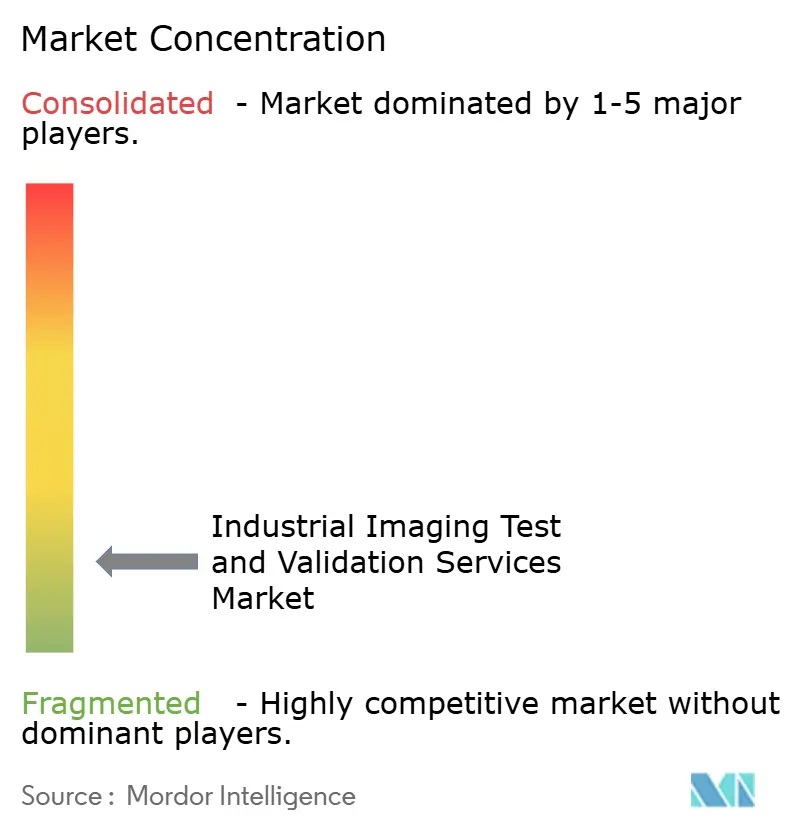
The industrial imaging test and validation services market is fragmented among specialist providers and partly consolidated among multinational testing organizations with broad geographic coverage and multi-industry accreditation portfolios. SGS, Intertek Group, Bureau Veritas, TÜV Rheinland, and TÜV SÜD operate across multiple industrial and regulated sectors, while North Star Imaging, DXOMARK, Optikos Corporation, FRAMOS GmbH, Eddyfi Technologies, and MISTRAS Group offer deeper expertise in defined modalities. These specialist firms compete by leveraging application knowledge, proprietary test methods, and tailored service delivery for specific industrial settings. The combination leaves room for global network providers and specialized technical firms, particularly where customers need highly specific inspection or validation capabilities. Competition is increasingly shaped by the ability to produce credible digital evidence and work across multi-vendor machine vision environments.
SGS launched an AI-powered thermal-runaway testing solution for energy storage batteries in August 2025, aligned with the requirements of ANSI/CAN/UL 9540A:2025. Intertek acquired Aerial PV Inspection GmbH in February 2026, adding drone-based inspection data collection and analysis capabilities for solar PV lifecycle assurance. North Star Imaging released efX Software Version 3.0 in April 2026, adding project-based CT inspection functions, multi-volume comparison, and ASTM E1695 support for regulated industries. These moves show how leading participants are connecting equipment capability, data analysis, and assurance services to maintain customer relationships beyond individual test projects. They also show why service firms may pursue both software features and specialist inspection assets as part of their competitive strategy.
Competition is increasing around AI model validation and interoperability testing for multi-vendor systems, where no provider in the supplied material controls a single accepted technical method. Remote monitoring models can change a one-time project into an ongoing service arrangement, as illustrated by MISTRAS’s July 2026 AEScout launch for remote interpretation of transmitted monitoring data. Providers also seek defensible approaches for digital evidence chains, repeatable acceptance criteria, and documented model evaluation. The industrial imaging test and validation services market, therefore, remains open to differentiated technical providers despite the presence of large testing networks.
Industrial Imaging Test and Validation Services Industry Leaders
Nikon Metrology, Inc.
Testia SAS
DXOMARK
Optikos Corporation
FRAMOS GmbH
- *Disclaimer: Major Players sorted in no particular order
Industrial Imaging Test and Validation Services Market Companies Covered in this Report
- DXOMARK
- Optikos Corporation
- FRAMOS GmbH
- Nikon Metrology, Inc.
- Testia SAS
- PISÉO SAS
- CIVIT Oy
- SI Sensors Ltd
- 3DIMETIK GmbH & Co. KG
- North Star Imaging, Inc.
- Avonix Imaging, LLC
- Diverse Dimensions, Inc.
- XRAY-LAB GmbH
- QPS Engineering AG
- Acuren Inspection, Inc.
- MISTRAS Group, Inc.
- Applus Services, S.A.
- SGS S.A.
- Intertek Group plc
- Bureau Veritas SA
- TÜV Rheinland AG
- TÜV SÜD AG
- Hexagon Manufacturing Intelligence
- Eddyfi Technologies Inc.
- ZEISS Industrial Quality Solutions

Recent Industry Developments in Industrial Imaging Test and Validation Services Market
- July 2026: MISTRAS Group launched AEScout, a rapid-deployment acoustic emission monitoring solution that transmits detection and source-location data wirelessly for remote expert interpretation. The product supports its Integrity Management as a Service strategy for oil and gas, aerospace and defense, and industrial clients.
- June 2026: North Star Imaging received Nadcap accreditation for its Orlando, Florida facility covering Aerospace Quality System AC7004 and Nondestructive Testing AC7114/AC7114/6. The Orlando facility became the first High Energy 9 MeV CT scanning service laboratory in the Southeastern United States and NSI's second Nadcap-accredited site.
- April 2026: North Star Imaging released efX Software Version 3.0, adding project-based CT inspection, multi-volume comparison, high-resolution animation tools, and ASTM E1695 support for regulated industries.
- April 2026: Intertek acquired solar PV laboratory assets in Ahmedabad, India, from Mitsui Chemicals India Pvt. Ltd. The acquisition established an ISO 17025-accredited facility with BIS and IECEE CB Scheme accreditations.


Global Industrial Imaging Test and Validation Services Market Report Scope
The Industrial Imaging Test and Validation Services Market comprises third-party and in-house testing, verification, validation, and certification services for assessing the performance, functionality, reliability, environmental robustness, interoperability, and regulatory compliance of industrial imaging systems and technologies. The market covers services that validate imaging hardware, software, integrated systems, and application-specific solutions before and during deployment in industrial environments.
The Industrial Imaging Test and Validation Services Market is Segmented by Service Type (Performance Testing Services, System Acceptance Testing Services, Functional and Capability Validation Services, Reliability and Stability Testing Services, Environmental Testing Services, and Compliance and Certification Testing Services), Imaging Modality (2D Imaging, 3D Imaging, Thermal and Infrared Imaging, and Multispectral and Hyperspectral Imaging), Validation Stage (Component-Level Validation, System-Level Validation, Application-Level Validation, and Production-Line and Site Acceptance Validation), Delivery Model (On-Site Testing, Laboratory Testing, and Remote/Software-Based Testing), Application (Machine Vision Guidance, Quality Inspection and Defect Detection, Dimensional Measurement and Metrology, Identification and Traceability, Process Monitoring, and Safety and Compliance Monitoring), Industry Vertical (Automotive and Mobility, Electronics and Semiconductors, Industrial Machinery Equipment, Aerospace and Defense, Food and Beverage, Pharmaceuticals and Life Sciences, and Other Industry Verticals), and Geography (North America, Europe, Asia-Pacific, South America, and Middle East and Africa). Market Forecasts are Provided in Terms of Value (USD).
| Performance Testing Services |
| System Acceptance Testing Services |
| Functional and Capability Validation Services |
| Reliability and Stability Testing Services |
| Environmental Testing Services |
| Compliance and Certification Testing Services |
| 2D Imaging |
| 3D Imaging |
| Thermal and Infrared Imaging |
| Multispectral and Hyperspectral Imaging |
| Component-Level Validation |
| System-Level Validation |
| Application-Level Validation |
| Production-Line / Site Acceptance Validation |
| On-Site Testing |
| Laboratory Testing |
| Remote / Software-Based Testing |
| Machine Vision Guidance |
| Dimensional Measurement and Metrology |
| Quality Inspection and Defect Detection |
| Identification and Traceability |
| Process Monitoring |
| Safety and Compliance Monitoring |
| Automotive and Mobility |
| Electronics and Semiconductors |
| Industrial Machinery and Equipment |
| Aerospace and Defense |
| Pharmaceuticals and Life Sciences |
| Food and Beverage |
| Other Industry Verticals |
| North America | United States | |
| Canada | ||
| Mexico | ||
| South America | Brazil | |
| Argentina | ||
| Rest of South America | ||
| Europe | Germany | |
| United Kingdom | ||
| France | ||
| Italy | ||
| Spain | ||
| Rest of Europe | ||
| Asia-Pacific | China | |
| Japan | ||
| India | ||
| South Korea | ||
| ASEAN | ||
| Rest of Asia-Pacific | ||
| Middle East and Africa | Middle East | Saudi Arabia |
| United Arab Emirates | ||
| Rest of the Middle East | ||
| Africa | South Africa | |
| Rest of Africa | ||
| By Service Type | Performance Testing Services | ||
| System Acceptance Testing Services | |||
| Functional and Capability Validation Services | |||
| Reliability and Stability Testing Services | |||
| Environmental Testing Services | |||
| Compliance and Certification Testing Services | |||
| By Imaging Modality | 2D Imaging | ||
| 3D Imaging | |||
| Thermal and Infrared Imaging | |||
| Multispectral and Hyperspectral Imaging | |||
| By Validation Stage | Component-Level Validation | ||
| System-Level Validation | |||
| Application-Level Validation | |||
| Production-Line / Site Acceptance Validation | |||
| By Delivery Model | On-Site Testing | ||
| Laboratory Testing | |||
| Remote / Software-Based Testing | |||
| By Application | Machine Vision Guidance | ||
| Dimensional Measurement and Metrology | |||
| Quality Inspection and Defect Detection | |||
| Identification and Traceability | |||
| Process Monitoring | |||
| Safety and Compliance Monitoring | |||
| By Industry Vertical | Automotive and Mobility | ||
| Electronics and Semiconductors | |||
| Industrial Machinery and Equipment | |||
| Aerospace and Defense | |||
| Pharmaceuticals and Life Sciences | |||
| Food and Beverage | |||
| Other Industry Verticals | |||
| By Geography | North America | United States | |
| Canada | |||
| Mexico | |||
| South America | Brazil | ||
| Argentina | |||
| Rest of South America | |||
| Europe | Germany | ||
| United Kingdom | |||
| France | |||
| Italy | |||
| Spain | |||
| Rest of Europe | |||
| Asia-Pacific | China | ||
| Japan | |||
| India | |||
| South Korea | |||
| ASEAN | |||
| Rest of Asia-Pacific | |||
| Middle East and Africa | Middle East | Saudi Arabia | |
| United Arab Emirates | |||
| Rest of the Middle East | |||
| Africa | South Africa | ||
| Rest of Africa | |||


Key Questions Answered in the Report
What is the size of the industrial imaging test and validation services market?
The industrial imaging test and validation services market was valued at USD 0.72 billion in 2025 and is estimated at USD 0.78 billion in 2026. It is forecast to reach USD 1.24 billion by 2031 at a 9.71% CAGR.
What is driving demand for industrial imaging testing services?
Manufacturers need validated vision systems for automated production, battery manufacturing, semiconductor packaging, and digital quality records.
Which service type is expanding fastest through 2031?
Compliance and Certification Testing Services is projected to expand at an 11.12% CAGR, supported by formal customer and regulatory documentation requirements.
Which imaging modality has the highest forecast CAGR?
Multispectral and Hyperspectral Imaging is projected to expand at an 11.56% CAGR through 2031, led by food, pharmaceutical, and specialty-material uses.
Which application is forecast to expand fastest?
Machine Vision Guidance is projected to expand at a 11.22% CAGR through 2031 as robot-guidance uses increase in automated production.
Which region is forecast to expand fastest?
Asia-Pacific is projected to expand at a 12.11% CAGR through 2031, supported by electronics, automotive, and semiconductor activity.
Page last updated on:





