
Industrial Imaging Retrofit Solutions Market Size and Share
Market Overview
| Study Period | 2020 - 2031 |
|---|---|
| Market Size (2026) | USD 0.6 Billion |
| Market Size (2031) | USD 1.02 Billion |
| Growth Rate (2026 - 2031) | 11.20 % |
| Fastest Growing Market | Middle East and Africa |
| Largest Market | Asia-Pacific |
| Market Concentration | Low |
Major Players *Disclaimer: Major Players sorted in no particular order Image © Mordor Intelligence. Reuse requires attribution under CC BY 4.0. | |
Industrial Imaging Retrofit Solutions Market Analysis by Mordor Intelligence
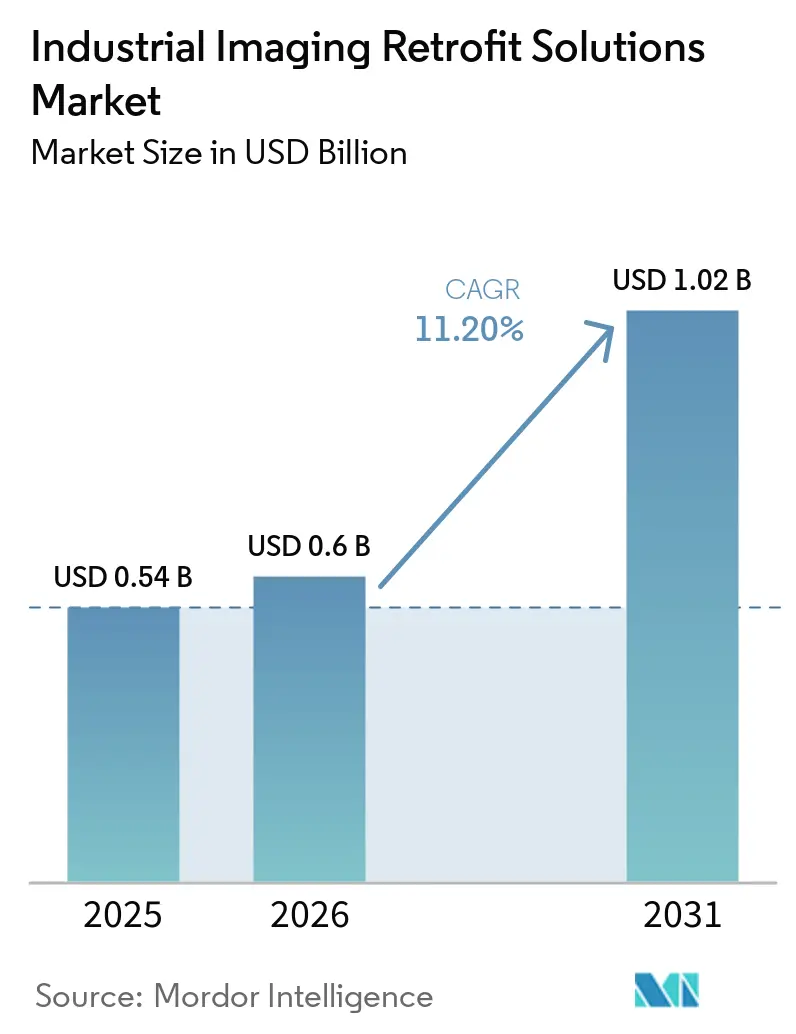
The Industrial Imaging Retrofit Solutions Market size is expected to increase from USD 0.54 billion in 2025 to USD 0.60 billion in 2026 and reach USD 1.02 billion by 2031, growing at a CAGR of 11.20% over 2026 to 2031. Manufacturers are extending the useful life of installed cameras while seeking stronger inspection performance. Smaller AI models, more accessible edge computing, and open vision protocols support upgrades without full production line replacement. A 2026 peer-reviewed study found that YOLO based methods achieved a mean average precision of 85.3% and 92.2% on 2 real production datasets, showing the performance potential of software-led upgrades. Open connectivity can reduce the need for custom middleware between legacy cameras, manufacturing execution systems, and programmable logic controllers. This allows suppliers to combine equipment, software, and integration services within the Industrial Imaging Retrofit Solutions Market.
Key Report Takeaways
- By retrofit solution type, Camera and Sensor Upgrade held 33.56% of the Industrial Imaging Retrofit Solutions Market share in 2025, while AI Software Overlay is forecast to grow at a 15.89% CAGR through 2031.
- By imaging technology, 2D Imaging held 63.11% of the Industrial Imaging Retrofit Solutions Market share in 2025, while multispectral, hyperspectral, and thermal imaging are forecast to grow at a 12.46% CAGR through 2031.
- By the retrofit approach, Component Level Retrofit held 48.88% share in 2025, while Full System Retrofit is forecast to grow at a 14.21% CAGR through 2031.
- By application, Quality Inspection accounted for 38.78% of the Industrial Imaging Retrofit Solutions Market in 2025, while Robot Guidance and Bin Picking are forecast to grow at a 14.71% CAGR through 2031.
- By industry vertical, Automotive and Mobility held 23.27% share in 2025, while Electronics and Semiconductors are forecast to grow at a 13.43% CAGR through 2031.
- By geography, the Asia Pacific held 35.12% Industrial Imaging Retrofit Solutions Market share in 2025, while the Middle East and Africa are forecast to grow at a 12.24% CAGR through 2031.
Note: Market size and forecast figures in this report are generated using Mordor Intelligence’s proprietary estimation framework, updated with the latest available data and insights as of January 2026.
Market Trends and Insights
Drivers Impact Analysis of Industrial Imaging Retrofit Solutions Market*
| Driver | (~) % Impact on CAGR Forecast | Geographic Relevance | Impact Timeline |
|---|---|---|---|
| Zero-Defect Manufacturing and Automated Inspection | +2.8% | Global, strongest in Asia-Pacific and Europe | Medium term (2-4 years) |
| AI-Based Defect Detection on Existing Camera Assets | +2.4% | Global, strongest in North American and Asia-Pacific electronics clusters | Short term (≤ 2 years) |
| Vision-Guided Robotics and Flexible Automation | +2.1% | North America, Europe, and Asia-Pacific | Medium term (2-4 years) |
| Food, Pharmaceutical, and Medical-Device Traceability Requirements | +1.6% | North America, Europe, and Asia-Pacific | Short term (≤ 2 years) |
| Legacy-Asset Connectivity Through Open Vision Protocols | +1.2% | Global, including the Middle East and Africa and South America | Medium term (2-4 years) |
| Edge Inference for Low-Latency Closed-Loop Control | +0.9% | North America, Europe, and Asia-Pacific | Long term (≥ 4 years) |
| Source: Mordor Intelligence | |||
Zero Defect Manufacturing and Automated Inspection
Zero-defect programs are making imaging upgrades a more regular production investment within the Industrial Imaging Retrofit Solutions Market. Manufacturers use these systems to identify defects before products move to later production stages, where rework and disposal become more costly. A 2026 review of more than 50 implementations reported defect detection accuracy above 95%, with some controlled cases reaching 98% to 100%.[1]Authors, “Machine Learning-Powered Vision for Robotic Inspection in Manufacturing,” Sensors, mdpi.com The same review found that 77% of implementations remained in prototype or pilot stages. This gap creates demand for suppliers that can combine a validated vision model with robust deployment, documented testing, and dependable support for line operators. China issued its AI+Manufacturing Specialized Action Plan in January 2026 and set a target of 500 high-quality manufacturing AI scenarios over 3 years.[2]VDMA Machine Vision, “OPC UA Machine Vision Companion Specification,” VDMA, vdma.org
AI Based Defect Detection on Existing Camera Assets
AI-based defect detection allows plants to improve results without replacing every installed camera. A 2026 framework for automated optical inspection outperformed a legacy rule-based approach by 8.9 percentage points on industrial datasets. The Industrial Imaging Retrofit Solutions Market benefits when existing optics have sufficient resolution, repeatable illumination, and stable image quality for the target defect class. MVTec's MERLIC deployment at Endress+Hauser began in March 2025 and was later extended to other manufacturing sites. The case shows how an initial deployment can support rollout across a manufacturer’s network after the first site demonstrates operational reliability. Models trained on site-specific image sets can also preserve production knowledge and make later supplier changes less attractive.
Vision Guided Robotics and Flexible Automation
Robot Guidance and Bin Picking are forecast to grow at a 14.71% CAGR through 2031. This application helps manufacturers handle variable parts and containers without relying on fixed-position fixtures or repeated manual sorting. A 2026 study reported a 99% grasping success rate for an industrial binocular stereo vision system under standard conditions. The study recorded average cycle times of 520 milliseconds and translation errors of less than 0.38 mm. These results support use in flexible assembly, material handling, and sorting work where repeatability is essential. The Industrial Imaging Retrofit Solutions Market can benefit as manufacturers automate production to adapt to changing product mixes while seeking greater labor flexibility.
Food, Pharmaceutical, and Medical Device Traceability Requirements
Traceability rules are supporting demand for imaging retrofits in regulated production environments. U.S. manufacturers and repackagers became subject to electronic package-level traceability requirements on May 27, 2025. Large dispensers followed on November 27, 2025, while smaller dispensers must comply by November 27, 2026.[3]U.S. Food and Drug Administration, “Drug Supply Chain Security Act,” FDA, fda.gov These requirements support investment in OCR, barcode verification, and direct part marking systems that record and confirm package information in an interoperable electronic format. Medical device traceability requirements in Europe also support the Industrial Imaging Retrofit Solutions Market. Such projects can receive priority because noncompliance poses risks to product movement, documentation, and facility operations.
Restraints Impact Analysis of Industrial Imaging Retrofit Solutions Market*
| Restraint | (~) % Impact on CAGR Forecast | Geographic Relevance | Impact Timeline |
|---|---|---|---|
| Shortage of Vision Integration and Model-Validation Skills | -1.4% | Global, most acute in South America, the Middle East and Africa, and Southeast Asia | Medium term (2-4 years) |
| High Cost of Advanced Cameras and Illumination | -1.0% | Global, especially smaller manufacturers in South America and the Middle East and Africa | Short term (≤ 2 years) |
| Retrofit-Induced Cybersecurity and Functional-Safety Exposure | -0.7% | North America and Europe, extending to Asia-Pacific | Medium term (2-4 years) |
| Inconsistent Legacy Image Data and Line-Specific Model Drift | -0.5% | Global, especially high-mix production sites | Long term (≥ 4 years) |
| Source: Mordor Intelligence | |||
Shortage of Vision Integration and Model Validation Skills
The shortage of integration and model validation skills can slow deployment in the Industrial Imaging Retrofit Solutions Market. Projects require practical knowledge of optics, machine learning models, programmable logic controller integration, and industrial control systems. The 2026 implementation review found that 77% of machine learning vision projects remained at prototype or pilot scale. This pattern points to deployment and validation constraints rather than a lack of algorithmic capability. Turnkey contracts can address the gap by bundling equipment, software, commissioning, operator training, documentation, and post-production support. Low-code tools can simplify model training, but regulated production still requires specialized validation work.
High Cost of Advanced Cameras and Illumination
Advanced cameras and illumination can extend evaluation cycles for capital-sensitive buyers. Multispectral, hyperspectral, structured light, and high-resolution line-scan systems require greater investment than basic 2D systems, especially when existing mounting and control infrastructure must also be updated. Teledyne DALSA introduced its Kaleido SWIR hyperspectral camera in May 2026, with up to 1,280-pixel spatial resolution and line rates exceeding 2.3 kHz. Specialized lighting can account for 20% to 30% of the total system cost and is often not fully considered at the start of a retrofit project. This pressure is greatest for smaller manufacturers that face similar quality requirements but have less procurement leverage and shorter planning horizons. The Industrial Imaging Retrofit Solutions Market, therefore, retains a role for software overlays and selective component replacements.
*Our forecasts treat driver/restraint impacts as directional, not additive. The impact forecasts reflect baseline growth, mix effects, and variable interactions.
Industrial Imaging Retrofit Solutions Market Segment Analysis
By Retrofit Solution Type:
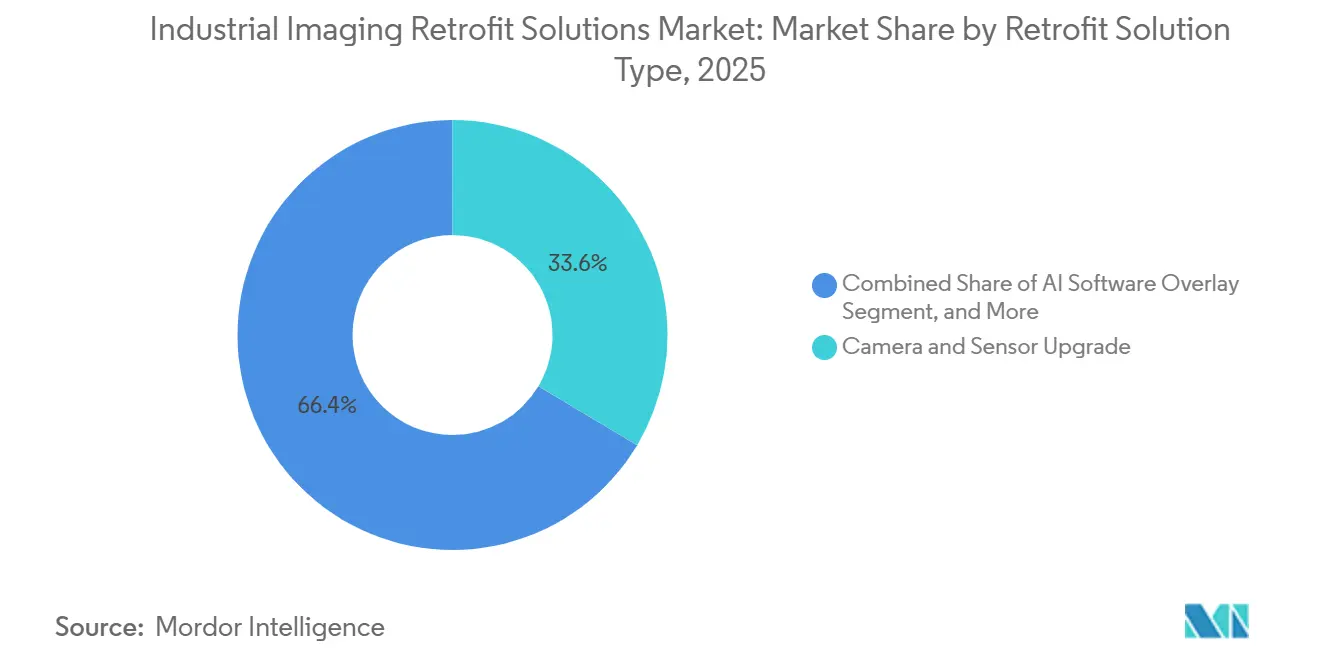
AI Overlays Grow Faster Than Hardware UpgradesCamera and Sensor Upgrade held 33.56% of the Industrial Imaging Retrofit Solutions Market share in 2025. Its lead reflected the large installed base of aging 1- to 5-megapixel cameras on established inspection lines, many of which were installed before higher-resolution sensors became more accessible. Plants can update sensors while retaining housings, lens mounts, control wiring, and familiar mechanical arrangements. This limits disruption and avoids lengthy shutdowns on lines that cannot pause production for full equipment replacement. Connectivity and Control Upgrade connects legacy cameras with current manufacturing execution systems, while Turnkey Inspection Station Retrofit serves sites where the optical and mechanical assembly cannot support a narrower upgrade.
AI Software Overlay is forecast to expand at a 15.89% CAGR through 2031. It can improve defect detection when installed cameras provide adequate resolution, stable lighting, usable image records, and consistent part presentation. The approach reduces the need to procure replacement hardware for every use case and lets suppliers place trained models close to the production process. Open industrial communication interfaces can make those models easier to connect with controllers, manufacturing systems, and existing production records. Specialized lighting, encoders, and triggers remain important because consistent image capture supports reliable model output and reduces variation between shifts.



By Imaging Technology:
2D Imaging Remains the Broadest Installed Base2D Imaging held 63.11% of the Industrial Imaging Retrofit Solutions Market share in 2025. It supports surface defect detection, label verification, and dimensional gauging across automotive, packaging, food, and electronics lines. Area-scan and line-scan cameras remain practical for routine visual tasks, supported by a mature ecosystem of optics, controllers, software libraries, and integration expertise. This supports continued retrofits in which an inspection function does not require depth, material discrimination, or spectral information. The segment remains important because its integration path is familiar to plant engineers and control teams, thereby reducing commissioning effort.
Multispectral, hyperspectral, and thermal imaging is forecast to grow at a 12.46% CAGR through 2031. These systems can distinguish material properties that conventional 2D optics cannot detect, thereby supporting food sorting, pharmaceutical inspection, battery cell verification, and recycling. Teledyne DALSA’s Kaleido camera targets applications in recycling, food safety, pharmaceuticals, and waste management. The European Commission’s HyperImage project included quality control in high-power electronics among 4 industrial use cases and projected 10%-20% yield improvements in participating environments. Thermal systems can also support equipment health monitoring, allowing a retrofit to contribute to both quality management and maintenance planning.
By Retrofit Approach:
Component Upgrades Lead While Full System Projects AccelerateComponent Level Retrofit held 48.88% of the Industrial Imaging Retrofit Solutions Market share in 2025. Plants use it to improve inspection capability without replacing an entire station or reopening every related production process. A camera body, frame grabber, or illumination module can be changed while controllers, wiring, safety procedures, and familiar workflows remain in place. This limits revalidation work in regulated factories and reduces disruption for operators who know the existing equipment. Multiple incompatible interfaces can, however, make piecemeal changes less economical over time, especially where several older systems must exchange data.
Full System Retrofit is forecast to expand at a 14.21% CAGR through 2031. It is suited to sites where old interfaces, inconsistent documentation, and accumulated adapters create more operational risk than value. A 2025 study found that OPC UA-based digital retrofitting can make comprehensive upgrades more workable for smaller manufacturers. The approach replaces fragile connections with a more consistent architecture and provides a clearer technical basis for future software, camera, and data management upgrades. The Industrial Imaging Retrofit Solutions Market includes both incremental projects and comprehensive rebuilds because legacy conditions differ widely among sites, lines, and industrial applications.
By Application:
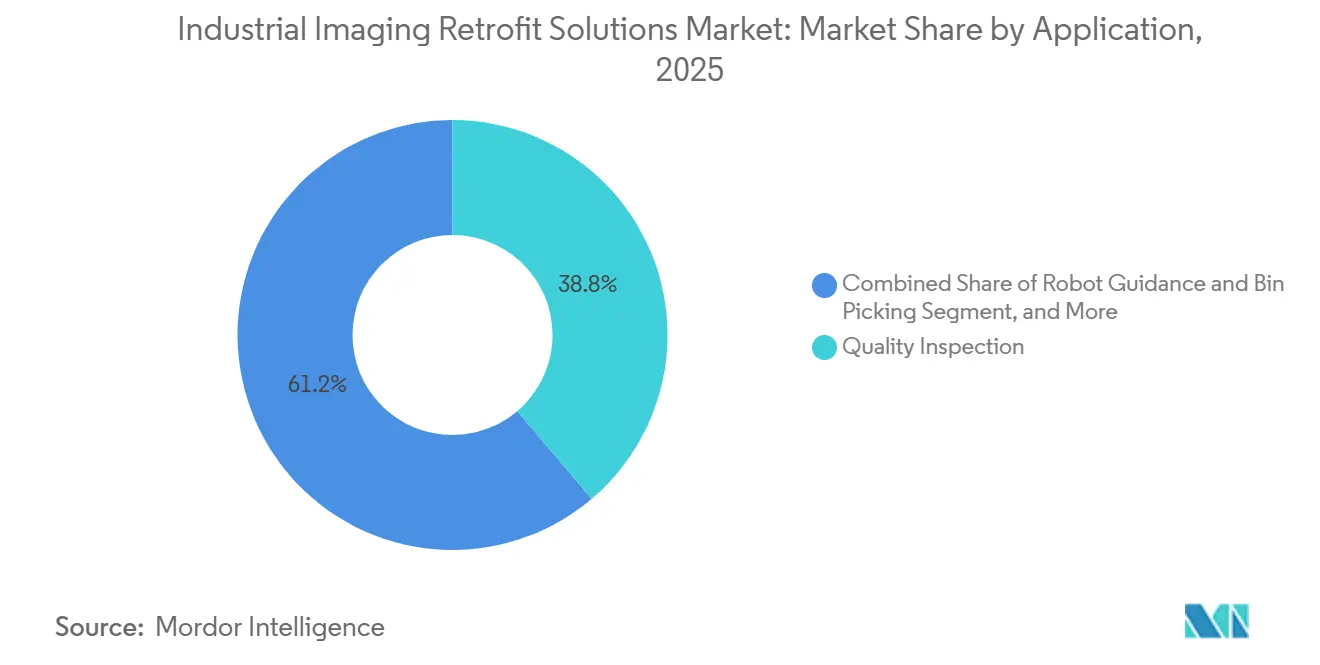
Quality Inspection Leads and Robot Guidance Gains GroundQuality Inspection held 38.78% of the Industrial Imaging Retrofit Solutions Market share in 2025. It covers work ranging from basic package checks to multi-camera inspection of electronic assemblies, solder joints, finished surfaces, and printed codes. Automotive, electronics, food, and pharmaceutical facilities all require dependable inline checks that can operate at production speed. Measurement and Metrology become more relevant as component tolerances narrow, while serialized product requirements support Identification, Traceability, and OCR. Barcode quality standards also provide buyers with a clearer technical basis for retrofit procurement and help align equipment specifications with compliance requirements.
Robot Guidance and Bin Picking are forecast to expand at a 14.71% CAGR through 2031. It supports flexible automation in automotive and electronics assembly, particularly where products, containers, or part positions vary. The 2026 stereo vision study reported 99% grasping success under standard conditions.[4]Authors, “An Integrated 3D Vision Sensor System with Adaptive Point Cloud Processing for Robotic Workpiece Localization in Industrial Bin Picking,” Discover Computing, link.springer.com Process Monitoring and Predictive Maintenance is another use for thermal and multispectral cameras originally installed for inspection. This broader use can strengthen the case for investment in the Industrial Imaging Retrofit Solutions Market by supporting more than 1 operational use case.
By Industry Vertical:
Automotive Leads While Electronics and Semiconductors Grow FastestAutomotive and Mobility accounted for 23.27% of the Industrial Imaging Retrofit Solutions Market in 2025. The sector has a long record of inline inspection, robotics, and parts traceability across OEM and supplier production lines. Retrofit demand includes body-in-white welding checks, sealant bead verification, fastener detection, and other tasks where defects can disrupt later assembly stages. AI-supported systems can reduce false rejects on reflective or changing surfaces that are difficult for fixed rule-based systems. Food and Beverage, Pharmaceuticals and Life Sciences, Packaging, and Metals and Machinery also use upgrades for contamination checks, labeling, product authentication, and dimensional inspection.
Electronics and Semiconductors are forecast to grow at a 13.43% CAGR through 2031. Advanced packaging formats, including fan-out wafer-level packaging and 3D IC stacking, require finer inspection precision than older cameras can provide. This increases demand for specialized cameras, improved lighting, and faster on-site processing to support line-speed decisions. The Industrial Imaging Retrofit Solutions Market also serves aerospace and defense applications that require detailed records, audit trails, validation, and requalification before deployment. These requirements can favor suppliers that provide complete technical support rather than just a camera or software component.
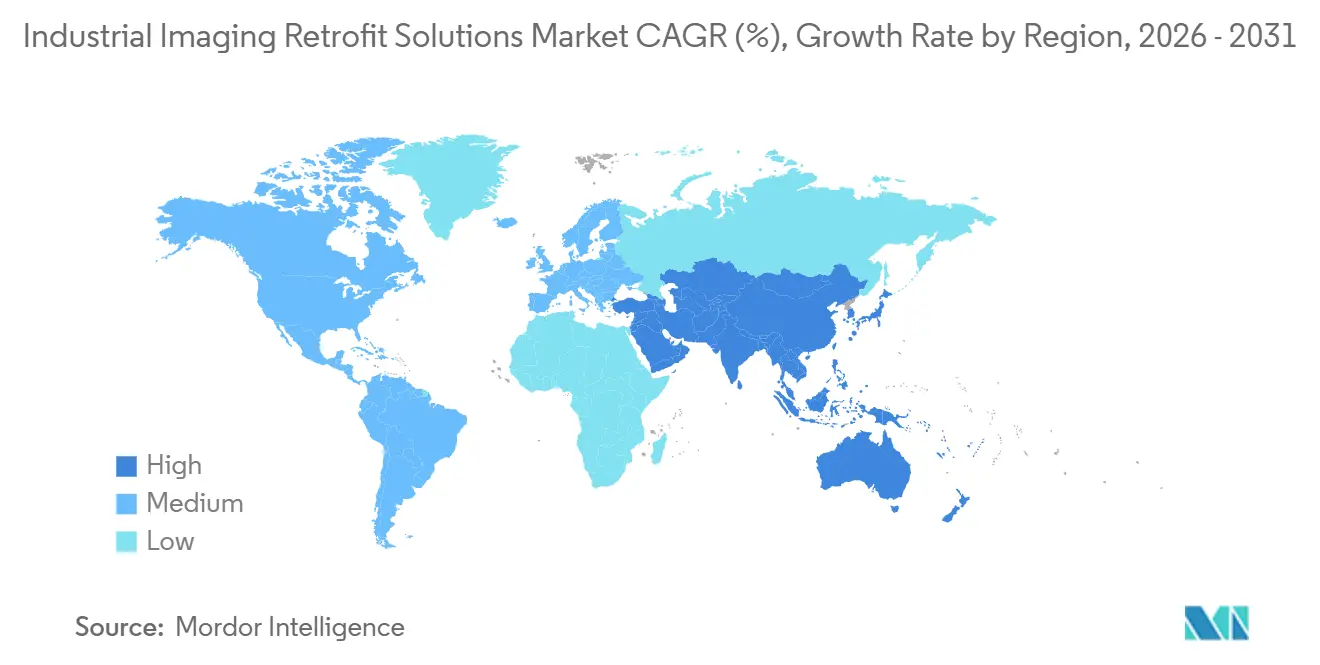
Geography Analysis
APAC Industrial Imaging Retrofit Solutions Market
Asia Pacific accounted for 35.12% of the Industrial Imaging Retrofit Solutions Market in 2025. China’s January 2026 manufacturing AI action plan identifies industrial vision inspection as a priority deployment area and targets 500 high-quality manufacturing AI scenarios over 3 years. Japan continues to introduce AI-based inspection systems, including Panasonic Connect’s Bead Eye M edition, released in June 2026. South Korea and ASEAN add demand through semiconductor, display panel, and battery production.
The Americas Industrial Imaging Retrofit Solutions Market
North America is the second largest regional market, supported by an established installed base of inspection equipment across automotive, aerospace, and pharmaceutical facilities. The United States remains important for hardware upgrades and for AI vision software platforms used in overlay projects. Drug traceability rules continue to support demand for pharmaceutical imaging. Canada and Mexico contribute through automotive supply chains and food processing. South America has aging equipment and rising labor costs that can support retrofit demand, although limited integration skills can slow adoption.
EMEA Industrial Imaging Retrofit Solutions Market
The Middle East and Africa is forecast to grow at a 12.24% CAGR through 2031, making it the fastest-growing geographic segment. Europe is the third-largest geographic cluster, with Germany, Italy, and France driving steady demand for quality upgrades across automotive and machinery value chains. The GreenRetroTwin project began in Germany in March 2026 and is developing tools to convert legacy engineering data into standardized digital representations. This work can reduce planning effort for broader retrofit programs. Greenfield manufacturing and energy inspection are the Middle East’s primary entry points.

Competitive Landscape
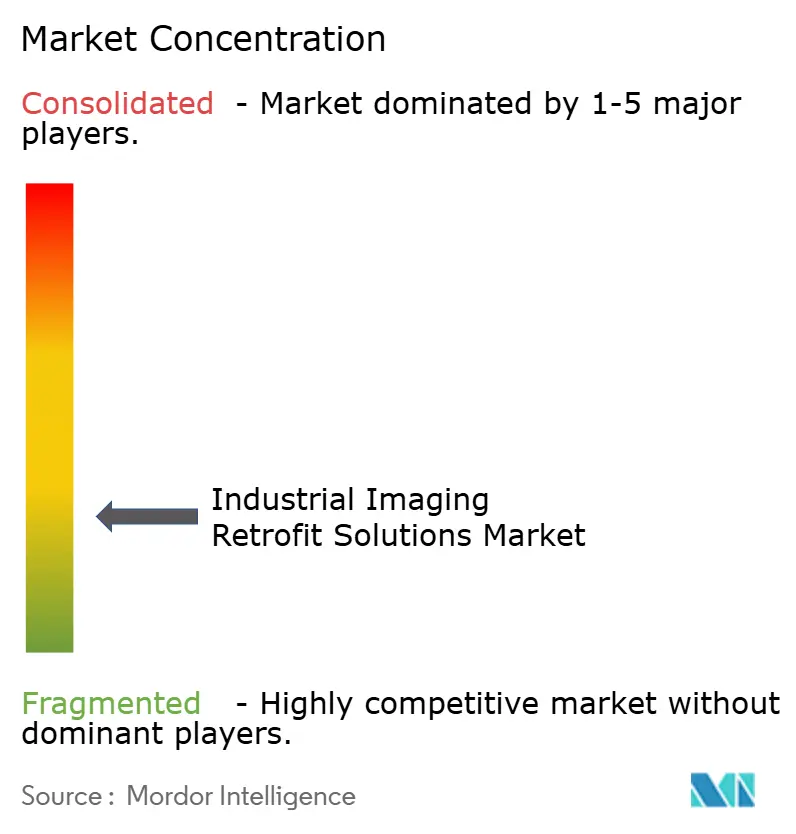
The Industrial Imaging Retrofit Solutions Market is fragmented at the system integration level. Camera and sensor specialists compete on image performance, interfaces, and distribution reach. Software suppliers compete through AI model training, edge deployment, and connectivity tools. Automation companies can bundle sensors, controls, robotics, and integration services, which reduces project risk for buyers seeking a single supplier.
The Industrial Imaging Retrofit Solutions Market includes KEYENCE Corporation, OMRON Corporation, Teledyne Technologies Incorporated, Basler AG, Allied Vision Technologies GmbH, JAI A/S, IDS Imaging Development Systems GmbH, Baumer Optronic GmbH, LMI Technologies Inc., MVTec Software GmbH, Datalogic S.p.A., Hikrobot Technology Co., Ltd., Adimec Advanced Image Systems B.V., Tordivel AS, STEMMER IMAGING AG, Pleora Technologies Inc., SICK AG, Sony Semiconductor Solutions Corporation, and Matrox Electronic Systems Ltd. They operate as camera manufacturers, sensor suppliers, software vendors, connectivity providers, or system integrators. Teledyne DALSA introduced the Kaleido SWIR hyperspectral camera in May 2026. Panasonic Connect released its Bead Eye M edition for AI welding inspection in June 2026. MVTec extended its MERLIC deployment from Endress+Hauser’s first site to additional sites during 2025.
Competition is shifting from one-time camera sales to integrated upgrade packages. AI software overlays can generate recurring software and service revenue, while multispectral and thermal packages can address regulated food and pharmaceutical uses. OPC UA Machine Vision interfaces can help suppliers connect legacy cameras with manufacturing systems. Cybersecurity is becoming a more important purchasing consideration when upgrades connect cameras to operational technology networks. Focused retrofit specialists retain an opening because many manufacturers continue to limit full equipment replacement.
Industrial Imaging Retrofit Solutions Industry Leaders
Cognex Corporation
Keyence Corporation
OMRON Corporation
Teledyne Technologies Incorporated
Basler AG
- *Disclaimer: Major Players sorted in no particular order
Industrial Imaging Retrofit Solutions Market Companies Covered in this Report
- Keyence Corporation
- OMRON Corporation
- Teledyne Technologies Incorporated
- Basler AG
- Allied Vision Technologies GmbH
- JAI A/S
- IDS Imaging Development Systems GmbH
- Baumer Optronic GmbH
- LMI Technologies Inc.
- MVTec Software GmbH
- Datalogic S.p.A.
- Hikrobot Technology Co., Ltd.
- Adimec Advanced Image Systems B.V.
- Tordivel AS
- STEMMER IMAGING AG
- Pleora Technologies Inc.
- SICK AG
- Sony Semiconductor Solutions Corporation
- Matrox Electronic Systems Ltd.

Recent Industry Developments in Industrial Imaging Retrofit Solutions Market
- July 2026: Mitsubishi Electric and Sony Semiconductor Solutions agreed to establish Advanced Vision Solutions Co., Ltd., subject to regulatory approvals. The joint venture is scheduled to begin operations in October 2026 and will develop AI vision sensors for manufacturing that process visual data directly on the sensor.
- July 2026: KEYENCE launched the VS-G Series AI-Powered High-Performance Vision System. Its 32-core AI engine processes 5-megapixel segmentation tasks 13 times faster than earlier VS-L/S/C platforms and supports up to 8 cameras for automotive and electronics inspection.
- July 2026: MAZIN launched TPIM01, an AI robot inspection device for turned metal parts. The system automates picking, inspection, and sorting without conventional teaching, helping Japanese manufacturers manage complex inspection workloads with limited specialist labor.
- May 2026: Panasonic Connect released the Bead Eye M edition, which combines a 3D sensor with welding-process AI for post-weld inspection. The solution reduces inspection setup labor by 90% and can be installed on existing welding lines without line modification.


Global Industrial Imaging Retrofit Solutions Market Report Scope
The Industrial Imaging Retrofit Solutions Market refers to upgrading existing legacy machine vision and inspection systems with modern technologies without requiring complete equipment replacement. These solutions range from component-level camera and sensor upgrades to full-system overhauls incorporating AI software overlays and advanced 2D or 3D imaging. They enable manufacturing industries to improve quality inspection, measurement accuracy, and robotic guidance cost-effectively, extending the lifespan of current infrastructure while boosting operational efficiency.
The Industrial Imaging Retrofit Solutions Market Report is Segmented by Retrofit Solution Type (Camera and Sensor Upgrade, AI Software Overlay, Connectivity and Control Upgrade, Turnkey Inspection-Station Retrofit, and Other Retrofit Solution Types), Imaging Technology (2D Imaging, 3D Imaging, and Multispectral, Hyperspectral, and Thermal Imaging), Retrofit Approach (Component-Level Retrofit, Subsystem Retrofit, and Full-System Retrofit), Application (Quality Inspection, Measurement and Metrology, Identification, Traceability, and OCR, Robot Guidance and Bin Picking, and Process Monitoring and Predictive Maintenance), Industry Vertical (Automotive and Mobility, Electronics and Semiconductors, Food and Beverage, Pharmaceuticals and Life Sciences, Packaging, Metals and Machinery, and Aerospace and Defense), and Geography (North America, South America, Europe, Asia-Pacific, and Middle East and Africa). The Market Forecasts are Provided in Terms of Value (USD).
| Camera and Sensor Upgrade |
| AI Software Overlay |
| Connectivity and Control Upgrade |
| Turnkey Inspection-Station Retrofit |
| Other Retrofit Solution Types |
| 2D Imaging |
| 3D Imaging |
| Multispectral, Hyperspectral, and Thermal Imaging |
| Component-Level Retrofit |
| Subsystem Retrofit |
| Full-System Retrofit |
| Quality Inspection |
| Measurement and Metrology |
| Identification, Traceability, and OCR |
| Robot Guidance and Bin Picking |
| Process Monitoring and Predictive Maintenance |
| Automotive and Mobility |
| Electronics and Semiconductors |
| Food and Beverage |
| Pharmaceuticals and Life Sciences |
| Packaging |
| Metals and Machinery |
| Aerospace and Defense |
| North America | United States | |
| Canada | ||
| Mexico | ||
| South America | Brazil | |
| Argentina | ||
| Rest of South America | ||
| Europe | Germany | |
| United Kingdom | ||
| France | ||
| Italy | ||
| Spain | ||
| Rest of Europe | ||
| Asia-Pacific | China | |
| Japan | ||
| India | ||
| South Korea | ||
| Rest of Asia-Pacific | ||
| Middle East and Africa | Middle East | Saudi Arabia |
| United Arab Emirates | ||
| Rest of the Middle East | ||
| Africa | South Africa | |
| Rest of Africa | ||
| By Retrofit Solution Type | Camera and Sensor Upgrade | ||
| AI Software Overlay | |||
| Connectivity and Control Upgrade | |||
| Turnkey Inspection-Station Retrofit | |||
| Other Retrofit Solution Types | |||
| By Imaging Technology | 2D Imaging | ||
| 3D Imaging | |||
| Multispectral, Hyperspectral, and Thermal Imaging | |||
| By Retrofit Approach | Component-Level Retrofit | ||
| Subsystem Retrofit | |||
| Full-System Retrofit | |||
| By Application | Quality Inspection | ||
| Measurement and Metrology | |||
| Identification, Traceability, and OCR | |||
| Robot Guidance and Bin Picking | |||
| Process Monitoring and Predictive Maintenance | |||
| By Industry Vertical | Automotive and Mobility | ||
| Electronics and Semiconductors | |||
| Food and Beverage | |||
| Pharmaceuticals and Life Sciences | |||
| Packaging | |||
| Metals and Machinery | |||
| Aerospace and Defense | |||
| By Geography | North America | United States | |
| Canada | |||
| Mexico | |||
| South America | Brazil | ||
| Argentina | |||
| Rest of South America | |||
| Europe | Germany | ||
| United Kingdom | |||
| France | |||
| Italy | |||
| Spain | |||
| Rest of Europe | |||
| Asia-Pacific | China | ||
| Japan | |||
| India | |||
| South Korea | |||
| Rest of Asia-Pacific | |||
| Middle East and Africa | Middle East | Saudi Arabia | |
| United Arab Emirates | |||
| Rest of the Middle East | |||
| Africa | South Africa | ||
| Rest of Africa | |||


Key Questions Answered in the Report
What is the Industrial Imaging Retrofit Solutions Market size?
The Industrial Imaging Retrofit Solutions Market is expected to increase from USD 0.54 billion in 2025 to USD 0.60 billion in 2026 and reach USD 1.02 billion by 2031.
What is driving demand for industrial imaging retrofits?
Manufacturers are extending camera life, improving defect detection, and meeting traceability requirements.
Which retrofit solution is growing fastest?
AI Software Overlay is forecast to grow at a 15.89% CAGR through 2031.
Which imaging technology has the largest share?
2D Imaging held 63.11% share in 2025 because it serves a broad range of inspection tasks.
Which application is growing fastest?
Robot Guidance and Bin Picking is forecast to grow at a 14.71% CAGR through 2031.
Which region leads demand?
Asia-Pacific held 35.12% share in 2025, while the Middle East and Africa is forecast to grow at a 12.24% CAGR through 2031.
Page last updated on:





