
Industrial Fixed-Mount Barcode Reader Market Size and Share
Market Overview
| Study Period | 2020 - 2031 |
|---|---|
| Market Size (2026) | USD 2.20 Billion |
| Market Size (2031) | USD 3.37 Billion |
| Growth Rate (2026 - 2031) | 8.90 % |
| Fastest Growing Market | Asia-Pacific |
| Largest Market | Asia-Pacific |
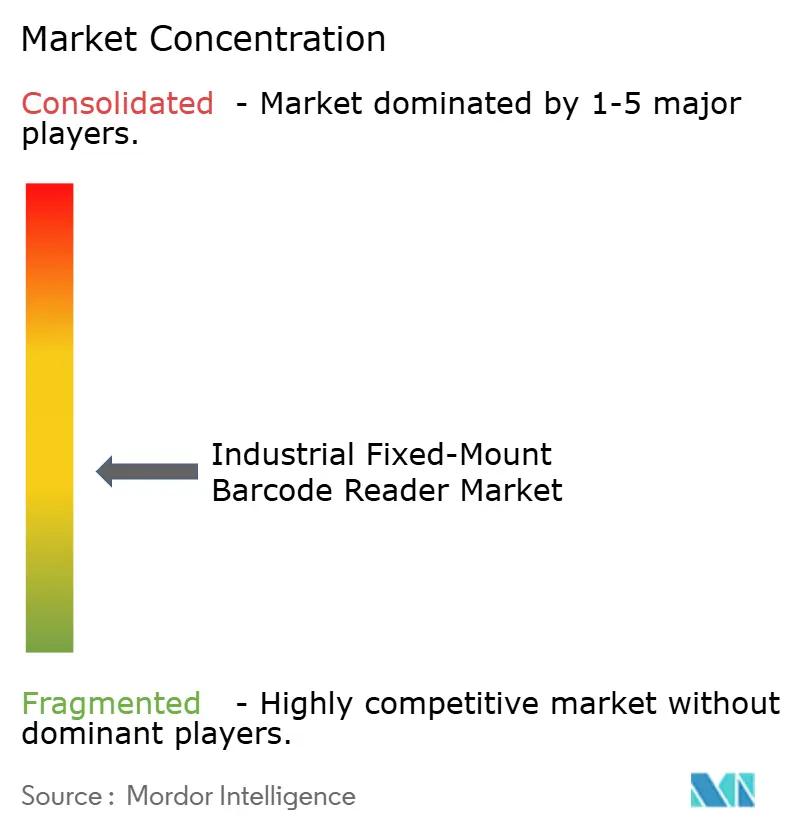
| Market Concentration | Medium |
Major Players *Disclaimer: Major Players sorted in no particular order Image © Mordor Intelligence. Reuse requires attribution under CC BY 4.0. | |
Industrial Fixed-Mount Barcode Reader Market Analysis by Mordor Intelligence
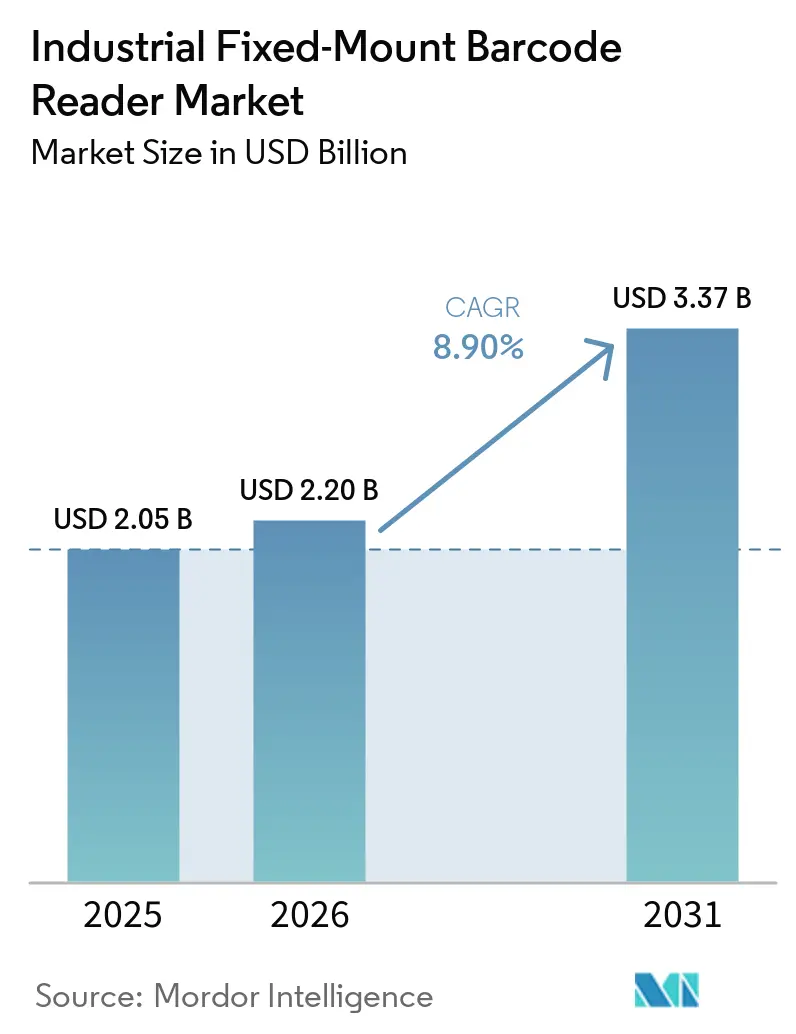
The Industrial Fixed-Mount Barcode Reader Market size was valued at USD 2.05 billion in 2025 and estimated to expand from USD 2.20 billion in 2026 to reach USD 3.37 billion by 2031, at a CAGR of 8.90% during the forecast period (2026-2031). Automated fulfillment projects are raising the need for reliable identification at conveyor, sortation, and packaging points. Serialization rules in pharmaceuticals and food are also moving spending from optional upgrades toward compliance-focused equipment. The shift from linear codes to 2D formats is widening the role of fixed readers in production and logistics workflows. Suppliers are responding with readers that combine code decoding, inspection, and software connectivity into a single device. The Industrial Fixed-Mount Barcode Reader Market therefore benefits from demand tied to facility investment plans, regulatory schedules, workforce availability, and planned equipment replacement cycles across industrial sites.
Key Report Takeaways
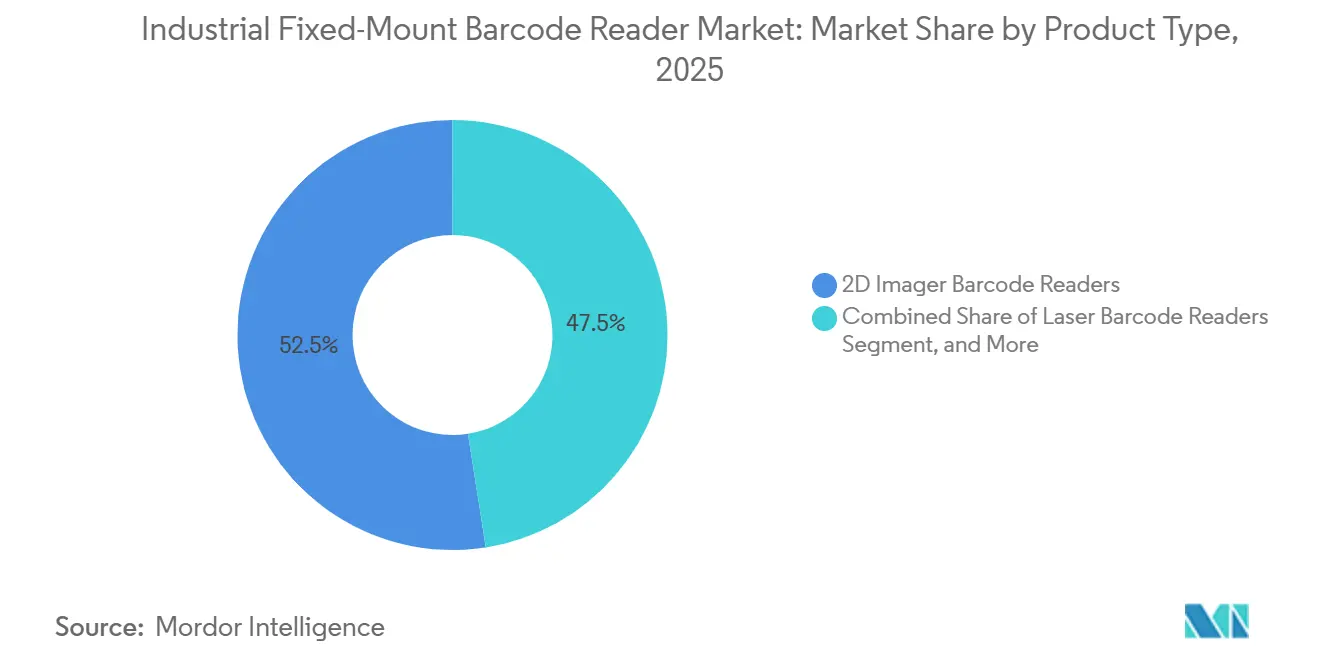
- By product type, 2D Imager Barcode Readers held 52.47% of the Industrial Fixed-Mount Barcode Reader Market share in 2025, while Laser Barcode Readers are projected to expand at a CAGR of 10.27% through 2031.
- By application, Conveyor, Sortation, and Distribution Scanning accounted for 32.13% of revenue in 2025, while Quality Inspection and Traceability are projected to expand at a CAGR of 10.93% through 2031.
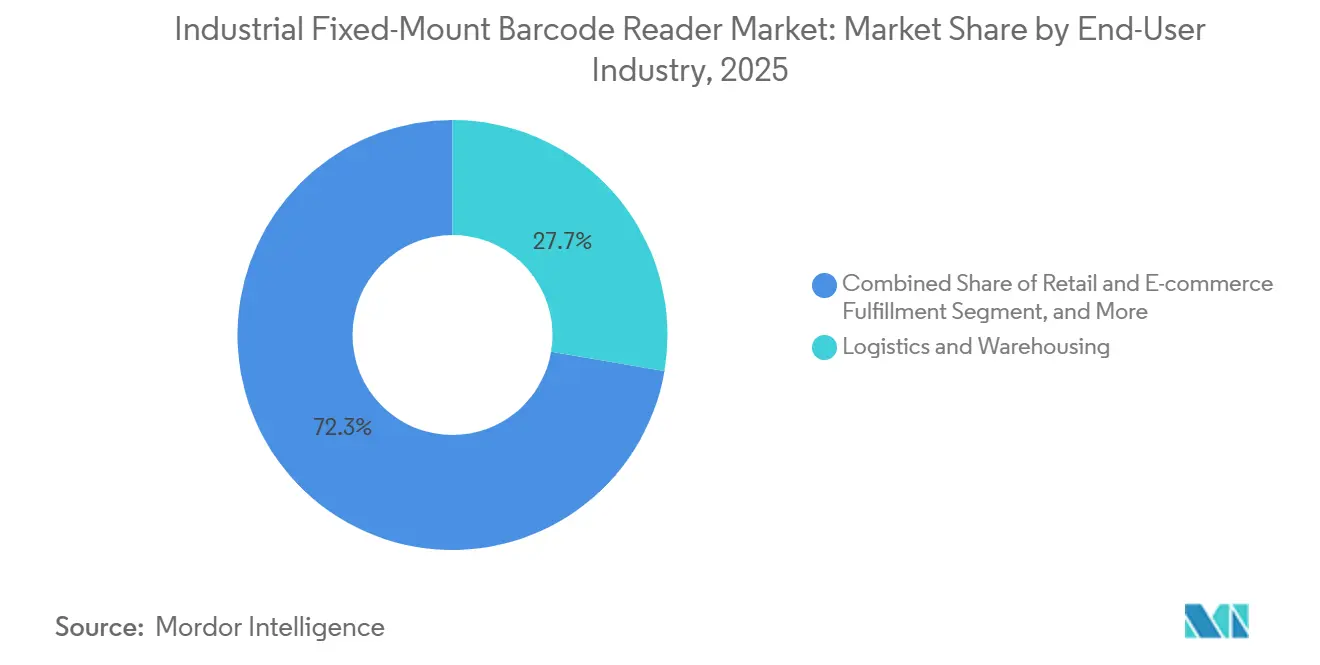
- By end-user industry, Logistics and Warehousing held 27.68% of revenue in 2025, while Retail and E-commerce Fulfillment is expected to expand at a CAGR of 11.47% through 2031.
- By system configuration, General-Purpose Fixed-Mount Readers held 46.83% of revenue in 2025, while High-Speed Tunnel and Multireader Systems are projected to expand at a CAGR of 11.79% through 2031.
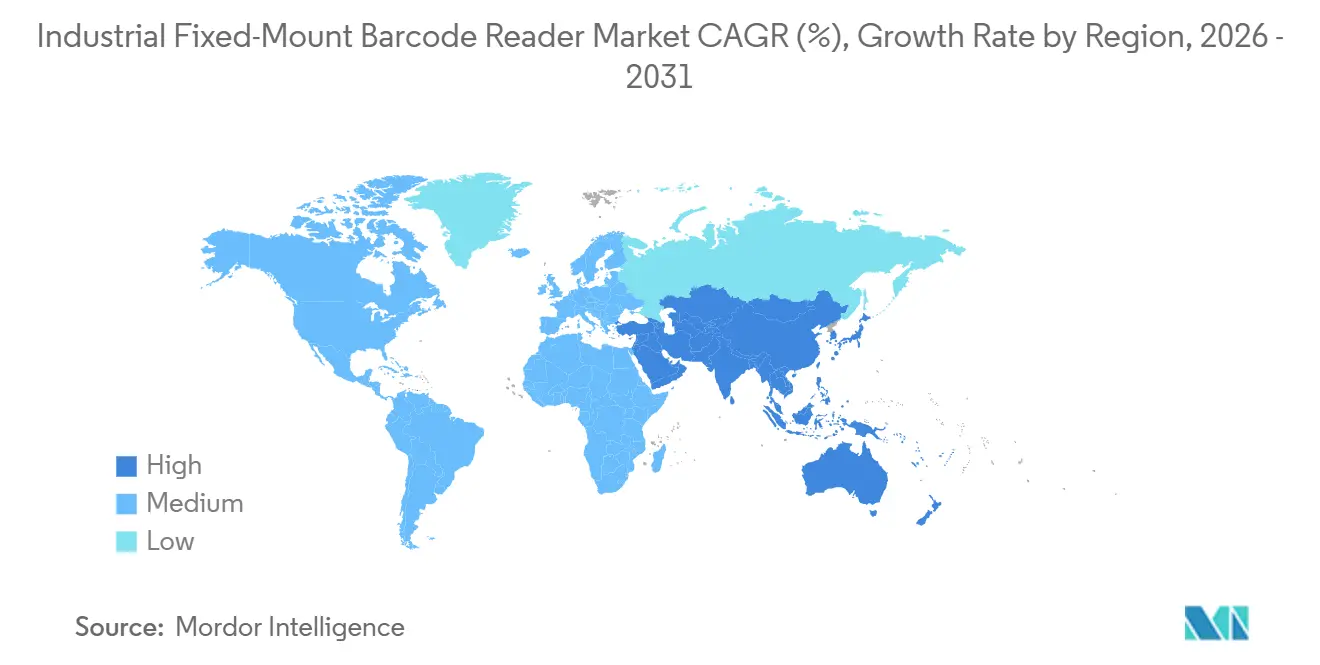
- By geography, Asia-Pacific accounted for 40.27% of revenue in 2025 and is projected to grow at a CAGR of 10.23% through 2031.
Note: Market size and forecast figures in this report are generated using Mordor Intelligence’s proprietary estimation framework, updated with the latest available data and insights as of January 2026.
Global Industrial Fixed-Mount Barcode Reader Market Trends and Insights
Drivers Impact Analysis*
| Driver | (~) % Impact on CAGR Forecast | Geographic Relevance | Impact Timeline |
|---|---|---|---|
| E-Commerce Fulfillment Automation | +2.5% | Global, particularly North America and Asia-Pacific | Short term (≤ 2 years) |
| Industry 4.0 Traceability Requirements | +2.0% | Global, with Asia-Pacific manufacturing hubs leading | Medium term (2-4 years) |
| Pharmaceutical and Food Serialization Mandates | +1.5% | Global, with strongest regulatory influence in the United States, Europe, and emerging markets | Medium term (2-4 years) |
| Labor Optimization in High-Throughput Operations | +1.2% | North America and Europe, with spillover to Asia-Pacific | Short term (≤ 2 years) |
| Expansion of 2D Codes and Digital Product Passports | +1.0% | Global, led by the European Union framework | Medium term (2-4 years) |
| AI-Assisted Decoding of Damaged and Low-Contrast Codes | +0.8% | Global, especially automotive and electronics hubs in Asia-Pacific, Germany, and the United States | Long term (≥ 4 years) |
| Source: Mordor Intelligence | |||
E-Commerce Fulfillment Automation Drives Infrastructure-Scale Deployments
Warehouse automation is adding identification points at induction, sorting, packing, and outbound transfer stages. The Industrial Fixed-Mount Barcode Reader Market benefits when facilities replace readers that cannot handle higher parcel density or 2D codes. Readers now work alongside warehouse software, vision tools, conveyors, and robotic equipment. North American warehouse businesses bought nearly 18,000 robots in the first half of 2026, valued at USD 1.2 billion.[1]Information Technology and Innovation Foundation, “Fact of the Week Robot Purchases in North American Warehousing Industry Totaled USD 1.2 Billion in First Half of 2026,” ITIF, itif.org This supports larger reader deployments across both new and upgraded distribution centers.
Industry 4.0 Traceability Requirements Anchor Cross-Sector Demand
NIST stated that traceability requires persistent identifiers at production and logistics points.[2]National Institute of Standards and Technology, “Supply Chain Traceability Manufacturing Meta-Framework,” NIST, nist.gov Fixed readers capture barcode, QR code, and direct part mark data for digital manufacturing systems. Automotive and electronics producers need reliable reading on metallic, curved, and low-contrast surfaces. Real-time EPCIS event data is increasing the need for consistent information capture across workflows. Buyers are placing greater weight on connectivity, standards compliance, and local processing capability.
Pharmaceutical and Food Serialization Mandates Create Recurring Capital Investment Cycles
The FDA set Drug Supply Chain Security Act enforcement milestones during 2025. Full EPCIS aggregation became mandatory on May 28, 2026. Packaging lines must verify codes and connect serialized products across handling stages.[3]U.S. Food and Drug Administration, “Drug Supply Chain Security Act,” FDA, fda.gov The Industrial Fixed-Mount Barcode Reader Market benefits from demand for print verification readers and aggregation scanners. Pharmaceutical applications can support higher selling prices because of validation and data-capture requirements.[4]Datalogic S.p.A., “Camera-Based Compact Fixed 1D Scanner BLADE Series,” Takagi, takagi-c.com
Labor Optimization in High-Throughput Operations Compresses Payback Periods
North American warehouse wages reached USD 27 per hour in June 2026, while 392,000 positions remained unfilled. Fixed readers reduce manual identification work at conveyor transfer points. They also let staff focus on exceptions, maintenance, and other tasks. Shorter payback periods can make automation practical for mid-sized operators. Buyers must still plan for redundancy, network readiness, and high-speed operating conditions.
Restraints Impact Analysis*
| Restraint | (~) % Impact on CAGR Forecast | Geographic Relevance | Impact Timeline |
|---|---|---|---|
| High Initial System and Integration Costs | -0.8% | Global, with a greater effect on small and medium-sized enterprises in South America and the Middle East and Africa | Long term (≥ 4 years) |
| Legacy-System Compatibility Constraints | -0.6% | Global, particularly mature industrial markets in Europe and North America | Medium term (2-4 years) |
| Competition From RFID and Hybrid Identification Systems | -0.5% | Global, strongest in high-volume logistics and pharmaceutical packaging | Medium term (2-4 years) |
| Maintenance and Optical Calibration Requirements | -0.3% | Global, particularly dusty or high-humidity manufacturing settings | Short term (≤ 2 years) |
| Source: Mordor Intelligence | |||
High Initial System and Integration Costs Limit Mid-Market and Emerging-Market Penetration
A fixed-reader project includes hardware, integration, software, and commissioning costs. Connecting readers with PLC, warehouse management, and manufacturing systems can be expensive in older facilities. Smaller manufacturers may retain handheld scanners when capital and engineering resources are limited. Reader failures can also create concerns about lost throughput on critical lines. Redundancy, network upgrades, and service support increase the total cost of ownership.
Legacy-System Compatibility Constraints Slow Brownfield Upgrades in Mature Markets
Many existing systems use RS-232 or RS-485 communication rather than newer Ethernet-based networks. A reader replacement can require PLC updates, cable changes, testing, and safety certification. Pharmaceutical manufacturers may need to validate a production line again under FDA and European requirements. These steps can delay the replacement of equipment that still works. The Industrial Fixed-Mount Barcode Reader Market experiences slower upgrades, with extensive integration and downtime planning.
*Our forecasts treat driver/restraint impacts as directional, not additive. The impact forecasts reflect baseline growth, mix effects, and variable interactions.
Segment Analysis
By Product Type: 2D Imaging Leads While Laser Platforms Regain Momentum
2D Imager Barcode Readers held 52.47% of the Industrial Fixed-Mount Barcode Reader Market share in 2025. Their position reflects the use of GS1 DataMatrix codes in pharmaceutical serialization and QR codes in digital product passport programs. GS1 described the role of GS1 standards in supporting the European Union digital product passport framework. Manufacturers are adding 2D-capable readers at packaging verification stations as dual coding becomes more common. This demand is not limited to warehouse automation budgets.
Laser Barcode Readers are projected to expand at a CAGR of 10.27% between 2026 and 2031. They remain well-suited to fast-moving packages that carry small, tightly spaced linear codes. Cognex introduced the DataMan 290 and DataMan 390 in January 2025 with AI-based decoding for manufacturing applications. The company also launched the DataMan 470 Series in November 2025 for blurred and direct-part-marked codes. Linear Imager Barcode Readers still serve entry-level 1D applications, especially on older distribution and food-processing lines.



By Application: Conveyor Scanning Commands Volume as Quality Inspection Accelerates
Conveyor, Sortation, and Distribution Scanning accounted for 32.13% of the Industrial Fixed-Mount Barcode Reader Market size in 2025. Large sortation hubs may use dozens of readers across separate conveyor zones. Multi-sided tunnels identify packages at high speeds and support the large number of installations in this application. Spending in this area follows parcel volumes and fulfillment center investment. Scan tunnels are also adding centralized code processing, dimensioning, hazardous materials label detection, and package damage inspection functions.
Quality Inspection and Traceability is projected to expand at a CAGR of 10.93% through 2031. Automotive and electronics manufacturers use direct part marks to maintain lifetime records for safety-critical components. This spending is more closely linked to traceability rules than to parcel demand. Product Production and WIP Scanning captures identity data during work-in-process transitions. Packaging and Print Verification checks code quality before products enter distribution, supporting compliance with ISO 15416 and ISO 15415.
By End-User Industry: Logistics Anchors Demand While E-Commerce Fulfillment Races Ahead
Logistics and Warehousing held 27.68% of the Industrial Fixed-Mount Barcode Reader Market share in 2025. This installed base was developed through long-standing use of conveyor scanning at docks and sortation lines. New fulfillment centers in North America and Asia-Pacific continue to add readers at the unit, case, and pallet-handling points. Traditional logistics sites commonly focus deployments at dock doors and sortation lines. Their scanning needs differ from unit-level e-commerce operations.
Retail and E-commerce Fulfillment is expected to expand at a CAGR of 11.47% through 2031. These operations require scanning at the pick, pack, and ship stations, thereby increasing installation density. Pharmaceutical and Healthcare Manufacturing has stringent compliance requirements for DataMatrix print verification and serial-number aggregation. Automotive Manufacturing, Electronics and Semiconductor Manufacturing, Food and Beverage Manufacturing, and Aerospace and Defense Manufacturing also need traceable identification processes. The Industrial Fixed-Mount Barcode Reader Market can benefit from these specialized uses, as readers must operate within specific production environments.
By System Configuration: General-Purpose Readers Dominate as Tunnel Systems Scale Up
General-Purpose Fixed-Mount Readers held 46.83% of revenue in 2025. They serve conveyor lines, dock doors, and robotic picking stations. Their broad use makes them a common choice for automation integrators seeking proven equipment. Compact Fixed-Mount Readers support space-constrained installations in electronics, semiconductor, and medical devices. Integrated Vision-Reader Systems combine inspection and identification in a single system, reducing the need for separate components.
High-Speed Tunnel and Multireader Systems are projected to expand at a CAGR of 11.79% through 2031. Parcel operators need these systems to handle higher throughput and a mix of barcode formats. Datalogic launched the Matrix 930 in March 2026 with a 28-megapixel sensor for conveyors up to 1 meter wide and PackTrack support for speeds up to 3.5 m/s. Process Monitoring and WIP Inspection configurations support real-time production control. Human Inspection Assistance and Decision Support configurations can flag nonconforming products before they proceed.
Geography Analysis
Asia-Pacific held 40.27% of the Industrial Fixed-Mount Barcode Reader Market share in 2025 and is projected to expand at a CAGR of 10.23% through 2031. China is deploying fixed identification systems in electronics and automotive plants through smart manufacturing programs. India is adding e-commerce logistics capacity that needs fixed-reader infrastructure. Japan maintains demand for direct-part-mark-capable equipment in precision manufacturing, while South Korea supports regional demand through semiconductor and electronics exports.
North America was the second-largest geography, led by the United States. The FDA's May 28, 2026, EPCIS aggregation requirement completed an important pharmaceutical compliance cycle. Warehouse wages and unfilled positions strengthened the business case for automation. Canada added demand through logistics operations, while Mexico supported sales through export-oriented automotive manufacturing. Europe had layered requirements from the EU Falsified Medicines Directive, the EU Battery Regulation, and digital product passports, with Germany central because of automotive OEM and supplier activity.
South America, the Middle East, and Africa represented smaller but distinct regional opportunities. Brazil supported South American demand through food and beverage manufacturing, pharmaceutical serialization, and e-commerce fulfillment. Saudi Arabia and the United Arab Emirates advanced adoption through warehouse and logistics projects connected with economic diversification programs. Egypt's pharmaceutical serialization mandate was activated in 2026, while South Africa and Nigeria remained key markets elsewhere in Africa. The Industrial Fixed-Mount Barcode Reader Market exhibits distinct regional demand patterns, with regulations, exports, and logistics investment shaping purchasing decisions.

Competitive Landscape
The Industrial Fixed-Mount Barcode Reader Market is moderately fragmented. Cognex Corporation, Zebra Technologies Corporation, Datalogic S.p.A., SICK AG, and KEYENCE CORPORATION compete for complex, higher-margin contracts. Fujian Newland Auto-ID Tech., RAKINDA Technologies, and MINDEO compete more heavily in general-purpose applications. Leading suppliers are building AI into decoding to read damaged, low-contrast, and distorted codes locally. This capability is particularly relevant for automotive and electronics direct-part-mark applications.
Zebra announced the NS42 Smart Vision Sensor in September 2026 for a VISION 2026 debut, combining anomaly detection, AI classification, and optical character recognition into a single device. The move shows how barcode identification and machine vision inspection are coming together in equipment used on logistics and manufacturing lines. Datalogic pursued easier brownfield integration through the BLADE Series compatibility design. Brady completed its USD 1.4 billion acquisition of Honeywell's Productivity Solutions and Services business in August 2026. The transaction brought scanning, printing, and workflow software into a broader industrial technology portfolio.
Mid-market brownfield sites and pharmaceutical compliance programs in emerging markets remain important areas for suppliers. Vendors that offer legacy protocol support and compatible mounting can reduce the friction of equipment upgrades. Chinese manufacturers are expanding in the Middle East, Africa, and South America with lower-cost equipment and financing options. This can put pressure on margins for general-purpose readers, especially when customers can compare basic hardware specifications without requiring advanced vision, software, or service capabilities. The Industrial Fixed-Mount Barcode Reader Market remains more differentiated in demanding applications where decoding, inspection, and integration capability matter.
Industrial Fixed-Mount Barcode Reader Industry Leaders
Cognex Corporation
Zebra Technologies Corporation
Datalogic S.p.A.
Honeywell International Inc.
SICK AG
- *Disclaimer: Major Players sorted in no particular order

Recent Industry Developments
- September 2026: Zebra Technologies announced it will debut the NS42 Smart Vision Sensor, CV70 CXP high-performance machine vision camera, AI-powered conveyor blockage detection, and Aurora Vision Guided Robotics Studio at VISION 2026 in Stuttgart, Germany, from October 6-8, 2026, targeting logistics middle-mile operations with integrated AI and 3D machine vision solutions.
- August 2026: Brady Corporation completed its USD 1.4 billion all-cash acquisition of Honeywell's Productivity Solutions and Services business, with FY2025 revenue of USD 1.1 billion, funded through cash on hand, a senior unsecured credit facility, and private placement debt, creating a scaled industrial technology company with integrated barcode scanning, printing, and workflow software capabilities.
- April 2026: Honeywell agreed to divest its Productivity Solutions and Services business to Brady Corporation in an all-cash deal for USD 1.4 billion, representing 8x EBITDA for the 12 months ended December 31, 2025, in a transaction unanimously approved by both companies' boards.
- April 2026: Datalogic presented the global commercial launch of the Matrix 830/930 image readers at MODEX 2026 in Atlanta, targeting courier services, 3PL providers, and distribution centers requiring next-generation high-speed parcel handling and conveyor-based logistics solutions.


Global Industrial Fixed-Mount Barcode Reader Market Report Scope
Industrial Fixed-Mount Barcode Readers are robust, stationary scanning devices designed for automated identification and data capture in high-speed manufacturing and logistics environments, enabling real-time traceability, inventory management, and process control by reading 1D and 2D codes on moving products or packages.
The Industrial Fixed-Mount Barcode Reader Market Report is Segmented by Product Type (Laser Barcode Readers, Linear Imager Barcode Readers, and 2D Imager Barcode Readers), Application (Product Production and WIP Scanning, Conveyor, Sortation and Distribution Scanning, Packaging and Print Verification, and Quality Inspection and Traceability), End-User Industry (Logistics and Warehousing, Automotive Manufacturing, Electronics and Semiconductor Manufacturing, Food and Beverage Manufacturing, Pharmaceutical and Healthcare Manufacturing, Retail and E-commerce Fulfillment, Aerospace and Defense Manufacturing, and Other End-User Industries), System Configuration (Compact Fixed-Mount Readers, General-Purpose Fixed-Mount Readers, High-Speed Tunnel and Multireader Systems, and Integrated Vision-Reader Systems), and Geography (North America, South America, Europe, Asia-Pacific, Middle East and Africa). The Market Forecasts are Provided in Terms of Value (USD).
| Laser Barcode Readers |
| Linear Imager Barcode Readers |
| 2D Imager Barcode Readers |
| Product Production and WIP Scanning |
| Conveyor, Sortation and Distribution Scanning |
| Packaging and Print Verification |
| Quality Inspection and Traceability |
| Other Applications |
| Logistics and Warehousing |
| Automotive Manufacturing |
| Electronics and Semiconductor Manufacturing |
| Food and Beverage Manufacturing |
| Pharmaceutical and Healthcare Manufacturing |
| Retail and E-commerce Fulfillment |
| Aerospace and Defense Manufacturing |
| Other End-User Industries |
| Compact Fixed-Mount Readers |
| General-Purpose Fixed-Mount Readers |
| High-Speed Tunnel and Multireader Systems |
| Integrated Vision-Reader Systems |
| Process Monitoring and WIP Inspection |
| Human Inspection Assistance and Decision Support |
| Other System Configurations |
| North America | United States | |
| Canada | ||
| Mexico | ||
| South America | Brazil | |
| Argentina | ||
| Rest of South America | ||
| Europe | Germany | |
| United Kingdom | ||
| France | ||
| Italy | ||
| Spain | ||
| Rest of Europe | ||
| Asia-Pacific | China | |
| Japan | ||
| India | ||
| South Korea | ||
| Rest of Asia-Pacific | ||
| Middle East and Africa | Middle East | Saudi Arabia |
| United Arab Emirates | ||
| Turkey | ||
| Rest of the Middle East | ||
| Africa | South Africa | |
| Nigeria | ||
| Rest of Africa | ||
| By Product Type | Laser Barcode Readers | ||
| Linear Imager Barcode Readers | |||
| 2D Imager Barcode Readers | |||
| By Application | Product Production and WIP Scanning | ||
| Conveyor, Sortation and Distribution Scanning | |||
| Packaging and Print Verification | |||
| Quality Inspection and Traceability | |||
| Other Applications | |||
| By End-User Industry | Logistics and Warehousing | ||
| Automotive Manufacturing | |||
| Electronics and Semiconductor Manufacturing | |||
| Food and Beverage Manufacturing | |||
| Pharmaceutical and Healthcare Manufacturing | |||
| Retail and E-commerce Fulfillment | |||
| Aerospace and Defense Manufacturing | |||
| Other End-User Industries | |||
| By System Configuration | Compact Fixed-Mount Readers | ||
| General-Purpose Fixed-Mount Readers | |||
| High-Speed Tunnel and Multireader Systems | |||
| Integrated Vision-Reader Systems | |||
| Process Monitoring and WIP Inspection | |||
| Human Inspection Assistance and Decision Support | |||
| Other System Configurations | |||
| By Geography | North America | United States | |
| Canada | |||
| Mexico | |||
| South America | Brazil | ||
| Argentina | |||
| Rest of South America | |||
| Europe | Germany | ||
| United Kingdom | |||
| France | |||
| Italy | |||
| Spain | |||
| Rest of Europe | |||
| Asia-Pacific | China | ||
| Japan | |||
| India | |||
| South Korea | |||
| Rest of Asia-Pacific | |||
| Middle East and Africa | Middle East | Saudi Arabia | |
| United Arab Emirates | |||
| Turkey | |||
| Rest of the Middle East | |||
| Africa | South Africa | ||
| Nigeria | |||
| Rest of Africa | |||


Key Questions Answered in the Report
What is the size of the Industrial Fixed-Mount Barcode Reader Market?
The Industrial Fixed-Mount Barcode Reader Market was valued at USD 2.05 billion in 2025 and is estimated at USD 2.20 billion in 2026. It is projected to reach USD 3.37 billion by 2031.
What is driving demand for industrial fixed-mount barcode readers?
Fulfillment automation, manufacturing traceability, pharmaceutical serialization, and labor constraints are supporting demand.
Which product type held the largest revenue share in 2025?
2D Imager Barcode Readers held 52.47% of revenue in 2025, supported by serialization and digital product passport requirements.
Which application is expected to expand the fastest through 2031?
Quality Inspection and Traceability is projected to expand at a CAGR of 10.93% through 2031.
Which end-user group is expected to expand the fastest?
Retail and E-commerce Fulfillment is expected to expand at a CAGR of 11.47% through 2031.
Which region leads demand for fixed-mount barcode readers?
Asia-Pacific held 40.27% of revenue in 2025 and is projected to expand at a CAGR of 10.23% through 2031.
Page last updated on:


 Your data is secure and never sold or shared.


