
Industrial Filters Market Size and Share
Market Overview
| Study Period | 2021 - 2031 |
|---|---|
| Market Size (2026) | USD 44.12 Billion |
| Market Size (2031) | USD 58.73 Billion |
| Growth Rate (2026 - 2031) | 5.89 % |
| Fastest Growing Market | Asia-Pacific |
| Largest Market | Asia-Pacific |
| Market Concentration | Medium |
Major Players *Disclaimer: Major Players sorted in no particular order Image © Mordor Intelligence. Reuse requires attribution under CC BY 4.0. | |
Industrial Filters Market Analysis by Mordor Intelligence
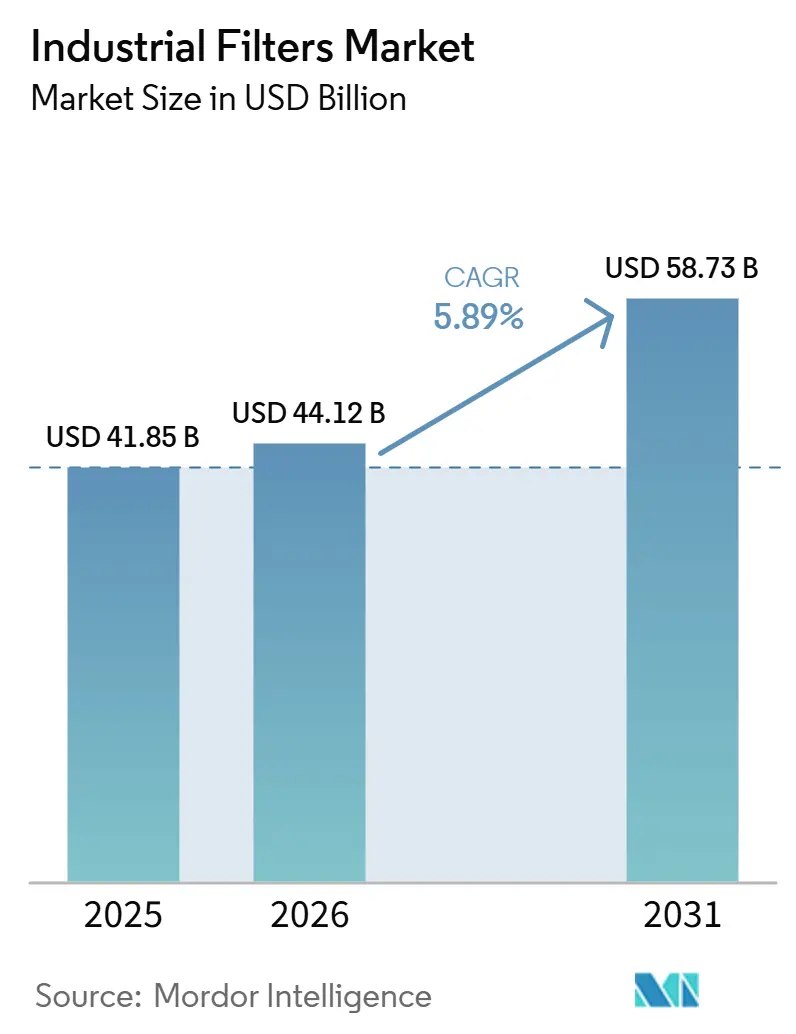
The Industrial Filters Market size is projected to expand from USD 41.85 billion in 2025 and USD 44.12 billion in 2026 to USD 58.73 billion by 2031, and is expected to register a CAGR of 5.89% between 2026 to 2031. The industrial filters market is supported by tighter wastewater treatment requirements, stricter plant air quality standards, and steady manufacturing growth across the Asia-Pacific. Buyers are treating filtration as an operational control tool rather than a compliance purchase, which keeps replacement demand firm across liquid systems and high-specification air systems. Membrane filtration, cleanroom-grade air solutions, and connected monitoring platforms are gaining attention due to their impact on sterility, uptime, and process consistency. The market is also benefiting from aftermarket service models, which leverage proprietary media and digital monitoring to support customer retention. At the same time, maintenance costs, fouling risk, and periodic pressure on media inputs continue to slow some replacement and upgrade decisions.
Key Report Takeaways
- By type, liquid filtration led with a 58.44% share in 2025, while air filtration is forecast to expand at a 6.47% CAGR through 2031.
- By filter media, activated carbon held a 30.21% share in 2025, while membrane filtration is projected to grow at a 7.24% CAGR through 2031.
- By end-user industry, chemicals and petrochemicals accounted for a 23.47% share in 2025, while pharmaceuticals are forecast to record the highest CAGR at 7.11% through 2031.
- By geography, Asia-Pacific held a 39.84% share in 2025 and is also projected to post the fastest CAGR at 6.73% through 2031.
Note: Market size and forecast figures in this report are generated using Mordor Intelligence’s proprietary estimation framework, updated with the latest available data and insights as of January 2026.
Market Trends and Insights
Drivers Impact Analysis of Industrial Filters Market*
| Drivers | (~) % Impact on CAGR Forecast | Geographic Relevance | Impact Timeline |
|---|---|---|---|
| Increasing Demand for Industrial Water Treatment and Process Fluid Filtration | +1.5% | Global, concentrated in Asia-Pacific, North America, and the Middle East | Medium term (2-4 years) |
| Stringent Environmental Regulations Driving Compliance Capital Expenditure | +1.3% | North America and Europe, with spillover to Southeast Asia and South America | Medium term (2-4 years) |
| Growing Demand for Air Quality Management in Industrial Settings | +1.1% | Asia-Pacific, especially China, India, South Korea, and North America | Short term (≤ 2 years) |
| Growing Adoption of Smart and IoT-Enabled Filtration Systems | +0.8% | Global, with early adoption concentrated in North America, Germany, and Japan | Long term (≥ 4 years) |
| Increasing Modernization of Industrial Infrastructure | +0.9% | North America and Europe for retrofits, and Asia-Pacific for greenfield additions | Medium term (2-4 years) |
| Source: Mordor Intelligence | |||
Increasing Demand for Industrial Water Treatment and Process Fluid Filtration
Industrial water treatment is shifting from a compliance function to a direct operating priority, driving demand across the industrial filters market. Water-stressed production zones in India, the Middle East, and northern China are pushing plants to recycle and reclaim wastewater more aggressively. This shift favors higher-performance liquid systems over basic separation methods, particularly in petrochemicals, textiles, and process manufacturing. It also supports a transition from conventional paper and fiberglass options to membrane and activated carbon media within reuse loops. The food and beverage sector adds another stable layer of demand, as clarification, microbial control, and clean-in-place processes keep liquid filtration systems operating at high utilization rates.
Stringent Environmental Regulations Driving Compliance Capital Expenditure
Stricter emissions rules are making filtration upgrades a required expense across the industrial filters market. The revised Industrial Emissions Directive in Europe entered into force in August 2024, and member states were required to transpose it by July 1, 2026, tightening obligations for a wide range of industrial facilities. The European Commission also stated that non-compliant installations can face penalties tied to annual turnover, making delays more costly for operators. In the United States, the EPA revised National Emission Standards for Hazardous Air Pollutants (NESHAP) rules for integrated iron and steel manufacturing in 2025 and extended the compliance timeline to April 2027, keeping advanced filtration projects active in plant planning[1]US Environmental Protection Agency, “National Emission Standards for Hazardous Air Pollutants: Integrated Iron and Steel Manufacturing,” Federal Register, federalregister.gov. These overlapping regulatory cycles are also generating more service work, as many mid-sized plants now rely on specialist firms for system design and compliance support.
Growing Demand for Air Quality Management in Industrial Settings
Air quality compliance requirements are becoming harder to defer, expanding the addressable market for industrial filters. Cleanroom and controlled-air requirements in semiconductor manufacturing across South Korea, Taiwan, and India are driving demand for HEPA and ULPA-class solutions. Camfil introduced the CC X-Series in March 2026 for manufacturing, food production, and logistics sites, indicating that suppliers are designing industrial systems around tighter filtration grades and molecular control. Replacement cartridges, bag filters, and HEPA elements provide suppliers with a recurring revenue stream that is generally more stable than one-time equipment orders.
Growing Adoption of Smart and Internet of Things (IoT)-Enabled Filtration Systems
Real-time monitoring is changing the value proposition of the industrial filters market from reactive replacement to condition-based management. Cleanova launched Sentinel Connect in February 2026 to collect operating data from dust collectors and transmit it to cloud-based systems for remote oversight and predictive maintenance. A 2026 peer-reviewed study in the International Journal of Advanced Manufacturing Technology showed that digital twin-based predictive maintenance for industrial filters can reduce unplanned maintenance events in refining applications. MANN+HUMMEL stated that it filed more than 100 priority patent applications during 2025, with more than half outside combustion engine technology, including work relevant to AI-supported media development. As connectivity becomes more common, suppliers are using software, analytics, and health monitoring to protect margins that hardware alone can no longer secure.
Restraints Impact Analysis of Industrial Filters Market*
| Restraints | (~) % Impact on CAGR Forecast | Geographic Relevance | Impact Timeline |
|---|---|---|---|
| High Installation, Replacement, and Maintenance Costs | -0.5% | Global, most acute among Small and Medium-sized Enterprises (SMEs) in emerging markets and general manufacturing | Medium term (2-4 years) |
| Filter Fouling and Performance Degradation | -0.3% | Global, concentrated in metal and mining, cement, and power generation | Short term (≤ 2 years) |
| Volatility in the Supply of Raw Materials | -0.5% | Global, with European and North American mid-tier manufacturers more exposed | Short term (≤ 2 years) |
| Source: Mordor Intelligence | |||
High Installation, Replacement, and Maintenance Costs
Cost remains a practical barrier across the industrial filters market, especially for smaller plants that struggle to justify large upfront expenditures. Industrial water filtration installations can range from USD 20,000 to more than USD 250,000, with installation and commissioning adding significantly to total project costs. In pharmaceutical-grade systems, replacement cartridges and membranes also account for a notable share of annual operating budgets. When budgets are constrained, operators often extend service intervals beyond recommended levels, which increases contamination risk and can lead to greater downtime. Larger suppliers are exploring modular and service-based models in response, but adoption among mid-market buyers remains limited.
Filter Fouling and Performance Degradation
Fouling remains one of the most disruptive operational challenges in the industrial filters market, particularly in metal processing, cement, refining, and other heavy-duty environments. As particulates, biological matter, or chemical deposits accumulate on media surfaces, pressure across the filter element increases, along with energy consumption. This shortens usable media life and reduces the business case for system upgrades when operators focus primarily on purchase price. In pharmaceutical liquid filtration, protein adsorption on membrane surfaces can affect batch purity and require additional validation work. In February 2026, HYDAC introduced SUSTAINMICRON, which offers a stated reduction of up to 30% in differential pressure, demonstrating how suppliers are addressing fouling and energy inefficiency through media engineering rather than solely increasing replacement frequency.
*Our forecasts treat driver/restraint impacts as directional, not additive. The impact forecasts reflect baseline growth, mix effects, and variable interactions.
Industrial Filters Market Segment Analysis
By Type:
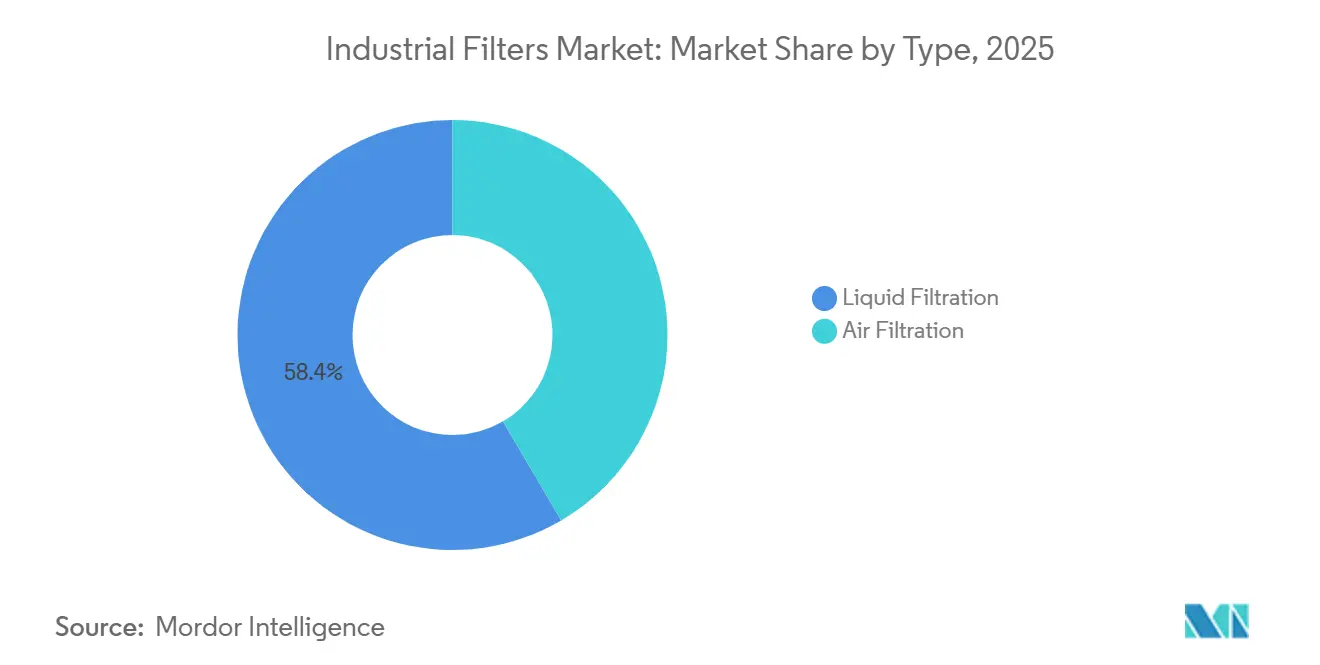
Air Filtration Accelerates as Liquid Filtration Anchors RevenueLiquid filtration held 58.44% of the industrial filters market share in 2025, while air filtration is projected to grow at a 6.47% CAGR through 2031. Liquid systems retained the larger revenue base because chemicals, refining, food processing, and pharmaceuticals require continuous process-fluid management. The large installed base supports steady replacement demand even when new project timing is uneven. The industrial filters market continues to depend on liquid filtration for scale, while air filtration is contributing a larger share of near-term growth.
Air filtration is gaining ground as plant operators face stricter requirements for worker exposure limits, dust capture, and clean manufacturing conditions. This segment of the industrial filters market is also more fragmented among small- and medium-sized industrial buyers, which supports firmer unit economics for suppliers. Camfil's expansion in Malaysia in 2026 reflects confidence that Asian air filtration demand will remain strong enough to justify additional local capacity. On the liquid side, Eaton introduced BECO Helix depth filter cartridges in 2025 to increase particle-holding capacity and extend service life, demonstrating that innovation remains active in the larger, more mature segment.



By Filter Media:
Membrane Filtration Leads Premium Migration Across Industrial End-UsesActivated carbon accounted for 30.21% of filter media revenue in 2025, while membrane filtration is projected to expand at a 7.24% CAGR through 2031. Activated carbon remained the largest media category because it addresses removal needs tied to per- and polyfluoroalkyl substances (PFAS), volatile organic compounds (VOCs), and heavy metals across water treatment and industrial processing. Membrane systems are growing faster because they meet selectivity, sterility, and recovery requirements that conventional media cannot always fulfill. Membrane filtration is a notable premium growth contributor to the industrial filters market size over the forecast period.
Fiberglass, metal, and non-woven media continue to serve broad industrial and heating, ventilation, and air conditioning (HVAC) applications, but pricing pressure is stronger where buyers can qualify multiple suppliers. Sustainable media development is creating differentiation opportunities within the industrial filters market. Ahlstrom expanded lignin-containing filtration media production in Europe in June 2026, targeting customers seeking lower-carbon alternatives for filtration applications. Ahlstrom also reported a 16.1% comparable EBITDA margin in the first quarter of 2026, indicating that specialty media with differentiated positioning can support stronger pricing than standard commodity inputs.
By End-user Industry:
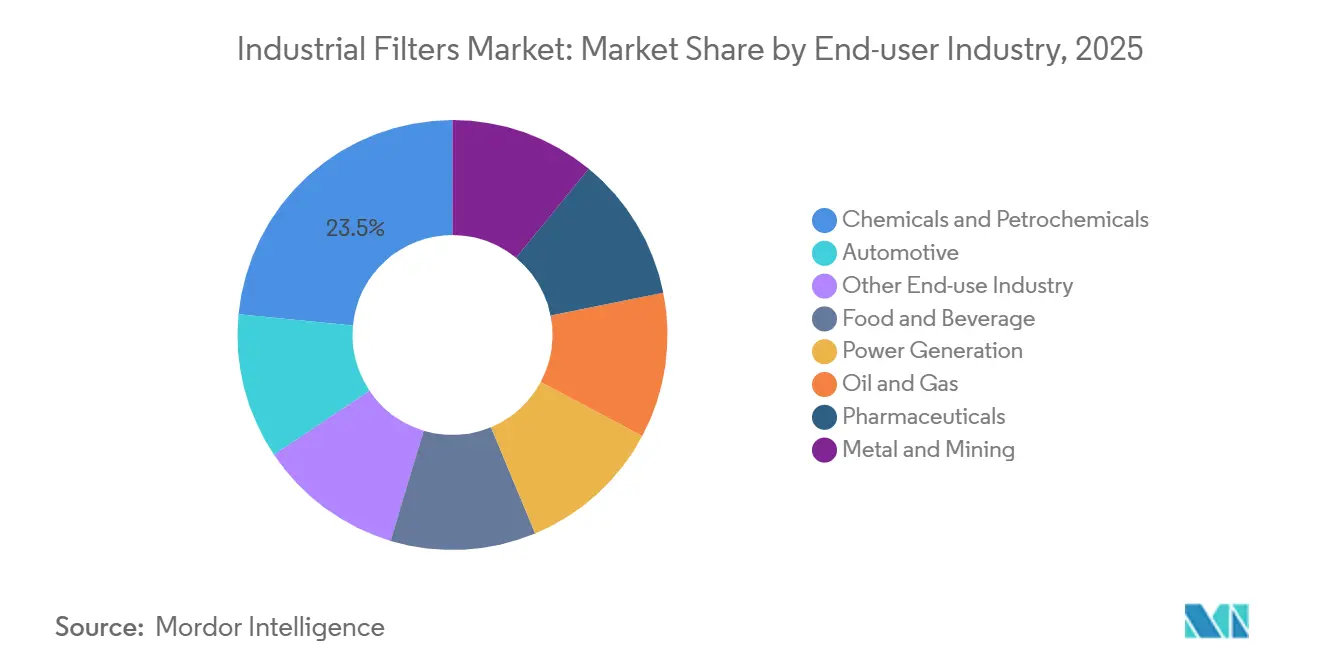
Pharmaceuticals Emerge as the High-Value Growth EngineChemicals and petrochemicals accounted for 23.47% of end-user demand in 2025, while pharmaceuticals are forecast to grow at a 7.11% CAGR through 2031. Chemicals retained the largest base because large plants require continuous liquid-solid separation, solvent recovery, and gas scrubbing support. Pharmaceuticals are growing faster because biologics, messenger RNA (mRNA) production, and sterile fill-finish lines depend on high-value filtration steps where reliability is closely tied to regulatory compliance. This shift is moving the industrial filters market toward a stronger mix of premium media, disposable assemblies, and validation-sensitive products.
Single-use capsules and membrane cartridges are replacing some stainless-steel systems in biopharma because they improve changeover speed and reduce cross-contamination risk. Within the industrial filters market, this migration is significant because value is rising faster than shipment volume. MANN+HUMMEL's investment focus on advanced filtration materials supports the move toward higher-specification pharmaceutical and gas-handling applications. Food and beverage remains another stable demand segment, as clarification, pasteurization support, and clean-in-place cycles keep replacement rates steady even when broader capital budgets fluctuate.
Geography Analysis
APAC Industrial Filters Market
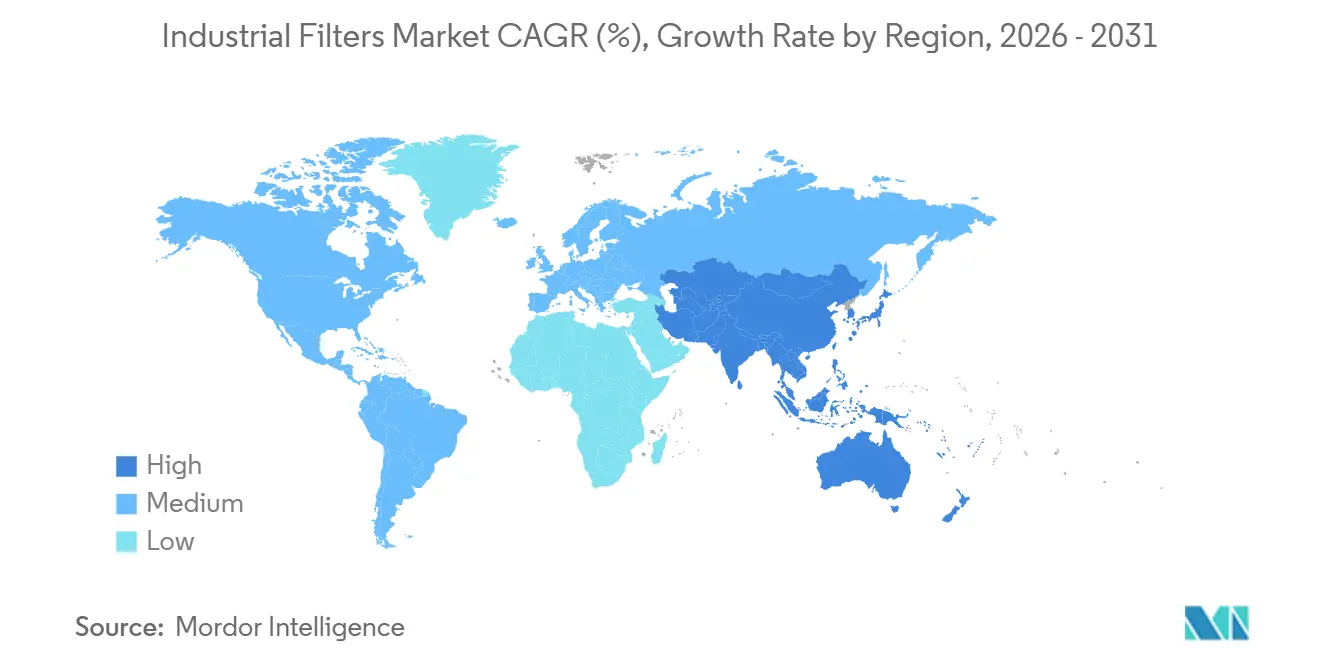
Asia-Pacific held 39.84% of the industrial filters market share in 2025 and is projected to grow at a 6.73% CAGR through 2031. China accounted for 24% of global revenue in 2025, supported by upgrades in petrochemicals, semiconductors, and food processing. India is emerging as a second growth engine, with pharmaceutical hubs in Hyderabad and Ahmedabad driving demand for membrane systems aligned with export-oriented compliance requirements. MANN+HUMMEL opened its largest development center outside Germany in Karnataka in May 2026, with combined investments expected to exceed INR 100 crores (USD 12 million), underscoring the region's strategic role in future supply and product development[2]MANN+HUMMEL, “MANN+HUMMEL Launches Global Technology & Innovation Center in Karnataka,” MANN+HUMMEL, mann-hummel.com.
Japan, South Korea and ASEAN Industrial Filters Market
South Korea and Japan contribute to regional depth through semiconductor cleanroom filtration and precision industrial fluid management. Southeast Asia is also expanding its demand base as food processing and petrochemical capacity continue to grow. These trends give Asia-Pacific a mix of large-volume industrial demand and high-specification applications, which should sustain activity across both local production and imported premium systems.
North America and Europe Industrial Filters Market
North America held the second-largest regional position in 2025, supported by recurring replacement activity driven by an aging installed base in refining, chemicals, and food processing. Donaldson reported above-market performance in fiscal 2025 from new dust-collection equipment and power-generation project wins, indicating healthy demand in industrial air applications. In Europe, the July 2026 transposition deadline for the revised Industrial Emissions Directive is accelerating plant upgrade decisions that had been deferred under the prior regulatory cycle. Germany, the United Kingdom, and France remain important demand centers, as chemicals, pharmaceuticals, energy, and food manufacturing continue to require high-performance filtration.
MEA and South America Industrial Filters Market
South America remains a developing opportunity, led by Brazil's oil and gas and food processing sectors, with Argentina contributing volume through chemicals and mining. In the Middle East and Africa, refinery operations, desalination infrastructure, mining activity, and growing pharmaceutical manufacturing are supporting longer-term regional demand. Saudi Arabia and South Africa are notable markets where water treatment and industrial processing needs are material to long-term filtration spending. While these regions represent smaller shares today, they remain connected to infrastructure programs and export-oriented industrial investment that support the broader industrial filters market.

Competitive Landscape
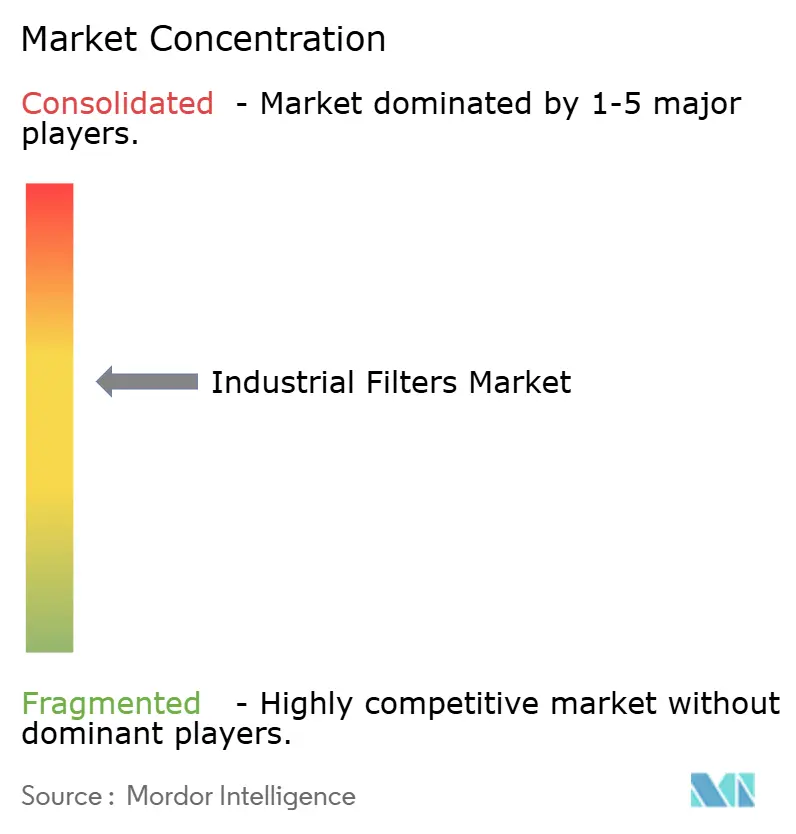
The industrial filters market is moderately consolidated, with Donaldson Company, Parker Hannifin, MANN+HUMMEL, Camfil, Eaton, and HYDAC among the key players. These companies compete through proprietary media, installed aftermarket relationships, and broad service coverage rather than solely on equipment volume. In November 2025, Parker Hannifin announced its USD 9.3 billion acquisition of Filtration Group Corporation, one of the largest recent transactions in this market, which expanded its exposure to filtration aftermarket revenue and adjacent verticals. In May 2026, Donaldson completed its USD 820 million acquisition of Facet Filtration, strengthening its position in mission-critical fuel and fluid filtration applications. In 2025, MANN+HUMMEL reinforced vertical integration through a dedicated Filtration Materials segment and a large patent filing program, both of which supported tighter control over core media development.
Standards compliance remains a barrier to entry in the industrial filters market, as customers expect proven performance in regulated and mission-critical applications. This gives large suppliers an advantage when buyers require validated systems, broad service support, and reliable replacement media. Challengers retain opportunities in managed filtration services, sustainable media, and regionally customized offerings. HYDAC's SUSTAINMICRON launch in 2026 and ongoing work on predictive maintenance platforms indicate that specialist players are pursuing differentiation through operational efficiency and software-linked value rather than scale alone.
Smaller regional firms continue to compete on customization speed and local regulatory knowledge, particularly where response time is more important than global brand recognition. This limits the degree of market concentration, even as a few multinationals set the pace on technology development and acquisitions. The industrial filters market rewards scale in aftermarket coverage while still leaving room for local specialists and media-focused innovators. Recent consolidation has increased competitive pressure without transforming the market into a tightly controlled oligopoly.
Industrial Filters Industry Leaders
Donaldson Company Inc.
PARKER HANNIFIN CORP
3M
Camfil
Filtration Group
- *Disclaimer: Major Players sorted in no particular order
Industrial Filters Market Companies Covered in this Report
- 3M
- AAF International
- Ahlstrom-Munksjö
- Air Filters Inc.
- BWF Envirotec GmbH
- Camfil
- Clarcor Inc.
- Donaldson Company Inc.
- Eaton Corporation
- Filtra-Systems Company LLC
- Filtration Group
- GRAVER Technologies
- Huber Technology GmbH
- Hydac International GmbH
- Industrial Filter and Pump Mfg. Co.
- Lydall, Inc.
- Mann+Hummel
- Nanjing Kairui Filter Co. Ltd.
- PARKER HANNIFIN CORP
- Sefar AG
- WAMGROUP S.p.A.

Recent Industry Developments in Industrial Filters Market
- May 2026: Donaldson Company, Inc. completed its acquisition of Facet Filtration in an all-cash transaction valued at approximately USD 820 million. Facet specializes in mission-critical jet fuel filtration across the refinery-to-fueling-point supply chain. The acquisition expands Donaldson's presence in the aerospace, defense, and power generation end markets.
- February 2026: HYDAC launched SUSTAINMICRON filtration technology across North American markets, delivering up to 30% reduction in differential pressure for hydraulic and industrial oil systems and improving electrostatic discharge management. The launch is part of HYDAC's Fluid Architecture Engineering design discipline, introduced at CONEXPO 2026.


Global Industrial Filters Market Report Scope
Industrial filters are specialized systems designed to remove contaminants, particulates, and impurities from liquids, gases, or air in manufacturing and processing operations. They protect equipment from wear, ensure regulatory compliance, and maintain the safety and quality of the final product.
The industrial filters market is segmented by type, filter media, end-use industry, and geography. By type, the market is segmented into Liquid filtration and air filtration. By filter media, the market is segmented into activated carbon, fiberglass, filter paper, metal, non-woven fabric, membrane, and other filter media. By end-use industry, the market is segmented into food and beverage, chemicals and petrochemicals, power generation, oil and gas, pharmaceuticals, metal and mining, automotive, and other end-use industry. The report also covers market size and forecasts for industrial filters across 16 countries in major regions. The market sizes and forecasts are provided in terms of value (USD).
| Liquid Filtration |
| Air Filtration |
| Activated Carbon |
| Fiber Glass |
| Filter Paper |
| Metal |
| Non-Woven Fabric |
| Membrane |
| Other Filter Media |
| Food and Beverage |
| Chemicals and Petrochemicals |
| Power Generation |
| Oil and Gas |
| Pharmaceuticals |
| Metal and Mining |
| Automotive |
| Other End-use Industry |
| Asia-Pacific | China |
| India | |
| Japan | |
| South Korea | |
| Rest of Asia-Pacific | |
| North America | United States |
| Canada | |
| Mexico | |
| Europe | Germany |
| United Kingdom | |
| France | |
| Italy | |
| Russia | |
| Rest of Europe | |
| South America | Brazil |
| Argentina | |
| Rest of South America | |
| Middle-East and Africa | Saudi Arabia |
| South Africa | |
| Rest of Middle-East and Africa |
| By Type | Liquid Filtration | |
| Air Filtration | ||
| By Filter Media | Activated Carbon | |
| Fiber Glass | ||
| Filter Paper | ||
| Metal | ||
| Non-Woven Fabric | ||
| Membrane | ||
| Other Filter Media | ||
| By End-user Industry | Food and Beverage | |
| Chemicals and Petrochemicals | ||
| Power Generation | ||
| Oil and Gas | ||
| Pharmaceuticals | ||
| Metal and Mining | ||
| Automotive | ||
| Other End-use Industry | ||
| By Geography | Asia-Pacific | China |
| India | ||
| Japan | ||
| South Korea | ||
| Rest of Asia-Pacific | ||
| North America | United States | |
| Canada | ||
| Mexico | ||
| Europe | Germany | |
| United Kingdom | ||
| France | ||
| Italy | ||
| Russia | ||
| Rest of Europe | ||
| South America | Brazil | |
| Argentina | ||
| Rest of South America | ||
| Middle-East and Africa | Saudi Arabia | |
| South Africa | ||
| Rest of Middle-East and Africa | ||


Key Questions Answered in the Report
What is current market size of Industrial Filters Market?
The Industrial Filters Market size is projected to expand from USD 41.85 billion in 2025 and USD 44.12 billion in 2026 to USD 58.73 billion by 2031, registering a CAGR of 5.89% between 2026 to 2031.
Which product type is larger, liquid or air filtration?
Liquid filtration maintained its larger share, with 58.44% in 2025, while air filtration is growing faster at a 6.47% CAGR through 2031.
Which filter media category is expanding the fastest?
Membrane filtration is the fastest-growing media segment with a projected 7.24% CAGR through 2031, supported by pharmaceutical, semiconductor, and bioprocessing needs.
Which end-user group is creating the strongest growth opportunity?
Pharmaceuticals are the fastest-growing end-user, with a 7.11% CAGR through 2031, while chemicals and petrochemicals still held the largest 2025 share at 23.47%.
Page last updated on:





