
Industrial B2B Marketing Services Market Size and Share
Market Overview
| Study Period | 2020 - 2031 |
|---|---|
| Market Size (2026) | USD 20.5 Billion |
| Market Size (2031) | USD 31.80 Billion |
| Growth Rate (2026 - 2031) | 9.18 % |
| Fastest Growing Market | Asia-Pacific |
| Largest Market | North America |
| Market Concentration | Low |
Major Players *Disclaimer: Major Players sorted in no particular order Image © Mordor Intelligence. Reuse requires attribution under CC BY 4.0. | |
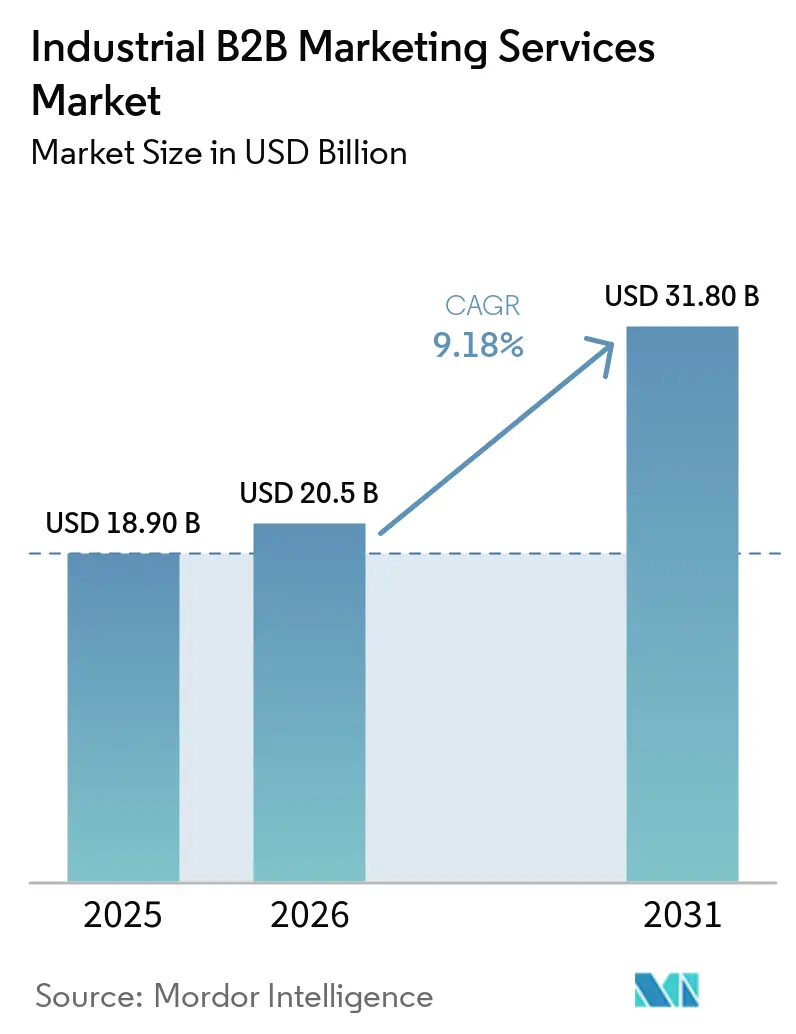
Industrial B2B Marketing Services Market Analysis by Mordor Intelligence
The Industrial B2B Marketing Services Market size is expected to increase from USD 18.90 billion in 2025 to USD 20.50 billion in 2026 and reach USD 31.80 billion by 2031, registering a CAGR of 9.18% over 2026-2031. Industrial buying is moving toward research that occurs before a supplier speaks with a prospect, which places greater weight on clear digital content and consistent visibility. Engineering companies must explain products that can involve specifications, integration requirements, safety considerations, and long operating lives. This change makes specialist support more important for firms that need to explain complex products to several decision-makers without reducing technical accuracy. Providers are also being asked to connect marketing activity with sales progress, rather than only producing campaigns or creative materials. The Industrial B2B Marketing Services Market therefore rewards agencies that can combine technical knowledge, account coordination, content governance, and measurement systems. Privacy rules reduced trackable signals, and limited access to internal experts may slow delivery, but they also increase the value of capable external partners.
Key Report Takeaways
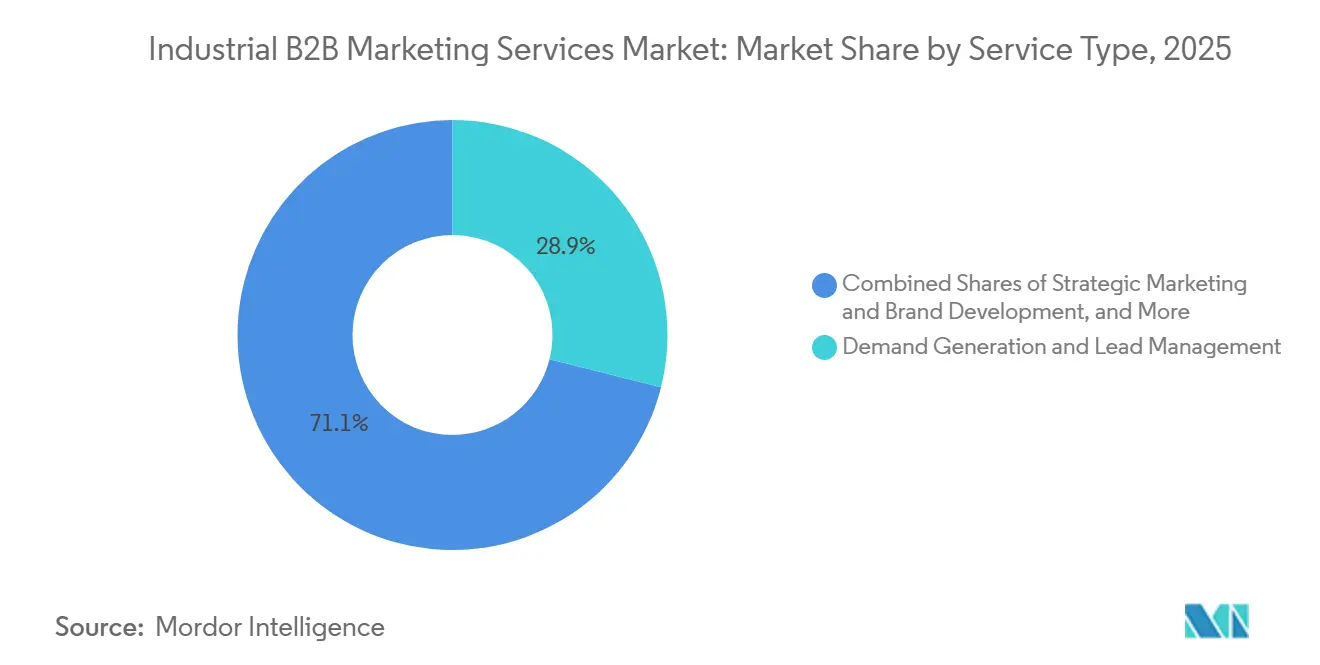
- By service type, Demand Generation and Lead Management held 28.90% share of the industrial B2B marketing services market size in 2025, while Digital Marketing and SEO is projected to expand at a 9.55% CAGR through 2031.
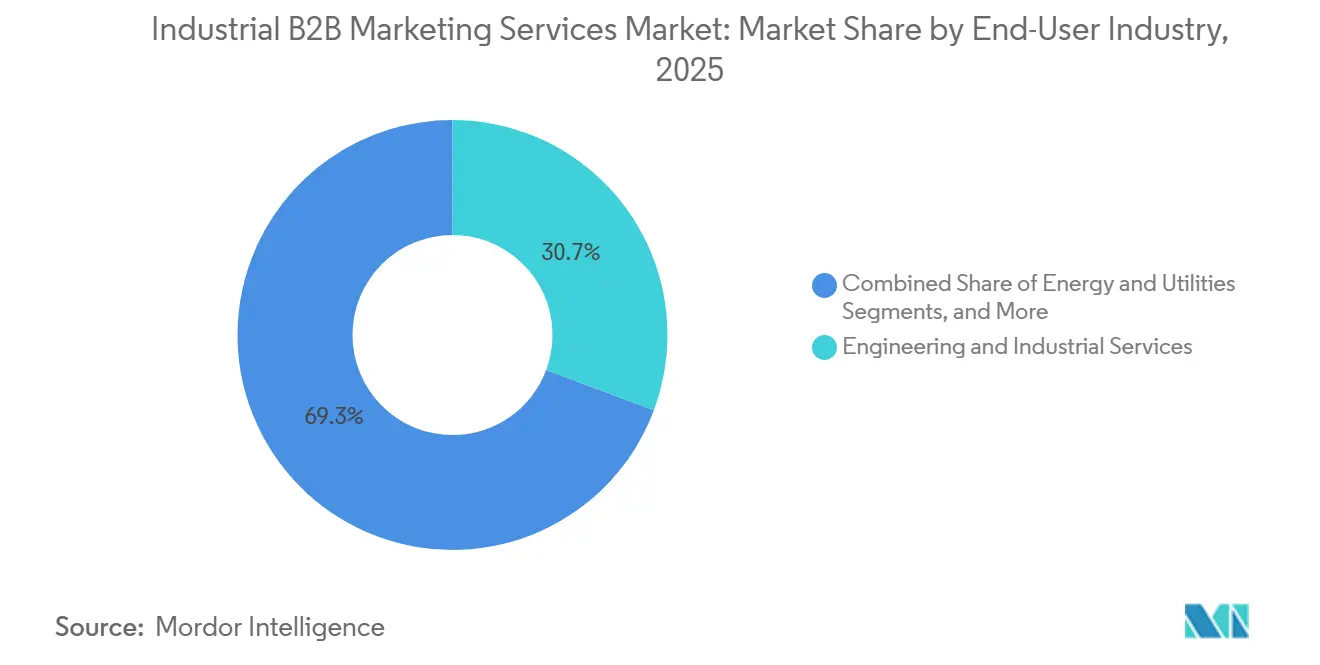
- By end-user industry, Engineering and Industrial Services accounted for 30.70% share of the Industrial B2B Marketing Services Market in 2025, while Energy and Utilities is expected to record the highest CAGR of 9.93% through 2031.
- By geography, North America held 39.04% of the share in the Industrial B2B Marketing Services Market in 2025, while Asia-Pacific is projected to grow at a 14.01% CAGR through 2031.
Note: Market size and forecast figures in this report are generated using Mordor Intelligence’s proprietary estimation framework, updated with the latest available data and insights as of January 2026.
Global Industrial B2B Marketing Services Market Trends and Insights
Drivers Impact Analysis*
| Driver | (~) % Impact on CAGR Forecast | Geographic Relevance | Impact Timeline |
|---|---|---|---|
| Digital Self-Service Research Before Sales Engagement | +2.1% | Global | Short term (≤ 2 years) |
| Rising Adoption of Account-Based Revenue Programs | +1.9% | North America and Europe, spillover to Asia-Pacific | Medium term (2-4 years) |
| Expanding Spend on Technical Content and Thought Leadership | +1.6% | Global | Short term (≤ 2 years) |
| Hybrid Trade Show and Event Programs as Pipeline Anchors | +1.2% | North America, Europe, and core Asia-Pacific markets | Medium term (2-4 years) |
| AI Answer-Engine Visibility for Specification-Rich Content | +1.1% | Global | Short term (≤ 2 years) |
| Digitized Distributor and Procurement Portals Raising Channel Content Requirements | +0.9% | North America and core Asia-Pacific markets, spillover to Europe | Long term (≥ 4 years) |
| Source: Mordor Intelligence | |||
Digital Self-Service Research Before Sales Engagement
Technical buyers increasingly complete much of their research before initiating a conversation with a supplier. The Industrial B2B Marketing Services Market benefits because manufacturers need credible material at the point where buyers compare options and prepare internal cases. TREW Marketing and GlobalSpec reported in 2026 that 62% of technical buyers spent most of the purchase journey online before vendor contact.[1] The research also found that brand recognition can influence choices between technically similar solutions. Agencies must help clients make product information visible, understandable, and relevant to technical, commercial, and procurement audiences. They must also maintain consistency across product pages, technical articles, email programs, sales material, and distributor resources. The Industrial B2B Marketing Services Market is supported when this work helps a buyer move from a general problem to a defensible shortlist with fewer unanswered questions. This need favors providers that can turn engineering knowledge into material that supports search, product evaluation, and sales discussions.
Rising Adoption of Account-Based Revenue Programs
Account-based programs direct marketing effort toward defined companies and the people involved in their buying decisions. This approach fits the Industrial B2B Marketing Services Market because industrial sales often require a long sequence of technical, commercial, and procurement conversations. A single industrial opportunity may involve product users, plant managers, engineers, finance teams, purchasing staff, and external channel partners. Agencies can coordinate account research, content, digital outreach, and follow-up across that sequence. The approach is especially relevant where a sale depends on several departments, distributors, integrators, or regional contacts. It creates demand for services that link marketing activity with account progression rather than with a single contact response. Providers must also identify where an account has stalled, which questions remain unresolved, and whether sales teams have the material needed for the next conversation. Providers with strong account planning and channel coordination can become more embedded in a client relationship as these programs expand.
Expanding Spend on Technical Content and Thought Leadership
Technical content remains important because industrial buyers must assess product performance, compliance, integration, and operating risk. The Industrial B2B Marketing Services Market gains when manufacturers need outside help to develop white papers, application material, case studies, and expert-led content. The 2024 Edelman and LinkedIn research cited in the supplied material indicated that 73% of B2B decision-makers considered thought leadership more trustworthy than vendor marketing material when evaluating a supplier. That finding supports the need for content that explains a buyer problem without relying on unsupported promotional claims. Specialist agencies can organize input from engineers and turn it into material suitable for product discovery, internal review, and customer education. They can also create a repeatable review process so technical teams do not need to rewrite the same explanation for every campaign. A useful content program keeps product claims current, distinguishes documented evidence from opinion, and provides sales teams with material that can be used without extensive revision. This work becomes harder when internal experts have limited time, which makes content planning and expert interviews important service capabilities.
Hybrid Trade Show and Event Programs as Pipeline Anchors
Industrial events remain important because buyers often need demonstrations, peer discussion, and direct access to product experts. The Industrial B2B Marketing Services Market expands when events are treated as connected programs instead of isolated booth activities. The supplied material cited CEIR research showing that B2B exhibitors allocated 40.8% of annual marketing budgets to exhibitions.[2] It also cited an industrial benchmark in which events and trade shows contributed 32% to 46% of pipeline activity. These figures indicate why agencies are combining pre-event campaigns, on-site engagement, and post-event follow-up in one operating model. A well-managed program can capture questions from attendees and use them to improve later content, sales follow-up, and account communications. It can also prepare sales staff with account context before a meeting, which improves the relevance of technical demonstrations and later conversations. Such work can increase the value of a contract because a provider supports preparation, execution, lead handling, and later account nurturing.
Restraints Impact Analysis*
| Restraint | (~) % Impact on CAGR Forecast | Geographic Relevance | Impact Timeline |
|---|---|---|---|
| Attribution Complexity Across Long Sales Cycles and Partner Routes | -1.5% | Global | Short term (≤ 2 years) |
| Data Privacy and Consent Constraints on Buying-Committee Targeting | -1.2% | Core Europe, spillover to North America and Asia-Pacific | Medium term (2-4 years) |
| Fragmented Enterprise Systems Limiting Scalable Content Operations | -0.9% | Global | Long term (≥ 4 years) |
| Limited Internal Subject-Matter Expert Bandwidth | -0.7% | Global | Short term (≤ 2 years) |
| Source: Mordor Intelligence | |||
Attribution Complexity Across Long Sales Cycles and Partner Routes
Attribution is difficult where a sale takes 6-18 months and moves through distributors, integrators, and several internal decision-makers. The Industrial B2B Marketing Services Market faces this restraint because early content and brand activity may not be visible in the final sales record. The supplied material reported that buying committees can engage through 8-14 touchpoints before a contract.[3] It also stated that third-party cookie changes reduced the trackable identity graph by 60% or more. A provider may have influenced buyer interest without being able to show that role through a last-touch measure. The problem is more acute where distributors complete the order and do not provide complete customer data to the original manufacturer. Measurement systems must therefore bring together campaign data, sales activity, account information, and channel feedback, although those systems can remain incomplete. This uncertainty can limit a client’s willingness to increase spending even when marketing activity supports future opportunities.
Data Privacy and Consent Constraints on Buying-Committee Targeting
Privacy and consent requirements restrict how agencies identify, profile, and retarget members of an industrial buying group. The Industrial B2B Marketing Services Market must operate across rules including GDPR in the European Union, the EU AI Act, CCPA and CPRA in California, PIPL in China, and the DPDP Act in India. The supplied material indicated that analytics consent opt-in rates average 35-65% under GDPR and comparable frameworks. This reduces the number of buyers who can be reached through conventional tracking and remarketing programs. Different rules across Asia-Pacific also increase the cost of coordinating multi-country campaigns. Agencies must assess data collection, consent records, content personalization, and cross-border information flows before launching a program. They also need to explain these limits clearly when clients expect individual-level reporting that a compliant system cannot provide. Agencies that understand consent management and server-side measurement can offer a more reliable service in regulated markets.
*Our forecasts treat driver/restraint impacts as directional, not additive. The impact forecasts reflect baseline growth, mix effects, and variable interactions.
Segment Analysis
By Service Type: Demand Generation Leads While Digital Marketing and SEO Has the Fastest Growth
Demand Generation and Lead Management held 28.90% of the Industrial B2B Marketing Services Market share in 2025. Industrial suppliers need continuous engagement because a prospect may research a solution, seek internal approval, request technical evidence, and involve channel partners before placing an order. This creates demand for account nurture, lead qualification, intent monitoring, and contact coordination. The service also increasingly includes multi-channel activation and links between campaign activity and customer relationship management systems. The Industrial B2B Marketing Services Market size for this service is supported by the need to maintain contact with several people across a long sales process. Agencies are valuable when they understand the client’s technical offer and can distinguish early interest from a qualified commercial opportunity. They may develop account maps that show the roles of product users, technical evaluators, commercial leaders, procurement contacts, and distributor representatives. Those maps help clients decide which information each audience needs at a particular stage. The service is strengthened when a provider can coordinate sales teams, product specialists, and distributors around the same account plan. Companies using this model are less likely to view demand generation as a series of separate lead campaigns.
Digital Marketing and SEO is projected to be the fastest-growing service type, with a 9.55% CAGR from 2026 to 2031. Its expansion reflects the movement of technical discovery toward digital search and AI-supported information tools. The bvik Trendbarometer Industriekommunikation 2026 found that 86% of surveyed industry professionals considered optimization for AI search engines necessary, and 75% identified AI-supported personalized content as a key lever for new B2B sales opportunities. This suggests that agencies will need to manage content structure, topic coverage, search visibility, and product information together. The work requires a clear distinction between evidence-based technical information and generic promotional language. It can also require content teams to update product descriptions, supporting documents, and internal links when specifications or regulations change. Digital Marketing and SEO can support channel partner programs when distributors use online catalogs and procurement portals. Strategic Marketing and Brand Development, Channel Partner Marketing, Events and Experiential Marketing, and other services remain relevant because industrial clients need a coordinated program rather than a single digital channel. The Industrial B2B Marketing Services industry is likely to favor providers that connect digital activity with technical content and sales support.

By End-User Industry: Engineering and Industrial Services Leads While Energy and Utilities Grows Fastest
Engineering and Industrial Services accounted for 30.70% of the share in the Industrial B2B Marketing Services Market in 2025. The segment relies on specialist agencies because technical messages must address engineers, procurement teams, management, and channel partners without losing accuracy. Buyers in this field often require evidence about performance, standards, implementation, and lifetime value. Content also needs to address how a product will work within an existing production process, facility, or equipment base. The supplied material reported that technical buyers rated the trustworthiness of generative AI answers at 4.7 out of 10. This supports continued use of expert-authored material and vendor-controlled publications. Chemicals and Materials, Logistics and Supply Chain, and Construction and Building Products face similar demands because qualification cycles are long and buyer decisions involve several stakeholders. Agencies serving these customers must also consider content linked to ISO 9001 and ISO 14001 compliance framing, where relevant. Clear review processes and careful use of technical examples help a provider retain credibility with these buyers.
Energy and Utilities is expected to record the highest end-user CAGR of 9.93% from 2026 to 2031. The Industrial B2B Marketing Services Market size for this vertical is supported by the need to explain security, affordability, sustainability, technology, and project risk in the same commercial conversation. The supplied material stated that AI-native tools can reduce campaign development from 6 weeks to less than 6 hours in energy marketing. It also noted that account-based approaches support buyer journeys lasting 12-18 months. These conditions increase the need for agencies that can manage technical topics and consistent account communication. Providers must often adapt a core message for equipment operators, utilities, project developers, public stakeholders, and procurement teams. Aerospace and Defense is another specialized area because ITAR requirements and security classifications create a need for agencies that understand regulated communications. Across these verticals, agency value depends on technical credibility, suitable review processes, and an ability to support complex stakeholder groups.
Geography Analysis
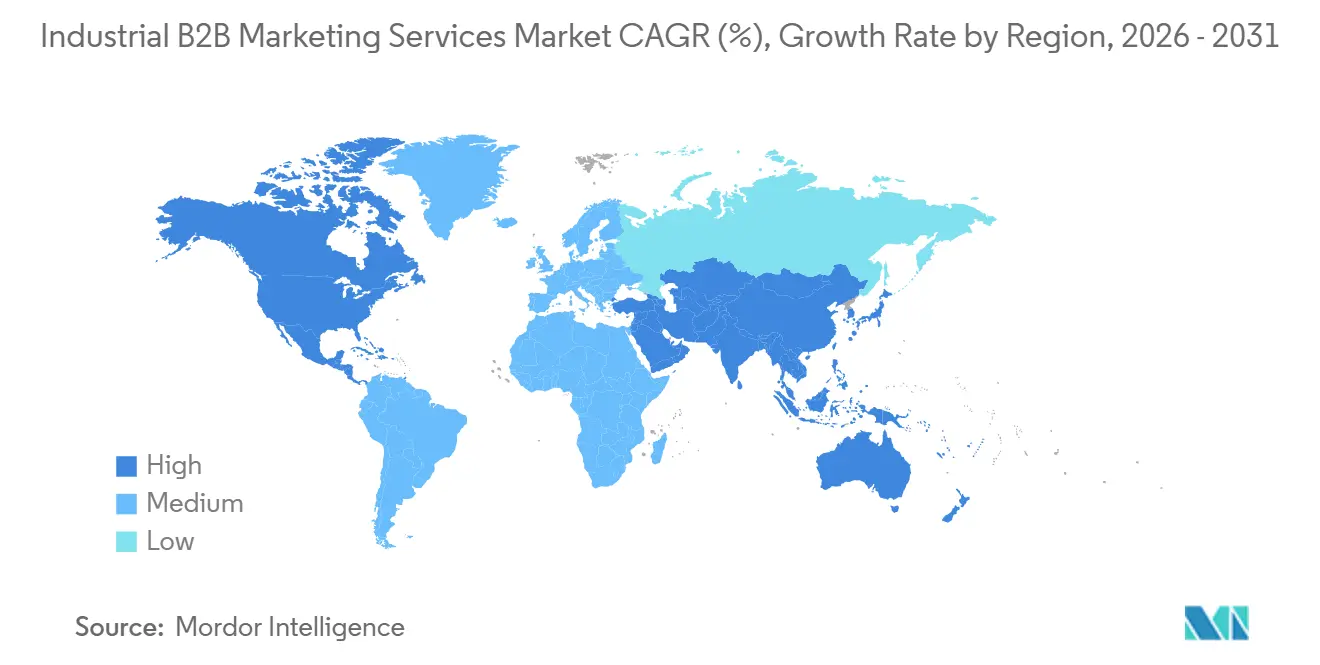
North America held 39.04% of the share in the Industrial B2B Marketing Services Market in 2025. The region has a deep base of specialist agencies, established account-based marketing tools, and industrial clients that use events alongside digital demand programs. The supplied material cited CEIR research showing that North American B2B exhibitors allocated 40.8% of annual marketing budgets to exhibitions, while a 2026 report showed that 46% of B2B firms used a hybrid agency model compared with 36% in 2025. Canada’s manufacturing and aerospace supply chains and Mexico’s maquiladora corridor add demand as suppliers digitize commercial operations, supporting work across content, account programs, event activation, and channel marketing.
Europe held the second-largest regional position in 2025. Germany, the United Kingdom, and France formed the main revenue base, supported by large manufacturing and industrial technology sectors. The supplied material described gaps in AI readiness and buyer-focused communication among German B2B marketers, which can increase demand for outside support. Germany’s trade fair spending remained important, with the cited AUMA outlook showing an increase from 38% in 2022-2023 to 45% in 2023-2024. The United Kingdom’s post-Brexit data protection regime adds an operational requirement for consent management, while Spain, Italy, and Russia contribute through specialized industrial content and distributor channel programs.
Asia-Pacific is projected to grow at a 14.01% CAGR from 2026 to 2031. The region combines growing digital adoption in manufacturing economies with more advanced AI deployment in Singapore, Japan, Australia, and South Korea. The supplied material reported that Indian chief marketing officers expected AI initiatives to generate 5-9% incremental revenue growth, while 73% placed agentic commerce among their top 3 priorities. It also reported that Baidu’s AI-driven marketing services grew 301% year over year and that its Wenxin AI assistant reached 202 million monthly active users. South America contributes through industrial digitization in Brazil, while Middle East growth is linked to infrastructure investment in Saudi Arabia and the United Arab Emirates’ position as a regional procurement hub. South Africa and Nigeria remain early-stage demand centers in Africa, where industrial suppliers are building digital commercial capabilities.
Competitive Landscape
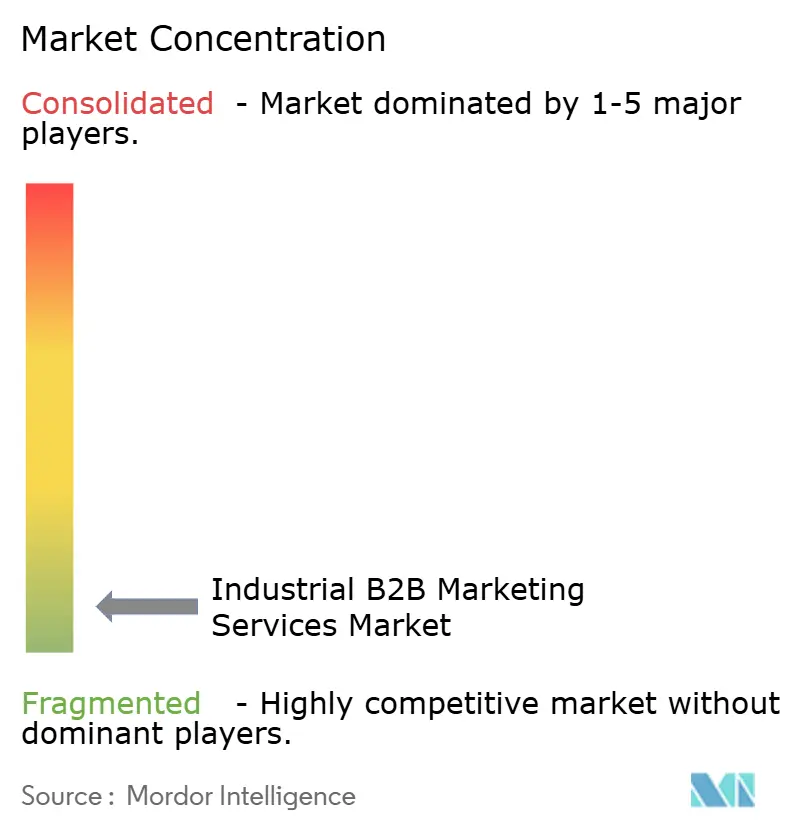
The Industrial B2B Marketing Services Market is fragmented, with specialist industrial agencies, full-service B2B firms, and content technology platforms competing across different services and regions. No provider was identified in the supplied material as holding a dominant share across all service types or geographies. Specialist agencies can build defensible positions through sector research, technical knowledge, and long-standing relationships with engineering clients. TREW Marketing’s State of Marketing to Engineers program, developed with GlobalSpec, provides an example of research that can reinforce a specialized agency position. The Industrial B2B Marketing Services Market also includes providers that use technology partnerships to extend from campaign services into measurement and revenue operations.
Consolidation is changing the mid-market competitive structure. In February 2026, Velocity Partners, Agent3, Publitek, This Machine, and Twogether officially unified as Pretzl under Next 15 Group. Pretzl launched JourneyLab, a proprietary AI platform intended to help understand B2B buyer behavior and optimize account-level programs. The combined organization brought together teams across North America, Europe, and Asia-Pacific. The supplied material described the group as a 300-person business, which illustrates the move toward larger providers that can offer wider geographic coverage and more integrated capabilities. This strategy may help larger agencies compete for enterprise retainer contracts that require account programs, content, data, regional delivery, and closer coordination with sales operations.
Technology and operating capability are becoming more important points of differentiation. The supplied material identified regulated industrial verticals, Asia-Pacific channel partner marketing, and AI-citation content architecture as areas where supply remains less established. It also described Stein’s rebrand from Stein IAS, its proprietary AI platform, and its Future of B2B Buying initiative with industry organizations. Stein published its 2026 conference findings with examples from Workday, SAP, HPE, Palo Alto Networks, and Univar Solutions on linking brand investment with demand generation. Agencies also face compliance expectations around the IAB Europe Transparency and Consent Framework and MRC viewability standards for programmatic work. The Industrial B2B Marketing Services industry will remain competitive because clients can choose between focused technical expertise and broader integrated service platforms.
Industrial B2B Marketing Services Industry Leaders
-
WPP Plc
-
Publicis Groupe S.A.
-
Omnicom Group Inc.
-
Dentsu Group Inc.
-
Accenture Plc
- *Disclaimer: Major Players sorted in no particular order
Recent Industry Developments
- July 2026: Madison Logic, in partnership with Harris Poll, published survey findings that 84% of B2B marketing leaders define their function around proving ROI, yet 48% admit they are guessing which activities drive purchasing decisions. The data, drawn from more than 300 U.S. marketing decision-makers, directly quantifies the attribution intelligence gap reshaping service vendor selection across industrial marketing budgets.
- June 2026: Walker Sands closed the acquisition of RevPartners, a revenue operations and go-to-market engineering firm that is the only company globally holding simultaneous HubSpot Elite Solutions Partner and Clay Elite Studio Partner credentials. The deal expands Walker Sands from strategic marketing into CRM architecture, demand orchestration, and managed RevOps, broadening its addressable mandate within industrial client relationships.
- April 2026: Madison Logic launched the Pipeline Insights Dashboard, providing real-time attribution connecting content syndication, programmatic display, LinkedIn advertising, and social engagement signals to stage-by-stage CRM pipeline advancement. The product directly addresses the measurement gap restraining industrial marketing budget expansion and is available to all Madison Logic clients.
- March 2026: Informa TechTarget launched two B2B content strategy services, the AI Visibility Audit and the GEO, Generative Engine Optimization, Topic Planner. Informa TechTarget cited Forrester data that B2B buyers adopt AI-powered search at 3 times the consumer rate, and reported a 235% increase in AI-driven traffic to its media sites and a 4× rise in membership sign-ups from AI referrals in 2025.
Global Industrial B2B Marketing Services Market Report Scope
The Industrial B2B Marketing Services Market Report is Segmented by Service Type (Strategic Marketing and Brand Development, Demand Generation and Lead Management, Digital Marketing and SEO, Channel Partner Marketing, Events and Experiential Marketing, and Other Service Types), End-User Industry (Engineering and Industrial Services, Chemicals and Materials, Energy and Utilities, Logistics and Supply Chain, Construction and Building Products, Aerospace and Defense, and Other End-User Industries), and Geography (North America [the United States, Canada, and Mexico], South America [Brazil, Argentina, Chile, and Rest of South America], Europe [Germany, the United Kingdom, France, Italy, Spain, Russia, and Rest of Europe], Asia-Pacific [China, Japan, India, South Korea, Australia, Singapore, and Rest of Asia-Pacific], Middle East [Saudi Arabia, the United Arab Emirates, Turkey, and Rest of Middle East], and Africa [South Africa, Egypt, Nigeria, and Rest of Africa]). The Market Forecasts are Provided in Terms of Value (USD).
| Strategic Marketing and Brand Development |
| Demand Generation and Lead Management |
| Digital Marketing and SEO |
| Channel Partner Marketing |
| Events and Experiential Marketing |
| Other Service Types |
| Engineering and Industrial Services |
| Chemicals and Materials |
| Energy and Utilities |
| Logistics and Supply Chain |
| Construction and Building Products |
| Aerospace and Defense |
| Other End-User Industries |
| North America | United States |
| Canada | |
| Mexico | |
| South America | Brazil |
| Argentina | |
| Chile | |
| Rest of South America | |
| Europe | Germany |
| United Kingdom | |
| France | |
| Italy | |
| Spain | |
| Russia | |
| Rest of Europe | |
| Asia-Pacific | China |
| Japan | |
| India | |
| South Korea | |
| Australia | |
| Singapore | |
| Rest of Asia-Pacific | |
| Middle East | Saudi Arabia |
| United Arab Emirates | |
| Turkey | |
| Rest of Middle East | |
| Africa | South Africa |
| Egypt | |
| Nigeria | |
| Rest of Africa |
| By Service Type | Strategic Marketing and Brand Development | |
| Demand Generation and Lead Management | ||
| Digital Marketing and SEO | ||
| Channel Partner Marketing | ||
| Events and Experiential Marketing | ||
| Other Service Types | ||
| By End-User Industry | Engineering and Industrial Services | |
| Chemicals and Materials | ||
| Energy and Utilities | ||
| Logistics and Supply Chain | ||
| Construction and Building Products | ||
| Aerospace and Defense | ||
| Other End-User Industries | ||
| By Geography | North America | United States |
| Canada | ||
| Mexico | ||
| South America | Brazil | |
| Argentina | ||
| Chile | ||
| Rest of South America | ||
| Europe | Germany | |
| United Kingdom | ||
| France | ||
| Italy | ||
| Spain | ||
| Russia | ||
| Rest of Europe | ||
| Asia-Pacific | China | |
| Japan | ||
| India | ||
| South Korea | ||
| Australia | ||
| Singapore | ||
| Rest of Asia-Pacific | ||
| Middle East | Saudi Arabia | |
| United Arab Emirates | ||
| Turkey | ||
| Rest of Middle East | ||
| Africa | South Africa | |
| Egypt | ||
| Nigeria | ||
| Rest of Africa | ||
Key Questions Answered in the Report
What is the size of the Industrial B2B Marketing Services Market?
The Industrial B2B Marketing Services Market is expected to increase from USD 20.50 billion in 2026 to USD 31.80 billion by 2031, at a 9.18% CAGR. The forecast reflects a shift toward digital research, technical content, account coordination, and measurable commercial programs. The expansion also reflects the need to support longer buying processes with material that serves technical, commercial, and procurement audiences.
Which service type has the largest share in industrial B2B marketing services?
Demand Generation and Lead Management held the largest share at 28.90% in 2025. The service supports extended buying processes through account nurture, qualification, contact coordination, and links between campaigns and sales activity. It remains important where a supplier must maintain contact with multiple people before a technical evaluation develops into a formal purchase decision.
Which service is expected to grow fastest through 2031?
Digital Marketing and SEO is projected to record the fastest service-type CAGR at 9.55% from 2026 to 2031. The segment reflects more technical research taking place through digital and AI-supported discovery tools. Its work can include search visibility, content structure, product information maintenance, and support for digital distributor resources, rather than a narrow focus on website traffic alone.
Which customer sector leads demand for industrial marketing services?
Engineering and Industrial Services accounted for 30.70% of demand in 2025. Its position reflects a need for credible technical content, customer education, and communication that can serve multiple stakeholder groups. Agencies in this area must translate specialist knowledge without overstating performance claims or overlooking the buyers operating context.
Which region is expected to expand fastest?
Asia-Pacific is projected to grow at a 14.01% CAGR through 2031. Growth is supported by digital adoption in manufacturing economies and stronger use of AI-led discovery tools in several regional markets. The Industrial B2B Marketing Services Market in this region also includes demand for local-language content, channel support, and commercial programs tailored to diverse regulatory and procurement environments.
Why are account-based programs important for industrial suppliers?
They help suppliers coordinate communication across long sales cycles, buying groups, and channel routes. They also give agencies a clearer role in planning content and follow-up for a defined commercial opportunity. In the Industrial B2B Marketing Services Market, this approach can align marketing activity with the information needs of technical evaluators, procurement staff, management, and channel partners. It can also help clients identify where a complex evaluation has paused and what evidence is needed to resume the discussion.