
Industrial Automation System Integration Services Market Size and Share
Market Overview
| Study Period | 2021 - 2032 |
|---|---|
| Market Size (2027) | USD 38.10 Billion |
| Market Size (2032) | USD 71.07 Billion |
| Growth Rate (2027 - 2032) | 13.28 % |
| Fastest Growing Market | Asia-Pacific |
| Largest Market | Asia-Pacific |
| Market Concentration | Low |
Major Players *Disclaimer: Major Players sorted in no particular order Image © Mordor Intelligence. Reuse requires attribution under CC BY 4.0. | |
Industrial Automation System Integration Services Market Analysis by Mordor Intelligence
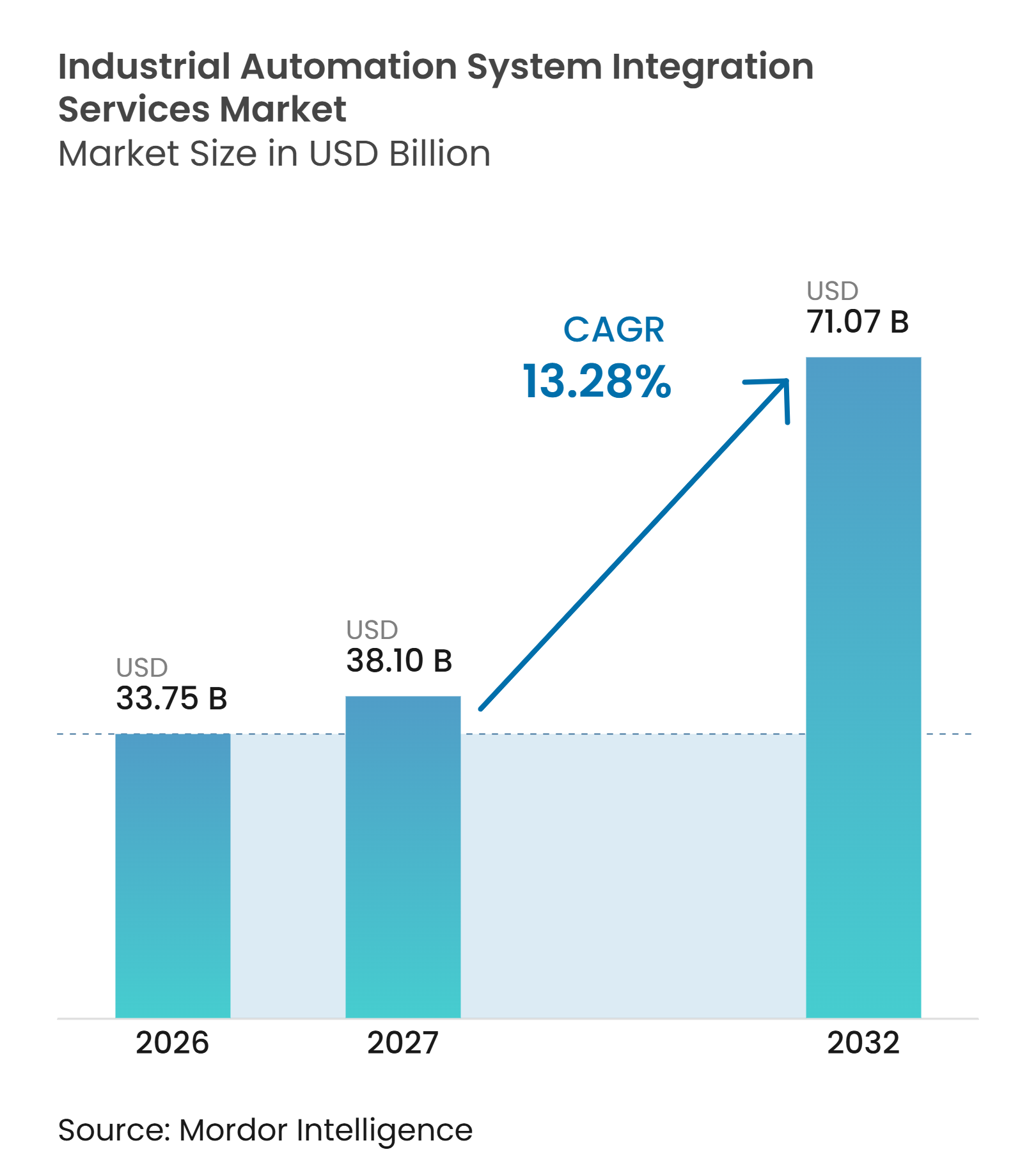
The industrial automation system integration services market size is projected to expand from USD 33.75 billion in 2026 to USD 38.10 billion in 2027, and to USD 71.07 billion by 2032, registering a CAGR of 13.28% between 2027 and 2032. Industrial operators are connecting operational technology with information technology to replace isolated control environments with coordinated software and data layers. This requirement is increasing the value of specialists who can connect control equipment, plant data, enterprise systems, and cloud platforms. Modernization programs at older facilities are also supporting a long pipeline of work, especially where distributed control systems require upgrades without interrupting production. Larger providers are responding by making acquisitions, expanding protocol capabilities, earning cybersecurity credentials, and offering managed-service offerings. The industrial automation system integration services market is therefore being shaped by the need to modernize physical assets and make plant information usable across multiple sites.
Key Report Takeaways
- By service type, software and digital integration services held 56.18% of the industrial automation system integration services market revenue in 2026, while hardware integration services are projected to expand at a 14.71% CAGR through 2032.
- By delivery model, turnkey project integration held 59.24% of the industrial automation system integration services market revenue in 2026, while remote and managed OT services are projected to expand at a 15.02% CAGR through 2032.
- By enterprise size, large enterprises held 70.21% of the industrial automation system integration services market revenue in 2026, while SMEs are projected to expand at a 15.38% CAGR through 2032.
- By end-user industry, oil and gas held 34.81% of the industrial automation system integration services market revenue in 2026, while healthcare and life sciences are projected to expand at a 14.06% CAGR through 2032.
- By geography, Asia-Pacific held 35.68% of the industrial automation system integration services market revenue in 2026 and is projected to expand at a 14.39% CAGR through 2032.
Note: Market numbers in this report are based on Mordor Intelligence's proprietary estimation framework, which combines nine months of actuals with Q4 projections for base year 2026.
Market Trends and Insights
Drivers Impact Analysis of Industrial Automation System Integration Services Market*
| Driver | (~) % Impact on CAGR Forecast | Geographic Relevance | Impact Timeline |
|---|---|---|---|
| Turnkey OT-IT Convergence Projects | +3.5% | Global, highest intensity in Asia-Pacific and North America | Medium term (2-4 years) |
| Brownfield Modernization of Aging Assets | +2.8% | Global, with strong concentration in North America and Europe | Short term (≤ 2 years) |
| Industrial AI and Edge-Data Readiness | +2.4% | Global, led by Asia-Pacific core with spillover to Middle East and Africa | Medium term (2-4 years) |
| Renewable-Energy and Distributed-Asset Digitalization | +1.6% | Global, led by Europe and Asia-Pacific | Long term (≥ 4 years) |
| Cyber-Secure SCADA and Critical-Infrastructure Retrofits | +1.5% | North America and Europe, with selective spillover to Middle East and Africa | Short term (≤ 2 years) |
| Plant-Floor Automation Talent Shortages | +1.2% | Global | Long term (≥ 4 years) |
| Source: Mordor Intelligence | |||
Turnkey OT-IT Convergence Projects Are Expanding Integration Contract Scopes
Industrial operators are moving from individual connectivity projects toward architectures that join plant controls with enterprise applications. This change increases the technical scope of engagements because providers must connect equipment, data models, cybersecurity controls, and business systems. OMRON and Cognizant formed a one-stop IT-OT partnership in April 2025 that combined OMRON control technology with Cognizant AI and cloud capabilities for manufacturers. The partnership showed how customers can seek a coordinated delivery model instead of separate control and IT projects. In the industrial automation system integration services market, this approach shifts contracts toward deployments that can cover multiple plants and wider operating processes. It also favors firms able to manage technical accountability across operational and enterprise teams.
Brownfield Modernization Of Aging Assets Drives A Durable Integration Pipeline
Control systems installed between 1995 and 2010 are reaching an age where operators must consider modernization, security, and maintainability together. Older facilities rarely have uniform documentation, which makes staged modernization more practical than replacing every system at once. The Control System Integrators Association has described approaches that allow upgrades in brownfield plants without production downtime, including parallel operation and shadow-mode methods. These methods create demand for providers capable of mapping existing systems, planning cutovers, and validating operations under live-plant conditions. The industrial automation system integration services market benefits as aging assets require engineering work, even when customers defer broader construction spending. The work also creates opportunities for follow-on maintenance, monitoring, and lifecycle service agreements.
Industrial AI And Edge-Data Readiness Are Redefining Integrator Skills
AI-enabled industrial applications depend on reliable data flows from sensors, controllers, production systems, and enterprise platforms. This need positions integrators as the link between operational hardware and the computing environments used for analytics and machine learning. Rockwell Automation launched the EdgeAI 4000 and EdgeAI 2000 industrial computers in November 2026, using NVIDIA Blackwell architecture for model predictive control, predictive maintenance, and small language model inference at the supervisory layer.[1] Siemens released its Industrial AI Suite in April 2026, enabling model retraining through combined MES production data and quality-inspection image data. Rockwell Automation found that only 22% of Asia-Pacific manufacturers had fully integrated MES for advanced analytics, while 40% identified ERP and MES integration as their largest modernization challenge. These conditions support the industrial automation system integration services market, as equipment deployment alone does not provide the connected data environment that AI applications require.
Renewable-Energy And Distributed-Asset Digitalization Create A Distinct Integration Vertical
Solar farms, battery storage systems, and offshore wind assets create control environments spanning multiple locations and equipment types. Their owners need SCADA systems that can collect data from devices supplied by different manufacturers and installed at different times. COPA-DATA presented a Unified Wind Farm SCADA solution in September 2026 for operators managing turbines, substations, and balance-of-plant systems from multiple manufacturers. This operating model requires providers capable of managing multi-protocol communication, centralized visualization, and portfolio-level control. The industrial automation system integration services market gains a specialized source of demand as power assets become more distributed and digitally connected. It also increases the value of teams that understand both automation engineering and the operating needs of renewable portfolios.
Restraints Impact Analysis of Industrial Automation System Integration Services Market*
| Restraint | (~) % Impact on CAGR Forecast | Geographic Relevance | Impact Timeline |
|---|---|---|---|
| Legacy-Protocol Interoperability Costs | -2.1% | Global, most acute in North America and Europe | Medium term (2-4 years) |
| Project Scope Creep and Commissioning Delays | -1.5% | Global | Short term (≤ 2 years) |
| Shortage of Certified Controls Engineers | -1.3% | Global, most acute in North America and Western Europe | Long term (≥ 4 years) |
| Liability in Safety-Critical Industrial Operations | -0.9% | Global, highest risk in energy, nuclear, and healthcare | Long term (≥ 4 years) |
| Source: Mordor Intelligence | |||
Legacy-Protocol Interoperability Costs Create Persistent Project Friction
Industrial sites often use Modbus RTU, PROFIBUS DP, DeviceNet, PROFINET, EtherNet/IP, and OPC UA within the same operating estate. These protocols were developed in different periods and usually require gateways or tailored engineering to exchange information at the application layer. The resulting work can increase validation needs, create interface risks, and make project planning less predictable. The industrial automation system integration services market must therefore address technology debt that cannot be removed through a simple software configuration. Customers may prioritize lower-cost staged upgrades, but those programs still need careful design to maintain operations and protect data quality. This restraint is strongest where mature facilities retain several generations of controls and communications hardware.
Project Scope Creep And Commissioning Delays Compress Integrator Margins
Brownfield projects often reveal undocumented machine connections after engineering work has started. A signal path between neighboring machines may be omitted from drawings until a commissioning team tests the facility under operating conditions. Control Engineering identified undocumented dependencies, network capacity assumptions, and operating-system compatibility gaps as common modernization risks. Each discovery can require redesign, additional testing, and a revised commissioning sequence. Fixed-price projects are particularly exposed because plant downtime and customer acceptance milestones can move beyond the original schedule. Standardized documentation, factory acceptance testing, and early site assessment can reduce exposure, but they require time and skilled engineering resources before work begins.
*Our forecasts treat driver/restraint impacts as directional, not additive. The impact forecasts reflect baseline growth, mix effects, and variable interactions.
Industrial Automation System Integration Services Market Segment Analysis
By Service Type:
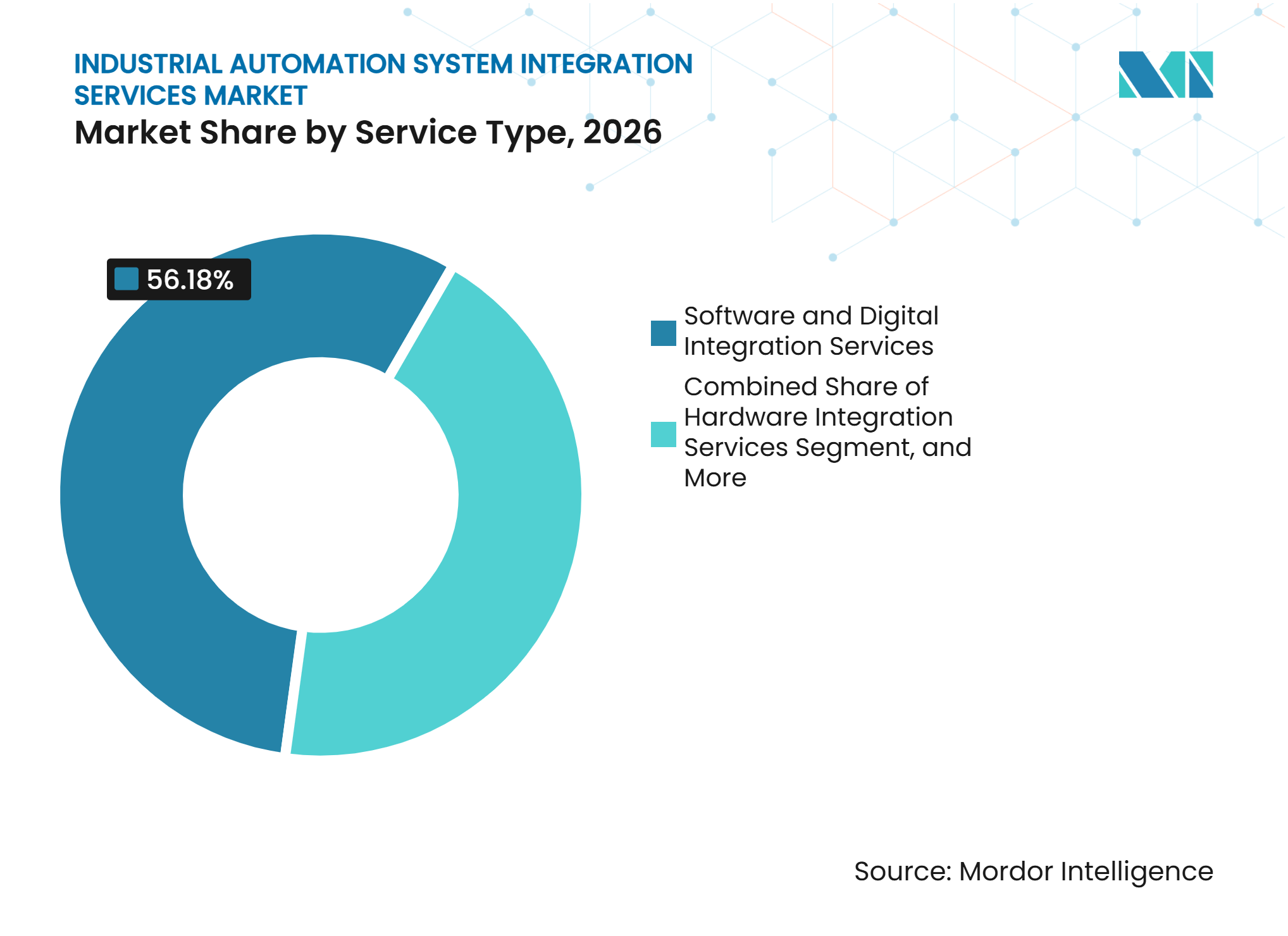
Software Integration Leads While Hardware Expands FastestSoftware and digital integration services held 56.18% of the industrial automation system integration services market share in 2026. Customers need middleware, MES connections, historian integration, data models, and cloud links that turn plant activity into usable information. Siemens released its Industrial Information Hub in April 2026 with bidirectional data-model synchronization between edge devices and central IT systems.[2] The release shows why software work requires knowledge of control data, edge environments, and enterprise integration.
Hardware integration services are projected to expand at a 14.71% CAGR from 2027 to 2032. Sensor deployment, robotics, edge computing, and connected equipment continue to require physical installation, device commissioning, and field validation. Consulting and engineering services support roadmaps, architecture choices, and greenfield design before detailed delivery begins. Lifecycle and managed services then support system maintenance, remote monitoring, and ongoing improvements after commissioning.



By Delivery Model:
Turnkey Projects Lead While Remote OT Services Advance FastestTurnkey project integration held 59.24% of delivery model revenue in 2026. Greenfield refineries, pharmaceutical plants, and semiconductor facilities need a single engineering party to coordinate interfaces, schedules, validation, and acceptance requirements. The delivery model is established in regulated environments, where customers need clear responsibility for the GMP validation lifecycle. The industrial automation system integration services industry plays a strong role in ensuring that controls, data systems, and regulatory processes work together.
Remote and managed OT services are projected to expand at a 15.02% CAGR from 2027 to 2032. Talent constraints and dispersed assets make permanent on-site support difficult for many operators. E Tech Group received Rockwell Automation’s SecureOT Platform Capability Badge in November 2026 and became the 2nd system integrator globally to achieve the designation. Such credentials can matter during vendor qualification when a customer needs secure, continuing support.
By Enterprise Size:
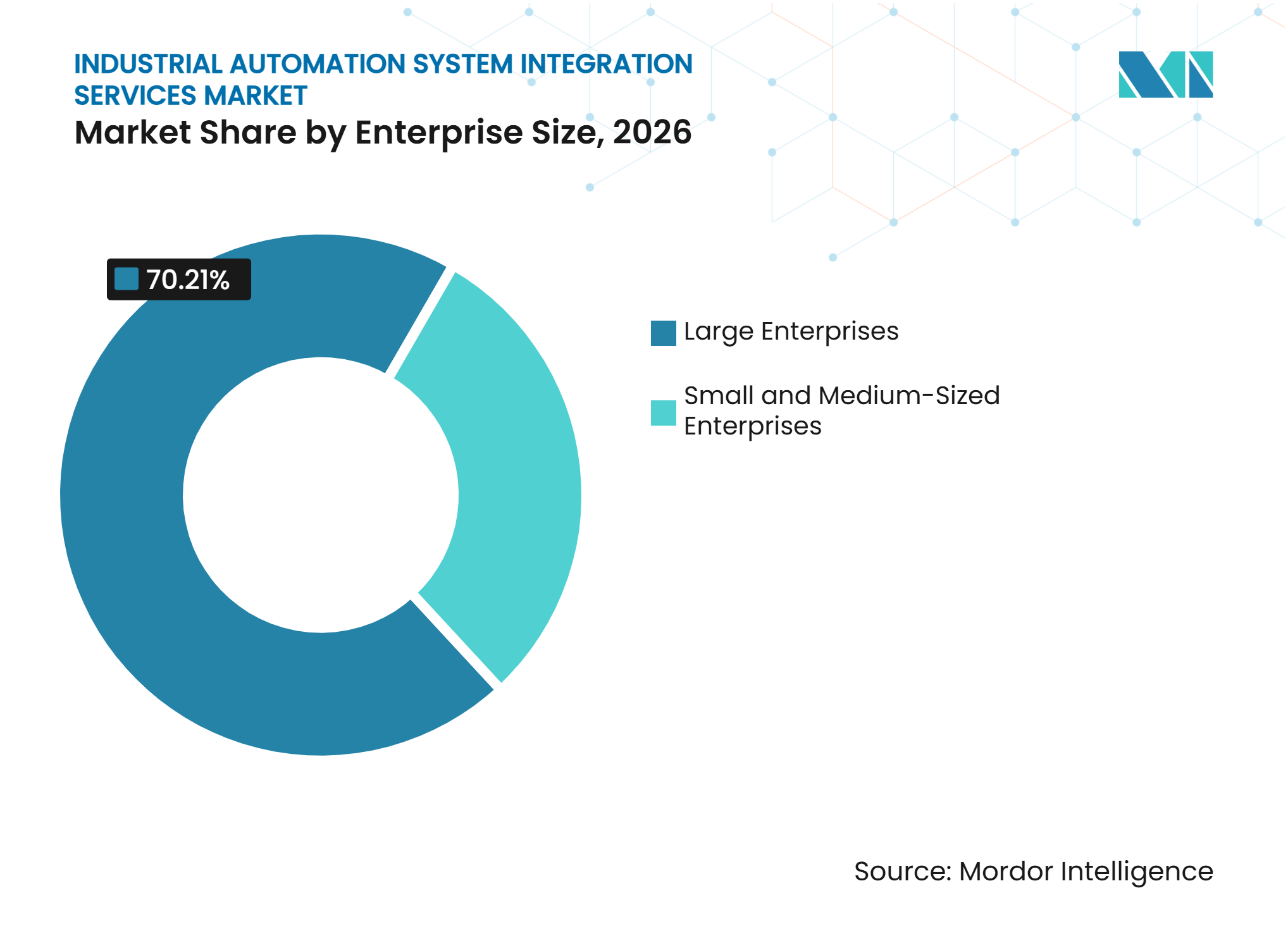
Large Enterprises Anchor Revenue While SMEs Gain MomentumLarge enterprises held 70.21% of revenue in 2026. Their operations can include distributed control systems, programmable logic controllers, SCADA, MES, and ERP layers from several vendors and facilities. ATS Corporation reported adjusted revenue for the fiscal year ended March 31, 2026, including revenue from custom integration and automation systems. The company reported USD 2.16 billion as the approximate equivalent of total adjusted revenue, demonstrating the scale of large-enterprise engagements.
SMEs are projected to expand at a 15.38% CAGR from 2027 to 2032. Modular IIoT platforms and cloud-based architectures can lower the cost threshold for firms that cannot fund a full transformation at once. A 2025 peer-reviewed study of SME plastics manufacturers reported a 20% gain in operational efficiency and a return on investment in under 12 months. Siemens also launched an SMB Production Optimization Starter Pack with a pay-as-you-scale model.

By End-User Industry:
Oil And Gas Leads Spending While Healthcare AcceleratesOil and gas held 34.81% of revenue in 2026. The sector continues to require SCADA modernization, pipeline-control upgrades, refinery automation, and offshore monitoring. Integrated control and safety systems combine process control, emergency shutdown, and fire-and-gas functions within a coordinated architecture. INTECH Process Automation won a November 2025 contract to provide a fully integrated ICSS at a Texas gas processing facility.
Healthcare and life sciences are projected to expand at a 14.06% CAGR from 2027 to 2032. Biopharma producers are scaling biosimilar, cell, and gene therapy production through multi-site MES deployments and GMP-controlled automation. Rockwell Automation and Cytiva launched the Figurate SCADA system for biopharmaceutical manufacturing in April 2026. Automotive, aerospace, defense, food and beverage, and consumer goods also generate demand for advanced assembly systems and brownfield upgrades.
Geography Analysis
Asia-Pacific
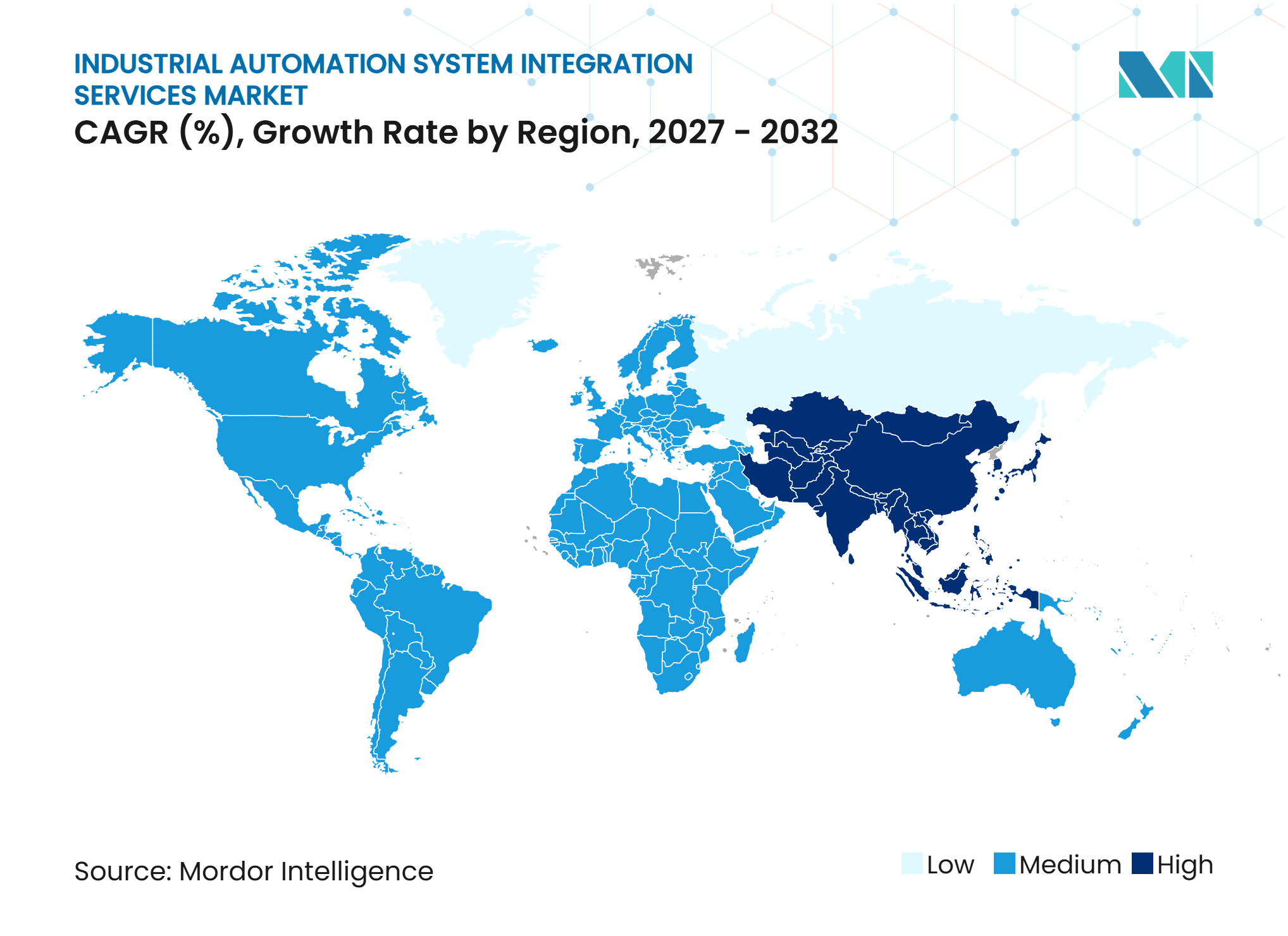
Asia-Pacific held 35.68% of the industrial automation system integration services market share in 2026 and is projected to expand at a 14.39% CAGR through 2032. China’s industrial robot base supports demand for control-system integration, digital-twin connectivity, and lifecycle management. India is expanding its adoption of automation in pharmaceuticals, automotive components, and food processing. Vietnam, Malaysia, and Thailand are also seeing increased demand as supply chains shift more manufacturing capacity to Southeast Asia.
North America
North America has a deep integration ecosystem with CSIA-certified providers and established automation engineering capabilities. Pharmaceuticals, food and beverage, oil and gas, and water infrastructure require detailed validation and consistent operating controls. Constellation Energy received U.S. Nuclear Regulatory Commission approval in January 2026 for a USD 167 million digital modernization plan at the Limerick Clean Energy Center. The project replaces analog instrumentation and control equipment with digital platforms at an operating nuclear plant.
Europe, South America, And Middle East And Africa
Europe combines established automation centers with developing demand in Central and Eastern Europe. Industrie 4.0 programs support advanced-manufacturing integration, while rising labor costs encourage investment in automation. Germany’s EV transition changes requirements toward battery handling and high-voltage testing. VINCI Energies acquired CDD Automation Solutions Ltd in October 2026, expanding the Actemium delivery network through a United Kingdom integrator certified across Rockwell Automation, Siemens, and AVEVA platforms. South America needs progressive controls upgrades across manufacturing and process facilities, while Saudi Arabia’s Vision 2030 and the UAE Industrial Strategy support industrial city developments with broad automation requirements.
Competitive Landscape
Market Concentration
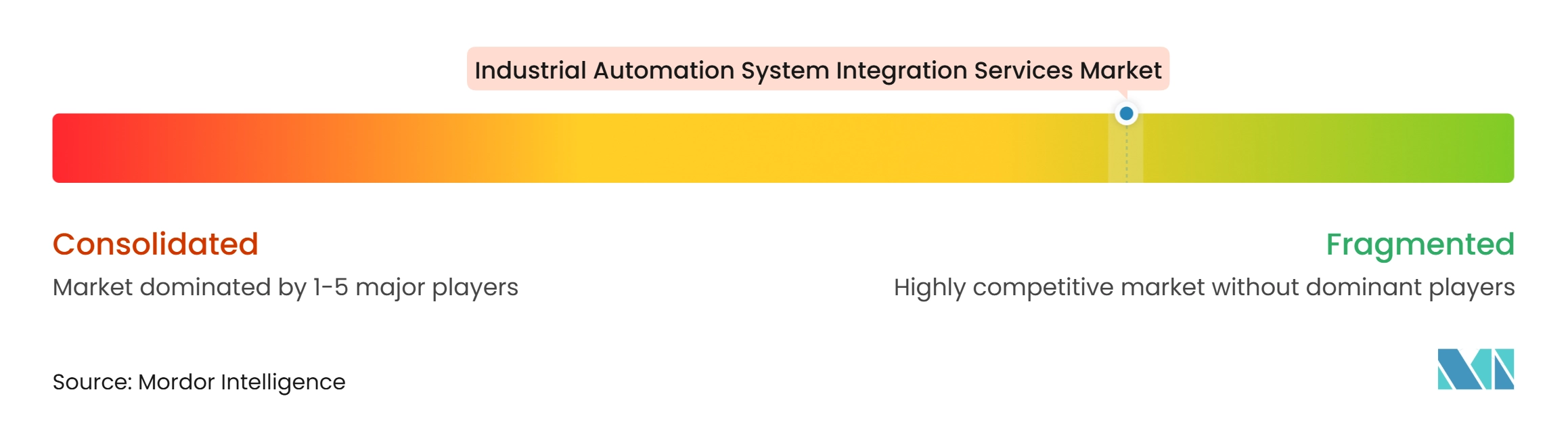
The industrial automation system integration services market is moderately fragmented. Large groups compete with hundreds of regional and specialist firms that offer process knowledge, local service coverage, or platform expertise. Larger firms are using acquisitions to broaden geographic coverage and add controls, data systems, and managed-service capabilities. Sonepar acquired EOSYS in November 2026 to strengthen cross-disciplinary automation and digital transformation services for complex industrial customers.
Competitive positioning increasingly depends on OT cybersecurity and industrial AI capability alongside conventional control-system engineering. CISA and the FBI advised critical infrastructure operators to examine third-party ICS integrators’ remote-access pathways and data storage jurisdictions in September 2026.[3] E Tech Group’s SecureOT recognition shows how verified cybersecurity practices can support managed-service qualification. Providers also need to manage the data-rich environments that link AI applications, edge systems, enterprise platforms, and plant equipment.
Specialists continue to compete through expertise in biopharma automation, renewable-energy SCADA, safety systems, and complex manufacturing. Collaborative Systems Integration and Toggle Engineering announced a 5-year exclusive Open Process Automation partnership for European client engagements in September 2026. The arrangement positions OPA-focused providers as neutral partners for customers reducing dependence on proprietary DCS platforms. Lifecycle services covering maintenance, monitoring, improvement, and data and system support are also becoming increasingly important. The industrial automation system integration services market remains open to specialists, but scale, cybersecurity controls, and multi-site delivery capability increasingly matter in large accounts.
Industrial Automation System Integration Services Industry Leaders
-
ATS Corporation
-
JR Automation Technologies, LLC
-
E Tech Group, Inc.
-
Thermo Systems LLC
-
Factory Automation Systems, Inc.
- *Disclaimer: Major Players sorted in no particular order
Industrial Automation System Integration Services Market Companies Covered in this Report
- ATS Corporation
- JR Automation Technologies, LLC
- ATS Global B.V.
- E Tech Group, Inc.
- RoviSys Company
- Thermo Systems LLC
- Convergix Automation Solutions, Inc.
- BW Design Group, Inc.
- Tesco Controls, Inc.
- Prime Controls, LP
- MAVERICK Technologies, LLC
- Burrow Global, LLC
- Wunderlich-Malec Engineering, Inc.
- Avanceon Limited
- INTECH Process Automation Inc.
- Malisko Engineering, Inc.
- Cates Control Systems, Inc.
- Automation and Control Services, Inc.
- Factory Automation Systems, Inc.
- TAI, Inc.
Recent Industry Developments in Industrial Automation System Integration Services Market
- November 2026: Rockwell Automation launched GPU-enabled EdgeAI 4000 and EdgeAI 2000 industrial computers powered by NVIDIA Blackwell architecture, designed to run model predictive control, predictive maintenance, and small language model inference at the supervisory layer, directly enlarging the technical scope of system integration projects by adding AI inference infrastructure as a commissioning requirement.
- November 2026: Sonepar acquired EOSYS, an engineering-led industrial automation solutions provider, to deliver cross-disciplinary automation and digital transformation services to complex industrial customers.
- November 2026: Rockwell Automation and Velotic announced a collaboration focused on connecting legacy and modern industrial systems to extend automation investments and enable AI, building on prior technology collaboration involving Kepware and ThingWorx.
- October 2026: VINCI Energies acquired CDD Automation Solutions Ltd from the Bühler Group, one of the United Kingdom’s leading food industry system integrators certified across Rockwell Automation, Siemens, and AVEVA platforms, extending Actemium brand industrial automation delivery reach.
Global Industrial Automation System Integration Services Market Report Scope
The Industrial Automation System Integration Services Market includes engineering, consulting, installation, programming, testing, commissioning, and maintenance services that connect diverse automation hardware, control systems, and software platforms into a unified operation. Service providers assess facility requirements, design control architectures, configure automation software, install hardware, and validate system performance. These services integrate field devices, programmable logic controllers PLCs, supervisory control and data acquisition SCADA systems, and human-machine interface HMI systems with enterprise platforms, such as manufacturing execution systems MES and enterprise resource planning ERP systems. System integration services may also include industrial network configuration, cybersecurity implementation, data visualization, alarm management, and lifecycle support. These services improve interoperability, reliability, data availability, and production efficiency across industrial facilities.
The Industrial Automation System Integration Services Market Report is Segmented by Service Type (Hardware Integration Services, Software and Digital Integration Services, Consulting and Engineering Services, and Lifecycle and Managed Integration Services), Delivery Model (Turnkey Project Integration, Brownfield Modernization, Greenfield Integration Programs, and Remote and Managed OT Services), Enterprise Size (Large Enterprises, and Small and Medium-Sized Enterprises), End-User Industry (Oil and Gas, Automotive, Aerospace and Defense, Healthcare and Life Sciences, Energy and Utilities, Other End-User Industries), and Geography (North America, South America, Europe, Asia-Pacific, Middle East, and Africa). The Market Forecasts are Provided in Terms of Value (USD).
Segmentation Overview
| Hardware Integration Services |
| Software and Digital Integration Services |
| Consulting and Engineering Services |
| Lifecycle and Managed Integration Services |
| Turnkey Project Integration |
| Brownfield Modernization |
| Greenfield Integration Programs |
| Remote and Managed OT Services |
| Large Enterprises |
| Small and Medium-Sized Enterprises |
| Oil and Gas |
| Automotive |
| Aerospace and Defense |
| Healthcare and Life Sciences |
| Energy and Utilities |
| Other End-User Industries |
| North America | United States |
| Canada | |
| Mexico | |
| South America | Brazil |
| Argentina | |
| Rest of South America | |
| Europe | Germany |
| United Kingdom | |
| France | |
| Italy | |
| Spain | |
| Russia | |
| Rest of Europe | |
| Asia-Pacific | China |
| India | |
| Japan | |
| South Korea | |
| Rest of Asia-Pacific | |
| Middle East | Saudi Arabia |
| United Arab Emirates | |
| Turkey | |
| Rest of Middle East | |
| Africa | South Africa |
| Nigeria | |
| Rest of Africa |
| By Service Type | Hardware Integration Services | |
| Software and Digital Integration Services | ||
| Consulting and Engineering Services | ||
| Lifecycle and Managed Integration Services | ||
| By Delivery Model | Turnkey Project Integration | |
| Brownfield Modernization | ||
| Greenfield Integration Programs | ||
| Remote and Managed OT Services | ||
| By Enterprise Size | Large Enterprises | |
| Small and Medium-Sized Enterprises | ||
| By End-User Industry | Oil and Gas | |
| Automotive | ||
| Aerospace and Defense | ||
| Healthcare and Life Sciences | ||
| Energy and Utilities | ||
| Other End-User Industries | ||
| By Geography | North America | United States |
| Canada | ||
| Mexico | ||
| South America | Brazil | |
| Argentina | ||
| Rest of South America | ||
| Europe | Germany | |
| United Kingdom | ||
| France | ||
| Italy | ||
| Spain | ||
| Russia | ||
| Rest of Europe | ||
| Asia-Pacific | China | |
| India | ||
| Japan | ||
| South Korea | ||
| Rest of Asia-Pacific | ||
| Middle East | Saudi Arabia | |
| United Arab Emirates | ||
| Turkey | ||
| Rest of Middle East | ||
| Africa | South Africa | |
| Nigeria | ||
| Rest of Africa | ||
Key Questions Answered in the Report
What is the size of the industrial automation system integration services market?
The industrial automation system integration services market is projected to move from USD 33.75 billion in 2026 and USD 38.10 billion in 2027 to USD 71.07 billion by 2032, at a 13.28% CAGR. This industrial automation system integration services market outlook reflects demand for connected controls and data systems.
Which service type leads industrial automation system integration services?
Within the industrial automation system integration services market, software and digital integration services led with 56.18% of revenue in 2026, supported by MES connections, historian integration, cloud links, and data architectures.
What is driving demand for industrial automation system integration services?
The industrial automation system integration services market is supported by OT-IT convergence, brownfield modernization, industrial AI readiness, distributed renewable assets, and cybersecurity requirements. The industrial automation system integration services market also depends on qualified delivery partners for these complex projects.
Which delivery model is expanding fastest?
In the industrial automation system integration services market, remote and managed OT services are projected to expand at a 15.02% CAGR through 2032 as operators seek support across dispersed assets.
Which end-user sector is expanding fastest?
In the industrial automation system integration services market, healthcare and life sciences are projected to expand at a 14.06% CAGR through 2032 as biopharma facilities deploy MES and GMP-compliant automation.
Which region is leading industrial automation system integration services?
Within the industrial automation system integration services market, Asia-Pacific led with 35.68% of revenue in 2026 and is projected to expand at a 14.39% CAGR through 2032.