
Induction Cooktops Market Size and Share
Market Overview
| Study Period | 2020 - 2031 |
|---|---|
| Market Size (2026) | USD 26.07 Billion |
| Market Size (2031) | USD 34.70 Billion |
| Growth Rate (2026 - 2031) | 5.88 % |
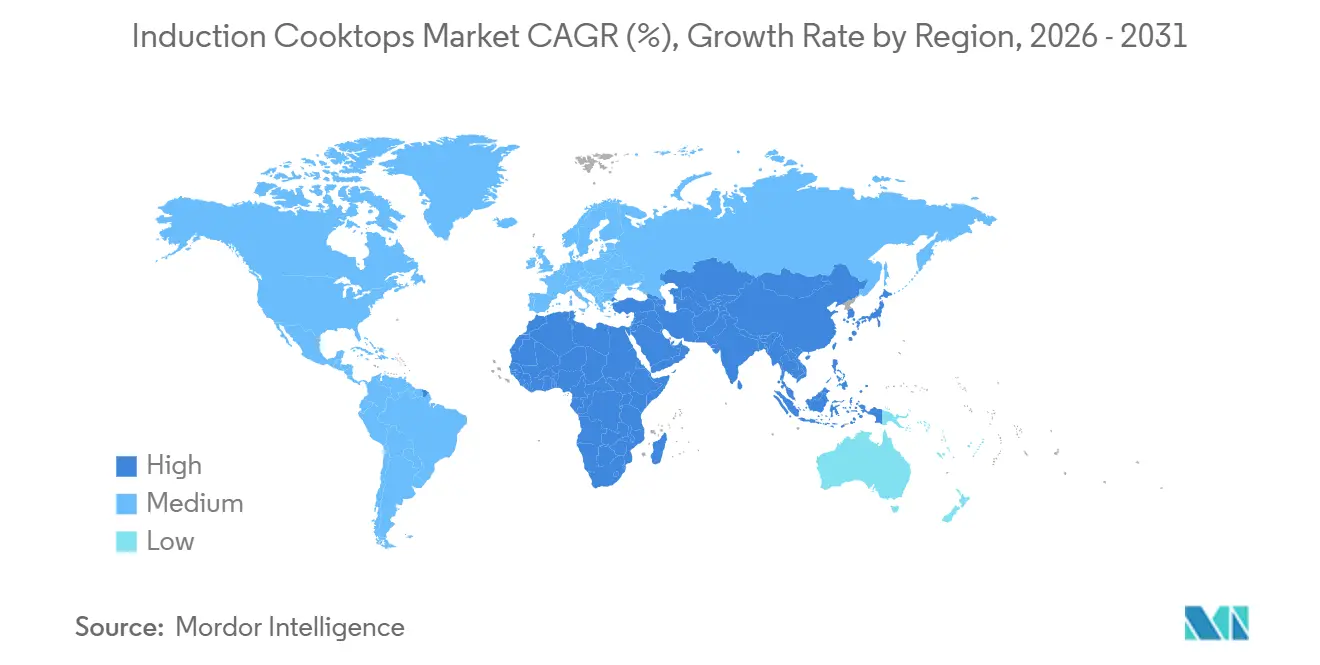
| Fastest Growing Market | Asia-Pacific |
| Largest Market | Europe |
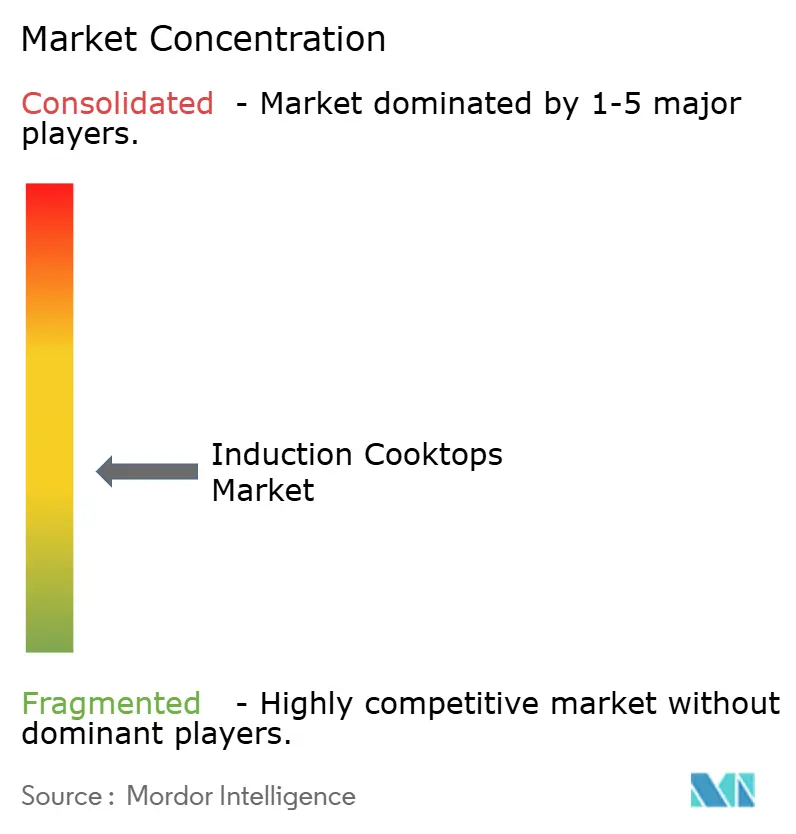
| Market Concentration | Medium |
Major Players *Disclaimer: Major Players sorted in no particular order Image © Mordor Intelligence. Reuse requires attribution under CC BY 4.0. | |
Induction Cooktops Market Analysis by Mordor Intelligence
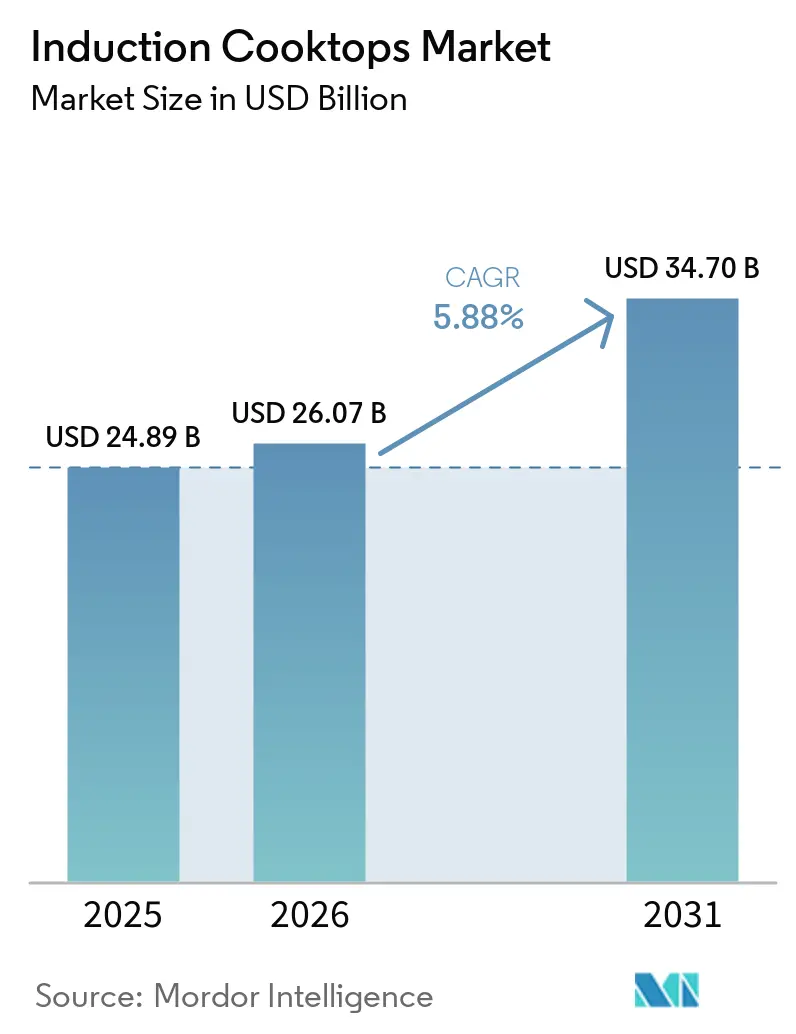
The induction cooktops market size was valued at USD 24.9 billion in 2025 and is estimated to grow from USD 26.1 billion in 2026 to reach USD 34.7 billion by 2031, at a CAGR of 5.9% during the forecast period 2026 to 2031. Government support for electric cooking, renovation-led demand for built-in appliances, and wider commercial use support the induction cooktops market. India is considering procurement under the National Efficient Cooking Programme, while California has approved a program to accelerate 120V induction adoption[1]. These measures can expand access beyond premium replacement purchases. Connected controls and integrated ventilation are becoming important points of differentiation for established appliance makers. Electrical capacity, upfront appliance costs, and cookware replacement needs continue to limit adoption in some homes. The induction cooktops market also faces different conditions by region, since policy, housing stock, grid capacity, and cooking habits vary widely.
Key Report Takeaways
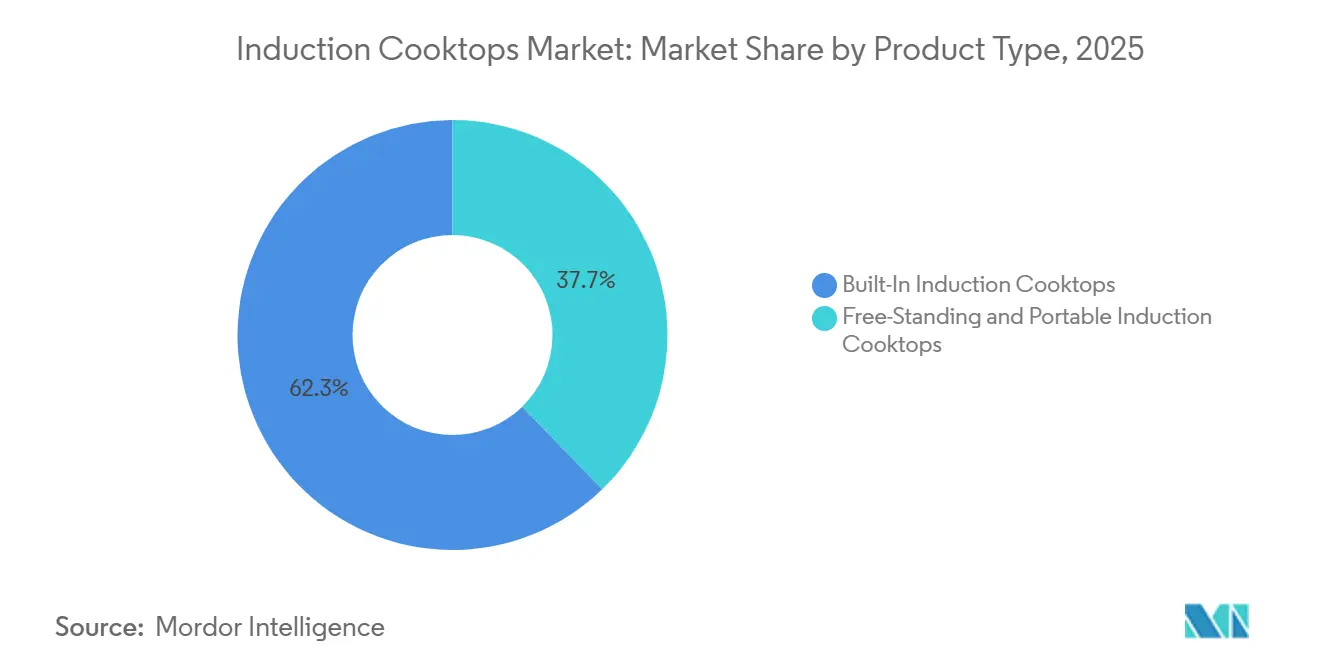
- By product type, built-in induction cooktops held 62.3% of the induction cooktops market share in 2025, while free-standing and portable models are forecast to grow at a 6.6% CAGR through 2031.
- By burner configuration, 4-zone units held 46.5% of revenue in 2025, while configurations with 5 zones or more are forecast to grow at a 6.2% CAGR through 2031.
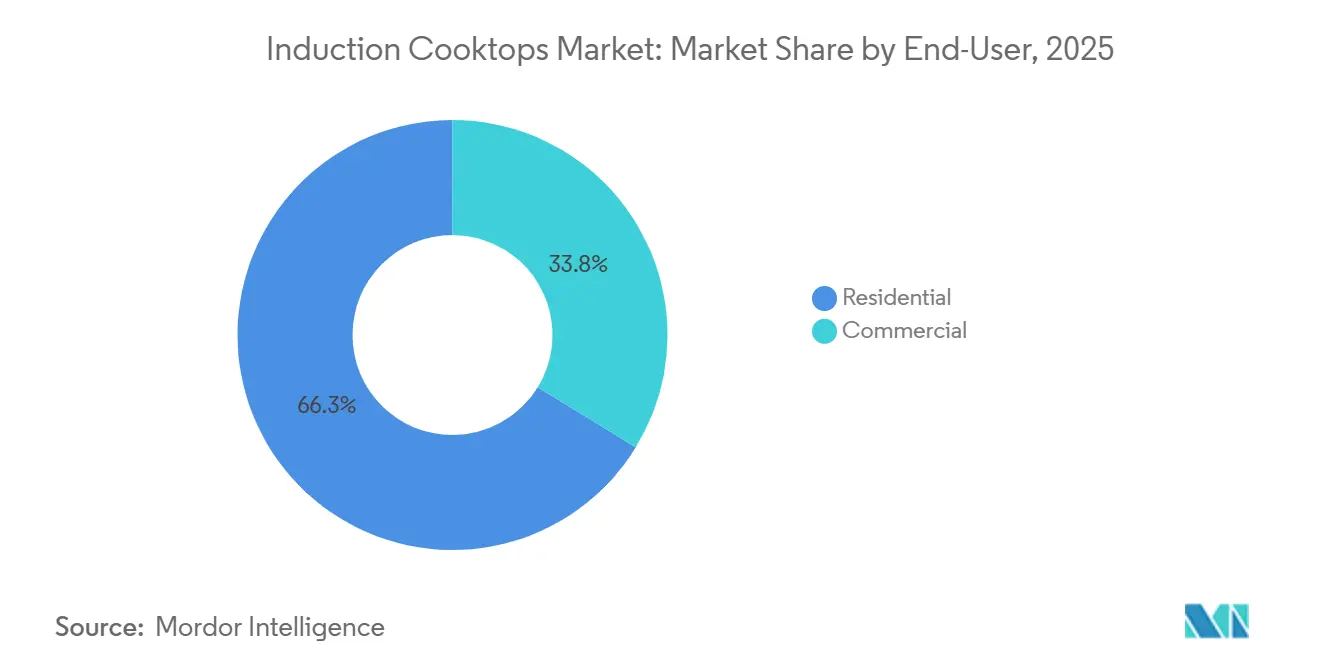
- By end-user, residential customers accounted for 66.3% of revenue in 2025 and are forecast to grow at a 6.4% CAGR through 2031.
- By distribution channel, B2C and retail held 72.5% of revenue in 2025 and are forecast to grow at a 6.1% CAGR through 2031.
- By geography, Europe held 35% of revenue in 2025, while Asia-Pacific is forecast to grow at a 6.8% CAGR through 2031.
Note: Market size and forecast figures in this report are generated using Mordor Intelligence’s proprietary estimation framework, updated with the latest available data and insights as of January 2026.
Market Trends and Insights
Drivers Impact Analysis of Induction Cooktops Market*
| Driver | (~) % Impact on CAGR Forecast | Geographic Relevance | Impact Timeline |
|---|---|---|---|
| Energy-Efficient Cooking and Electrification | +1.7% | Global, concentrated in India, North America, and European Union | Short term (≤ 2 years) |
| Smart Kitchen and Connected Appliance Adoption | +1.0% | South Korea, European Union, North America, with spillover to Japan and Australia | Medium term (2-4 years) |
| Modular Kitchen and Premium Renovation Demand | +0.8% | European Union core, Middle East premium segment | Medium term (2-4 years) |
| Expansion of Foodservice and Cloud-Kitchen Capacity | +0.7% | India, Southeast Asia, North America, Middle East | Short term (≤ 2 years) |
| Induction Performance Standardization Through Cookware Ecosystems | +0.5% | Global, with early gains in South Korea, Germany, and Japan | Long term (≥ 4 years) |
| Grid-Responsive Cooking and Residential Load Management | +0.3% | North America, European Union, and Australia | Long term (≥ 4 years) |
| Source: Mordor Intelligence | |||
Energy-Efficient Cooking and Electrification
Government procurement and electrification programs are changing the demand profile of the induction cooktops market. India’s EESL floated a pilot tender for 200,000 cooktops under the National Efficient Cooking Programme in May 2026. The program’s stated ambitions extend to 6 million to 8 million units over 12 to 18 months. India is also considering a lower GST rate and customs-duty relief for relevant components. California’s Induction Cooking Market Transformation Initiative has allocated USD 39 million for 120V induction adoption. The plan projects USD 496 million in total system benefits through 2045. These actions can make portable and entry-level products more accessible for households that cannot easily modify their electrical systems. They can also create larger, more predictable orders for appliance suppliers and their component partners.
Smart Kitchen and Connected Appliance Adoption
The induction cooktops market is moving toward connected functions in premium product ranges. Samsung introduced SmartThings-based remote control in its 2024 Bespoke induction lineup after receiving South Korean regulatory sandbox approval. LG Electronics received an exemption in August 2026 for a 200,000-unit demonstration of remotely controlled induction cooktops[2]. The LG demonstration includes temperature-probe sensors and safety algorithms for ThinQ-enabled remote shut-off. BSH introduced Bosch Cook AI for the Home Connect application at CES 2026[3]. The function coordinates several Bosch appliances and adjusts guidance according to available ingredients. Connected cooking functions can give manufacturers a clearer reason to differentiate products that otherwise have similar heating performance. Remote control requires a stronger safety case than passive monitoring because appliance makers must manage cookware detection, temperature, and user oversight.
Modular Kitchen and Premium Renovation Demand
Renovation activity supports built-in products in the induction cooktops market. ZVEI reported that Germany sold 2.1 million cooktop units in 2025. Built-in appliance volumes increased 13% even as residential construction declined[4]. This pattern shows that replacement and renovation demand can remain active when new-home construction weakens. LG presented its Hood Integrated Induction Cooktop at EuroCucina 2026 with a 189mm ultra-slim body. The product received an iF Design Award in 2026. Integrated ventilation is important because it can remove the need for an overhead hood in an island kitchen layout. This approach allows appliance brands to position the cooktop as part of a coordinated kitchen system. Samsung’s Extractor Induction Hob also combines cooking and extraction functions with Flex Zone Plus and automatic cookware detection.
Expansion of Foodservice and Cloud-Kitchen Capacity
Commercial kitchens are a separate source of demand for the induction cooktops market. Induction equipment transfers more than 90% of input energy to cookware, compared with 40% to 45% for gas equipment. This efficiency can reduce excess heat in kitchens that operate within a limited space. It can also support a safer cooking area because the equipment does not use an open flame. Vollrath’s InductIQ platform offers programmable time and temperature sequences for foodservice operations. Such controls can help standardize repeatable tasks in kitchens with frequent staff turnover. Commercial buyers often prioritize consistent cooking results, equipment reliability, and service coverage over household design features.
Restraints Impact Analysis of Induction Cooktops Market*
| Restraint | (~) % Impact on CAGR Forecast | Geographic Relevance | Impact Timeline |
|---|---|---|---|
| High Upfront Cost Compared With Gas Cooktops | -1.0% | North America, South America, Middle East and Africa, price-sensitive Asia-Pacific | Short term (≤ 2 years) |
| Induction-Compatible Cookware Requirement | -0.7% | Global, most acute in South Asia, Southeast Asia, and Middle East and Africa | Medium term (2-4 years) |
| Electrical Panel and Circuit Upgrade Bottlenecks | -0.5% | North American retrofit segment and parts of South America | Medium term (2-4 years) |
| Electromagnetic Compatibility and Perceived Medical-Device Risk | -0.2% | Global, with greater perception risk in aging European populations | Long term (≥ 4 years) |
| Source: Mordor Intelligence | |||
High Upfront Cost Compared With Gas Cooktops
Upfront pricing remains a restraint for the induction cooktops market, particularly where households compare an appliance purchase with an existing gas cooktop. Premium built-in products can cost 2 to 4 times more than mid-range gas alternatives. U.S. federal incentives can provide up to USD 840 for eligible ENERGY STAR-certified induction cooktops. India is considering a GST reduction from 18% to 5% and component-duty relief. Lower purchase prices can broaden demand, but program conditions and eligibility rules may limit the immediate benefit for some households. California’s 120V initiative addresses another part of the cost challenge by promoting products that can operate without major panel upgrades.
Induction-Compatible Cookware Requirement
Cookware compatibility creates a practical switching cost for households considering induction. Customers with aluminum, copper, or ceramic cookware may need to replace part or all of their existing collections. This added expense can change how households judge the total cost of the appliance purchase. The issue is more visible in markets where households have long used nonferromagnetic cookware. Product makers and cookware brands can reduce confusion by making compatibility labels clear at retail and online. IEC 60335-2-9 sets requirements that support cookware-detection functions in household cooking appliances. Ecodesign rules also set product requirements for domestic hobs.
*Our forecasts treat driver/restraint impacts as directional, not additive. The impact forecasts reflect baseline growth, mix effects, and variable interactions.
Induction Cooktops Market Segment Analysis
By Product Type:
Built-In Designs Anchor Premium RevenueBuilt-in designs are projected to account for 62.3% of the induction cooktops market share in 2025, driven by demand from modular kitchens, renovation projects, and higher-income urban households. Consumers commonly select these models when redesigning countertops, cabinetry, and ventilation systems together. LG’s EuroCucina 2026 range will include a hood-integrated product with a 189 mm ultra-slim body, while Samsung’s Extractor Induction Hob combines a ventilation hood, Flex Zone Plus, and automatic cookware detection. Integrated ventilation and flexible cooking zones are key differentiators in the premium built-in segment. The segment also benefits from renovation activity, which is less dependent on annual new-home construction. Germany’s projected increase in built-in appliance volumes in 2025 supports this relationship.
Free-standing and portable models are forecast to expand at a CAGR of 6.6% through 2031. These products serve households that rent, relocate frequently, have limited counter space, or cannot upgrade their electrical systems. Consumers can also use them as secondary cooking surfaces in hybrid kitchens. California’s program positions 120 V products as an option for households where standard electrical infrastructure presents a constraint. Their minimal installation requirements can also support public electrification programs. Although portable designs can broaden access, they face greater price competition than premium built-in appliances. Manufacturers must provide reliable performance, intuitive controls, and clear cookware compatibility guidance to maintain customer confidence in this segment.
By Burner Configuration:
Multi-Zone Capacity Redefines Performance ExpectationsFour-zone units accounted for 46.5% of revenue in 2025. This configuration fits the standard layout for built-in residential hobs in Europe and premium Asia-Pacific markets. It also aligns with the cooking needs of households that prepare several dishes at once. The 4-zone format remains the practical center of the residential built-in range. LG’s 36-inch Full-Flex Induction Cooktop supports 2 large cookware items up to 320mm at the same time. The product also includes an AI Water Boiling Alert. Such upgrades show how established 4-zone platforms are being improved instead of replaced. Smaller configurations remain relevant for portable use, entry-level kitchens, and locations with limited electrical capacity. They offer a lower-cost entry point for households that do not need a full built-in cooking surface.
Products with 5 zones or more are forecast to grow at a 6.2% CAGR through 2031. These configurations serve larger households, high-end residences, and foodservice kitchens that need greater cooking flexibility. Fisher & Paykel launched its Series 11 and Series 9 Modular Cooktop Family in February 2025. The platform allows modular induction and teppanyaki units to be joined and controlled through a single touchscreen. The line can be configured for up to 9 cooking zones. This reflects a wider move toward configurable kitchen products that allow buyers to plan around their cooking habits. Large-zone products can also replace gas in professional-style residential and front-of-house cooking areas. Their higher price and installation needs limit their reach, but their use cases support stronger value per unit.
By End-User:
Residential Dominates in Both Scale and Growth RateResidential users accounted for 66.3% of revenue in 2025 and are forecast to grow at a 6.4% CAGR through 2031. This means the largest end-user segment is also expected to deliver the highest growth rate. Household demand is supported by electrification programs, renovation activity, and interest in safer cooking surfaces. The segment includes premium built-in installations as well as portable products used in smaller homes. Germany’s built-in cooktop volumes rose 13% in 2025 despite weaker residential construction. This shows that replacement and renovation purchases remain important for residential demand. In other regions, portable 120V units can give households a way to adopt induction without substantial electrical work. Residential growth depends on whether customers see clear benefits in speed, safety, cleaning, and energy use. It also depends on local access to compatible cookware and skilled installation support.
Commercial users include hotels, restaurants, institutional kitchens, corporate cafeterias, and transportation catering operations. This group represents a smaller share of the induction cooktops market than residential users, but it can generate larger orders per project. Commercial buyers favor accurate temperature control, reduced kitchen heat, and a cooking surface without an open flame. These features can be useful in cloud kitchens and sites with limited ventilation capacity. Vollrath provides programmable induction equipment for foodservice workflows. Standardized programs can reduce the training burden for repetitive kitchen tasks. Commercial customers also require dependable servicing and equipment uptime, which makes local technical support important. The segment can therefore reward suppliers that pair product capability with installation planning, staff training, and after-sales service.
By Distribution Channel:
Retail Scale Grows as Online Penetration DeepensB2C and retail channels held 72.5% of revenue in 2025 and are forecast to grow at a 6.1% CAGR through 2031. Appliance stores, home-improvement retailers, and online marketplaces all play a role in consumer purchasing. The channel is especially important for portable products because buyers often compare price, wattage, cookware compatibility, and product reviews before purchase. Physical retail remains useful when consumers want a demonstration or need help selecting a product. Midea and 99 Speed Mart signed a memorandum of understanding in July 2026 to distribute home appliances through more than 3,100 Malaysian branches from August 2026. The agreement illustrates how neighborhood retail can expand appliance access beyond specialist chains. Brands also use omnichannel activity to support buyers who research online and complete the purchase in-store. Clear product explanations are important because customer hesitation often concerns cookware, installation, and electrical requirements.
B2B and direct-from-manufacturer channels are important for commercial projects and new kitchen installations. These channels allow suppliers to work directly with developers, kitchen designers, foodservice contractors, and institutional buyers. Product specification, service terms, and delivery reliability matter more in this channel than shelf placement. Midea presented new 4-burner and 5-burner cooking ranges at KBIS 2026 as part of its wider North American appliance offering. This supports the company’s effort to reach trade buyers as well as household customers. Direct channels can help manufacturers demonstrate complex built-in and commercial systems before purchase. They can also support longer-term service relationships after installation. The induction cooktops market needs both consumer retail reach and project-sales capability because the product mix ranges from portable units to integrated kitchen systems.
Geography Analysis
Europe Induction Cooktops Market
Europe held 35% of the induction cooktops market size in 2025. The region benefits from established built-in kitchen demand, renovation activity, and rules that support efficient domestic appliances. Germany sold 2.1 million cooktop units in 2025. Built-in appliance volumes in Germany grew 13% during the year despite weaker residential construction. This makes the renovation and replacement cycle important to regional sales. EU Ecodesign rules set product requirements for hobs, and connected appliance makers also need to consider the Cyber Resilience Act. These requirements favor manufacturers that can manage product development, cybersecurity, and compliance across a large installed base. Premium products with integrated ventilation and connected controls have a natural fit in this region.
APAC Induction Cooktops Market
Asia-Pacific is forecast to grow at a 6.8% CAGR through 2031. The region contains very different national demand patterns, from India’s portable and hybrid-cooking demand to South Korea’s connected-appliance development. South Korea is a key market for remote-control demonstrations by Samsung and LG. LG’s August 2026 program covers 200,000 remotely controlled induction cooktops with temperature-probe safety algorithms. This program can provide useful operational evidence for future safety requirements. China supports high volume through dense urban housing and widespread smart-appliance adoption. Japan remains more mature and has a stronger focus on built-in products. The induction cooktops market in Asia-Pacific is therefore not defined by one purchase pattern. Suppliers need product ranges that match local price points, power supply conditions, kitchen sizes, and digital preferences.
The Americas and MEA Induction Cooktops Market
North America is developing through policy support and retrofit-friendly products. California’s USD 39 million initiative is focused on accelerating 120V induction adoption. This creates an opening for products that avoid expensive electrical panel work. South America remains at an earlier stage, with Brazil identified as the largest market in the region. Middle East and Africa demand is connected to hospitality projects and commercial kitchen development in the UAE and Saudi Arabia. Grid reliability and unit cost remain significant constraints in South Africa and Nigeria. The induction cooktops market has an opportunity in locations that need portable products suited to variable electrical conditions. Manufacturers need to balance energy performance with durability, local servicing, and accessible pricing across these regions.
Competitive Landscape
The induction cooktops market is moderately concentrated in the premium tier and fragmented across the mid-value and value categories. BSH Hausgeräte, LG Electronics, Samsung Electronics, Midea Group, and Electrolux compete through product design, technology, and retail presence. The supplied evidence does not provide a combined market share for the leading companies. Premium suppliers are prioritizing connected platforms and kitchen-system integration over basic heating functions. BSH introduced Bosch Cook AI for Home Connect at CES 2026. The function coordinates multiple Bosch appliances and tailors cooking guidance to available ingredients. This strategy positions BSH within the broader connected-kitchen ecosystem rather than around a single appliance. LG and Samsung are making similar investments in smart controls and integrated extraction products.
LG’s regulatory clearance for a 200,000-unit remote-control demonstration in South Korea represents a strategic move that gives the company data on connected-cooking safety. Samsung launched the Bespoke AI Extractor Induction Hob in South Korea in April 2026. The product includes a ventilation hood, boost extraction, Flex Zone Plus, automatic cookware detection, and an A+ EU energy rating. LG introduced a built-in kitchen package, including its hood-integrated induction cooktop, at EuroCucina 2026. These launches highlight competition in kitchen design, ventilation, and digital controls. Midea is expanding its product portfolio and retail presence across several regions. Its collaboration with 99 Speed Mart expands access to home appliances through Malaysia’s extensive convenience-store network. These initiatives combine product development with broader local availability.
Regional brands remain relevant because they can respond to local voltage conditions, price expectations, and retail practices. TTK Prestige maintains a presence in India, while Vollrath serves commercial foodservice applications in the United States and Western Europe. Competitive opportunities include affordable 120V portable models for North American homes that cannot accommodate major electrical upgrades, as well as durable products for areas with variable grid conditions in Southeast Asia and Africa. Global platforms may find it difficult to address these requirements through a uniform product design. The induction cooktops industry therefore provides opportunities for both global appliance groups and specialized regional suppliers.
Induction Cooktops Industry Leaders
-
LG Electronics Inc.
-
Samsung Electronics Co., Ltd.
-
Electrolux AB
-
Whirlpool Corporation
-
BSH Hausgeräte GmbH
- *Disclaimer: Major Players sorted in no particular order
Induction Cooktops Market Companies Covered in this Report
- LG Electronics Inc.
- Samsung Electronics Co., Ltd.
- Whirlpool Corporation
- Electrolux AB
- Robert Bosch GmbH
- BSH Hausgeräte GmbH
- Panasonic Holdings Corporation
- Haier Smart Home Co., Ltd.
- Midea Group Co., Ltd.
- Versuni
- Miele & Cie. KG
- SMEG S.p.A.
- Sub-Zero Group, Inc.
- Fisher & Paykel Appliances Limited
- TTK Prestige Limited
- Groupe SEB
- Glen Dimplex Home Appliances
- Faber S.p.A.
- Breville Group Limited
- The Vollrath Company, LLC
Recent Industry Developments in Induction Cooktops Market
- August 2026: LG Electronics received South Korean Ministry of Trade regulatory clearance for a 200,000-unit demonstration of Wi-Fi-enabled, remotely controlled induction cooktops with temperature-probe safety algorithms, positioning LG to co-develop formal remote-control safety standards alongside regulators and gain a first-mover data advantage ahead of any market-wide certification rollout.
- April 2026: Samsung Electronics launched the Bespoke AI Extractor Induction Hob in Korea on April 21, 2026, integrating a ventilation hood with boost extraction to 720 cubic meters per hour, Flex Zone Plus, automatic cookware detection, and A+ EU energy rating.
- April 2026: LG Electronics unveiled its LG Built-in full kitchen package at EuroCucina 2026, held April 20 to 26 in Milan, anchored by the Hood Integrated Induction Cooktop with a 189mm ultra-slim design and an iF Design Award 2026, and the Full-Flex Induction Cooktop.
- January 2026: BSH unveiled Bosch Cook AI at CES 2026. The feature for the Home Connect application adapts cooking guidance, coordinates Bosch appliances, and can prepare several items to different specifications at the same time.
Global Induction Cooktops Market Report Scope
Segmentation Overview
| Built-In Induction Cooktops |
| Free-Standing and Portable Induction Cooktops |
| 1 Zone |
| 2 Zones |
| 3 Zones |
| 4 Zones |
| 5 Zones or Above |
| Residential | |
| Commercial | HoReCa (Hotels, Restaurants and Cafés/Catering) |
| Institutional Kitchens | |
| Corporate and Office Cafeterias | |
| Other Commercial Applications, including Transportation, Retail and Healthcare |
| B2B / Direct from Manufacturers | |
| B2C / Retail | Multi-Brand Stores |
| Exclusive Brand Outlets | |
| Online | |
| Other Distribution Channels |
| North America | Canada |
| United States | |
| Mexico | |
| South America | Brazil |
| Peru | |
| Chile | |
| Argentina | |
| Rest of South America | |
| Europe | United Kingdom |
| Germany | |
| France | |
| Spain | |
| Italy | |
| BENELUX (Belgium, Netherlands, and Luxembourg) | |
| NORDICS (Denmark, Finland, Iceland, Norway, and Sweden) | |
| Rest of Europe | |
| Asia-Pacific | India |
| China | |
| Japan | |
| Australia | |
| South Korea | |
| South East Asia (Singapore, Malaysia, Thailand, Indonesia, Vietnam, and the Philippines) | |
| Rest of Asia-Pacific | |
| Middle East and Africa | United Arab Emirates |
| Saudi Arabia | |
| South Africa | |
| Nigeria | |
| Rest of the Middle East and Africa |
| By Product Type | Built-In Induction Cooktops | |
| Free-Standing and Portable Induction Cooktops | ||
| By Burner Configuration | 1 Zone | |
| 2 Zones | ||
| 3 Zones | ||
| 4 Zones | ||
| 5 Zones or Above | ||
| By End-User | Residential | |
| Commercial | HoReCa (Hotels, Restaurants and Cafés/Catering) | |
| Institutional Kitchens | ||
| Corporate and Office Cafeterias | ||
| Other Commercial Applications, including Transportation, Retail and Healthcare | ||
| By Distribution Channel | B2B / Direct from Manufacturers | |
| B2C / Retail | Multi-Brand Stores | |
| Exclusive Brand Outlets | ||
| Online | ||
| Other Distribution Channels | ||
| By Geography | North America | Canada |
| United States | ||
| Mexico | ||
| South America | Brazil | |
| Peru | ||
| Chile | ||
| Argentina | ||
| Rest of South America | ||
| Europe | United Kingdom | |
| Germany | ||
| France | ||
| Spain | ||
| Italy | ||
| BENELUX (Belgium, Netherlands, and Luxembourg) | ||
| NORDICS (Denmark, Finland, Iceland, Norway, and Sweden) | ||
| Rest of Europe | ||
| Asia-Pacific | India | |
| China | ||
| Japan | ||
| Australia | ||
| South Korea | ||
| South East Asia (Singapore, Malaysia, Thailand, Indonesia, Vietnam, and the Philippines) | ||
| Rest of Asia-Pacific | ||
| Middle East and Africa | United Arab Emirates | |
| Saudi Arabia | ||
| South Africa | ||
| Nigeria | ||
| Rest of the Middle East and Africa | ||
Key Questions Answered in the Report
What is driving demand for induction cooktops?
Electric-cooking programs, built-in kitchen renovations, and commercial kitchen demand support growth. The global value is forecast to reach USD 34.7 billion by 2031.
Which product type leads induction cooktop sales?
Built-in models led with 62.3% of revenue in 2025. Their demand is supported by kitchen renovation and integrated ventilation designs.
Are portable induction cooktops growing faster than built-in models?
Yes. Free-standing and portable models are forecast to grow at a 6.6% CAGR through 2031, supported by lower installation needs and 120V options.
Which region is growing fastest for induction cooktops?
Asia-Pacific is forecast to grow at a 6.8% CAGR through 2031. Demand is supported by portable cooking, smart appliances, and different national adoption patterns.
What is the main barrier to wider household adoption?
Upfront cost, cookware compatibility, and electrical upgrade needs remain the most important barriers for many households.