
Indonesia Hair Care Market Size and Share
Market Overview
| Study Period | 2021 - 2031 |
|---|---|
| Forecast Data Period | 2026 - 2031 |
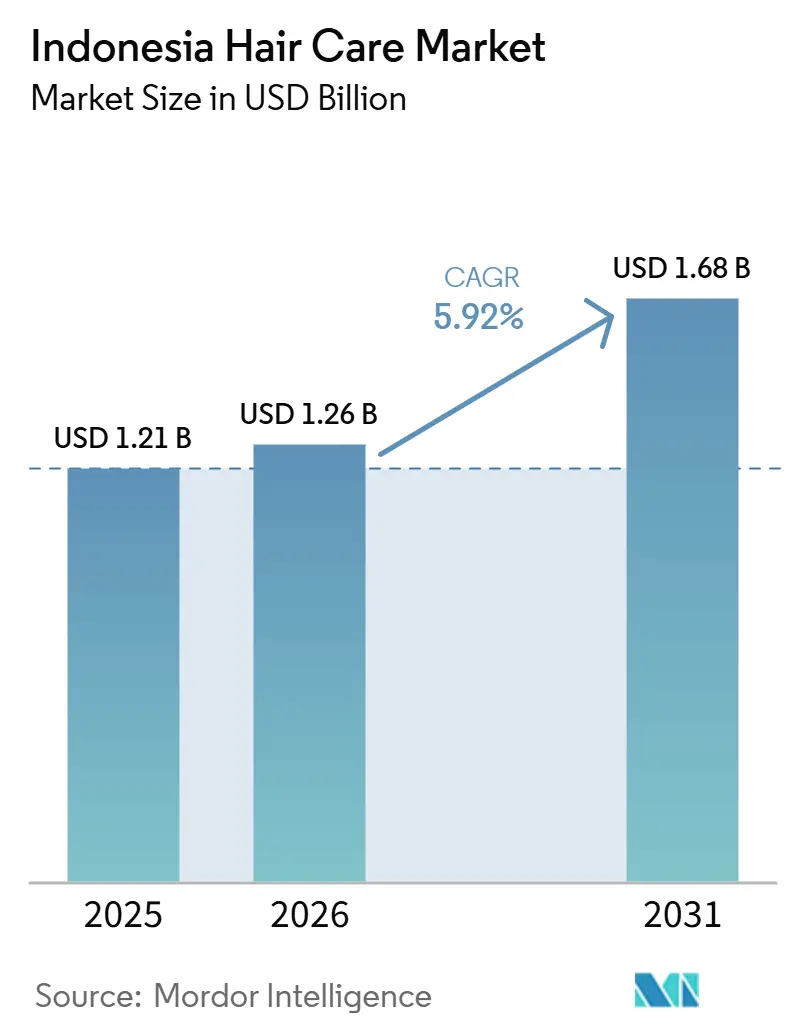
| Base Year Market Size (2025) | USD 1.21 Billion |
| Market Size (2026) | USD 1.26 Billion |
| Market Size (2031) | USD 1.68 Billion |
| Growth Rate (2026 - 2031) | 5.92 % |
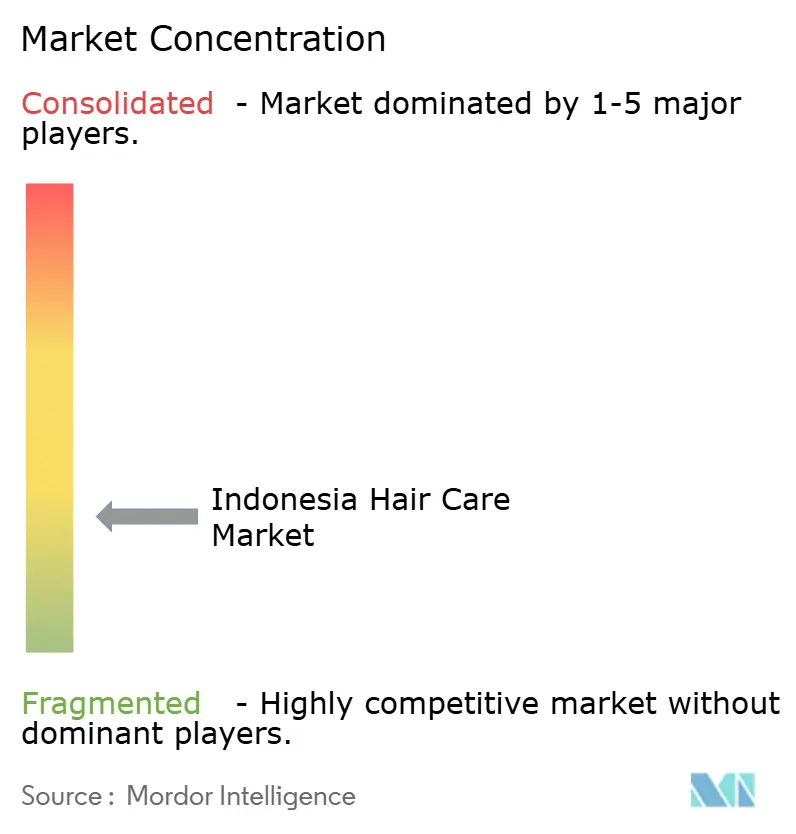
| Market Concentration | Low |
Major Players *Disclaimer: Major Players sorted in no particular order Image © Mordor Intelligence. Reuse requires attribution under CC BY 4.0. | |
Indonesia Hair Care Market Analysis by Mordor Intelligence
The Indonesia hair care market size was valued at USD 1.21 billion in 2025 and is estimated to grow from USD 1.28 billion in 2026 to reach USD 1.68 billion by 2031, at a CAGR of 5.92% during the forecast period (2026-2031). October 2026 brings parallel compliance requirements for halal certification and cosmetic ingredients, which are changing formulation and sourcing decisions across the Indonesia hair care market. These requirements support demand for products that can demonstrate halal status, ingredient safety, and clear product performance. A population with more than 60% of people below 40 supports recurring demand for cleansing, conditioning, treatment, and styling products. Companies are balancing mass-volume formats with premium scalp care and treatment ranges, while online selling gives local brands a direct path to consumers. The Indonesia hair care market also offers room for brands that can meet regulatory requirements quickly and connect botanical ingredients with credible product claims.
Key Report Takeaways
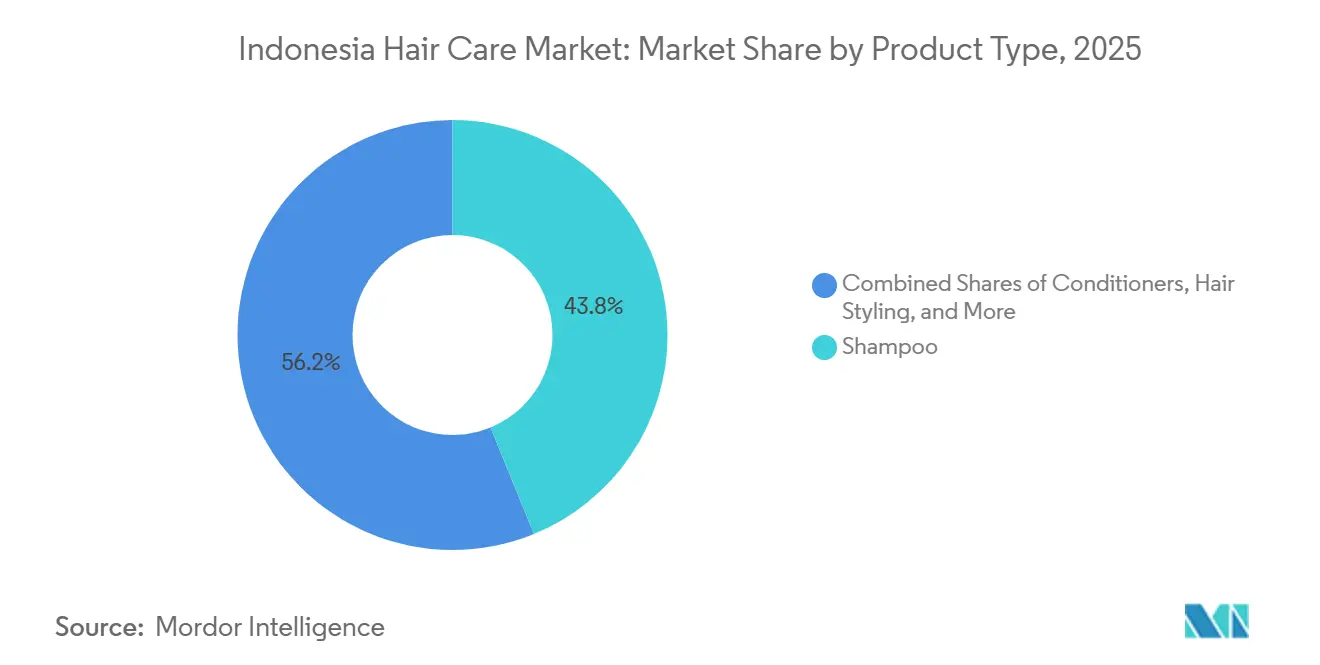
- By product type, shampoo held 43.81% of the Indonesia hair care market share in 2025, while hair styling products are forecast to grow at an 8.02% CAGR through 2031.
- By category, the mass segment accounted for more than 85% of the Indonesia hair care market size in 2025, while premium products are projected to expand at a 7.62% CAGR through 2031.
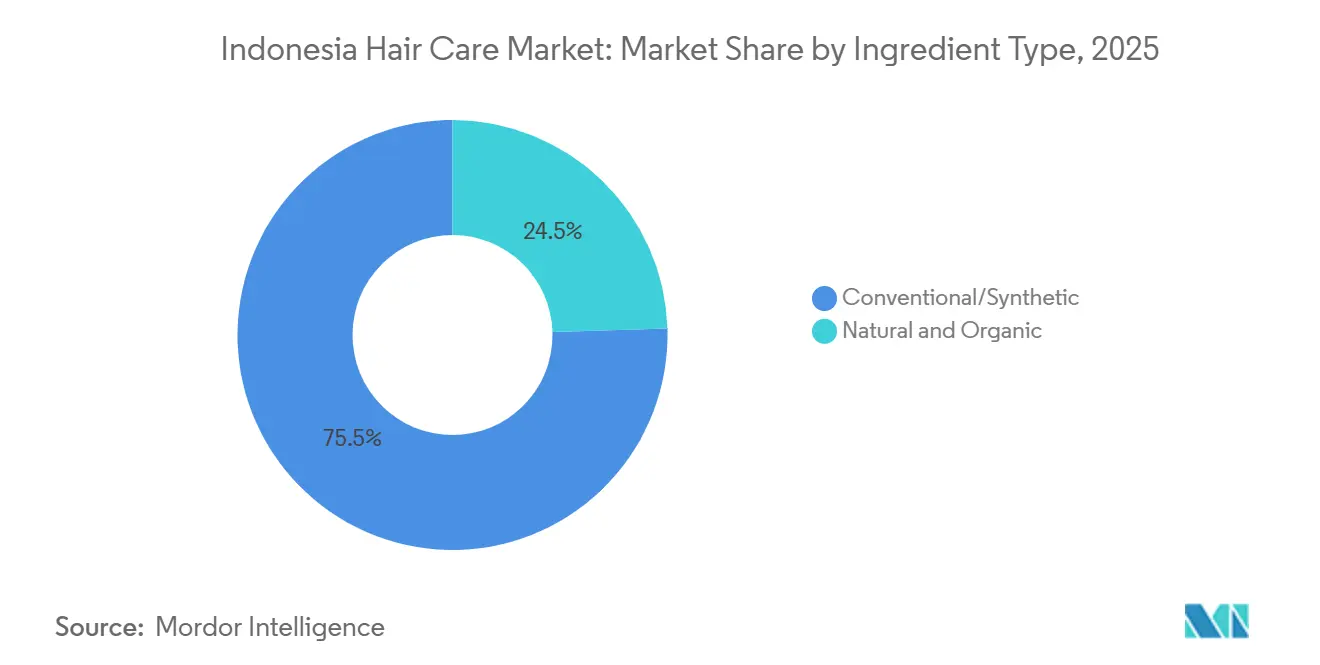
- By ingredient type, conventional and synthetic products held 75.48% of the Indonesia hair care market share in 2025, while natural and organic ingredients are forecast to grow at a 7.45% CAGR through 2031.
- By distribution channel, supermarkets and hypermarkets held 32.36% of the Indonesia hair care market in 2025, while online retail is projected to grow at a 7.66% CAGR through 2031.
Note: Market size and forecast figures in this report are generated using Mordor Intelligence’s proprietary estimation framework, updated with the latest available data and insights as of January 2026.
Indonesia Hair Care Market Trends and Insights
Drivers Impact Analysis*
| Driver | (~) % Impact on CAGR Forecasts | Geographic Relevance | Impact Timeline |
|---|---|---|---|
| Increasing Consumer Awareness of Personal Grooming and Hair Hygiene | +1.2% | National, concentrated in Java and major urban centers | Short term (≤ 2 years) |
| Growing Demand for Halal-Certified and Natural Ingredient-Based Hair Care Products | +1.4% | National, core impact across all Indonesian regions | Medium term (2-4 years) |
| Expansion of Social Commerce and Digital Beauty Influencing Product Adoption | +1.0% | National, accelerated in Tier-1 and Tier-2 cities | Short term (≤ 2 years) |
| Premiumization Driven by Demand for Scalp Care and Hair Repair Solutions | +0.7% | Concentrated in Greater Jakarta, Surabaya, and Bandung | Medium term (2-4 years) |
| Rising Demand for Hair Care Products Tailored to Hijab Wearers and Tropical Climate Conditions | +0.6% | National, with intensity in Muslim-majority provinces across Java, Sumatra, and West Nusa Tenggara | Medium term (2-4 years) |
| Growing Utilization of Indigenous Botanical Ingredients to Differentiate Hair Care Formulations | +0.5% | National, with botanical sourcing hubs in Java, Sumatra, and Sulawesi | Long term (≥ 4 years) |
| Source: Mordor Intelligence | |||
Growing Demand for Halal-Certified and Natural Ingredient-Based Hair Care Products
Cosmetics distributed in Indonesia must have halal certification by October 17, 2026, under the product assurance framework administered by BPJH[1]Source: Halal Product Assurance Agency, “Cosmetic Products Must Have Halal Certification by October 2026,” bpjph.halal.go.id. . The requirement covers shampoos, conditioners, treatments, serums, and colorants sold in the country. It makes supply-chain review more important because manufacturers need to verify ingredients and production processes before a product reaches retail. Halal status is also becoming a broader trust signal for consumers who link it with ingredient safety and responsible sourcing. Domestic brands with established halal systems may move faster than importers that depend on formulas not yet adapted for Indonesia. This setting favors botanical formulations that can meet both consumer preferences and halal requirements in the Indonesia hair care market.
Expansion of Social Commerce and Digital Beauty Influencing Product Adoption
Personal grooming and hair hygiene are becoming more visible in daily consumer routines, particularly in Java and other large urban markets. Social commerce shortens the path from a product demonstration to a purchase through creator content, live selling, and affiliate links. TikTok Shop and Shopee Live are useful for scalp treatments, botanical oils, cooling products, and styling products because creators can show application and describe intended benefits. Makarizo held 11.25% of hair care platform share on Shopee Indonesia in Q1 2025, showing the ability of a local brand to gain digital visibility. This route to consumers reduces reliance on television advertising and large in-store campaigns. Brands in the Indonesia hair care market need product education, affiliate programs, and clear digital product pages alongside established retail activity.
Rising Demand for Hair Care Products Tailored to Hijab Wearers and Tropical Climate Conditions
Hair and scalp needs linked with hijab use and humid weather are shaping product design in the Indonesia hair care market. Extended hair covering in tropical conditions can create scalp discomfort and can increase interest in cooling, cleansing, and anti-dandruff products. Companies are responding with products designed around scalp comfort, oil control, and hair fall concerns. ParagonCorp launched Dermascalp Expert in January 2026 with Biomimetic ScalpTech halal technology and products for conditions linked with hijab use, helmets, humidity, and daily styling PARAGONCORP. The range uses Micro Complex Keratin and Biotin Peptide, and the company stated that it reduced hair fall by 60% within 28 days. Hijab-focused expertise is becoming a practical capability for brands seeking a larger position in scalp care rather than a narrow product niche.
Premiumization Driven by Demand for Scalp Care and Hair Repair Solutions
Premium demand is growing as consumers seek products with clinical claims, transparent ingredients, and salon-style outcomes at home. Scalp serums, repair treatments, and products that use biomimetic technology or biotin peptides give companies a basis for higher pricing. PT Mandom Indonesia Tbk recorded IDR 830.25 billion in hair care revenue in FY2025, equal to USD 51 million, after 6.2% year-on-year growth supported by its LUCIDO-L Serum Boost series. Kao identified premium in-bath care and hair color as priorities for its Asia strategy in its FY2025 results. Indonesia has a large range of native plants that can support culturally relevant product stories, including candlenut, pandan leaf, and urang aring. IPB University published a pandan leaf shampoo formulation in December 2025 using pandan powder with aloe vera, rosemary oil, and tea tree oil[2]Source: IPB University, “Peneliti IPB University Kembangkan Sampo Daun Pandan, Inovasi Kearifan Lokal Bernilai Ekonomi Tinggi,” ipb.ac.id. . These developments support premium products that combine local ingredients with more structured scalp and hair care routines.
Restraints Impact Analysis*
| Restraint | (~) % Impact on CAGR Forecasts | Geographic Relevance | Impact Timeline |
|---|---|---|---|
| Availability of Counterfeit and Unregistered Products | -0.5% | National, informal trade channels, traditional markets, outer islands | Short term (≤ 2 years) |
| Increasing Regulatory Compliance Requirements | -0.4% | National, heightened pressure on importers and mid-tier manufacturers | Short term (≤ 2 years) |
| Distribution Challenges Across Indonesia's Archipelago | -0.4% | Outer islands: Maluku, Papua, NTT, eastern Kalimantan, remote Sulawesi | Long term (≥ 4 years) |
| Competition from Traditional Homemade Hair Treatments | -0.3% | Rural and semi-urban Indonesia, outer Java and outer islands | Medium term (2-4 years) |
| Source: Mordor Intelligence | |||
Availability of Counterfeit and Unregistered Products
Counterfeit and unregistered cosmetics create price pressure for compliant companies in the Indonesia hair care market. ANTARA reported that authorities seized more than 2 million illegally distributed cosmetics valued at IDR 27.6 billion, equal to USD 1.7 million, in a 2025 enforcement action. The products were largely linked to unlicensed imports, which avoid the testing, registration, and compliance costs carried by established brands. In Q1 2026 surveillance, BPOM identified 11 dangerous cosmetic products, including an anti-dandruff shampoo, that contained prohibited or unsafe ingredients[3]Source: National Agency of Drug and Food Control, “BPOM Regulation No. 8 of 2026 on Certification of Good Cosmetic Manufacturing Practices,” jdih.pom.go.id. . Informal social selling and unverified online stores can make enforcement more difficult because products may move outside established retail controls. Stronger enforcement before the October 2026 deadline can improve formalization, but informal channels will remain a challenge in price-sensitive areas.
Distribution Challenges Across Indonesia's Archipelago
Indonesia's geography makes national distribution difficult because products must reach consumers across 17,000 islands. Liquid products need reliable packaging and handling, while active ingredient products may require more careful temperature management. Multiple distributor layers can reduce margins and limit the reach of new launches outside major population centers. Traditional stores and small local retailers remain important in rural and outer-island locations, where single-use sachets fit frequent and low-value purchasing patterns. Brands commonly rely on domestic distributors and local agency relationships to build last-mile availability beyond Java. Improvements in selected transport corridors can help, but the Indonesia hair care market will continue to need channel strategies adapted to local logistics conditions.
*Our forecasts treat driver/restraint impacts as directional, not additive. The impact forecasts reflect baseline growth, mix effects, and variable interactions.
Segment Analysis
By Product Type: Shampoo Supports Volume While Styling Extends Consumer Routines
Shampoo held 43.81% of the Indonesia hair care market in 2025, making it the category's main volume base across income groups. Frequent household use supports repeat purchases and makes shampoo the usual entry point to a broader routine. Single-use sachets remain important for consumers who prefer low out-of-pocket spending per purchase. Conditioner has lower penetration than shampoo, which gives brands an opportunity to explain its role in post-wash care. This may be relevant for consumers who experience friction-related hair damage from head coverings or daily styling.
Hair styling products are projected to grow at an 8.02% CAGR through 2031, the fastest rate among product types. Urban consumers are adding setting, smoothing, finishing, and heat-protection steps after basic cleansing. Short product videos and styling tutorials help build demand for waxes, serums, and similar products. Other products, such as hair tonics, scalp treatments, and hair vitamins, are increasingly presented as preventive care rather than only therapeutic remedies. Companies that link shampoo with a complementary treatment or styling product can increase the value of the consumer basket in the Indonesia hair care market.



By Category: Mass Products Retain Scale While Premium Products Grow Faster
The mass segment accounted for more than 85% of the Indonesia hair care market size in 2025, supported by sachet formats and broad availability in rural and semi-urban locations. Price per use remains central for many mass consumers, particularly where routine products are purchased frequently. Mass brands can protect volume by maintaining small pack sizes and dependable traditional trade distribution. At the same time, halal certification and botanical ingredient narratives can make accessible products appear more credible without moving them beyond mass price points. This has narrowed the perceived distance between some local mass brands and imported premium alternatives.
Premium products are forecast to grow at a 7.62% CAGR through 2031 as consumers pay more for scalp care, ingredient transparency, and product claims linked with repair. Digital-native millennials and Gen Z consumers often compare local products with Korean and Japanese beauty standards before making purchases. Affiliate creators and online reviews can validate a premium purchase before a consumer tries a product. Several local companies sell premium stock-keeping units online while retaining mass sachet lines in traditional trade. This dual approach helps the Indonesia hair care market serve urban margin opportunities without giving up rural volume.
By Ingredient Type: Natural Products Gain Attention While Conventional Products Keep the Largest Base
Conventional and synthetic products retained 75.48% of the Indonesia hair care market in 2025 because synthetic ingredients remain cost-competitive and are widely used in existing formulas. This position also reflects the long-standing presence of global formulations in mass and mainstream ranges. Regulatory requirements for cosmetic ingredients are limiting the flexibility of products that depend on certain established components. Per BPOM No. 25 of 2025 restricts or bans ingredients including Octamethylcyclotetrasiloxane, known as D4, and Quaternium-15. Companies affected by the rules need to reformulate before they can continue to sell products that meet current requirements.
Natural and organic ingredients are forecast to grow at a 7.45% CAGR through 2031, making them the fastest-growing ingredient group. Candlenut oil has been studied in a nanoemulsion for its hair-growth potential, which supports its use in local product development. Pandan, coconut oil, tropical herbs, kombucha fermentation extracts, and plant-derived antifungal agents give brands several formulation paths. Natural claims can be more convincing when they are supported by safety work, transparent ingredient lists, and halal documentation. The Indonesia hair care industry can use indigenous ingredients to differentiate products without treating botanical positioning as a substitute for product performance.
By Distribution Channel: Modern Retail Leads Sales While Online Retail Changes Discovery
Supermarkets and hypermarkets accounted for 32.36% of Indonesia's hair care market in 2025, supported by regular footfall, trusted shopping environments, and visible displays. These stores are important for multi-pack sales, promotional activity, and products that depend on shelf visibility. Specialty stores and salon networks are more relevant for professional and premium ranges. L'Oréal uses specialty beauty retail and salon networks to establish Kérastase's professional positioning in Indonesia. Traditional warungs and convenience outlets remain essential for sachet sales and everyday access outside larger retail centers.
Online retail is forecast to grow at a 7.66% CAGR through 2031, the fastest pace among distribution channels. Social commerce combines product discovery, product education, and checkout in the same consumer journey. Affiliate commission structures encourage creators to explain products with more involved uses, including scalp treatments and repair products. Local brands can secure digital shelf space without matching the store investment of larger multinational companies. Physical retail and online retail will therefore serve different roles, with the former supporting routine availability and the second allowing the Indonesia hair care market to introduce higher-value and more specialized products.
Geography Analysis
Java is the largest commercial center for the Indonesia hair care market because it combines consumer spending, modern retail, and early-stage product launches. Greater Jakarta, Surabaya, and Bandung have strong hypermarket networks, higher incomes, and widespread e-commerce use. These conditions support demand for premium scalp care, treatment products, and new halal-certified botanical lines. Eastern and Central Java extend organized retail into peri-urban areas, where consumers are moving from sachets bought at warungs toward bottled products.
Sumatra, Kalimantan, and Sulawesi form a growing corridor with different product and channel needs. Sumatra's strong Islamic identity, especially in Aceh and West Sumatra, supports demand for halal-certified products ahead of the October 2026 mandate. Coconut oil and other tropical herbs from Sumatran regions can also support local ingredient positioning. Transport investment along the Trans-Sumatra Highway is improving connectivity in some areas and can lower delivery costs over time. Kalimantan and Sulawesi combine resource-sector income communities with a continued dependence on traditional trade, so brand availability must be supported by local retailer activation.
Eastern Indonesia, including Papua, Maluku, and Nusa Tenggara, remains less served by modern retail and faces higher inter-island logistics costs. Limited physical availability restricts product choice and can slow the introduction of specialized ranges. Sachets and value-tier products are likely to remain important during the forecast period. Mobile internet and e-commerce offer consumers another route to product access where retail coverage is limited. Brands need local distributors with established transport and agency relationships to achieve practical last-mile reach across the Indonesia hair care market.
Competitive Landscape
The Indonesia hair care market has a concentration score of 3 out of 10 and remains fragmented because no company holds a decisive position across all segments. Unilever, Procter & Gamble, L'Oréal, and Kao compete with domestic companies such as PT Paragon Technology and Innovation, PT Kino Indonesia Tbk, PT Mandom Indonesia Tbk, and Makarizo. Global companies use research and development capabilities, established brand recognition, and international product platforms. Domestic competitors use halal-first positioning, local botanical narratives, and products designed for hijab wearers.
P&G launched Pantene Miracles Biotin Strength and Collagen Repair shampoos in Indonesia in April 2026 for local hair care needs. Kao announced its redefined Liese hair color series with H-Linx TECH in July 2026 and planned rollout across 7 markets from August 2026. PT Paragon Technology and Innovation introduced Dermascalp Expert with AI Scalp Analysis developed with dermatologists and trichologists. These moves show competition centered on repair, color, scalp diagnostics, and halal product development. The October 2026 halal requirement may favor companies that can confirm compliance with ingredients and manufacturing systems without disrupting supply.
Companies also have room to develop accessible scalp diagnostics, professional-grade halal scalp treatments sold online, and botanical products for male grooming. Local direct-to-consumer brands use TikTok and Shopee Live to build demand without the cost structure of broad traditional trade networks. BPOM Regulation No. 8 of 2026 set updated Good Cosmetic Manufacturing Practice standards in April 2026. The regulation places additional pressure on smaller producers that do not have formal manufacturing controls. Over time, this may strengthen compliant participants, even though the Indonesia hair care market is likely to remain diverse because consumer demand is split across many price points and product needs.
Indonesia Hair Care Industry Leaders
Kao Corporation
Unilever Plc
Kenvue
Shiseido Company, Limited
L'Oréal SA
- *Disclaimer: Major Players sorted in no particular order

Recent Industry Developments
- April 2026: P&G's Pantene Indonesia launched two new product lines, Miracles Biotin Strength and Collagen Repair shampoos, designed to address hair integrity challenges specific to Indonesian women's hair types, introduced alongside Pantene brand ambassadors at a dedicated launch event in Jakarta.
- January 2026: PT Paragon Technology and Innovation launched Dermascalp Expert, billed as the world's first Biomimetic ScalpTech halal hair and scalp care range, at Beauty Science Tech 2026 in Jakarta. The product line integrates AI Scalp Analysis developed with dermatologists and trichologists, targeting pressured hair conditions linked to humidity, hijab use, and daily styling stress.
- December 2025: Unilever Indonesia launched an upgraded Dove Hairfall Control formula with a scalp-health-first formulation approach, presented at a dedicated press event in Jakarta, reinforcing Dove's pivot from hair-strand to scalp-microbiome positioning.


Indonesia Hair Care Market Report Scope
| Shampoo |
| Conditioner |
| Hair Colorants |
| Hair Styling Products |
| Other Product Types |
| Premium Products |
| Mass Products |
| Natural and Organic |
| Conventional / Synthetic |
| Specialty Stores |
| Supermarkets / Hypermarkets |
| Online Retail Stores |
| Other Channels |
| By Product Type | Shampoo |
| Conditioner | |
| Hair Colorants | |
| Hair Styling Products | |
| Other Product Types | |
| By Category | Premium Products |
| Mass Products | |
| By Ingredient Type | Natural and Organic |
| Conventional / Synthetic | |
| By Distribution Channel | Specialty Stores |
| Supermarkets / Hypermarkets | |
| Online Retail Stores | |
| Other Channels |


Key Questions Answered in the Report
What is the projected growth rate for hair care in Indonesia?
The category is forecast to grow at a CAGR of 5.92% from 2026 to 2031, reaching USD 1.68 billion by 2031.
Which product type has the largest sales base in Indonesia?
Shampoo held 43.81% of sales in 2025 because it is a frequent household purchase across income groups.
Which hair care product type is growing fastest?
Hair styling products are forecast to grow at an 8.02% CAGR through 2031 as consumers add finishing and treatment steps.
How will halal certification affect companies in Indonesia?
Cosmetics distributed in Indonesia must have halal certification by October 17, 2026, making ingredient and supply-chain compliance important.
Page last updated on:





