
Indonesia Commercial Roofing Market Size and Share
Market Overview
| Study Period | 2021 - 2032 |
|---|---|
| Forecast Data Period | 2027 - 2032 |
| Base Year Market Size (2026) | USD 1.40 Billion |
| Market Size (2027) | USD 1.51 Billion |
| Market Size (2032) | USD 2.12 Billion |
| Growth Rate (2027 - 2032) | 7.10 % |
| Market Concentration | Medium |
Major Players *Disclaimer: Major Players sorted in no particular order Image © Mordor Intelligence. Reuse requires attribution under CC BY 4.0. | |
Indonesia Commercial Roofing Market Analysis by Mordor Intelligence
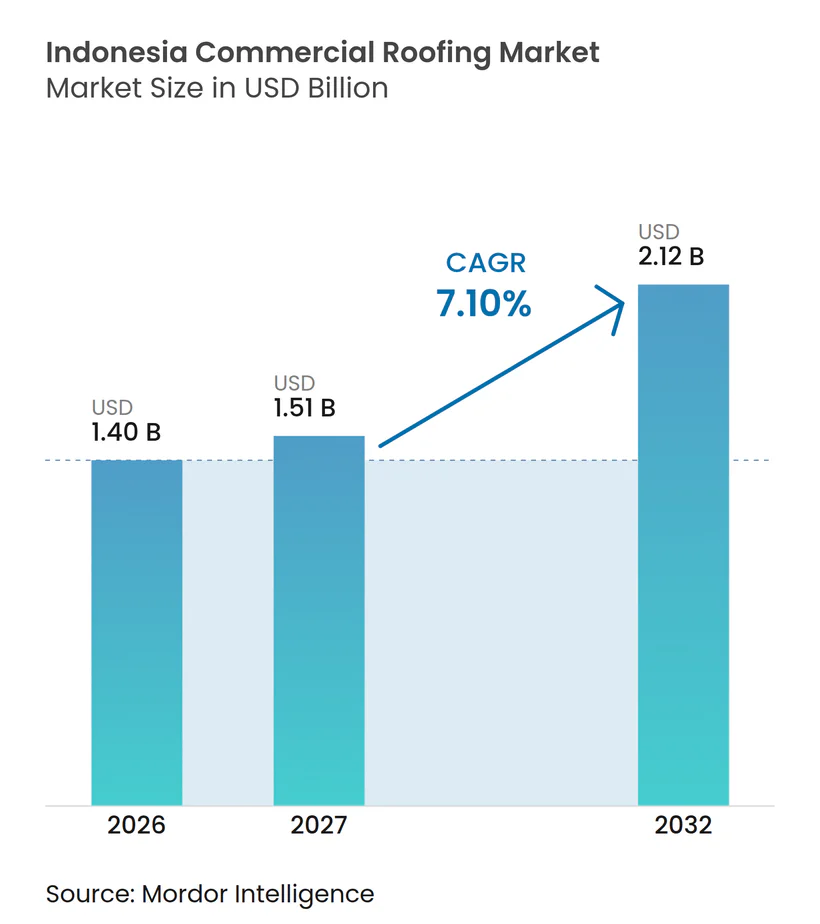
The Indonesia Commercial Roofing Market size is expected to grow from USD 1.40 billion in 2026 to USD 1.51 billion in 2027 and is forecast to reach USD 2.12 billion by 2032 at 7.10% CAGR over 2027-2032.
Demand is being supported by new industrial parks, manufacturing campuses, logistics facilities, and cold-chain warehouses that require large roof areas with defined performance standards. Government-backed infrastructure activity in Kalimantan and industrial investment outside Java are widening the addressable project base for the Indonesia commercial roofing market. Roofing suppliers are also competing on roof durability, water control, thermal performance, and the ability to support rooftop solar equipment rather than on product price alone. Import dependence for specialized membranes remains a constraint because foreign exchange changes and supply disruptions can raise installed costs for projects using those systems.
Key Report Takeaways
- By material type, metal roofing held 58.00% of the Indonesia commercial roofing market share in 2026, while single-ply membranes are forecast to grow at a 10.20% CAGR through 2032.
- By construction type, new construction accounted for 68.00% of the Indonesia commercial roofing market size in 2026 and is forecast to expand at a 10.00% CAGR through 2032.
- By application, industrial roofing held 41.00% of the Indonesia commercial roofing market share in 2026, while the industrial segment is forecast to grow at a 10.40% CAGR through 2032.
- By geography, Java accounted for 62.00% of the Indonesia commercial roofing market size in 2026, while Kalimantan is forecast to grow at an 11.00% CAGR through 2032.
Note: Market numbers in this report are based on Mordor Intelligence's proprietary estimation framework, which combines nine months of actuals with Q4 projections for base year 2026.
Market Trends and Insights
Drivers Impact Analysis of Indonesia Commercial Roofing Market*
| Drivers | (~) % Impact on CAGR Forecast | Geographic Relevance | Impact Timeline |
|---|---|---|---|
| Industrial Estate and Manufacturing Campus Expansion | +2% | Java, West Kalimantan, South Sulawesi, Central Java | Short term (≤ 2 years) |
| E-Commerce Warehousing and Cold-Chain Development | +1.5% | Java and Sumatra | Short term (≤ 2 years) |
| New Capital and Public Infrastructure Construction | +1.2% | East Kalimantan and South Kalimantan | Medium term (2-4 years) |
| Pre-Engineered Building and Metal-Roof Adoption | +0.9% | All industrial provinces | Short term (≤ 2 years) |
| Tropical Rainfall and Corrosion-Resistant Roof Specifications | +0.8% | Coastal and high-humidity provinces | Medium term (2-4 years) |
| Rooftop Solar Deployment on Industrial Assets | +0.6% | Java, East Kalimantan, Central Java | Long term (≥ 4 years) |
| Source: Mordor Intelligence | |||
Industrial Estate and Manufacturing Campus Expansion
Industrial estate development provides a clear pipeline for the Indonesia commercial roofing market because every factory, standard factory building, and logistics facility requires a roof before operations can begin. Indonesia commissioned 9 industrial parks between October 2024 and October 2025, adding 4,468 hectares across South Sulawesi, West Java, West Kalimantan, and Central Java. Investment in these parks reached USD 36.9 billion and was 9.3% higher than a year earlier[1]. The pattern favors repeatable roof designs because developers can use standardized materials and installation methods across multiple buildings in one park. This supports suppliers that can deliver coated steel, framing, and related components consistently across large sites.
E-Commerce Warehousing and Cold-Chain Development
Warehouse and cold-chain construction are increasing the need for durable roofs that can manage moisture, insulation, and equipment loads. Cold storage buildings need controlled vapor transmission and thermal resistance to reduce refrigeration demand, which can favor membrane systems paired with insulation boards. The Global Cold Chain Alliance reported that operators in the Asia-Pacific region are prioritizing rooftop solar integration in 2025[2]. That requirement can influence roof selection because the roof structure must support solar modules and retain reliable drainage. As logistics networks develop, the Indonesia commercial roofing market is likely to see more projects where roof performance affects both building operations and energy spending.
New Capital and Public Infrastructure Construction
Construction for Nusantara, Indonesia's new capital city, is creating demand for institutional buildings, residential towers, roads, and supporting facilities in East Kalimantan. The Nusantara Capital City Authority began Phase II construction in 2025, supported by a USD 2.8 billion state budget for legislative, judicial, and ecosystem infrastructure[3]. Public-private partnership plans also include USD 3.5 billion for residential towers and road networks, which extend the construction schedule through 2029. Public projects often require compliance with Indonesian National Standard, or SNI, building requirements and longer-life materials. This raises the importance of certified roofing systems in the Indonesia commercial roofing market, especially for projects linked to public procurement.
Pre-Engineered Building and Metal-Roof Adoption
Pre-engineered buildings are supporting demand for metal roofing across industrial provinces because their components are designed for repeatable factory and warehouse projects. Standard factory buildings can reduce the time between site preparation and roof installation. This approach suits industrial parks that require several facilities with comparable spans, loading requirements, and drainage needs. Metal roof suppliers can plan fabrication, delivery, and installation more efficiently when project specifications are standardized. The model also gives developers a practical route to faster occupancy of logistics and manufacturing space.
Restraints Impact Analysis of Indonesia Commercial Roofing Market*
| Restraints | (~) % Impact on CAGR Forecast | Geographic Relevance | Impact Timeline |
|---|---|---|---|
| High Rainfall and Humidity Installation Constraints | -0.4% | Nationwide, particularly coastal Sumatra, Kalimantan, and eastern Indonesia | Short term (≤ 2 years) |
| Island-to-Island Logistics and Distribution Costs | -0.3% | Sulawesi, Maluku, Papua, Nusa Tenggara, and outer Kalimantan | Medium term (2-4 years) |
| Import Dependence for Specialty Membranes | -0.2% | National, especially urban projects using TPO, EPDM, and PVC | Medium term (2-4 years) |
| Fragmented Installer Skills and Warranty Practices | -0.2% | Nationwide, particularly Tier 2 and Tier 3 cities | Long-term (≥ 4 years) |
| Source: Mordor Intelligence | |||
High Rainfall and Humidity Installation Constraints
Indonesia's climate reduces the number of suitable installation days for some commercial roofing systems. High humidity can narrow the adhesive window for bituminous and single-ply membrane work, while frequent rainfall can pause exposed metal installation. These conditions can extend project schedules and increase labor costs in coastal Sumatra, Kalimantan, Sulawesi, and other wet locations. SNI 8399:2017 governs light steel roof framing, so installers must also meet anchoring requirements where wind exposure is high. The Indonesia commercial roofing market therefore needs materials and installation plans that suit local weather conditions as well as building design.
Island-to-Island Logistics and Distribution Costs
Indonesia's geography creates a higher delivered-cost base for commercial roofing products outside Java and North Sumatra. Metal roofing coils and prefabricated panels require inter-island shipping, which adds handling, storage, and corrosion-protection needs. These costs can lead developers in Sulawesi, Nusa Tenggara, and outer Kalimantan to select lower-cost specifications. Transport improvements can reduce this pressure over time, but distribution remains a material issue for projects in eastern Indonesia. The constraint affects product value even where roof installation volumes continue to grow.
*Our forecasts treat driver/restraint impacts as directional, not additive. The impact forecasts reflect baseline growth, mix effects, and variable interactions.
Indonesia Commercial Roofing Market Segment Analysis
By Material Type:
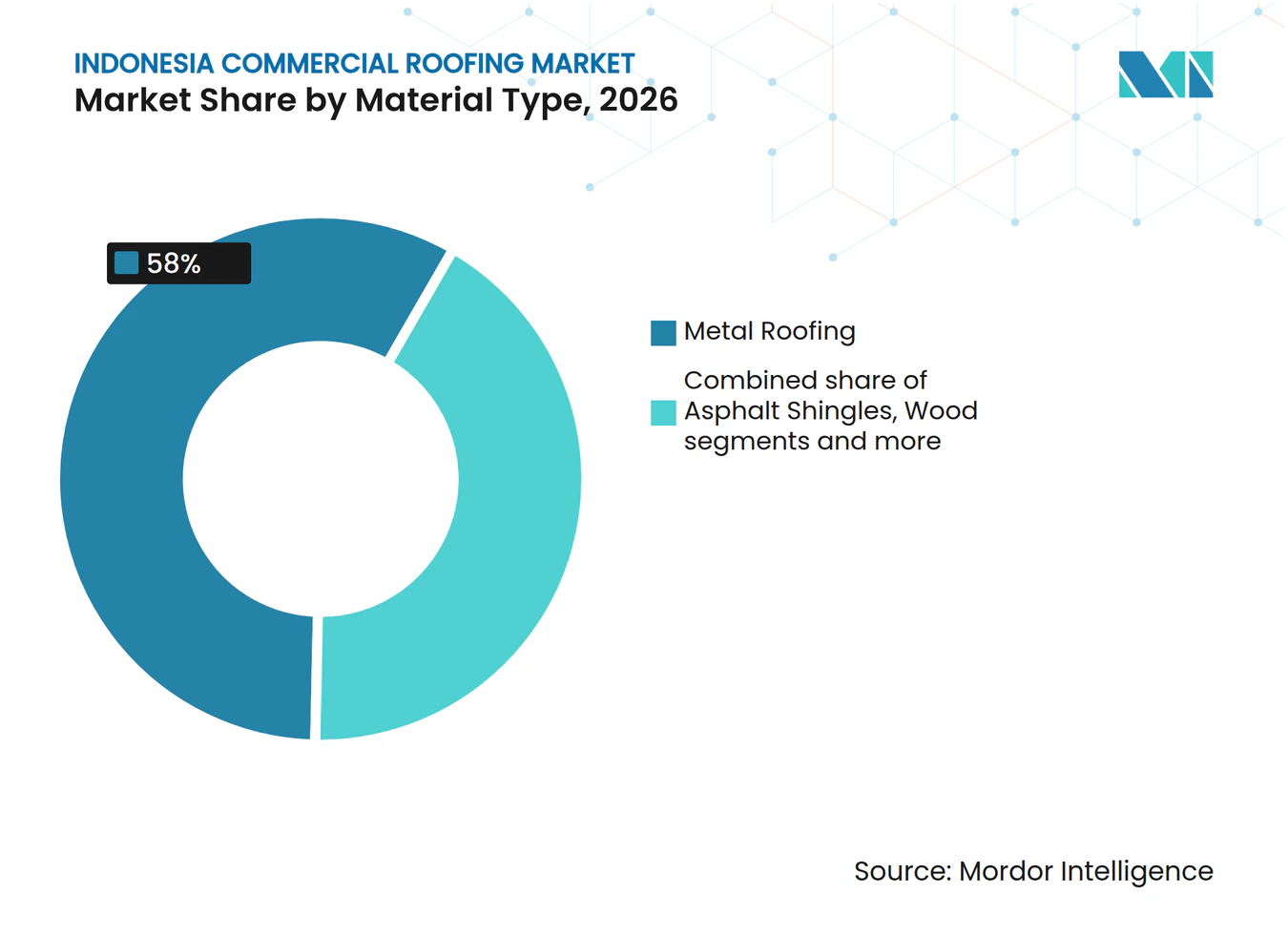
Metal Roofing Leads While Single-Ply Membranes Grow FasterMetal roofing held 58.00% of 2026 value, making it the leading material category in this sector. It suits wide-span factories and warehouses because profiled steel provides strength at a manageable installed cost. PT Krakatau Steel (Persero) Tbk reported a 2025 target of 1.7 million tons of steel product sales, including products for metal roofs and structural profiles. PT NS BlueScope Indonesia has positioned COLORBOND Steel XAL for projects requiring thermal management and coastal durability. These supplier positions reflect continued demand for metal systems in industrial construction.
Single-ply membranes are forecast to record the fastest material growth at a 10.20% CAGR through 2032. This group includes thermoplastic polyolefin, ethylene propylene diene monomer, and polyvinyl chloride systems. They are well suited to flat-roof warehouses, cold-chain buildings, and data centers where waterproofing performance is important. Bituminous and modified bitumen membranes remain relevant for reroofing and roof terraces because installers are familiar with them and the initial cost can be lower. Asphalt shingles, clay and concrete tiles, and wood retain smaller roles in low-rise retail, hospitality, heritage, and boutique projects.



By Construction Type:
New Construction Provides Most DemandNew construction accounted for 68.00% of 2026 value in the Indonesia commercial roofing market. This leading position reflects the current wave of industrial parks, logistics campuses, and public infrastructure projects. Standard factory buildings in Bekasi, Karawang, and Purwakarta enable concentrated procurement because developers build several similar facilities within one location. That setting allows suppliers to plan deliveries and use repeatable roof specifications. It also favors companies with reliable stocks of steel sheets, framing, fasteners, and installation support.
New construction is also forecast to be the fastest-growing construction type at a 10.00% CAGR through 2032. Reroofing and replacement provide a value opportunity because material matching, substrate removal, and waterproofing connections require more specialized work. Older industrial roofs may need replacement before solar modules can be installed if they cannot meet load and drainage requirements. Alam Energy Renewables completed a 2.3 MWp roof-mounted solar project for PT FCC Indonesia in Karawang in September 2025 across 10,000 square meters. Such projects can shorten replacement cycles for roofs that were built before solar readiness became a practical requirement.
By Application:
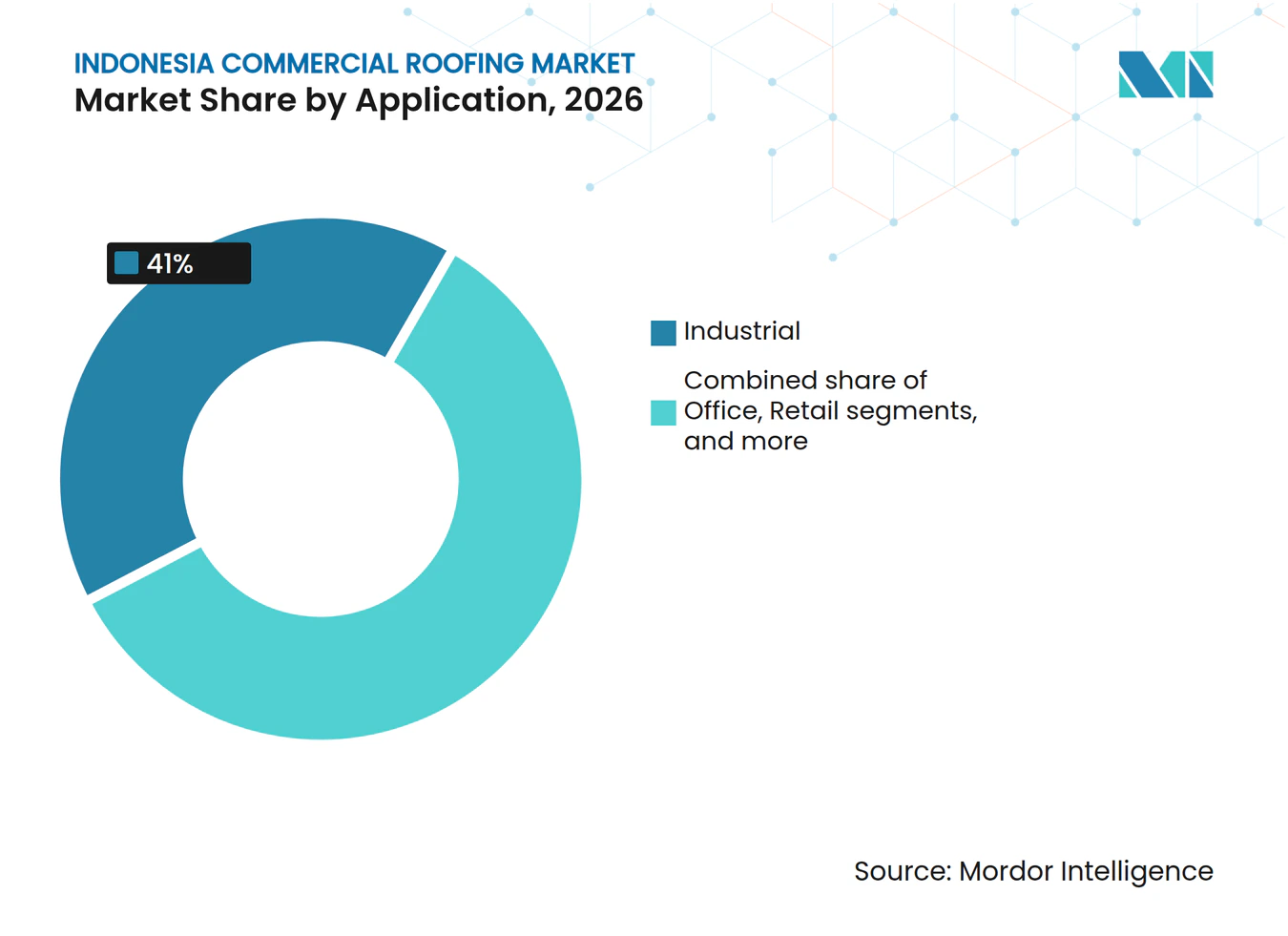
Industrial Buildings are the Largest Use CaseIndustrial roofing held 41.00% of 2026 value in the Indonesia commercial roofing market. Factories, warehouses, and logistics hubs use larger roof areas than most offices and retail facilities. The Special Economic Zone at Industropolis Batang is targeting USD 4.6 billion in investment over 5 years. These developments support demand for roofing with corrosion resistance, controlled drainage, and solar-ready structural capacity. Industrial clients also place more importance on keeping facilities operational during repair and replacement work.
The industrial segment is forecast to grow at a 10.40% CAGR through 2032, the highest rate among applications. Rooftop photovoltaic projects add to demand because they require a roof that can carry equipment and manage water safely. Retail buildings continue to require roofing for modern trade sites and mixed-use logistics facilities, although their roof areas are generally smaller. Office buildings are adopting higher waterproofing, insulation, and solar-readiness specifications as green building requirements become more relevant to premium tenants. Hospitality, healthcare, and institutional buildings make up the remaining application group and often have more varied material requirements.

Geography Analysis
Java accounted for 62.00% of the 2026 value in the Indonesia commercial roofing market. Its lead comes from the dense concentration of industrial estates, commercial property, manufacturing, and logistics operations. In September 2025, Sinar Primera Group began work on the 27-hectare Sinar Primera Industrial Narogong project in Bekasi, with 80,000 square meters of net lettable warehouse, cold storage, and built-to-suit space in its first phase. Java also has a deeper local supply chain of coil producers, membrane distributors, and experienced installers.
Kalimantan is forecast to grow at an 11.00% CAGR through 2032, the strongest regional rate. Nusantara Phase II and related infrastructure spending are supporting construction in East Kalimantan. The project pipeline extends beyond the capital city through industrial zones, processing activity, and logistics investment in other provinces. South Kalimantan is also investing in transportation links that can improve access to the wider island. Suppliers that establish regional distribution and installation capacity may be better placed to serve sites where transport costs and weather conditions remain demanding.
Sumatra remains the second-largest geographic area, with Medan and Palembang serving as key commercial construction centers. PT NS BlueScope Indonesia and PT Prima Manunggal Inti Internusa launched Prima Supreme Truss in Palembang in August 2025 for projects requiring heavy-duty steel roof framing in humid conditions. Sulawesi is adding industrial capacity through newly commissioned parks, which creates a wider base for higher-specification roofing. Bali and Nusa Tenggara have a different demand pattern because hospitality and premium retail can favor clay tile and architectural metal. The rest of Indonesia is supported by public spending on healthcare, education, and administration facilities.
Competitive Landscape
Market Concentration
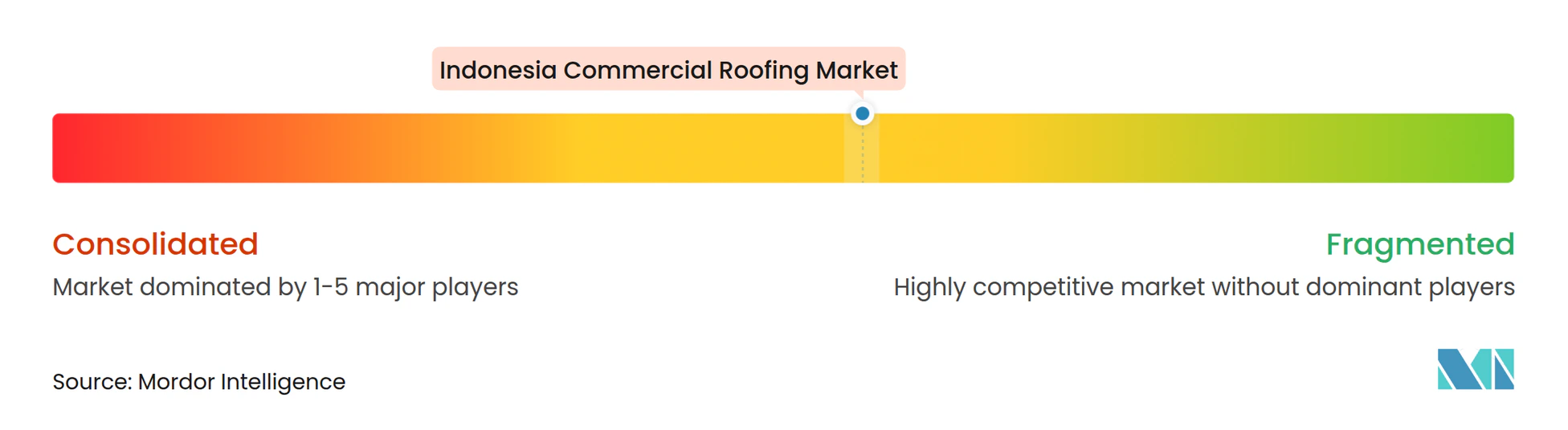
The Indonesia commercial roofing market has a moderately concentrated upper tier of material producers and a fragmented group of local processors, distributors, and installers. PT NS BlueScope Lysaght Indonesia and PT NS BlueScope Indonesia compete in coated steel on product performance, certification, and supply reliability. Their COLORBOND range has been used in projects such as Jakarta International Stadium, where the company highlighted coastal durability and a contribution to the project's Green Building Council Indonesia certification. PT Krakatau Steel is strengthening its downstream steel position for metal roofing and light steel framing. PT Sarana Central Bajatama Tbk and PT Tata Metal Lestari compete in galvanized and Zincalume coil products where price and channel access are important.
Membrane suppliers compete through technical specifications and application support. PT Sika Indonesia and PT Saint-Gobain Indonesia serve projects where fire, vapor transmission, waterproofing, and application engineering influence the purchase decision. Their position is stronger when designers and engineers define the system before construction starts. State-owned contractors such as PT Waskita Karya (Persero) Tbk, PT Pembangunan Perumahan (Persero) Tbk, PT Hutama Karya, and PT Adhi Karya (Persero) Tbk shape demand through infrastructure and public-building contracts. PT Wijaya Karya secured a road improvement contract for the Nusantara core government area in June 2025, which illustrates the construction activity supporting nearby facilities and related material demand.
The commercial opportunity is growing around solar-compatible and corrosion-resistant roofing systems for industrial locations, including eastern Indonesia. This type of project favors providers that can assess roof load, drainage, corrosion exposure, and long-term maintenance together. Distribution reach remains important because island-to-island freight adds cost and can affect material condition in transit. Companies that can link roof specification with solar readiness have a distinct route to higher-value projects.
Indonesia Commercial Roofing Industry Leaders
-
PT Krakatau Steel (Persero) Tbk
-
PT Tata Metal Lestari
-
PT Bluescope Lysaght Indonesia
-
PT NS BlueScope Indonesia
-
PT Union Metal
- *Disclaimer: Major Players sorted in no particular order
Indonesia Commercial Roofing Market Companies Covered in this Report
- PT Krakatau Steel (Persero) Tbk
- PT Tata Metal Lestari
- PT Bluescope Lysaght Indonesia
- PT NS BlueScope Indonesia
- PT Union Metal
- PT Sidoarjo Jaya
- PT Onduline Indonesia
- PT Maju Jaya
- PT Sarana Central Bajatama Tbk
- PT Cisarua Mountain Dairy Tbk
- PT Sika Indonesia
- PT Saint-Gobain Indonesia
- PT Adhi Karya (Persero) Tbk
- PT Wijaya Karya (Persero) Tbk
- PT Pembangunan Perumahan (Persero) Tbk
- PT Total Bangun Persada Tbk
- PT Jaya Konstruksi Manggala Pratama Tbk
- PT Hutama Karya
- PT Wika Gedung
- PT Waskita Karya (Persero) Tbk
Recent Industry Developments in Indonesia Commercial Roofing Market
- October 2026: PT FUMIRA, part of Argo Manunggal Group, introduced Atap Baja Urat Kayu, a decorative wood-grain steel roofing sheet, at Trade Expo Indonesia 2026. The product is available in 6 color variants with a 0.25 mm thickness. It extends the company’s offering for design-led retail and light-commercial projects where appearance can affect material selection.
- September 2026: BMB Steel reported 38.15% erection progress on the VinFast Phase 2 manufacturing facility in Indonesia. The project covers 13,000 tons of steel structure across more than 130,000 square meters. BMB Steel is supplying and erecting the main frame, roofing sheets, sandwich panels, and related accessories, making it a major industrial roofing package in 2026
- August 2026: Tedmond Groups entered the building materials sector with Atap uPVC Grand Luxe for commercial and industrial buildings. The roof uses a 10 mm double-layer design, precision interlock joints, ultraviolet protection, fire-retardant and chemical-resistant properties, and a load capacity of up to 100 kg. The product targets contractors seeking corrosion-resistant, low-maintenance alternatives for wet industrial locations.
Indonesia Commercial Roofing Market Report Scope
Segmentation Overview
| Asphalt Shingles |
| Clay & Concrete Tiles |
| Metal Roofing |
| Bituminous / Modified Bitumen Membranes |
| Single-Ply Membranes (TPO, EPDM, and PVC) |
| Wood |
| Others |
| New Construction |
| Reroofing and Replacement |
| Retail |
| Office |
| Industrial |
| Others |
| Java |
| Sumatra |
| Kalimantan |
| Sulawesi |
| Bali and Nusa Tenggara |
| Rest of Indonesia |
| By Material Type | Asphalt Shingles |
| Clay & Concrete Tiles | |
| Metal Roofing | |
| Bituminous / Modified Bitumen Membranes | |
| Single-Ply Membranes (TPO, EPDM, and PVC) | |
| Wood | |
| Others | |
| By Construction Type | New Construction |
| Reroofing and Replacement | |
| By Application | Retail |
| Office | |
| Industrial | |
| Others | |
| By Geography | Java |
| Sumatra | |
| Kalimantan | |
| Sulawesi | |
| Bali and Nusa Tenggara | |
| Rest of Indonesia |
Key Questions Answered in the Report
What is the projected value of commercial roofing demand in Indonesia by 2032?
The Indonesia Commercial Roofing Market size is expected to grow from USD 1.40 billion in 2026 to USD 1.51 billion in 2027 and is forecast to reach USD 2.12 billion by 2032 at 7.10% CAGR over 2027-2032.
Which roofing material has the largest share in Indonesia?
Metal roofing leads with 58.00% of 2026 value because it fits wide-span industrial and warehouse buildings. Coated steel products also suit repeatable specifications at large industrial sites.
Which commercial roofing segment is expanding the fastest?
Single-ply membranes are forecast to grow at a 10.20% CAGR through 2032. Growth is supported by flat-roof logistics, cold-chain, and data-center projects that need reliable waterproofing.
Why is rooftop solar important for commercial roofing in Indonesia?
Solar systems can require structural upgrades or roof replacement to meet load and drainage requirements. This creates additional re-roofing demand before photovoltaic equipment is installed.
Which area is expected to record the fastest roofing growth?
Kalimantan is forecast to grow at an 11.00% CAGR through 2032. Nusantara construction, industrial projects, and transport development support this demand.
What is the largest application for commercial roofing products?
Industrial buildings hold 41.00% of 2026 demand and are forecast to grow at a 10.40% CAGR through 2032. Factories, warehouses, and logistics facilities require extensive roof coverage.