
Indonesia Bonsai Market Size and Share
Market Overview
| Study Period | 2021 - 2031 |
|---|---|
| Forecast Data Period | 2026 - 2031 |
| Base Year Market Size (2025) | USD 75 Million |
| Market Size (2026) | USD 81.70 Million |
| Market Size (2031) | USD 125.10 Million |
| Growth Rate (2026 - 2031) | 8.89 % |
| Market Concentration | Medium |
Major Players *Disclaimer: Major Players sorted in no particular order Image © Mordor Intelligence. Reuse requires attribution under CC BY 4.0. | |
Indonesia Bonsai Market Analysis by Mordor Intelligence
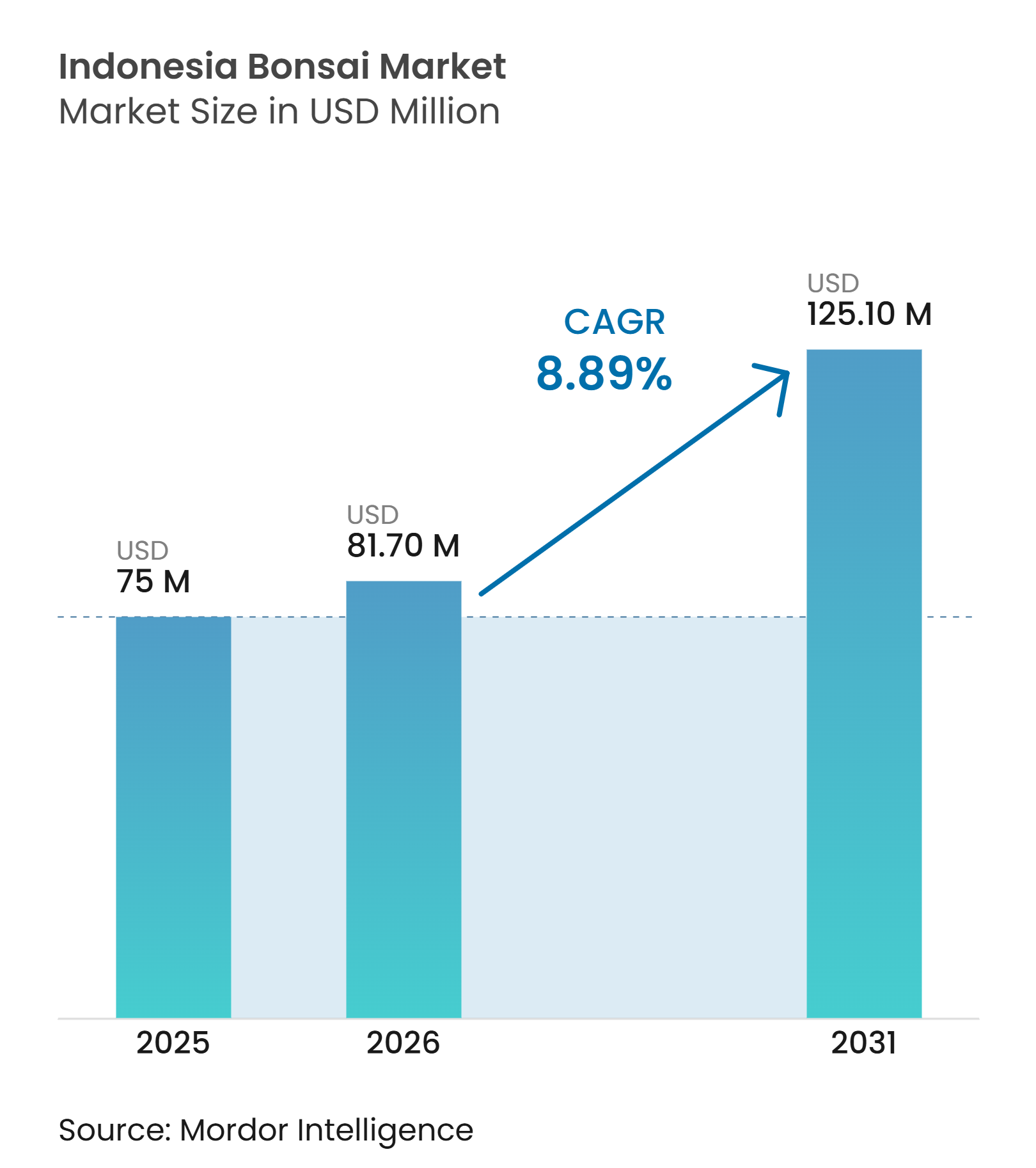
The Indonesia bonsai market was valued at USD 75.0 million in 2025 and is projected to grow from USD 81.70 million in 2026 to USD 125.10 million by 2031, at a CAGR of 8.89% during the forecast period (2026-2031). Urban living is driving demand for compact plants suited to apartments, small homes, and managed indoor spaces. Indonesia has a broad base of tropical species, active collector communities, and a developing export channel for specialist buyers. The market also benefits from exhibitions that connect growers, collectors, and buyers while increasing the visibility of recognized trees. Smaller growers remain important to supply, but a limited pool of trained artisans and uneven export readiness could restrict the pace of market development. Growth will depend on improvements in horticultural training, handling practices, and quarantine processes.
Key Report Takeaways
- By species, outdoor species accounted for the largest 48.0% of Indonesia bonsai market share in 2025, while indoor species is projected to grow at the fastest CAGR of 10.9% from 2026 to 2031.
- By distribution channel, offline accounted for the largest share at 58.0% in 2025, while the Indonesia bonsai market size for the online segment is projected to grow at the fastest CAGR of 13.2% from 2026 to 2031.
- By application, Residential accounted for the largest share at 51.0% in 2025, while the commercial segment is projected to grow at the fastest CAGR of 9.6% from 2026 to 2031.
Note: Market size and forecast figures in this report are generated using Mordor Intelligence’s proprietary estimation framework, updated with the latest available data and insights as of January 2026.
Market Trends and Insights
Drivers Impact Analysis of Indonesia Bonsai Market*
| Driver | (~) % Impact on CAGR Forecast | Geographic Relevance | Impact Timeline |
|---|---|---|---|
| Urban Gardening and Compact Living | 1.5% | Java, including Jakarta, Surabaya, and Bandung, and Bali | Short term (≤ 2 years) |
| Social Media Led Plant Discovery and Commerce | 1.8% | National, with early strength in Java and Bali | Short term (≤ 2 years) |
| Bonsai Exhibitions and Club Network Expansion | 1.2% | National, including Perkumpulan Penggemar Bonsai Indonesia (PPBI) branches | Medium term (2-4 years) |
| Tropical Species and Local Genetic Diversity | 1.0% | Java, Bali, Nusa Tenggara, and Sumatra | Medium term (2-4 years) |
| Premium Collectible and Investment Purchases | 1.3% | Central Java, East Java, and Bali | Medium term (2-4 years) |
| Export Demand for Indonesian Tropical Bonsai | 1.4% | Central Java, with potential spillover to Bali | Long term (≥ 4 years) |
| Source: Mordor Intelligence | |||
Urban Gardening and Compact Living
Indonesia's growing urban population is driving demand for bonsai suited to compact residential spaces. According to the World Bank, based on estimates from the United Nations Population Division's World Urbanization Prospects, Indonesia's urban population reached 169,698.15 thousand in 2025[1]. A larger urban population increases the number of households in built-up areas, where space for conventional gardens is limited. Bonsai offers an ornamental greenery option for space-constrained residential settings, supporting consumer adoption and contributing to the growth of the bonsai market in Indonesia.
Social Media Led Plant Discovery and Commerce
Social media-driven plant discovery and commerce supports the market by expanding opportunities for sellers to promote plants and interact with potential buyers through digital channels. The Ministry of Communication and Digital Affairs (Komdigi) reported in 2025 that 19.3% of individuals use social media for business or promotional activities daily. This regular promotional activity gives bonsai sellers a direct channel to showcase trees, share cultivation information, and reach prospective customers beyond physical nurseries. Greater use of social media for promotion can therefore improve digital product visibility and customer engagement, supporting market growth.
Bonsai Exhibitions and Club Network Expansion
Bonsai exhibitions and club networks support the market by providing venues for product discovery, transactions, knowledge sharing, and customer engagement. In 2025, the Department of Tourism, Creative Economy, Youth and Sports of Gunungkidul Regency (Dispar Ekrafpora) reported that the Handayani Bonsai Fest generated Rp400 million (USD 23,421) in transaction turnover[2]. The event featured a bonsai marketplace and drew participants from across Indonesia. Such exhibition-led commercial activity provides growers and sellers with opportunities to showcase and sell bonsai, increasing consumer exposure and supporting overall market growth.
Tropical Species and Local Genetic Diversity
Indonesia's tropical environment supports distinctive bonsai species such as Santigi. Genetic variation in these species can provide diverse plant characteristics for cultivation and collection. A 2025 study by researchers from Universitas Negeri Gorontalo and Indonesia's National Research and Innovation Agency (BRIN) found an 88.92% polymorphism rate in Pemphis acidula populations across three coastal locations in Gorontalo, indicating high genetic variation. The study also identifies Santigi as a species suitable for bonsai cultivation with high economic value. This genetic diversity supports a wide range of bonsai material, contributing to species diversity and growth opportunities in Indonesia's bonsai market.
Restraints Impact Analysis of Indonesia Bonsai Market*
| Restraint | (~) % Impact on CAGR Forecast | Geographic Relevance | Impact Timeline |
|---|---|---|---|
| Limited Skilled Pruning and Wiring Labor | -1.0% | National, with greater pressure outside Java | Long term (≥ 4 years) |
| Plant Mortality and Transit Risk | -0.8% | Export corridors and domestic interisland routes | Short term (≤ 2 years) |
| Fragmented Quality Standards and Price Discovery | -0.7% | National, especially informal retail channels | Medium term (2-4 years) |
| Quarantine and Phytosanitary Export Friction | -0.9% | Central Java export routes to Europe and the Middle East | Medium term (2-4 years) |
| Source: Mordor Intelligence | |||
Limited Skilled Pruning and Wiring Labor
Limited access to specialized bonsai skills can restrain the Indonesia bonsai market. Techniques such as pruning, wiring, shaping, repositioning, and aftercare require hands-on expertise that directly influences plant quality and commercial value. When advanced techniques are not widely available locally, growers and sellers may find it difficult to maintain consistent quality, develop mature bonsai, and meet the expectations of experienced buyers. This skill gap can increase reliance on specialized training and limit smaller nurseries' ability to scale production efficiently. As a result, uneven access to technical expertise can constrain production quality, market participation, and overall market growth.
Quarantine and Phytosanitary Export Friction
Quarantine and phytosanitary export requirements can constrain the market, as live plants require certification, documentation, and precise timing of shipments before reaching buyers. In 2025, the United States Department of Agriculture (USDA) reported that Indonesia's quarantine rules require plant shipments to depart within 21 days of the issuance of a phytosanitary certificate[3]. This fixed window creates pressure on bonsai exporters coordinating inspection, certification, plant preparation, and transport. Missed deadlines can disrupt shipments and increase compliance costs, limiting smaller exporters' ability to serve international markets.
*Our forecasts treat driver/restraint impacts as directional, not additive. The impact forecasts reflect baseline growth, mix effects, and variable interactions.
Indonesia Bonsai Market Segment Analysis
By Species:
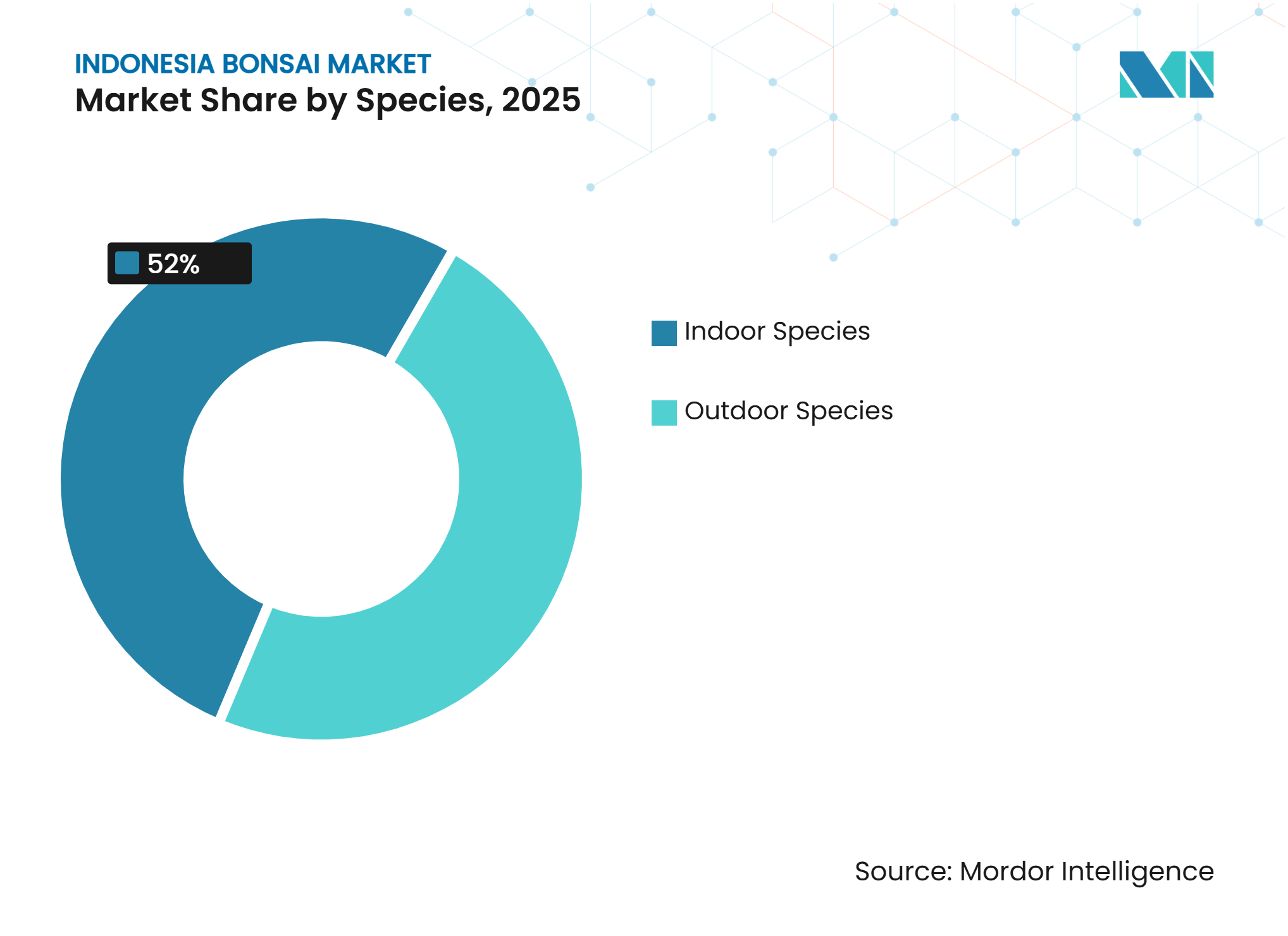
Outdoor Species Anchor Value While Indoor Species Build VolumeOutdoor Species accounted for the largest 48.0% of Indonesia bonsai market share in 2025. Outdoor collections remain central to the market as established bonsai are commonly cultivated for gardens, courtyards, terraces, and dedicated display areas. Santigi, Sancang, Beringin, and Ficus varieties can develop into distinctive specimen trees through long-term pruning, wiring, root development, and styling. Needle-bearing varieties such as Cemara Udang provide additional visual diversity. The segment combines established collector preferences with species suited to Indonesia's tropical conditions, supporting sustained demand across specialist nurseries, exhibitions, collectors, and buyers seeking mature outdoor specimens.
The indoor species segment is projected to grow at the fastest CAGR of 10.9% from 2026 to 2031. Indoor collections can broaden participation in bonsai by offering compact plants suited to apartments, offices, balconies, and other space-constrained settings. Anting Putri, Indoor Ficus, and Bougainvillea provide adaptable options for newer hobbyists and buyers seeking manageable ornamental plants. Their compact presentation also supports gifting, interior decoration, and lifestyle-oriented purchasing. As consumers seek greenery suitable for smaller living environments, growers offering appropriate varieties and maintenance guidance can address broader customer needs, supporting faster growth of the indoor segment.



By Distribution Channel:
Offline Segment Anchor Sales While Online Segment Accelerate GrowthOffline channels accounted for the largest share at 58.0% in 2025. Physical purchasing remains important because buyers can directly inspect trunk structure, root spread, branch placement, pot selection, health, and overall styling before purchasing a bonsai. Nurseries, plant markets, exhibitions, and specialist sellers also provide opportunities for demonstrations, consultations, relationship-building, and after-sales guidance for collectors. These interactions are particularly relevant for higher-value trees where appearance and condition can materially influence purchasing decisions. Continued reliance on direct inspection supports the established role of offline channels within the market.
The Indonesia market size for the online segment is projected to grow at the fastest CAGR of 13.2% from 2026 to 2031. Digital channels can expand bonsai discovery beyond local nurseries by enabling growers to showcase species, styling stages, prices, and care information through catalogs and social platforms. Live selling and video demonstrations can help sellers communicate plant condition and cultivation requirements before purchase. These capabilities can attract hobbyists and geographically dispersed buyers while giving established nurseries additional ways to communicate inventory. As digital discovery improves access, online distribution can broaden participation and support faster channel development.
By Application:
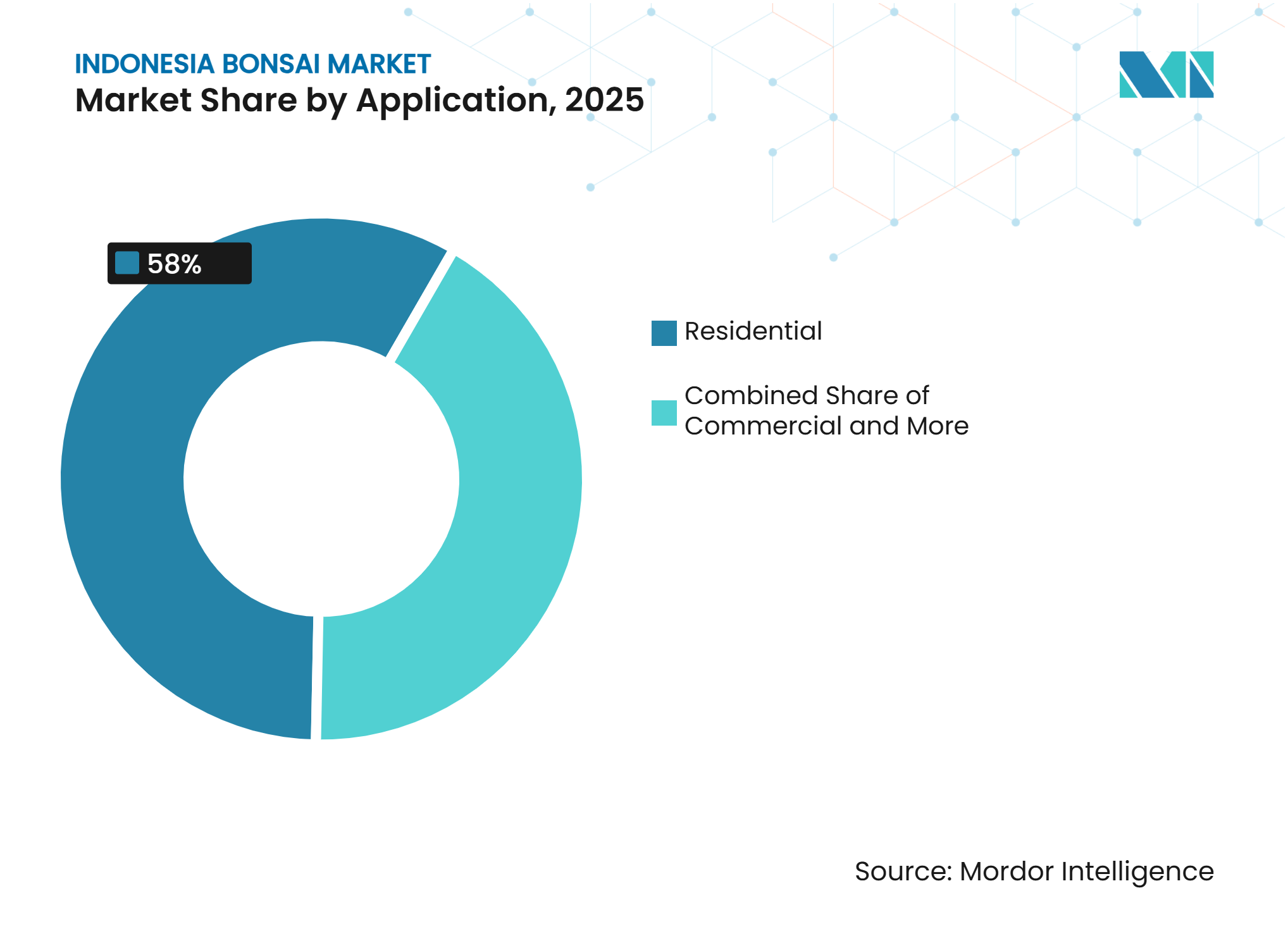
Residential Anchors Demand While Commercial Expands GrowthResidential accounted for the largest share at 51.0% in 2025. Household demand spans hobbyists, established collectors, and consumers seeking ornamental plants for homes, balconies, terraces, and compact living spaces. Residential buyers can begin with accessible bonsai and gradually develop deeper interests in species selection, styling, and collection building. Community groups, exhibitions, and specialist nurseries reinforce this progression by providing advice, demonstrations, and opportunities for knowledge exchange. The residential segment thus provides a broad base of recurring consumer demand and supports continued participation in the Indonesian bonsai market across different experience levels.
The commercial segment is projected to grow at the fastest CAGR of 9.6% from 2026 to 2031. Hotels, resorts, restaurants, offices, wellness facilities, and other commercial properties use bonsai as living decorative elements that reinforce landscaping themes and local visual identity. Commercial buyers may also require recurring maintenance, replacement, and styling services, creating opportunities beyond one-time plant sales. Suppliers that combine specimen selection with installation and care can address these requirements more effectively. Growing commercial adoption can broaden end-use applications and create additional demand channels for growers and specialist bonsai service providers.

Geography Analysis
Java remains a major center for the bonsai market, supported by dense urban demand, established horticultural activity, specialist nurseries, and strong collector networks. Central Java supports commercial cultivation and export-oriented operations, while West Java benefits from the horticultural belt around Bogor, Cisarua, and Puncak. East Java contributes through local exhibitions, communities, and specialist sellers. The concentration of production knowledge and consumer access across these areas supports the efficient movement of bonsai among growers, collectors, retailers, and exhibition venues, reinforcing Java's role in the national market and fostering nationwide commercial connections.
Bali holds a prominent position in the market through its tourism economy, distinctive botanical identity, and active bonsai community. Gianyar serves as an important meeting point for domestic and international enthusiasts, while Klungkung and other areas support specialist growers and collectors. Bonsai activity connects with hospitality, cultural events, and destination-based retail, creating opportunities for premium displays and visitor engagement. The combination of tourism exposure, local plant knowledge, and international bonsai events strengthens market visibility and provides channels for growers to reach collectors, businesses, and visitors seeking distinctive plant art.
Other regions, including Sumatra, Kalimantan, Sulawesi, and Nusa Tenggara, contribute through local species, collection areas, growers, and regional bonsai communities. The geographic breadth of participation was illustrated by the Handayani Bonsai Fest 2025 in Gunungkidul, where the official district government reported more than 700 participants from multiple Indonesian regions. This indicates that bonsai activity extends beyond established centers in Java and Bali, creating opportunities for regional growers to connect with buyers and enthusiasts. Broader geographic participation can strengthen domestic market linkages, diversify sourcing, and support collection activity across Indonesia.
Competitive Landscape
Market Concentration
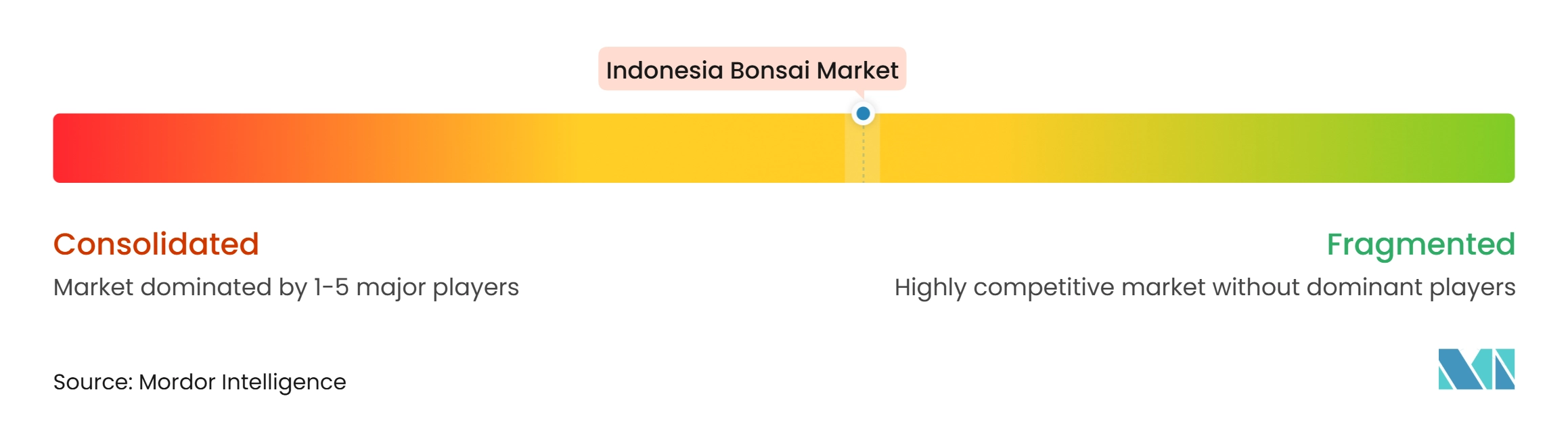
The Indonesia bonsai market is moderately fragmented in 2025. Key players include CV. Exotic Bonsai Indonesia, Indo Cipanas Bonsai, Artha Bonsai, PT Bonsai Buitenzorg Internasional, and Bali Akah Bonsai. Competition is shaped by species availability, tree maturity, styling quality, cultivation expertise, and collector relationships. Export-oriented businesses differentiate themselves through plant preparation, packing, documentation, and compliance with destination quarantine requirements. Established nurseries strengthen their market presence through exhibitions, physical consultations, digital catalogs, and specialist customer relationships, while businesses with broader inventories and service capabilities can address diverse domestic and international buyer requirements.
Competitive differentiation increasingly depends on combining specialist cultivation with broader customer access. Physical nurseries remain important because buyers can evaluate structure, health, styling, and presentation, while digital catalogs and social platforms extend visibility beyond local markets. Businesses that provide maintenance guidance, repotting, installation, or export preparation services can strengthen customer relationships beyond individual transactions. Community exhibitions also provide opportunities to demonstrate expertise and build recognition. These factors create an environment where reputation, technical capability, product presentation, and service quality are relevant alongside price when growers seek to retain collectors and attract new buyers.
Specialist knowledge remains an important competitive capability because advanced bonsai work requires practical skills in pruning, shaping, repositioning, and care. The Gianyar Regency Government reported in 2025 that 6 international bonsai trainers conducted demonstrations covering these techniques during the 17th Asia-Pacific Bonsai and Suiseki Exhibition and Convention. This highlights how technical knowledge is shared through specialist events and can differentiate growers with stronger cultivation capabilities. Businesses that develop comparable expertise can improve consistency, communicate quality effectively, and build credibility with experienced collectors, strengthening their competitive position within Indonesia's fragmented bonsai market.
Indonesia Bonsai Industry Leaders
-
CV. Exotic Bonsai Indonesia
-
Indo Cipanas Bonsai
-
Artha Bonsai
-
PT Bonsai Buitenzorg Internasional
-
Bali Akah Bonsai
- *Disclaimer: Major Players sorted in no particular order
Indonesia Bonsai Market Companies Covered in this Report
- CV. Exotic Bonsai Indonesia
- Pesona Bonsai
- Indo cipanas bonsai
- Artha Bonsai
- PT Bonsai Buitenzorg Internasional
- Bali Akah Bonsai
- Kingdom Bonsai Indonesia
- Mysha Bonsai
- Rumah Bonsai Indonesia Trenggalek
- Wijaya bonsai
Recent Industry Developments in Indonesia Bonsai Market
- July 2025: Indonesia hosted the 17th Asia-Pacific Bonsai and Suiseki Exhibition and Conference (ASPAC) in Gianyar, Bali. The event brought international bonsai expertise, exhibitions, and technical knowledge to Indonesia, strengthening industry visibility, supporting collector engagement, and creating opportunities for local growers to connect with regional and international buyers.
- October 2024: Australia's Department of Agriculture, Fisheries and Forestry introduced mandatory prior notice and enhanced phytosanitary documentation requirements for certain plant imports from Indonesia, increasing compliance requirements for Indonesian bonsai exporters and potentially complicating access to the Australian market.
- September 2024: PT Bonsai Buitenzorg Internasional entered a one-year partnership with MANTTRA HQ, covering sponsorship of a Bonsai and Suiseki Festival, a sales space, and a planned bonsai and suiseki education and commercial center in Bogor.
Indonesia Bonsai Market Report Scope
Bonsai is the Japanese art of cultivating miniature trees in containers through pruning, wiring, and root management to replicate the form and proportions of mature trees. It is primarily used for ornamental, cultural, residential, commercial, and institutional applications.
The Indonesia bonsai market report is segmented by species (indoor species, outdoor species, needle tree species, and deciduous tree species), by distribution channel (online and offline), and by application (residential, commercial, and others (institutional gifts, art fairs). The market forecasts are provided in terms of value (USD).
Segmentation Overview
| Indoor Species |
| Outdoor Species |
| Needle Tree Species |
| Deciduous Tree Species |
| Online |
| Offline |
| Residential |
| Commercial |
| Others (Institutional Gifts, Art Fairs) |
| By Species | Indoor Species |
| Outdoor Species | |
| Needle Tree Species | |
| Deciduous Tree Species | |
| By Distribution Channel | Online |
| Offline | |
| By Application | Residential |
| Commercial | |
| Others (Institutional Gifts, Art Fairs) |
Key Questions Answered in the Report
What is the projected value of Indonesia’s bonsai sector by 2031?
The Indonesia bonsai market is forecast to reach USD 125.10 million by 2031.
Which bonsai species category leads sales in Indonesia?
The Indonesia bonsai market for outdoor species led with the largest 48.0% share in 2025.
Which sales channel is growing fastest for bonsai in Indonesia?
Online segment is projected to grow at the fastest CAGR of 3.2% from 2026 to 2031.
What limits bonsai exports from Indonesia?
Plant health documentation, quarantine requirements, shipping risk, and a shortage of export-ready growing and handling capacity are key constraints. These factors matter because living plants can lose quality or fail if the journey is poorly managed, delayed, or handled with unsuitable packaging.