
India Textile Machinery Market Size and Share
Market Overview
| Study Period | 2020 - 2031 |
|---|---|
| Forecast Data Period | 2026 - 2031 |
| Base Year Market Size (2025) | USD 4.05 Billion |
| Market Size (2026) | USD 4.25 Billion |
| Market Size (2031) | USD 5.45 Billion |
| Growth Rate (2026 - 2031) | 5.10 % |
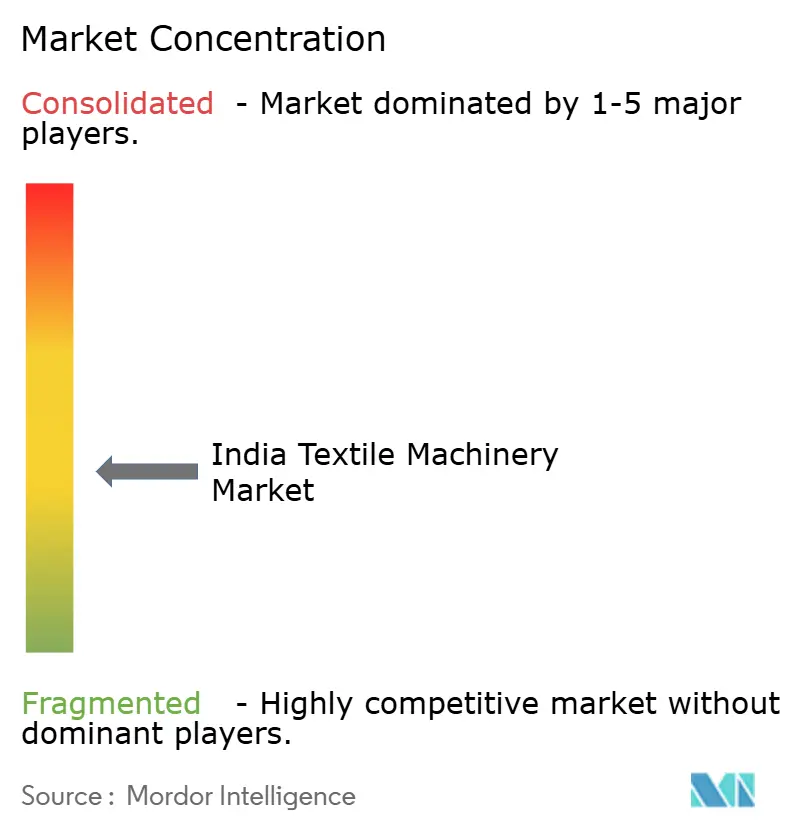
| Market Concentration | Medium |
Major Players *Disclaimer: Major Players sorted in no particular order Image © Mordor Intelligence. Reuse requires attribution under CC BY 4.0. | |
India Textile Machinery Market Analysis by Mordor Intelligence
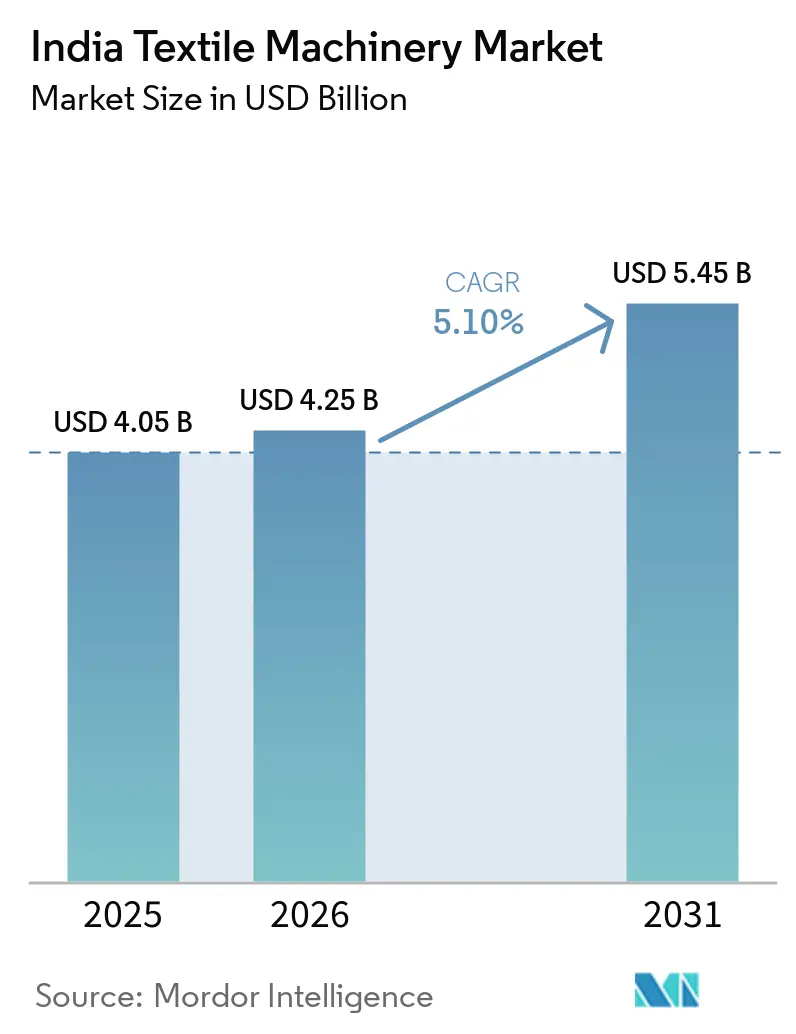
The India Textile Machinery Market size is projected to be USD 4.05 billion in 2025, USD 4.25 billion in 2026, and reach USD 5.45 billion by 2031, growing at a CAGR of 5.10% from 2026 to 2031.
The India textile machinery market is supported by machinery replacement, capacity additions in artificial fibers and technical textiles, and larger investment programs across textile clusters. Seven PM MITRA parks had secured investment memoranda exceeding INR 27,434 crore (USD 3,148.5 million) by 2025, while the textile PLI scheme had committed investment of INR 41,533 crore (USD 4,766.6 million) across artificial fiber apparel, fabrics, and technical textiles. These programs create demand for machinery from fiber preparation through processing and finishing. The India textile machinery market also benefits from exporters preparing for higher quality, traceability, and delivery requirements in the United Kingdom and European Union. Manufacturers are responding with automation, local production, service support, and partnerships that bring specialized equipment closer to Indian customers.
Key Report Takeaways
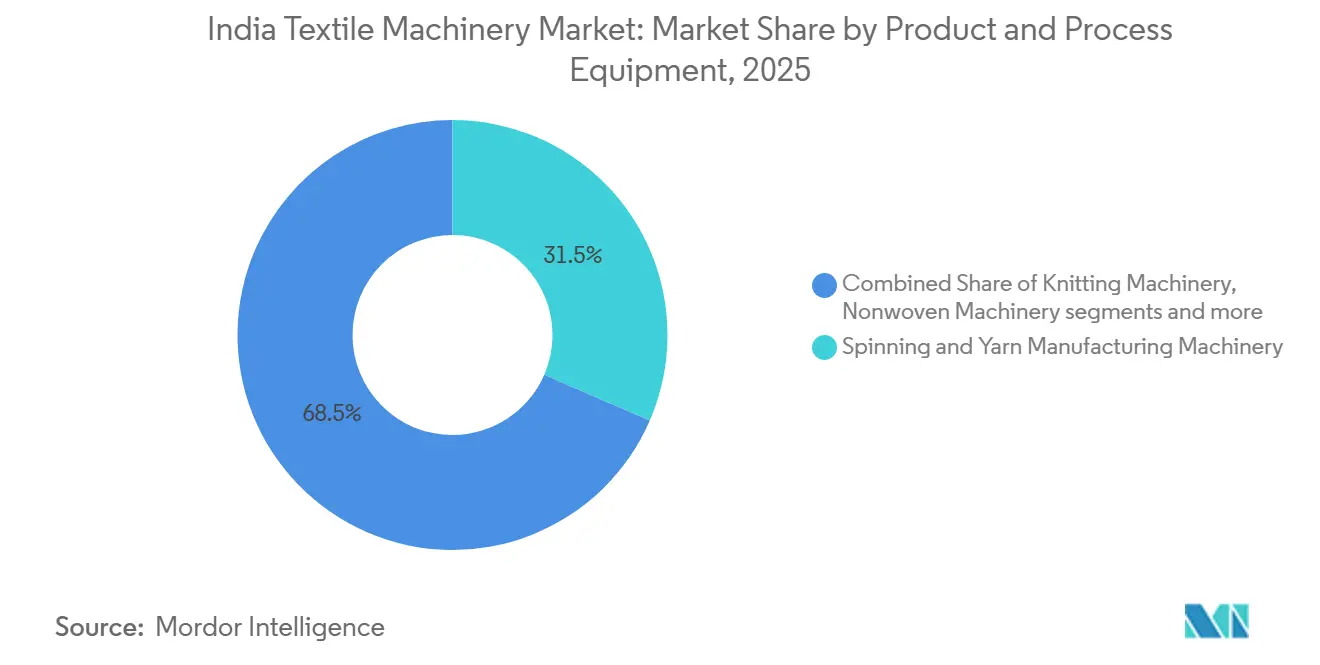
- By product and process equipment, spinning and yarn manufacturing machinery held 31.5% of the India textile machinery market share in 2025, while textile printing machinery is forecast to grow at a 6.8% CAGR through 2031.
- By source of supply, domestically manufactured machinery held a 64% share in 2025, while imported machinery is forecast to grow at a 5.9% CAGR through 2031.
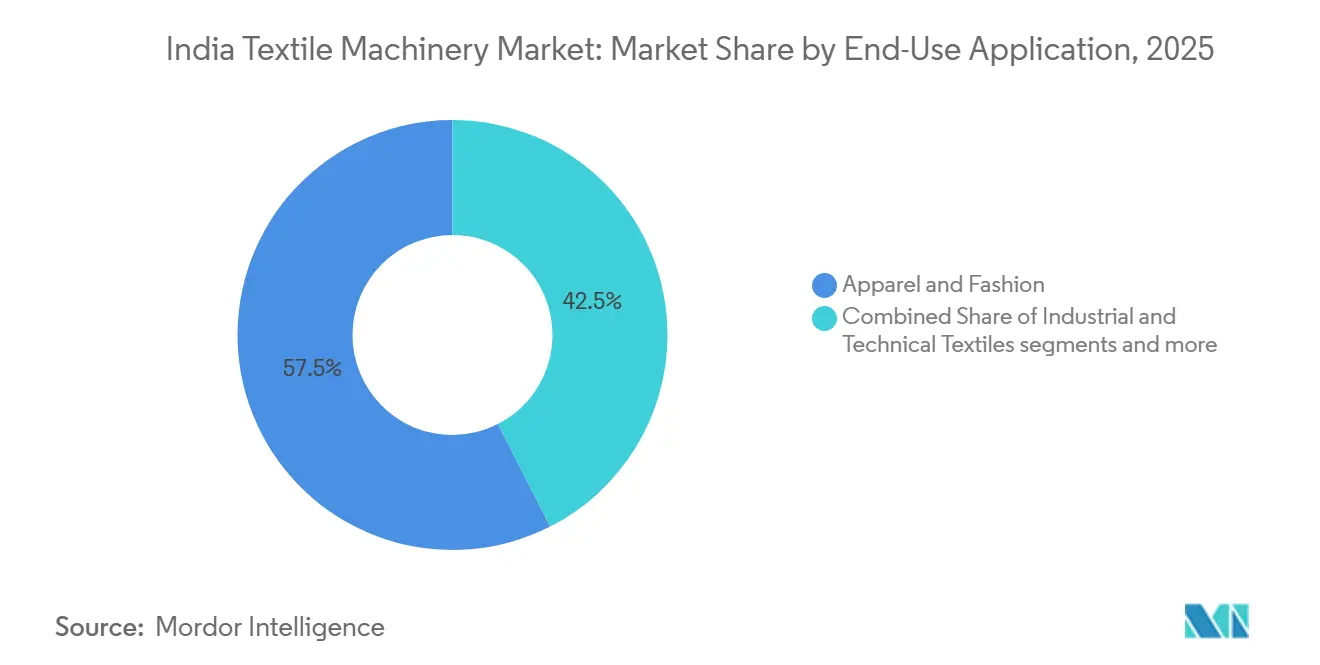
- By end-use application, apparel and fashion held a 57.5% share in 2025, while industrial and technical textiles is forecast to grow at a 7.2% CAGR through 2031.
- By geography, South India held 39% of the India textile machinery market size in 2025, while West India is forecast to grow at a 5.8% CAGR through 2031.
Note: Market size and forecast figures in this report are generated using Mordor Intelligence’s proprietary estimation framework, updated with the latest available data and insights as of January 2026.
India Textile Machinery Market Trends and Insights
Drivers Impact Analysis*
| Driver | (~) % Impact on CAGR Forecast | Geographic Relevance | Impact Timeline |
|---|---|---|---|
| Modernization and Replacement of Legacy Textile Machinery | +1.5% | Pan-India, with early gains in South India and West India | Short term (≤ 2 years) |
| Capacity Expansion in Man-Made Fibers, Technical Textiles, and Nonwovens | +1.3% | West India and South India, with spillover to North India | Medium term (2-4 years) |
| Government-Supported Textile Parks, Clusters and Capacity Investments | +0.9% | Gujarat, Tamil Nadu, Maharashtra, Madhya Pradesh, Karnataka, Uttar Pradesh, and Telangana | Medium term (2-4 years) |
| Labor Productivity and Manufacturing Automation | +0.7% | South India and West India textile clusters | Medium term (2-4 years) |
| Export Competitiveness, Quality, and Traceability Requirements | +0.5% | Tirupur, Surat, Ludhiana, Bhilwara, and NCR | Medium term (2-4 years) |
| Energy, Water, and Chemical Efficiency Requirements | +0.3% | South India and West India | Long term (≥ 4 years) |
| Source: Mordor Intelligence | |||
Modernization and Replacement of Legacy Textile Machinery
The India textile machinery market is gaining support from replacement demand across an installed base that includes more than 50 million spindles and several hundred thousand power looms. Older equipment raises operating costs and limits consistency in yarn and fabric quality. India increased investment in open-end rotors by 12% in 2025 and recorded a 21% increase in rapier and projectile loom deliveries. Modern ring frames with automated doffing and compact-spinning configurations can lower per-kilogram yarn costs compared with machinery that is 15 to 20 years old. Export-oriented weaving and knitting mills also face tighter buyer requirements for traceability from fibre to finished fabric. These conditions shorten the practical life of legacy machinery and encourage planned modernization.
Capacity Expansion in Man-Made Fibers, Technical Textiles, and Nonwovens
Capacity additions in artificial fibers, technical textiles, and nonwovens are widening the India textile machinery market beyond conventional spinning demand. Of the 170 textile PLI participants, 89 operated technical textiles, with committed investment of INR 27,832 crore (USD 3,194.2 million) in that area.[1] The National Technical Textiles Mission has an outlay of INR 1,480 crore (USD 169.9 million), which supports the policy focus on domestic technical textile capacity.[2] Spunweb India commissioned 2 new nonwoven lines at Wankaner in January 2026 and increased annual installed capacity from 12,240 MT to 18,740 MT. Sanathan Textiles was on track to double technical textile yarn capacity at Silvassa from 9,000 MTPA to 18,000 MTPA by mid-2026. The resulting projects need specialized carding, needlepunching, spunbond, and meltblown equipment that is often imported.
Government-Supported Textile Parks, Clusters and Capacity Investments
Government-backed parks and cluster investments provide a structured source of demand for the India textile machinery market. By 2025, all 7 PM MITRA parks had completed land acquisition, 4 detailed project reports worth INR 7,024 crore (USD 806.1 million) had approval, and infrastructure work worth INR 2,590.99 crore (USD 297.4 million) had started across park states. Greenfield facilities require machinery across the value chain, including blowroom, carding, spinning, weaving, processing, and finishing. The Ministry of Textiles received INR 5,272 crore (USD 605.1 million) for 2025-26, which was 19% above the prior budget estimate. The India textile machinery market, therefore, has a broader order base than a cycle based only on brownfield replacement. Investment is also spreading across multiple states rather than remaining limited to established production centers.
Labor Productivity, Automation, and Export Requirements
Labor availability and quality requirements are making automation more important for the India textile machinery market. Mills in Tirupur, Surat, and Ludhiana face higher wage expectations and difficulty retaining skilled operators. IoT-enabled looms, AI-based inspection, and automated doffing reduced operational waste by 15%, machine downtime by 20%, and electricity costs by up to 15% at early adopters. A 2025 peer-reviewed study identified 11 significant barriers to Industry 4.0 adoption in Indian textile and clothing operations, with cybersecurity risk as the most important causal barrier. Suppliers that combine equipment with reliable connectivity, quality inspection, and service can address this concern. Better energy, water, and chemical efficiency also support procurement where zero-liquid-discharge and sustainability requirements are more strictly applied.
Restraints Impact Analysis*
| Restraint | (~) % Impact on CAGR Forecast | Geographic Relevance | Impact Timeline |
|---|---|---|---|
| High Capital Costs and Extended Investment Payback Periods | -1.0% | Pan-India, particularly MSME clusters in North India and West India | Medium term (2-4 years) |
| Dependence on Imported High-Technology Machinery and Components | -0.8% | All regions, especially the technical textiles investment in West India and South India | Medium term (2-4 years) |
| Cyclical Textile Demand and Uneven Mill Capacity Utilization | -0.6% | Pan-India, particularly export-dependent weaving clusters | Short term (≤ 2 years) |
| Fragmented MSME Customer Base and Limited Access to Capital Expenditure Financing | -0.4% | Punjab, Rajasthan, Surat, and Ichalkaranji | Medium term (2-4 years) |
| Source: Mordor Intelligence | |||
High Capital Costs and Extended Investment Payback Periods
High equipment costs and restricted financing continue to limit the India, particularly in decentralized MSME clusters. A 25,000-spindle greenfield spinning line with automation and utilities can require INR 100 crore (USD 11.5 million) to INR 200 crore (USD 23.0 million) or more. Banks serving textile MSMEs require a minimum 25% margin and collateral of 50% to 75% of the loan value for term loans. The Union Budget 2025-26 increased credit guarantee cover for micro and small enterprises from INR 5 crore (USD 0.6 million) to INR 10 crore (USD 1.1 million) and introduced term loans up to INR 20 crore (USD 2.3 million) for exporter MSMEs.[3] These measures remain below the funding need for meaningful mill-scale modernization. Uneven mill utilization and periods of weaker apparel exports can further delay investment decisions and lengthen payback expectations.
Dependence on Imported High-Technology Machinery and Components
Dependence on imported high-technology equipment remains a restraint for the India textile machinery market. Domestic suppliers have limited coverage in specialized weaving, knitting, processing, and technical textile machinery. The Ministry of Heavy Industries withdrew the Machinery and Electrical Equipment Safety Order on January 16, 2026, citing public interest and limited availability of advanced domestic machinery. While the January 2026 withdrawal of the machinery safety order reduces near-term certification friction for specialized imports, longer-term dependence on foreign technology remains a structural restraint. Complex European and Japanese machines can have supply lead times of 6 to 18 months. Bureau of Indian Standards guidance for weaving machinery and the IS 17361 series provide a framework for safer and more consistent equipment, but domestic product coverage will take time to expand.
*Our forecasts treat driver/restraint impacts as directional, not additive. The impact forecasts reflect baseline growth, mix effects, and variable interactions.
Segment Analysis
By Product and Process Equipment: Digital Printing and Technical Textile Equipment Lead the Technology Upgrade Cycle
Spinning and yarn manufacturing machinery held a 31.5% share in 2025 because India has a large cotton and blended yarn production base. Sportking India selected a complete Rieter line from blowroom to winding for its 150,000-spindle compact-spinning project in Odisha. India was among the leading global investors in short-staple spindles in 2025. The country also ranked 2nd globally in large circular knitting installations, with 4,100 units absorbed during 2025. Weaving and weaving preparation equipment form the next major demand area.
Textile printing machinery is forecast to grow at a 6.8% CAGR through 2031. Digital printing is expanding across Surat’s synthetic fabrics, Tirupur’s knitwear printing base, and home furnishings. Nonwoven equipment also has a growing role because PLI-supported technical textile projects need specialized production lines. Dyeing, processing, finishing, testing, inspection, and quality-control equipment retain steady demand as brands require better sustainability and traceability performance. BIS machinery guidance supports a shift toward certified and standards-aligned equipment over the medium term

By Source of Supply: Localization Momentum Builds Against an Import-Dependent Technology Frontier
Domestically manufactured machinery held a 64% share of supply in 2025, especially in spinning preparation. The local ecosystem includes LMW, Trützschler India, Rieter India, Saurer Textile Solutions, and Kirloskar Toyota Textile Machinery. Their product coverage includes blowrooms, carding machines, draw frames, combers, ring frames, open-end rotors, and winding machines. Trützschler India opened a 164,000 sq m plant in Sanand in May 2025 with AI-enabled process optimization and ISO 9001, ISO 14001, and ISO 50001 certifications. Local manufacturing helps suppliers shorten service and delivery cycles for Indian mills.
Imported machinery is forecast to grow at a 5.9% CAGR through 2031. Germany, Italy, Switzerland, Belgium, Austria, and Japan supply specialized machinery for weaving, knitting, printing, and technical textiles. A February 2026 technology transfer agreement between Yash Textile Machines and Italy’s TEXMA brought manufacturing of industrial stitching and preparation systems to India for Asian and CIS markets. The January 2026 withdrawal of the machinery safety order helps maintain access to specialized imports. The India Textile Machinery Market will continue to use a mixed sourcing model as local suppliers expand their technical range.
By End-Use Application: Industrial Textiles Redefine the Demand Mix Beyond Apparel
Apparel and fashion held a 57.5% share of end-use demand in 2025. The segment requires spinning, weaving, knitting, and garmenting equipment across integrated mills and standalone units. India’s textile and apparel exports reached USD 37.8 billion in 2024-25, with a trade surplus of USD 28.2 billion. Higher export volumes and quality requirements can bring forward procurement in spinning, weaving, and processing. Apparel investment connects machinery demand to domestic consumption and export orders.
Industrial and technical textiles are forecast to grow at a 7.2% CAGR through 2031. Infrastructure spending, automotive lightweighting, medical device localization, and defense fabric requirements increase demand for nonwovens, geotextiles, composites, and medical fabrics. Tamil Nadu introduced its Integrated Textile Policy 2025/2026 and a 6% interest subsidy for spinning machinery adoption. Home textile equipment is supported by domestic demand and exports of bedding, terry towels, and upholstery. Automotive, medical, hygiene, agrotextile, geotextile, and protective textile applications form an emerging demand base.
Geography Analysis
South India held 39% of the India textile machinery market size in 2025. Tamil Nadu has dense spinning, weaving, processing, and garmenting activity across Coimbatore, Tirupur, Erode, Salem, and Karur. The state has the highest cotton yarn production volume in India and the 2nd-highest textile GSDP. This concentration supports replacement demand and more frequent technology upgrades. Karnataka’s Kalaburagi PM MITRA park adds upstream demand for garmenting and processing equipment.
West India is the fastest-growing regional area for the India textile machinery market. Gujarat is India’s key artificial fiber center and an important location for PM MITRA infrastructure. Wankaner and Surat are adding nonwoven lines and shuttleless looms. Trützschler’s Sanand plant and Spunweb’s new Wankaner lines show the state’s private-sector investment momentum. Maharashtra also adds demand through Ichalkaranji and its machinery ancillary base around Pune and Nashik.
North India and East India form an emerging frontier, with Punjab’s hosiery cluster and Rajasthan’s Bhilwara suiting hub gradually modernizing their machinery base. Uttar Pradesh has a PM MITRA park under development and is becoming an integrated textile investment location. Bihar committed INR 1,476 crore in textile memoranda at Bharat Tex 2026, with projects expected to create more than 40,500 jobs. Sportking’s 150,000-spindle project in Odisha also points to new spinning capacity in East India. These states can add demand as infrastructure and incentive programs become operational.
Competitive Landscape
The India textile machinery market exhibits a medium level of market concentration. In spinning and yarn preparation, suppliers with Indian operations compete through technology depth, installed bases, and service networks. Replacement cycles of 20 to 25 years raise switching costs for mills. In weaving, knitting, technical textiles, and digital printing, customers compare vendors on specifications, service, and price. KARL MAYER reported that India represented 30% of its qualified discussions at ITMA Asia + CITME 2025.
The India textile machinery market has opportunities in testing and quality-control equipment, powerloom retrofits, and service networks for nonwoven machinery. Mid-tier mills often need practical upgrades such as servo systems, digital monitoring tools, and automated inspection instead of full machine replacement. Suppliers also need spare parts and maintenance capabilities for the expanding technical textile installed base. BIS machinery guidance creates a compliance advantage for suppliers that prepare documentation and certification early, particularly as institutional buyers may specify certified equipment. These needs favor suppliers that can support equipment through its operating life.
The India textile machinery market also shows a movement toward localized manufacturing and accessible automation. Trützschler expanded its Indian manufacturing footprint through the Sanand facility in 2025, while its TRUECYCLED installations show early positioning in textile-to-textile recycling. Yash Textile Machines and TEXMA’s 2026 partnership is another example of European intellectual property being manufactured locally. Domestic suppliers are exploring compact and modular machines for decentralized clusters. Competitive differentiation will increasingly hinge on localized service depth, compliance-ready documentation for BIS standards, and modular product offerings suited to MSME-scale mills.
India Textile Machinery Industry Leaders
-
LMW Limited
-
Rieter India Private Limited
-
Trützschler India Private Limited
-
Saurer Textile Solutions Private Limited
-
Kirloskar Toyota Textile Machinery Private Limited
- *Disclaimer: Major Players sorted in no particular order
Recent Industry Developments
- January 2026: Spunweb India Private Limited commissioned 2 new nonwoven production lines at its Wankaner, Gujarat facility. Annual installed nonwoven capacity increased from 12,240 metric ton to 18,740 metric ton.
- January 2026: The Ministry of Heavy Industries rescinded the Machinery and Electrical Equipment Safety Order, 2024. The decision removed mandatory BIS certification requirements for imported textile machinery and cited public interest and limited domestic machinery availability.
India Textile Machinery Market Report Scope
The India Textile Machinery Market Is Segmented by Product and Process Equipment (Spinning, Weaving, Knitting, Nonwoven, Dyeing, Processing, and more), By Source of Supply (Domestic and Imported Machinery), By End-Use Application (Apparel, Home Textiles, Industrial and Technical Textiles, and Others), and by geography (North, West, South, and East). The Market Forecasts are Provided in Terms of Value (USD).
| Spinning and Yarn Manufacturing Machinery |
| Weaving and Weaving Preparation Machinery |
| Knitting Machinery |
| Nonwoven Machinery |
| Textile Dyeing, Processing and Finishing Machinery |
| Textile Printing Machinery |
| Textile Testing, Inspection and Quality-Control Equipment |
| Others (Textile Material Handling Equipment, Humidification Systems, fibre-recovery machinery, doffing and packaging systems, etc.) |
| Domestically Manufactured Machinery |
| Imported Machinery |
| Apparel and Fashion |
| Home Textiles |
| Industrial and Technical Textiles |
| Others (Automotive Textiles, Medical and Hygiene Textiles, Geotextiles, Agrotextiles, Protective Textiles, Carpets and Floor Coverings, and Specialty Textile Applications) |
| North India (Punjab, Haryana, Delhi, Himachal Pradesh, Uttarakhand, Uttar Pradesh, Jammu & Kashmir, Rajasthan) |
| West India (Maharashtra, Gujarat, Goa) |
| South India (Tamil Nadu, Karnataka, Telangana, Andhra Pradesh, Kerala) |
| East India (West Bengal, Odisha, Bihar, Jharkhand, Chhattisgarh, Assam and Rest of North East India) |
| By Product and Process Equipment | Spinning and Yarn Manufacturing Machinery |
| Weaving and Weaving Preparation Machinery | |
| Knitting Machinery | |
| Nonwoven Machinery | |
| Textile Dyeing, Processing and Finishing Machinery | |
| Textile Printing Machinery | |
| Textile Testing, Inspection and Quality-Control Equipment | |
| Others (Textile Material Handling Equipment, Humidification Systems, fibre-recovery machinery, doffing and packaging systems, etc.) | |
| By Source of Supply | Domestically Manufactured Machinery |
| Imported Machinery | |
| By End-Use Application | Apparel and Fashion |
| Home Textiles | |
| Industrial and Technical Textiles | |
| Others (Automotive Textiles, Medical and Hygiene Textiles, Geotextiles, Agrotextiles, Protective Textiles, Carpets and Floor Coverings, and Specialty Textile Applications) | |
| By Geography | North India (Punjab, Haryana, Delhi, Himachal Pradesh, Uttarakhand, Uttar Pradesh, Jammu & Kashmir, Rajasthan) |
| West India (Maharashtra, Gujarat, Goa) | |
| South India (Tamil Nadu, Karnataka, Telangana, Andhra Pradesh, Kerala) | |
| East India (West Bengal, Odisha, Bihar, Jharkhand, Chhattisgarh, Assam and Rest of North East India) |
Key Questions Answered in the Report
What is the forecast value of textile machinery demand in India by 2031?
The India textile machinery market is forecast to reach USD 5.45 billion by 2031, growing at a 5.1% CAGR from 2026. The forecast reflects replacement activity, capacity additions, and government-supported investment.
Which equipment category has the greatest demand in India?
Spinning and yarn manufacturing machinery has the greatest demand because of India’s extensive cotton and blended yarn production base. It is also supported by modernization at mills using older equipment.
Which application is growing fastest for textile machinery suppliers?
Industrial and technical textiles are the fastest-growing application, supported by nonwovens, geotextiles, medical fabrics, and defense-related requirements. Technical textile PLI participants had committed INR 27,832 crore in investment.
Why is India importing specialized textile equipment?
Local suppliers have limited coverage in specialized weaving, knitting, processing, printing, and technical textile machinery. Imports remain necessary where mills need advanced specifications or specialized process capability.
Which region leads machinery demand in India?
South India leads demand, supported by Tamil Nadu’s concentrated spinning, weaving, processing, and garmenting base. West India is growing fastest through Gujarat’s artificial fiber and nonwoven investments.
What is driving machine modernization at Indian mills?
Higher costs on legacy equipment, export quality requirements, labor constraints, and automation benefits are increasing replacement demand. Automated systems have reduced waste, downtime, and electricity costs at early-adopting mills.