
India Inverter Battery Market Size and Share
Market Overview
| Study Period | 2021 - 2031 |
|---|---|
| Forecast Data Period | 2026 - 2031 |
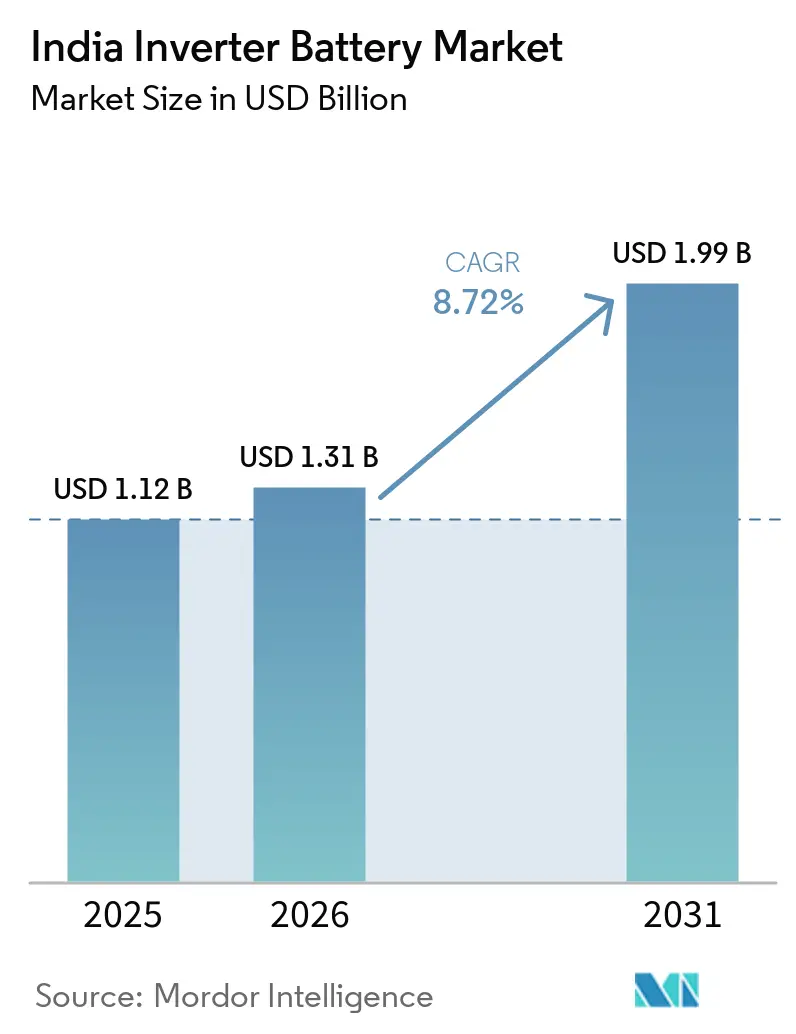
| Base Year Market Size (2025) | USD 1.12 Billion |
| Market Size (2026) | USD 1.31 Billion |
| Market Size (2031) | USD 1.99 Billion |
| Growth Rate (2026 - 2031) | 8.72 % |
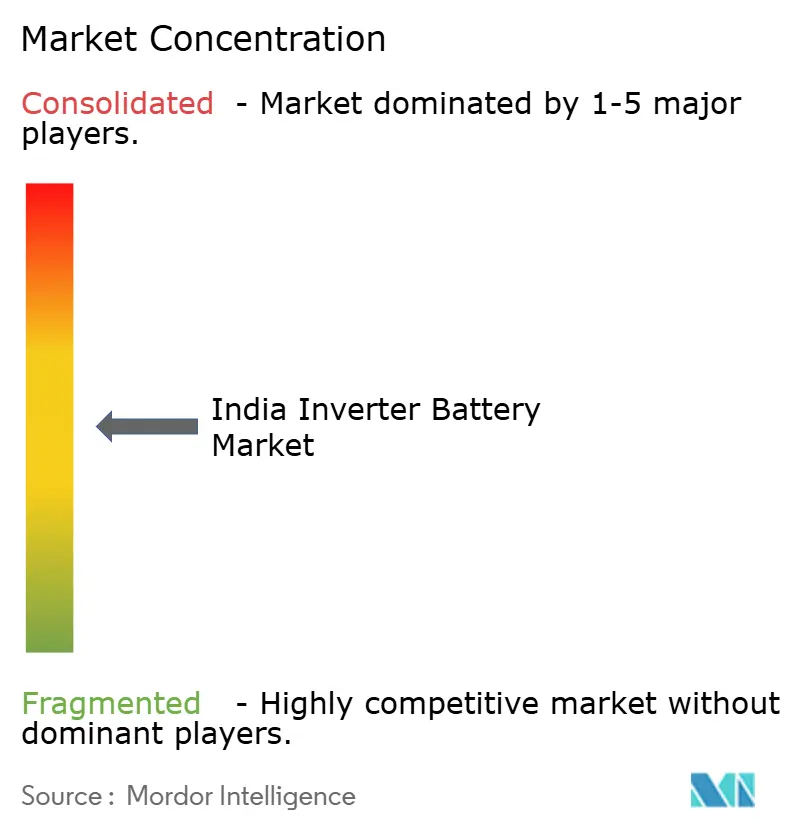
| Market Concentration | Medium |
Major Players *Disclaimer: Major Players sorted in no particular order Image © Mordor Intelligence. Reuse requires attribution under CC BY 4.0. | |
India Inverter Battery Market Analysis by Mordor Intelligence
The India Inverter Battery Market size is expected to increase from USD 1.12 billion in 2025 to USD 1.31 billion in 2026 and reach USD 1.99 billion by 2031, growing at a CAGR of 8.72% over 2026-2031. India’s evening electricity demand is increasing as cooling use continues after solar generation declines, which keeps reliable backup power relevant for households and productive users. Peak demand reached 270.8 GW on May 21, 2026, and nighttime shortages have made the duration of interruptions more important to buyers than their frequency alone[1]. The India inverter battery market, therefore, benefits from replacement demand as well as higher-capacity purchases by users seeking longer backup periods. Rooftop solar is expanding the role of batteries because grid-connected systems do not provide backup during an outage unless storage is installed[2]. Domestic suppliers are extending lead-acid portfolios while developing lithium-ion products, and hybrid inverter suppliers are competing for installer relationships and solar distribution channels.
Key Report Takeaways
- By battery chemistry, lead-acid batteries held 85.2% of the India inverter battery market share in 2025, while lithium-ion batteries are forecast to grow at a 10.4% CAGR through 2031.
- By inverter type, standalone inverters held 55.4% of the India inverter battery market share in 2025, while hybrid inverters are forecast to grow at an 11.2% CAGR through 2031.
- By application, residential power backup accounted for 62.4% of the India inverter battery market size in 2025, while renewable energy storage is forecast to grow at an 11.7% CAGR through 2031.
Note: Market size and forecast figures in this report are generated using Mordor Intelligence’s proprietary estimation framework, updated with the latest available data and insights as of January 2026.
India Inverter Battery Market Trends and Insights
Drivers Impact Analysis*
| Driver | (~) % Impact on CAGR Forecast | Geographic Relevance | Impact Timeline |
|---|---|---|---|
| Frequent Grid Interruptions and Backup-Critical Loads | +2.00% | National, with concentrated impact in Uttar Pradesh, Bihar, Rajasthan, Haryana, Madhya Pradesh | Short term (≤ 2 years) |
| Rooftop Solar and Solar-Plus-Storage Adoption | +1.80% | National; early gains in Maharashtra, Gujarat, Karnataka, Rajasthan | Medium term (2–4 years) |
| Government-Led Storage Obligations and Viability-Gap Funding | +1.50% | National; state-level DISCOM and SERC jurisdictions | Medium term (2–4 years) |
| Lithium-Ion Cost and Cycle-Life Advantage | +1.20% | National, skewed toward urban and semi-urban daily-cycling consumers | Long term (≥ 4 years) |
| Installer-Led Bundling of Inverters, Batteries, and Service | +0.80% | National; concentrated in Tier-1 and Tier-2 cities with spill-over to Tier-3 towns | Medium term (2–4 years) |
| Battery Health Telemetry Reducing Perceived Lithium-Ion Risk | +0.60% | National; early traction in urban markets | Long term (≥ 4 years) |
| Source: Mordor Intelligence | |||
Frequent Grid Interruptions Sustaining Structural Backup Demand
India’s electricity challenge increasingly concerns evening dispatchability rather than installed generation capacity. The India inverter battery market responds to this condition because solar output falls while cooling demand and household consumption continue into the night. The International Energy Agency reported that nighttime demand has increased as cooling demand has risen, creating a stronger need for resources that can supply electricity after sunset. Longer interruptions increase the energy capacity required for a typical installation and can encourage users to select higher-Ah lead-acid units or lithium-based systems. This supports higher transaction values in northern and western states where outages are more disruptive. Small enterprises also require dependable power for lighting, refrigeration, communications, and other essential loads, so demand extends across household and business users.
Rooftop Solar and Solar-Plus-Storage Integration Reshaping Demand Architecture
India added 7.1 GW of rooftop solar in 2025, compared with 3.2 GW in 2024, and residential consumers accounted for nearly 76% of the new capacity. The India inverter battery market gains from this installed base because battery storage converts a grid-connected solar system into a source of backup power during outages. Research by CEEW found that 3 in 10 households expected rooftop solar to provide power backup, even though a standard grid-connected system cannot do so without storage. This gap gives installers a practical opportunity to explain the role of batteries and hybrid inverters during the sales process. The PM Surya Ghar program has made rooftop solar a larger consumer purchase category, which brings battery makers closer to solar installers and EPC distribution networks. As systems become more integrated, product compatibility, installation quality, and service support carry more weight in the buying decision.
Government-Led Storage Obligations and Viability-Gap Funding Lowering Market Risk
Government policy is treating energy storage more directly as electricity infrastructure, which strengthens the longer-term setting for the India inverter battery market. The government approved a 30 GWh battery energy storage system viability gap funding program in June 2025 with INR 5,400 crore in support through the Power System Development Fund[3]. Earlier support covered 13.2 GWh, and these programs built demand for engineering, installation, and integration capability across the storage value chain[4]. The Economic Survey 2025-26 stated that India needs 336 GWh of storage by 2029-30 and 411 GWh by 2031-32 to support renewable integration. Experience gained in large storage projects can strengthen the availability of skilled installers and system integrators for commercial and residential work. The 2026-27 customs-duty exemption for capital goods used in battery energy storage manufacturing also supports India-based production and project development.
Lithium-Ion Cost and Cycle-Life Advantage Accelerating Chemistry Migration
Lithium-ion batteries are gaining attention where batteries are cycled daily and lifetime operating costs matter more than the purchase price alone. The India inverter battery market has a large retrofit opportunity because existing inverter owners can replace an end-of-life lead-acid unit without necessarily replacing the whole system. Livguard introduced its Lithium XOne Universal Battery in 2025 for compatibility with existing inverter setups, which reflects this replacement-led route to adoption. Berkeley research on Indian solar-plus-storage auctions reported falling storage costs and showed how declining battery costs are improving the economics of storage applications. Lithium-ion systems offer longer cycle life and deeper usable discharge, which can matter for users experiencing repeated outages. Import dependence and changes in cell pricing can still delay price convergence, particularly for buyers outside daily-cycling use cases.
Restraints Impact Analysis*
| Restraint | (~) % Impact on CAGR Forecast | Geographic Relevance | Impact Timeline |
|---|---|---|---|
| High Upfront Cost of Lithium-Ion Systems | -1.20% | National; most acute in Tier-2/3 cities and rural markets | Short term (≤ 2 years) |
| Lead, Lithium and Critical-Mineral Supply Exposure | -0.80% | National; lead supply concentrated in Rajasthan; lithium import-dependent from China | Medium term (2–4 years) |
| Inconsistent Installation, Sizing and After-Sales Quality | -0.50% | National; highest variability in Tier-2/3 and rural markets | Short term (≤ 2 years) |
| Fragmented State-Level Interconnection and Tariff Rules | -0.40% | State-specific; most constraining in states without updated net metering regulations | Medium term (2–4 years) |
| Source: Mordor Intelligence | |||
High Upfront Cost of Lithium-Ion Systems Limiting Mass-Market Penetration
The initial cost of a lithium-ion system remains the clearest constraint on mass adoption in the India inverter battery market. Buyers who face only occasional outages may not recover the higher initial outlay through lower replacement needs or operating benefits. This limitation is strongest in Tier-2, Tier-3, and rural markets, where lead-acid batteries remain familiar, widely available, and easier to replace through local dealers. Consumer financing for storage is also less standardized than financing for many other household durable products. A solar-plus-storage system requires a larger initial commitment than a grid-connected solar installation without a battery. Adoption will therefore be most immediate in areas with frequent outages, high daily cycling, or clear economic savings from storage use.
Lead, Lithium, and Critical-Mineral Supply Exposure Creating Input Volatility
The India inverter battery market depends on two supply chains with different vulnerabilities. Lead-acid products depend heavily on a recycling system in which informal collection still competes with authorized channels. Hindustan Zinc stated that recycled lead supplied more than 60% of India’s domestic lead demand in FY2024-25. Battery manufacturers must also meet extended producer responsibility requirements under the Battery Waste Management Rules, which makes a traceable recycling supply important. Lithium-ion products remain exposed to imported cells and critical-mineral pricing, which can affect equipment costs even when local pack assembly expands. The Advanced Chemistry Cell production-linked incentive program supports domestic capacity, but stationary storage cells will continue to rely on imports in the near term.
*Our forecasts treat driver/restraint impacts as directional, not additive. The impact forecasts reflect baseline growth, mix effects, and variable interactions.
Segment Analysis
By Battery Chemistry: Lithium-Ion Premium Packs Gaining Ground Within Lead-Acid's Hold
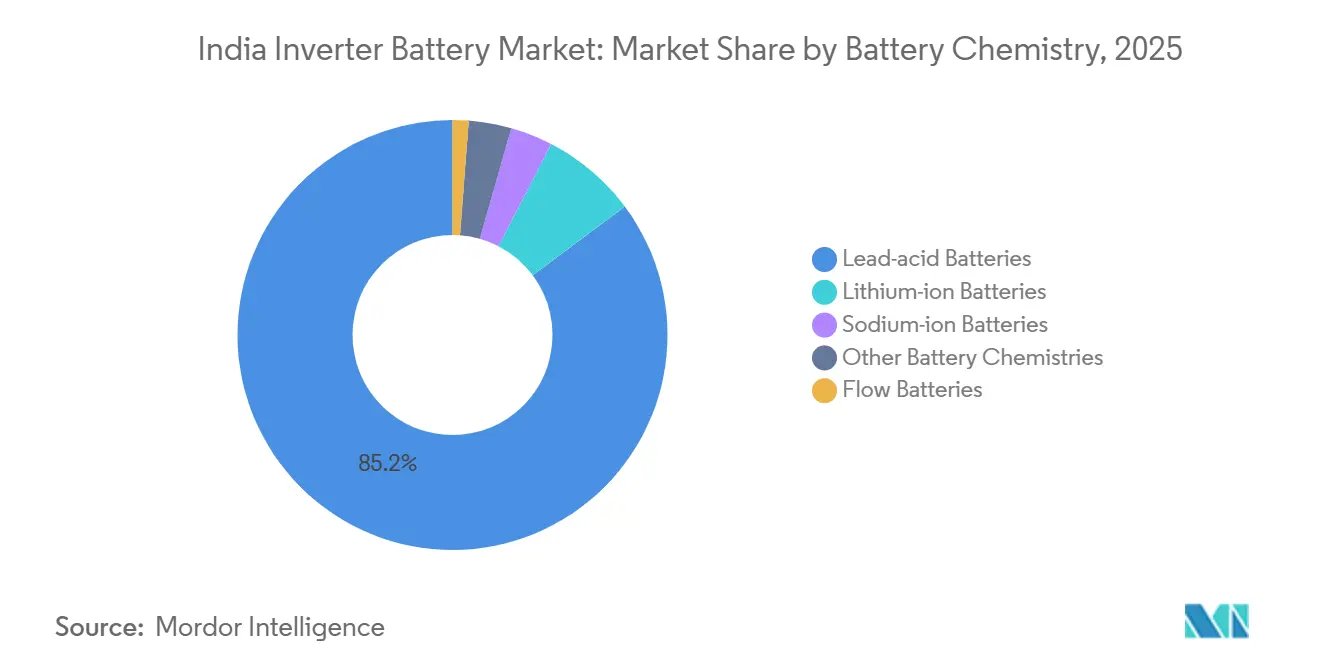
Lead-acid batteries held 85.2% of sales in 2025, supported by the country’s extensive installed base and routine tubular battery replacement cycle. This chemistry remains accessible to price-sensitive buyers through established retailers and service networks. Manufacturers are using higher-capacity and compact designs to retain consumers who need longer backup time but do not wish to replace a complete inverter system. Okaya introduced the JXT 90 Ah inverter battery in January 2026 after launching its Super Jumbo Tubular and Advanced Tall Tubular ranges during 2025. These product extensions show how suppliers can improve backup duration while maintaining a familiar lead-acid format.
Lithium-ion batteries are forecast to expand at a 10.4% CAGR through 2031, making them the fastest-growing battery chemistry in the India inverter battery market. Their appeal is strongest for daily cycling, where longer life and higher usable capacity can outweigh a higher purchase cost. The segment also benefits from retrofit demand, since compatible packs can upgrade existing inverter installations. Luminous introduced the Helios lithium-ion battery series in September 2025, including a 51.2V 314 Ah configuration and systems scalable to 1 MWh. Sodium-ion and flow batteries remain small within the present mix, although alternative chemistries could become more relevant if local manufacturing matures and critical-mineral exposure persists.

By Inverter Type: Hybrid Inverters Converging from Solar Add-On to System Core
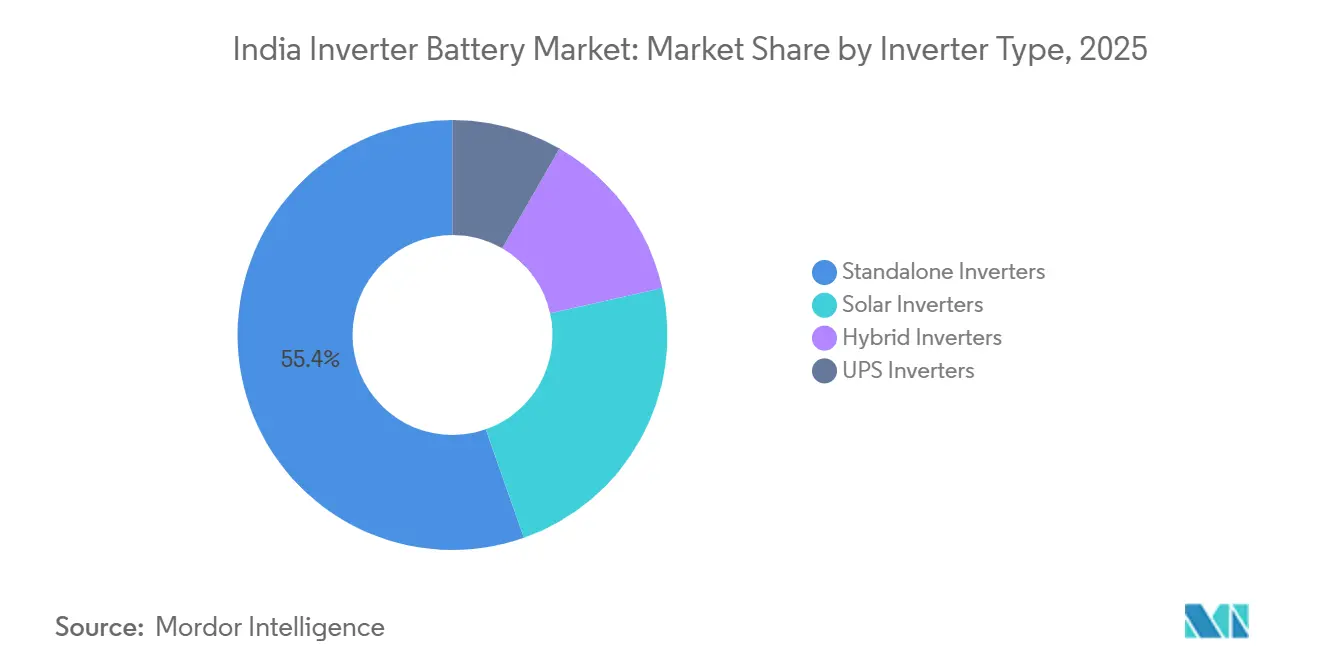
Standalone inverters held 55.4% of sales in 2025, reflecting the large installed base in residential and commercial backup applications. They remain the usual entry product for many first-time buyers, especially where a rooftop solar purchase is not part of the decision. UPS inverters continue to serve offices, IT infrastructure, and industrial settings that need reliable power quality. Solar inverters track rooftop deployment, while standalone systems retain importance where the buyer needs an uncomplicated replacement. Distributors can continue to use these products as a practical starting point for users who prioritize affordability and familiar after-sales support.
Hybrid inverters are forecast to grow at an 11.2% CAGR through 2031, supported by solar-plus-storage adoption and evolving grid-interconnection rules. They combine solar charging, grid interaction, battery management, and backup in one system, which reduces complexity for users seeking a single equipment package. Rajasthan enabled hybrid inverters under net metering in 2025 after amendments to its distributed renewable energy regulations. Avaada launched its Halo all-in-one hybrid battery inverter in 3 kW, 5 kW, and 10 kW configurations in 2025. Wider use of remote monitoring and common communication standards can lower integration difficulty across solar, inverter, and battery brands.
By Application: Residential Backup Dominates, Renewable Storage Segment Accelerating
Residential power backup accounted for 62.4% of the India inverter battery market size in 2025, driven by an extensive household inverter base that requires periodic battery replacement. Longer evening shortfalls can lead users to select higher-capacity batteries and systems with greater usable energy. Residential demand also gives suppliers a recurring service relationship through replacement, installation, and maintenance. Commercial, telecom, and industrial users provide further demand through predictable replacement cycles and critical-load requirements. In Maharashtra, Gujarat, and Karnataka, time-of-day tariffs are also strengthening the case for storage as a way to manage electricity costs rather than solely as backup equipment.
Renewable energy storage is forecast to grow at an 11.7% CAGR through 2031, the strongest rate among application segments in the India inverter battery market. It follows the expanding base of rooftop solar systems and the need to retain electricity for use after daylight hours. Residential solar users may add storage when they recognize that a grid-connected system cannot provide outage protection without a battery. Commercial rooftop projects can also use batteries to support load management, operating continuity, and better use of on-site solar generation. Energy Storage Obligations under the Ministry of Power framework further support storage procurement for renewable projects and related commercial applications.
Geography Analysis
Northern India represents the largest concentration of backup-oriented demand within the India inverter battery market, due to frequent interruptions across Uttar Pradesh, Bihar, Rajasthan, Haryana, Madhya Pradesh, and Punjab. These states support substantial lead-acid replacement volumes and are gradually moving toward solar-plus-storage use. Evening shortfalls have increased the need for longer backup duration, which encourages capacity upgrades for households and small enterprises. The region also has a substantial base of residential rooftop solar installations, creating future scope for battery additions. The India inverter battery market size in these states is supported by both familiar replacement buying and more integrated solar-based purchases.
Western and Southern India are the fastest-growing areas for hybrid inverters and lithium-ion battery upgrades. Maharashtra, Gujarat, Karnataka, and Rajasthan are adopting time-of-day tariff structures that improve the value of charging batteries during lower-cost periods and using stored power during higher-rate periods. Rajasthan’s 2025 net-metering decision for hybrid systems supports this transition. Karnataka has an established electronics and solar manufacturing ecosystem, which supports hybrid inverter assembly and service activity.
Eastern India and the northeast remain emerging opportunity areas in the India inverter battery market, with lead-acid replacement demand still central in West Bengal, Odisha, Jharkhand, and northeastern states. Grid coverage has improved, but supply quality and predictability remain uneven in several locations. Rising cooling demand in urban centers adds to the requirement for dependable backup. Established brands such as Exide and Amara Raja have distribution and service advantages in parts of this region. Battery waste rules and traceable recycling requirements can strengthen formal-sector suppliers that maintain compliant lead procurement and collection systems.
Competitive Landscape
The India inverter battery market is moderately concentrated, with Exide Industries, Luminous Power Technologies, Amara Raja Energy and Mobility, Microtek International, and Livguard Energy forming a leading domestic group. Their distribution networks, dealer relationships, and established service coverage remain important advantages in lead-acid and standalone systems. Exide reported INR 5,305 crore in revenue and INR 407 crore in net profit for the first quarter of FY2027, while its inverter, solar, and industrial businesses continued to show double-digit momentum. Amara Raja’s lead-acid business remained a major revenue source even as it continued investment in new-energy capacity. This combination of an established lead-acid base and planned lithium-ion investment defines the competitive transition.
Exide is advancing a 6 GWh lithium-ion cell facility in Bengaluru that is expected to begin generating revenue in the third quarter of FY2027. Livguard has introduced Lithium X products and a universal battery designed for existing inverter systems, emphasizing product compatibility and access to the installed base. Luminous expanded its lithium-ion portfolio with Helios products positioned from residential to commercial use. These moves show that companies compete through local manufacturing plans, faster product launches, and practical system upgrades. Brand competition also remains important as suppliers protect their position in traditional retail channels.
Sungrow, Deye, GoodWe, and Solis are gaining installer attention in hybrid inverters, particularly in commercial and industrial solar projects. Their equipment competes through pricing and feature sets, while domestic suppliers retain an advantage in service coverage and compatibility with the existing inverter base. Huawei FusionSolar, Delta Electronics, BYD, and other power and storage suppliers also participate in commercial applications. Expected certification requirements for battery energy storage systems can raise the value of local testing, compliance, and service infrastructure. Market concentration score: 5 out of 10, because the leading domestic firms have strong distribution positions but no supplied evidence shows that the top 5 collectively hold at least 60% of sales, while several domestic and international suppliers compete across product categories.
India Inverter Battery Industry Leaders
-
Exide Industries Limited
-
Luminous Power Technologies Pvt. Ltd.
-
Amara Raja Energy & Mobility Limited
-
Microtek International Pvt. Ltd.
-
Livguard Energy Technologies Private Limited
- *Disclaimer: Major Players sorted in no particular order
Recent Industry Developments
- July 2026: Exide Industries reports Q4 FY26 standalone revenue of INR 4,551 crore, up 9.4% year-on-year, and PAT up 22%. Inverter and solar business grew mid-to-high teens, and the Bengaluru 6 GWh lithium-ion cell plant is at an advanced installation and validation stage.
- May 2026: India’s third VGF scheme for 112 GWh of energy storage at INR 15,000 crore enters inter-ministerial consultation. The scheme covers 50 GWh BESS, 60 GWh pumped hydro, and 2 GWh next-generation storage technologies, representing the largest single government energy storage commitment and signaling sustained market support through the decade.
- March 2026: MNRE issues firmware and testing guidelines for RMS and dataloggers under PM Surya Ghar: Muft Bijli Yojana. The guidelines require open-protocol communication, standardized parameter mapping, and integration with the centralized MNRE IoT SCADA platform.
- March 2026: Involtics launches GTSI series single-phase hybrid inverters in 3 kW, 3.6 kW, 5 kW, and 6 kW configurations. The products support lead-acid and lithium-ion batteries with connectivity, zero-export, peak-shaving, and outage-switching functions.
India Inverter Battery Market Report Scope
An inverter battery is a rechargeable battery that stores electrical energy and supplies it to an inverter when the main power supply fails or when stored energy is required.
The India inverter battery market is segmented by battery chemistry, inverter type, and application. By battery chemistry, the market is segmented into lithium-ion, lead-acid, sodium-ion, flow, and other chemistries. By inverter type, the market is segmented into standalone, solar, hybrid, and UPS inverters. By application, the market is segmented into residential, commercial, industrial, telecommunications, renewable energy storage, and other applications. For each segment, the market sizing and forecasts have been provided on the basis of value (USD).
| Lithium-ion Batteries |
| Lead-acid Batteries |
| Sodium-ion Batteries |
| Flow Batteries |
| Other Battery Chemistries |
| Standalone Inverters |
| Solar Inverters |
| Hybrid Inverters |
| UPS Inverters |
| Residential Power Backup |
| Commercial |
| Industrial |
| Telecommunications |
| Renewable Energy Storage |
| Other Applications |
| By Battery Chemistry | Lithium-ion Batteries |
| Lead-acid Batteries | |
| Sodium-ion Batteries | |
| Flow Batteries | |
| Other Battery Chemistries | |
| By Inverter Type | Standalone Inverters |
| Solar Inverters | |
| Hybrid Inverters | |
| UPS Inverters | |
| By Application | Residential Power Backup |
| Commercial | |
| Industrial | |
| Telecommunications | |
| Renewable Energy Storage | |
| Other Applications |
Key Questions Answered in the Report
What is the forecast growth rate for India’s inverter battery sector?
The India inverter battery market is forecast to grow at an 8.7% CAGR from 2026 to 2031, reaching USD 1.99 billion by 2031.
Which battery chemistry has the largest share in India?
Lead-acid batteries held 85.2% of sales in 2025 because of their large installed base, established dealer network, and replacement demand.
Why are lithium-ion inverter batteries gaining adoption?
Lithium-ion batteries are forecast to grow at a 10.4% CAGR through 2031, led by daily-cycling use cases, longer life, and retrofit compatibility.
What is driving demand for hybrid inverters in India?
Hybrid inverters are forecast to grow at an 11.2% CAGR through 2031 as rooftop solar buyers seek backup, battery integration, and grid interaction in one system.
Which application will grow fastest through 2031?
Renewable energy storage is forecast to expand at an 11.7% CAGR through 2031 as more rooftop solar systems add batteries for backup and load management.
What limits wider lithium-ion battery adoption?
The higher upfront cost, uncertain financing access, and imported-cell exposure constrain adoption, especially in areas with infrequent power interruptions.